Overview
On January 22, 2022, a group of truck drivers assembled in the city of Prince Rupert in northern British Columbia (Canada) and began a cross-country journey that would eventually take them to Ottawa, the capital of Canada located in the province of Ontario. During the first leg of their trip, they drove through British Columbian localities, which allowed for local supporters to join their Convoy (
Meissner, 2022). Over the next week, the column of semis and other vehicles made its way east, passing through many provinces—including Alberta, Saskatchewan, Manitoba, and Ontario—and growing its ranks as backers of their effort took the road in support of their initiative (e.g.,
CBC News, 2022a;
Lampert, 2022;
Melnychuk, 2022;
Ranger, 2022). In the meantime, sympathizers in other parts of the country—such as Newfoundland & Labrador, New Brunswick, Ontario, and Quebec—also mobilized and headed toward Ottawa to take part in a demonstration that was planned for January 29, 2022 (e.g.,
Bonang, 2022;
Gaulin, 2022).
This movement—known as Freedom Convoy (
Convoi de la liberté in French)—was launched by the group
Canada Unity and spearheaded by a small number of core leaders, many of whom had an active social media presence (e.g., James Bauder, Tamara Lich, and Benjamin Dichter). This protest initiative emerged and gained traction in opposition to public health measures implemented by the Canadian federal government under the leadership of the Liberal Party of Canada’s (LPC) Justin Trudeau in response to the coronavirus disease 2019 (COVID-19) health emergency (
Canada Unity, 2021;
Ling, 2022;
Parkhill, 2022). Many of its early supporters objected to the federal vaccine mandates imposed on cross-border travel between Canada and the United States on January 15, 2022, which directly impacted long-haul truckers’ ability to work (
Parkhill, 2022). In many ways, the Freedom Convoy leaders identified and seized social and political opportunities linked to the COVID-19 health emergency. In turn, it allowed them to shape the emergence of the protest movement, as well as frame its grievances, demands, and objectives—or more broadly a protest narrative—to garner public support.
As the movement grew in size, scope, and intensity, its membership and leadership diversified and its demands expanded and fragmented. Some factions called for the end of vaccine mandates, vaccine passports, and contact tracing programs that they argued breached the “freedoms outlined in the Charter of Rights and Freedoms” (
Freedom Convoy, 2022). Others adopted more extreme positions. Some denounced what they defined as the authoritarian, treasonous, and corrupt governing practices of prime minister Justin Trudeau and requested the dissolution of the government (
Ling, 2022). One early leader of the movement—Patrick King—likened the COVID-19 restrictions to efforts to depopulate “the Caucasian race” in a video publication shared on social media (
Ling, 2022).
This protest movement was backed by many local, provincial, and national politicians and elected officials across Canada. Among them include independent member of the Ontario provincial parliament (MPP) Randy Hillier, People Party of Canada’s leader Maxime Bernier, and conservative member of parliament Andrew Scheer. It was also supported by on- and off-line formal and informal groups, including
No More Lockdowns Canada1 and
Yellow Vests Canada movement2 (
Gilmore, 2022;
Ling, 2022). Social fundraising platforms, such as
GoFundMe and
GiveSendGo,
3 helped the movement broaden its reach and receive donations from individuals and organizations based in Canada and internationally (
Gilmore, 2022;
Parkhill, 2022). A February 2022 Ipsos poll suggests that while Freedom Convoy protesters’ actions did not garner widespread support, a sizable portion of Canadians shared their concerns. Specifically, 46% of Canadians indicated that they “may not agree with everything the people who have taken part in the truck protests in Ottawa have said, but their frustration is legitimate and worthy of our sympathy” (
Ipsos, 2022). It should be noted that many organizations opposed this initiative, such as the
Canadian Trucking Alliance/Alliance Canadienne du Camionnage and the
Atlantic Provinces Trucking Association (
Canadian Trucking Alliance/Alliance Canadienne du Camionnage, 2022;
CBC News, 2022c).
This mobilization initiative culminated with a large demonstration in Ottawa on January 29, 2022. This day-long event turned into a more than three-week occupation of the vicinity of the Canadian Parliament as well as other parts of the city of Ottawa and its outskirts. Freedom Convoy supporters and sympathizers also organized rallies in localities across Canada and caused disruptions at border crossings between the United States and Canada in several provinces (e.g., Ontario, Alberta, Manitoba) (
CBC News, 2022b). Additionally, a decentralized network of activists leveraged social media and streaming services—including platforms such as Facebook, Telegram, Cozy.tv, Twitter, Twitch.tv, and TikTok—and other mass communication channels to share information, reach out to and engage with different segments of the Canadian public, and generate or coordinate mobilization efforts (
Broderick, 2022). This allowed the protest movement to garner significant journalistic coverage, which helped it shape the political and public health conversations in Canada. In many ways, the Freedom Convoy temporarily upended many sectors of the Canadian economy, the daily life of Ottawa residents and, more broadly, some aspects of the functioning of the Canadian federal government (
Ling, 2022).
Following weeks of protests and disruptions, Justin Trudeau invoked the Emergencies Act on February 14, 2022. This statute, which was passed by the Canadian Parliament in 1988, gave the federal government temporary powers to restore and maintain public order (
Rozdilsky, 2022). The invocation of this measure was confirmed by a House of Commons vote on February 21, 2022, with Justin Trudeau’s LPC and Jagmeet Singh’s New Democratic Party (NDP) supporting it and Yves-François Blanchet’s Bloc Québécois and Erin O’Toole’s Conservative Party of Canada (CPC) voting it down. Over the ten days, law enforcement agencies from across Canada worked collaboratively to dislodge protesters blocking border crossings across Canada and occupying parts of the city of Ottawa and its surroundings. The Emergencies Act was lifted by Trudeau on February 23, 2022 after bringing to an end most major protests (
Rozdilsky, 2022).
Some observers argue that the Freedom Convoy protest “shattered” more conventional norms of political discourse and protest as well as contributed to the redefinition of the political landscape in Canada (e.g.,
Hogan, 2022;
Oxford Analytica, 2022). This research note argues differently. It makes the case that the ways in which Freedom Convoy members and their allies were active politically on- and off-line corresponds with more contemporary patterns of political expression and engagement that have been observed in Canada and internationally. While differing in priorities, tone, and membership, this protest initiative has manifested itself—for the most part—in ways inspired by and/or reinforcing a political action blueprint used by other protest initiatives of all political persuasion (e.g.,
Fotaki & Foroughi, 2021;
Lalancette & Raynauld, 2019;
Xu, 2020). This includes—but is not limited to—how some protest movements have been co-opted by specific political groups and how issues, such as public health and science during the COVID-19 pandemic, have been transformed into political rallying cries. This research note explores the main characteristics of the Freedom Convoy and establishes connections with key trends shaping contemporary politics. It also lays the foundation for future research on protest and political engagement.
This research note zeros in on specific—and interconnected—dimensions of the aforementioned dynamics: (1) the structure of political expression and action; (2) the structure and tone of protest messaging; (3) the effects of protest messaging on science and health-based communication, which can be seen as an integral element fueling the Freedom Convoy. Indeed, the protests were timed so closely to the loosening of pandemic restrictions in Canada that it could be argued that they helped alter provincial and federal governments’ science communications and health messaging outreach (
Tasker, 2022).
Fluid and Identity-Driven Populist Political Contention
Much research has been done on more contemporary, decentralized, and often social media-fueled forms of political engagement and protest. Of particular interest for this research note are works on the U.S.-based Tea Party movement (e.g.,
Agarwal et al., 2014;
Turcotte & Raynauld, 2014), the international Occupy protest effort (e.g.,
Kavada, 2020), the France-based Yellow Vest (
Gilets Jaunes in French) movement (e.g.,
Souillard et al., 2020), Hong Kong’s Umbrella movement (e.g.,
Agur & Frisch, 2019), and the international “School Strike 4 Climate” protest initiative (e.g.,
Boulianne et al., 2020;
Lalancette & Raynauld, 2020, p. 224) analysis of two Canada-based protest initiatives—the Quebec student strike and the Indigenous-led Idle No More movement in Canada—found that recent trends in protest politics have helped foster the development of a “revised blueprint for grassroots-intensive political and civic engagement outside the realm of established political structures.”
Much like the Freedom Convoy, the aforementioned protest initiatives can be characterized as the materialization of connective political action. It can be defined as “more individualized and technologically organized” patterns of political action that do not necessarily require “collective action, collective identity framing, or the levels of organizational resources required to respond effectively to opportunities” (
Bennett & Segerberg, 2012: p. 750; see also:
McInroy & Beer, 2022). The progressive diversification and fragmentation of the off- and on-line political mediascape—including the popularization of third-party, identity-centric social media services—coupled with progressive shifts in the understanding of and engagement in politics among some segments of the public have led to the growing traction of more personalized—or identity-driven—frames of political action outside the realm of traditional politics. They are often anchored in elements such as “personal hopes, lifestyles, and grievances” (
Bennett & Segerberg, 2012: p. 743; see also
Gotlieb & Sarge, 2021;
Ohme, 2019). In other words, political engagement is increasingly tied to individual circumstances, often connected to aspects of personal, social, and professional identity, experiences, perceptions, and histories that can be very narrow in nature (
Bennett & Segerberg, 2012;
McInroy & Beer, 2022). While many scholars have linked connective political action to youth political engagement (e.g.
McInroy & Beer, 2022;
Vromen et al., 2015), it can be argued that it is reshaping broader logics of political and protest action, such as those observed within the Freedom Convoy.
As formal—or elite-led—political organizations (including government institutions, as evidenced by polls in Canada and the United States, for example [e.g.,
Proof Strategies, 2022;
SurveyMonkey, 2022]) are losing relevancy, relatability, credibility, and trust in the eyes of many among the public, third-party communication platforms are helping to bridge the gap. They have enabled their users to gather and share information, engage in networking activities, and be active politically on their own terms (
Cao, 2022;
Chen et al., 2021). In essence, more traditional, brick-and-mortar approaches to politics are giving way to more decentralized, fluid, and—in many respects—reactive forms of organizing providing individuals with more flexibility to engage in self-expressive and lifestyle-infused politics, outside the realm of institutionalized frameworks of politicking (
Cao, 2022;
Cheng et al., 2023). These flows of political communication and social interactions at the intersection of public and private life are helping to activate more niche and entrepreneurial forms of political discourse and organizing (
Kavada, 2016,
2020).
Shifts in the Structure and Tone of Political Messaging
The aforementioned dynamics have also generated shifts in political and protest messaging. Of note is the informalization of the tone and grammar of textual and visual politics. Building on recent scholarship (e.g.,
Gerstlé & Nai, 2019;
Nai & Maier, 2018), it can be argued that growing uses of digital media for political and protest organizing—which oftentimes require users to turn to more identity-infused, familiar and, in many ways, accessible language due to their distinct structural and functional properties—and the decline of traditional political organizations have fueled this process. They have fostered an environment where uses of informal and relatable language (e.g., simple expressions “void of excessively technical terms”) as well as the adoption of a negative—and in many instances confrontational—tone toward established political elites can convey a sense of “anti-intellectualism,” anti-elitism, and broad discontent fitting the populist sentiments that have gained traction in recent years (
Gerstlé & Nai, 2019: p. 414;
Nai & Maier, 2018). Furthermore, rhetorical mechanisms associated with themes such as “immorality, exaggeration, scandal, emergency,” unfairness, and confrontation have moved to the center of protest politics, which have in turn rendered it more emotional and reactionary in nature (
Ernst et al., 2019). In many ways, these are key facets of populist political protest and organizing, especially against political and policy elites (
Salmela & von Scheve, 2018). From a broader perspective,
Gerbaudo (2018) notes that social media has contributed to these dynamics as there is a clear “elective affinity” between these digital media platforms and populism.
Canada has been unaccustomed to modern populist politics but there is a longstanding tradition of populism, from the right and the left, associated with political and social movements. Rural, agrarian populism led to formation of left-leaning parties that ultimately became the NDP. It also found its way into the more conservative western Canadian Social Credit movement and years later became a harbinger for the Reform Party. Quebec separatism also had populist elements and nationalism, some of which would not be out of touch with current right-wing populist trends (
Gillies, 2020). But for the most part, Canada’s two brokerage parties—the LPC and the CPC—have deftly stayed away from populism. During the last two federal elections, CPC leaders Andrew Scheer in 2019 and Erin O’Toole in 2021 campaigned as center-right alternatives to the LPC. Neither of these campaigns were successful apart from holding the Justin Trudeau-led Liberals to minority governments. So the impetus for populism has long existed in Canada but the safety valve both major parties provided as a bulwark against populism seems to be breaking in 2022 with the Freedom Convoy being mainstreamed into a Conservative Party leadership race.
The COVID-19 pandemic has brought to the surface bubbling populist tensions that materialized, in part, through the Freedom Convoy. Polling during and after the Ottawa demonstrations showed a vast majority of the country unsympathetic to Freedom Convoy tactics (
Angus Reid Institute, 2022;
Ipsos, 2022). As a protest, it was unsuccessful because it lacked a clear, centralized message. As mentioned previously, it mixed public health and economic concerns—mandatory vaccination of truckers and concerns over the supply chains—with an array of anti-vaccination, anti-masking, and anti-mandate theories as well as anti-Justin Trudeau messaging. In fact, the Freedom Convoy tactics (e.g., blocking border crossings, causing disruptions in cities) exacerbated slowdowns in Canadian supply chains and fueled the rise of the cost of some goods and services.
While the remnants of the protests have had some effects, whether they are profound or not depends on whether populism really takes hold in Canadian politics. Despite widespread polling and journalistic and political commentary that the tactics used by Freedom Convoy protesters were disruptive, did not represent Canadian values, and damaged the Canadian economy in the short-term, the light shone on how Canada managed the pandemic and discussion around rights and freedoms could not be ignored. It did not help political messaging that public health officials and politicians no longer had good, relatable scientific arguments for masking, vaccinations, and lockdowns, as it will be discussed later in this research note. It made the mandates less administratively functional.
Protest politics have tended to be a more subdued affair in Canada. However, right-wing populist protest is a more recent phenomenon and the Freedom Convoy protest suggests it is not going away. The question is whether this kind of protest moves the political and policy needle. That is unclear. But for the CPC, there is recognition among strategists that there are some shifts in political and policy priorities in some slices of the electorate. To some strategists, a detente with these voters could expand the vote on the right. Pierre Poilievre, the frontrunner for 2022 CPC leadership, has very much tackled these protesters in framing his campaign messages. So they see an opportunity to build in populism to the Poilievre message. But is this a good tactic and will it reap election rewards? Polievre’s embrace of populist protest politics (e.g., policy pronouncements around deregulating cryptocurrencies and firing the Governor of the Bank of Canada) could help him make some gains among some Canadian voters.
A Closer Look at Science and Health-Based Communication
In addition to reflecting on how Canadian political dynamics and the messaging of Canada’s political leaders contributed to the Freedom Convoy, it is worth considering how changing dynamics in government and media-based science communication may have—intentionally or not—created circumstances fueling the protest movement. It is also instructive to think about how the legitimacy of scientific claims about COVID-19 became a focus of the protests.
In many ways, “the scientization of politics [. . .] necessarily brings in its train the politicization of science” (Eyal, 2019, cited in
Brubaker, 2021). In the summer of 2021—months before the protests—provincial governments across some regions of Canada had begun developing and communicating their “re-opening” plans, which included the removal and/or loosening of public health restrictions. As
Contandriopoulos (2021) argues, this shift in public health appeared to be a “Faustian Bargain,” one potentially undermining the moral authority of public health leaders as they appeared to retreat from messaging about protecting the public from exposure to the SARS-CoV-2 coronavirus to a narrow focus on hospital capacity. The turn to re-opening also raised questions about public health officials’ use of evidence as, “public health officials explicitly endorsed and defended [re-opening plans] [. . .] while international evidence on the transmissibility and immune evasion capacity of the Delta Variant showed that vaccination alone would not prevent further waves of infection” (
Contandriopoulos, 2021: p. 971). Science communication was further politicized during the Fall 2021 federal elections, as vaccine mandates became an election issue (
Ward, 2022).
Within this period of change and contradiction in government science communications, media framing of the pandemic also became more critical of public health leadership. Research on the early months of the COVID-19 pandemic in Canada has shown that public trust in science ran high for the first few months of the pandemic (
Contandriopoulos, 2021). International research on public understanding of science shows that during the first several months of the pandemic, for instance, members of the public generally agreed with the importance of scientific knowledge for slowing the spread of COVID-19, and agreed that science should inform political decision making (
Bromme et al., 2022). Research on Canadian attitudes and information-seeking during the first wave of the Covid-19 shows that while there were demographic differences in perceptions of the seriousness of the pandemic, Canadians primarily consulted news and social media that centered on advice and information from public health authorities (
Haman, 2021;
Parsons Leigh et al., 2022). Examinations of Canadian national news media show that in the early months of the pandemic the Canadian news media were disciplined in their framing of the pandemic, ensuring that reporting closely corresponded to epidemiologists’ data on disease transmission, recovery, and domestic and international infection rates (
Wallace et al., 2021). In the weeks leading up to the Freedom Convoy’s actions in Ottawa, the press had taken a more critical and questioning approach toward public health officials. In some cases, it accused those officials of abandoning the scientific basis for their decisions in order to appease political leaders (
Fortnum, 2022).
These challenges to the credibility and independence of public health authorities offered an opportunity for Freedom Convoy members’ messaging. COVID-19 restrictions were a symptom of political overreach, rather than a scientific necessity. It is worth considering that the informational environment, the types of information sought, and the roles and expectations of citizens also evolved over the pandemic (
Post et al., 2021). At the outset of the pandemic, policy makers, media, and the public scrambled for scientific knowledge, initiating what some commentators call a turn to “post-normal science” differentiated from ordinary science communication by the level of scientific uncertainty and political centrality of experts in political decision making (
Post et al., 2021). As part of “post-normal science,” public health leaders were not merely advisers, but also decision-makers and communicators arguing publicly for or against particular policy measures (e.g., social distancing, lockdowns). This rapid growth in information disclosure and media engagement of public health authorities and other scientists meant that the initial informational deficit on COVID-19 quickly reversed into an informational glut (
Post et al., 2021).
Post et al. (2021) comment that, within this abundance, consumption of scientific information on COVID-19 takes different directions, depending on whether the audience is searching for authoritative answers or for ideas to compare and assess as part of the development of their own opinions. Those who are seeking clear and definite answers tend to want to know what scientists recommend with little journalistic analysis added, whereas people seeking information with desire to form an opinion want journalists to include probing questions about policy and science. It may be that the Freedom Convoy felt greater possibility to present their views in an increasingly full and open marketplace of ideas.
The idea of “post-normal science” provides one further point for consideration when it comes to understanding how science communications contributed to the background tensions or dynamics of the Freedom Convoy. While most of the Freedom Convoy’s protests were focused on locations of political and economic symbolisms, and much of the rhetoric was political in focus, particularly critical of the LPC and its leader, the anti-establishment focus of populist movements like the Freedom Convoy also extends to scientists as policy makers. Science communications research has repeatedly established that antagonism toward science is central to contemporary populism and shapes the tone of protest messaging (
Brubaker, 2021;
Eberl et al., 2021;
Mede & Schafer, 2022). Populists for instance, view science as a group of elites and distrust the influence that scientists have on the policy agenda. In addition to viewing scientists as illegitimately influential, populists also argue that scientists conceal information from the public in order to further the interest of other elite groups, such as the pharmaceutical industry (
Eberl et al., 2021). This suspicion of scientists also encompasses critique of the scientific method itself—populists view science as overly complex, artificial, changeable and divorced from the common sense of “the people” (
Brubaker, 2021).
Mede and Schafer (2022) argue that populists’ view that scientists are opposed to “the people’s” interests allows them to mobilize around goals of reclaiming “sovereignty” over science. One form of sovereignty is “decision making sovereignty”; this involves the view that science requires greater public oversight and direction in order to prevent elites from misusing scientific claims for their own interests (
Mede & Schafer, 2022). This claim to sovereignty relates to the Convoy’s stated goal of ending vaccine mandates and other forms of public health restriction; it may also suggest that Convoy sympathizers will seek to influence public health research on Covid-19 in the future (for instance, this might involve advocating against some forms of health reporting or for research into vaccine side effects). Additionally, the Freedom Convoy can be approached as a movement that embraces the goal of “truth speaking sovereignty” (
Mede & Schafer, 2022), whereby everyday experiences and common sense of ordinary people are to be promoted and used as the basis for policy. This element is evident in the Freedom Convoy’s (disputed) messaging that they were the voice not only of the trucking industry but also of people who felt harmed by vaccine mandates for any other reason. If truth-speaking sovereignty is indeed one of the goals of populist movements then this highlights that the goals of the Freedom Convoy involve a social dimension of recognition and normalization of members’ views (
Hogan, 2019). However, it is unclear that they achieved much given the largely negative media coverage they received during the protest and the relative media quiescence on the Freedom Convoy in the ensuing months.
Discussion
In many respects, the Freedom Convoy movement has portrayed Canada in a negative light. As argued by
Eisler and Lynch (2022), it has impacted negatively “Canada’s brand” internationally. Specifically, it has potentially damaged Canada’s reputation as a bulwark against populism, disrupted the Canadian supply chains by shutting down major thoroughfares and border crossings, as well as highlighted some issues relating to municipal, provincial, and federal law and order adaptability and preparedness (
Eisler & Lynch, 2022). But the question remains whether this form of protest can have lasting effects on policy and politics.
This research note, which reflects on how scientific information became entangled in the circumstances leading up to the protest as well as in the protest movement itself, helps to reinforce the necessity of interpreting populist-infused protest, in Canada and elsewhere, as fluid and identity-focused. It is doubtful that any of the particular shifts in government, media, or movement uses of science alone can explain what gave the Freedom Convoy the impetus that it did in early 2022. However, they help to capture the general climate of inconsistency or contradiction in which the movement could act. The idea of entanglement runs across this analysis. The movement is itself an entanglement of different identity groups (e.g., truckers, anti-vaxxers, and anti-maskers). Local, regional, and national political leaders entangled themselves by commenting on their abhorrence—or sympathy—for the protesters and their cause. Science communication was entangled because shifts in messaging created confusion and tension over the role of scientific expertise. This was part of what the movement set itself against.
Traditional and digital media channels—including social media—helped amplify Freedom Convoy voices and are likely to remain important players in the Canadian political landscape. As restrained as they have been in Canada, populist impulses—both on the right and on the left of the political spectrum—have been brewing for some time. Canadian political parties have provided a safety valve as a populist bulwark. However, as parties embrace more populist leaders or at the very least leverage populist values for political outreach and engagement, that could be in flux as well (
Wherry, 2022). Of particular interest is Pierre Poilievre’s 2022 campaign for the Conservative Party leadership which has been infused with populist appeals, oftentimes echoing some of the messaging of the Freedom Convoy, especially when it comes to the COVID-19 pandemic and its effects on different facets of Canadian society (
Coyne, 2022). Poilievre may not be successful in a general election but his leadership campaign likely will be as he uses Trump-style tactics in targeting groups of habitual non-voters with populist appeals (
MacDougall, 2022).
Connective political engagement is certainly being embraced by successful formal and informal political actors. As personalization of political messaging evolves, the building of political coalitions, including through, co-opting or focusing on protest politics messaging, will likely continue in Canada. The shift to more informal political information and conversation will also continue unabated. This is where populism can take hold.
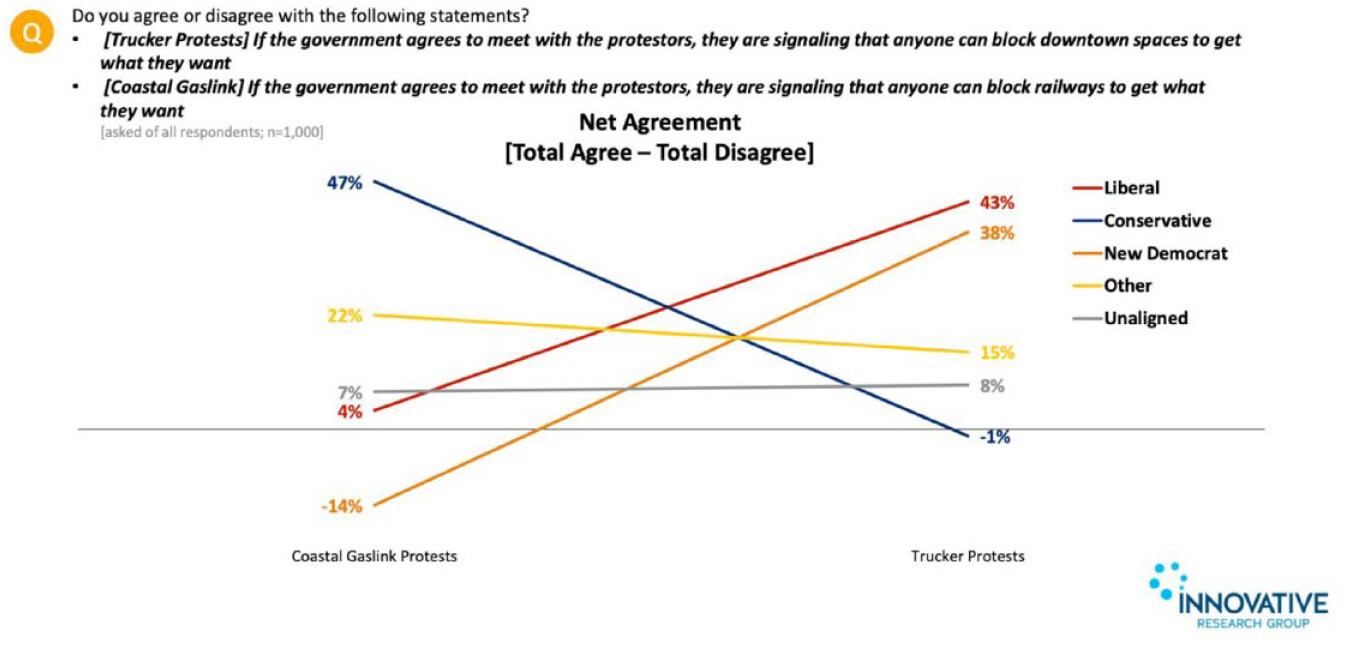
For a case in point, Innovative Research Group’s polling of both the 2020 Coastal GasLink pipeline protests in Northern British Columbia and the 2022 Freedom Convoy in Ottawa shows that support for this populist protest is highly correlated with partisan support (
Wells, 2022). As shown in
Figure 1, the CPC overwhelmingly opposed the pipeline protests and did not support Indigenous activists blocking pipeline construction. But they also overwhelmingly approved of the tactics used by the trucker protesters. In many ways, populist politics and populist political protests are being institutionalized and Canada is no exception.