Intended for healthcare professionals
Restricted access
Research article
First published online December 28, 2021

Trends in prescription of psychotropic medications to children and adolescents in Australian primary care from 2011 to 2018

Abstract

Objective:

To examine trends in prescribing psychotropic medications to children and adolescents in Australian primary care from 2011 to 2018.

Method:

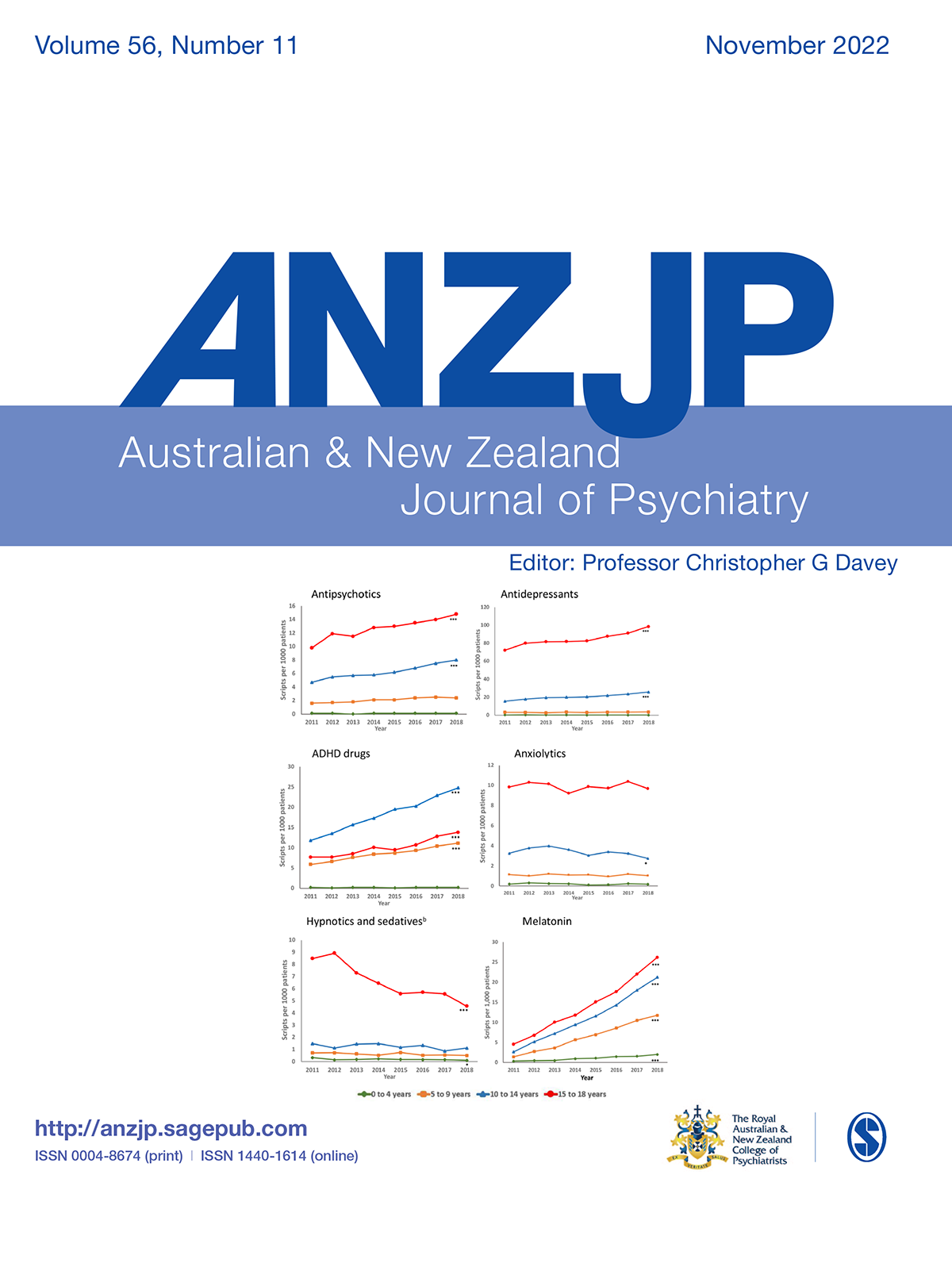
A retrospective cohort study examined prescriptions written by general practitioners using MedicineInsight, a large Australian primary care database, covering approximately 9% of all general practitioner practices. Numbers of patients receiving prescriptions for five main classes of psychotropics (antipsychotics, antidepressants, attention deficit hyperactivity disorder medications, anxiolytics, and hypnotics/sedatives [including benzodiazepines and Z-drugs, but excluding melatonin]) were examined annually by age-group (0–4, 5–9, 10–14, 15–18 years). Melatonin was analysed separately.

Results:

The number of patients prescribed any psychotropic increased from 25.6 to 36.2 per 1000 individuals from 2011 to 2018 (average annual increase +4.5%, 95% confidence interval [4.1%, 4.9%]; overall +41.4%). Among the five main classes, the largest annual increase was for attention deficit hyperactivity disorder medications (+9.6%, 95% confidence interval [8.8%, 10.5%]; overall +95.8%), followed by antipsychotics (+6.2%, 95% confidence interval [5.0%, 7.3%]; overall +62.8%) and antidepressants (+4.5%, 95% confidence interval [4.0%, 5.0%]; overall +42.8%). Hypnotic/sedative prescribing decreased on average 6.5% per year (95% confidence interval [–8.0%, –5.0%]; overall −40.2%). Anxiolytic prescribing remained steady. Melatonin prescriptions showed the highest increase of all (+24.7%, 95% confidence interval [23.7%, 25.8%]; overall +606.7%). The largest annual increase in antipsychotic, antidepressant or attention deficit hyperactivity disorder medication prescribing occurred in 10- to 14-year-olds (+7.5%, +6.5% and +10.4%, respectively). The largest point prevalence occurred in 2018 among 15- to 18-year-olds, with 98.5 per 1000 prescribed antidepressants. Antidepressants were more frequently prescribed to females; antipsychotics, attention deficit hyperactivity disorder medications and melatonin more often to males. The most prescribed antipsychotics were risperidone (<15 years) and quetiapine (15- to 18-year-olds). Fluoxetine was the most prescribed antidepressant in those aged 5+ years and amitriptyline in 0- to 4-year-olds.

Conclusion:

General practitioner prescribing of melatonin, antipsychotics, antidepressants and attention deficit hyperactivity disorder medications to under-19-year-olds increased markedly from 2011 to 2018. Although benzodiazepine and Z-drug prescriptions declined, this was offset by a substantial increase in melatonin prescribing.

Get full access to this article

View all access and purchase options for this article.

References

Australian ADHD Professionals Association (2021) ADHD Stimulant Prescribing Regulations & Authorities in Australia & New Zealand. Available at: https://aadpa.com.au/adhd-stimulant-prescribing-regulations-authorities-in-australia-new-zealand/#act (accessed 4 October 2021).
Australian Bureau of Statistics (ABS) (2009/2018) Survey of Disability, Ageing and Carers: Anxiety/Phobic Disorders Based on TableBuilder Data for 2009 and 2018 (accessed 31 May 2021).
Australian Bureau of Statistics (ABS) (2018a) ASGS: The Australian Statistical Geography Standard. Available at: www.abs.gov.au/ausstats/[email protected]/Latestproducts/1270.0.55.005Main%20Features15July%202016?opendocument&tabname=Summary&prodno=1270.0.55.005&issue=July%202016&num=&view= (accessed 4 October 2021).
Australian Bureau of Statistics (ABS) (2018b) IRSAD: Index of Relative Socio-economic Advantage and Disadvantage. Available at: www.abs.gov.au/ausstats/[email protected]/Lookup/by%20Subject/2033.0.55.001~2016~Main%20Features~IRSAD~20 (accessed 4 October 2021).
Australian Curriculum Assessment and Reporting Authority (ACARA) (2019) National Report on Schooling in Australia 2019. Available at: https://acaraweb.blob.core.windows.net/acaraweb/docs/default-source/assessment-and-reporting-publications/national-report-on-schooling-in-australia-2019.pdf?sfvrsn=434b4d07_0 (accessed 4 October 2021).
Australian Institute of Health and Welfare (AIHW) (2017) Autism in Australia. Available at: www.aihw.gov.au/reports/disability/autism-in-australia/contents/autism (accessed 4 October 2021).
Australian Institute of Health and Welfare (AIHW) (2020) Mental Health Related Prescriptions. Available at: www.aihw.gov.au/reports/mental-health-services/mental-health-services-in-australia/report-contents/mental-health-related-prescriptions (accessed 30 August 2020).
Bachmann CJ, Aagaard L, Burcu M, et al. (2016) Trends and patterns of antidepressant use in children and adolescents from five western countries, 2005-2012. European Neuropsychopharmacology 26: 411–419.
Bachmann CJ, Wijlaars LP, Kalverdijk LJ, et al. (2017) Trends in ADHD medication use in children and adolescents in five western countries, 2005-2012. European Neuropsychopharmacology 27: 484–493.
Barczyk ZA, Rucklidge JJ, Eggleston M, et al. (2020) Psychotropic medication prescription rates and trends for New Zealand children and adolescents 2008-2016. Journal of Child and Adolescent Psychopharmacology 30: 87–96.
Begum M, Gonzalez-Chica D, Bernardo C, et al. (2021) Trends in the prescription of drugs used for insomnia: An open-cohort study in Australian general practice, 2011-2018. British Journal of General Practice 71: e877–e886.
BMJ Best Practice (2020) Enuresis. Available at: https://bestpractice.bmj.com/topics/en-gb/690 (accessed 4 October 2021).
Boafo A, Greenham S, Alenezi S, et al. (2019) Could long-term administration of melatonin to prepubertal children affect timing of puberty? A clinician’s perspective. Nature and Science of Sleep 11: 1–10.
Boehringer Ingelheim Pty Ltd (2019) Australian Product Information – Catapres®: Clonidine Hydrochloride Tablets and Injection Ampoules. Available at: www.ebs.tga.gov.au/ebs/picmi/picmirepository.nsf/pdf?OpenAgent&id=CP-2010-PI-02400-3&d=202010231016933 (accessed 4 October 2021).
Busingye D, Gianacas C, Pollack A, et al. (2019) Data Resource Profile: MedicineInsight, an Australian national primary health care database. International Journal of Epidemiology 48: 1741–1741h.
Carton L, Cottencin O, Lapeyre-Mestre M, et al. (2015) Off-label prescribing of antipsychotics in adults, children and elderly individuals: A systematic review of recent prescription trends. Current Pharmaceutical Design 21: 3280–3297.
Cheung AH, Zuckerbrot RA, Jensen PS, et al. (2018) Guidelines for adolescent depression in primary care (GLAD-PC): Part II. Treatment and ongoing management. Pediatrics 141: e20174082.
Correll CU, Detraux J, De Lepeleire J, et al. (2015) Effects of antipsychotics, antidepressants and mood stabilizers on risk for physical diseases in people with schizophrenia, depression and bipolar disorder. World Psychiatry 14: 119–136.
Drug Utilisation Sub-Committee (DUSC) (2018) Attention Deficit Hyperactivity Disorder: Utilisation Analysis. Available at: www.pbs.gov.au/info/industry/listing/participants/public-release-docs/2018-05/attention-deficit-hyperactivity-disorder (accessed 4 October 2021).
Efron D, Danchin MH, Cranswick NE, et al. (2017) Medication prescribed by Australian paediatricians: Psychotropics predominate. Journal of Paediatrics and Child Health 53: 957–962.
Enticott JC, Meadows GN, Shawyer F, et al. (2016) Mental disorders and distress: Associations with demographics, remoteness and socioeconomic deprivation of area of residence across Australia. Australian and New Zealand Journal of Psychiatry 50: 1169–1179.
Galletly C, Castle D, Dark F, et al. (2016) Royal Australian and New Zealand College of Psychiatrists clinical practice guidelines for the management of schizophrenia and related disorders. Australian and New Zealand Journal of Psychiatry 50: 410–472.
Hálfdánarson O, Zoega H, Aagaard L, et al. (2017) International trends in antipsychotic use: A study in 16 countries, 2005-2014. European Neuropsychopharmacology 27: 1064–1076.
Hartz I, Skurtveit S, Steffenak AK, et al. (2016) Psychotropic drug use among 0-17 year olds during 2004-2014: A nationwide prescription database study. BMC Psychiatry 16: 12.
Hetrick SE, McKenzie JE, Bailey AP, et al. (2021) New generation antidepressants for depression in children and adolescents: A network meta-analysis. Cochrane Database Systematic Reviews 5: CD013674.
Hetrick SE, McKenzie JE, Cox GR, et al. (2012) Newer generation antidepressants for depressive disorders in children and adolescents. Cochrane Database Systematic Reviews 11: CD004851.
Janjua I, Goldman RD (2016) Sleep-related melatonin use in healthy children. Canadian Family Physician 62: 315–317.
John A, Marchant AL, Fone DL, et al. (2016) Recent trends in primary-care antidepressant prescribing to children and young people: An e-cohort study. Psychological Medicine 46: 3315–3327.
John A, Marchant AL, McGregor JI, et al. (2015) Recent trends in the incidence of anxiety and prescription of anxiolytics and hypnotics in children and young people: An e-cohort study. Journal of Affective Disorders 183: 134–141.
Karanges EA, Stephenson CP, McGregor IS (2014) Longitudinal trends in the dispensing of psychotropic medications in Australia from 2009-2012: Focus on children, adolescents and prescriber specialty. Australian and New Zealand Journal of Psychiatry 48: 917–931.
Lagerberg T, Molero Y, D’Onofrio BM, et al. (2019) Antidepressant prescription patterns and CNS polypharmacy with antidepressants among children, adolescents, and young adults: A population-based study in Sweden. European Child and Adolescent Psychiatry 28: 1137–1145.
Lawrence D, Johnson S, Hafekost J, et al. (2015) The Mental Health of Children and Adolescents: Report on the Second Australian Child and Adolescent Survey of Mental Health and Wellbeing. Canberra, ACT, Australia: Department of Health. Available at: www.health.gov.au/resources/publications/the-mental-health-of-children-and-adolescents (accessed 4 October 2021).
McDermott B, Baigent M, Chanen A, et al. (2011) Clinical Practice Guidelines: Depression in Adolescents and Young Adults. Available at: www.24hmb.com/voimages/web_image//upload/file/20140614/20851402752241427.pdf (accessed 4 October 2021).
Morrison O, Raymond C, Firipis M (2014) Use of Antipsychotics in Children and Adolescents: A Report Prepared by the Drug Utilisation Subcommittee of the Pharmaceutical Benefits Advisory Committee. Available at: www.pbs.gov.au/info/industry/listing/participants/public-release-docs/antipsychotics/antipsychotics-children-adolescents-2013 (accessed 4 October 2021).
Nankivell G, Caldwell P (2014) Paediatric urinary incontinence. Australian Prescriber 37: 192–195.
National Institute for Health and Care Excellence (NICE) (2019) Depression in Children and Young People: Identification and Management: ng134. Available at: www.nice.org.uk/guidance/ng134 (accessed 4 October 2021).
NPS MedicineWise (2020) MedicineInsight Data Book Version 3.0. Available at: www.nps.org.au/assets/NPS/pdf/MedicineInsight-databook-2020.pdf (accessed 4 October 2021).
Nunn SPT, Kritsotakis EI, Harpin V, et al. (2020) Social gradients in the receipt of medication for attention-deficit hyperactivity disorder in children and young people in Sheffield. BJPsych Open 6: e14.
O’Sullivan K, Reulbach U, Boland F, et al. (2015) Benzodiazepine prescribing in children under 15 years of age receiving free medical care on the General Medical Services scheme in Ireland. BMJ Open 5: e007070.
Penfold RB, Stewart C, Hunkeler EM, et al. (2013) Use of antipsychotic medications in pediatric populations: What do the data say? Current Psychiatry Reports 15: 426.
Pringsheim T, Stewart DG, Chan P, et al. (2019) The pharmacoepidemiology of psychotropic medication use in Canadian children from 2012 to 2016. Journal of Child and Adolescent Psychopharmacology 29: 740–745.
Raman SR, Man KKC, Bahmanyar S, et al. (2018) Trends in attention-deficit hyperactivity disorder medication use: A retrospective observational study using population-based databases. The Lancet Psychiatry 5: 824–835.
Sarginson J, Webb RT, Stocks SJ, et al. (2017) Temporal trends in antidepressant prescribing to children in UK primary care, 2000-2015. Journal of Affective Disorders 210: 312–318.
Sawyer MG, Reece CE, Sawyer ACP, et al. (2018) Has the prevalence of child and adolescent mental disorders in Australia changed between 1998 and 2013 to 2014? Journal of the American Academy of Child and Adolescent Psychiatry 57: 343–350.e5.
Spence SH, Zubrick SR, Lawrence D (2018) A profile of social, separation and generalized anxiety disorders in an Australian nationally representative sample of children and adolescents: Prevalence, comorbidity and correlates. Australian and New Zealand Journal of Psychiatry 52: 446–460.
Vitiello B, Correll C, van Zwieten-Boot B, et al. (2009) Antipsychotics in children and adolescents: Increasing use, evidence for efficacy and safety concerns. European Neuropsychopharmacology 19: 629–635.
Whitely M, Raven M, Jureidini J (2020) Antidepressant prescribing and suicide/self-harm by young Australians: Regulatory warnings, contradictory advice, and long-term trends. Frontiers in Psychiatry 11: 478.
World Health Organization (WHO) Collaborating Centre for Drug Statistics Methodology (2021) ATC/DDD Index. Available at: www.whocc.no/atc_ddd_index/ (accessed 4 October 2021).

Supplementary Material

Please find the following supplemental material available below.

For Open Access articles published under a Creative Commons License, all supplemental material carries the same license as the article it is associated with.

For non-Open Access articles published, all supplemental material carries a non-exclusive license, and permission requests for re-use of supplemental material or any part of supplemental material shall be sent directly to the copyright owner as specified in the copyright notice associated with the article.