Intended for healthcare professionals
Open access
Research article
First published online February 27, 2026

From the Frigid Arctic Waters to the Warmth of the Indian Ocean: Maritime Bilateralism between Canada and India

Abstract

The post–Cold War concept of security has undergone a significant transformation, from a conventional military-centric understanding towards a wide-ranging approach under the framework of human security. Using relevant theoretical approaches, this paper examines the geostrategic and non-traditional security intricacies of the Arctic and Indian Oceans by virtue of their distinct geostrategic positions, and the resulting implications for Canada and India. In particular this paper looks at the cases of the Northwest Passage and Arctic boundaries of Canada; the Himalayas, monsoon, and mangrove vegetations of India; and the geostrategic vulnerabilities encountered by Indigenous Peoples in Canada's Arctic and on India's Andaman and Nicobar Islands. The study also discusses the rationale behind Canada's involvement in the Indo-Pacific and India's engagement in the Arctic. The paper concludes that the presence of these common concerns has facilitated a convergence of interests between these maritime powers, contributing to the potential crafting of a durable and long-lasting bilateral relationship.

Introduction

Over the years, the Arctic and Indian Oceans have earned distinct standings in the geopolitical, geoeconomic, and geostrategic landscape of the world, shaped by interwoven networks of politico-economic, socio-environmental and climate-related factors. Both oceans are among the fastest-warming regions on Earth, and their consequent transformations have cascading impacts not only on their respective surroundings but also beyond their geographical locales. Accordingly, Canada, as an Arctic state, and India, as a littoral state of the Indian Ocean, experience similar outcomes within their respective oceanic and territorial domains. Geostrategic threats emanating from extra-regional actors have altered the maritime security equations of these two oceans, demanding bilateral cooperation between Ottawa and New Delhi.
Global warming and the consequent loss of sea ice are not only accelerating navigability in the once-permafrost Arctic Ocean and the Northwest Passage, but are also increasing the presence of international vessels in this geographically-sensitive sovereign territory of Canada. By contrast, as one of the busiest sea routes, the Indian Ocean is connected to the most significant international waterways through strategic chokepoints and transit passages, which serve as lifelines for shipping. Moreover, scientists have revealed the thawing Arctic's profound impact on India's tropical climate, the Himalayas, and mangrove forests, with spillover effects on its people. In addition, the emergence of the Indo-Pacific as the centre stage for global geopolitical contestation is endangering Canadian and Indian national security priorities.
This paper begins by briefly explaining the relevant theoretical discourses drawn from both conventional and non-traditional understandings of security. Taking cues from these discourses, the following section explores some of the crucial geostrategic and non-traditional security considerations involving the Arctic and Indian Oceans, and their implications for Canada and India. The next segment examines the rationale behind Canada's engagement in the Indo-Pacific and India's venture into the Arctic in pursuit of better security, economic, and humanitarian outcomes. That section is followed by concluding remarks on where Canada and India's mutual interests coalesce for establishing a long-lasting bilateral relationship.

National security and theoretical debates

The geopolitical and geostrategic significance of political space have been at the heart of the study of international relations since time immemorial. Kautilya, the father of Indian statecraft, argued in his magnum opus, Arthashastra, that a kingdom's natural boundaries (such as mountains, deserts, forests, rivers, and oceans) were indispensable elements of its strength, adding strategic significance to its security and sovereignty.1 Resonating with this idea millennia later, Alfred Thayer Mahan, the doyen of maritime strategic studies, argued from a classical realist perspective that continuous and unbroken oceans, together with connected waterways, geographical contiguity, and the number of people living within coastal areas, play pivotal roles in determining the national security of sovereign states.2
Emanating from realist and neorealist traditions, the maritime foreign policy of states until the Cold War was driven by strategic-military-security calculations, such as aggregate power, threat perception, geographical proximity, and offensive capability, which determined the nature of interstate alliances and relationships. These efforts aimed to ensure states’ survival and uphold their national interests.3 The post–Cold War period, however, has witnessed a conspicuous shift towards awareness of non-traditional security threats originating from unconventional and non-military dimensions that have significantly challenged long-term, unidimensional, state-centric understandings of security and strategy. These threats include climate change, food and water insecurity, wildfires, disasters, resource extraction, poverty, and other socioeconomic, environmental, and human security concerns that require critical attention.
Among the many branches of scholarship that have departed significantly from conventional security understandings is the theoretical discourse of the Copenhagen School, pioneered by Barry Buzan, Ole Wæver, and Jaap de Wilde, which postulates a wider approach that incorporates unconventional security issues across the political, economic, social, and ecological sectors, which had previously remained unobtrusive or beyond the traditional military-security spectrum.4 By contrast, the constructivist approach advances the primacy of identity, culture, and norms as essential elements shaping the conceptualization of security and the alliance behaviour of states.5 Over the years, concepts such as Amartya Sen's “human development” approach,6 Mahbub ul Haq's “human security,”7 and gender and environmental sustainability issues8 have come to encompass nearly every veritable aspect of security from multidimensional perspectives, particularly challenges experienced by the developing world, in which national security is one but concern. As a result, these ideas have transcended the theorization of security from the state- and power-centric standpoints towards people- and environment-related outlooks, compelling states to adopt more holistic approaches to security, and redefining the logic of interstate relations accordingly.

The Indo-Canadian oceanic saga

As Commonwealth partners, Canada and India value their historic friendship by virtue of shared European colonialism and liberal, constitutional, and multicultural traditions and identities.9 Both democracies possess extensive maritime boundaries accompanied by significant strategic and non-conventional security concerns. This section discusses some of the challenges that are critical to their respective security dynamics specifically in regard to their oceanic positions.

The exemplary Arctic Ocean

Situated between the Arctic Circle and the North Pole, and covering an area of 15.6 million square kilometres, the Arctic Ocean is the world's smallest, shallowest, coldest, and northernmost ocean and is the link between the Atlantic and Pacific. It is the least saline of the world's oceans and contains more freshwater due to its perennial sea ice cover, which engenders a unique habitat for marine and terrestrial ecosystems distributed among the eight Arctic states. Russia possesses 53 percent of this ocean, while the remaining area is shared among the other seven littoral states: Canada, Denmark (including Greenland), Finland, Iceland, Norway, Sweden, and the United States. Together, these states established the Arctic Council in 1996, with Canada playing a leading role in its formation. The Council is a premier intergovernmental organization whose aim is to promote multilateral, non-military cooperation for a sustainable Arctic. Amid the harsh Arctic climate and life-sustaining challenges, more than forty different Indigenous Peoples from these Arctic states (with the exception of Iceland) have been calling this region their home for thousands of years, and are represented within the Arctic Council through six Indigenous organizations recognized as Permanent Participants.10
Over the years, the Arctic has become a focus of global attention due to the severe consequences of climate change. The region is warming three times faster than rest of the world, with its average temperature increasing nearly four times faster than the global average.11 A recent report by the World Wildlife Fund reveals that “while Arctic glaciers and ice caps represent only 25 percent of the world's land ice area, meltwater from these sources accounts for 35 percent of the current global sea-level rise.”12 Furthermore, phenomena that were previously unimaginable in the Arctic, such as the surge in wildfires and increasingly wet summers, have now become common occurrences due to Arctic thawing, thereby transforming the region from a carbon sink into a carbon emitter.13
Along with these extraordinary transformations, transoceanic navigation between the Pacific and the Atlantic via the Arctic Ocean is increasingly becoming viable, as it significantly reduces both fuel consumption and transit time. Additionally, Arctic thawing has exposed natural resources such as oil, gas, and critical minerals that had previously remained hidden and inaccessible beneath deep permafrost ice-covers, offering new opportunities for extraction, exploration, and deep-sea mining. Consequently, there has been a marked increase in the presence of international shipping vessels, nuclear-powered icebreakers, oil tankers, bulk carriers, submarines, scientific and research vessels, fishing vessels, and tourist vessels undertaking longer seasonal operations than in previous years. As revealed in Table 1, fishing vessels are taking the lead in expanding their presence for resource extraction in the Arctic.
Table 1. Types of vessels traversing the Arctic Polar Code Area in selected years.
Vessel type2013201920202021202220232024Total
Container ships12911108131578
Crude oil tankers12262418163146173
Gas tankers1242626263143177
Research vessels62484750515456368
Cargo ships1411551872191831811871253
Fishing vessels5666716818077367256924,878
Other vessels5046955706106577477424,525
Total1,2981,6281,5461,7401,6771,7821,78111,452
Note: Prepared from “Arctic Council,” Arctic Ship Status Reports, 2021–2025, https://oaarchive.Arctic-council.org/items/01ddf449-9048-4d6a-a056-65303831bb63 (accessed 24 May 2025).

Canada as an Arctic State

With the second-largest Arctic coastline after Russia, Canada has approximately 40 percent of its territory and 70 percent of its coastline shared among ninety-four major islands and 36,469 minor islands, covering a total of 1.4 million square kilometres that spans between the Arctic Circle and the North Pole. Together, these islands form the Canadian Arctic Archipelago, the world's largest High Arctic landmass. More than half of this region's inhabitants are Indigenous Peoples, the majority of whom are Inuit, along with the Innu, Dene, and Cree. These peoples have inhabited this vast region for millennia across what are today the territories of the Yukon, the Northwest Territories, and Nunavut, and the provinces of Québec and Newfoundland and Labrador. Resembling a crown in its geographic shape, the Arctic Archipelago not only signifies Canada's national identity, sovereignty, and security, but also encompasses its people and resources, for which Canada pursues robust policies embedded within its national, Indigenous, and foreign policy priorities.
Ever since the British transferred Arctic sovereignty to Ottawa in 1880, followed by the abandonment of individual claims by Denmark and Norway over Ellesmere Island in 1920 and the Sverdrup Islands in 1928–1930, respectively,14 Canada has taken pride in protecting and managing its circumpolar affairs and upholding Arctic sovereignty. However, as the region represents the shortest flight and missile trajectory from Russia to the US, the Arctic witnessed intense militarization during the Second World War and the Cold War, including the establishment of joint Canada–US surveillance operations through the North American Aerospace Defense Command (NORAD) and the Distant Early Warning (DEW) Line to deter possible Soviet air threats.15
While post–Cold War desecuritization programs, including former Soviet premier Mikhail Gorbachev's Murmansk Initiative (1987),16 endorsed a nuclear-weapons-free Arctic through the dismantling of security installations, the promotion of non-military cooperation, and the deescalation of tensions between Russia and the West, the region has once again assumed centre stage with the rise of Russia's Vladimir Putin and China's Xi Jinping, along with Moscow's ongoing belligerence against Ukraine, reigniting the strategic argument for defending the North. It was therefore rightly observed by Canada's governor general, Mary Simon, while serving as the minister's special representative in 2017, that there is “no other region of Canada that has experienced the breadth and pace of geopolitical development in the last fifty years than the Arctic.”17 This new geopolitical reality is discussed below.

The Arctic geopolitics

Geopolitical assertions in the Arctic were unleashed with Russia's planting of a titanium national flag on the North Pole seabed in 2007 and the US Geological Survey's publication the following year on available Arctic hydrocarbons, developments that precipitated interstate competition over the extracting and mining of Arctic resources.18 This competition was further intensified by the Kremlin's deployment of nuclear-powered icebreakers (the largest fleet in the world), together with floating nuclear power plants, nuclear submarines, strategic bombers, and patrolling activities along the Northern Sea Route, which have all served to remilitarize the vulnerable High North. In conjunction with such overtures, China's pursuit of scientific research, shipping routes, and resource exploitation in the Arctic is now a reality under its Polar Silk Road initiative,19 a transoceanic transport corridor linking Shanghai and Rotterdam via Siberia through the Northern Sea, thus bypassing the Suez Canal. Branding itself as a “near-Arctic state” and an “important stakeholder in Arctic affairs,” Beijing even secured observer status at the Arctic Council in 2013, enabling deeper involvement in the region. These intensified assertions by Russia and China, including the dispatch of spy balloons and ocean buoys in the Canadian Arctic, along with President Trump's recent statements about the US annexing Canada and Greenland, have raised serious concerns for Canada's northern sovereignty.
Hence, Canada has been heightening its focus on the Arctic through increased defence spending and patrolling, aimed at asserting its sovereign control. Echoing the emphasis of the chief of the defence staff, General Jennie Carignan, on increased recruitment, defence modernization, and new capabilities,20 Prime Minister Mark Carney allocated $420 million to the defence sector for expanded northern and Arctic operations, training exercises, and deployment of additional defence personnel, while also underscoring increased cooperation with NATO allies during his visit to Iqaluit in March 2025.21 In response to President Trump's proposal for a “Golden Dome” missile defence system (for which Canada would reportedly be required to pay $61 billion), Ottawa is building new over-the-horizon radar systems to enhance coverage, surveillance, and detection capabilities under the NORAD modernization project. Canada is also deepening its partnerships with the European Union (EU), Australia, South Korea, and others, on the grounds that, as Prime Minister Carney articulated, it “should not look first to others [the US] to defend our nations.”22
Another geopolitically contentious and complex issue related to Canada's Arctic security is the bid to extend the continental shelf an additional 150 nautical miles beyond the existing 200 nautical miles as part of an Extended Continental Shelf (ECS) in accordance with Article 76 of the UN Convention on the Laws of the Sea. The four circumpolar nations—Canada, the US, Denmark (Greenland), and Russia—have submitted their respective, overlapping claims for the ECS around the Arctic and North Pole, including the Lomonosov Ridge (believed to be a promising storehouse of hydrocarbons). Resolution of these claims is expected to be complicated.23 Additionally, Arctic thawing is facilitating access to previously unexplored and inaccessible resources, particularly, diamond, gold, base metals, rare earth minerals, and hydrocarbon reserves, spawning a scramble for Arctic resources not only among the Arctic members, but also non-Arctic powers, notably China.

The Northwest Passage and Canada's sovereignty

Within the vast Canadian Arctic Archipelago lies the Northwest Passage, one of the widest and deepest shipping lanes connecting the Atlantic and the Pacific through the Arctic Ocean. Considered one of the most remote and challenging navigational sea routes due to its multi-year impenetrable ice packs, the Northwest Passage extends between the Davis Strait and Baffin Bay in the east and the Berring Strait in the west. Comprising seven principal navigational routes, the passage offers continuous journey between islands and a geographically shorter route between Asia and Europe than routes via the Panama Canal, reducing the distance from approximately 13,000 to 8,500 nautical miles.24 Above all, with the disappearance of Arctic summer ice and the increasing demand for containerized transport of international cargo, the Northwest Passage appears to be a game-changer in international shipping.
However, Canada's sovereignty and legal status over the Northwest Passage and its historic internal waters have been challenged and opposed by external powers, including the US, the EU, China, and New Zealand. They argue, citing international case-studies, that the Passage is an international strait, subject to a right of transit by foreign vessels.25 In response, Ottawa has sought to prove and reaffirm, with credible evidence, the inviolability of Canada's Arctic internal waters and its sovereignty claim.
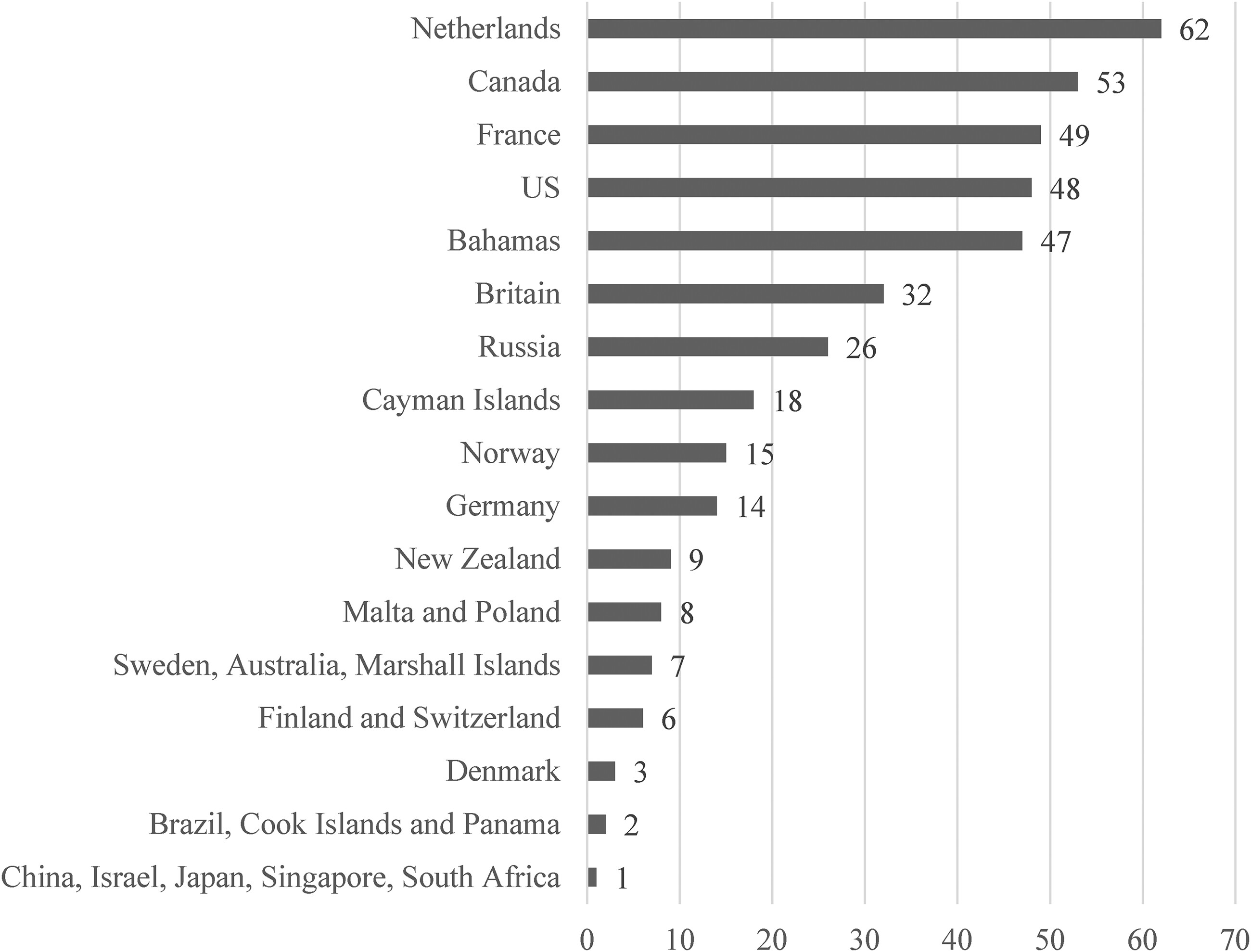
Below is the list of countries that have dispatched maximum vessels through the Northwest Passage from 1940 to 2025 (Graph 1).
Graph 1. List of countries sending registered vessels to transit the Northwest Passage, 1940–2025.
Note: Prepared from the Scott Polar Research Institute (SPRI) Data, University of Cambridge, 4 January 2025, https://www.spri.cam.ac.UK/resources/infosheets/northwestpassage.pdf (accessed 27 January 2026). Vessels included icebreakers, naval ships, oil tankers, cargo ships, schooners, yacht, cruise ships, except submarines.
The above graph reveals that vessels from non-Arctic countries appear more frequently in Canadian Arctic waters than vessels from Arctic states themselves. This expanding international presence raises additional environmental and climate-related challenges for the region.
An examination of the Table 2 below reveals that, from 2015 to 2025, vessels from non-Arctic states transiting the Northwest Passage surpassed those of Canada and other Arctic Council members.
Table 2. Number of flagship vessels completing their transit through the Northwest Passage, 2015–2025.
YearFlagships of CanadaFlagships from remaining Arctic Council membersFlagships from non–Arctic Council statesTotal
2015151016
2016011718
2017282232
20180022
2019132125
20200066
20211135
2022132327
2023263341
2024192737
2025292334
Note: Prepared from the Scott Polar Research Institute (SPRI) data, ibid.
Consequently, Canada has introduced multidimensional legislation and policy measures for comprehensive protection of its Arctic ecosystem and environment under the Arctic Waters Pollution Prevention Act (1985 and amended in 2019) that impose strict regulations on transiting vessels in accordance with international law.26

The Indigenous Arctic

Geopolitical developments in the Canadian Arctic are inherently intertwined with the livelihoods of Indigenous Peoples, who are experiencing disproportionate consequences of climate change that are significantly transforming their food habits, housing, and infrastructure, endangering their long-term sustainability. During the Cold War, the Inuit, the largest Indigenous nation in the Canadian Arctic, experienced serious negative impacts following the DEW Line installations in the Arctic between 1955 and 1957, ranging from forced relocations to exposure to toxic waste left behind after the system's closure in 1993. By 2014, the federal government had completed its clean-up after shipping 222,000 barrels of hazardous waste to the south for incineration and burying the equivalent of 1.8 million barrels of non-toxic waste in Arctic landfills.27 Nevertheless, having used the frozen sea as highways for survival for generations, the Inuit are now bearing the brunt of climate change, as Arctic thawing and the resulting expansion of economic development and international shipping encroach on their traditional pathways.28
Today, Indigenous communities in the North are at the crossroads of multidimensional security challenges, including growing food insecurity; inadequate educational opportunities and resulting unemployment (notably, the Inuit have one of the youngest populations in Canada, with an average age of thirty years); insufficient housing; disparities in healthcare; and broader socioeconomic inequities that necessitate additional attention.29 These challenges are compounded by heightened instability associated with ongoing resource exploitation and accelerated mining operations, which have already placed the Arctic environment in peril. Moreover, environmental pollution from shipping vessels, including oil spills, waste-dumping, and noise pollution, has created additional challenges both for Indigenous communities and for the government. In response, Ottawa has allocated funds and resources over the years to support Indigenous wellbeing and has reaffirmed the importance of the partnership with Indigenous Peoples in addressing Arctic challenges.

Primacy of the Indian Ocean

The Indian Ocean covers an area of 70 million square kilometres and stretches from East Africa to Australia, with the Indian subcontinent at its centre. As the third-largest ocean, its border states collectively account for 60 percent of the world's population and some of its largest economies.30 The ocean occupies one of the most critical geostrategic and geoeconomic positions, connecting the Far East, Australasia, Africa, and the Middle East, and, by extension, Europe and the Americas. A hub of commercial and cultural exchange since antiquity, it witnessed naval battles involving Portuguese, Dutch, Danish, British, and French colonial powers in support of their respective colonial endeavours in the Indian subcontinent from the seventeenth century onwards. With Britain's eventual predominance, the Indian Ocean was effectively transformed into a “British lake” until the Second World War.
Since the Second World War, the Indian Ocean has emerged as one of the most militarized oceans in the world, driven by recurring conflicts in its littoral states, including the India–Pakistan and Arab–Israeli wars since 1948, and vulnerabilities in the Persian Gulf, Gulf of Aden, Horn of Africa, and Southeast Asia. Its geostrategic position prompted the joint US–British overseas naval command to establish their overseas naval base on the atoll of Diego Garcia in 1966. The US even interfered in the India–Pakistan War of 1971 by dispatching its largest nuclear-powered aircraft carrier, the USS Enterprise, against India, despite the latter's declaration of the Indian Ocean as a zone of peace under UN Resolution 2832 (1971).
In the twenty-first century, the Indian Ocean has increasingly encountered multipronged, unconventional security threats, including a surge in maritime piracy, human and narcotics trafficking, and weapons smuggling. These developments have re-institutionalized great power rivalries through new patron-client dynamics, coinciding with the rise of China. Subsequently, the Indian Ocean's shores are home to the world's largest arms importers, with Saudi Arabia, Qatar, the United Arab Emirates (UAE), Kuwait, India, Pakistan, Australia, Indonesia, the Philippines, Vietnam, and Thailand as top-rankers.31
Another important feature of the Indian Ocean is that it is home to the world's largest energy reserve in the Persian Gulf (with Saudi Arabia, Iran, Iraq, the United Arab Emirates, Kuwait, and Qatar as the largest producers of oil and natural gas), and an impressive fish reserve that the world depends upon. Additionally, most of the major international Sea Lanes of Communication (SLOCs) between Asia and the world (also called shipping corridors or chokepoints), run through this ocean, including its marginal seas, gulfs, straits, and bays (the Bay of Bengal being the largest in the world). The Indian Ocean includes five of the world's seven most strategically significant and heavily-used shipping corridors: the Malacca Strait, Strait of Hormuz, Bab-el-Mandeb, the Suez Canal, and Cape of Good Hope.32 With the steep rise in international maritime transport, 73.5 percent of global maritime trade passes through these strategic chokepoints, as illustrated by the graph below, signifying its primacy in the global economy (Graph 2).
Graph 2. Percentage of maritime trade through major chokepoints in 2024.
Note: Prepared from UNCTAD Review of Maritime Transport, 2024, 19, https://unctad.org/system/files/official-document/rmt2024ch1_en.pdf (accessed 9 April 2025).

India as a littoral state

Endowed with a vast marine ecosystem and rich biodiversity along its 11,098.81 kilometres of coastline, and situated at the centre of the Indian Ocean, India occupies an integral position in the Indian Ocean region, with civilizational, economic, religious, cultural, and maritime relationships with the Far East, Southeast Asia, the Middle East, Africa, and Europe, extending back to its ancient Indus Valley Civilization (3500 BC). However, India's subjugation as a British colony after 1757 diminished its maritime prowess, a condition that persisted even after its independence from Britain in 1947, when India disregarded the strategic consensus for a proactive maritime security outlook, advocated by prominent diplomat K.M. Panikkar.33 India limited its focus instead to coastal defence and building peace with littoral states, despite encountering aggression from its neighbours. The onset of the twenty-first century introduced new adversities and circumstances that have prompted India to reassess its national security and foreign policy priorities, some of which are discussed below.

Geopolitics in the Indian Ocean

The relative power vacuum stemming from the conspicuous maritime apathy among the Indian Ocean's littoral states in the post–Cold War era might have impelled China, as an extra-regional power, to play its geostrategic and geoeconomic card in pursuit of resource security and expanding its operations in the region. Beijing's establishment of strategic installations, military positions, and deep and expansive seaports in the area of the Indian Ocean surrounding the Indian Peninsula (referred to as the “String of Pearls”), together with the increased presence of the People's Liberation Army Navy (PLAN) in the Indian Ocean, have interfered with India's maritime interests in the region. Moreover, its coveted land and maritime economic corridors under the Belt and Road Initiative (BRI) covering South and Southeast Asia pose a threat to India's regional interests.34
Against this backdrop, India has synthesized Kautilyan, Mahanian, and Panikkarian perspectives on maritime geopolitics to counter China's maritime hegemonism, through a human security–oriented multilateral framework, Security and Growth for All (SAGAR). This approach is intended not only to respond to security challenges, but also to help India reclaim the prestige it enjoyed in the precolonial period. Accordingly, India has pursued multilateral strategic, maritime, economic, cultural, social, and non-military partnerships under its ambitious Maritime India Vision 2030, which provides a blueprint for New Delhi's intensified engagement not only with neighbouring littoral states, but also with external powers. Through this plan, India seeks to realize its vision of becoming a robust maritime authority with advanced combat vessels, submarines, aircraft carriers, and other technologies, while also emphasizing green technology, port enhancement, recycling, and shipbuilding.35 India has sponsored joint naval exercises annually, such as MALABAR with the Quadrilateral Security Dialogue (Quad); MILAN with Canada and others; EUNAVFOR with the EU; and AIKEYME with African states. Further, it has established humanitarian, scientific, and cultural organizations through its ambitious “Look West,” “Act East,” and “Neighbourhood First” policies with littoral states for promoting an open, free, and inclusive Indian Ocean.

Fate of the Himalayas, monsoon, and mangrove forests

The Himalayas, celebrated as the crown of India, are the anchor of India's geography and have determined its history, economy, society, culture, and sovereign international relations since time immemorial. The glaciers of the Hindukush, the Karakoram, and the Himalayan mountains are the source of the perennial waters of the Kabul-Indus-Ganges-Yamuna-Brahmaputra-Yangtze-Huanghe-Irrawaddy-Salween-Mekong river systems that are the lifelines of Afghanistan, Pakistan, India, Nepal, Bhutan, Bangladesh, China, Myanmar, and Vietnam. Their combined drainage basins support a population of over four billion people and generate trillions of dollars in economic activity. The Himalayas have earned the reputation as the “Third Pole” of the world, as they contain the largest reservoir of ice and snow outside the Arctic and Antarctic.36 Nevertheless, facing unprecedented transformation as a result of global warming, coupled with rapid urbanization and unplanned development, the region now faces grave threats from frequent environmental disasters, including glacial retreat, erosion, periodic floods, landslides, and drought, which in turn affect its people and their livelihoods, including those living downstream.
Parallelly, the Indian Ocean is another lifeline for India's overall wellbeing. The rainfall from monsoon winds that originate from this ocean determine 75 percent of India's rainfall, thus affecting agriculture, food and water security, hydroelectricity, and the economic livelihood of India's citizens.37 This is primarily because the Himalayas acts as a protective shield by preventing these rain-bearing monsoon winds from leaving India so that the country can absorb maximum rainfall output from these winds. However, global warming and its resultant shifting rainfall patterns are severely affecting the country, ranging from severe heatwaves as early as the spring, to insufficient rainfall affecting agricultural productivity, prolonged drought and over-flooding that impair crop production and heighten food insecurity.38
Additionally, the rise in sea-level due to glacial melting from the Arctic and the Himalayas, is having a compounding impact on India's Mangrove vegetation, particularly at the Sunderban Gangetic Delta on the Bay of Bengal, the world's largest Mangrove reserve. These are natural protectors against soil erosion from tropical cyclones. This biodiverse coastal ecosystem is currently experiencing both climate-related and anthropogenic vulnerabilities, resulting in increased salinity, oceanic acidification and loss of freshwater, deforestation through urbanization and agriculture, and island submergence amid rising sea-levels.39
Thus, in spite of being one of the largest carbon emitters, India has introduced several measures to mitigate these climate-induced challenges including through domestic legislation and international agreements, by switching gradually towards renewable energy, recycling and green technology, while actively engaging in international climate negotiations.

Vulnerability of Andaman and Nicobar Islands

Nestled in the Bay of Bengal, the 836 islands of the Andaman and Nicobar Islands archipelago bear the longest coastline among all seaside provinces and union territories of India. Geographically distant from mainland India, it lies close to Myanmar and Indonesia, and is situated at the strategic crossroads and international shipping lanes of the Malacca Strait. Hence, the islands hold geostrategic significance for India's maritime sovereignty. Furthermore, these islands are inhabited by distinct Indigenous Tribes of India, among whom, the Sentinelese, the Jarawa and the Shompen are some of the most isolated and uncontacted native peoples of the world and are endangered communities.
Today, this archipelago is experiencing multi-faceted threats, especially infrastructure development and consequent environmental devastation. India has already lost a chunk of its southernmost territory, the “Indira Point” of Great Nicobar island, during the devastating 2004 Tsunami. Moreover, the islands are geopolitically vulnerable to China's increased military and surveillance presence. Accordingly, India's naval bases in the archipelago guard its maritime boundaries with constant vigilance. India's recent US $5 billion-commercial project for creating International Container Transshipment Port at the geostrategically sensitive Galathea Bay at the Great Nicobar Island is intended to thwart external threats and leverage its geostrategic space. However, in so doing, it would not only encroach on Indigenous reserved areas but also compromise its critically endangered wildlife, including the vulnerable leatherback turtle (found only in this area in India), despite civilian and environmental protests.40

Convergence of maritime interests

As littoral states of the Arctic and Indian Oceans respectively, both Canada and India have independent stakes in each other's shores that range from strategic, economic, scientific to environmental and humanitarian factors. This section highlights some of those relevant areas that contribute to their convergence of maritime interests and promote bilateral cooperation.

Canada's rendezvous with the Indo-Pacific

Stretching from east Africa to the western coastline of the Americas, the Indo-Pacific has gained wider currency as a distinct geostrategic locale among major powers in recent years, in which, both Canada and India are inherently intertwined. Equating the Indo-Pacific's strategic importance to that of the Arctic, in 2022 former Prime Minister Justin Trudeau launched a multi-billion-dollar ‘Indo-Pacific Strategy’ to accomplish Canada's geopolitical, economic, humanitarian, and environmental objectives, deepen its political, economic and security partnerships, and expand its socio-cultural footprint in the region. As a Pacific nation, Canada recognizes the Indo-Pacific as “a new horizon of opportunities” comprising 50 percent of global GDP, 65 percent of global population, 67 percent of Indigenous Peoples and a place where 1 in every 5 Canadians have family ties.41 Ottawa therefore, aims to be a reliable partner for promoting security, peace, resilience, and people-centric approaches that uphold international law and democracy, address climate change, and advocate for an open and inclusive Indo-Pacific.
Understanding the geostrategic salience of this region, Ottawa has deployed a part of its defence forces to maintaining a meaningful and persistent presence in the Indo-Pacific, conducting defence exercises with multi-national forces both from littoral powers (including Japan, South Korea, India, Southeast Asian states, Australia, and the US) and France as extra-regional partner under Operation HORIZON.42 It is noteworthy here that amidst a bilateral diplomatic dispute between India and Canada, Canadian participation at the thirteenth Indo-Pacific Army Chief's Conference in New Delhi in September 2023 reiterated the importance of the Indo-Pacific to Canadian foreign policy.43
Additionally, Moscow's ongoing belligerence against Ukraine and preponderant missions in the Arctic both individually and collaboratively with Beijing have further impelled Canada to expand its defence engagement and interoperability with regional security groupings, such as the AUKUS (Australia, the UK and the US) and the Quad (the US, India, Australia, Japan). Simultaneously, it has also renewed its multilateral commitment for a value-based friendship by invoking Comprehensive Economic Partnership Agreements with Japan, South Korea, and ASEAN members, and Pacific Alliance Free Trade Agreements with Mexico, Colombia, Chile, and Peru.
Canada is keenly aware of the climate-related vulnerability of the Indo-Pacific and of the non-traditional security threats associated with retreating Himalayan glaciers, rising sea-levels, increased rates of natural disasters, consequent biodiversity loss and the loss of human habitat, all of which will contribute to rising poverty, drought, food and water insecurity, and human rights challenges. Hence, from a humanitarian perspective, Canada is committed to addressing these unconventional security predicaments that embroil the Indo-Pacific, drawing it closer to India in the process.

India's engagement in the Arctic

India's involvement with the Arctic dates back to its conclusion of the Treaty of Svalbard (formerly, the Treaty of Spitsbergen) in February 1920 as one of the founding members of the League of Nations under the British Empire along with the British Dominions of Australia, Canada, New Zealand, and South Africa. The agreement legitimized Norwegian sovereignty over the Spitsbergen Archipelago while granting fishing and mineral rights, equal right to entry, and to practice maritime, industrial and commercial activities to all its contracting parties, including India. However, it was not until 2008 that India recognized the need to install its first Arctic research station, Himadri, at Ny-Ålesund as the only developing country apart from China to do so. Since then, India has accomplished multidimensional Arctic missions by undertaking scientific, atmospheric, biological, microbial, oceanographic, cryosphere, environmental, and glacial research, in addition to securing an observer status at the Kiruna Arctic Council Summit in 2013 alongside China, Japan, Italy, South Korea, and Singapore.
India's engagements in the Arctic accelerated when Prime Ministers Justin Trudeau and Narendra Modi issued a joint statement during the former's visit to India in 2018; it called for India's participation at the Canadian High Arctic Research Station, among other collaborative engagements.44 Consequently, India's involvement at the Canadian Arctic Expedition at Cambridge Bay, Nunavut, in August-September 2023 heralded a new chapter in forging the Arctic partnership between the two nations, even amidst diplomatic setbacks. Similarly, India's participation in the Arctic Council's Arctic Monitoring and Assessment Programme (AMAP), Conservation of Arctic Flora and Fauna (CAFF) program, and Protection of the Arctic Marine Environment (PAME) program have enhanced New Delhi's opportunity to explore the ecological impact of climate change in the Arctic vis-à-vis the Himalayas.
This connection was highlighted by Dr. Ólafur Ragnar Grímsson, the former President of Iceland, in his speech in Bhutan in 2015, in which he called for inter-governmental cooperation to address the situation.45 In a similar fashion, at the NATO Parliamentary Assembly in Brussels in May 2017, Norway's Minister of Climate and Environment, Vidar Helgesen, reflected that “What happens in the Arctic, does not stay in the Arctic.”46 These views showcase the global impact of Arctic melt. Recently, the Intergovernmental Panel on Climate Change (IPCC) has confirmed the close linkage between the Arctic thaw and retreating Himalayan glaciers and consequent rise in sea-level that are triggering irreversible impacts on the Indian subcontinent.47 As a logical corollary, India's recent Arctic Policy (2022) looks for more engagement in the Arctic to gain a better understanding of the consequences occurring at the Third Pole and resulting issues around human security threats, climate and environmental protection, economic and human development, and international cooperation for a sustainable Arctic.48
India's Arctic endeavour also has a geostrategic element, which is critical for its national security interests: the China factor. Beijing's military installations and infrastructure development along the Sino-Indian border and naval operations in the Indian Ocean, together with its foray into the Arctic, have automatically driven New Delhi to counterbalance its Asian competitor. Hence, its Arctic Policy prioritizes an India-sponsored International North-South Transport Corridor for linking Europe and Arctic through Iran, Central Asia, and the Caspian Sea, as a plausible response to China's Belt and Road Initiative. Additionally, India's advancement in hydrographic innovations for Arctic mapping could also be useful for sustainable exploration and appropriation of Arctic resources thereby countering China's own search for Arctic resources. Although Indian commentators are mixed in their support or opposition to India's Arctic engagement, it would be better for New Delhi to limit itself to the scientific-environmental realm, looking at a research-oriented approach for addressing climate change than joining the scramble for Arctic resources. This path would consolidate India's position better as a credible partner for peace in the Arctic and better preserve the vulnerable Arctic ecosystem.

Conclusion

Since the end of the Cold War the concept of security has been decoupled from the realist-neorealist outlook, where security was chiefly understood through the state-centric military prism. Now, security accommodates non-traditional, non-military and unconventional threats emanating from economic, environmental, ecological, and other sectors that necessitate both national and human security understandings and responses. As I have made clear in this paper, in terms of both of these conventional and non-traditional security realms, the Arctic and Indian Oceans play pivotal roles that have repercussions in both regional and extra-regional political domains by virtue of their crucial geostrategic positions. Accordingly, Canada and India have articulated comprehensive security policies that encompass both conventional and human security components in the protection of their respective national interests.
As discussed above, the Arctic is overwhelmingly becoming a critical crossroads where a multitude of both conventional threats (sovereignty, territorial and marine expansion, external aggression) converge with non-traditional security issues, including resource exploitation, accelerated international shipping, sea-ice thawing, biodiversity loss, and impacts on the livelihood of Indigenous Peoples. By the same token, the overarching primacy of the Indian Ocean as the major transportation route of global trade, its deposits of crucial natural resources, and its unique geostrategic space at the fulcrum of the Indo-Pacific strategic discourse, have led powers to vie for regional dominance. Above all, the consequences of climate change and rising sea-levels are further transforming the ocean's ecological-environmental surroundings.
This paper has explored some of the common areas where Canadian and Indian interests converge, raising the possibility of future bilateral cooperation for securing their respective national interests. As crucial maritime powers, both Canada and India share common strategic interests to offset common threats. Just as Canada has a concern over Sino-Russian military and economic cooperation near its territorial and marine boundaries, likewise, India is alarmed by the overwhelming Chinese presence in its surroundings. By the same token, since the Indo-Pacific region is Canada's second largest trading partner, Ottawa wants to deepen its strategic, socio-economic, and cultural ties with the region. Likewise, the implications of climate change in the Arctic are reverberating in the Indian subcontinent, leading New Delhi to expand its scientific research and environmental monitoring in the Arctic. Both governments have undertaken collaborative research in the Canadian Arctic and naval partnership in the Indo-Pacific to expand their bilateral ties, keeping aside their diplomatic impediments. Such efforts reflect their desire for building reciprocal relationships in fulfilling their respective national security predicaments. Given efforts by the Canadian prime minister Mark Carney to improve Indo-Canadian relations and his wider effort to diversify Canada's trade and security relationships, one can expect that the ties between Canada and India will increase in the near future.

Acknowledgements

I am thankful to Major General John McLearn (Retd.), Canadian Army and Vice President of Royal United Services Institute of Nova Scotia (RUSI-NS); Lieutenant Jerome Downey, Public Affairs Officer and Stakeholder Engagement Office (Eastern Canada), Department of National Defence, Government of Canada; Ms. Ajanta Dey, Joint Secretary and Program Director of ‘Nature Environment and Wildlife Society’ (NEWS), Kolkata, India; and my husband, Mr. Indranil Gupta, for their valuable insights.

Declaration of conflicting interests

The author declared no potential conflicts of interest with respect to the research, authorship, and/or publication of this article.

Funding

The author received no financial support for the research, authorship, and/or publication of this article.

ORCID iD

Footnotes

1. Kautilya, Arthashastra, written between 321 and 300 BCE (discovered and translated into English by R. Shamashastri in 1909; reprint Government of Mysore, 1924).
2. Alfred Mahan, The Influence of Sea Power Upon History, 1660–1783 (Cambridge: University Press, 1890).
3. Kenneth Waltz, Theory of International Politics (Reading: Addison-Wesley, 1979); Stephen Walt, The Origin of Alliances (Ithaca: Cornell University Press, 1987).
4. Barry Buzan Jaap de Wilde and Ole Wæver, Security: A New Framework for Analysis (London: Lynne Reiner, 1998).
5. Michael Barnett and Jack Levy, “Domestic sources of alliances and alignments: The case of Egypt, 1962–73,” International Organization 45, no. 3 (1991): 369–395; Peter Katzenstein, The Culture of National Security: Norms and Identity in World Politics (Columbia University Press, 1996).
6. Amartya Sen, Development as Freedom (New York: Anchor Books, 1999).
7. United Nations Development Programme, Human Development Report 1994: New Dimensions of Human Security (New York: UNDP, 1994). For further discussion, see Amitav Acharya, “Idea-shift’: How ideas from the rest are reshaping global order,” Third World Quarterly 37, no.7 (2016): 1156–1170.
8. Richard Jolly, Louis Emmerij and Thomas Weiss, UN Ideas that Changed the World (Indianapolis: Indiana University Press, 2009).
9. Madhuparna Gupta, “Bonds of Empire,” Canada's History, April–May 2023, 103(2), 22–34.
10. Arctic Indigenous Peoples, Arctic Centre, University of Lapland, https://www.arcticcentre.org/EN/arcticregion/Arctic-Indigenous-Peoples (accessed 27 February 2024).
11. “The Arctic,” World Wildlife Fund for Nature, https://www.arcticwwf.org/about/the-arctic/ (accessed 29 April 2024).
12. “Climate Change,” World Wildlife Fund, https://www.arcticwwf.org/threats/climate-change/ (accessed 29 April 2024).
13. “The Arctic is on fire,” Université de Montréal, https://nouvelles.umontreal.ca/en/article/2024/12/10/the-arctic-is-on-fire/ (accessed 15 April 2025).
14. Michael Byers and Suzanne Lalonde, “Who controls the Northwest Passage,” Vanderbilt Journal of Transnational Law, 42 (2007): 1146.
15. P. Whitney Lackenbauer, Canada's Northern Strategies: From Trudeau to Trudeau, 1970–2020 (University of Calgary, 2020), 73–75.
16. Mikhail Gorbachev's Speech in Murmansk, Soviet News, 7 October 1987, 363, https://www.marxists.org/history/ussr/publications/soviet-news/1987/sovietnews_6395_1087.pdf (accessed 9 April 2024).
17. Mary Simon, “A new shared Arctic leadership model,” Government of Canada, 2017, 4, https://www.rcaanc-cirnac.gc.ca/eng/1492708558500/1537886544718 (accessed 10 January 2024).
18. Michael Klare, The Race for What's Left: The Global Scramble for the World's Last Resources (New York: Metropolitan Books, 2012), 75–94.
19. “China's Arctic Policy 2018,” People's Republic of China White Paper, https://english.www.gov.cn/archive/white_paper/2018/01/26/content_281476026660336.htm (accessed 5 September 2024).
20. General Carignan's conversation with Mercedes Stephenson, Global News, 24 November 2024, https://globalnews.ca/news/10885532/canada-military-needs-defence-staff-carignan/ (accessed 8 December 2024).
21. “Prime Minister Carney strengthens Canada's security and sovereignty,” Prime Minister's Office, 18 March 2025, https://www.pm.gc.ca/en/news/news-releases/2025/03/18/prime-minister-carney-strengthens-canada-security-and-sovereignty (accessed 25 January 2026).
22. Ibid.
23. Isabelle Wallace, “Territorial claims in the Arctic Circle: An explainer,” The Observer, 25 September 2020, https://theobserver-qiaa.org/territorial-claims-in-the-arctic-circle-an-explainer (accessed 15 April 2024).
24. Michael Mifflin, “Arctic sovereignty: A view from the North,” Policy Options (May 2007), 54.
25. For details, see P. Whitney Lackenbauer, Suzanne Lalonde, and Elizabeth Riddell-Dixon, Canada and the Maritime Arctic: Boundaries, Shelves, and Waters (NAADSN, 2000).
26. Government of Canada, https://laws-lois.justice.gc.ca/eng/acts/a-12/index.html#hist (accessed 28 May 2024).
27. Information gathered from exhibits at the Diefenbunker Museum, Ontario, during personal visit in 2022.
28. “The sea ice is our highway: An Inuit perspective on transportation in the Arctic,” Inuit Circumpolar Council-Canada, March 2008, https://www.inuitcircumpolar.com/project/the-sea-ice-is-our-highway-an-inuit-perspective-on-transportation-in-the-arctic/ (accessed 10 January 2024).
29. Simon, “A New Shared Arctic Leadership Model,” 2.
30. UNFPA Asia and Pacific: Population Trends, https://asiapacific.unfpa.org/en/topics/population-trends-9, (accessed January 10 2025).
31. Stockholm International Peace Research Institute (SIPRI), Trends in World Military Expenditure Reports, 2020–2024, https://www.sipri.org/ (accessed 30 May 2025).
32. UNCTAD Review of Maritime Transport, 2024, https://unctad.org/system/files/official-document/rmt2024ch1_en.pdf (accessed 30 January 2026); We Freight, “Maritime chokepoints: The Achilles Heel of global trade,” https://wefreight.com/maritime-chokepoints-the-achilles-heel-of-global-trade/ (accessed 30 January 2026).
33. K.M. Panikkar, India and the Indian Ocean: An Essay on the Influence of Sea Power on Indian History (London, George Allen and Unwin, 1951).
34. Madhuparna Gupta, “The nexus of India and the Gulf Cooperation Council: The dynamics of partnership and dissension.” Journal of Advanced Research in Social Sciences 4, no. 2 (2021): 29.
35. “Maritime India Vision 2030,” Government of India, February 2021, https://wwwcdn.imo.org/localresources/en/OurWork/Environment/Documents/Air%20pollution/Maritime%20India%20vision%202030.pdf (accessed 15 April 2024).
36. Philippus Wester, Arabinda Mishra, Aditi Mukherji, and Arun Shrestha eds., The Hindu Kush Himalaya Assessment: Mountains, Climate Change, Sustainability and People (Cham: Springer, 2019).
37. Monsoon 2024: A Report, India Meteorological Department, Government of India, New Delhi, 2025. https://mausam.imd.gov.in/imd_latest/monsoonreport2024.pdf (accessed 27 February 2025).
38. Anandabazar Patrika (daily newspaper in Bengali language), Kolkata, India, 1 June 2025.
39. “Mangrove Manual: In the context of Indian Sundarban Ecosystem,” Nature Environment & Wildlife Society (NEWS), Kolkata, 2021, 1–2, https://naturewildlife.org/wp-content/uploads/2024/11/MANGROVE-MANUAL.pdf (accessed 10 January 2025).
40. Sumit Mukherjee, “Indigenous Nicobar Islanders face destruction as mega development advances,” https://eastasiaforum.org/2024/09/28/indigenous-nicobar-islanders-face-destruction-as-mega-development-advances/ (accessed 28 May 2025).
41. “Indo-Pacific Engagement and Priorities,” Government of Canada, https://www.international.gc.ca/world-monde/international_relations-relations_internationales/indo-pacific-pacifique/index.aspx?lang=eng (accessed 4 May 2025).
43. “Diplomatic row won't affect military ties with India: Top Canadian Army officer,” India Today, 26 September 2023, https://www.indiatoday.in/world/story/diplomatic-row-wont-affect-our-military-ties-with-india-canadian-army-official-2440682-2023-09-26 (accessed 17 March 2024).
45. A Speech by the President of Iceland Ólafur Ragnar Grímsson at the Himalaya-Third Pole Circle, https://olafur.forseti.is/media/PDF/2015_02_05_Butanraeda.pdf (accessed 5 May 2025).
46. NATO Parliamentary Assembly News, 17 May, 2017, https://www.nato-pa.int/news/what-happens-arctic-does-not-stay-arctic-climate-change-arctic-will-have-global-consequences (accessed 14 February 2020).
47. IPCC Special Report: Special Report on the Ocean and Cryosphere in a Changing Climate, 2019, https://www.ipcc.ch/srocc/chapter/summary-for-policymakers/ (accessed 5 May 2025).
48. Government of India, India's Arctic Policy 2022, https://www.moes.gov.in/sites/default/files/2022-03/compressed-SINGLE-PAGE-ENGLISH.pdf (accessed 9 April 2024).

Biographies

Madhuparna Gupta (PhD in International Relations, Jadavpur University, India) is an instructor at the Department of Political Science and Global Development Studies, and a Research Associate at the Gorsebrook Research Institute, Saint Mary's University. Her research interests include International Relations, Strategic Studies, and Canada-India Bilateral Relations.