Introduction
The
Almagest dates from around 150 AD and was written by Claudius Ptolemy, a resident of Alexandria or its surroundings.
1 Originally written in Greek and referred to as
Syntaxis mathematica, it is better known by its mediaeval Arabic name
Almagest derived from the Greek
megistos.
2 In the subsequent one and a half millennia a variety of other sets of astronomical tables, in Arabic called
zījes, replaced the
Almagest in practice but it always retained its status as the standard textbook of mathematical astronomy.
3 This is essentially due to the fact that beyond tables and rules for their application, in the
Almagest the derivation of the tables themselves from geometrical models are exemplified, or proven, in great detail by paradigm calculations.
4The two oldest manuscripts of the Greek version of the
Almagest known to survive both date from the 9th century and are kept in Paris (BnF, Grec 2389) and the Vatican (BAV, Vat. gr. 1594).
5 Arabic translations from the Greek text were made in the 9th century. In total there were four or possibly five different Arabic translations, only two of which are ascertained to have survived completely.
6 The first of these two surviving Arabic translations was made in 827/8 by al-Ḥajjāj ibn Yūsuf ibn Maṭar. Al-Ḥajjāj’s version is extant in one complete copy in Leiden (UB, Or. 680) that was copied before the year 1219. An incomplete copy written after the year 1287 is extant in London (BL, Add. 7474).
7 The second surviving Arabic translation was made between 879 and 890 by Abū Yaʿqūb Isḥāq ibn Ḥunayn and was later revised by Thābit ibn Qurra. There are 10 manuscript copies extant of Isḥāq/Thābit’s version, the earliest of which can be dated to the year 1085 (Tunis, BNT, 7116).
8In the Latin West knowledge of the
Almagest was constituted by Gerard of Cremona’s (1114–87) translation from Arabic into Latin, which I will refer to as Gerard’s Latin
Almagest throughout this work. Beyond dozens of scientific translations from Arabic into Latin by Gerard, his translation of the
Almagest is considered as a main objective and long-term enterprise of his activity in Toledo and may have lasted about 30 years from 1150 to 1180.
9 For his translation Gerard made use of both al-Ḥajjāj’s and Isḥāq/Thābit’s still extant Arabic translations of the
Almagest—both of which were known and used in Islamicate Spain.
10 Gerard’s translation itself exists in two versions: an earlier version denoted (A)-family and its later revision denoted (B)-family.
11 The oldest known manuscript copy is of (A)-family and was copied in Northern France in a region close to Paris while Gerard was still alive. It is now in Paris (BnF, lat. 14738).
12Both families of Gerard’s translation from Arabic circulated widely in Europe well until the 15th century. A deep interest and engagement of mediaeval scholars with Gerard’s translation is reflected by a large number of significant marginal glosses in numerous manuscripts.
13 Scholars of the astral sciences possessed, copied, and engaged with Gerard’s translation from Arabic well into and beyond the 15th century.
The first complete, printed edition of Ptolemy’s
Almagest appeared in 1515 and is based on Gerard of Cremona’s translation from Arabic into Latin. According to the analysis of its text it is based on manuscripts of both (A)- and (B)-family.
14 It was followed by a printed edition of George of Trebizond’s translation from Greek into Latin in 1528.
15 The first Greek edition was printed in 1538 in Basel.
16Later printed editions of the
Almagest or parts of it, like Erasmus Reinhold’s edition of book one, are exclusively based on the Greek tradition—either through direct Greek editions or translations thereof.
17 The most recent editions of the
Almagest comply with this tradition. Nicolas Halma, for example, prepared a Greek edition printed in 1813/16, including a French translation, that is mainly based on the early Greek manuscript dated to the 9th century kept in Paris (BnF, Grec 2389).
18 A century later, a new critical Greek edition was compiled by Johan Ludvig Heiberg in 1898/1902 based on six different Greek manuscripts.
19 It was subsequently used for a German translation by Karl Manitius printed in 1912/13.
20 Heiberg’s edition has also been the basis for Gerald Toomer’s seminal English translation printed in 1984. Since all the printed editions of the
Almagest, except the first from 1515, are based on the Greek tradition, also critical analysis in the history of science has primarily focused on the Greek tradition. So far, the only exception to this is the authoritative work by Paul Kunitzsch and his critical edition of the star catalogues of al-Ḥajjāj’s and Isḥāq/Thābit’s Arabic and Gerard’s Latin
Almagest.
21In this article I will analyze some of the tables of Gerard’s Latin
Almagest that have not been scrutinized before. As I will show, some fundamental tables in Gerard’s translation are significantly different from the Greek and Arabic traditions of the
Almagest. They clearly appear to have been corrected and newly computed in order to match Ptolemy’s textual explanations given in the proofs and paradigm calculations. This is not the case in the Greek and Arabic manuscript traditions, in which the tables are identical with the exceptions of scribal errors and usually diverge from Ptolemy’s paradigm computational data. For my analysis I have collated three manuscripts of (A)-family and three manuscripts of (B)-family along with the printed 1515 Venice edition of Gerard’s translation.
22 Their readings have been compared with the tables in Toomer’s translation based on Heiberg’s Greek edition and two Arabic manuscripts, one of al-Ḥajjāj’s version (Leiden, UB, Or. 680) and one of Isḥāq/Thābit’s version (Tunis, BNT, 7116). Beyond critical comparison, I have recomputed the tables by exclusively employing the mathematical methods outlined by Ptolemy. Nowhere in the
Almagest did Ptolemy give a general formula or expression from which a final result could be obtained by plugging in some values for a specific problem at hand. Rather, in his proofs he gave certain steps in form of paradigm computations for some concrete numbers, and usually a geometrical diagram to convey the relations between quantities. In my analysis I will refrain from rendering any of Ptolemy’s methods into modern mathematical terms or functions but follow his mathematical practice. This includes exclusively looking up values in sub-tables necessary for a certain computation and strict use of sexagesimal arithmetic. For this purpose, I have introduced a novel methodological tool that I denote
accuracy vector.
Computations in the
Almagest are conducted in hierarchical sexagesimal arithmetic. That is, Ptolemy’s proofs and paradigm calculations comprise certain steps that result in sexagesimal intermediate numbers with a particular precision. These intermediate numbers with finite precision are then input values for further manipulations in subsequent steps.
23 Thus, the order of operations becomes important and hierarchical. In his paradigm calculations Ptolemy usually gives a series of numerical values from certain stages of his manipulations. In practice his procedures and numerical demonstrations are under-determined from a mathematical point of view: The details of how to read a table directly or inversely, even how to multiply or divide, how to extract a square root, how to remove ratios, and especially to what precision intermediate results should be obtained are generally omitted by Ptolemy. In order to follow and reproduce the details of his paradigm calculations, however, these blank spots need to be filled in. By doing so, the paradigm calculations will be turned from procedures into algorithms consisting of actual steps.
24 The
accuracy vector then is spanned by the number of steps, while its entries represent a specific choice for each step within the algorithm and, moreover, specify the sexagesimal precision with which the corresponding step is performed. The computations can then be performed with a variant number of steps, variable intermediate precisions and, if applicable, different algorithms, which effects the overall accuracy of the result. Statistical analysis of different accuracy vectors can then be used to find probable calculational scenarios.
From the numerous tables of the Almagest, I have chosen the most fundamental ones of spherical trigonometry, on which the other tables are in principle based. In the following sections I will analyze the interpolation values of the chord table, the declination table, and tables of rising times, including their tabular dependencies. These tables will clearly be seen to have been newly computed using Ptolemy’s parameters and methods. This is unprecedented in the history of astronomy. Gerard himself or someone in his company deliberately corrected the practical part of the ancient classic of astronomy, to comply with the paradigm calculations given in the text. The article concludes with a discussion of Gerard’s practice of translation, edition, and revision of the Almagest from a perspective of mathematical astronomy.
Chord table interpolation values
In the
Almagest the chord and its inverse appear in numerous problems and for ease and ready-to-hand use, Ptolemy included a chord table in chapter 11 of the first book. In Ptolemy’s table, the arcs and their corresponding chords are tabulated with an increment of half a degree of arc.
25 Thus, his table contains 360 entries, starting with the argument of arc of half a degree in the first column and, in the second column, the corresponding chords, assuming a diameter of 120 parts, given in sexagesimal numbers with two fractional digits, that is minutes and seconds. As an example, an excerpt of the chord table from the Latin
Almagest translated from the Greek by George of Trebizond is given in
Figure 1. Ptolemy’s chord table is given for arcs up to 180°, its complement to the full circle of 360° follows from symmetry. How such a table might in principle be calculated, Ptolemy explicated in the preceding chapter of the
Almagest but the details of his theorems are not important for the discussion that follows.
26As a matter of fact, in most astronomical computations chords of all sorts of subtending arcs appear—not just of multiples of half a degree (30 minutes). To meet requirements of accuracy that originate from such intermediate values, Ptolemy suggested linear interpolation and thus also tabulated the mean amount by which the chord increases for increments of 1 minute per 30-minute interval of arc. These interpolation values, for each interval of 30 minutes of arc, were entered in a third column entitled “sixtieths” or sometimes termed “thirtieths” (see
Figure 1). In Ptolemy’s words, this third column contained
the thirtieth part of the increment in the chord for each interval. [This last] is so that we may have the average increment corresponding to one minute [of arc], which will not be sensibly different from the true increment [for each minute]. Thus we can easily calculate the amount of the chord corresponding to fractions which fall between the [tabulated] half-degree intervals.
27
If, for example, the problem of determining the chord of an arc of 36 minutes appeared in a computation, all that was needed was to add six times the value of the third column to the value of the chord in the second column from the corresponding row for half a degree—without any need for performing a division.
28 The inverse, to find the arc from a given chord worked in a similar fashion, though division is inevitable.
The interpolation terms in the third column of Ptolemy’s chord table, however, have a peculiar feature. They are given with a precision of three sexagesimal fractional digits, that is up to thirds, while the chords themselves are only tabulated up to seconds. This difference alone is of no peculiarity; however, in conjunction with the fact that about half of all tabulated sixtieths are odd in their thirds (
cf.
Figure 1), it becomes an irregularity. Ptolemy stated that the interpolation term in each row was the thirtieth part of the difference of the chord to the next-larger chord. Thus, the sexagesimal thirds of the interpolation values would always identically correspond to twice the difference of the seconds of the corresponding chords. Or simply stated: all interpolation terms must necessarily be even in their last sexagesimal digit. This is a straightforward consequence of sexagesimal arithmetic, where dividing by thirty is identical to multiplication by two and shifting by one sexagesimal digit. In Toomer’s translation, however, 175 of the 360 corresponding thirds of the interpolation terms are odd. This would be impossible unless Ptolemy would have had a chord table with an accuracy to at least sexagesimal thirds, such that the corresponding interpolation terms would be evenly distributed between odd and even numbers in their thirds. Consequently, this must indeed have been the case as clearly witnessed by the evenly distributed number of odd and even values. Moreover, it implies that Ptolemy’s table of chords is not, what I term,
self-contained.
29 For the chord table this means that part of its tabular data, the sixtieths, originates from a set of higher precision data, the chords, that is not given in the table or that had been rounded when the table was compiled into manuscript form.
30 This should not be considered an inconsistency—Ptolemy nowhere stated that the chord table was supposed to be self-contained. In fact, the only text passage in the
Almagest where he refers to possible scribal errors is in relation to the chord table and directly follows his explanation of the interpolation terms, though without any intent to employ the latter:
It is easy to see that, if we suspect some scribal corruption in one of the values for the chord in the table, the same theorems which we have already set out will enable us to test and correct it easily, either by taking the chord of double the arc [of that] of the chord in question, or from the difference with some other given chord, or from the chord of the supplement.
31
Ptolemy, here, remains silent about the interpolation terms and only mentions three theorems of the chord itself. Both quoted text passages, on the interpolation terms and on scribal errors, indicate that Ptolemy’s textual description should not be taken as instruction on how to derive the interpolation column. For the interpolation values higher precision chord data has been used than given in the Almagest. In fact, Ptolemy is also careful not to say that he derived the chord table from the propositions and methods that he supplied.
This mismatch between textual description of how to derive the table in principle and the tabular data itself has not remained unnoticed in modern analysis but has been observed from different perspectives within the Greek tradition of the
Almagest.
32 More importantly, this mismatch also appears to have been noticed in the second half of the 12th century when Gerard of Cremona compiled his translation from Arabic into Latin in Toledo.
The chord table in the printed 1515 Venice edition that is based on Gerard’s translation has a significant difference in comparison to the Greek manuscript tradition: only two of the 360 interpolation terms are odd in their thirds.
33 By the above arguments, these two must be either typesetting or previous scribal errors. This basic difference of the interpolation terms in the printed Venice edition had already been noted in modern analysis, but thoughtlessly rejected as “utterly useless; they [. . .] are all even in their thirds and have been newly computed by an incompetent editor from the given chords.”
34 The contrary is true. The adjustment has been skillfully performed by literally following the details of Ptolemy’s explication. Moreover, this feature is not only found in the printed 1515 Venice edition but also in both families of manuscripts of Gerard’s translation, as I will show in the following. Gerard or someone in his company has been this editor and deliberately intervened in the mathematical structure of the
Almagest with the aim to change its chord table. Thereby the table was rendered into what I call a
self-contained table that is robust against scribal errors.
An early manuscript of the (A)-family that was copied while Gerard of Cremona was still alive (Paris, BnF, lat. 14738) contains in total five odd values. Two of these are identical to the two odd values in the Venice edition, the remaining three are thus additional scribal errors. Other manuscripts of the (A)-family comply with the same pattern: Regiomontanus’ autograph copy (Nuremberg, SB, Cent. III, 25) contains five odd values in the same entries as the early manuscript in Paris and three additional ones scattered among differing entries. A manuscript owned and annotated by Johannes Virdung (BAV, Pal. lat. 1365) contains in total seven odd values, four of which also appear in the early Paris manuscript and Regiomontanus copy.
35 Thus, compared to the total number of 360 interpolation values, the number of odd interpolation values in (A)-family manuscripts is vanishing—they are all scribal errors partly passed through different copies and other errors added to them.
Manuscripts of the (B)-family show the very same pattern. A manuscript from the early 13th century written in the north of Italy that is now in Melbourne (SLoV, RARESF 091 P95A), contains no odd values at all. This could either indicate a mathematically versed scribe, who assumed that Ptolemy’s text is a literal explanation of the table’s calculation and thus excluded odd values, or a very diligent scribe with a temporal and local proximity to Gerard’s own manuscripts.
36 Also a manuscript kept at the Vatican Library (BAV, Vat. Lat. 2057) does not contain any odd values. Another manuscript of the (B)-family kept in Wolfenbüttel (HAB, 147 Gud. Lat.) contains eight odd values, which statistically, as in the case of (A)-family, is a negligible number. The eight odd values are random scribal errors that are accompanied by seven further obvious scribal errors among the even values. This might indicate that the manuscript is a later copy and has a longer history of transmission.
37Beyond the interpolation terms, also the chord values themselves show a variance between Gerard’s Latin translation and its Arabic and Greek precursors. Between the chords of Toomer’s translation based on Heiberg’s Greek edition and a reading of Gerard’s Latin
Almagest there is mismatch in 16 of 360 values.
38 Thirteen of these values differ by an absolute value of 1″ and three values differ by an absolute value of 2″. In all three cases that differ by 2″ the median corresponds to the modern numerical value indicating that the mismatches are not scribal errors, but deliberate attempts at correction. In the remaining 13 cases, six values in the Greek version and, respectively, seven values in Gerard’s translation from Arabic conform to the modern values. Given the fact that in general the values of the chord table have a standard deviation of about 30‴, this variance alone is inconclusive. Nevertheless, the 16 chord values of Gerard’s Latin
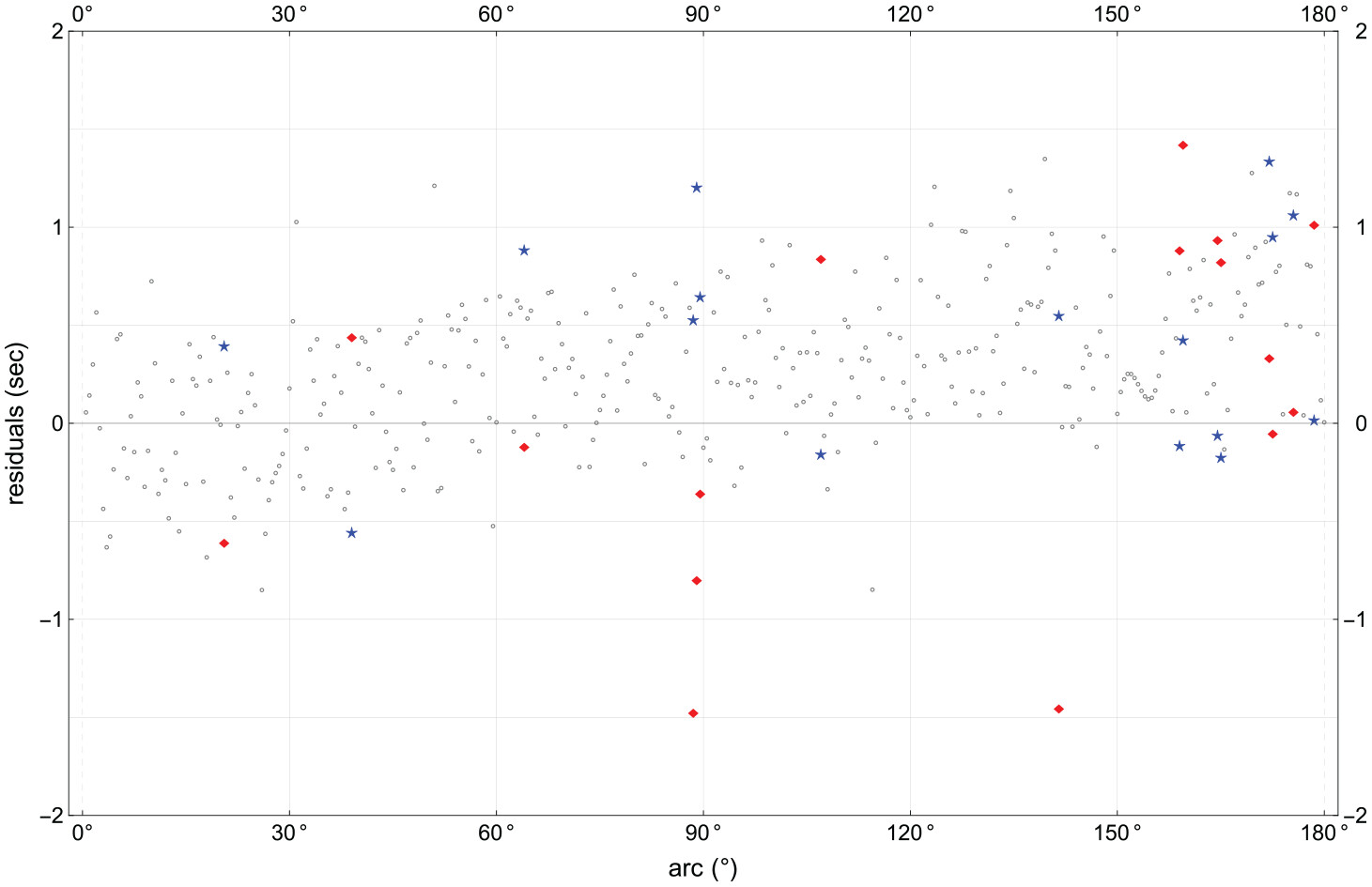
Almagest that do deviate include the major outliers in the error plot of the Greek tradition table (
Figure 2).
39 Moreover, the chord values in Gerard’s translation are in complete agreement with the interpolation terms. Therefore the 16 different chord values are not random scribal errors but appear to be deliberately corrected in correspondence and based on the even interpolation values by a diligent scribe who knew that the table entries should change smoothly.
40By the time Gerard of Cremona compiled his translation, other chord or sine tables than Ptolemy’s had been computed and were available. One of these tables could also have served to correct the chord table of Gerard’s Latin
Almagest. If a sine table would have been used, it necessarily would have to include three fractional sexagesimal digits and a refined interval of 15 minutes. Otherwise, all seconds of the chord values deduced from it would be even, which is not the case, and 30-minute-entries could not have been obtained independently. A sine table that exactly fulfills these boundary conditions is from al-Bīrūnī’s
Masudic Canon.
41 However, al-Bīrūnī’s values have an accuracy that matches modern computed values to the second and therefore cannot produce the variance of the chord table in the
Almagest.
42 Interestingly al-Bīrūnī’s table is also self-contained—interpolation terms following from given sine values—and thus shares a pivotal feature with the chord table in Gerard’s Latin
Almagest.
43From the few variances of the chord values in conjunction with the significant difference of the interpolation terms, it should therefore be concluded that the chord table in Gerard’s Latin Almagest was adjusted and reworked based on a principle of even interpolation values. Thereby the chord table was rendered into a self-contained table. The interpolation terms follow directly from the given chord values, or, vice-versa, the tabulated chord values can also be inferred from the interpolation terms. Although this corresponds, in principle, to a reduction in accuracy in comparison to the Greek and Arabic tradition, there is the benefit of making the table robust against scribal errors in its transmission. Any scribal errors in the table could be easily spotted because the self-contained nature of the table allows a double-check on each value.
Gerard’s reworking of Ptolemy’s chord table for his translation is not a singularity in the history of mathematical astronomy. About a century later, Campanus of Novara, in turn, approached Gerard’s translation in the very same manner. He verified Gerard’s table and added a complete second table of chords that is found in a manuscript of (A)-family now in Paris (BnF, lat. 7256).
44 As compared to Gerard, Campanus’ table has 57 differences in the chord values of order ±1″, evenly distributed, with the interpolation values corrected accordingly. Possibly Campanus even recomputed the chords themselves, but what he did not know is that the table he sought to improve was partially already reworked by Gerard and his collaborators.
In both extant versions of the Arabic translation of the
Almagest, the chord table shares the same basic properties as in the Greek manuscript tradition with around half of the 360 interpolation values being odd. Al-Ḥajjāj’s translation that is extant in one complete copy now in Leiden (Leiden, UB, Or. 680) has 175 odd values among the interpolation terms—this is the same overall number as in the critical Greek edition, though there are a few scribal errors where odd values turned even and vice versa. A manuscript of the Isḥāq/Thābit version now in Tunis (Tunis, BNT, 7116) has 185 odd values.
45The chord tables in the Greek and Arabic manuscript traditions of the Almagest show a definite tendency to diligently copy Ptolemy’s table. In Gerard of Cremona’s Latin translation from Arabic, in contrast, the incongruence between text and table was mended and the chord table, especially the interpolation values, had been adjusted according to the methods outlined by Ptolemy. Thus, while in the Greek and Arabic tradition Ptolemy had been copied with obedience, as one would expect, for Gerard’s translation the details of Ptolemy’s mathematical methods, explanations, and corresponding tables, had been checked and adjusted when deemed necessary, generally assuming that Ptolemy actually computed the tables according to his proofs and paradigm calculations.
The adjustments of the chord table, in summary, are all minor. Nevertheless, they should be visible in any other table that includes the chord and that has an accuracy to seconds. The only table of the Almagest for which this is true is the declination table, which will be analyzed in the next section.
Declination
The first instance in which Ptolemy refers to a numerical value of a chord in his paradigm calculations is the determination of the declination in
Almagest I:14. Here the declination is the angular distance between a point of the ecliptic and its projection onto the equator along a great circle that includes the celestial poles. It depends on the obliquity of the ecliptic
ε, which Ptolemy took as
ε = 23;51,20°.
46 In later parts of the
Almagest, for other tables and quantities, declination is “given” to show that these tables and quantities are also “given.”
47 Ptolemy solved the problem of declination by the application of Menelaus’ Theorem, which he had treated in
Almagest I:13.
48 His table, given in I:15, lists the values of declination to seconds for each degree of longitude in the first quadrant of the ecliptic. The other quadrants simply follow by symmetry. An example for the table of declination from a manuscript copy of Gerard’s Latin
Almagest is given in
Figure 3.
In the declination table of the Greek tradition
Almagest the tabulated values significantly deviate from the mathematical arguments and methods presented in Ptolemy’s proof. The pattern of its residuals is plotted in
Figure 4.
49 An early attempt to explain this mismatch made the claim that Ptolemy did not compute the table of declination but copied it from an earlier source that in turn was based on a less accurate table of chords.
50 This claim was followed by an attempt to determine the underlying table of chords.
51 Both approaches assumed that each single entry in the table had been computed independently with some chord table. However, later on, it was convincingly shown that only multiples of 10° were computed independently while intermediate values were obtained from interpolation—the interpolation scheme itself nevertheless remains unknown.
52When preparing his Greek edition of 1813, Halma had already noticed the deviations in the Greek table. His insight may have derived from comparison with a (B)-family manuscript of Gerard’s translation (Paris, BnF, lat 7258) that he stated he consulted and that he judged to generally have more exact numbers.
53 But instead of a critical analysis and comparison of both tables, Halma computed a new declination table, translated it into Greek, and integrated it into his edition without any comment.
54 In his introduction, though, he stated that he had used computation to correct errors he believed to be copying errors.
55 As I will show below, Halma’s approach is quite similar to Gerard’s practice.
The six manuscript copies of Gerard’s translation that I have collated only show very few variations among themselves with about three differing values on average.
56 My critical reading of Gerard’s table of declinations is identical, except for one value, to the table in MS SLoV, RARESF 091 P95A (
Figure 3).
57 The latter contains only one obvious scribal error.
58 My critical reading of Gerard’s table, however, witnesses a significant deviation from Toomer’s Greek translation with 52 of the 90 values differing with a standard deviation of about 3 seconds. Both versions of the Arabic
Almagest, in turn, appear to be identical to the Greek tradition up to few common scribal errors. For example, MS Leiden, UB, Or. 680 (Al-Ḥajjāj) has six mismatches with the critical Greek edition and MS Tunis, BNT, 7116 (Isḥāq/Thābit) has five mismatches—both share mismatches for 15° and 28°.
I have performed a recomputation of the declination table in Gerard’s translation, following the proof and its paradigm computation outlined in the
Almagest with the accuracy vector. My reconstruction of the computation consists of six hierarchical steps with a finite precision of intermediate sexagesimal results, and only uses tabular chord data. The details are given in the
Appendix. When following the numerical examples given by Ptolemy in his proof and using the chord table from Gerard’s Latin
Almagest the recomputation produces 64 values that match exactly, 24 that differ by ±1″, and 2 that differs by −2″ (
Figure 4). Using the Greek chord table with its different interpolation values instead, the recomputation produces 41 values that match exactly, 47 that differ by −1″, and 2 that differ by −2″. Therefore, within the framework set by Ptolemy’s proof, it appears to be likely that the declination table in Gerard’s Latin
Almagest is also based on the chord table and its interpolation values that were reworked for Gerard’s translation.
The declination table in Gerard’s translation of the
Almagest was evidently newly computed, probably employing the adjusted chord table with its interpolation values. The parameter used for the obliquity was identical to Ptolemy’s value
ε = 23;51,20° given in the
Almagest.
59 To date, there is no other known declination table computed for this value of the obliquity.
60 Modern analysis could not reveal the construction principle of Ptolemy’s own declination table and, most likely, Gerard and collaborators faced the very same issue. Their answer to this problem was to recompute the table, employing Ptolemy’s parameters and the theorems he gives as far as possible. In 1812, Halma approached that problem in a similar manner, except that he employed the mathematical methods of his time and did not follow Ptolemy’s practice as Gerard had done.
In the next section I will focus on rising times, which for their calculation necessitate the use of both the chord and declination table. Using the method of the accuracy vector, I will show that also the rising times were recomputed for Gerard’s translation in order to match the propositions developed in Ptolemy’s text.
Rising times
Beyond their mathematical application to determine other astronomical quantities, in antiquity and the Middle Ages rising times, that is, right and oblique ascensions, served a practical function for reckoning time and determining the ascendant of a horoscope.
61 Ptolemy included a combined table for right ascension and oblique ascensions for 10 different northern latitudes in
Almagest II:8. The table is given at 10° intervals of the ecliptic. The rising times are given in time-degrees accumulating per 10° interval as well as in increments per interval, both with a precision to minutes. Moreover, the table is self-contained and increments are supposed to follow from accumulated time degrees or vice-versa. This renders the table very robust against scribal errors. In total the table has 792 entries, which, however, are not all independent. The relation between accumulated time-degrees and their increments already reduces the number of independent entries by half. Furthermore, the rising times enjoy two symmetries with respect to the equinoxes and solstices that further reduce the number of independent values by three quarters.
62 In summary there are 99 independent values that had to be computed.
63 That is, only one quadrant needed to be considered for each latitude, which is explicitly mentioned and made use of in
Almagest II:7.
In
Almagest I:16 Ptolemy proves the magnitudes of right ascension for 30° and 60° of ecliptic longitude. His paradigm computation employs the first Menelaus’ theorem and the use of the declination and chord table. Since right ascension is computed only for every 10° of the first quadrant of the ecliptic, only multiples of 10° from the declination table will enter the computation. Between Toomer’s translation and Gerard’s version of the declination table only the value for 40° differs by 1″ while the other eight values are identical—an indication of the underlying 10°-interpolation-grid in the Greek tradition.
64 Because right ascension is eventually given to minutes only, the marginal differences in the chord and 10°-interval declination table will hardly accumulate to any sensible difference in minutes between the Greek tradition and Gerard’s Latin
Almagest witnessed in the previous sections.
In fact, the critical Greek edition and my critical reading of Gerard’s table of right ascensions are completely identical (
Figure 5).
65 Nevertheless, I have implemented the computational scheme in both cases with their corresponding table dependencies in eight steps, modeling Ptolemy’s paradigmatic examples.
66 In both cases, this setup correctly reproduces all values but not the ones for 90°. However for the latter the accumulated time-degrees are trivially identical to 90° and do not necessitate any computation. Nevertheless, Ptolemy stated in I:16 that “[t]he sum for the whole quadrant is 90°, as it should be.”
67 To the modern reader this appears as an independent check of Ptolemy’s method, while, on the contrary, the last increment for 90° has more likely been obtained from the complement of the whole quadrant and was not computed independently.
68The case of oblique ascensions is considerably different. While the critical Greek edition is again identical to both extant Arabic versions up to a very few scribal errors, Gerard’s version is significantly different.
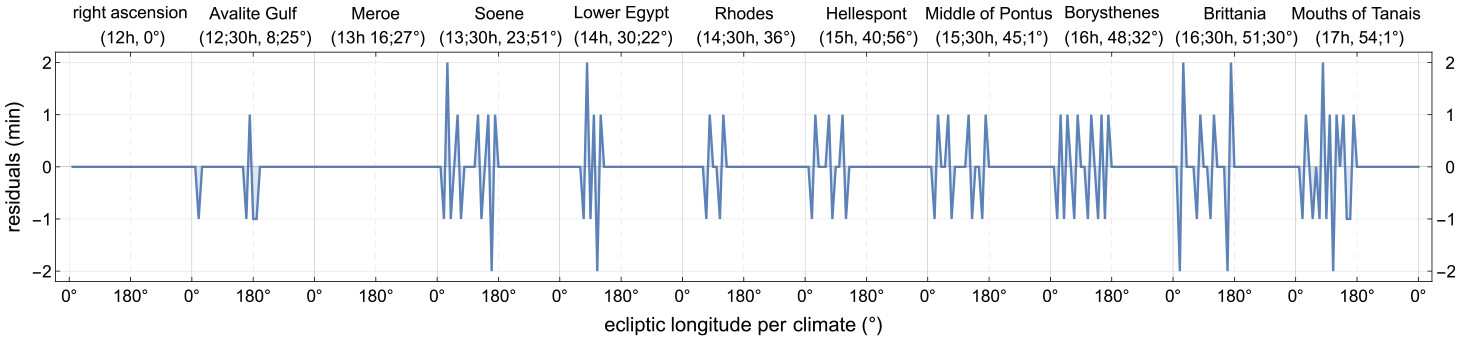
69 In comparison to the Greek edition there is a mismatch up to ±2′ in 35 of 90 independent values for the increments. Only for the case of Meroë are the Greek and Gerard’s table identical. The number of mismatches for the other nine locations, however, by far exceeds common scribal errors and the table appears to be newly calculated. The differences of oblique ascensions for all 10 different locations are plotted in
Figure 5. Furthermore
Figure 5 exhibits another salient feature of Gerard’s table and its preparation in manuscript form. Oblique ascension is symmetric around the equinoxes. In each climate, therefore, the residuals should be symmetric around 180° ecliptic longitude, which apparently is not the case. Also, the values for accumulated time-degrees are identical to the Arabic and Greek
Almagest and do not correspond to the given increments. Most likely the scribe of the earliest manuscript had a minimal non-trivial list of oblique ascension differences up to 180° and no understanding that they just needed to be copied in reverse order for the second half of the full circle and simply added for the accumulated time-degrees. Instead, the missing values have been copied from Arabic templates and entered into the table. This explains the lack of symmetry of the residuals around 180°.
As in the case of right ascension, the computation of oblique ascension, described in
Almagest II:7, employs the chord table and multiples of 10° from the declination table. Furthermore, the table of right ascension is also used in the computation.
70 The final results are given to minutes.
71 Since right ascension is identical in both cases, and the mismatch in declination and the chord is of order 1″, where could the difference of up to ±2 minutes in oblique ascension originate from at all?
The answer is related to the fact that Ptolemy proves two different methods for computing oblique ascension for a specific location. Effectively, one is based on the latitude of the location, the other is based on the length of the longest day in equinoctial hours. These two values need not be mathematically equivalent and each could have been obtained independently of the other. In the case of Meroë, for example, the longest day of 13 hours is in agreement with the given latitude of 16;27° according to the relation described in
Almagest II:3. Ptolemy most likely obtained the latter from the former.
72 Consequently, the resulting oblique ascension for Meroë is identical in both methods (
cf.
Figure 5). For the other locations, however, the given latitude and length of the longest day do not properly correspond to each other and are usually in error by a few minutes.
73 Syene, for example, with a longest day of 13;30 hours is rather made to lie directly under the Tropic of Cancer and its latitude 23;51° is thus taken to be identical to the obliquity in minutes, thereby readily accepting an error of 3 minutes in latitude.
74 These errors between latitude and longest day light and the corresponding different computational methods give rise to the mismatch between the Greek and Gerard’s tables of oblique ascensions.
75Ptolemy’s first method is based on a direct application of the second Menelaus’ theorem and latitude. I have turned his paradigm computation into an algorithm and implemented the latter in seven steps with variable accuracy vectors for intermediate sexagesimal results in place. The second method also uses the second Menelaus’ theorem but employs the length of the longest day. According to my reconstruction, it consists of nine computational steps with intermediate sexagesimal result.
76 While the second method appears to be more cumbersome at first glance, it has the benefit that its first seven out of nine steps are independent of the location and result in an auxiliary table. Only in the last two steps the location is specified by the length of its longest day. Clearly the second method is advantageous when computing oblique ascension for several locations. Moreover, the auxiliary table is explicitly given by Ptolemy, though not in tabular form but included in the text.
77 Ptolemy refers to the second method as “another easier and more practical procedure,” which may be interpreted to mean that this is the method he used.
78For my recomputation I have treated each location as independent, which means that I allow for different accuracy vectors for different locations. This should accommodate the possibility that not all oblique ascensions may have been computed by Ptolemy himself, if any at all, and that he may have included already existing tables. In the case of Gerard’s translation this might correspond to different persons involved in the preparation of the table. The best fit scenarios of my recomputation are summarized in
Table 1, where the given numbers correspond to the number of residuals that do not exactly match the table of oblique ascensions out of 90 values in total.
A few comments are in order. My computational implementation with full tabular dependencies and variable accuracy vectors cannot discriminate between the two methods in the Greek and Arabic tradition of the
Almagest. For both methods the residuals are equally distributed and of order ±1′, while the latitude method includes some residuals of ±2′. Ptolemy’s auxiliary table used in the method of the longest day contains computational slips in two out of its nine values.
79 Using the correct values instead does not alter the number of residuals. Therefore, there is no statistical significance in favor of either of the two methods. As the table is very robust against scribal errors this may be taken as a token that Ptolemy did not follow either of his paradigm computations when compiling the table or that some of the tables for specific locations originated from earlier sources and were not computed by Ptolemy.
For Gerard’s translation, in contrast, there is a clear statistical significance that the method of the length of the longest day has been applied for the recomputation of the table.
80 Ptolemy’s appraisal that this method is “easier and more practical,” thus, has been taken for granted that it ought to be applied.
81 To achieve this fit I have replaced the two erroneous values in the auxiliary table by its corrected values.
82 This indicates that the values stated in the text have not been used in the construction of the table and that text and table are considered two distinct entities in Gerard’s translation. While it was essential to follow the text as closely as possible for the translation, the tables have been recalculated according to the given paradigm computations, which in this case meant to apply the method of length of the longest day.
83For the rising times, as in the case of declination, I have shown that Gerard’s apparently newly computed tables are based on the assumption that Ptolemy’s paradigm computations ought to be applied for the derivation of the tables, even if this required one to correct some of Ptolemy’s computational slips for some intermediate results. The text, however, remained unaltered and the slips contained therein were exactly reproduced in Gerard’s translation.
Conclusion
For Gerard of Cremona’s translation of the Almagest from Arabic into Latin, some of the tables of mathematical astronomy were recomputed and adjusted in order to comply with the text. I have shown this explicitly for three of the most fundamental tables: chord (interpolation values), declination, and rising times. In all three cases the basic reasons and principles for the corrections were of different nature, but unambiguously based upon the textual descriptions, proofs, and paradigm computations. First, for the chord the interpolation values were adjusted to comply with the given textual evidence, stated by Ptolemy, of how they can in principle be derived. In doing so, Gerard and his company tacitly assumed that Ptolemy’s paradigm computations are to be understood as the construction principle of the corresponding tables. Based on even interpolation values, the chord values were corrected accordingly by first-order differences of the even interpolation terms. Second, the declination table was recomputed for each integer degree resulting in a much more accurate table than Ptolemy’s. Most likely the adjusted chord table was used for this computation. Third, the rising times were recomputed consistently according to one of the two given methods that was apparently preferred by Ptolemy. These recomputations were performed according to the techniques described in the Almagest as I have shown with my concept of the accuracy vector that aims to reconstruct historical mathematical practices—in this case the practices of Gerard of Cremona. Text and tables in Gerard’s translation, thus, form a hierarchical structure in which the text is the constitutive element to which the tables have been adjusted. Because of this practice, at least in the case of the Almagest, tables possess a higher variability than textual elements and might serve as an excellent marker for the study of translational practices, different scientific traditions, and medieval cross-cultural exchanges. The analysis of variations in tables and especially their underlying structure, in turn, might bring to the fore the very mathematical and technical practices of its originators and thus further elucidate the translation and transmission of knowledge between cultures, thereby complementing philological studies.
Other tables in Gerard’s translation also differ from the Greek manuscript tradition. One of these differences was already noted by Regiomontanus. To the tables of visibilities, the last table of the
Almagest presented in XIII:10, Regiomontanus added in his copy of Gerard’s translation the marginal note: “This table does not agree to what is in the new translation.”
84 The new translation that Regiomontanus compared the table with was the translation from Greek into Latin by George of Trebizond of which Regiomontanus also owned a copy he made himself.
85 Indeed the tabular data of the two tables is entirely different. Moreover, in the
Almagest the derivation of this table is partially left unclear, but in the text Ptolemy states that the table is computed for the latitude of “the intermediate parallel used above,” which corresponds to the latitude of Phoenicia of 33;18° with a longest day of 14¼ hours.
86 The table of visibilities as it appears in Gerard’s translation, however, is for the latitude of Rhodes of 36° with a longest day of 14½ hours, which can be inferred upon comparison to other existing tables. In fact, this table already appeared in Ptolemy’s
Handy Tables, for the fourth of the seven climates, and in al-Battānī’s
ṣābiʾ Zīj.
87 Either Gerard intended to make the
Almagest, in this regard, useable in more northern latitudes, or he tried to correct it by literally choosing the middle of the seven climates, or the template he translated from already had this feature.
Still other tables in Gerard’s translation appear to have been checked for internal consistency by first-order differences. For example, in most Greek manuscripts, and also in Toomer’s translation, the interpolation column in the table of the complete lunar anomaly has an irregularity at a center of 168°, which has a value of 0;59,4.
88 Gerard’s translation, however, has a value of 0;59,16, which appears to be corrected by first-order differences.
89In case of the translation of the
Almagest, Gerard of Cremona, or somebody commissioned in his company, appears as a table maker and calculator. The Englishman Daniel of Morley, who stayed in Toledo before 1175 and who attended lectures of Gerard, reported that the Mozarab Galippus helped Gerard to translate the
Almagest.
90 Both, Galippus and Gerard, therefore qualify as table makers and calculators. Some of the tables in Gerard and Galippus’ translation are unprecedented and were exclusively recomputed, or corrected for the Latin translation of the
Almagest. This laborious mathematical activity may explain why the translation of the
Almagest was a life-long enterprise for Gerard, while George of Trebizond accomplished his translation from Greek in less than a year, not bothering about any of the tables.
Among the Arabic works translated by Gerard is also the
Iṣlāḥ al-Majisṭī, or
Correction of the Almagest, written by Jābir ibn Aflaḥ who was active in Seville in the first half of the 12th century.
91 Since Gerard’s engagement with the
Almagest was a lifelong enterprise, he must have had proper knowledge of the
Iṣlāḥ before he finished his translation. The
Iṣlāḥ is a purely theoretical work that focuses on the underlying mathematical structure of the
Almagest and aims for a pedagogical discussion. It is not concerned with practical astronomical computations and does not contain any tables. However, Jābir ibn Aflaḥ criticizes what he considered to be errors and supplies a number of technical and astronomical corrections.
92 It may well be that Jābir’s criticism spurred Gerard’s efforts to verify and correct the tabular data according to Ptolemy’s methods. Especially for the tables for lunar anomalies and eclipses, not discussed in this article, it might therefore be worthwhile to carefully analyze the corresponding parts of the
Iṣlāh, because most of Jābir’s criticism is concerned with these.
93Gerard of Cremona’s name is also entangled with the Toledan Tables that constituted the standard for contemporary practice of computational astronomy during Gerard’s lifetime. The tables originated in Al-Andalus around 1070 and were composed in Arabic. While no Arabic manuscript of the Toledan Tables has been found, the Latin version, translated during the 12th century, is extant in numerous manuscripts. There are three different sets of rules for the application of the tables that circulated with different manuscripts. One of them, canon
Cb, includes the name of the town of Cremona.
94 Therefore, Gerard had formerly been cited for the compilation and revision of this specific canon.
95 This notion is rather rejected nowadays.
96 Be that as it may, the reference Cremona also appears among the tables. Several manuscript witnesses of the Toledan Tables include a table of oblique ascension for the location of Cremona with 45° latitude. Therefore Gerard was held responsible for adding this table to the Toledan Tables.
97 Modern recomputation has shown a Ptolemaic obliquity of
underlying the table, which differs from the obliquity used for the corresponding oblique ascension table of Toledo. Nevertheless, since the use of parameters in the Toledan Tables is generally not consistent, Gerard’s authorship of the table has not been considered cogently.
98 Moreover, because Gerard is preferably regarded as faithfully translating text from Arabic into Latin instead of revising canons or computing tables he is discharged from both latter activities.
99My analysis suggests that the use of a Ptolemaic parameter in the oblique ascension table for Cremona might be more than accidental. I have shown Gerard, or someone in his company, Galippus, to actively intervene into the practical, tabular part of the
Almagest. Gerard’s
socii stated in the
Vita “because of his love for the
Almagest, which he did not find at all amongst the Latins, he made his way to Toledo.”
100 It is more than likely that Gerard and Gallipus mastered the mathematical practice and specific techniques of the
Almagest. In the case of the recomputation of oblique ascension in
Almagest II:8, they used a specific method, defined parameters, and a distinct calculational procedure. Their practice could thus serve to generate a calculational fingerprint to elucidate their contribution to the Toledan Tables. Gerard might have been more than a faithful translator of knowledge.
101 To allow for future investigations of this possibility, however, he first has to be relocated into a less static environment, open to continued change, in which mathematical and geometrical practices constitute a cross-cultural exchange.
102