Embodying the Police: The Effects of Enclothed Cognition on Shooting Decisions
Abstract
The theory of enclothed cognition proposes that wearing physical articles of clothing can trigger psychological processes and behavioral tendencies connected to their symbolic meaning. Furthermore, past research has found that increases in power are associated with greater approach orientation and action tendencies. In this study, we integrate these two literatures to examine how embodying the role of a police officer through wearing a uniform would affect responses on a reaction-time measure known as the Shooter Task. This first-person video game simulation requires participants to shoot or not shoot targets holding guns or objects. The task typically elicits a stereotypical pattern of responses, such that unarmed Black versus White targets are more likely to be mistakenly shot and armed Black versus White targets are more likely to be correctly shot. Based on the relationship between power and action, we hypothesized that participants who were randomly assigned to wear a police uniform would show more shooting errors, particularly false alarms, than control participants. Consistent with our hypotheses, participants in uniform were more likely to shoot unarmed targets, regardless of their race. Moreover, this pattern was partially moderated by attitudes about the police and their abuse of power. Specifically, uniformed participants who justified police use of power were more likely to shoot innocent targets than those who were wary of it. We discuss implications for police perceptions and the theory of enclothed cognition more broadly.
Introduction
The seemingly frequent occurrence of fatal civilian shootings by the police in recent years has shone a negative spotlight on law enforcement across the country (Cook, 2015; Nix, Campbell, Byers, & Alpert, 2017). The fact that these high-profile cases have disproportionately involved unarmed Black men has brought attention to the racial disparities that have long persisted in the criminal justice system (Kahn & Martin, 2016). Furthermore, social unrest has been sparked by the perceived leniency shown to police officers, who are rarely charged or convicted for their use of lethal force (Stinson, 2017). Researchers have therefore sought to better understand the factors that influence police decisions to shoot, with much of the focus centering around the target’s race or ethnicity (Correll, Park, Judd, & Wittenbrink, 2002; Sadler, Correll, Park, & Judd, 2012). In this study, we extend this line of psychological inquiry by examining not only the impact of race but also the effect of power conferred on the shooter by the police uniform.
Racial bias in weapon perception
Although explicit forms of prejudice undoubtedly contribute to discriminatory practices and biased policing (Hall, Hall, & Perry, 2016), a considerable amount of social cognition research has established that race can also implicitly bias people’s perceptions and behaviors (for a review, see Amodio & Mendoza, 2010). Specifically, negative stereotypes that associate Black individuals with greater hostility and violence can influence the processing of weapon stimuli. For instance, following the supraliminal presentation of a Black versus a White facial prime, individuals are generally faster to identify a gun and are more likely to misidentify a tool as a gun (Amodio et al., 2004; Klauer & Voss, 2008; Payne, 2001; Payne, Lambert, & Jacoby, 2002). In addition, the subliminal presentation of a Black, compared to a White, facial prime can facilitate the accurate detection of degraded weapon images (Eberhardt, Goff, Purdie, & Davies, 2004).
Converging evidence of bias has emerged from psychological studies that more directly examine how race can affect decisions to shoot criminal suspects (e.g., Correll et al., 2002; Greenwald, Oaks, & Hoffman, 2003; Plant, Peruche, & Butz, 2005). In one paradigm known as the first-person Shooter Task, participants must quickly decide whether to shoot or not shoot Black and White male targets who appear on the screen holding handguns or innocuous objects like wallets and cell phones (Correll et al., 2002). Across numerous studies, a pattern of racial bias has emerged in both the shoot/don’t shoot decisions and the speed of such responses, depending on the provided response window (for a review, see Correll, Hudson, Guillermo, & Ma, 2014; for a meta-analysis, see Mekawi & Bresin, 2015). When participants are given 630 ms to respond, error rates are biased such that unarmed Black men are more likely to be mistakenly shot than unarmed White men, and armed White men are less likely to be correctly shot than armed Black men. If the response deadline is extended to 850 ms, participants are typically faster to shoot armed Black men, but slower to not shoot unarmed Black men, compared to White targets. These responses may, in part, be driven by the activation of cultural stereotypes that link Black Americans to danger and threat (Correll et al., 2002; Correll, Urland, & Ito, 2006; but see Mekawi & Bresin, 2015 for further discussion). As such, various groups of individuals demonstrate a form of shooter bias on the task, including egalitarian-minded White undergraduates and Black community members (Correll et al., 2002), as well as actual police officers (particularly in their reaction times; Correll et al., 2007; Cox, Devine, Plant, & Schwartz, 2014; Sim, Correll, & Sadler, 2013).
These past findings have established that the automatic processing of the target’s race can influence the decision to shoot. However, we propose that the police uniform, and the power associated with it, may be another important variable that has been previously overlooked in understanding shooting decisions. To explore how physically adopting the role of a police officer may affect this behavioral outcome, we turned to the literature on the psychological effects of clothing.
The psychological effects of clothing and power
A plethora of research has investigated how clothing can affect both social and self-perception (for a review, see K. Johnson, Lennon, & Rudd, 2014). One research focus within the field has been comparing formal versus casual styles of dress. Individuals who wear formal clothing are perceived by others to be more competent across a variety of occupational contexts (Behling & Williams, 1991; Furnham, Chan, & Wilson, 2013; Gherardi, Cameron, West, & Crossley, 2009). Adopting formal attire can also influence the extent to which people feel ambitious, authoritative, trustworthy, and powerful (Hannover & Kühnen, 2002; Peluchette & Karl, 2007; Slepian, Ferber, Gold, & Rutchick, 2015). Thus, clothing can carry specific associations that guide, and perhaps bias, perceptions of ourselves and others.
Adam and Galinsky (2012) proposed a psychological model to explain how clothing can influence one’s mental state and behavior. According to the theory of enclothed cognition, the physical experience of putting on clothing with symbolic meaning can activate its associated concepts to influence psychological processes and behavioral tendencies. Much like the effect of physical movements on how humans feel, process information, or behave (e.g., making a fist can activate the concept of power; Schubert, 2004), a person may come to embody (or adopt) the characteristics associated with a specific piece of clothing. As such, this theory is grounded in the literature on embodied cognition, which posits that physical experiences can trigger related mental concepts (Niedenthal, Barsalou, Winkielman, Krauth-Gruber, & Ric, 2005).
To test their enclothed cognition hypothesis, Adam and Galinsky (2012) ran three studies using a lab coat that had been pretested for its association with attentiveness (see also Van Stockum & DeCaro, 2014). In their first study, participants who were assigned to wear, versus not wear, a lab coat while completing a Stroop Task showed more evidence of selective attention in their performance (i.e., made fewer errors on incongruent trials). Participants in their follow-up studies who put on a doctor’s lab coat demonstrated greater sustained attention on a visual search task compared to participants who wore a painter’s coat, saw a doctor’s coat nearby, or reflected on the personal meaning of the doctor’s coat. These results therefore suggest that enclothed cognition effects are dependent on the clothing’s symbolic meaning and are distinct from those that would be caused by basic priming (Adam & Galinsky, 2012). Indeed, enclothed cognition requires both the physical experience and the attribution of meaning, as the same article of clothing can have different influences based on personal associations with the item (e.g., whether a tunic is identified as a cleaning or nursing uniform; López-Pérez, Ambrona, Wilson, & Khalil, 2016).
The theory of enclothed cognition provides a framework for understanding how putting on symbolic clothing, such as a police uniform, can influence behavior. Past research has found that the police uniform can represent safety, honesty, and helpfulness (Mauro, 1984), but is also linked to authority (Bell, 1982; Lowenstein, Blank, & Sauer, 2010), legitimacy (Bushman, 1988), and power (R. R. Johnson, 2005). These latter effects of the uniform are evident in the pattern of abusive behavior displayed by role-playing police guards in the classic Stanford Prison Experiment (Haney, Banks, & Zimbardo, 1973), as well as findings that citizens are more compliant with requests from individuals wearing police-like uniforms (Bickman, 1974; Bushman, 1988). Furthermore, police officers have reported the psychological effects of the uniform on self-perceptions, including feeling a near-celebrity status when wearing it (De Camargo, 2012). As others have suggested, a police officer is a socially dominant role (Sidanius, Liu, Pratto, & Shaw, 1994), and the uniform serves as a symbol of this power (Vrij & Winkel, 1991).
The theory of enclothed cognition would therefore posit that wearing a police uniform can psychologically impact the wearer in line with the clothing’s associations. Recently, Civile and Obhi (2017) examined this possibility by having participants wear a police uniform, mechanic overalls, or their own clothing while completing a series of visual attention tasks. Their first two studies found that those in a police uniform showed an attentional bias (assessed by reaction times) toward stimuli involving low-socioeconomic status targets wearing hoodies compared with high-socioeconomic status targets wearing business suits. Similar effects emerged in a third study that compared participants who wore a police uniform or simply saw one placed next to them.
Thus, the extant research on enclothed cognition has demonstrated that attention can be biased by wearing a symbolic article of clothing like a police uniform. However, research on the social priming of power suggests police uniforms should also have visible effects for action tendencies related to policing behavior. For example, power increases approach orientation (Keltner, Gruenfeld, & Anderson, 2003; Smith & Bargh, 2008) and action (Galinsky, Gruenfeld, & Magee, 2003; Smith & Bargh, 2008). Anderson and Galinsky (2006) found that this tendency to act was mediated by optimistic risk perceptions, suggesting that the sense of power associated with a police uniform could increase individuals’ tolerance for risk-taking behaviors, such as shooting potentially innocent targets. In addition, those with power are more likely to make errors because they are overconfident (See, Morrison, Rothman, & Soll, 2011), as well as show less distress and compassion toward the plight of others (Van Kleef et al., 2008).
Together, past studies examining enclothed cognition and power effects suggest that wearing a police uniform should increase the propensity to shoot, even at the cost of accuracy. We propose this overall power effect on action initiation should occur independent of the target’s race. Although powerful individuals have been shown to attend more to stereotype-consistent information (e.g., Civile & Obhi, 2017; Fiske & Dépret, 1996), research has generally demonstrated that power does not increase stereotyping and prejudice except in perceiving others in instrumental ways (i.e., as a means to achieve one’s goal; Chen, Lee-Chai, & Bargh, 2001; Fiske, 1993; Guinote, 2007; Overbeck & Park, 2006; Vescio, Snyder, & Butz, 2003). We therefore expected that wearing a uniform would lower participants’ threshold for shooting targets, regardless of their race.
Current research
In this study, we examined the effect of wearing a police uniform on Shooter Task performance using a short response window (i.e., in which bias should be observed in error rates but not reaction times; Mekawi & Bresin, 2015). The original point structure by Correll et al. (2002) differentially rewards correct or incorrect responses based on type of response (i.e., 5 points for correct rejection, 10 points for hit, −20 points for a false alarm, and −40 points for a miss), producing an average payoff of 25 points for consistently choosing a shoot response. D. J. Johnson, Cesario, and Pleskac (2018) demonstrated that giving higher payoffs for shoot decisions significantly affects multiple aspects of the shooting decision, by increasing participants’ initial bias to favor a shoot response and creating a learning curve toward shooting over time. To avoid this biasing influence and more cleanly test our hypothesis, we altered the point system to equally reward correct responses (+10 points) and penalize incorrect responses (−10 points), as well as discourage nonresponsiveness (−5 points).
Given the aforementioned links between power and action, we hypothesized that uniformed participants would be more likely to commit errors overall, especially false alarms. However, because recent research has shown that behavior may be impacted by personal beliefs about power (Hays & Goldstein, 2015), we also examined whether participants’ attitudes about the use of power by police would moderate the tendency to shoot unarmed targets. Thus, we predicted that individual perceptions regarding the legitimacy of police power would moderate the predicted effect of wearing a uniform on shooting decisions.

Method
Participants and design
A total of 191 undergraduates aged 18–22 years (M = 19.19, SD = 1.13) participated in our study on video game vigilance and received either partial course credit or $5 as compensation (there were no performance differences based on compensation). Our sample closely reflected the racial demographics of Providence College, with 81% of participants identifying as White, 10% as Hispanic/Latino, 4% as Black, 2% as Asian, and 3% as other. The study used a between-subjects design with participants randomly assigned to either the control or uniform condition.
Measures
Shooter task
The Shooter Task was adapted from Correll et al. (2002) and consisted of 20 practice trials and 80 critical trials presented in the form of a shooter video game through Inquisit 4 Lab (Millisecond Software LLC, 2015). Each trial began with a fixation point, followed by a series of one to four randomly presented background images lasting 500–1000 ms. These images depicted various real-life settings (e.g., parks, courtyards, offices), with the final image showing a superimposed Black or White male target who was holding a gun or object. The participants’ goal was to shoot armed targets and not shoot unarmed targets as quickly as possible by pressing one of two computer keys that were counterbalanced across participants. A 630 ms response deadline was implemented to preclude deliberative responses (as in Correll et al., 2002; Mendoza, Gollwitzer, & Amodio, 2010), and parallel rewards and penalties were allotted to correct (+10) and incorrect (−10) responses, with a smaller penalty for nonresponse (−5).
Police power attitudes
As part of an online battery that included other sociopolitical questions and was administered at the beginning of the semester, all eligible participants responded to a bipolar item asking how much they thought the police did not abuse (1) or abused (6) their power, with higher scores reflecting more negative law enforcement perceptions (M = 3.51, SD = 1.25).
Procedure
All consenting participants were run individually and informed that they would be playing the role of a police officer in a shooter video game. As in prior Shooter Task studies, participants in the control condition wore their own clothing while completing the game in a private computer area. Participants in the uniform condition were told that they would wear a police uniform in order to add realism to the game. To avoid having the police uniforms feel like themed costumes, we purchased several sizes of black long sleeve tops and pants from a company that provides professional gear to law enforcement agencies (www.511tactical.com). Black uniforms were chosen because they are the most commonly used in U.S. police departments (R. R. Johnson, 2013), including the city where the study took place. Participants were instructed to wear the uniform over their own clothing along with a police badge on their upper left chest pocket. Once the participants had changed, the experimenter directed them to a private computer to read the task instructions and start the game. At the end of the task, all participants completed a basic demographic questionnaire and were carefully debriefed verbally and in writing.
Results
Data reduction
Because the task specifically examines stereotyping against African Americans, we made an a priori decision to exclude data from Black participants (n = 8) due to the variability in their implicit in-group evaluations (Ashburn-Nardo, Knowles, & Monteith, 2003; Livingston, 2002). We included data from other non-White participants for statistical power (n = 28), but the small representation of students of color in the sample did not allow us to appropriately test for the possible moderating effect of participant race in our study. The pattern and significance of the reported results did not change when we only analyzed data from White participants or included data from Black participants.
Task performance was primarily assessed through error rates given our use of the 630 ms respond deadline (as in Correll et al., 2002 and Mendoza et al., 2010). Data were excluded from two participants who failed to follow the uniform instructions, as well as from one participant who reported during the debriefing process learning about the study’s hypotheses from a friend. In addition, two participants were excluded for having a mean time-out rate that exceeded three standard deviations. Our analyses were therefore conducted using a final sample of 178 participants (84% White, 65% female) who were comparably distributed into the two conditions (ncontrol = 91, nuniform = 87).1
Police uniform effects on task performance
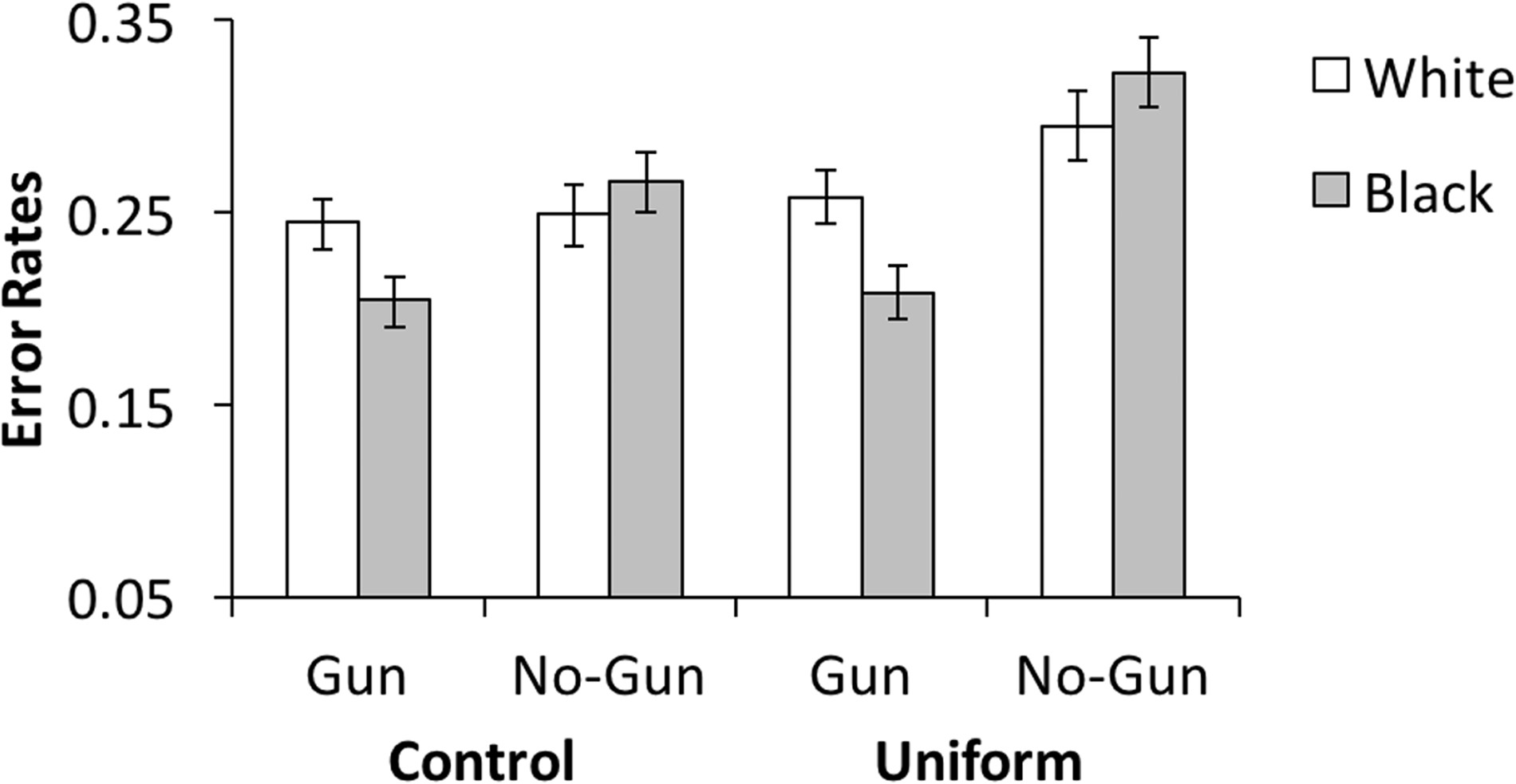
To examine our predicted uniform effects on task performance, we submitted error rates to a 2 (Race: White vs. Black) × 2 (Object: gun vs. no gun) × 2 (Condition: no uniform vs. uniform) mixed-model analysis of variance.2 As seen in Figure 1, we found the predicted condition × object interaction, F(1, 176) = 6.10, p = .014, = .033, as well as the expected main effect of condition, F(1, 176) = 4.43, p = .037, = .025. Deconstructing the interaction revealed that participants in the uniform condition were more likely to commit a false alarm by erroneously shooting unarmed targets (M = .32, SD = .15) than those in the control condition (M = .26, SD = .12), F(1, 176) = 7.62, p = .006, = .042, but uniform participants (M = .23, SD = .11) did not differ from control participants in their gun trial errors (i.e., failing to shoot an armed target; M = .22, SD = .10), F < 1.

Given that we altered the original point system, it was also important for us to validate the task by examining whether it elicited the stereotypical pattern of shooter bias across conditions. The critical race × object interaction was observed, F(1, 176) = 16.39, p < .001, = .085, along with a main effect of object, F(1, 176) = 32.41, p < .001, = .156, reflecting a tendency to make more errors on no-gun versus gun trials. Simple effect tests following the significant interaction revealed that participants were significantly more likely to not shoot armed White (M = .25, SD = .12) versus Black (M =.21, SD = .13) targets, F(1, 176) = 19.81, p < .001, = .101, and had a greater tendency to shoot unarmed Black (M = .30, SD = .17) versus White (M = .27, SD = .16) targets, F(1, 176) = 3.43, p = .066, = .019. Thus, the task produced the typical pattern of shooter bias against Black targets. No other significant main effects or interactions emerged (all ps > .17).
To further investigate the impact of the police uniform on task responses, we applied signal detection theory by following the recommendations of Stanislaw and Todorov (1999). Specifically, we used the z-scored hit rate (i.e., correct responses on gun trials) and false alarm (i.e., errors on no-gun trials) averages to calculate the decision criterion c, which reflects the participants’ threshold for shooting versus not shooting a target. Deviations from zero in a positive direction indicate a bias favoring the don’t shoot response and deviations in the negative direction indicate a shoot bias (Mekawi & Bresin, 2015). Consistent with our expectation that wearing a uniform would produce a relative shooting bias, there was a significant difference between the two groups, t(176) = 2.08, p = .039, such that uniformed participants (M = −.09, SD = .60) demonstrated a more liberal shooting threshold than control participants (M = .08, SD = .47).
Police power attitudes
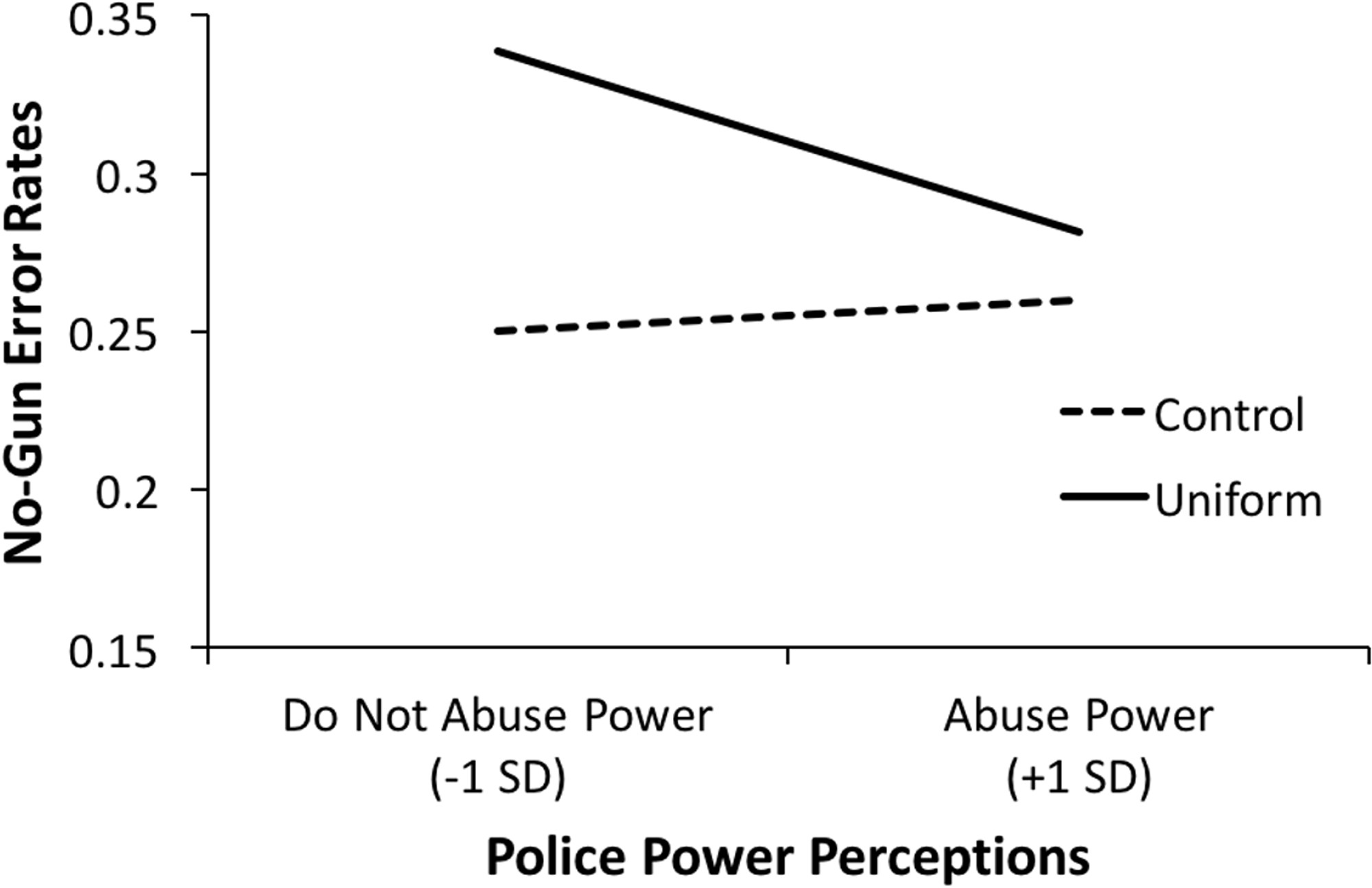
Finally, we tested whether the observed uniform effects on participants’ tendency to shoot unarmed targets would be moderated by their attitudes about police power. The no-gun error rate (i.e., shooting unarmed targets) was entered as the outcome in a regression that included the effect-coded condition (control = −1, uniform = 1), the mean-centered police power item, and the interaction between these two predictors. The regression model explained a significant amount of variance in no-gun error rates, F(3, 172) = 4.25, p = .006, R2 = .069. The expected interaction between uniform condition and attitude about police power was marginally significant, b = −.02, t(174) = 1.76, p = .081, 95% confidence interval (CI) [−.031, .002], suggesting that attitudes about power moderated the effect of wearing a uniform on shooting unarmed targets. The effect of condition remained significant, b = .03, t(173) = 2.78, p = .003, 95% CI [.01, .051], but the item measuring participants’ attitudes about police power was not a significant predictor on its own, b = −.01, t(174) = 1.27, p = .207, 95% CI [−.027, .006].
To better understand how the relationship between participant attitudes and task behavior differed by condition, we ran separate follow-up regressions using the police power item as a predictor of no-gun errors. Within the uniform condition, perceiving that the police did not abuse their power produced a marginal increase in shooting unarmed targets, b = −.03, t(85) = 1.83, p = .07, 95% CI [−.053, .002], suggesting that the uniform’s increase in the propensity to shoot was found particularly among those with positive attitudes about police use of power. By comparison, no relationship between power perceptions and shooting errors emerged within the control condition, b = .004, t(89) = .41, p = .68, 95% CI [−.016, .024].3 Participants who had more positive attitudes about police power were more likely to shoot unarmed targets in the uniform condition only (Figure 2).

Discussion
High-profile shootings of unarmed civilians have impacted public perceptions of police officers across America and sparked national debates about the factors that contribute to systematic forms of bias in law enforcement (Nix & Wolfe, 2017; Pew Research Center, 2017). In this study, we moved beyond the well-established influence of suspect race and investigated how wearing clothing imbued with power can affect shooting decisions. In line with our theorizing, we found that participants wearing a police uniform possessed a lower threshold for shooting, resulting in more unarmed targets being wrongly shot.
Theoretical and practical implications
Our findings have implications for the enclothed cognition literature. All participants in our study were playing the role of a police officer in a shooter game, which should have activated similar goals and values across conditions. Yet, wearing the police uniform uniquely impacted participant behavior in a manner that also reflected their personal attitudes. Those who were wary of police abusing their power tended not to show an increase in shooting unarmed targets as a result of wearing a police uniform, whereas those who were supportive of police power were more likely to shoot unarmed civilians while wearing the uniform. This moderating effect of participants’ attitudes associated with the article of clothing is consistent with recent research showing that the symbolic meaning of an article of clothing is an independent factor in determining the effect on one’s cognitions and behavior (López-Pérez et al., 2016). Our behavioral findings therefore extend our understanding of enclothed cognition theory by demonstrating that its effects are not limited to general attentional processes, and that the impact of physically wearing symbolic clothing can be influenced by more personal associations.
Consistent with prior Shooter Task research, we also found the expected race by object interaction: participants were more likely to not shoot armed White versus Black men and were marginally more likely to shoot unarmed Black versus White men. This pattern emerged across conditions, confirming that implicit stereotypes do impact shooting decisions, but wearing a police uniform does not exacerbate this racial bias. Similarly, Civile and Obhi (2017: Study 1 and Study 2) did not find an effect of wearing a police uniform on attention toward Black compared to White faces. Although these findings might seem surprising when considering real-life patterns of police shootings, they are consistent with prior research showing that power predominantly affects behavior by increasing one’s action orientation (Galinsky et al., 2003), rather than selectively increasing stereotyping.
One practical implication of this research is that distrust of police power may actually be beneficial for shooting decision accuracy. In our study, only participants who viewed police power as benign showed a higher error rate for shooting unarmed targets when wearing a police uniform, suggesting that only those who have positive attitudes about police power feel empowered and emboldened to action by embodying this role. Those with concerns about abusive police power did not show an increase in false alarms, a benefit to performance that was not accompanied by a higher miss rate (i.e., failing to shoot armed targets). This suggests that heightened awareness and education about the dangers of the abuse of police power may be a beneficial approach for police departments. Indeed, a recent national survey found that 76% of officers have received some training on bias or fairness in the past 12 months (Pew Research Center, 2017). Yearly data collected since 2015 by the Washington Post on police shootings also points to a decline in the killing of unarmed civilians (Sullivan, Tate, & Jenkins, 2018), perhaps reflecting the impact of police training programs and public discourse on this social issue.
Limitations and future directions
As with much social psychological experimental research, our study relied on undergraduate participants from a western, educated, industrialized, rich, and democratic society (WEIRD; Henrich, Heine, & Norenzayan, 2010), limiting its generalizability to other populations. In addition, our sample was obtained from a primarily White institution with less than 5% Black students, preventing us from examining meaningful interactions between the uniform condition and the race of participants. This would be an important area to investigate in future work, since racial differences in perceptions of and interactions with the police have long been established (Brown & Benedict, 2002). Future research should also seek to replicate these findings with a diverse sample of police officers to examine the influence of prior job experience and neighborhood composition on shooting decisions, as others have done (Correll et al., 2007; D. J. Johnson et al., 2018). Given that police officers have been shown to have higher levels of social dominance orientation (SDO; see Swencionis & Goff, 2017), it may also be critical to examine whether individual differences like SDO moderate the observed uniform effects.
We further recommend future studies to examine whether uniform color moderates the influence of wearing a uniform on shooting decisions. Here, we used the black uniforms commonly found in American police departments and in our local community. However, dark uniforms may not only affect public perceptions of the police, but also produce more aggressive responses than light ones (e.g., Frank & Gilovich, 1988; Peña, Hancock, & Merola, 2009). Recent research has demonstrated that small changes to an officer’s uniform (e.g., high visibility vests, black gloves, and batons) can affect civilian’s perceptions of officers (Simpson, 2018), and future research could explore whether these features of a uniform impact the enclothed cognition effects.
Although we currently focused on the impact of the police uniform on external behaviors toward potential criminals, studies could also examine whether temporarily embodying the police influences civilians’ affective responses. For example, does wearing the clothing associated with this role increase empathy and perspective-taking with the police officer? How would this proposed shift toward the perspective of the police officer affect intergroup attitudes? These perspective taking effects may depend on whether a positive or negative association of police power is activated by the uniform, which could be manipulated through pictures or text that reflect their role as protectors of all sides during a community crisis or, alternatively, as provocateurs. Thus, future studies can explore the implications of enclothed cognition effects for individuals and group dynamics.
Conclusion
The present research represents only a first step in understanding the intersecting effects of power, stereotypes, and enclothed cognition on intergroup behavior. Our findings suggest that, for those who are not concerned about the police abusing power, the uniform emboldens them to take action, potentially contributing to excessive use of force and the shooting of unarmed civilians. However, the flip side of this finding provides a more promising message: awareness of the potential abuse of police power can potentially eliminate the increases in shooting unarmed civilians otherwise associated with this uniform, without a corresponding increase in misses. Only time will tell whether current attention on law enforcement practices will bring about positive changes in shooting behavior and public perceptions of the police.
Acknowledgments
The authors thank the members of the Social Perception & Attitudes Lab at Providence College for their assistance with data collection and for providing comments on earlier versions of the manuscript. Research materials will be shared upon request by the corresponding author.
Footnotes
Saaid A. Mendoza, PhD is an assistant professor of psychology at Providence College, where he directs the Social Perception & Attitudes Lab. His research examines how stereotyping processes interact with goals and norms to bias behavior within intergroup contexts.
Elizabeth J. Parks-Stamm, PhD is a part-time faculty member in the Psychology Department at the University of Southern Maine and in the College of Doctoral Studies at Grand Canyon University.
The author(s) declared no potential conflicts of interest with respect to the research, authorship, and/or publication of this article.
The author(s) received no financial support for the research, authorship, and/or publication of this article.
1 Due to the limited size of the subject pool, we subsequently ran a separate control group using 60 participants who completed the Shooter Task with a police uniform folded next to them (as in Civile & Obhi, 2017). This group produced a mean error rate (M = .24, SD = .11) that was comparable to the control condition in our study, consistent with Adam and Galinsky’s (2012) assertion that putting on symbolic clothing can influence behavior in a manner that is distinct from basic material priming effects.
2 Although studies with a 630 ms response window generally produce no shooter bias in reaction times (Mekawi & Bresin, 2015), we discuss the results of those secondary analyses here. Log-transformed reaction times (reported in raw form for clarity) from correct trials were submitted to a 2 (Race: White vs. Black) × 2 (Object: gun vs. no gun) × 2 (Condition: no uniform vs. uniform) mixed-model analysis of variance. In line with past studies that have used a short response window, the object × race interaction indicative of shooter bias was not significant, F < 1. Furthermore, there was no difference between the control and uniform groups in overall reaction time, F < 1, nor any interactions with condition (all ps > .12). A main effect of object did emerge, F(1, 176) = 75.06, p < .001, = .299, such that participants were significantly faster to shoot on gun trials (M = 500.56, SD = 25.45) than to not shoot on unarmed trials (M = 537.75, SD = 33.41). There was also a marginal effect of race, F(1, 176) = 3.79, p = .053, = .021, reflecting a tendency for participants to respond faster to Black (M = 517.05, SD = 32.06) versus White (M = 521.46, SD = 24.21) targets.
3 As an exploratory analysis, we examined whether this observed relationship was more predictive of shooting errors involving Black versus White unarmed targets among uniformed participants. Power perceptions of the police were marginally predictive of Black no-gun errors, b = −.03, t(85) = 1.78, p = .079, 95% CI [−.059, .003], but were unrelated to White no-gun errors, b = −.02, t(85) = 1.42, p = .159, 95% CI [−.054, .009], suggesting that positive attitudes about the police were associated with a greater tendency for uniformed participants to erroneously shoot Black, but not White, unarmed civilians.
Article Notes
Author BiographiesDeclaration of Conflicting InterestsFundingNotesReferences
Adam H., Galinsky A. D. (2012). Enclothed cognition. Journal of Experimental Social Psychology, 48, 918–925.
Amodio D. M., Harmon-Jones E., Devine P. G., Curtin J. J., Hartley S. L., Covert A. E. (2004). Neural signals for the detection of unintentional race bias. Psychological Science, 15, 88–93.
Amodio D. M., Mendoza S. A. (2010). Implicit intergroup bias: Cognitive, affective, and motivational underpinnings. In Gawronski B., Payne B. K. (Eds.), Handbook of Implicit Social Cognition (pp. 353–374). New York, NY: Guilford.
Anderson C., Galinsky A. D. (2006). Power, optimism, and risk-taking. European Journal of Social Psychology, 36, 511–536.
Ashburn-Nardo L., Knowles M. L., Monteith M. J. (2003). Black Americans’ implicit racial associations and their implications for intergroup judgment. Social Cognition, 21, 61–87.
Behling D. U., Williams E. A. (1991). Influence of dress on perception of intelligence and expectations of scholastic achievement. Clothing and Textiles Research Journal, 9, 1–7.
Bell D. J. (1982). Police uniforms, attitudes, and citizens. Journal of Criminal Justice, 10, 45–55.
Bickman L. (1974). The social power of a uniform. Journal of Applied Social Psychology, 4, 47–61.
Brown B., Benedict W. R. (2002). Perceptions of the police: Past findings, methodological issues, conceptual issues and policy implications. Policing: An International Journal of Police Strategies & Management, 25, 543–580.
Bushman B. J. (1988). The effects of apparel on compliance: A field experiment with a female authority figure. Personality and Social Psychology Bulletin, 14, 459–467.
Chen S., Lee-Chai A. Y., Bargh J. A. (2001). Relationship orientation as a moderator of the effects of social power. Journal of Personality and Social Psychology, 80, 173–187.
Civile C., Obhi S. S. (2017). Students wearing police uniforms exhibit biased attention towards individuals wearing hoodies. Frontiers in Psychology, 8, 1–14.
Cook P. J. (2015). Will the current crisis in police legitimacy increase crime? Research offers a way forward. Psychological Science in the Public Interest, 16, 71–74.
Correll J., Hudson S. M., Guillermo S., Ma D. S. (2014). The police officer’s dilemma: A decade of research on racial bias in the decision to shoot. Social and Personality Psychology Compass, 8, 201–213.
Correll J., Park B., Judd C. M., Wittenbrink B. (2002). The police officer’s dilemma: Using ethnicity to disambiguate potentially threatening individuals. Journal of Personality and Social Psychology, 83, 1314–1329.
Correll J., Park B., Judd C. M., Wittenbrink B., Sadler M. S., Keesee T. (2007). Across the thin blue line: Police officers and racial bias in the decision to shoot. Journal of Personality and Social Psychology, 92, 1006–1023.
Correll J., Urland G. L., Ito T. A. (2006). Event-related potentials and the decision to shoot: The role of threat perception and cognitive control. Journal of Experimental Social Psychology, 42, 120–128.
Cox W. T., Devine P. G., Plant E. A., Schwartz L. L. (2014). Toward a comprehensive understanding of officers’ shooting decisions: No simple answers to this complex problem. Basic and Applied Social Psychology, 36, 356–364.
De Camargo C. (2012). The police uniform: Power, authority and culture. Internet Journal of Criminology, 1, 1–58.
Eberhardt J. L., Goff P. A., Purdie V. J., Davies P. G. (2004). Seeing black: Race, crime, and visual processing. Journal of Personality and Social Psychology, 87, 876–893.
Fiske S. T. (1993). Controlling other people: The impact of power on stereotyping. American Psychologist, 48, 621–628.
Fiske S. T., Dépret E. (1996). Control, interdependence and power: Understanding social cognition in its social context. European Review of Social Psychology, 7, 31–61.
Frank M. G., Gilovich T. (1988). The dark side of self- and social perception: Black uniforms and aggression in professional sports. Journal of Personality and Social Psychology, 54, 74–85.
Furnham A., Chan P. S., Wilson E. (2013). What to wear? The influence of attire on perceived professionalism of dentists and lawyers. Journal of Applied Social Psychology, 43, 1838–1850.
Galinsky A. D., Gruenfeld D. H., Magee J. C. (2003). From power to action. Journal of Personality and Social Psychology, 85, 453–466.
Gherardi G., Cameron J., West A., Crossley M. (2009). Are we dressed to impress? A descriptive survey assessing patients’ preference of doctors’ attire in the hospital setting. Clinical Medicine, 9, 519–524.
Greenwald A. G., Oaks M. A., Hoffman H. G. (2003). Targets of discrimination: Effects of race on responses to weapons holders. Journal of Experimental Social Psychology, 39, 399–405.
Guinote A. (2007). Power and goal pursuit. Personality and Social Psychology Bulletin, 33, 1076–1087.
Hall A. V., Hall E. V., Perry J. L. (2016). Black and blue: Exploring racial bias and law enforcement in the killings of unarmed black male civilians. American Psychologist, 71, 175–186.
Haney C., Banks C., Zimbardo P. G. (1973). Interpersonal dynamics in a simulated prison. International Journal of Criminology and Penology, 1, 69–97.
Hannover B., Kühnen U. (2002). The clothing makes the self via knowledge activation. Journal of Applied Social Psychology, 32, 2513–2525.
Hays N. A., Goldstein N. J. (2015). Power and legitimacy influence conformity. Journal of Experimental Social Psychology, 60, 17–26.
Henrich J., Heine S. J., Norenzayan A. (2010). Most people are not WEIRD. Nature, 466, 29.
Johnson D. J., Cesario J., Pleskac T. J. (2018). How prior information and police experience impact decisions to shoot. Journal of Personality and Social Psychology, 115, 601–623.
Johnson R. R. (2005). Police uniform color and citizen impression formation. Journal of Police and Criminal Psychology, 20, 58–66.
Johnson R. R. (2013). An examination of police department uniform color and police-citizen aggression. Criminal Justice and Behavior, 40, 228–244.
Johnson K., Lennon S. J., Rudd N. (2014). Dress, body, and self: Research in the social psychology of dress. Fashion and Textiles, 1, 1–24.
Kahn K. B., Martin K. M. (2016). Policing and race: Disparate treatment, perceptions, and policy responses. Social Issues and Policy Review, 10, 82–121.
Keltner D., Gruenfeld D. H., Anderson C. (2003). Power, approach, and inhibition. Psychological Review, 110, 265–284.
Klauer K. C., Voss A. (2008). Effects of race on responses and response latencies in the weapon identification task: A test of six models. Personality and Social Psychology Bulletin, 34, 1124–1140.
Livingston R. W. (2002). The role of perceived negativity in the moderation of African Americans’ implicit and explicit racial attitudes. Journal of Experimental Social Psychology, 38, 405–413.
López-Pérez B., Ambrona T., Wilson E. L., Khalil M. (2016). The effect of enclothed cognition on empathic responses and helping behavior. Social Psychology, 47, 223–231.
Lowenstein J. A., Blank H., Sauer J. D. (2010). Uniforms affect the accuracy of children’s eyewitness identification decisions. Investigative Psychology and Offender Profiling, 7, 59–73.
Mauro, R. (1984). The constable's new clothes: Effects of uniforms on perceptions and problems of police officers. Journal of Applied Social Psychology, 14, 42–56. https://doi.org/10.1111/j.1559-1816.1984.tb02219.x
Mekawi Y., Bresin K. (2015). Is the evidence from racial bias shooting task studies a smoking gun? Results from a meta-analysis. Journal of Experimental Social Psychology, 61, 120–130.
Mendoza S. A., Gollwitzer P. M., Amodio D. M. (2010). Reducing the expression of implicit stereotypes: Reflexive control through implementation intentions. Personality and Social Psychology Bulletin, 36, 512–523.
Millisecond Software LLC. Inquisit 4 [Computer software]. (2015). Retrieved from http://www.millisecond.com
Niedenthal P. M., Barsalou L. W., Winkielman P., Krauth-Gruber S., Ric F. (2005). Embodiment in attitudes, social perception, and emotion. Personality and Social Psychology Review, 9, 184–211.
Nix J., Campbell B. A., Byers E. H., Alpert G. A. (2017). A bird’s eye view of civilians killed by police in 2015: Further evidence of implicit bias. Criminology & Public Policy, 16, 309–340.
Nix J., Wolfe S. E. (2017). The impact of negative publicity on police self-legitimacy. Justice Quarterly, 34, 84–108.
Overbeck J. R., Park B. (2006). Powerful perceivers, powerless objects: Flexibility of powerholders’ social attention. Organizational Behavior and Human Decision Processes, 99, 227–243.
Payne B. K. (2001). Prejudice and perception: The role of automatic and controlled processes in misperceiving a weapon. Journal of Personality and Social Psychology, 81, 181–192.
Payne B. K., Lambert A. J., Jacoby L. L. (2002). Best laid plans: Effects of goals on accessibility bias and cognitive control in race-based misperceptions of weapons. Journal of Experimental Social Psychology, 38, 384–396.
Peluchette J. V., Karl K. (2007). The impact of workplace attire on employee self-perceptions. Human Resource Development Quarterly, 18, 345–360.
Peña J., Hancock J. T., Merola N. A. (2009). The priming effects of avatars in virtual settings. Communication Research, 36, 838–856.
Pew Research Center. (2017). Behind the Badge: Amid protests and calls for reform, how police view their jobs, key issues and recent fatal encounters between blacks and police. Poll results, May 19–August 14, 2016. Retrieved from http://assets.pewresearch.org/wp-content/uploads/sites/3/2017/01/06171402/Police-Report_FINAL_web.pdf
Plant E. A., Peruche B. M., Butz D. A. (2005). Eliminating automatic racial bias: Making race non-diagnostic for responses to criminal suspects. Journal of Experimental Social Psychology, 41, 141–156.
Sadler M. S., Correll J., Park B., Judd C. M. (2012). The world is not Black and White: Racial bias in the decision to shoot in a multiethnic context. Journal of Social Issues, 68, 286–313.
Schubert T. W. (2004). The power in your hand: Gender differences in bodily feedback from making a fist. Personality and Social Psychology Bulletin, 30, 757–769.
See K. E., Morrison E. W., Rothman N. B., Soll J. B. (2011). The detrimental effects of power on confidence, advice taking, and accuracy. Organizational Behavior and Human Decision Processes, 116, 272–285.
Sidanius J., Liu J., Pratto F., Shaw J. (1994). Social dominance orientation, hierarchy-attenuators and hierarchy-enhancers: Social dominance theory and the criminal justice system. Journal of Applied Social Psychology, 24, 338–366.
Sim J. J., Correll J., Sadler M. S. (2013). Understanding police and expert performance: When training attenuates (vs. exacerbates) stereotypic bias in the decision to shoot. Personality & Social Psychology Bulletin, 39, 291–304.
Simpson R. (2018). Officer appearance and perceptions of police: Accoutrements as signals of intent. Policing: A Journal of Policy and Practice, pay015.
Slepian M. L., Ferber S. N., Gold J. M., Rutchick A. M. (2015). The cognitive consequences of formal clothing. Social Psychological and Personality Science, 6, 661–668.
Smith P. K., Bargh J. A. (2008). Nonconscious effects of power on basic approach and avoidance tendencies. Social Cognition, 26, 1–24.
Stanislaw H., Todorov N. (1999). Calculation of signal detection theory measures. Behavior Research Methods, Instruments, & Computers, 31, 137–149.
Stinson P. M. (2017). Charging a police officer in fatal shooting cases is rare, and a conviction is even rarer. Criminal Justice Faculty Publications, 80. Retrieved from https://scholarworks.bgsu.edu/crim_just_pub/80
Sullivan, J., Tate, J., & Jenkins, J. (2018, May). Fatal police shootings of unarmed people have significantly declined, experts say. The Washington Post. Retrieved from: https://www.washingtonpost.com/investigations/fatal-police-shootings-of-unarmed-people-have-significantly-declined-experts-say/2018/05/03/d5eab374-4349-11e8-8569-26fda6b404c7_story.html?noredirect=on&utm_term=.c14e76109115
Swencionis J. K., Goff P. A. (2017). The psychological science of racial bias and policing. Psychology, Public Policy, and Law, 23, 398–409.
Van Kleef G. A., Oveis C., Van Der Löwe I., LuoKogan A., Goetz J., Keltner D. (2008). Power, distress, and compassion: Turning a blind eye to the suffering of others. Psychological Science, 19, 1315–1322. 1467-9280.2008.02241.x
Van Stockum C. A., DeCaro M. S. (2014). Enclothed cognition and controlled attention during insight problem-solving. The Journal of Problem Solving, 7, 73–83.
Vescio T. K., Snyder M., Butz D. A. (2003). Power in stereotypically masculine domains: A social influence strategy × stereotype match model. Journal of Personality and Social Psychology, 85, 1062–1078.
Vrij A., Winkel F. W. (1991). Cultural patterns in Dutch and Surinam nonverbal behavior: An analysis of simulated police/citizen encounters. Journal of Nonverbal Behavior, 15, 169–184.
Cite
Cite
Cite
OR
Download to reference manager
If you have citation software installed, you can download citation data to the citation manager of your choice
Information, rights and permissions
Information
Published In
Article first published online: July 4, 2019
Issue published: December 2020
Keywords
PubMed: 31272294
Authors
Metrics and citations
Metrics
Publication usage*
Total views and downloads: 6635
*Publication usage tracking started in December 2016
Publications citing this one
Receive email alerts when this publication is cited
Web of Science: 7 view articles Opens in new tab
Crossref: 10
- Applied Psychology in Fashion
- The Palgrave Handbook of Fashion and Politics
- Evaluating the Evidence for Enclothed Cognition: Z-Curve and Meta-Analyses
- The superhero effect: How enclothed cognition can impact on the perceptions and actions of serving UK police officers
- Confronting whiteness through virtual humans: a review of 20 years of research in prejudice and racial bias using virtual environments
- Seeing through the shades of situated affectivity. Sunglasses as a socio-affective artifact
- Exploring the relationship between uniform and perceived employee happiness and productivity
- Wearing an Anti-COVID Face Mask Predisposes to Spontaneity and Ideas’ Expression in Social Interactions: Findings from a Pilot Experiment
- Delivering the Multisensory Experience of Dining-Out, for Those Dining-In, During the Covid Pandemic
- How Subtle Bias Infects the Law
Figures and tables
Figures & Media
Tables
View Options
View options
PDF/EPUB
View PDF/EPUBAccess options
If you have access to journal content via a personal subscription, university, library, employer or society, select from the options below:
loading institutional access options
Alternatively, view purchase options below:
Purchase 24 hour online access to view and download content.
Access journal content via a DeepDyve subscription or find out more about this option.