The French school system has long been depicted as the purveyor of a legitimatized elite culture (since
Bourdieu 1966,
1979a), which demeans the cultures of working-class children. Bourdieu developed the concept of cultural capital to explain class reproduction through the school system, and it was taken up within a quantitative tradition of American scholarship. This work has given some attention to class- and race-based variations in educational returns to cultural capital (
DiMaggio 1982;
Roscigno and Ainsworth-Darnell 1999), and scholars have recently called for a race-conscious approach that decenters whiteness (
Richards 2020). However, the possibility of racial variations on cultural capital in France has not been explored. In fact, this line of work, developed in American quantitative scholarship, has been criticized for straying from Bourdieu’s original conception.
In this article, I apply the quantitative approach more common in U.S. scholarship to French data. Applying this approach to France, in the context where cultural capital emerged as a concept and is thought to function best and where its racial and ethnic dimension was neglected, provides compelling empirical findings that contribute to discussions of cultural capital. Debates abound around the definition and operationalization of cultural capital in quantitative studies. Rather than arbitrate between approaches, I test a number of cultural practices that are potential candidates for cultural capital, traditional and new, and thus provide a variety of results that can be a basis for improving the measure and definition of this long-debated concept.
Studying how different cultural practices may have different effects on children’s educational outcomes along dimensions of race or ethnicity also has important political stakes. Organizations and education ministries in some countries have launched programs to promote certain cultural practices among disadvantaged children (e.g., leisure reading or performing music in a youth orchestra), sometimes with the explicit goal of reducing school inequalities. Among many possible examples, a program in France based on a partnership between the Ministry of Education and the Paris national Opera,
Dix Mois d’École et d’Opéra, presents itself as contributing to students’ success. More generally in France, since its creation in the 1960s, the Ministry of Culture was given the mission to “democratize” culture—although founder André Malraux was reluctant to link cultural and educational policy (
Tarragoni 2017). In the 1980s, cultural policy also became a matter of immigrant integration, but administrators allocated a meaning to immigrant “culture” as different from the majority (
Escafré-Dublet 2019). Indeed,
Escafré-Dublet (2019) argues that whiteness characterizes official definitions of French culture (see also
Beaman 2017). Therefore, the political stakes involved in culture democratization, and the potentially related educational advantages, call for attention to the racialized dimension of culture.
Race has a structuring role in France, but the country is also characterized by a deep-seated “race-blind” ideology and “category-blindness” (
Keaton 2010) that prevents access to racial and ethnic data in public statistics (
Simon 2008). This has practical effects in the educational context and in its study. For instance, the “unreckoned use of ethno-racial categories” has consequences in the disciplining of minority students (
Zéphir 2013). In studies of school inequalities, the focus on immigrant status—either to avoid or as a proxy for ethno-racial categories—has long inhibited analysis of racial discrimination. Race-blind ideology makes such studies difficult, but developing a race-conscious approach to cultural capital, as advocated by
Richards (2020), is necessary to reveal possible racialized advantages and disadvantages.
Cultural Capital and Social Reproduction
The concept of cultural capital was initially developed by
Bourdieu and Passeron ([1964] 1979) to explain social reproduction through the education system. It challenged human capital theory, which contended that children of parents with higher socioeconomic status (SES) were doing better in school because they were developing more skills. Rather than focus on students’ different levels of cognitive aptitudes, they suggested that dominant classes were advantaged due to their familiarity with a “legitimate” culture valued by the school system and teachers.
Bourdieu (1979b) defined three forms that cultural capital could take:
embodied,
objectified, or
institutionalized. An important mechanism in this theory is the establishment of a form of status communication between high-SES students and their teachers, thus leading to better school results through a “signal” effect of cultural capital, or “teacher-selection” as later scholarship put it.
Bourdieu’s definition of cultural capital evolved through time, and different interpretations and extensions followed. Notably,
DiMaggio (1982) reformulated the theory to develop a“cultural mobility” model contrasting with Bourdieu’s reproduction model. These models have been debated for many years in the United States, where the cultural mobility model was believed to better describe the U.S. case but with some scholars suggesting cultural capital should be redefined and applied with respect to Bourdieu’s initial attention on power relations (
Lamont and Lareau 1988). Another strand of U.S. scholarship has focused on parenting styles and cultural transmission (
Lareau and Weininger 2003). More flexible and less restrictive than the cultural mobility tradition and its quantitative application, this approach has recently received more favor in France (
Draelants and Ballatore 2014). The divide in cultural capital’s conceptualization overlaps with differences in methodological tools. Much of the quantitative research operationalizes the concept of cultural capital through indicators of participation in “highbrow” culture, thus following a narrower definition of the concept. Yet qualitative research on parenting styles allows one to study a wider array of practices, with a focus on their transmission. Ethnographic methods have also made it possible to observe how parents’ advantageous dispositions become interiorized by children and activated in the classroom (
Calarco 2014).
Critiques of the regression-based tradition of research argue it unduly simplifies Bourdieu’s thought (
Draelants and Ballatore 2014). Indeed, they insist the highbrow culture aspect was not essential to Bourdieu’s description of cultural capital, which was linked to his notion of habitus and, therefore, more general embodied dispositions, such as behaviors. Second, they underline the essential methodological incompatibility between his theory and the ceteris paribus reasoning of regression analysis. A similar critique exists in U.S. scholarship:
Besbris and Khan (2017) argue that quantitative studies have created confusion around the theory by transposing the French tradition of correspondence analysis into the more American style of regression analysis, thus assimilating cultural capital to a quantifiable currency and neglecting its fundamentally relational aspect. Qualitative approaches are more comprehensive because they encompass aspects of embodied cultural capital beyond highbrow culture that pose operationalization issues quantitatively. However, some statistical studies have sought to incorporate elements inspired from the parenting style research, such as indicators of “concerted cultivation” (
Cheadle and Amato 2011). Researchers need to test different practices, as I propose to do here, to update cultural capital’s definition in accordance with the evolution of cultural practices since the 1960s.
Cultural Capital’s Debated Role and Definition
Besides methodological and definitional debates, the actual relevance of cultural capital has also been questioned. For some, culture is important mostly because it allows for the development of skills (
Kingston 2001), which comes back to a human capital explanation of school inequalities. For others, the important aspect of cultural capital is not the teacher-selection effect, central to reproduction theory, but a “self-selection” effect. Indeed, cultural practices raise students’ scholarly and professional aspirations, thus augmenting their school results (
Wildhagen 2009). However, other research suggests different mechanisms can coexist. For instance, a study focused on the role of musical participation in France concludes it has a positive effect on school results through both “signaling” and “skills” (
Huguet 2008). In another study,
Paino and Renzulli (2013:126) pointed out the “digital dimension” of cultural capital in the United States and showed that along with acquiring computer
skills useful for academic achievement, students were “presenting themselves as culturally competent members of our information-age society,” which translated into different levels of academic achievement through “teacher expectancy.” Finally, sports participation is a prime example of a cultural practice known for its dissonant effect on educational outcomes: Studies have found contradictory results and investigated its complex relationship with various indicators (
Eitle and Eitle 2002).
Building on these debates over cultural capital, studies have tested different measurements and found mixed results on two questions. First is the question of cultural capital’s pertinence, or the debate over its continued importance, decline, or relevance. To this question,
Draelants and Ballatore (2014) answer that the importance of cultural capital in its restricted, highbrow sense might be declining in France, yet its larger definition may have become more relevant. Cultural capital may thus explain inequalities if we identify its new forms after cultural practices have evolved. For instance, in addition to reading, which is one of the most important and reliable variables to explain school inequalities (
De Graaf, De Graaf, and Kraaykamp 2000), research shows television habits also have an effect (when students watch “sophisticated” programs such as documentaries;
Sullivan 2001). The second question regards cultural capital’s different mechanisms to affect school results. These mechanisms may vary by type of cultural capital:
Wildhagen (2009) claims highbrow culture affects students’ results through self-selection but concedes broader cultural capital may function through teacher-selection. Finally, different definitions may support different theories:
Jæger (2011) finds that highbrow culture operates through cultural reproduction, whereas concerted cultivation may operate through cultural mobility.
Cultural Capital Along Race and Ethnicity Dimensions
Sociologists have debated whether Bourdieu’s sociology of education is applicable beyond the French system in the 1970s (
Robbins 2004), yetstudies in several countries have applied his theory to help understand racial and ethnic educational inequalities.
Lareau and Horvat (1999) compared family–school relationships based on class and race and highlighted “moments of social inclusion” or “exclusion” based on different experiences with activating cultural capital valued in a specific field. For cultural capital to matter, individuals must be able to activate it, which depends not only on their skills but also the opportunities they are given and recognition of their capital. For instance, Lareau and Horvat showed how some middle-class Black parents’ attempts at mobilizing cultural capital in negotiations was interpreted as hostility and therefore led to their social exclusion.
A quantitative study by
Roscigno and Ainsworth-Darnell (1999) tested the cultural mobility model for African Americans after it had been repeatedly tested on predominantly White samples.The authors defined indicators of cultural capital in the restricted highbrow sense (e.g., trips to art museums and music classes), and they interacted SES and race in regression analyses. They found that elite cultural resources did not always yield the same returns in achievement for Black students as they did for White students. They proposedthat this difference might be explained by “micropolitical processes” in classrooms, which could be verified with observational, qualitative data (
Roscigno and Ainsworth-Darnell 1999:165).
Driessen (2001) explored a similar question in the Netherlands by comparing the effect of cultural capital depending on class for different ethnic groups. Driessen found, for example, that Turkish and Moroccan parents read fewer hours per week than do native Dutch parents and that Surinamese parents read as many (mothers) or more (fathers) hours than Dutch parents. Also, compared to native Dutch parents, a greater proportion of all ethnic minority parents thought that attaining many years of education and performing school-appropriate behaviors were important. Overall, Driessen found lower correlations between cultural practices/values and language and math scores.
In France, only one comparable article has been published, by
Felouzis, Fouquet-Chauprade, and Charmillot (2015). Using the OECD’s PISA data for France, they looked at interaction effects between migratory status and cultural capital—defined as parental education level. Far from the particulars of the debate over the definition of cultural capital, parental education can only be a proxy for a child’s cultural capital in its embodied form (unless it is considered as parents’ institutionalized cultural capital). And the use of migratory status, of course, differs in focus from racial minorities; however, this kind of information is more readily available and used in France. Felouzis and colleagues describe a widening gap over time between children of highly educated parents, with children of immigrants attaining much lower scores than native-born children. However, although methodologically and empirically comparable with previous studies, the authors’ approach differs on a theoretical level: They frame their research as an arbitration between cultural and structural explanations of school inequalities, proposing to link the two types of explanation through the concept of secondary cultural discontinuity (
Ogbu 1982). Therefore, their explanation factors in discrimination anticipated by students (i.e., on the job market) and systemic discrimination stemming from school-level segregation as sources of inequality, but it leaves out other forms of race-based educational discrimination.
Cultural Capital as Racialized
Scholars have revisited and proposed various ways to adapt Bourdieu’s theory to studies of racial minorities. Addressing the “immigrant paradox” (
Feliciano and Lanuza 2017) in the United Kingdom—that is, second-generation ethnic minority students succeeding more in school than expected—
Modood (2004) develops the idea of “ethnic capital.” Criticizing a “rucksack approach” to cultural capital prevalent in migration studies,
Erel (2010) writes about migrant women’s “migration-specific cultural capital” challenging host countries’ systems of cultural validation.
Some scholars have explicitly developed a race-conscious framework, such as
Yosso (2005), whose discussion of “community cultural wealth” is inspired by “funds of knowledge” (see
Rios-Aguilar et al. 2011) and directly informed by critical race theory.
Carter’s (2003,
2005) formulation of minorities’ cultural capital as a “non-dominant” form of capital also aims to avoid a deficit approach to minorities’ educational experiences and recognize the resources that people of color are endowed with, besides White, middle-class cultural capital. Her work has inspired the theorization of “Black cultural capital,” developed in the United States and the United Kingdom (
Meghji 2019). In particular, studies of Caribbean youth in the United Kingdom have deployed a race-conscious understanding of Bourdieu’s theory (
Rollock 2014;
Wallace 2017). This recent stream of work emphasizes cultural capital and distinction being both “classed” and “raced” (
Meghji 2019;
Rollock 2014), given the association between middle-class identity and whiteness in the United Kingdom (
Rollock et al. 2013), and discusses cultural capital “as whiteness” (
Wallace 2018). Work on the U.S. Black middle-class also describes how Black cultural consumption differs from the dominant, White norm, combining “class and racial tastes and affinities” in aspirational consumption (see
Claytor 2021:498). Accordingly, scholars have advocated for understanding concerted cultivation (
Lareau 2003) as a parental strategy that is classed
and racialized (
Bodovski 2010;
Vincent et al. 2013).
Recently,
Richards (2020) built on these studies to call for a race-conscious model of cultural capital research in education. She discusses previous studies that paved the way in exploring racial inequality in education within the cultural capital framework (
Dumais, Kessinger, and Ghosh 2012;
Kalmijn and Kraaykamp 1996;
Lee and Kao 2009;
Roscigno and Ainsworth-Darnell 1999) and points to a tendency to perpetuate White-centered approaches to cultural capital. Indeed, Richards emphasizes the nature of cultural capital as relational with race and the necessity to operationalize it as racialized. Finally, I turn to
Cartwright’s (2022) recent proposition in theorizing racialized cultural capital. Beyond conceptions of cultural capital as practices valued for high-SES
and White people and nondominant cultural capital as valued resources in minority contexts, she adds that what functions as cultural capital might vary across groups. Her formulation does more than simply translate the mechanism of the original class-based theory: Cartwright affirms that dominant groups and institutions control what qualifies as legitimate and adds that they may expect a different set of appropriate behaviors and practices from minority groups. This proposition makes for a productive extension of the original theory in pointing out that the class-based theory may not necessarily translate directly along racial lines and suggests an alternative, race-specific mechanism.
Sports participation is a prime example of a practice discussed extensively with attention to race. Athletics has been understood as classed since
Bourdieu’s (1979a) Distinction, and research in the context of U.S. education has established it as also racialized. For instance,
Eitle and Eitle (2002) found that sports played more often by Black male students displayed negative or no association with achievement indicators, whereas other sports were positively associated with grades for White students and negatively associated with grades for Black students. Prior work emphasizes the racialized, negative stereotyping of Black student-athletes (e.g., casting them as “at risk” students in Canada; see
James 2012) and has investigated a “Black edge” discourse essentializing Black students’ sport skills in PE classes (
Azzarito and Harrison 2008).
Adeyemo (2022) theorizes specific forms of capital leveraged through sports by Black students (e.g., aspirational capital), inspired by
Yosso’s (2005) “community cultural wealth” and consistent with the “non-dominant” and “Black cultural capital” strand of research.
Cartwright’s (2022) recent reformulation draws attention to sports as racialized cultural capital in the sense that racial stereotypes may drive differential rewards in White institutions. Cartwright’s study identifies physicality as a case of racialized cultural (or bodily) capital— with standards favoring tall and “manly” stature
not applying to non-White boys, who were instead rewarded for physical smallness. Similarly, athletic dispositions valued in White students may be viewed less positively or even negatively for non-White students (
Eitle and Eitle 2002), especially if their skills are associated with negative stereotypes or essentialized as natural ability.
School inequalities in france: immigrants or racial minorities; culture or race?
Throughout important waves of immigration during the twentieth century, France has used varying strategies for school integration. Until the 1980s, school policies were intended to integrate children of immigrants
and prepare them to return to their origin countries, but this approach shifted with the realization that immigrant families were there to stay (
Bozec 2020). Early 1980s policies tried to take an anti-racist and anti-colonial turn by positively recognizing cultural diversity, but they tended to essentialize children of immigrants’ culture (
Bonafoux, de Cock-Pierrepont, and Falaize 2007;
Lorcerie 2002) and obscure school inequalities (
Sayad 2014). The end of the 1980s saw Islam-focused, public debates on the veil and other religious signs, until the “Muslim problem” and “communitarianism” became prominent political issues in the 2000s, and promotion of cultural diversity decreased in official discourses and school curricula (
Bozec 2020). Today, the French school system remains culturalist at heart in the way it addresses school inequalities, as evidenced by analyses of administrators’ and teachers’ interactions with families (
Belkacem and Chauvel 2019), which hide racism under cultural differentialism by using culture as a euphemism for race, class, and ethnicity (
Potot 2000;
Riban 2021).
This focus on cultural difference is reflected in French studies of school inequalities, although there is a growing interest in researching racism and discrimination.
Felouzis and colleagues (2015) describe the existing literature as divided in two broad explanations for inequalities between children of natives and immigrants or minorities. On one hand, the idea of “cultural discontinuity,” inspired by
Bourdieu and Passeron ([1964] 1979),
Ogbu (1982), and the American anthropological tradition (
Van Zanten and Anderson-Levitt 1992), was long hegemonic in France for explaining underperformance among working-class and second-generation immigrant children. For example, Ogbu’s work was applied to a case of postcolonial immigration in the French context—Maghrébin-origin youth (
Akkari 2001). More recently,
Ichou (2014) argues that considering the entirety of immigrants’ trajectories, including their educational attainment in the origin country, helps explain differential achievement of their children in France.
On the other hand, systemic discrimination is now examined through studies of residential and school segregation or tracking (
Felouzis et al. 2015). Studies about experiences of discrimination show that nationality and origins rank first, followed by skin color, among motives of discrimination reported by certain students (
Brinbaum and Primon 2013;
Ferry and Tenret 2017). Analyses include dimensions of immigrant status as well as religion and race within and in access to school; for instance, the overrepresentation of children of immigrants in nonacademic tracking (
Palheta 2012), Muslim students facing religious discrimination within French schools (
Orange 2016) and in access to private schools (
Brodaty, Du Parquet, and Petit 2014), Roma children’s ethnic discrimination in access to school (
Véniat 2016), or Black students’ experience of racism in school (
Druez 2016).
However, analyses of racism and racial discrimination in school still lack legitimacy due to the common characterization of racism, in the French context, as a far-right ideology or a matter of rare, individual “misconducts” (
Dhume and Cognet 2020:19). Reference to race in sociological analyses is controversial itself. Some suspect it further racializes and essentializes working-class children of postcolonial immigrants whose difficulties are deemed a matter of class inequalities, whereas others call for an explicitly intersectional analysis of school inequalities (
Belkacem, Gallot, and Mosconi 2019). Hence, debates are still ongoing in France on the role of race, culture, and class in explaining school inequalities among racial minorities or second-generation immigrants (depending on framing)—and the lack of data on race in surveys does not help settle the question.
How are cultural practices and school grades associated depending on students’ race/ethnicity?
This study assesses potentially differential correlations between school grades (evaluated by teachers) and a range of different practices, in interaction with students’ migratory and racial/ethnic background. Do cultural practices that are positively associated with school grades work the same for children of immigrants and minorities as they do for children of the French native majority population? I consider multiple types of cultural practices that may act as forms of cultural capital, ranging from the well-established practice of reading to more recent practices such as television consumption, internet use, and sports and music participation. The results contribute to our understanding of minorities’ school experience in France and to our redefining of cultural capital contemporarily.
Data and Methods
The data used in this study consist of a survey on middle-schoolers’ activities backed by a panel survey conducted by the DEPP
1 department of the French Ministry of Education. This panel was set up to follow students entering middle school in 2007.
2 The main panel data set has been widely analyzed, but the
Loisirs (“leisure/hobbies”) survey submitted to students in 2008 and 2011 is seldom used. I use the
Loisirs survey to examine cultural practices variables in relation to school results. Variables for school grades, background, and various controls are retrieved through the main panel data. This rich data set, however, does not include observations in both 2008 and 2011 for some key variables (e.g., the outcome), thus limiting the ability to use panel data over time.
I focus on the “continuous evaluation” average grade of students who were in their last year of middle school (
3ème) in 2011 and were around 14 years old. The required
brevet national exam consists of tests in several subjects and includes their average grade in continuous evaluation, that is, evaluations by teachers throughout the year. I selected this grade as my outcome variable precisely because I am interested in capturing potential biases, or “micropolitical processes,” interfering with teachers’ evaluation of students (
Roscigno and Ainsworth-Darnell 1999). This grade heavily weighs into the total brevet scores
3 and is thus consequential: The national exam determines access to high school, and to pass, students must have a minimum grade of 10/20.
Appendix B shows average continuous grades and standard deviations for the models’ larger-
N subsample and broken down by background. This study focuses on the student population who made it on time to
3ème grade to take the exam in 2011, with a final subsample of 19,377.
4Minority Background Variables
I use two different types of codes for minority status, with different definitions and levels of detail: an immigrant background variable as a binary indicator and a detailed racialization proxy categorizing students whose parents are French-born (except the overseas-born), North African, African, Asian, Turkish, European, Haitian-origin coupled with French overseas (“outre-mer”) departments native-born (hereafter, Haiti/DOM), and other (mixed/unknown).
I also created an alternative variable reattributing “other” observations as far as possible (into mixed categories) to test results across codings (models are provided in the
appendices).
Appendices also include a detailed description of variable coding (
Appendix A) and descriptive statistics for all background variables (
Appendix D).
Control Variables
Models include control variables at the family/individual-level (parents’ SES, family structure, number of siblings, gender) and school environment-level (
ambition-réussite network school [this indicates underprivileged schools, and its definition includes proportion of lower-SES and immigrant families], private school, urban area). I also include controls for previous academic achievement to address spuriousness and for
institutional and
objectified forms of cultural capital (parents’ education, number of books at home). Details on variable coding and descriptive statistics, including a breakout by immigrant background and detailed origins, are available in
Appendices A and B.
Cultural Variables
I test several cultural practices, some that are well established and some potentially new forms of
embodied cultural capital proposed in the literature: reading, internet use, documentaries viewing, sports participation, and music participation. Frequency is measured from “never” engaging in a given practice to practicing “once or twice per quarter,” “once or twice a month,” “once or twice a week,” or “every day or almost every day.” Each of these cultural practice measures is used as a continuous variable in models. Details on survey questions, variable codings, and descriptive statistics are available in
Appendices A, B, and C. A correlation matrix is provided in
Appendix E.
I ran regression models with continuous evaluation as the dependent variable to look for interactions between different cultural practices and the two versions of minority background variables. Each model includes the minority background variable and all the individual-, family-, and school-level controls (socio-professional category, family structure, siblings, gender, ambition-réussite network school, private school, urban area, previous academic score) as well as two controls that are closely related to other forms of cultural capital (parents’ highest level of education and number of books at home). Interaction models add an interaction between the background variable and the cultural practice of interest. I then compare interaction coefficients across models depending on the minority variable used.
Results
The tables presented here provide regression coefficients for variables measuring potential aspects of embodied cultural capital. The outcome variable is continuous evaluation (teacher-given GPA of students in their last year of middle school). Each table focuses on one cultural practice and provides interaction results with either immigrant background or detailed origins. In each case, there are two columns: One shows coefficients for the background variable (immigrant or detailed origin) and the variable of interest (reading, internet, documentaries, sports, music) without interaction terms, and one shows the interaction between the tested cultural and background variables. I include coefficients for the other forms of cultural capital controls (parents’ education and number of books at home, as measures of institutionalized and objectified cultural capital).
For all models, controls not shown in the excerpted tables include the socio-professional category of the head of household, nontraditional family background, siblings, gender,
ambition-réussite network (for disadvantaged schools), private schools, urban area, and previous academic assessment. Full models are available in
Appendices F and G.
Appendix H displays full models using the second coding of detailed origins, which I used to check the consistency of results when reattributing “other” observations.
Reading
Table 1 shows that reading is significantly and positively correlated with better grades. Most interaction coefficients are negative, suggesting the relationship between reading and school achievement might be weaker for minorities, although the only significant interaction is for the Haiti/DOM group (−0.32;
p < .01).
Figure 1 shows predicted values as reading frequency changes for the different subgroups.
Internet Use
Table 2 suggests that using the internet for schoolwork (a new form of digital cultural capital) does benefit students, with some minor variations. Indeed, consistent use yields significant, positive effects for students. Interaction coefficients’ signs go both ways; however, here as well the Haiti/DOM group displays the only significant result (−0.29;
p < .01). Hence, internet use is associated less positively with school achievement for them than for the majority. This may also be the case for African-origin children, and the opposite might be true of North African, Asian, Turkish, and European-origin children, but those coefficients are not significant at the
p < .05 threshold. Students’ capacity to use the internet, if one were to consider it a form of digital cultural capital, might not function the same way for all groups of children and certainly not for the Haiti/DOM minority compared to the majority (as visible in
Figure 2).
Watching Documentaries
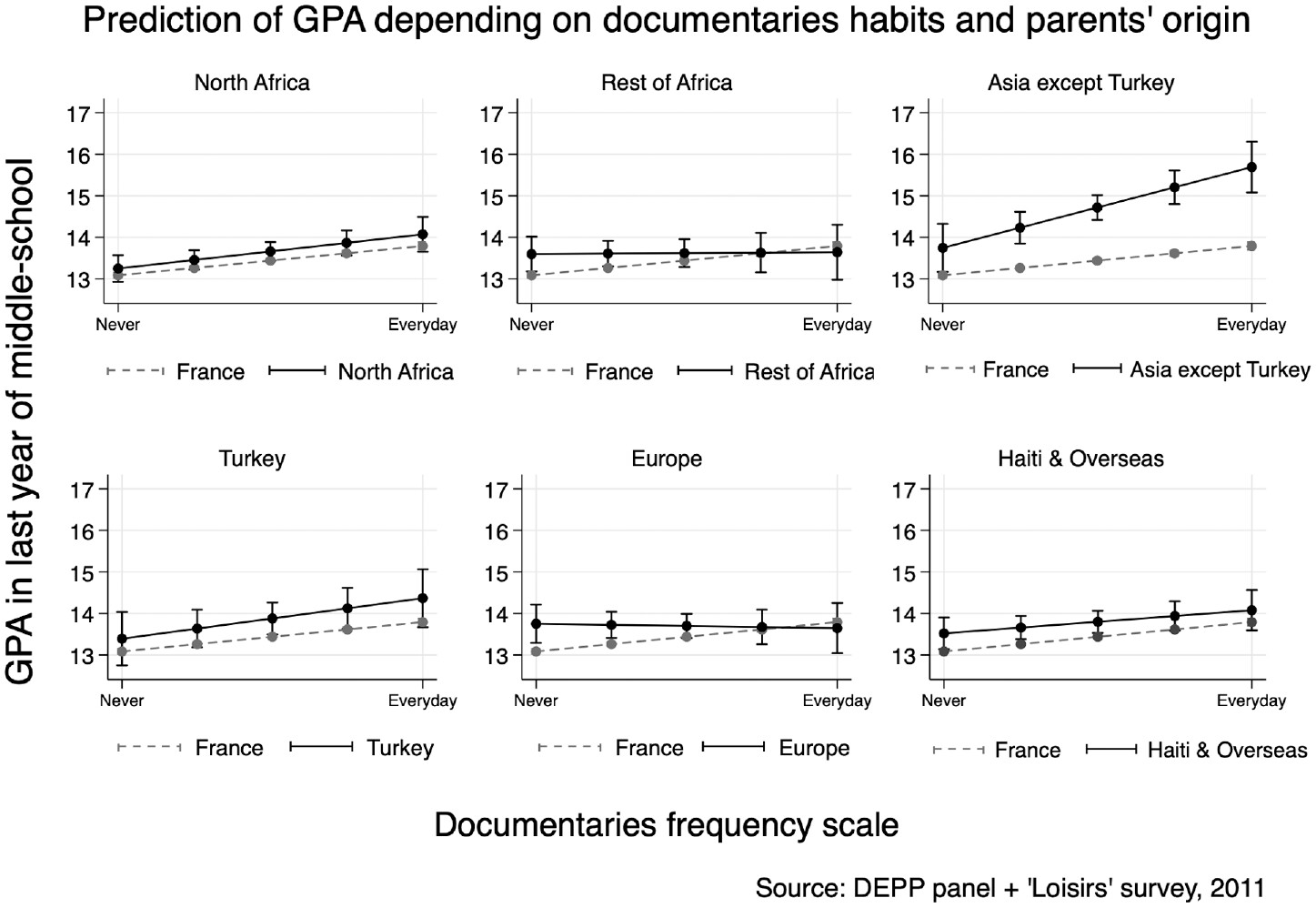
Table 3 corroborates previous research on the benefits of select forms of pedagogical television consumption: Higher frequencies of documentary watching are significantly correlated with better grades. As a control, I added an aggregate scale including numerous types of programs (overall television consumption, in contrast, is negatively correlated with grades; see full models). Hence, this model accounts for the effect of documentary consumption, controlling for overall television consumption. The only significant interaction coefficient is that of children with Asian parents (0.31;
p < .05); however, this result does not hold across models with the second detailed coding, where none of the interaction coefficients with documentaries are significant (see
Appendix H). Therefore, I will not comment on this coefficient further.
Figure 3 shows predicted values across documentaries frequency for each subgroup.
Sports Participation
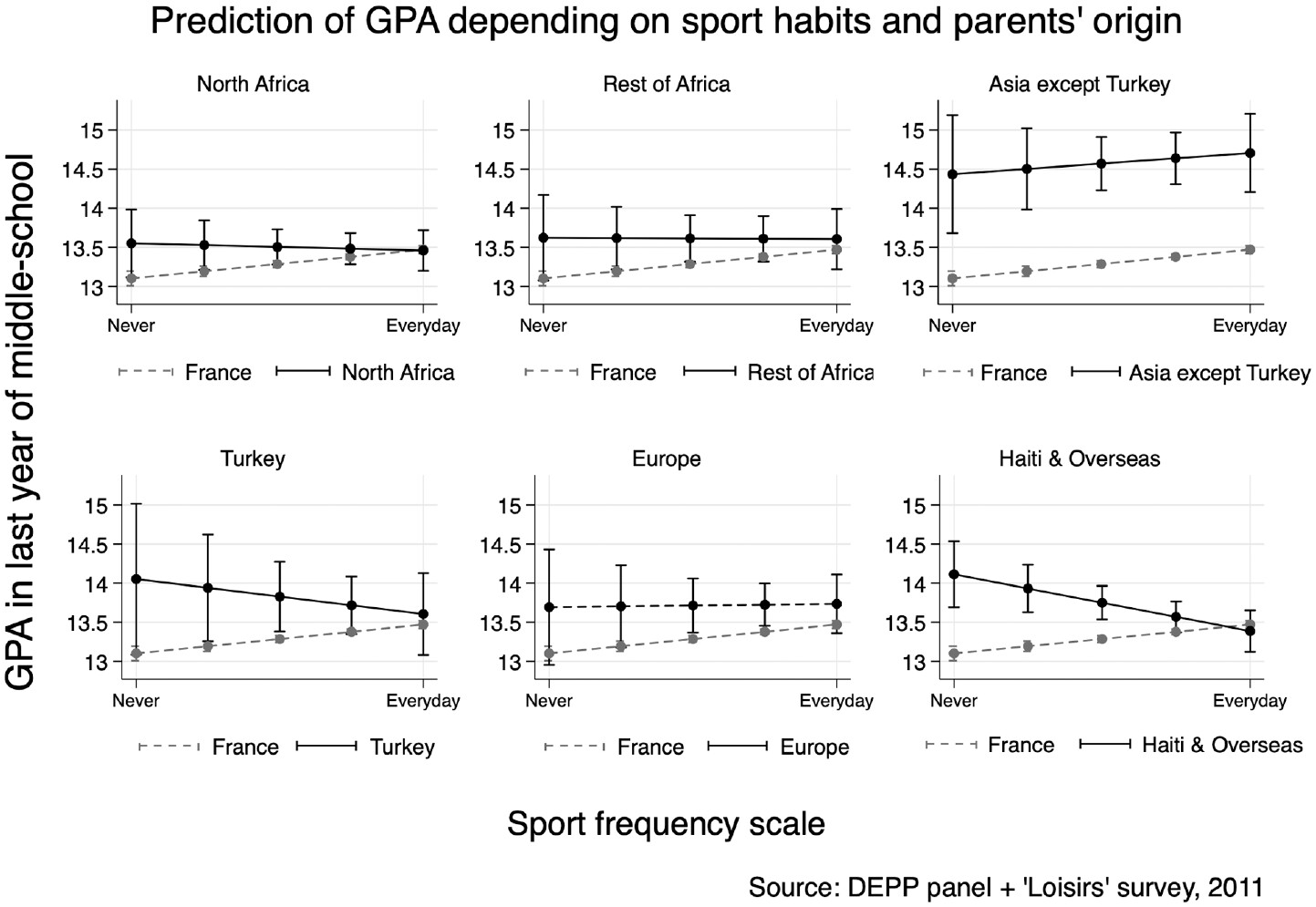
More frequent sports participation or physical exercise is significantly correlated with higher grades, according to
Table 4, but interaction results are significant and negative for students with an immigrant background (−0.10;
p < .01). Notably, the detailed variable shows a strong negative effect for the Haiti/DOM group (−0.27;
p < .001), which can be visualized in
Figure 4. Other interaction coefficients are also negative, although smaller in size and nonsignificant.
Music Practice
Regressions involving playing a musical instrument or singing suggest such activities have a positive, although relatively smaller, effect on school results.
Table 5 and
Figure 5 show that all interactions but the one for the Asian subgroup point in the direction of a reduced benefit; however, the only significant coefficient is for the Haiti/DOM group (−0.13;
p < .05).
Substantive Significance and Implications
Although I found no significant interaction effect for documentaries, all other results suggest differences in return may affect GPA outcomes for one group quite substantially. In the case of reading, a 0.26 (
p < .001) coefficient is reported in the baseline model with detailed origin areas (
Table 1, Model 3). Controlling for other forms of cultural capital, previous school achievement, school environment, gender, family structure, SES, and origin, the model predicts that a child who reads every day, rather than never, has a GPA around 1.04 points higher. In
Table 1, Model 4, the effect of reading for the reference population is 0.27 (
p < .001), and the interaction coefficient for the Haiti/DOM group is −0.32 (
p < .01). This negative interaction coefficient predicts that a Haiti/DOM-origin child’s GPA outcome when reading every day, rather than never, is 1.28 points lower than for a native majority child—thus suggesting basically no benefits of reading for that group. Similarly in the case of internet use, the −0.29 (
p < .01) interaction coefficient found for the Haiti/DOM group (
Table 2, Model 4) translates to a 1.16 GPA gap to the detriment of Haiti/DOM-origin students who use the internet every day, rather than never, compared to the French White majority students.
Regarding sports, the significantly negative interaction coefficient found for the Haiti/DOM group (
Table 4, Model 4) is much larger than the positive coefficients found in the baseline model and for the majority population: Participating in sports regularly is moderately beneficial for most students, but it is associated with substantially lower GPAs for the Haiti/DOM group. Indeed, the baseline model predicts that playing sports every day, rather than never, is associated with an outcome around 0.28 higher (0.07 coefficient;
p < .001). However, in the interaction models, Haiti/DOM-origin students who participate in sports everyday are predicted to have an outcome one point lower (around −1.08 for a −0.27 coefficient;
p < .001) compared to similar White majority-origin students—thus making sports detrimental for that group. This aligns with
Eitle and Eitle’s (2002) findings in the United States concerning Black students. Something similar happens with music practice, although to a lesser extent, with a half a point gap (around −0.52 for a −0.13 coefficient;
p < .05; see
Table 5, Model 4) between Haiti/DOM-origin and White native majority students who practice music every day.
Researching differential returns across a wide array of practices is important because small disadvantages may combine into substantial inequalities with serious implications. Among practices with significant interaction coefficients, results ultimately translate into returns gaps ranging from half a point to over 1 point in GPA. These differences could combine into even wider gaps between Haiti/DOM-origin and majority students accumulating several forms of embodied cultural capital. Hence, parents’ efforts at concerted cultivation projects involving the development of various skills (e.g., regular reading, sports, and music activities) might ultimately be much less rewarded for certain minority groups. Furthermore, while grades in France are distributed between 0 and 20, their standard deviation around the mean is 2.44, so a 1-point difference in overall grade can be consequential in students’ educational trajectories and reproducing inequalities at a larger scale. Indeed, grades in the last year of middle school matter for high school access and tracking (which in turn determines later access to higher education), and we already know that academic and vocational tracking are racialized in France (
Palheta 2012).
Discussion
All the practices tested here are associated with significantly higher school grades, but in most cases, interaction coefficients point in the direction of lower grades for Haiti/DOM-origin children. Thus, this study corroborates previous research updating cultural capital through an array of practices, and it provides mixed results regarding the role of race/ethnicity in the workings of cultural capital in France—as evidenced for one group.
Reading is associated with better grades, but to a lesser degree for Haiti/DOM-origin students. This result could be explained in several ways. The “scholarly scriptural” relation to language developed through reading (
Lahire 1993) might be less noticed or rewarded by teachers for these children, or different reading preferences might send lower signals to teachers. In any case, these children display a particular relationship between reading habits and grades received, which could be further investigated through qualitative studies of their reading practices and related micropolitical processes in teachers’ assessment.
The correlation between internet use as a resource for schoolwork and higher grades confirms the emergence of a “digital” form of cultural capital in France. Sociologists have already demonstrated how such digital practices improve achievement not only through skills development but also through a teacher expectancy mechanism that rewards students who present as “culturally competent” (
Paino and Renzulli 2013:126). Yet it is unclear how this emerging form of capital may be racialized: Interaction coefficients work in different directions. The Haiti/DOM group does display a significant interaction coefficient, to their detriment again. This finding could be further investigated qualitatively to find out more about the nature of children’s internet use for school purposes and how it plays out in school and is received by teachers. The rapid development of internet use also warrants an update, given that its usage among youth, the resources available online, and teachers’ expectations of digitally "competent" students have certainly evolved over the past decade.
Finally, I find that extracurricular activities, such as sports or music, are also positively correlated with students’ average grade, with negative interactions for Haiti/DOM-origin children. Sports are known to have a dissonant relationship with education outcomes: Athletic aspirations and participation, for instance, are often seen as competing with academic returns (
Adeyemo 2022). Additionally, educational returns vary greatly across different sports—notably based on racialized patterns that devalue sports played more often by Black students (
Eitle and Eitle 2002). Race may exacerbate sports’ dissonant relationship with school achievement in other ways. It may further reduce educational returns for minorities through racialized stereotyping of athletes as less capable academically (
James 2012) or naturally more gifted athletically (
Azzarito and Harrison 2008); such controlling images could lead to contradictory forms of physicality working as capital for different students (
Cartwright 2022). Finally, tension between sports and academics may translate into lower educational returns for groups who rely most on sports-as-capital. These mechanisms may combine to exacerbate a complex, racialized relationship between sports and academic outcomes in France, where recent studies have addressed the racialized dimension of sports. Minority groups’ relation to sports is described as both essentializing and emancipatory, with certain sports more commonly practiced by racialized descendants of immigrants (
Oualhaci 2014,
2020). French Black athletes, who are stereotyped and considered naturally more skilled, develop social capital in association with a distinctly Black urban culture that is stigmatized by upper-class Whites (
Forté-Gallois 2010). Similar to the athletic career aspirations of some Black U.S. high school students (
Adeyemo 2022), some working-class minorities in France invest in athletic careers in the hope of social mobility (notably with soccer; see
Nazareth 2014).
Regular sport and music activities are rewarded directly through physical education and music grades factored into students’ GPA. But they also may work as cultural capital in students’ presentation as practitioners of more or less socially valued (and racialized) hobbies and extracurriculars. Moreover, evaluation and rewarding of such competence is open to racial bias. Indeed, students of Haiti/DOM origin might participate in different, less “legitimate” sports than do other students, or racial biases might underlie educators’ evaluation of their physical ability and investment, devaluing the advantage procured by sport as cultural capital. Strategies of investment in racialized sports may further lower educational returns for that racial group in France, similar to the U.S. context.
The same mix of racialized mechanisms described for athletes and sports participation may apply to musicians and music practice. French youth’s music consumption has moved toward omnivorous tastes as a new form of distinction (
Coulangeon 2003), yet research has described the French Caribbean community’s consumption of genres that the majority population deems less legitimate (e.g., dancehall, rap) in relation to a specifically French
and Black identity (
Zobda-Zebina 2008). These specific tastes may reflect in regular music activities that are relatively less beneficial when judged by teachers’ dominant standards.
More work is needed to refine our understanding of these mechanisms. A question remains in explaining unequal returns: Is it more about differences in the exact practices groups engage in or about how practices are valued when associated with different groups? Each activity should be further investigated, quantitatively and qualitatively, with attention to variations across students (e.g., in genre consumption). This study has limitations pertaining to its method and data: The panel lacks observations across time for certain variables, and it does not include ethnic or racial categories, thus entailing the use of proxies and coding that reduces statistical power due to small numbers of observations for minorities. Additionally, qualitative research among particular groups, like Haiti/DOM-origin children, and inside classrooms is needed to understand the processes that might set apart these children in the activation and retribution of their (nondominant) cultural capital.
From Highbrow White-Centered Practices to Broader, Racialized Understandings of Cultural Capital
This study tested a breadth of practices for evidence of their relevance as cultural capital and their racialized dimension. The array of practices I explored adds to previous discussions about updating cultural capital beyond its restricted highbrow definition; the results confirm
Draelants and Ballatore’s (2014) idea that a broader definition of embodied cultural capital is relevant today in France. Findings of differential returns in four out of five measures also support
Richards’s (2020) call to move away from class-based, White-centered research and develop a race-conscious model of cultural capital in France and elsewhere.
A race-conscious model may require a broader understanding of cultural capital and a conceptualization that helps explain fundamentally different, race-specific dynamics. The fact that reading, internet use, watching documentaries, and sport and music participation are all associated with higher grades—although less so for a minority group than for the majority in some cases—means future studies should consider a diverse set of practices as measures of
racialized cultural capital. At the same time, descriptive statistics findings follow different patterns by class and race, which is surprising given the usual “dominant interpretation” of cultural capital (
Lareau and Weininger 2003). On one hand, I find the expected pattern in terms of SES (see
Appendix C for a breakdown across working-class, middle-class, and upper-class groups). Upper-class individuals read more, watch more documentaries (and less television overall), and participate in more sport and musical activities. Internet use is the only exception, with a slightly higher score for the middle-class group, making it a potentially more “middlebrow” activity. Hence, these practices are generally associated with higher-SES families and would be considered reasonable measures of cultural capital by most definitions in class-based studies. On the other hand, origin-based statistics (
Appendix B) suggest the dominant group does not necessarily partake in rewarded activities at a higher rate than do minority groups. On the contrary, patterns vary by practice and by group. Haiti/DOM-origin children, for instance, report reading, using the internet, watching more television
and documentaries, and practicing music slightly more often, on average, than the majority population while participating in sports slightly less. The distribution of activities seems to work to this group’s advantage in most cases and does not simply map onto class-based patterns. This pattern in favor of a minority group apparently contradicts the usual conceptualization of cultural capital as monopolized by dominant groups (i.e., as a distinctly high-SES and White resource).
Conceptualizing cultural capital as racialized can explain these counterintuitive patterns through the idea of nondominant cultural capital valued among minority groups but not dominant institutions (
Carter 2003). Broad categories of practices include various subgenres or repertoires, some of which are less valued and specific to students’ racial and ethnic socialization (e.g., different musical tastes). Moreover, as minority groups accumulate dominant and nondominant repertoires, it could drive up overall engagement with a given practice among minorities compared to the majority without having more of the legitimate kind. Hence, a higher score among minorities is not necessarily due to investment in high-status practices, and it probably hides higher levels of relatively less valued practices.
Furthermore, considering cultural capital as relational with race and not universal (
Cartwright 2022) helps us understand race-specific patterns. Indeed, the fact that minorities invest in certain traditionally high-SES practices (perhaps for aspirational reasons) does not necessarily contradict notions of racialized cultural capital. When particular resources function as cultural capital for the majority population more so than for non-White populations, it is one indication that cultural capital is racialized. Beyond class-based approaches that view race as a moderating factor,
Cartwright (2022) theorizes racialized cultural capital as different sets of characteristics being valued relationally with race. Here, practices associated with higher-SES groups could work as cultural capital among the majority—no matter the higher scores displayed by minority groups, who might be rewarded for different practices. Cases where class and race patterns are mismatched offer grounds for theorizing racialized cultural capital as existing within related but separate systems of distinction and reward. Means of distinction for the White upper-class may include devaluing particular practices also common among minority groups and yet retaining their high-status among the majority. Such practices would effectively function as cultural capital for White individuals by means of racial exclusion. These theoretical extensions allow for productive discussions on the articulation of class and race dimensions that are not reduced to strictly overlapping systems of domination.
This study thus engages in important conversations assessing the reach of cultural capital theory beyond class-based analyses. Of course, one approach is to restrict the idea of cultural capital to practices taken up by high-SES White people. This study’s results would then be interpreted as unequal returns on various practices that are beneficial for the majority more so than for Haitian- and overseas-origin children. The main takeaway, at least, is that they are cultural resources with racialized rewards that can contribute to reproducing racial inequalities—and these resources would be considered cultural capital if this study took the usual White-centered, “class-based master narrative” (
Richards 2020) without attention to race-based variations. In another interpretation, these practices do qualify as cultural capital in a broader sense. Beyond the highbrow, dominant interpretation, the concept encompasses elements of human capital and skills and emphasizes a group’s ability to impose advantageous evaluative standards (
Lareau and Weininger 2003), rewarding different skills for White and non-White individuals (
Cartwright 2022). In any case, introducing a racial dimension challenges the class-based understanding of cultural capital and calls for a conceptualization that accounts for race. Disqualifying a cultural capital framework when a race-conscious approach produces findings not quite aligned with traditional, class-based understandings would perpetuate the “class-based master narrative.” Instead of assuming that certain practices function as cultural capital using class-based models, future studies should take heed of possible disconnections between class- and race-based patterns—whichever way they choose to conceptualize cultural capital accounting for race.
Ultimately, I inscribe these findings in the developing literature on racialized cultural capital by acknowledging two important points of differentiation, other than levels of engagement with cultural practices. The first point emphasizes differences in the content of (racialized) practices, which goes in pair with the wider conceptualization of cultural capital that qualitative sociologists have advocated for. The second point notes the differences in what is valued and expected from minority groups, which remains in line with a relational approach to cultural capital. A necessarily broader, race-conscious conceptualization of cultural capital may be refined in the future through continued investigation along these two dimensions.
Conclusion
Overall, the trend here shows significant interaction results for the Haiti/DOM group, who display negative coefficients for four practices out of five (reading, using the internet, sports, music). Interaction results for the binary immigrant background variable are not significant except for sports, suggesting those inequalities are not so much about migratory background but, rather, about a racialized process concerning a group with a mostly French,
nonimmigrant background and particular significance to France’s colonial history. This group mainly comprises people who hail from France’s former American colonies built on slavery. While Haiti gained its independence in 1804, the current overseas departments (Martinique, Guadeloupe, French Guiana, and the Reunion Island in the Indian ocean) became fully integrated in the republic in 1946, thus granting their population French citizenship. Yet scholars have characterized the citizenship of French Caribbean people living in the mainland as “ambivalent,” standing in between French citizenship and foreignness (
Célestine 2011), and describe high levels of reported discrimination and racism (
Haddad 2018). The fact that the African subgroup’s results are not significant suggests the explanation for the Haiti/DOM case may lie in a distinctive trait beyond racialization as Black for most of these populations. This group might hold a particular kind of nondominant (
Carter 2003) or Black cultural capital, akin to descriptions of Caribbean youth in the United Kingdom (
Meghji 2019;
Rollock et al. 2013;
Wallace 2018). To what extent do Haiti/DOM-origin students have distinct activities and tastes that may be less valued in the school context? Or to what extent is their engagement with valued practices less rewarded due to differences in educators’ perceptions that may be grounded in that group’s colonial history? More research on French Caribbean youth’s nondominant capital is needed to understand the mechanism(s) shaping these students’ distinct relationship to cultural capital. Meanwhile, this study contributes to the literature on French Caribbean and DOM populations and more generally to work on race, culture, and education in France, where attention to racial socialization is only emerging (
Brun 2022).
These results have implications for the efficacy of cultural and educational policies designed to “democratize” culture among disadvantaged children, and they contribute to a cross-national endeavor to take a race-conscious turn in studies of cultural capital.
Richards (2020:4) writes that such research “acknowledges that slavery, colonialism, and the ideology of white supremacy are foundational to the development of Western societies”—France included. This study provides evidence that points toward populations hailing from places directly built on French slavery, colonialism, and White supremacy. The racialization of cultural capital likely applies in other Western settings, as Richards suggests. For instance, studies on Caribbean youth’s Black cultural capital in the United Kingdom suggests comparable results may be found there. Conducting similar research across national contexts will be crucial to understanding how racialized cultural capital plays out depending on countries’ sociohistorical specificities in racial formation. France is sometimes described as the archetypical race- or color-blind country, but so is the rest of continental Europe (
Maneri 2021). Additionally,
Escafré-Dublet (2019) argues that the “return of assimilation as white backlash” shapes France’s cultural policies, which can probably be likened to other Western countries where critiques of multiculturalism are on the rise. Finally, the broader conceptualization of cultural capital tested here for France may apply in other contexts, with significant implications.Indeed, educational systems where extracurriculars are especially important, such as in the United States (
Friedman 2013)—more so than in France—warrant attention to the wide array of cultural practices accessible to students outside school.
In addition to social class reproduction, a race-conscious study of cultural capital can show its role in the reproduction of race. The fact that practices—or embodied cultural capital—do not translate into school achievement to the same degree and may ultimately not transform into the same institutionalized capital for all is a racial inequality reproducing mechanism. Therefore, this study provides some support to the idea that cultural reproduction is not only about reproducing elite advantage but also White European advantage. In France, where difficulties in classifying racial groups make it difficult to uncover racial disparities, such findings address controversies in the role of race and ethnicity, rather than class alone, in social stratification. Such results are also important for debates within and beyond France on the operationalization of cultural capital: School reproduction of racial advantage may happen not only through the usual highbrow suspects but also through an array of practices—including internet use or sport activities.
Acknowledgments
I thank Mary Pattillo and participants of the Race & Society Workshop at Northwestern’s Department of Sociology, as well as Mathéa Boudinet, Camille Collin, Manon Pothet, Marion Valarcher, Mirna Safi, Mathieu Ichou, and Philippe Coulangeon for their feedback on various versions of this article. I am particularly indebted to Lincoln Quillian, Yannick Savina, and to the editors and anonymous reviewers who helped improve it significantly.
Research Ethics
The data used in this study were collected by the French Ministry of Education, and their use by the author was approved by the National Archive of Data from Official Statistics in charge of granting its access. It does not constitute human subjects research. The data include the Loisirs complementary survey and the main panel: Panel d’élèves du second degré, recrutement 2007-2007-2017, Ministère de l’Éducation, DEPP (production), ADISP (diffusion).