Introduction: an immense machine
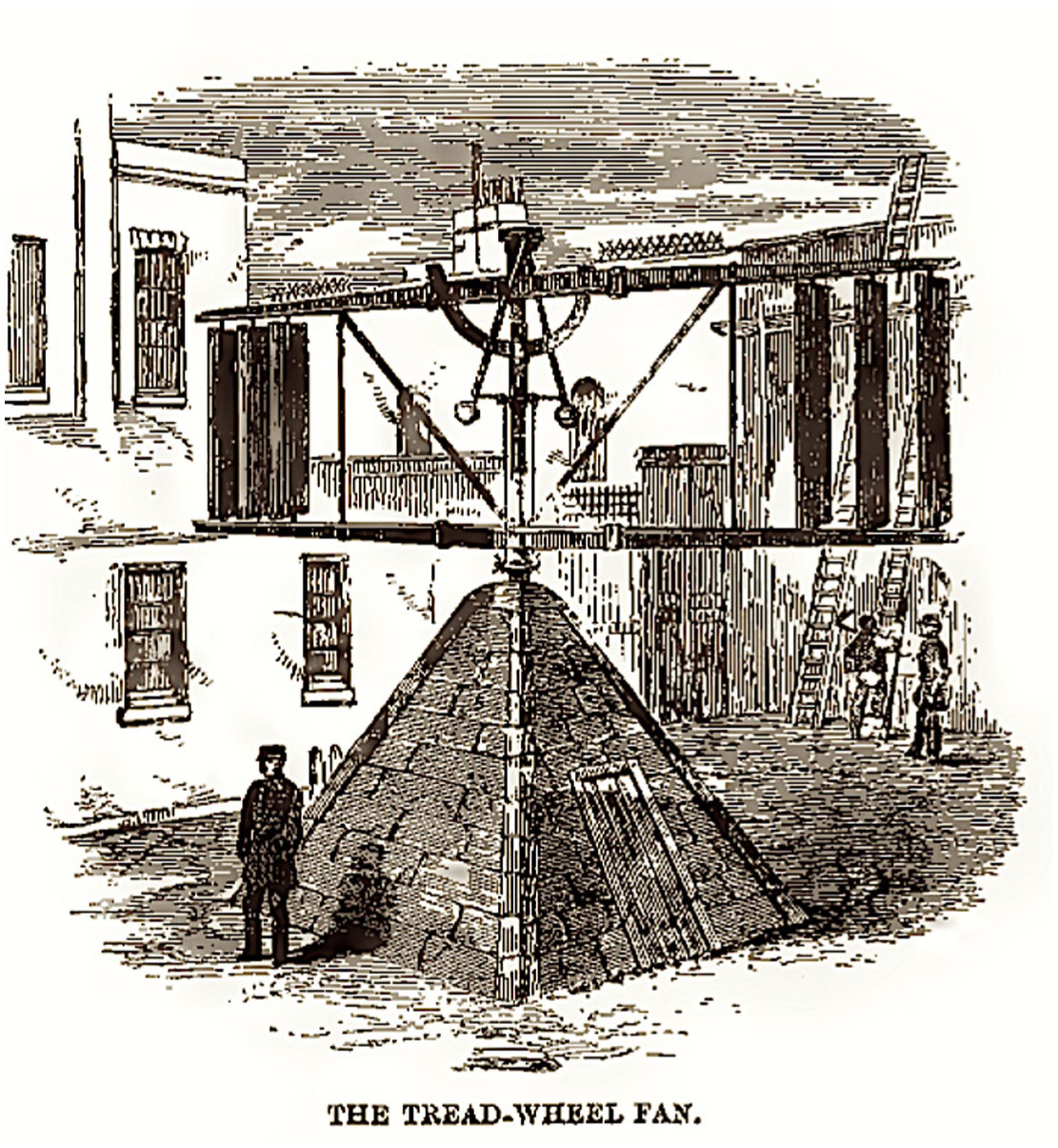
As we were leaving the gate, we caught sight, for the first time, of an immense machine situated in the paved court. In the centre of a mound, shaped like a pyramid, stands a strong iron shaft, on the top of which is a horizontal beam some twenty feet long and with three fans standing up at either end, and which was revolving at such a rapid pace that the current of air created by it blew the hair from the temples each time it whizzed past. (Henry Mayhew,
The Great World of London, 1856; see
Figure 1)
So the prolific London journalist and social explorer Henry Mayhew reported from his visit to the vast prison at Coldbath Fields. Founder of
Punch and the short-lived
Iron Times, compiler of graphic accounts of
London Labour and the London Poor in three volumes in 1851, Mayhew had notoriously divided Londoners between those who “
will work,
won’t work and
can’t work.”
1 At Coldbath Fields he paid particular attention to men working machines linked to the courtyard apparatus – six treadwheels each of sixteen-feet diameter spinning twice a minute, every one carrying twenty-four prisoners, “somewhat resembling the acrobats we have seen at a circus” or “a number of squirrels working outside rather than inside the barrels of their cages.” He recorded the heat generated by sweating prisoners treading the wheels and desperate to avoid this labor, and their subterfuges of swallowing soap pills or self-administered wounds, nicknamed “foxes.”
2“We need no better proof of the inefficacy of these degraded penal instruments,” Mayhew thundered, “which have been disguised under the name of
industrial machines.” These were devices that generated nothing. He reckoned the “immense machine” in the courtyard was peculiarly disgraceful. Its speed regulated by a rotating mechanical governor, “by this apparatus, the resistance necessary for rendering the tread-wheel
hard labour is obtained.” Contemptible, in this analysis, was the lack of productive value developed by inmates’ labor. “As that power is applied to no useful purpose, the only thing which it is made to grind is, as the prisoners themselves say, the
wind.”
3For historians of mid-nineteenth century physical sciences – the epoch of energy and labor, capital accumulation, and workforce exploitation – the significance of such human-powered wheels is unmistakable, evident in the problems of work and waste.
4 Apparently embodied, irrecoverable, practical knowledge could instead become robustly evident in the body techniques of mid-nineteenth century energy physics. These were gestural knowledges, influentially so termed by Otto Sibum in his reconstruction and self-experimentation on the Manchester programs of James Joule’s fusion of brewing practice with thermometric surveillance. These kinds of practices became representatives of communal material cultures of measurement and precision scrutiny of working bodies. To establish this mechanical equivalence, working bodies had to be integrated within industrial machinery and, ultimately, evaluated as though machines. Artisans’ opaque workplaces were somehow to be countered by settings where organized effort could be combined, determined, and exploited by excise and inspection. This aim was frequently thwarted in rituals and practices of class struggles.
5In his first systematic writings on the proletariat’s alienation under industrial capitalism, composed in summer 1844, Karl Marx made the direct connection with the workings of the treadmill. He declared that capitalist political economy achieved its ends “by reducing the worker’s needs to the paltriest minimum necessary to maintain his physical existence and by reducing his activity to the most abstract mechanical movement.” Under these exploitative conditions of reductive mechanization, so Marx argued, “the crudest modes (and instruments) of human labour reappear; for example, the tread-mill has become the mode of production and mode of existence of many English workers.”
6The grim wheels Mayhew saw at Coldbath Fields and other London jails displayed this complex development in its clearest form. In his accounts of analysis in nineteenth-century industrial Britain, William Ashworth argued that penal treadmills were exemplary of capitalist enterprise. These devices “capture the mechanical voice of calculation prescribing the motion of labour and machines as one.”
7 Juxtapose these recognitions of the audibility of labor processes on rotating machines with histories of a range of mid-century investigations of muscle work that emphasize the strong connections between these systems of engineering and the experimental work of physiology at exactly this conjuncture.
8 There were certainly many close links between physiological trials and engineering principles. In Manchester, for example, Joule worked with instrument maker William Scoresby to show laboring animals were much more efficient machines than electromagnetic motors or steam engines, countering the engineer and natural philosopher Moritz Jacobi’s claims that electromagnetic motors suitably engineered could deliver almost limitless power.
9Engineers applied their principles to physiology; physiologists used animals and humans as so many engines. In the 1840s, notably, the eminent chemist Justus Liebig had dubiously insisted that muscular labor depended on protein dissociation into carbonic components, responsible for animal heat, and nitrogenous components, separately responsible for work executed.
10 Urea excretion, the form in which nitrogenous compounds were released, became a proxy for labor performance. Yet it was shown by Liebig’s student the dietary physiologist Carl von Voit that a farm dog trained to work a large treadwheel of exactly the kind “used in industries when a small amount of power is required” produced little more urea: “the difference is hardly detectable.” These treadwheel trials made Liebig’s calibrations seem doubtful.
11In experiments to “demonstrate the principle of conservation of force” in animal movement, von Voit learned of treadmills’ high efficiency from data of the eminent engineer Ferdinand Redtenbacher, who ran the Karlsruhe Polytechnic from a converted military institute.
12 Military and penal discipline aided these forms of physiological surveillance – as in
Woyzeck, the former Giessen student Georg Büchner’s brilliant satire on victims of medics and the military, composed in 1836.
13 Liebig’s own Giessen lab was situated in a former military barracks; he was eulogized as “furnishing trained soldiers to wield the arms he provided,” his sole recorded experiment on living beings was an exacting November 1840 survey of the diet, feces, and urine of almost 900 Hessian troops charged with guarding the Giessen prison.
14 Lyon Playfair, Liebig’s Giessen student and Joule’s Manchester collaborator, pursued similar trials “on nitrogenous ingredients as a magazine of force for the production of dynamical effects” by surveying London prisoners and Chatham soldiers. Playfair urged that different physiological processes observable in barracks and jails somehow drove heat and work, for which “urea is a representative of dynamical labour.”
15 These claims about labor measurement and its chemical production were widely disputed by physiologists and physicians.
Salient was the physiologist Hermann Helmholtz’s critique of Liebig’s animal chemistry of muscular effort, crucial in forming Helmholtz’s version of the conservation of force. “The idea of work for machines or natural processes,” declared Helmholtz, “is taken from the comparison with the working power of man and we can therefore best illustrate from human labour the most important features of the question.”
16 In consonance with Foucauldian models of disciplinary order, Robert Brain has traced these links between surveillance of labor power and new energy sciences, “the widespread model of panoptic visibility and self-registration simultaneously being instantiated in factories, offices, hospitals, and prisons.”
17 In what follows, the prison and its machinery emerge as key sites for the evaluation of work’s economy.
Treadwheel systems revealed crises of economy: wastage of human bodies and of mechanical power. Prisoners suffered on the wheel; the wheel often generated no useful work. Some prison physicians might officially report that treadwheel labor did no harm. Several prisons did use treadwheels to pump water or grind grain. But Mayhew’s reportage, among others, documented inmates’ deterioration and saw the treadwheel as “the very worst form of idleness, idleness with all the physical fatigue of industry, without any of industry’s rewards.”
18 The link between practices of health and profit depended on the political economy of labor and material knowledges in penal work. This was especially so because of the use of treadwheels in physiological
self-experimentation, where from the mid-1850s the scrutiny to which prisoners were subject was turned onto the experimenter’s own physique, inputs, and outputs, in pursuit of the animal economy trialed by Liebig, Playfair, and their allies. Ultimately, labor history of energy, analysis of the development of energetics through the performance of bodily work, was at stake in treadwheels’ and bodies’ performances. The path from penal work to the perfected body encapsulated in the career of the treadmill forms a significant part of the history of exploitative capital.
19The treadmill is a painful occupation
The treadmill is a painful occupation, and since it is above all applicable to deprivations of liberty of short duration, it must be calculated in a manner to produce terror. By the very fact that it constitutes a painful occupation, fixing its extent is of great importance. (Nicolaus Heinrich Julius, Vorlesungen über die Gefangniß-Kunde, delivered in Berlin, spring 1827, published 1828)
Treadmills’ forms were based on much older devices, walking cranes common from the thirteenth century as devices in large-scale construction and commodity movements.
20 Their integration into British jails followed legislation in 1779 during the American war’s blockage of transatlantic convict transportation. It was proposed instead to build “houses of hard labour,” with “treading in a wheel” counted among the forms specified.
21 From then, treadmills held central roles in the politics and mechanics of the disciplinary system, as in the notorious panoptic schemes concocted by the engineer Samuel Bentham and his lawyer brother Jeremy. As evidenced by the Benthams’ engagement with Russian projects for industrial and economic reform, such schemes for management and discipline implemented during late eighteenth-century conflicts relied closely on entanglements of human machinery with sovereign powers of theatrical politics.
22In his parliamentary evidence, Jeremy Bentham claimed “human labour, to be extracted from a class of persons on whose part neither dexterity nor good will were to be reckoned upon, was now substituted to the steam engine.”
23 In the wake of his Russian engineering schemes, Samuel meanwhile proposed combining a lower wheel on which men would walk, and an upper wheel to grasp.
24 In his market-oriented penal project, Jeremy insisted on the need to make this labor profitable: “industry is a blessing – why paint it as a curse?” Jeremy Bentham even contemplated encouraging the East India Company to use wheel-bound elephants, otherwise used for war or ceremony: “four elephants would keep up a perpetual motion.” Key were relations between authoritarian power over labor, human and non-human, and power’s subjection to measure.
25 “The same labour does the business of health and economy at the same time,” Bentham insisted, arguing that maximum profit demanded separation of force generation from its direction. “Everyone who is at all conversant with the principles of mechanics knows,” he wrote in 1791, “that when you have obtained a given quantity of power, the direction that may be given to it and the uses it may be applied to are at your command.” The conclusion, even if contradicted by the principles of much contemporary mechanics, was that “you may have a
perpetual motion if you please.” Not only perpetual, but precise. An inspector would use a small index wheel decisively visible to him but inaccessible to prisoners: “a lazy prisoner cannot cheat you” and “a partial or tyrannical inspector cannot assign to a prisoner too little of this exercise or too much.” Power freely available precisely because extracted from the unfree would ground a theatrical system of institutional value abstraction.
26The epoch of the French wars and their aftermath saw intense reorganization of British state and commercial engineering and punishment. Political economy of rational and applied mechanics nourished the measures and morals of these performances, projects to estimate the duty of productive machines, whether mechanical, steam-driven or electrical, which soon encouraged inquiries of Joule and his Manchester allies. In 1806 at the Royal Engineers’ military academy at Woolwich, Olinthus Gregory composed an introductory mechanics treatise that described the physics and prudence of a walking crane installed by the East India Company at its London warehouses. This innovative device demanded the workforce pace the wheel outside, not within. It also reportedly damaged their bodies, but stayed in use until at least the 1820s.
27 Quaker campaigners, initially backed by political economists such as James Mill and David Ricardo, organized a Society for Improvement of Prison Discipline (SIPD), which welded mechanization of prison labor to disciplinary overhaul.
28Decisive was the 1818 design of a treadmill by the engineer William Cubitt for Bury St Edmunds jail. Like the East India Company walking cranes described by Gregory, this new treadmill was set up so workmen walked its outer rim, increasing the power developed. Cubitt claimed “unwilling agents” could be combined and classified, which “by these means enable the governor to assign any proportionable quantum of labour to the men.”
29 In view of Samuel Bentham’s prior involvement in Russian imperial schemes and his effective project to construct a panopticon within industrial school and steam-driven workshops in St Petersburg that ran from 1806 until 1818, it is telling that the SIPD now encouraged the establishment of an equivalent prison organization in the Russian capital. In early 1819 a plan and model of the overhauled Bury St Edmunds jail was offered in person by British missionaries to the tsar Alexander I, who actively encouraged its adoption.
30The novel penal machine, known as the
discipline mill, became highly visible – in parliamentary debates, pamphlet literature, and public lectures. Mayhew and many others retold the story of its invention. The county surveyor John Millington designed a comparable treadwheel for Bedford jail, and lectured on its principles at the Royal Institution in London, where he was mechanics professor. Cubitt’s friend the astronomer George Airy used the Bury treadwheel as a key example in his new Cambridge University mathematics course. The reformist SIPD propagandized in print for the treadwheel.
31 By 1825 it was estimated by government inspectors that there were treadmills in at least fifty-four prisons in England and Wales. The Middlesex magistrate in charge of Coldbath Fields jail declared that “man, especially in the laborious classes of society, is and should be mechanical in his habits.”
32 It was claimed by Bentham’s publicist Étienne Dumont that a few days’ habit on the discipline mill turned effort into mere mechanical routine. The French prison inspector Louis
-Mathurin Moreau-Christophe, who toured English jails in the 1830s, tried pacing the treadmill himself at the Westminster House of Correction, and reported it merely tiresome rather than strenuously hard labor. “By substituting mechanical for moral means, man is entirely reduced to a machine moving its legs; it follows,” he insisted, “that prison government becomes the easiest thing in the world, and requires no great talents or vigilance on the part of director and guards.”
The Woolwich mathematics instructor and instrument maker Peter Barlow similarly appealed to the “higher order of economy” that “this uncompromising machine” embodied. Because of its design “there can never be any necessity for an error of estimation,” Barlow claimed: “the tread-mill is perhaps better suited than any other machine whatever to involuntary labour and prison discipline.”
33 Uniform discipline was linked with health and diet. The SIPD cited Charles Coulomb’s well-known 1778 memoir on labor efficiency, based on trials performed in the West Indian colonies on unfree and military labor, to defend climbing steps as the most economical work. By 1824, the Norfolk engineer William Hase designed what he reckoned to be an improved version of Cubitt’s scheme, with moving handrails to increase efficiency, which “promotes the health and muscular strength of the prisoners.” Hase had prior experience in brewery works, repairing coppers and pumps for a local beer firm. He now insisted in the case of his treadmill design that “whether the manufacturer wants the power or not, is of no consequence to the prisoners.” As the SIPD proclaimed, “the means issued are such as connect useful mechanical labour with strict discipline and healthy exercise.”
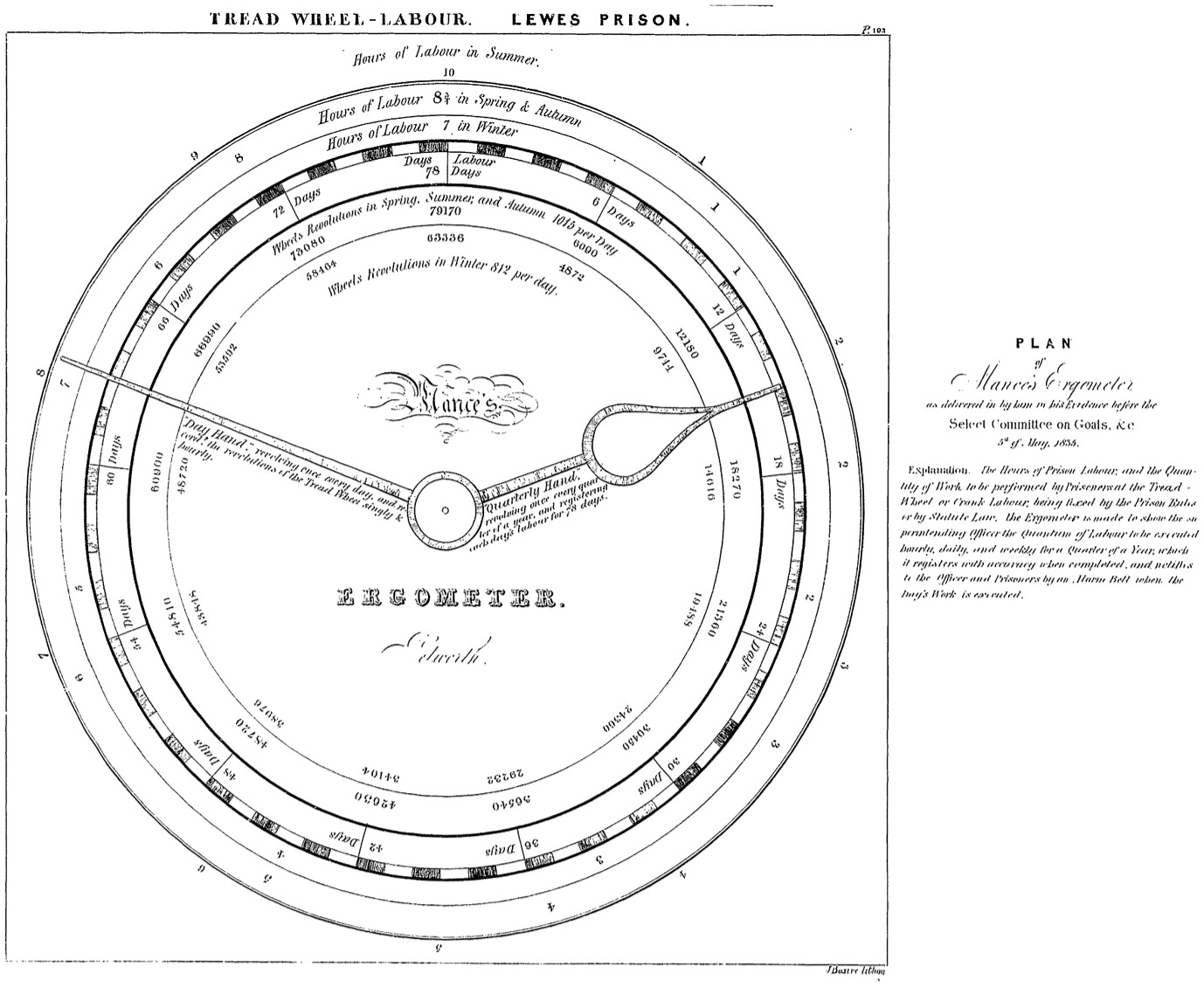
34The SIPD reported that at Brixton Prison a flywheel could store work when prisoners were not performing treadwheel labor. The relation between labor extraction and time measurement was direct across the intensified industrial system. E. P. Thompson demonstrated how conflicts over time discipline were most intense where discipline was most severe. In some cases the capacity to tell time was hidden from the workforce or else timepieces manipulated for the masters’ benefit. William Ashworth has documented how in summer 1822 the SIPD celebrated the London instrument maker Robert Bate’s production of a mechanical governor to register wheels’ revolutions and a slide rule to “promote a greater uniformity of practice.” The instrument’s glass-covered dial was inaccessible to prisoners, always visible to the prison governor. In Sussex, the prison governor John Mance designed an “ergometer” to record labor rates on the wheel and standardize work assignments (see
Figure 2).
35Yet from the 1820s controversy raged about the wheels’ worth. Moreau-Christophe reported how at Coldbath Fields, where the wheels produced nothing, their rotation was balanced against the rotating wind vanes, or else correspondingly opposed cranks were turned by a different group of convicts. “I know nothing harder or more degrading than this labour: the prisoners I’ve seen involved in it seemed to me to undergo genuine humiliation.” London newspapers reported on a Brixton prisoners’ strike against the treadwheel in July 1822, their protest broken only when confined on a bread and water regime.
36 At Coldbath Fields, treadwheels could cut into inmates’ flesh, with their back and shoulders injured severely. There were reports of treadmill work leading to a Norwich inmate’s foot being amputated and a Nottinghamshire convict boy being killed.
37 Prisoners baptized the machine “the everlasting staircase,” expressed as paces per day, normally around 10,000–12,000 feet. The governor of Coldbath Fields admitted the “disastrous consequences of this prolonged toil” but that “to discard the treadmill is neither just to the honest nor politic as regards society.” Heights mounted were compared with the ascent of mountains. The governor of York jail analogized treadmill work to climbing Ararat.
38 Bourgeois campaigns against the treadmill’s use at prisons like Coldbath Fields and Brixton involved inspection visits based on medical and mechanical evidence. These moral polemics nevertheless unambiguously agreed that “the habitual use of hard manual labour” was “a great and permanent good.” It was rather the uselessness of machines’ work, “wheels idly expending their power and that of their workers in the air,” and physiological damage, “debilitating effects on the body and demoralizing influence on the mind,” that drew any criticism.
39Especially vocal were Bentham’s East India House disciples, James Mill and his precocious son John Stuart Mill. The Mills argued that labor must not be treated as punishment, lest prisoners be encouraged to loathe work. “People who love labour seldom become the criminal inmates of a prison,” reckoned James Mill. “The turning of a wheel, by human labour, when so many better means of turning it are possessed in abundance,” was both wasteful and immoral.
40 His son agreed. Treadmill labor was not, it was argued, precisely quantifiable enough by central authority; the discipline mill violated the distinction between punishment and reformation. It was, so John Stuart Mill urged in the press, “unequalled in the annals of
legalised torture.” Mayhew’s reports from Coldbath Fields and other London jails echoed these sentiments, condemning the “folly of endeavouring to reform a habit of idleness by making industry a penal infliction” (See
Figure 3).
41Despite – or because of – relations between diet and strength, punishment and labor, British treadmill systems were adopted across Europe and its colonies. In Jamaica, enslavement of the plantation workforce was abolished in 1833, followed by immediate implementation of the so-called ‘apprenticeship’ system, under which the formerly enslaved population was rigidly subject to indentured labor and confinement allegedly to habituate them to paid work. Aided by SIPD lobbies, treadmills were at once introduced into the colony’s jails, the machines advertised in planters’ newspapers. The dilemma of making labor a form of punishment was inescapable: freedom must somehow mean freedom from work. The Jamaican treadmills became a sign of the distinction between unfree labor on the plantations and the condition of imprisonment. It was ensured that the discipline mills were always visible from outside the jail walls. Abolitionist broadsides showed how these machines were abused, but with little direct condemnation of their use.
42Elsewhere, as in influential lectures delivered by physician and administrator Nicolaus Julius at Berlin in spring 1827, the treadmill system received examination and endorsement. Julius praised its precision, explained relations between treadmill labor and improved dietaries, urging it marked secular shifts from penal security to surveillance. Julius baldly dismissed any German criticism of medical damage caused to prisoners’ bodies. Such machines, he lectured, were an indispensable part of “the means used by the prison system established in England to act on the
exterior individuality [
ausseren Menschen] of the prisoners.” He recorded treadmills introduced into jails in the Ruhr, Bavaria and his native city Hamburg, but nevertheless warned that “the treadmill, whatever the skill with which it can be employed, teaches the prisoner absolutely nothing.” Though he recognized its disciplinary utility and insisted on its physiological welfare, the Hamburg medic argued that by “subjecting the man to an entirely mechanical occupation, it degrades him instead of raising and regenerating him.”
43 The theme became commonplace. The Paris political economist Léon Faucher concurred. He cited Julius’s claims that the machine did not hurt the inmates and agreed that “work must be the prisons’ religion. For a machine society, purely mechanical means of reform are needed.” Yet, like Julius, Faucher insisted that “as labor or means of exercise,” the discipline wheel was nothing but “stupid and barbarous treatment.”
44According to Michel Foucault, Julius’s lectures gave “disciplinary society its birth certificate.” Foucault explained in lectures given in 1973, in the very first version of his arguments about surveillance and punishment, that Julius, “whom I recommend that you read,” made sense of the capitalist utopia of the prison factory. Similarly, in his sole mention of the treadmill, Foucault also cited Faucher’s writings for evidence that the device “provided a disciplinary mechanization of the inmates with no end product.” The penal system of treadmills and surveillance was not, apparently, to be understood as workshop nor productive system, but rather an inscription in prisoners’ bodies of the hierarchical logic of industrial society, “a machine whose convict workers are both the cogs and its products.” On this showing, embodiment of treadwheel labor put mechanisms of physiological order at the heart of penal systems.
45Suffering is exact
What can be said,
Except that suffering is exact, but where
Desire takes charge, readings will grow erratic?
—Philip Larkin,
Deceptions (1951)
46
Experimental schemes on prison treadmills launched in the 1850s after the projects of Joule and his interlocutors made this physiological order the subject of surveillance of both prisoners and the experimenters themselves in measured performances connected to energy conservation and its knowledge forms. These trials were launched by a London physician Edward Smith in October 1856, at exactly the same moment as the publication of Mayhew’s reports from Coldbath Fields. He had recently resigned in high dudgeon from Charing Cross Hospital and was working at a hospital for consumptives in Brompton, then applied his experience in registering his own pulse rate, breathing, and labor capacity to a series of trials on the Coldbath treadmill.
47 Smith was already skeptical of the Liebig model of a purely nitrogenous source for efficient human labor. His view was that “there is no question in physiological chemistry on which so many observers are engaged on as this.” Smith designed a form of spirometer, an ingenious face mask to measure changes induced by different exercise (see
Figure 4).
He faced the typical dilemma of the body techniques of those who experimented on themselves at this epoch: they reckoned they were uniquely capable of self-registration, yet made their own bodies universally representative. “I was in all instances the subject of enquiry,” Smith recorded, “since by that alone could I be assured of the degree of health, careful trained attention, mental control and uniformity of procedure.”
48At Coldbath Fields jail Smith stepped the wheel himself through seven periods of fifteen minutes for a total ascent of 480 feet each time. He assured the Royal Society that after an entire day’s self-experiment “I was quite fit for every duty and did attend the sittings of a scientific society immediately afterwards.” To compensate for the ascent, he did the same self-examination in February 1857 at the Duke of York’s column next to St James’s Park: climbing the pillar at the same rate as walking the treadwheel, he estimated an excess of 600 cubic inches in respiration on the discipline mill. He connected variations in respiration with those of necessary food, mimicking Mayhew’s distinctions between “unoccupied gentlemen,” “ordinary tradesmen,” and “hardworking labourers,” demonstrating the need for an improved diet for treadmill workers, insisting that this meant regulating prisoners’ labor rates and nutrition.
49Through 1857, Smith propagandized widely for the results of his trials on his own body and those of prison inmates. He gave reports to the Royal Society, the Royal Medical and Chirurgical Society, and the new National Association for the Promotion of Social Science. The treadmill “is an uneven punishment, the inequality not being that of guilt, but of physical confirmation and health, and moreover the resistance offered by the wheel is not uniform.” Smith cited Mayhew’s jails stories as evidence for treadwheels’ unproductive and damaging effects, damning a system in which “the lives of the prisoners are at the mercy of uneducated engineers.”
50 Between 1857 and 1860 Smith energetically extended these forms of self-experiment. He repeated his treadmill trials at Coldbath Fields in October 1858, recruiting colleagues such as the eminent London chemist Edward Frankland, former student of Liebig and Playfair, to measure gases absorbed and produced. In a referee report on trials in which he had himself been a participant, Frankland judged Smith’s “experimental methods” were “perfectly trustworthy and the results undoubtedly constitute data far more complete and extensive than any hitherto published.” Within months, Frankland aided Smith’s election as a Fellow of the Royal Society.
51At the start of 1860 Smith started a two-year project to collect his own urine, checking output against everyday labor, and in March he returned for a third time to Coldbath Fields, selecting four prisoners working the treadmill and weighing them when they were naked. “With the use of instruments differing so greatly in power over the human system,” Smith explained, “the plan pursued in each jail is well adapted to the usual powers of the body.” He used his spirometer to determine gas exchange while working the treadmill, “used without inconvenience when placed on a shelf over the wheel and at a suitable distance from the person to be experimented upon.”
52These new trials, on his own and prisoners’ respiration, urine, and feces under controlled diets of vegetables and boneless meat, were widely publicized. In September 1860, Smith was commissioned by the British Association for the Advancement of Science (BAAS) to report on prison diet and discipline, and prepared a long account published by BAAS in 1861 and by the Royal Society. His vast tables showed nitrogenous output, calibrated by urea weight, that might well have been related to protein consumption but, against the orthodoxy of Liebig and Playfair, was entirely independent of labor performed. His treadwheel measures demonstrated that starch and fat were the principal sources for muscular work. Smith applied these results on work and heat to the prison regime. “No plan can be so wasteful,” he told the BAAS Manchester meeting, “as that which enforces profitless labour and supplies an expensive diet to meet its demands.” He demanded imposition of uniformly designed instruments and labor: “a committee of scientific men would find no difficulty in placing this on a satisfactory basis.”
53Smith’s controversial campaign to turn prison labor into a system governed by what he judged to be scientific expertise drew considerable attention. Soon appointed medical officer to the Poor Law Board and charged by government to investigate the diets of Manchester workers suffering from the cotton famine during blockades of the Confederacy in the American Civil War, Smith sustained his active attacks on Liebig’s program. In 1863 he told a parliamentary prisons committee that “I have determined in many prisons the effect of treadwheel labour on myself,” insisting on his claim that labor power was not generated by muscle oxidation, but by an increase of carbon, and that treadmill work must be standardized and compulsory. These parliamentarians tried to define “hard labour” on treadwheels: “work which visibly quickens the breath and opens the pores.”
54Men of science concerned with body technique and energy economy exploited Smith’s treadmill data. For Hermann Helmholtz, the critique of Liebig’s physiology of muscular work and formulation of conservation physics depended on these jail trials. In April 1861, while Smith was at work on treadmills and urine monitoring, Helmholtz delivered a prestigious Friday Evening Discourse at the Royal Institution. The Heidelberg professor offered his fashionable audience what he now decided to name
energy conservation as “a general law” applicable both to “general speculations” and “the construction of machines.” Helmholtz briefly lauded Joule’s measure of the mechanical equivalent of heat, “principally guided by the more practical interests of engineering.” But he paid much greater attention to Smith’s treadmill projects, quoting the London medic’s estimates of air breathed and carbonic acid produced during jail labor. A swift calculation, combining data from Smith’s prison experiments and from Ferdinand Redtenbacher’s mechanical engineering, showed that the body on the treadmill was “a better machine than the steam-engine, only its fuel is more expensive than the fuel of steam-engines.” Calibrating treadmill climbs against mountains, Helmholtz lectured that Smith’s “measurements give us another analogy. We see that in ascending a mountain we produce heat and mechanical work.”
55Smith’s coexperimenter Edward Frankland, chemist and keen alpinist, however, took this mountain analogy literally. He sought better evidence for Smith’s attack on Liebig’s doctrine of muscular oxidation in the replacement of treadmill by mountain climbing. In summer 1865 Frankland encouraged his Swiss-German kinsmen, the physiologist Adolph Fick and the chemist Johannes Wislicenus, to survive on a protein-free diet of fried starch cakes and strong sweet tea while climbing the Faulhorn in the Bernese Oberland. Frankland worked out how much heat would be generated by oxidizing a given quantity of protein (“albuminoid substances”) into urea and carbonic gas, then used Joule’s numbers to convert this heat into equivalent mechanical work. Even though scarcely decisive, wittily satirized in contemporary doggerel, yet the mountaineers’ self-measurements showed the protein they’d already metabolized was insufficient for the climb, with almost twice as much work performed than could come from the albumen. “We preferred the mountain to a
treadmill,” declared the Zurich professors, “not merely because the ascent is a more entertaining employment, but chiefly for the reason that we had no treadmill at our disposition.”
56 The career of the Faulhorn as a scientific site, its construction as “a huge open-air laboratory,” as David Aubin has described it, brings out the singularity of the Faulhorn through its hotel facilities and “cultural prominence.”
57 It is suggestive to see the metropolitan prison treadmills discussed here as comparably external, managed, and transient sites of knowledge making.
Conclusion: compulsion and freedom
I turn my eyes to the Schools & Universities of Europe
And there behold the Loom of Locke whose Woof rages dire
Washd by the Water-wheels of Newton. Black the cloth
In heavy wreathes folds over every Nation; cruel Works
Of many Wheels I View, wheel without wheel, with cogs tyrannic
Moving by compulsion each other: not as those in Eden: which
Wheel within Wheel in freedom revolve in harmony & peace
—William Blake, Jerusalem: the Emanation of the Giant Albion (etched in London 1820), chapter 1, plate 15
When in 1866 Frankland summarized the Faulhorn trials alongside those of Smith at Coldbath Fields, he polemically insisted that scrutiny of prisoners’ labor demonstrated how “potential energy” stored in the muscle became “actual energy.” Frankland exclaimed:
here is the source of animal heat, here the origin of muscular power! Like the piston and cylinder of a steam-engine, the muscle itself is only a machine for the transformation of heat into motion; both are subject to wear and tear, and require renewal, but neither contributes in any important degree, by its own oxidation, to the actual production of the mechanical power which it exerts.
58
Identification of working muscles with dynamic engines appealed simultaneously to the gestural knowledges common in lab, mountain, and prison. This identification was central to mid-century class struggles. In his political journalism in the wake of the 1848 revolutions, Marx damned proletarian confinement where “activity is restricted to a form of revolting, unproductive, meaningless drudgery, such as work at the treadmill, which deadens both mind and body.”
59 Then in a London speech of April 1856, delivered at the same time as Henry Mayhew’s reports on the city’s treadmills, Marx declared the revolutions were but surface phenomena: “steam, electricity, and the self-acting mule were revolutionists of a rather more dangerous character.” He claimed “machinery, gifted with the wonderful power of shortening and fructifying human labor, we behold starving and overworking it; all our invention and progress seem to result in endowing material forces with intellectual life, and in stultifying human life into a material force.”
60Marx was not alone in recognizing that machines might liberate human capacity, but that capacity would be incorporated as mechanism. Nineteenth-century critics of the “unavoidable uselessness” of the treadmill, denying its output could be part of the convict’s consciousness, claimed the prison worker’s “share is just the same as is due to the weight of a clock or the action of a mill-horse or the steam of a steam-engine.” In St Petersburg in 1848 Moritz Jacobi, sometime advocate of the possibility of almost perpetual motion from his electromagnetic devices, insisted that “Man ought to be worth more than a waterfall, a bushel of coal or an ox.” Jacobi reckoned that “in order for machines to achieve recognition,” he continued, “they are on the one hand called upon to increase production to a huge extent, but on the other hand, until their organs achieve their necessary mechanical perfection, they require the help of earlier methods.” Otto Sibum convincingly read Jacobi as bewailing the revolutions’ failure to develop machinery for human emancipation.
61 The aim here has been to reflect in complementary terms on the gestural knowledges embodied in some mid-nineteenth century machines both to refine and define human confinement. In their long journey from jails to gyms, treadmills provide a lucid example of this dialectic of compulsion and freedom.