Hurricane María swept across Puerto Rico on September 20, 2017, knocking out power for 3.3 million residents. It was the end of the year before San Juan, the capital, had power restored; roughly half the population had the lights on by February, but a full 11 months passed before grid repairs were complete in the mountainous interior. Counting time and people affected, the blackout has been ranked the worst in U.S. history and second-worst in the world (
Houser and Marsters, 2018). A
New York Times report captured the profound significance of the disaster, noting that after María, Puerto Rico “all but slipped from the modern era” (
Glanz and Robles, 2018).
In this article I use the case of the blackout to examine the relationship of debt, colonial status, and oil dependence as Puerto Ricans struggle to design a more resilient future in a climate-changed Caribbean where threats from giant storms are the new norm. The research draws in part on a series of 32 in-depth interviews with island residents, scholars, policy experts, relief workers, journalists, and advocates during three visits to Puerto Rico with a cinematographer in January and July 2018 and April-May 2019 for production of
Dis.em.POWER.ed: Puerto Rico’s Perfect Storm, a documentary on the blackout.
1 The key questions for the project were how to account for such a long blackout affecting a large population in a modern place that has counted on electric service for over 40 years and what the disaster says about the nexus of climate change, fossil-fuel dependency, and neoliberal capitalism that we face in this new epoch of the Anthropocene, in which the concept of “normal” weather no longer applies.
Most citizens of industrialized countries take the electric grid for granted. Only in (usually temporary) blackouts does access to electricity climb into public awareness (
Rupp, 2013). Thus, social activism over electricity is rare. But for rural Puerto Ricans, nearly four months without power reached a nadir the day after my arrival in January 2018, when several hundred rural residents protested outside Governor Ricardo Rosselló’s mansion in El Viejo San Juan (San Juan’s Old Town). A dozen activists stretched a large banner across the street that read “Sobre 100 días sin luz . . . ” (Over 100 days without power . . .)
2 with a list of rural towns still in the dark (see
Figure 1). Many remained dark for months to come.
Weather-related electrical outages have risen steeply during the past decade in Puerto Rico because of its aging energy infrastructure and debt crisis (
Nussey, 2017). Warmer ocean temperatures, combined with rising sea levels and more atmospheric water vapor, are fueling more intense and destructive hurricanes in the Caribbean (
Union of Concerned Scientists, 2017). Changing weather cycles are often linked to upsurges of “energy poverty.” Studies in this new interdisciplinary field have documented the tight relationship between affordable access to energy and social well-being (
Bouzarovski, 2018). The field as it has emerged is somewhat bifurcated between the Global North and the South. Energy poverty studies have grown rapidly in Europe as high energy costs emerged as a major impact on low-income residents because of social service cuts in the United Kingdom and the imposition of economic austerity in Spain and Greece during the European Union debt crisis.
3 In the United States, most studies have focused on disproportionately high energy costs in rural and minority communities (e.g.,.
Boyce and Wirfs-Brock, 2016). Another wing of energy poverty work has focused on energy as a component of international development. Affordable energy is now a key goal in World Bank lending in places like Africa and India, where access to electricity remains limited in rural areas (
World Bank, 2017).
Puerto Rico, in contrast to many islands in the Caribbean, has been electrified for over 50 years. For that reason, I refer to “new” energy poverty in this article to draw attention to relatively sudden but profound crises of energy access in developed places that have enjoyed access to energy services for decades. My research to date on emergent energy crises in Puerto Rico and Greece (
Smith-Nonini, 2020) suggests that oil dependence, chronic debt, and legacies of political and economic dependency present risk factors for new energy poverty. Small island states (or territories) that lack sufficient domestic energy resources and/or have limited (or no) grid sharing across borders face special challenges in transitioning away from oil, especially in cases where a low gross- domestic-product (GDP)/debt ratio hampers the potential for shifting to renewable energy. Bringing energy (and oil dependence) into the question of Puerto Rico’s debt crisis is important because it helps shed light on the tight relationship between petroleum flows and capital flows that
Timothy Mitchell (2011) argues created the conditions for American hegemony during the Keynesian and the neoliberal eras. Emerging studies of such “energo-political” relationships (
Boyer, 2011) reconceptualize capitalist growth as historically dependent on cheap energy (
Moore, 2015).
The central dilemma of Puerto Rico’s debt and dysfunction was summed up by CNN reporter
John Sutter (2017) in the aftermath of María:
Puerto Rico is part of America and yet it isn’t. It’s a territory of the richest nation on Earth—a country founded in opposition to colonialism . . . a place where the federal government oversees a financial crisis and controls . . . aspects of commerce and shipping, but where Americans can’t cast ballots in presidential general elections, and where the island’s one representative in Congress can’t vote, either.
Indeed, imperial disregard was on public display following Hurricane María when President Donald Trump, facing criticism over the slow relief effort, visited San Juan two weeks after the storm. Trump joked about how relief costs would hurt his budget and lobbed paper towel rolls at the crowd as if at a campaign rally. He later complained in a tweet that local leaders “want everything to be done for them” (
McCaskill and Nussbaum, 2017). Perhaps the best-known ongoing colonial insult for Puerto Ricans is the Jones Act, a federal trade law dating to World War I that requires the territory to pay a penalty on shipped goods that do not come on comparatively high-priced U.S. ships with U.S. crews. A recent report by the island’s Government Development Bank found that the law doubled transport costs for imports compared with nearby islands (
Economist,
2017). After appeals to waive the Jones Act to facilitate relief aid after the storm, Trump suspended the law for a mere 10 days.
The devastation of María, a powerful Category 4 storm, was especially horrific in Puerto Rico because of the population’s economic vulnerabilities. In 2015 the U.S. Census Bureau reported that the island had a 46.1 percent poverty rate (twice the level of Mississippi, the poorest state) and an unemployment rate of 12.2 percent, more than twice the level on the mainland. Yet the territory receives far less federal aid for social needs than do states (
Borgen Project, 2017).The ongoing debt crisis put even these modest social services at risk. In 2017 Puerto Rico’s government owed US$74 billion to lenders,
4 four times more than the debt of bankrupt Detroit in 2013. Its territorial status prohibited Puerto Rico from following Detroit’s lead and declaring bankruptcy. Instead, after a long delay the U.S. Congress passed the Puerto Rico Oversight, Management, and Economic Stability Act (PROMESA) authorizing a form of bankruptcy in 2016. But the nondemocratic PROMESA board, after heavy lobbying by Puerto Rico’s creditors, imposed austerity—deep cuts in pensions and government programs, including health clinics, universities, and schools—and restricted the island’s ability to restructure its debts, which is usually a central rationale for bankruptcy (
Aronoff, 2018;
Merling et al., 2017).
An important caveat is that the level of debt remains under dispute. A popular movement in Puerto Rico calls for an audit of the debt, which has roughly doubled in a decade, charging that much of it was acquired illegally following controversial Citibank-guided debt financing and bond maturity extensions in 2006 that exceeded constitutional limits. Sales of high-risk bonds to hedge funds also greatly inflated the debt (
Aronoff, 2018;
Merling et al., 2017). While the bankruptcy generated headlines, far less has been written about Puerto Rico’s severe oil dependence and the impact of a decade of high oil prices on the island’s economy. A key question is how the Puerto Rico Electric Power Authority (PREPA), the monopoly electric utility, came to hold over US$9 billion in debt (12 percent of the territory’s debt). A shroud of secrecy has long hidden PREPA’s accounting, protecting its officers and the ruling political parties that appoint them from public scrutiny. The debt delayed recovery from the storm and helped justify current plans to privatize the utility, a proposal that many believe will lead to unaffordable rates and further endanger vital public access to energy.
The next two sections draw on popular accounts and a chronology of events to reflect on the multiple ways lack of electricity sabotaged the metabolism of modern life for residents. The remainder of the paper examines the intersection of three contributors to the fiasco: Puerto Rico’s colonial development model, its ongoing debt crisis, and its oil dependence, a set of interconnected vulnerabilities that challenges the simplistic depictions of an island sabotaged by corrupt politicians that are favored by the Trump administration and many media outlets. Instead, this study finds that the Puerto Rican blackout demonstrates the way complex risks can play out as the challenges of extreme weather intersect with global tensions over slowing economic growth and access to fuel and capital.
Short-Circuit: Puerto Rico “Upside Down”
The scale and duration of Puerto Rico’s grid failure was unprecedented in the industrialized West. The contrast between nighttime satellite photos taken before and after the storm is startling: Puerto Rico all but disappears in the darkness of the surrounding ocean.
5 With the exception of San Juan in the Northeast, most of the island remained in the dark for the rest of 2017. Ed Muller, a former utility executive with many weather disasters under his belt, found the blackout exceptional, noting “I’ve never seen anything like that—not in a developed nation” (
Glanz and Robles, 2018). Without power the daily metabolism of provisioning, transport, and communication came to a standstill. “People cannot afford to be in this society, a high-energy society, without electricity,” asserted Juan Rosario, a local environmental activist and former public representative on the PREPA board. “After María, the whole country was upside down because they didn’t have electricity” (interview, San Juan, July 25, 2018).
The town of Ciales, located on a central plateau, was especially hard hit. As the wind’s fury descended. Melissa Melendez watched in dismay from her parents’ house next door as the roof was torn off the new house she and her husband had nearly completed building. She gave us a tour of the storm-damaged interior, which was covered by a blue tarp. “The first weeks were very hard,” she recalled. “No aid arrived. We had to go looking for provisions, but the lines were a thousand meters long. I got sunburned waiting in lines for water and food because the supermarkets didn’t have anything” (interview, Ciales, January 23, 2018). Caño Martín Peña, a poor barrio of San Juan that flooded during the storm, was still without power when we visited four months later. Jazmín Palau, a resident, said that for many weeks “the food was scarce, two-hour, three-hour lines, if they had what you needed when you got there. We didn’t have milk, no bread. We had no cell phones. We had to get by with the money we had. Couldn’t go to a bank, no ATM, nothing!” (interview, San Juan, January 24, 2018).
At the January 2018 San Juan protest an elderly woman held a hand-lettered sign that read “They are killing us old and sick people.” The truth of her claim emerged months later with a study by George Washington University Public Health researchers estimating that 2,975 extra deaths occurred during the last three months of 2017. They found that lack of air conditioning, refrigeration, respiratory therapy, and kidney dialysis posed immediate threats to life for many elderly or ill individuals (
Milken Institute School of Public Health, 2018). One of the most damning lapses of the U.S. relief effort was inadequate drinking water distribution. A month after the storm a third of the population still lacked clean water, and many rural residents reported no contact with the Federal Emergency Management Agency (FEMA). The water shortage was partly caused by the blackout, which disabled pumps for potable water or sewage treatment, a problem that lasted five or six months. Contaminated water was linked to at least four deaths and uncounted illnesses (
Calma, 2017), including Palau’s family. She recalled, “I got sick. The kids got sick. It was very difficult” (interview, San Juan, January 24, 2018). In mid-fall the island was using 250,000 gallons of diesel each day just to pump water (
Malik, 2017).
Alex Figueroa, a reporter with El Nuevo Diá who covered the rural impact, said, “What struck me the most was effects of the distribution chain being interrupted and people beginning to fear a food shortage, and this lasted months. . . . When you saw the long lines at supermarkets, gas stations, shelters, and distribution centers . . . no fuel for trucks, no contingency plan, where to call for help. . . . It was a very scary period” (interview, San Juan, July 27, 2018). He encountered food stamp recipients in the countryside desperate for food because they were unable to swipe their cards at stores. Meanwhile, store owners often delayed bringing perishable goods to stores because their generators had died, so they left food in containers at ports to keep it refrigerated. Melendez’s father, Hiram, said that these practices, combined with outbreaks of illness, left the public in doubt about the quality of food being sold. Meat was especially rare because large quantities had perished in warm freezers. Later some store owners bought new generators, but consumers harbored doubts. “If you refreeze bad meat, when you cook it it’s going to make you sick! So . . . no, no, no, I didn’t buy meat of any kind!” Hiram said (interview, Ciales, January 23, 2018).
Families with the means also turned to loud, polluting generators, but it took months for enough to be shipped to the island to satisfy demand. Melendez’s family relied on a generator for nearly four months, at a cost of US$15 per day for fuel—which allowed them to run the motor only a few hours daily, usually in the evenings, to charge phones and make ice (interview, San Juan, January 23, 2018). Many reported routines of sharing between generator owners and neighbors, who pitched in to help with diesel in exchange for loaned extension cords and a niche in a cold freezer. Figueroa decried federal excuses for the botched relief effort. “FEMA said two other hurricanes affected their response, but now we know there weren’t sufficient plans in place, there weren’t enough people in place. . . . There were supplies stuck in Jacksonville, and not enough boats. . . . [The real reason] has to do with politics. We’re not a high priority in the eyes of the government. We’re not a real state” (interview, San Juan, July 27, 2018).
The Makings of a Record Blackout
The delays in power restoration began with a surprise decision by PREPA’s chief executive, Ricardo Ramos, to hire Whitefish Energy, an inexperienced company with only two employees, to repair the grid and his signing a contract for US$300 million. Criticism erupted from every side, not least because the company was based in Whitefish, Montana, hometown of Ryan Zinke, U.S. Secretary of the Interior (now resigned), and the two men were friends. Zinke denied offering assistance (
Acosta and Healy, 2017).
Asked about the hiring, José Alberto Pérez Vélez, director of Puerto Rico’s Independent Office of Consumer Protection, replied, “Outrageous. There are people here in Puerto Rico doing the same job with more experience, and they were paying Whitefish 500 percent more. Whitefish . . . lacked the tools and the history, and they had to subcontract to others to do the work.” The inflated charges and illegal clauses in the contract led FEMA to insist on its cancellation, and Governor Rosselló forced Ramos to resign — the first of four PREPA CEOs who resigned or were forced out over the next year (interview, San Juan, July 26, 2018;
Acosta and Healy, 2017).
Because of the scandal, it was late October before Rosselló formally requested “mutual aid”—the usual postdisaster practice whereby utilities cross state borders to assist in power restoration. After that utility crews began arriving and the Trump administration assigned the U.S. Army Corps of Engineers (USACE) the massive job of overseeing grid restoration, something the Corps had never done previously (
Glanz and Robles, 2018). USACE was to collaborate with PREPA, but the utility’s workforce had been reduced by one-third since 2012 because of austerity measures. The challenges of merging PREPA’s workforce with that of USACE, setting up a regional supply network, and ordering and transporting parts tied up the rest of 2017. In the chaos, some U.S. electric crews arrived only to spend their time on the island idle for lack of parts. It was mid-January before the full workforce and barges of equipment arrived. Compounding the problems, the grid’s infrastructure had been crumbling for years as immediate needs took precedence over maintenance during the debt crisis. Also, Puerto Rico competed with Florida and Texas for electrical parts. Hurricanes Harvey and Irma had knocked out power in parts of those states prior to María’s landfall (FEMA and USACE staff, interviews, San Juan, January 17 and 24, 2018).
Without power few businesses could operate. An estimated 10,000 small businesses (20 percent of the island’s total) and many larger ones remained closed five months after the storm (
Goldstein, 2018). The closures represented further lost revenue for PREPA and the island’s government, and the exodus left hundreds of thousands of former employees without income. By late fall over 185,000 people had left the island in an upsurge over what was already a heavy migration flow due to the financial crisis (
Criollo Oquero, 2018).
Fossil Colonialism: Energo-Politics of the Cold War
“Fossil colonialism” evokes the long history of imperial energo-politics embedded in Puerto Rico’s colonial subjugation (
de Onís, 2017a). Cheap energy was the key to Operation Bootstrap, a U.S. postwar industrialization development program shaped by the Cold War. The modernist mantra of endless growth helped justify electrification policies that depended on flows of oil paid for by federal subsidies. The huge infrastructure projects had dual goals of pacifying political movements for independence while serving the profit motives of U.S. corporations. In the 1960s hundreds of U.S. textile plants were lured to Puerto Rico with tax breaks and promises of cheap labor and electricity (
Bernabe, 2007;
de Onís, 2017a). Operation Bootstrap gradually “shifted from development to a growth model: production for export, not for local use,” said Figueroa, who did a historical study of the program. Authorities started to borrow with municipal and utility bonds, and Puerto Rican bonds were attractive to investors because Congress had granted them a rare triple-tax-exempt status, meaning that investors paid no taxes on yields at the local, state, or federal level.
To Washington politicians, Puerto Rico’s transformation was a capitalist showcase and counterpoint to socialist Cuba, and as a result cost was not an issue. For example, Figueroa described how helicopters installed poles on mountains where it was too difficult to drive trucks, creating problems in maintaining the grid. The new development succeeded in creating jobs in the early years, fostering a burgeoning middle class and investments in social programs and education. But net job creation ran aground by the late 1960s as out-migration slowed and new manufacturing jobs failed to replace lost agricultural jobs, in part because of rising competition from Taiwan and Korea, where textile wages were a fifth of those in Puerto Rico. Unemployment doubled following the oil crisis of 1973 (
U.S. Department of Commerce, 1979: 40, 70, 108–109).
By then the new favored industries were refineries, chemical plants, and power plants. Reports by U.S. government planners revealed an “almost obsessive commitment” to the petrochemical industry (
Chapman, 1982). On top of tax incentives, federal subsidies included permission to import lower-cost foreign oil and cheap electricity. Even the oil shock of 1973, which left island refineries in a profit crisis, failed to dent federal optimism, as officials called for building two more large refineries, in addition to the three in operation, and projected that the industry would generate 50,000 new jobs (
Chapman, 1982: 406–408). Actual job creation amounted to less than a fifth of that number. Once plant construction was completed, the chemical plants got by on smaller workforces. A loss of profits due to the oil crisis bankrupted the large Commonwealth Oil Refinery in 1978, precipitating closures of several smaller plants dependent on its feedstocks (
Chapman, 1982). After 1978 the island’s jobless rate continued to climb (
Caraballo Cueto and Lara, 2017).
In the early 1980s, the new magic touted by Washington and San Juan was incentives for pharmaceuticals, which remains a major Puerto Rican industry. But the new tax breaks were phased out over a decade beginning in 1996, when they came under attack by Republicans supporting free trade. In the six-year period after 2006, when the incentives ended, Puerto Rico lost 80,000 manufacturing jobs, according to a study by the University of Puerto Rico (UPR)’s Census Information Center. Although many media outlets cite local political corruption to explain the island’s debt, according to José Caraballo Cueto, an economist based at UPR-Cayey who directs the center, it was the massive job losses associated with the end of federal tax breaks that best explain the chronic borrowing by officials. By 2012, labor force participation had dropped 5 percent below 2005 levels, while the number of Puerto Rican businesses moving to the mainland rose by 150,000 in the same period (
Caraballo Cueto and Lara, 2017; José Caraballo Cueto, interview, San Juan, January 26, 2018).
Electric “Currency”: Energy as Political Graft
As their economic base declined, Puerto Rican governors turned to borrowing to balance their budgets, a feat made easier by the island’s triple-tax-exempt bonds. Control of the governor’s office alternated between the neoliberal, pro-statehood Partido Nuevo Progresista (New Progressive Party—PNP) of Rosselló and the more centrist Partido Popular Democrático (Popular Democratic Party—PPD), and as the island’s debt grew—especially after 2003—politicians of both parties began borrowing just to cover operating costs (
Merling et al., 2017). While debt financing is not uncommon for indebted U.S. cities, it created a crisis for Puerto Rico because of the territory’s inability to restore economic growth or restructure its debts, made worse by its lack of voting rights in Congress.
As the debt has come under scrutiny, manipulations by Wall Street and local politicians have become apparent. Despite the warning signs of rising oil costs and the exodus of manufacturers, Wall Street investors continued to bet on PREPA because of its solid record with financial ratings agencies. As conventional sources of loans dried up after 2006, Puerto Rican governors turned to high-interest lenders like hedge funds, causing the island’s total debt to roughly double in a decade. Public utilities like PREPA, with a customer base and rights to issue bonds, were especially attractive to lenders (
Merling et al., 2017). “A whole scheme had been created,” said Rosario. “The [electric] corporation was captured by whichever political party was in power. For two decades the corporation was run like a political subsidiary of the party in power, and if you put that together with an economic model that is dying, it is the perfect storm” (interview, San Juan, July 25, 2018).
Forensic analyses of PREPA’s debt support assertions by Puerto Rican activists and scholars that PREPA’s monopoly control over electricity and lucrative lines of credit came to be used by ruling politicians to fund campaigns and reward key political constituents. For example, an old program of electric subsidies to towns was expanded in 2004, making electricity completely free to municipalities in return for their waiving property taxes on PREPA facilities. As a result, many mayors formed partnerships with businesses that relied heavily on electricity. The municipality of Aguadilla, for example, built an ice-skating rink, a water park, and a stadium. Other towns invested in hotels or restaurants. “They don’t pay for electricity at all; we [residential customers] pay them!” Rosario exclaimed (interview, San Juan, July 25, 2018). Ironically, as the crisis worsened and impacted the public, it became harder for politicians to phase out these popular subsidies (
Walsh, 2016).
Appointments of political cronies to PREPA administrative jobs created operational problems for PREPA, said Fredison Martínez, vice president of the Unión de Trabajadores de la Industria Eléctrica y Riego (Union of Electrical and Irrigation Industry Workers—UTIER). “Politicians don’t know nothing about electricity. They know politics. . . . We have to deal with [new hires] who are not prepared.” Another practice was ruling parties’ relying on utility employees to turn out voters during election campaigns. Such PREPA foot soldiers were nicknamed
los energéticos by local residents, said Marla Pérez Lugo, an environmental sociologist at UPR-Mayaguez (interview, Princeton, NJ, August 4, 2018).
6Debt and Oil
Despite a worsening budget crunch in the late 1990s, PREPA’s basic electric rate remained unchanged for many years, both because fuel prices were low and because politicians had learned that raising rates was unpopular. This became a problem, however, after 2003, when oil prices began a decade-long rise and the territory’s oil dependence became an economic albatross. Until 2016 petroleum-based generation accounted for two-thirds of the island’s electricity compared with the mainland, where only an average of 0.3 percent of electricity was generated from oil. Decades ago most other states replaced oil-fired generation with natural gas, which has lower CO2 emissions (
EIA, 2019a;
2019b).
7The bulk of PREPA’s operating expenses have long been spent on fuel, which during the high-oil-price years sometimes ate up as much as 61 percent of revenues (
EIA, 2019a). PREPA relied on fuel credit lines from banks, including Citibank and Scotiabank, which continued lending to the corporation long after its expenditures clearly exceeded revenues (
Financial and Oversight Management Board, 2018). The utility is authorized to pass excess fuel costs to the public, and this is why residents saw their electric costs rising rapidly as world oil prices tripled and then quadrupled from 2003 to 2008, then fell and soared again from 2010 to 2014, creating a problem that affected not only Puerto Rico but also oil-dependent Hawaii and other U.S. island territories.
8 At one point Puerto Ricans were paying electric bills three times higher than average mainland costs, which constituted an enormous household burden for citizens, given the island’s high poverty rate. The public outcry over high electricity bills helped spur passage of a 2014 reform law that established the island’s first energy regulatory authority and required election of two public representatives to the PREPA board (one of whom became Juan Rosario).
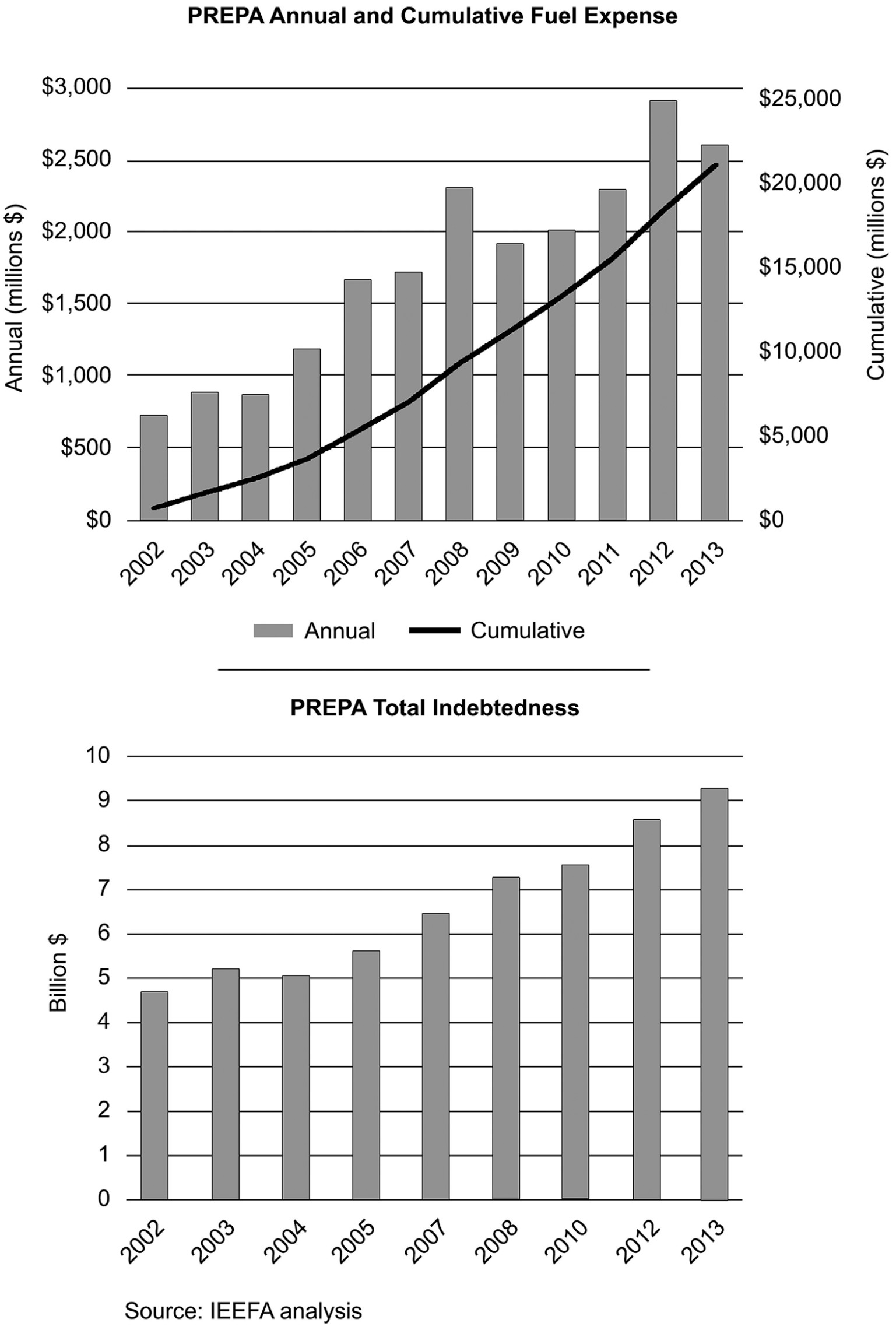
In retrospect it is clear that the most rapid growth of debt for the territory’s government and PREPA coincided with the island’s GDP crash after the phase-out of federal tax incentives in 2006. Puerto Rico lost the ability to borrow on capital markets in the same year that financial ratings agencies reacted to the crisis, just as oil prices became stratospheric (
Figure 2).
The coincidence of the island’s oil dependence and debt was not a surprise to researchers at the Instituto Nacional de Energía y Sostenibilidad Isleña (National Institute for Island Energy and Sustainability—INESI) based at UPR-Mayagüez, but their warnings had seldom gained a hearing from island authorities. Shortly after María hit, as the entire island struggled in the dark, Marla Pérez Lugo and Cecílio Ortíz García, cofounders of INESI, tried again. They attempted to deliver a letter about oil costs signed by INESI professors to Governor Rosselló at a San Juan convention center where officials were meeting with relief workers but were once more turned away. The letter stated in part: “In 2015 . . . Puerto Rico imported 155,000 barrels of oil a day. The price of that fuel? Nearly US$8 million leave the island permanently every day. This is economically, environmentally, and socially unsustainable.” The researchers advocated for shifting the grid to greater dependence on renewables (Cecílio Ortiz García and Marla Pérez Lugo, interview, Princeton, NJ, August 4, 2018;
de Onís, 2017b).
In addition to high energy bills, another motivator for Puerto Rican energy reforms was a fuel-buying scandal that made headlines in 2016 over charges of fraud and possible kickbacks by the director of PREPA’s fuel purchasing office. In Puerto Rican Senate hearings, investigators presented evidence that the office had borrowed funds from bank credit lines with the stated intent to buy premium-grade oil but instead took delivery of cheaper, dirty high-sulfur oil. A class action suit brought by ratepayers implicates five oil companies (Shell, Petro West, Petrobras, Vitol, and Trafigura) along with three oil testing labs and alleges that during the years 2002–2014, when the scheme was in operation, PREPA purchased US$23.4 billion in illegal dirty oil, including overpayments that cost electric consumers US$1 billion. The FBI now has the criminal case but has filed no charges. Meanwhile, the fuel-buying official, William Clark, retired from his post and reportedly celebrated with a party at a luxury beach hotel attended by executives of several major oil companies (Alberto Pérez Velez, interview, San Juan, July 26, 2018;
Berman, 2018;
Sanzillo and Kunkel, 2018a: 2–6).
Analysts reviewing the case at the Institute for Energy Economics and Financial Analysis traced the origins of funds used for fuel purchases and concluded that the scandal helps explain the PREPA budget deficit. During the 12 years of the alleged scheme, PREPA borrowed US$10 billion by issuing power revenue bonds underwritten by Citibank for capital improvements, but investigators concluded that only a little over half that amount was spent on facilities, with the rest diverted to fuel as the utility struggled to keep plants operating during the years of high oil prices (
Sanzillo and Kunkel, 2018a: 3, 9). Indeed, an audit of PREPA’s first rate case for its proposed 2017 budget revealed that the utility had repeatedly underestimated fuel costs in fiscal planning and had spent 40–60 percent more on fuel in recent years than was budgeted (
Fisher and Horowitz, 2016: 172–178). This understatement of costs was likely intended to reassure creditors by creating the impression that there was room for debt service in the budget without the need to raise electric rates further (
Sanzillo and Kunkel, 2018a). Reflecting on his two years as a public observer on the PREPA board, Juan Rosario noted that it should not be surprising that electricity service had become so central to political intrigue. He replied, “It’s incredible! Although electricity is not usually seen as a basic need like water and air . . . our society is so dependent on energy that the electric company has become the perfect place for politicians to hide corruption” (interview, San Juan, July 25, 2018).
Through the PROMESA board, Puerto Rico’s creditors (which now include vulture hedge funds) have gained influence over both the island’s government and PREPA’s budget decisions, including proposals for privatization. For example, Citibank, an underwriter for the utility’s 2010 issue of power revenue bonds, also benefited from an US$822 million principal loan it made that allowed PREPA to pay the bank back US$191 million that the utility had borrowed from Citibank to buy fuel. Citibank is also the main investment bank consulting for PROMESA and PREPA on privatization (
Aronoff, 2018).
Auditors found that during 2010, when bank creditors, including JP Morgan Chase and UBS, were aware that the utility was technically bankrupt, they collaborated with PREPA in an accelerated series of bond issuances. PREPA then drew on borrowed funds to pay interest on the bonds and issued more bonds to pay interest on its new bank loans in what some have called a Ponzi scheme. The banks benefited when they bought the bankrupt utility’s new (government-backed) bonds, since PREPA used the new bond income to pay off outstanding bank debt (which the banks might otherwise have had to write down as uncollectible). Given that costs for this new debt were passed on to ratepayers, another term for this practice might be predatory lending (
Financial and Oversight Management Board, 2018: 132–147;
Puerto Rico, 2015: 15–18;
Sloan and Bhatti, 2017).
Wear-Down: Delayed Maintenance, Blocked Funds, and Privatization
“Poor maintenance” became a universal mantra in 2018 news accounts on the glacial pace of grid repair, which was usually blamed on official “corruption” with little explanation. As the cases above illustrate, in addition to petty corruption, billions of dollars borrowed for maintenance and capital improvements were diverted to fuel costs for over a decade. Then, as one of our informants put it, “Hurricane María took the lid off of Puerto Rico,” revealing its deep vulnerabilities (Luis Carlos Robles, interview, San Juan, July 26, 2018).
At the USACE command center in early 2018, engineers pointed to a large wall map of PREPA’s transmission grid as they explained the challenge of repairing hundreds of downed high-voltage towers. The map showed multiple lines of towers spanning rugged mountains from ports and power plants in the South to bring power to the populated Northeast around San Juan (interview, San Juan, January 24, 2018). “The current electric system was designed primarily for industrial use,” Pérez Lugo later explained. “That’s why production plants are on one side of island and most people live on the other side—the purpose of the system was the aspect that made it so weak. It was electrical towers on high ridges that suffered the most damage from the hurricane” (interview, Princeton, NJ, August 4, 2018). These towers, many installed more than 50 years ago with no rights-of-way to keep them free of vegetation, became impossible to maintain. A study of grid repairs by the
New York Times found that many towers fell in the high winds because of corroded “deadman anchors”—concrete-encased steel rods attached to the guy wires. Other utilities that use those anchors have protocols for regular inspections and repair, but PREPA did not (
Glanz and Robles, 2018).
Unfortunately, advocates for using the storm as an opportunity to strengthen the fragile system were disappointed. The U.S. Stafford Act limited USACE to repairs of the grid that adhered to standards in place prior to the disaster. This led to utility linemen’s having to reconstruct arcane pieces of hardware that had long gone out of service on the mainland (interviews, USACE staff, January 24, 2018). In addition to the hardware challenges, PREPA’s diminished manpower slowed grid repair. The utility had gradually reduced its workforce by 30 percent because of austerity measures instituted since 2012, with most of the cuts affecting the operations staff (
PREPA, 2018).
Total federal costs for restoring the grid after Hurricane María came to US$3.2 billion,
9 but funds to make the grid more resilient in future storms have not been forthcoming. The territory’s allocated post-María federal aid has been far lower than that of states affected by recent hurricanes and tens of billions short of the US$94.4 billion that disaster experts estimated is needed for a full recovery (
Johnson, 2018a;
Mazzei, 2018). In addition, as of November 2019, FEMA continued to delay on delivering most of US$45 million in allocated recovery funds, even as an American Society of Civil Engineers survey gave Puerto Rico a close to failing grade (D–) on infrastructure that month. The federal agency of Housing and Urban Development (HUD) also continued to hold up nearly US$20 million allocated by Congress, which included funds for rooftop and community-scale solar, on the premise that Puerto Rico’s government was corrupt (
Wehrman, 2019). Revelations in late 2019 of irregularities involving up to US$50.1 million in federal funds paid to USACE and FEMA contractors (
Rodríguez Velázquez and Colón Almenas, 2019) did not temper the Trump administration’s resolve to tar Puerto Rican officials as the source of corruption, which some U.S. legislators have denounced as a racist strategy.
10In January 2018 Governor Rosselló announced plans to privatize PREPA, pleasing congressional Republicans and the island’s creditors but setting off a huge debate in Puerto Rico. While many residents expressed hope that privatization might lead to reliable electricity, others feared that the move would mean more rate increases. As a resident of San Juan’s Santurce district put it, “Who is going to pay for their profits after privatization? Is it me?” (informal interview, San Juan, January 26, 2018). It is a reasonable question. The Independent Office of Consumer Protection ombudsman Pérez Vélez said that privatization of PREPA would be a huge profit opportunity. “It’s a monopoly. [The government] is selling a guarantee of US$4 billion in revenues” (interview, July 26, 2018). Tellingly, plans for restructuring PREPA’s debt (to make it more attractive to investors) have drawn criticism for projecting that costs for new loans would be passed on to customers through increases in electric rates (
Sanzillo and Kunkel, 2018b).
Indeed, studies of public utility privatizations in indebted countries reveal that these sales often lead to corporate takeovers of profitable services (like electric generation) while leaving unprofitable services (like distribution) in the hands of a government that, deprived of revenues from consumers, is ill-equipped to invest in and maintain the infrastructure (
Degani, 2013;
Nepal and Jamasb, 2013;
Smith-Nonini, 2020).
In Puerto Rico, the threat of privatization and a string of new blackouts of reenergized areas helped motivate a resurgence of antiausterity activism in March 2018, led in part by UTIER, which has taken the stand that electrical services should remain a public good under control of Puerto Ricans rather than a corporate entity that will lack incentives to consider environmental concerns or affordability of rates. UTIER is backed by a global network of 74 unions called Trade Unions for Energy Democracy that seeks to enhance democratic management of energy services, with goals of alleviating energy poverty and addressing the climate crisis (
Sweeney, 2018).
Power Struggle: Getting to Resilience
Prior to María, PREPA’s grid had already been prone to blackouts, which after 2014 occurred four to five times more often than at other U.S. utilities, reflecting both increased storm intensities and PREPA’s staff cutbacks and delayed maintenance (
Fisher and Horowitz, 2016). For many towns in the interior where outages were most frequent, the long blackout reaffirmed a growing loss of trust in the grid. After María there was a surge of new interest in generator back-up and rooftop solar (
Johnson, 2018b). Hawaii, which cut its oil dependence by 12 percent using renewables, is a model that many Puerto Ricans cite (
EIA, 2019b).
But PREPA failed to meet its previous target of achieving 12 percent renewable generation by 2015; only 3 percent of the island’s electricity comes from renewables today. One mission of the new electric regulatory agency is to enhance grid resilience and oversee progress toward renewable generation. After María the agency established new rules for mini-grids that can operate in isolation from the regular grid after a weather emergency (
Johnson, 2018b), and a law passed in the spring of 2019 allows distributed solar and energy cooperatives for the first time. However, tax incentives for renewables have been complicated by delays in recovery funds and the Trump tax law, which treats Puerto Rico like a foreign jurisdiction (
Mock, 2019).
In addition, Puerto Ricans have learned that renewable energy may be as badly managed as fossil fuels. Luis Fortuño, a former governor, used federal funds in 2010 to initiate several private solar and wind projects, but nearly all charged very high rates (
Martínez Mercado, 2018a). For example, a 2018 investigation revealed that nearly a thousand complaints had been filed with the Independent Office of Consumer Protection by residents claiming that they were being overcharged for rooftop solar by Texas-based Sunnova, one of the companies benefiting from Fortuño’s renewables effort. Many early adopters had mortgaged their homes to install solar but later found themselves locked into contracts based on the very high electric rates PREPA was charging at the time. As oil prices declined, rates adjusted, but their contracts did not (
Martínez Mercado, 2018b).
Such scandals and PREPA’s poor record have led energy advocates on the island to call for greater democratic participation in decision making about electricity. Since the hurricane Ortiz García and Pérez Lugo have worked to build a network of allies among universities and nonprofits on the mainland that are involved in post-María recovery efforts with the goal of strengthening support for democratic approaches to development. A more grassroots approach is being pioneered by Casa Pueblo, a 35-year-old nonprofit we visited in the mountain town of Adjuntas, which is helping the local area transition to solar. “The hurricane actually unveiled the reality of our energy system, how outdated and corrupt it is,” said Arturo Massól, the Casa’s associate director. His staff used its solar-powered radio station to put out a call for aid after Hurricane María, and its solarized community center became a local resource for Internet and phone charging (interview, Adjuntas, January 23, 2018).
To date Puerto Rican political leaders and PREPA have prioritized converting oil generating plants to natural gas over investing in renewables, with preliminary plans to import fracked gas from the mainland. The latest development involves a controversial proposal to build a potentially explosive liquefied natural gas facility at the San Juan port. While gas emits less carbon than oil, discoveries of widespread methane emissions from fracking have convinced environmental scientists that any benefit is likely negated by the short-term effects of methane in the atmosphere, which speeds up global heating (
Schwartz and Plumer, 2018). Also, analysts predict that financing the gas plan would raise electric prices back to the levels of the high-oil-price years, and costs for the new infrastructure would likely preclude spending on renewables during the lifetime of gas facilities (
Sanzillo and Kunkel, 2019).
Marcel Castro Sitiriche, a UPR researcher who tracked communities left in the dark during the final months of the post-María blackout, argues that since resiliency from future storms is the stated goal of federal aid for energy reforms, such funds would be far better spent putting solar on houses of families in mountainous or remote towns at the ends of distribution networks (the last to have power restored) than building gas plants (
Castro Sitiriche, 2019a;
2019b). “The most important thing in this energy revolution,” Rosario argues, “is who owns it and who rules. It has to be ruled by the people. The beauty of the new technology like solar panels is it can be very democratic. I don’t have to wait for someone to give me electricity. But I don’t think [the authorities] want that. They want to keep controlling the energy so they can keep controlling the people” (interview, San Juan, July 25, 2018).
Conclusion
Puerto Rico’s long blackout—which contributed to thousands of deaths and months of disruption of vital services such as water, food distribution, communication, transportation, and economic life—offers a stark cautionary tale about the politics of energy system resilience, an area poorly studied to date in the social sciences. This case suggests that resilience in the face of climate change will hinge on the capacity of governments to actively confront long-standing structural inequities, including colonial legacies, chronic debt, and fossil-fuel dependency.
Infrastructure like the grid for electricity, a service that has become essential in all aspects of modern life, is especially vulnerable to interruption because the systems (many built during the fossil-fueled high-growth Keynesian era) are aging and fragile, and repair and maintenance tend to be neglected in urban budgets. In addition, the U.S. regulatory focus on access to capital and reliability, combined with the “black box” invisibility of energy to citizens (
Graham, 2010: 6), make utilities ideal sites for political and financial manipulation by interested parties.
While Puerto Rico’s level of dependency is unusual, many places, including much of Africa, Central America, parts of Southeast Asia, and many small island states and territories, struggle with blackouts, high energy prices, and energy poverty as a result of high debt and expensive oil dependency. Even developed European states like Spain and Greece are seeing new energy poverty as debt and austerity interact with the vicissitudes of oil price volatility. Electric utilities, whether private or public, are vulnerable to political patronage and excess borrowing in states struggling with public debt. Even when states have poor credit, public utilities look like good bets to lenders because of their large customer base and ability to issue bonds or raise rates to cover costs. But rate hikes rapidly inflict burdens on working-class and poor residents and contribute to capital flight as energy-sensitive businesses move abroad (
Degani, 2013;
Franquesa, 2018;
Smith-Nonini, 2020).
In many countries the curse of overreliance on oil—whether for electricity or transport—can be traced to colonial and neocolonial legacies of economic dependency for development on fossil infrastructure and well-connected oil and gas elites. This is aggravated by the fact that most oil sales are denominated in dollars and therefore, when oil prices rise, indebted countries must borrow yet again or cut back on already fragile social services to keep the lights on. While geography remains a challenge for island states and territories, the hypervulnerability of maritime places to sea-level rise and monster storms argues for action—the bitter irony being that climatic turmoil itself was brought about by the past 150 years of fossil-fueled capitalism.
Oil dependence leaves Puerto Rico and many other indebted governments vulnerable to financial and political manipulation by powerful external actors, including U.S. government officials, oil and gas corporations, and investment banks—actors that are well-positioned to strategically move capital and fuel across borders and influence access to and values of key assets (
Smith-Nonini, 2020). For example, Shell Oil, one of the companies involved in the 2016 fuel scandal in Puerto Rico, rapidly pivoted to leading a private consortium
11 in 2018 that expressed interest in the sale of key PREPA assets (
Balmaceda, 2018), and Governor Rosselló pushed successfully in 2018 for legislation to weaken the electric regulatory authority in order to facilitate quick privatization plans involving gas-fueled generation (
Schlissel, 2018).
There is a widespread, hope-filled faith among many green-energy promoters and the public that some combination of government investment and market solutions such as carbon taxes will solve our energy problems. Yet the roles of major oil companies and investment banks in illegal transactions with PREPA, which both exploited and exacerbated Puerto Rico’s crisis, should serve as an object lesson about the hidden costs of growth and capital accumulation in the neoliberal era. The conflicts of interest, Ponzi schemes, and predatory bank lending outlined above offer prime examples but are far from a comprehensive review of the financial manipulations in Puerto Rico, which fit the profile of “shadow banking”—a realm that has become increasingly important to global finance during the recurrent crises of falling capitalist growth rates and the decline of cheaper, conventionally sourced fuels. Debt is lucrative.
David Harvey (2005: 162) described how public and private debt (often exacerbated by crises) facilitates “accumulation through dispossession.” Such profit seeking is international and domestic and often racialized as in post-2008 Detroit or post-Katrina New Orleans (
Wang, 2018) and, I would argue, post-María Puerto Rico. With debt leverage direct ownership of assets is not necessary for profit. The goal with privatization, according to Michael Hudson, is to turn public assets of industrial economies into “tollbooth opportunities” for private income flows (
2015: Chap. 27).
Without this perspective, when it comes to energy transitions we risk falling into the trap of technical fetishism. Ortiz García warned (interview, Princeton, NJ, August 4, 2018),
We are repeating a process where we buy into a belief that technological improvements bring about purpose, and it doesn’t work that way. We need to reflect on our purpose in society. What does sustainability mean for Puerto Rico? . . . Instead of just concentrating on the next Tesla fad, or the next technical fix . . . what we need is innovation in governance of energy systems. We need people to come to the table and ask what kind of Puerto Rico we want in 20–30 years.
That process may be beginning. When we began our research, informants often lamented a culture of complacency in Puerto Rico due to its colonial status and history of weak politicians who lack the power to solve problems. The option of migration to the mainland has also long functioned to mitigate discontent. But many hoped that the post-María debacle would “open people’s eyes.” While the current push to privatize PREPA and maintain reliance on fossil fuels is disappointing, there are signs that the landscape of power is shifting.
More than 40 public meetings took place across the island to gather input into the new law on renewables that passed in early 2019, followed by a series of unprecedented urban protests that July that forced Governor Rosselló’s resignation (in response to funding scandals and leaked chatroom comments in which he insulted hurricane victims and political enemies). The long blackout was a common grievance that protesters cited to reporters to explain their activism during the two weeks in which they filled the streets. Two months after Rosselló’s ouster, the
New York Times reported routine impromptu gatherings of citizens in the squares and parks of San Juan—not to skateboard or hear music but to discuss the future they want for the island (
Mazzei and Rosa, 2019).