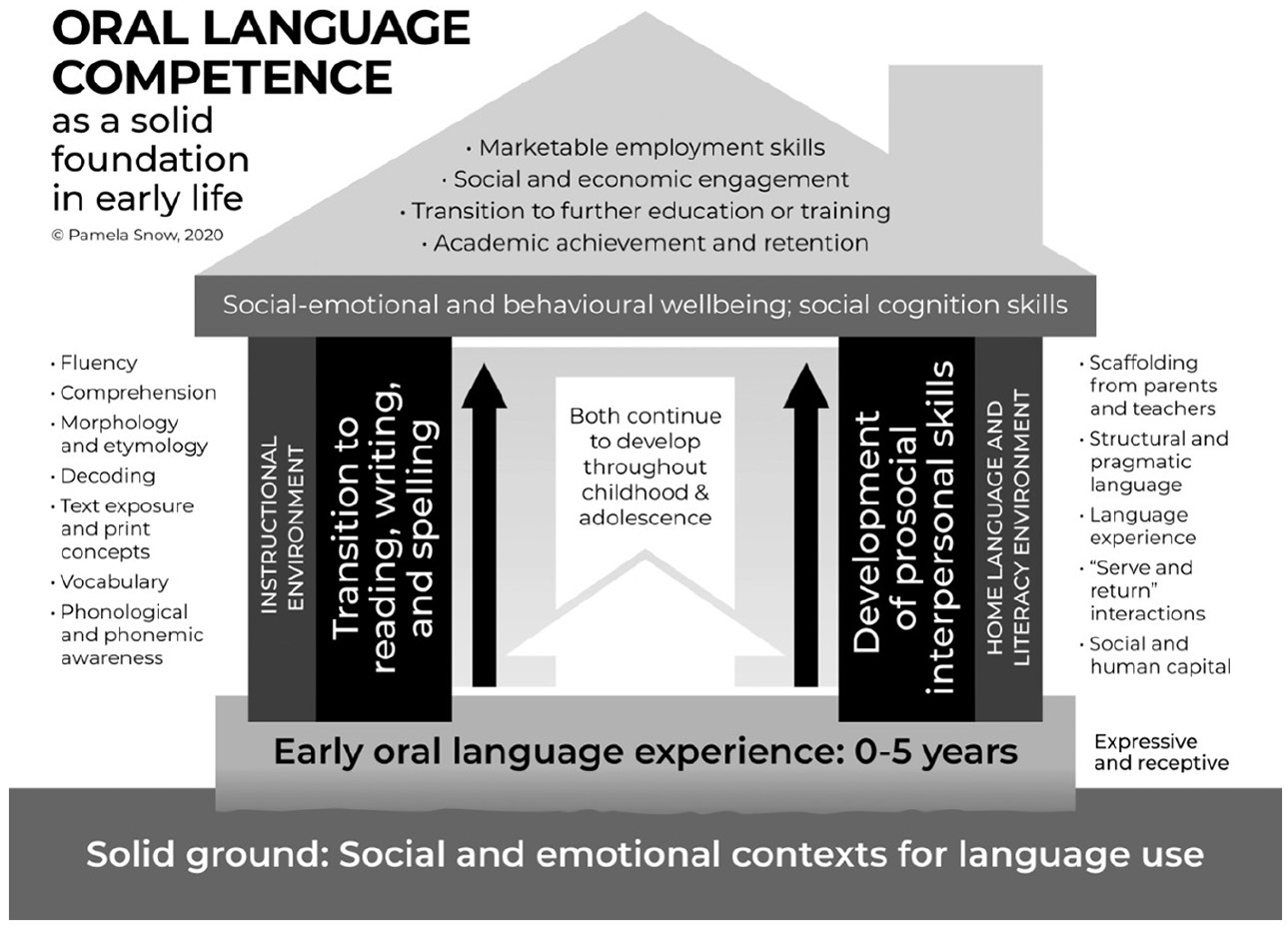
Taking the information presented above, it is possible to conceptualize the processes involved in promoting both oral language competence and reading success (and vocational achievement as a consequence of academic success) as being akin to building a ‘Language House’ (see
Figure 1). This conceptualization is offered as a way of considering the developmental links between oral language, reading development, social-emotional wellbeing, and academic/vocational outcomes, together with the role of SLT in promoting research-informed policy and practice across the developmental period from infancy to early adulthood. The metaphor that applies to this schema is as follows:
When we build a house, we do not commence with walls or the roof. We commence with foundations; but before foundations can be laid, we must consider the ground into which they will be embedded. Reclaimed land could mean the foundations will sink, and solid rock will mean the foundations do not penetrate beneath the surface. With the right ground selected (in this case, the social and emotional contexts for early language acquisition), the conditions are created for solid foundations to be laid. Here, the foundations represent the first five years of receptive and expressive oral language development and the mental processes represented by language (e.g. concepts, opinions, and memories). This is a metaphorical ‘slab of granite’ that will support the walls on both sides. In one wall, we have the development of pro-social interpersonal skills, and the factors that need to be in place to support these. In the other, we have the development of reading and writing skills. Both walls are represented with a brick pattern, because they are built up over many years, well into late adolescence and early adulthood.
With the walls firmly built and sufficiently strong, we can ensure strong support for the roof, in the form of social-emotional and behavioural wellbeing, including social cognition/inferencing skills. The roof then represents the individual’s ability to transition from school to further training and education, to gain marketable employment skills and be part of the social and economic mainstream. This needs to be considered in the context of diminishing employment opportunities for unskilled workers in first-world, industrialized nations.
I will consider each of the elements of the metaphorical Language House below, together with the contribution they make to successful reading acquisition and their SLT implications for identification and support of children with weak oral language and/or reading skills. It is important to stress that while oral language skills – as biologically primary functions – precede the emergence of biologically secondary reading and writing, their development continues well beyond the first five years in which their metaphorical foundations are laid in this schematic representation.
1 Solid ground: The emotional and interpersonal experience of infancy
In optimal circumstances, infants are cared for by adults who are emotionally and practically available to them to literally meet their every need, in a prompt, warm, responsive manner. Human infants are among the most helpless and dependent on the planet, requiring around two decades of care, nurturing, and adult support and role-modelling in order to transition to independence across a range of psychosocial domains. The human infant cannot emotionally self-regulate, requiring adult care-givers to function as external psychobiological regulators (
Newman et al., 2015). This experience-dependent emotional attunement forms the basis of early infant attachment and adult–child bonding, which, in turn, provide internal working models of attachment, empathy, and emotional self-regulation (
Newman et al., 2015;
Perry et al., 1995;
Snow, 2009). Emotional self-regulation is a critical skill for social and academic success, as it promotes the child’s ability to maintain behavioural homeostasis and tolerate some affective discomfort, in order to focus on tasks at hand (
Perry et al., 1995). Poor emotional self-regulation is a long-recognized and common feature in children identified as at-risk for language and/or learning difficulties and often becomes a focus of intervention efforts in order for higher-order skills to be addressed, though underlying language difficulties can easily go undetected in such children (
Beitchman and Brownlie, 2013;
Cohen, 2001;
Cross, 2011;
Snow, 2019).
As I have observed previously ‘The relational milieu in which children are raised cannot be separated from the nature of the verbal input to which they are exposed’ (
Snow, 2009: 101). This is important not simply for the degree of emotional warmth to which children are exposed, but also for their opportunities to learn and understand words associated with emotions: their own, and those of others.
Dunn (1991: 111) observed that ‘Differences between families in the frequency and extent of discussion of others’ feelings, motives, and behaviour are striking.’ These differences matter because explicit use of mental state language (use of wanting, believing, knowing verbs) is important for the development of theory of mind and social cognition skills (
Cohen, 2001).
The solid ground component of this conceptualization is most commonly disrupted by child maltreatment: neglect and/or abuse of various forms, which typically co-occur, albeit in different patterns for different children (
Bromfield and Higgins, 2004). Child maltreatment has been identified as an independent risk factor for compromised language development (
Lum et al., 2018) and low language skills exist in both children (
Lum et al., 2018) and adolescents in the child protection system (
Trout et al., 2011). Unfortunately, a significant number of children are part of a metaphorical ‘school-to-prison pipeline’ (
Snow, 2019) from early in their lives, culminating in formal contact with child protection and/or youth justice services. Such children and adolescents are high-risk for compromised language and reading development, but their difficulties are often undiagnosed and/or mis-managed in the school system, e.g. through an over-emphasis on behavioural manifestations and a perhaps understandable, yet still misplaced over-reliance on suspensions and exclusions (
Snow, 2019).
Perry (2006) outlined a theoretical framework termed the Neurosequential Model of Therapeutics for understanding how early experiences and interventions impact on the developing brain.
Perry (2016) has subsequently observed that ‘The key to the success of any educational experience is the capacity to “get to the cortex”.’ This is vital for a biologically secondary function such as reading, yet large numbers of children have compromised executive functions because of the effects of trauma.
Unpredictable home environments can condition children to be hyper-vigilant to threat, such that otherwise benign changes in the classroom (e.g. the teacher raising her voice to be heard above a noisy throng) can foster a persistent state of alarm. This in turn, can appear to teachers and other support staff as inattentiveness and/or uncooperative behaviour, resulting in sanctions that further impede the child’s ability to attend to and engage with the teacher’s instructions (
Perry, 2016). SLTs are well-positioned to reframe behaviour as a form of communication and to encourage thoughtful consideration of underlying drivers of challenging behaviour.
2 Strong foundations: Oral language development in the pre-school years
Expressive and receptive language development is one of the hallmark developments of the preschool years. Phonological awareness develops apace in the first year of life, refining the infant’s ability to discern speech sounds and prosodic contours associated with the language(s) to which they are regularly exposed in their home and other care environments (
Fellowes and Oakley, 2020). In optimal circumstances, children’s exposure to rhyme and song in the pre-school years lays the foundations for early phonemic awareness, the ability to auditorily discern sounds within words and to identify words that do and do not rhyme, do and do not begin or end with the same sound, and to understand the concept of syllables within words (
Kilpatrick, 2015). Phonemic awareness is widely considered a critical precursor to early reading success, and is also likely strengthened through reading instruction approaches that emphasize phoneme-grapheme correspondences (
Kilpatrick, 2015).
It has been known for some decades that parental SES has a significant impact on the quantity and quality of language to which children are exposed in the pre-school years. Perhaps the most well-known evidence of this is the work of
Hart and Risley (1995) who identified the so-called ‘30-million-word gap’ by age three, between children of professional parents and children of parents on welfare benefits. Other workers, in the UK, USA, and Australia have confirmed the presence of a social gradient with respect to early oral language exposure (
Snow, 2019). What this means, as noted by
Roy and Chiat (2013), is that early years’ classroom instruction needs to accelerate, not merely progress the oral language skills of children who start from behind.
Assuming that there are no neurobiological barriers and that severe environmental deprivation is not a factor, the average six-year old can understand approximately 10,000 words and has an expressive vocabulary of some 2600 words (
Fellowes and Oakley, 2020). These words form the basis of what is commonly described as Tier 1 vocabulary because they make up the bulk of everyday conversations between children and adults and between children and their peers (
Beck et al., 2013). Tier 2 vocabulary refers to common, high-frequency words used across a range of domains by mature language users. These words are important for reading comprehension and are sometimes polysemous. Teachers should explicitly teach these words as not all children will acquire them naturally. Tier 3 vocabulary is subject-specific and needs to be explicitly taught e.g. words such as photosynthesize, and enzyme in the biology curriculum (
Beck et al., 2013).
However, language development in the pre-school years comprises more than just vocabulary growth. Children also develop their ability to produce and understand morphologically and syntactically complex sentences, to mark tense, plurality, temporal order, and conditionality. Through the emergence of coordinating conjunctions such as ‘and’ children learn to link (‘chain’) events and, later, through the use of subordinating conjunctions, to place two ideas together in one sentence, but in such a way as to subordinate one idea (clause) to the other, e.g. ‘I’m going for a swim
because it’s hot outside’ (
Fellowes and Oakley, 2020).
In addition to and alongside developments in these structural elements of language, children acquire skills across a range of discourse genres in the first five years of life, including conversation, narrative and expository text (
Fellowes and Oakley, 2020). As an interactive genre, conversation may have other genres, particularly narratives, embedded within it and co-constructed by the conversational partners. Children also need to acquire a range of culturally-relevant conversational ‘rules’ that pertain to turn-taking, interruption, topic management, and repair of misunderstandings (
Snow and Douglas, 2017).
Not surprisingly, the skills outlined above take many years to acquire and refine, and are sensitive to the effects of a range of common neurodevelopmental disorders, such as intellectual impairment, attention deficit-hyperactivity disorder, hearing impairment, and/or autism spectrum disorder (see
Snow and Douglas, 2017). Thus although oral language development is biologically primary and ‘natural’, it is by no means ‘set and forget’, in that (a) many children struggle to master its intricacies in a developmentally timely manner, as a result of diagnosed and undiagnosed disorders, and (b) even in the most optimal of circumstances, parents and other carers invest considerable time into teaching structural and pragmatic language skills to young children. They do this in part through the use of ‘parentese’, in which intonational contours are exaggerated, salient features are repeated and emphasized, and sentence complexity is reduced (
Bowen and Snow, 2017). All of this language knowledge later needs to be brought to bear on the process of understanding and producing written text.
3 The prosocial interpersonal skills and the home language and literacy environment wall
Refining the pragmatic aspects of language use takes many years, and is built on prolonged exposure to ‘serve-and-return’ exchanges (
Center on the Developing Child, 2020;
Levitt and Eagleson, 2018) that support both infant-carer attachment and the development of a variety of discourse functions in everyday life, e.g. commenting, requesting, commanding, agreeing, dissenting, objecting, seeking comfort, to name a few (
Fellowes and Oakley, 2020). The importance of serve-and-return is well-recognized for infants, but it is also the basis (albeit in ever-evolving, age-appropriate ways) of the ongoing development of vocabulary, sentence complexity, discourse and pragmatic language skills throughout childhood and adolescence. In the school years, children and adolescents continue to be highly reliant on parents and teachers to disambiguate social interactions and support the refinement of culturally relevant social skills and pragmatic language abilities. This includes their mastery of figurative and idiomatic language, such as metaphors and local idioms, as well as other linguistic devices such as sarcasm, humour, and analogy (
Nippold, 2007). It is important to consider that where this type of non-literal language occurs in written texts, it is devoid of contextual cues such as body language, intonational contour and other environmental cues, thus placing higher demands on the reader’s inferencing skills and background knowledge acquired through explicit and implicit learning opportunities (
Beck et al., 2013;
Nippold, 2007).
Children who have more proficient oral language skills have been shown to be more successful in making and retaining friendships, which in turn is positive for mental health and wellbeing (
Fujiki et al., 2001). Specific skills of relevance here include making and responding to bids from peers and participating fully in group discussions, rather than displaying reticence. These skills are related to social cognition, which refers to ‘the cognitive processes individuals apply to understand social situations’ (
Cohen, 2001: 33). Expressed another way, social cognition is our ability to ‘read the play’ and to understand that verbal signals and nonverbal/environmental cues may sometimes be at odds with each other, because humans are socialized to play against their emotions in some situations, e.g. to say they are enjoying a family gathering when they are not. In addition to the ability to use social inferencing to arrive at correct conclusions from incomplete or ambiguous social cues, social cognition supports the ability to use implicature and indirect speech acts to comply with culturally constrained politeness conventions, for example asking a stranger ‘Are you able to tell me the time please?’ rather than the more abrupt ‘What’s the time?’ which is likely to be perceived as rude and socially inappropriate.
This disambiguation of social cues (as speaker and listener) is difficult for young children and for children, adolescents and adults with neurobiological disorders such as autism spectrum disorders, intellectual impairment, acquired brain injury, and attentional disorders, all of which are associated with pragmatic language difficulties (
Snow and Douglas, 2017). Alexithymia (difficulty recognizing and identifying one’s own affective states) may also be present in clinical populations for whom language disorders are over-represented, and provides a further barrier to intrapersonal wellbeing and psychosocial success (see
Snow, 2019).
All of these skills are supported directly and indirectly through the home literacy environment (HLE) which was defined by
Hart et al. (2009: 911) as ‘participation in literacy activities in the home, and includes both exposure to and frequency of parental activities such as joint book reading, modeling of independent reading and support of literacy-related activities, providing books, and going to the library’. The HLE comprises both formal and informal activities, including parents reading to children, directing children’s attention to environmental print, and teaching letter names and sounds: all activities that are thought to promote oral language skills and comprehension (
Puglisi et al., 2017).
4 The reading, writing, and spelling and instructional environment wall
This is the part of the Language House that arouses controversy in education circles, due to the long-running and highly counter-productive reading wars (see
Castles et al., 2018). There does seem to be bipartisan agreement in this debate that in the pre-school years (and beyond) oral language development is critically important for reading and writing. However, we are a long way from consensus on how oral language skills should be harnessed to support children to shift from a skill-set that is biologically natural (speaking and listening) to one that is not (reading and writing). It is important to note here that while reading to children in the pre-school years is important for vocabulary development, exposure to increasingly complex sentences and discourse genres, and the acquisition of background knowledge, it is not enough, in itself, to transition a child from being a ‘good talker’ to a ‘good reader’. The latter requires effective reading instruction on school entry (
Snow, 2016). It is for this reason, that the influence of the instructional environment needs to be examined with respect to the degree of explicitness with which the full range of sub-skills driving reading success is addressed in early years classrooms.
As noted earlier in this article, three national inquiries into reading instruction in the last two decades have affirmed the linguistic basis of learning to read, together with the need for children to be explicitly taught about the alphabetic principle and how phonemes and graphemes map to each other. In the school years, explicit attention to morphology (and etymology) is critical because English is a morpho-phonemic language and the ability to grasp the intricacies of the English writing system hinges heavily on the child’s ability to segment words into phonemes and morphemes, for the purposes of both reading and spelling (
Moats, 2010).
It is important that all clinical work is underpinned by theoretical models derived from the peer-reviewed literature, so that evidence-informed decisions are made about assessment and intervention. The Simple View of Reading (SVR;
Gough and Tunmer, 2006) stands up as one of the most enduring and highly-regarded conceptual frameworks for understanding the process of transitioning from novice to competence in the first three years of school, and provides a conceptual bridge from oral language to reading and writing. The SVR holds that successful reading is the product (not sum) of a child’s ability to decode text and her ability to understand it. While the comprehension side of the equation is not contentious in early reading instruction, the process by which children arrive at the point of comprehension is. Advocates of Whole Language, and its descendent pedagogy, Balanced Literacy maintain that because reading is a meaning-based activity, instruction should begin with meaning (
Snow, 2016). Those who endorse the science of reading, however, argue that children need to ‘crack the code’ and should be taught to do so in a way that is structured and systematic. This remains a key sticking point between the two sides in the reading debate (
Castles et al., 2018).
Recently, the Cognitive Foundations of Learning to Read framework has offered a more detailed breakdown of the components underlying both elements of the SVR equation. On the decoding (word recognition) side, it includes alphabetic coding skills: knowledge of the alphabetic principle, concepts about print, letter knowledge and phonemic awareness. On the language comprehension side, it covers background knowledge and inferencing skills, and linguistic knowledge across the phonological, syntactic, and semantic domains (
Tunmer and Hoover, 2019).
Because parental SES and level of education exert clear influence on the richness and diversity of children’s Tier 1 vocabulary, early years’ classrooms require a focus on vocabulary development alongside formal early reading instruction, so that, in line with the SVR (
Gough and Tunmer, 2006), they are able to both decode and understand text. It is widely accepted (though possibly overlooked) that the relationship between oral language and reading skills in the school years is reciprocal: developments in one domain promote developments in the other (
Adlof, 2019;
Nippold, 2007) and children who have a word in their spoken vocabulary are more likely to arrive at its correct pronunciation during reading (
Adlof, 2019). This reciprocity between spoken and written language in the school years is an obvious area of classroom and clinical support in which SLTs can model and promote optimal practices.
6 The roof: Access to the social and economic mainstream through marketable employment sills
The roof of the house in this schema represents the ability to fully engage, socially and economically, in mainstream society. Where once, it was possible for school-leavers with poor reading and writing skills to hold down unskilled employment, the labour-force impact of automation and artificial intelligence means that jobs for unskilled workers are disappearing (
Council for Economic Development, 2015). There are few avenues by which to be labelled unskilled that surpass low language and reading skills, given their importance, even at the most basic level, for workplace safety and being able to follow spoken and written instructions.
It is common in everyday parlance and in education circles to see reference to so-called ‘functional literacy’, sometimes with an implication that this is a ‘good enough’ base requirement for modern living. Examples of functional literacy include being able to read medication instructions or a transport timetable. As long ago as the early 1980s however, the concept of functional literacy was being questioned, e.g. by
Levine (1982: 415), who observed that ‘the term probably suggested little more than a general level of attainment which enabled adults to “fit in” and “function” in their social environments.’ Functional literacy represents society’s lowest aspirations for students, and in the twenty-first century, offers negligible opportunities for school completion and transition to further training and education, as a basis for full mainstream participation. We must not delude ourselves that it is ‘good enough’ for a significant proportion of the population, given the handicaps imposed by weak skills in these critical domains.