


Improving oral language skills in children with developmental delays: The role of an oral language-oriented instructional program
Abstract
I. Introduction
1. Oral language skills in young children
2. Transition from preschool to primary school
3. Integrating instant feedback system into education
4. Research questions
RQ1: What are the immediate effects of integrating AT devices (Smartclass + talk) into oral language teaching on improving the oral language skills of preschool children with developmental delays?
RQ2: What are the maintenance effects of integrating AT devices (Smartclass + talk) into oral language teaching on improving the oral language skills of preschool children with developmental delays?
RQ3: To what extent are such interventions socially valid from the perspective of the children's parents?
II. Method
1. Participants
2. Materials
3. Experimental design
4. Experimental conditions
5. Procedure
6. Independent variable: intervention
7. Dependent variable
8. Data collection and interobserver agreement
9. Statistical analysis
10. Procedural fidelity
11. Social validity
III. Results
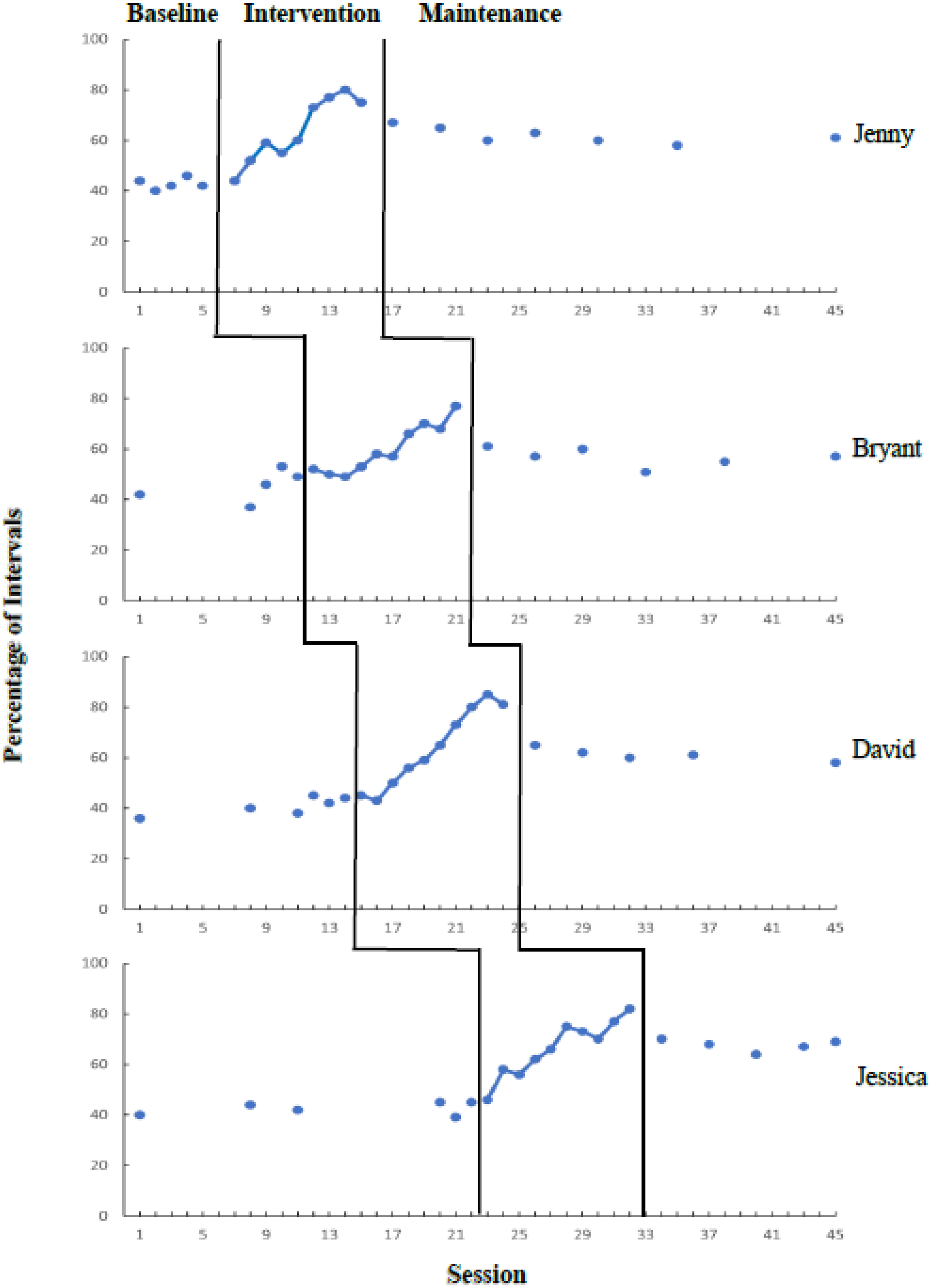
1. Oral language skills
2. Social validity
IV. Discussion
1. Limitations
2. Implications for practice and research
V. Conclusion
Acknowledgments
Ethical considerations
Declaration of conflicting interests
Funding
ORCID iD
Data availability statement
References
Supplementary Material
Please find the following supplemental material available below.
For Open Access articles published under a Creative Commons License, all supplemental material carries the same license as the article it is associated with.
For non-Open Access articles published, all supplemental material carries a non-exclusive license, and permission requests for re-use of supplemental material or any part of supplemental material shall be sent directly to the copyright owner as specified in the copyright notice associated with the article.
Cite
Cite
Cite
Download to reference manager
If you have citation software installed, you can download citation data to the citation manager of your choice
Information, rights and permissions
Information
Published In

Keywords
Rights and permissions

Data availability statement
Authors
Author contributions
Metrics and citations
Metrics
Journals metrics
This article was published in Child Language Teaching and Therapy.
View All Journal MetricsPublication usage*
Total views and downloads: 86
*Publication usage tracking started in December 2016
Altmetric
See the impact this article is making through the number of times it’s been read, and the Altmetric Score.
Learn more about the Altmetric Scores
Publications citing this one
Receive email alerts when this publication is cited
Web of Science: 0
Crossref:
There are no citing articles to show.
Figures and tables
Figures & Media
Tables
View Options
View options
PDF/EPUB
View PDF/EPUBAccess options
If you have access to journal content via a personal subscription, university, library, employer or society, select from the options below:
I am signed in as:
View my profileSign out

I can access personal subscriptions, purchases, paired institutional access and free tools such as favourite journals, email alerts and saved searches.
loading institutional access options
Alternatively, view purchase options below:
Purchase 24 hour online access to view and download content.
Access journal content via a DeepDyve subscription or find out more about this option.

