Since the 2016 United States presidential election, authoritarian attitudes among the public have become a salient topic of discussion and research inquiry (
Box, 2022;
MacWilliams, 2016;
Simon & Moltz, 2022;
Wronski et al., 2018). After this election, another troubling trend continued to worsen in the United States. Pew Research Center data documented a nine-point decline in favorable perceptions of state and local government between April 2019 (pre-pandemic) and December 2023 (
Copeland, 2024). These declines in trust in subnational governments continue a troubling trend of declining trust in government that began in the United States during the 1960s (
Cole & Kincaid, 2000;
Cooper et al., 2008). Public trust is essential to a democratic administration of government as it enables governments to function without a costly and dangerous overreliance on coercion or excessive appeals to self-interest (
Brown et al., 2021;
Hough et al., 2010;
Kim, 2005;
Mizrahi et al., 2023). Given the rising salience of authoritarian attitudes, understanding their relationship with trust in multilevel federal systems offers new insights, perhaps that could be helpful in reversing this long-term decline.
Research suggests that citizens form differentiated expectations and judgments toward various levels of government within federalist systems (
Jacobs, 2017;
Schneider et al., 2011;
Wehde & Nowlin, 2021). For example, research has examined how risk perceptions may increase preferences for more centralized risk regulations at the federal government level (
Maestas et al., 2020). Like risk, threats to safety have also been found to increase authoritarian attitudes (
Hetherington & Suhay, 2011). Yet we know little about how individual attitudes like authoritarianism, the learned social attitude of conventionalism, submission to authority, and dislike of outside groups (
Altemeyer, 1996;
Feldman, 2003;
Stenner, 2005), and public service motivation (PSM), the predisposition to help others grounded in public institutions (
Perry & Wise, 1990;
Piatak & Holt, 2021), might shape public trust. Could it be that individuals high in authoritarian attitudes, who seek order, hierarchy, and institutional control (
Hetherington & Weiler, 2010), are more trusting of centralized and powerful governments at the state and federal level of the United States system, but no more trusting in the characteristically decentralized and fragmented local governance? Moreover, how might PSM, found associated with greater trust at the state and local government levels (
Jensen & Piatak, 2024), relate to trust across levels and potentially moderate the relationship between authoritarian attitudes and government trust?
By examining these questions, this study offers a novel theoretical contribution to the literature on federalism, authoritarian attitudes, and PSM. We find authoritarian attitudes producing asymmetric levels of trust across the levels of government. We also interact authoritarian attitudes with the PSM to assess whether individuals with high PSM but differing authoritarian tendencies exhibit distinct patterns of institutional trust across levels of government. Using data from the 2023 Cooperative Election Study (CES), we show that individuals high in authoritarian attitudes are significantly more trusting of federal and state governments, but not local governments, even when controlling for political ideology. However, people with higher levels of PSM have higher levels of trust across levels of government, and those high in both PSM and authoritarian views have higher trust compared to those with high PSM and lower authoritarian views. These findings carry important implications for understanding public trust, democratic legitimacy, and the psychological underpinnings of trust in federalist systems of government.
While PSM is generally understood as a pro-social orientation grounded in democratic public institutions (
Perry & Wise, 1990), it is worth considering whether individuals with strong authoritarian dispositions may channel their public service motivation in ways that prioritize institutional control and conformity over democratic responsiveness. If so, PSM may not uniformly serve democratic governance, raising questions about the boundary conditions of PSM theory in an era of rising authoritarian attitudes.
In the following sections, we review the literature on federalism followed by our hypotheses on authoritarian attitudes across levels of government and the direct and potentially moderating influence of PSM. We then present our methods and results before discussing our findings and their implications for research and practice in the discussion and conclusion.
Federalism, Public Preferences, and Trust in Government
The United States and other countries with federalist systems or multi-level governance allocate different government responsibilities to different levels of government. Across different policy areas, responsibilities may be distributed across levels of government. Take public safety for example, police and fire services are at the local government level, highway safety is provided by state police, and the federal government provides protection at the national level, such as for national and international travel through the Department of Homeland Security.
The “ distribution of governing authority is an essential feature of how American government works.” (
Jacobs, 2017, p. 572;
Schneider et al., 2011). Through observing and experiencing a U.S. federalist system of shared responsibility, citizens “come to believe that the arrangement of power should look a certain way” (
Jacobs, 2017, p. 573). Although citizens do not use the word federalism, they do think about how responsibilities should be divided between different governments.
Research has examined how blame should be assigned across levels of governments (e.g.,
Connolly et al., 2020;
Leland et al., 2021;
Wehde & Nowlin, 2021) and which level of government the public views should be responsible for different policy areas (e.g.,
Leland et al., 2021;
Maestas et al., 2020). For example, people with greater risk perceptions prefer more uniform, centralized regulation at the federal government level (
Maestas et al., 2020), and those with greater relative trust in state government tend to support devolution of policy responsibilities to the states (
Leland et al., 2021). Partisan and ideological cues also shape preferences across levels of government (
Konisky, 2011;
Wehde & Choi, 2022;
Wehde & Nowlin, 2021), as do policy domains (
Jacobs, 2017). Generally, research has found that the public can differentiate between the responsibilities of the levels of government in a federalist system (
Arceneaux, 2005;
Konisky, 2011).
Trust in government is needed for policy implementation, democratic legitimacy, and public accountability. Yet public trust in government continues to decline across the federal, state, and local government levels (
Cole & Kincaid, 2000;
Peng & Ross, 2025). Trust varies across actors, within levels of government such as state policies influence local government trust (
Peng & Ross, 2025), and across levels of government (
Cole & Kincaid, 2000;
Jensen & Piatak, 2024). For example,
Cooper et al. (2008) find that trust in the local government corresponds to support for zoning, which is typically a local government policy area. Trust in government plays a vital role in gaining and restoring public support and confidence in public institutions. Given the importance of trust in government, how does the rise of authoritarian attitudes influence trust in government across the federal, state, and local government levels? Moreover, what role may PSM play directly and potentially moderate this relationship?
Theory and Hypotheses
Individual-level psychological attitudes and predispositions, like authoritarian attitudes and PSM, might shape public trust. High-authoritarian individuals tend to prioritize order, hierarchy, and strong leadership (
Hetherington & Weiler, 2010), and may therefore gravitate toward levels of government they perceive as more powerful or directive, such as federal or state government in the United States. However, this presents a conceptual tension as those with high authoritarian attitudes tend to hold more right-wing policy preferences and exhibit lower trust in government (
Federico & Tagar, 2014;
Hetherington & Suhay, 2011;
Jensen & Piatak, 2024). This tension highlights the need to examine authoritarian attitudes and PSM in conjunction in relation to trust across levels of government in the US federalist system.
While political ideology is a well-established moderator, shaping whether citizens trust federal or state authorities, an authoritarian disposition may operate independently or even in opposition. In other words, while conservatives may be predisposed to distrust federal power, high authoritarians among them may nonetheless express trust in centralized authority as a source of order and stability. This raises a key question: When controlling for political ideology, do authoritarian attitudes uniquely predict greater trust in federal or state government? More specifically, does trust in government operate differently among high-authoritarian individuals, who might instinctively gravitate toward centralized institutions and view local governance as too diffuse or disordered to inspire confidence?
Authoritarian Attitudes and Trust in the U.S. Federalist System
The study of authoritarian attitudes has its origins in the work of
Adorno, Frenkel-Brunswik, Levinson and Sanford (1950), who developed the F-scale to identify personality characteristics associated with susceptibility to fascist ideology. While the F-scale was groundbreaking, it faced criticism for response-set bias and conceptual conflation with political ideology (see
Altemeyer, 1981,
1988). Altemeyer's subsequent development of the Right-Wing Authoritarianism (RWA) scale addressed some of these concerns but remained vulnerable to critiques that it failed to distinguish authoritarian attitudes from social conservatism (
Hetherington & Suhay, 2011). More recent approaches, including the child-rearing value measures employed in this study, were developed to capture the core authoritarian dimension of conformity versus autonomy without the ideological confounds of earlier instruments (
Feldman, 2003;
Feldman & Stenner, 1997;
Stenner, 2005).
Authoritarian attitudes can be defined as “dispositional needs for order, certainty, and security and adherence to conventional, established institutions” (
Hetherington & Suhay, 2011;
Jost et al., 2003;
Wronski et al., 2018, p. 1385). The focus on authoritarianism began with Altemeyer's (
1988) scale measure of right-wing authoritarianism (RWA), which is highly predictive of both intolerance toward outgroups and support for right-wing authoritarian political parties. However, the RWA scale is problematic as the “scale items measure attitudes that are similar to the dependent variables the scale is supposed to predict. Critics also argue that the RWA scale fails to distinguish between conservatism, especially social conservatism, and authoritarian sectarianism” (
Hetherington & Suhay, 2011, p. 550). Finally, authoritarian attitudes are only partially related to concepts like right-wing authoritarian populism (RWAP), which combines authoritarian attitudes with the concepts of nativism (i.e., xenophobia) and populism (
Kaltwasser & Mudde, 2017, p. 22;
Simon & Moltz, 2022). Overall, authoritarian attitudes refer to preferences for order, certainty, and adherence to established authorities or institutions, rather than any political orientation or regime type.
High authoritarians possess dispositional needs for order, certainty, security, and adherence to conventional, established institutions (M.
Hetherington & Suhay, 2011; M.
Hetherington & Weiler, 2010;
Wronski et al., 2018). Research finds that authoritarian attitudes predict certain political behaviors, such as intra-party primary preferences (
Wronski et al., 2018), attitudes toward foreign policy and the use of military force (
Hetherington and Suhay, 2011), and opinions on immigration (
Hetherington & Weiler, 2009). However, it is less clear whether authoritarian attitudes are associated with broader views like trust in government or what their implications are for the administration of government. Yet, the implications of authoritarian attitudes for institutional trust, particularly across levels of government, remain understudied. Since
Hetherington and Weiler (2009, p. 55) suggest that the “theory about authoritarianism and cognition suggests that the presence of high levels of authoritarianism should lead to a strong need for order and, conversely, an aversion to ambiguity,” and trust in government reflects an individual's perception of government competence, integrity, and goodwill (
Grimmelikhuijsen & Meijer, 2014). For individuals high in authoritarianism, governments that project consistency, control, and adherence to established norms may satisfy their psychological need for predictability and structure. This potential alignment suggests that authoritarian attitudes may predispose individuals to greater trust in governmental institutions, particularly those perceived as stable, rule-bound, and capable of maintaining socio-economic norms and order.
For those high in authoritarianism, institutions that project strength, control, and tradition are cognitively reassuring because they satisfy psychological needs for order and security, particularly when those structures are seen as protecting the status quo or enforcing societal norms. This helps explain why authoritarian individuals may exhibit heightened trust in government, not because they are more civically engaged or optimistic about government, but because trust in established authority itself is a psychological expression of their need for structure and control. However, in federalist systems where the authority and capacity of government vary by level of government, the extent to which each level fulfills these psychological needs likely differs. Thus, while the congruence between authoritarian needs and the symbolic or functional attributes of government might produce a generalized orientation toward trust, this association is likely to be asymmetric and stronger for centralized, resource-rich institutions (e.g., federal or state governments) and weaker for more decentralized or participatory ones (e.g., local governments).
Local Government
Authoritarian individuals prioritize strong, centralized control, which local governments typically lack. In contrast, local governments are inherently fragmented and decentralized, often composed of multiple overlapping jurisdictions with limited capacity for uniform policy enforcement (
Parks & Oakerson, 2000;
Tiebout, 1956). This is true especially when compared to their state and federal government counterparts (
O’Toole, 1990). Due to the potential for both federal and state preemption, local governments have the least autonomy under the U.S. federalist system (
Hanson & Zeemering, 2021). These structural limitations, both in terms of policy-making authority and jurisdictional scope, make local governments ill-suited to meet the authoritarian preference for hierarchical control and institutional stability. As a result, individuals with strong authoritarian dispositions may view local governments as less capable of delivering the order and predictability they psychologically seek. This logic leads to the following hypothesis:
H1: Individuals with higher levels of authoritarian attitudes will report lower levels of trust in local government.
State and Federal Governments
Authoritarian individuals often favor strong, centralized authority, which federal and state governments embody more than local governments. Federal and state institutions, such as the presidency or governorships, and national and state security agencies, have broad jurisdiction and significantly more resources than local governments. This is clear in disaster scenarios where, although local governments are involved and help lead the response, it is understood that they will heavily rely on state agency assistance and federal funding (
Wehde & Choi, 2022). This is not only true of exogenous shocks to local governance systems, but even for planned expenses, intergovernmental revenues, which are primarily from the federal and state governments, can exceed forty percent of some local government budgets (
Carroll et al., 2003). Additionally, experimental evidence suggests that when states call in the National Guard to assist with a large-scale event or threats that this action can enhance perceived legitimacy and effectiveness over simply relying on a local police response (
Blankshain et al., 2025). For authoritarian individuals, this finding may suggest that state and federal interventions, such as calling in the National Guard, are viewed as more legitimate and effective than relying solely on local responses.
However, it is unclear whether high authoritarians will trust the federal government, which has the most legal and financial strength, or state governments, which may be most consistent with co-occurring high authoritarian and conservative ideologies. For example, research finds a public preference for the federal level for uniform regulations when the public sees a high risk (
Maestas et al., 2020), whereas those who trust state governments, compared to the federal government, support devolving policy areas to the states (
Leland et al., 2021). As a result, we suggest that the relationship between authoritarian attitudes will be positive at the state and federal levels of government.
H2: Individuals with stronger authoritarian attitudes will report higher levels of trust in state governments.
H3: Individuals with stronger authoritarian attitudes will report higher levels of trust in the federal government.
Public Service Motivation (PSM)
Public service motivation (PSM) arose out of research on distinctions between the public and private sectors, especially unique motives to join public service (e.g.,
Rainey et al., 1976).
Perry and Wise (1990) first coined the term public service motivation that entailed normative, affective, and rational motives. PSM comprises multiple dimensions (
Perry, 1996) and has been employed to explain numerous behaviors both within and outside of the workplace, such as volunteering (
Clerkin & Fotheringham, 2017;
Holt & Piatak, 2023) and organizational citizenship behavior (
Campbell & Im, 2016;
Holt & Piatak, 2023). PSM represents a predisposition toward the betterment of society, based in public institutions, and has been linked to public opinion (
Piatak & Holt, 2021, pp. 52–53). PSM offers a theory as to why some individuals place more trust in government than others. PSM has been found to correspond to both generalized trust and institutional trust (
Kim & Kim, 2024). In the context of a federalist system, individuals high in PSM may be especially inclined to trust government institutions they perceive as capable of delivering services effectively (
Jensen & Piatak, 2024;
Piatak & Jensen, 2024;
Weske et al., 2020).
Individuals high in PSM tend to value government institutions as legitimate vehicles for achieving collective goals in a value-congruent manner (
Perry & Wise, 1990;
Piatak & Holt, 2021), whereas individuals high in authoritarian attitudes tend to value government institutions as sources of stability, control, and tradition (
Hetherington & Weiler, 2009;
Stenner, 2005). While their motivations differ (altruistic vs. order-seeking), both dispositions converge around a belief in the importance of strong, functioning public institutions. This convergence is particularly salient at the state and federal levels, where institutions are more hierarchical, resource-rich, and symbolically authoritative features simultaneously appeal to the PSM-driven desire for effective public service and the authoritarian preference for centralized authority and predictability. As such, individuals high in both PSM and authoritarian attitudes may exhibit amplified trust in these levels of government, as these institutions satisfy both instrumental goals (serving the public) and psychological needs (providing order and control). In contrast, when authoritarian attitudes are low, PSM may not lead to increased trust in centralized institutions, as there is less psychological reinforcement from the institutional attributes that authoritarianism favors.
However, trust in government may not be driven solely by altruistic motivations. Individuals high in authoritarian attitudes also place value on strong, centralized institutions, but for different reasons: they seek order, control, and stability. While PSM and authoritarianism are distinct psychological constructs, they can converge in their institutional preferences. Both value a functioning and capable government, albeit through different normative lenses. This overlap is especially pronounced at the state and federal levels, where bureaucracies tend to be more hierarchical, professionalized, and symbolically authoritative. These features simultaneously fulfill PSM's desire for effective service delivery and authoritarianism's preference for predictability and centralized control. As such, the combination of high PSM and high authoritarian attitudes may produce especially strong trust in these institutions. In contrast, among individuals low in authoritarianism, who may be less psychologically drawn to centralized authority, PSM alone may not be sufficient to generate elevated trust in the state and federal government. In these cases, PSM-driven trust may be moderated by doubts about the legitimacy of hierarchical authority.
H4: An increase in PSM is associated with an increase in State (4a) and Federal (4b) government trust when authoritarian attitudes are high, but not when authoritarian attitudes are low or absent.
Data and Methods
Similar to
Connolly et al. (2020), to empirically assess these hypotheses, we included survey questions regarding trust in each of the three levels of government in the United States, public service motivation (PSM), and authoritarian attitudes in the 2023 Cooperative Elections Study (CES). The CES is a collaborative survey coordinated by scholars at Harvard University and Tufts University and administered by YouGov. It features a nationally stratified sample of 24,500 individuals to be representative of the US, with scholars from various universities contributing survey items to specific modules. Our survey items were included in a subset of 1,000 respondents. After accounting for missing data on key variables, our final analytic sample consists of 801 respondents. For additional details on the 2023 CES, see:
Schaffner et al. (2024).
We examine trust in government across the three primary levels of government in the United States: state, local, and federal. To measure trust in government, respondents were asked: “Overall, how much trust and confidence do you have in the (level of government) to do a good job in carrying out its responsibilities? Would you say:”. Respondents were given four ordinal response categories: (1) none at all, (2) not very much, (3) a fair amount, and (4) a great deal. This question and the corresponding response options were the same across all three levels of government: state, local, and federal. This measure of trust, with four-point ordinal response options, is similar to measures of trust that have been used by others who have examined trust in state, local, and federal government in the United States in prior research (
Cooper et al., 2008;
Jensen & Piatak, 2024). Like decade-long trends (
Cole & Kincaid, 2000;
Peng & Ross, 2025), the summary statistics shown in
Table 1 indicate that trust in the federal government is the lowest, followed by the highest levels of trust in government reported at the local level. Simple t-tests indicate that these differences are significant at the p < .001 level. These descriptive statistics align with prior research on subjective rationality, which suggests that individuals form opinions about trust in each level of government individually rather than form around the most salient governments, generally, national governments, and use those opinions serve as the basis for one's opinion or level of trust in other levels of government, the theory of institutional salience (
Cole & Kincaid, 2000;
Jacobs, 2017;
Kincaid & Cole, 2016;
Schneider et al., 2011;
Torcal & Christmann, 2019;
Wehde & Nowlin, 2021).
How are authoritarian attitudes measured? This measure is designed to capture a respondent's level of authoritarian emphasis on order and control, conformity, and obedience. Using discrete binary choice questions asking respondents to identify which value in the following pairings is more desirable: “respect for elders” versus “independence,” “obedience” versus “self-reliance,” “curiosity” versus “good manners,” and “being considerate” versus “being well-behaved.” The authoritarian response in each pair is scored as one, and the nonauthoritarian response is zero. We combine the four items additively and take the mean for each respondent. As a result, this measure of authoritarian attitudes is unlikely to be conflated with social conservatism or other related concepts like political ideology and is easily distinguished from the dependent variables (M.
Hetherington & Suhay, 2011, p. 550). This measure has been used to examine interparty (
MacWilliams, 2016) and intraparty (
Wronski et al., 2018) differences in vote choice as well as the relationship between authoritarian attitudes and public opinion on foreign policy and polarization (M.
Hetherington & Suhay, 2011; M.
Hetherington & Weiler, 2010).
This measure of authoritarian attitudes uses child-rearing value pairings originally developed by
Feldman and Stenner (1997) to capture an underlying conformity-versus-autonomy dimension. Each pairing contrasts a value reflecting openness and independent thinking (e.g., curiosity, independence, self-reliance) with one reflecting obedience to social norms and deference to authority (e.g., good manners, respect for elders, obedience). For instance, the “curiosity” versus “good manners” pairing distinguishes individuals who prioritize independent exploration from those who emphasize adherence to conventional social expectations. These pairings have been extensively validated in political behavior research and are widely used precisely because they capture authoritarian predispositions without directly referencing political content, thereby avoiding the conflation with conservatism that plagued earlier scales (
Hetherington & Suhay, 2011;
Hetherington & Weiler, 2009;
MacWilliams, 2016;
Wronski et al., 2018).
The binary forced-choice format is a deliberate design feature of this measure (
Feldman & Stenner, 1997). By requiring respondents to choose between two socially desirable values, the format minimizes acquiescence bias and social desirability effects, compelling respondents to reveal their relative position along the conformity-versus-autonomy dimension. This approach stands in contrast to Likert-based measures of authoritarianism, which are more susceptible to response-set bias (
Altemeyer, 1981;
Hetherington & Suhay, 2011).
The second primary independent variable in our analysis is public service motivation (PSM). We use the five-item measure of PSM (originating from:
Perry, 1996; see also:
Piatak & Holt, 2021;
Wright et al., 2013). Scholars have validated this measure since it was originally included on the Merit System Protection Board Survey (the MSPB5 scale;
Naff & Crum, 1999). Our additive PSM scale has a Cronbach's alpha of 0.819.
We also include several variables to control for individual-level and contextual factors, which have established importance in the literature on government trust (
Christensen & Laegreid, 2005;
Rahn & Rudolph, 2005) (e.g.,
Christensen & Lægreid, 2005;
Rahn & Rudolph, 2005). First, since political ideology is correlated with a preference for less federal government involvement (
Konisky, 2011;
Schneider et al., 2011;
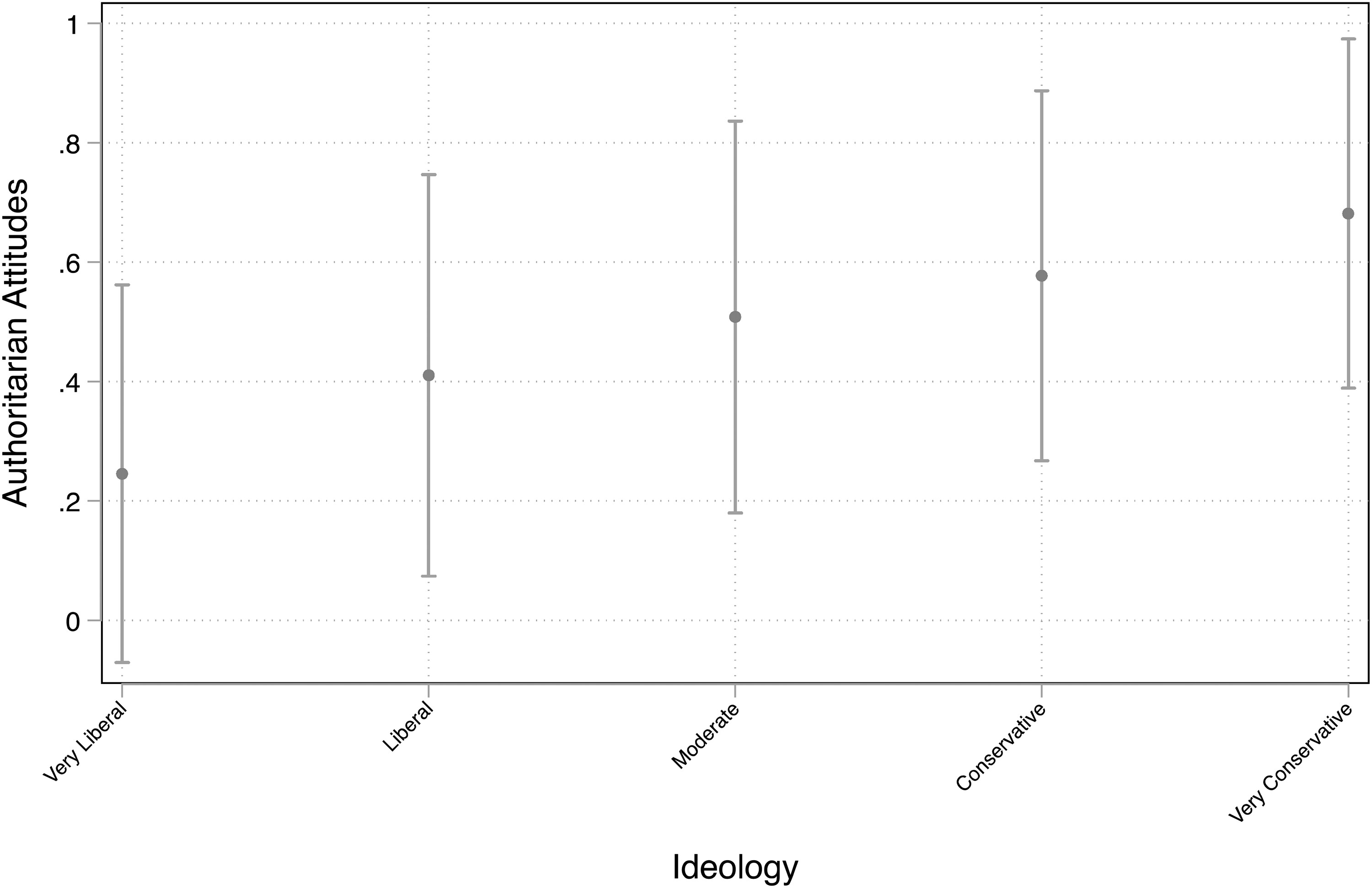
Wehde & Nowlin, 2021), we control for political ideology. We use a five-point Likert scale with 1 representing “very liberal” and 4 representing “very conservative” to measure political ideology. As shown in
Figure 1, a t-test reveals that the difference between the aggregate authoritarian attitudes of those who self-report as very liberal and those who are very conservative is statistically significant at the p < .001 level. In
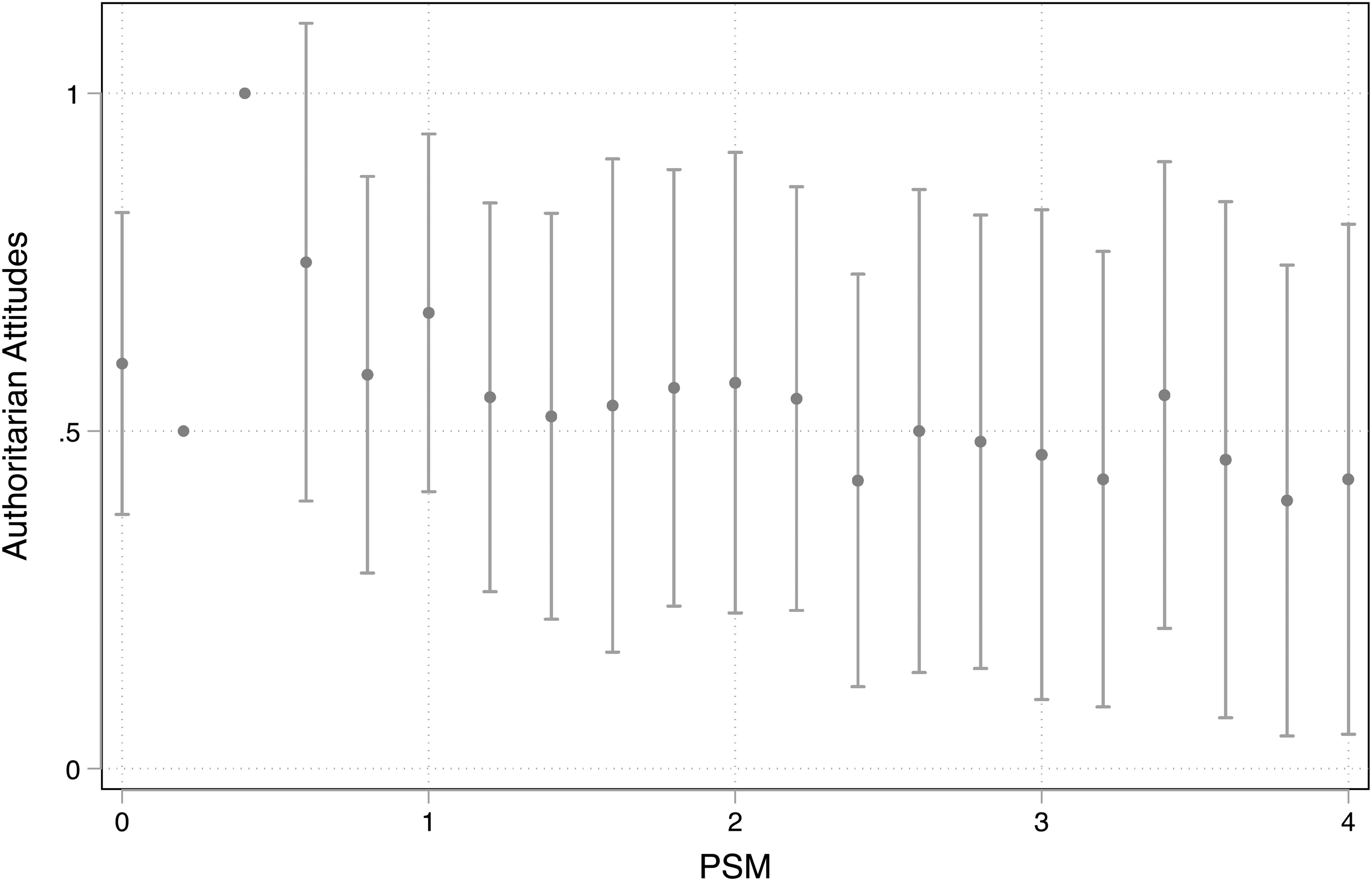
Figure 2, which shows the variance of authoritarian attitudes across various levels of PSM, unlike political ideology, we do not see a significant difference in authoritarian attitudes across different levels of PSM. Both constructs, PSM and authoritarian attitudes, share a core appreciation for the role of institutions in maintaining societal well-being.
Second, we include a number of sociodemographic control variables similar to those used in other empirical works that investigate the public's opinion formation on multilevel federalist systems in the United States (
Wehde & Nowlin, 2021), including gender, age, race and ethnicity, income, and education. These demographic control variables have the potential to shape both interactions with each level of government (
Moynihan et al., 2015) and socialization on issues related to governance (
Ray et al., 2023).
Ordinal logistic regression is used to examine trust in each level of government since the dependent variable for each service area has four ordinal response options ranging from “no trust at all” to “a great deal of trust.” This ordinal dependent variable structure would typically be well suited for ordinal logistic regression. However, Brant tests that reveal violations of the parallel regression, or parallel odds, assumption, so, as recommended by
Long and Freese (2014), we use stereotype logistic regression, which relaxes the parallel odds assumption for ordinal regression. Checks for multicollinearity indicate no correlation |r| > .4. Correlations |r| > .7 would likely distort model estimation (
Dormann et al., 2013).
Statistical Results
In
Table 2, Models 1–3 test our first three hypotheses on authoritarian attitudes and their association with trust in government across levels of government. However, for hypothesis one, we observe no association between trust in local government and authoritarian attitudes, rather than a negative relationship. Models 3–6 in
Table 2 add an interaction term between authoritarian attitudes and PSM to test hypothesis four. Our findings are mostly consistent with our hypotheses and prior literature, with two notable exceptions: first, we observe no significant association between authoritarian attitudes and trust in local government (H1 predicted a negative relationship), and second, the interaction between PSM and authoritarian attitudes is significant across all three levels of government, whereas H4 predicted this interaction only at the state and federal levels. The null finding for local government may reflect that trust at this level is driven more by direct service experiences and performance perceptions (
Cooper et al., 2008;
Van Ryzin, 2007) than by the psychological need for hierarchical control that shapes trust in more centralized institutions. The broader-than-expected moderating role of PSM suggests that the convergence of public service values and authoritarian dispositions may activate a generalized pro-institutional trust (
Kim & Kim, 2024) that extends even to levels of government where authoritarianism alone does not predict higher trust. For a substantive interpretation of the hypothesized relationship between authoritarian attitudes and trust, see
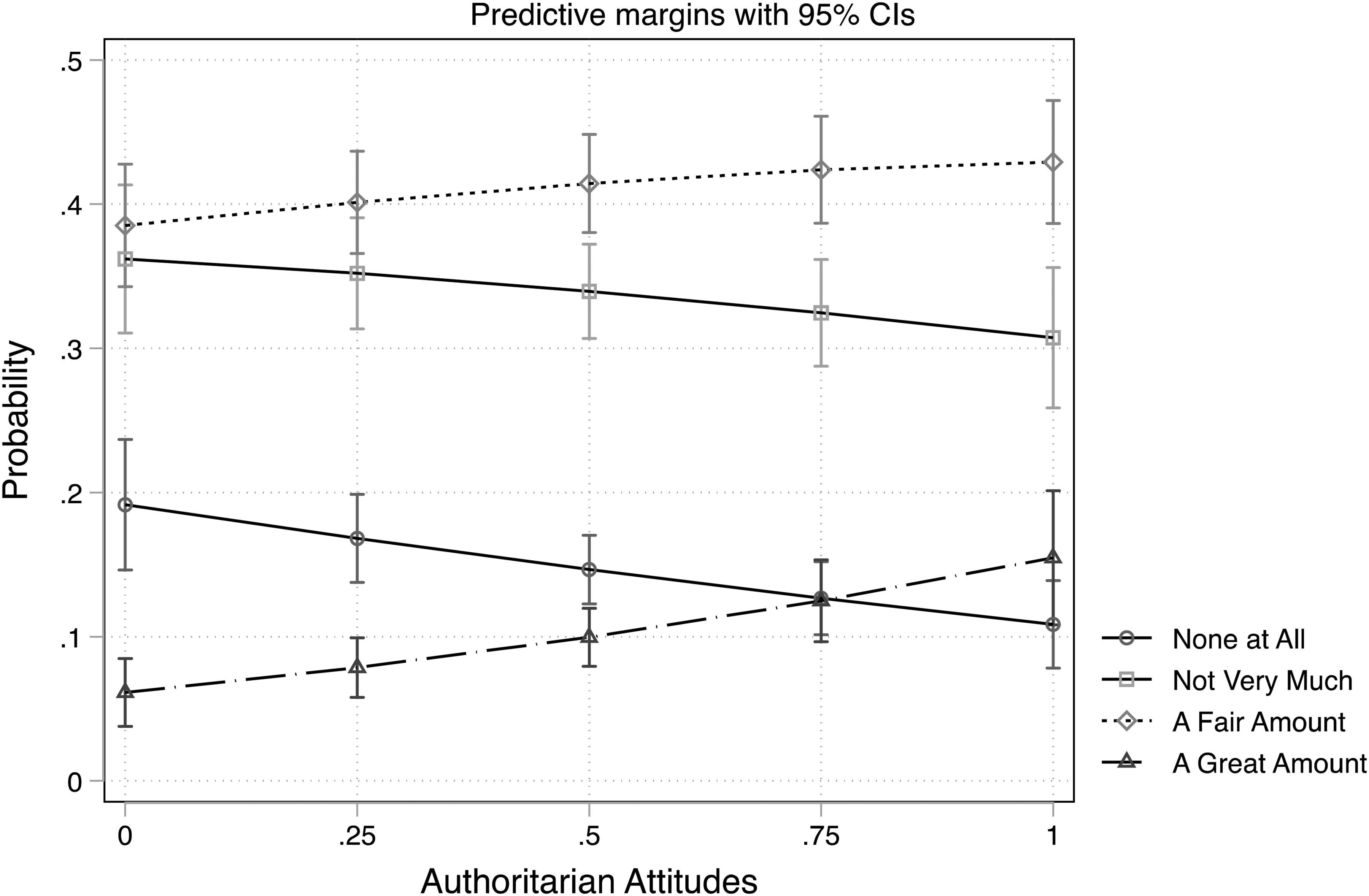
Figure 3. For the same relationship, contingent on PSM, see the margins plot presented in
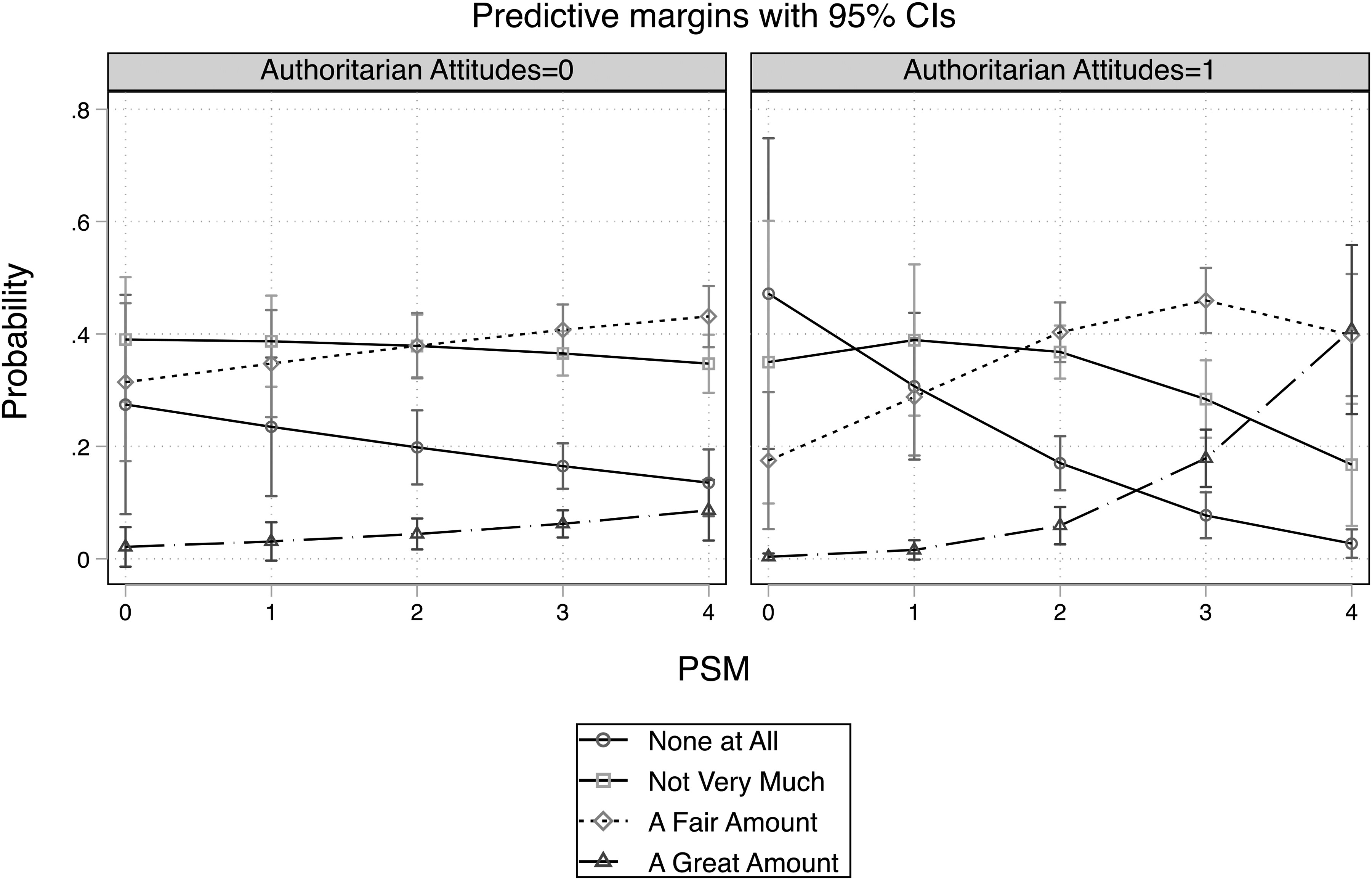
Figure 4.
As shown in
Figure 4, the effect of Public Service Motivation (PSM) on the predicted probability of support intensifies significantly when authoritarian attitudes are high. Among low-authoritarian individuals, increasing PSM results in only modest changes, with the probability of reporting “A Great Amount” of support rising by about 7 percentage points (from ∼0.03 to ∼0.10). In contrast, among high-authoritarian individuals, the same increase in PSM is associated with a more than 40-point increase in the likelihood of reporting “A Great Amount” (from near-zero to over 0.4), while the likelihood of reporting “None at All” falls by a comparable margin. These results indicate that authoritarianism moderates the impact of PSM, amplifying its effect on the strength of support.
Additionally,
Figure 3, from
Table 1 Model 2, is similar to the findings for the same relationship in
Table 1 Model 3 for the association between authoritarian attitudes and trust in the federal government. The interaction term visualized in the margins plot in
Figure 4, taken from
Table 1, Model 5, shows a similar relationship to the results for the interaction term at the local level, Model 4, and federal government, Model 6, in
Table 2. In the models without the interaction term for PSM and authoritarian attitudes, authoritarian attitudes are positively associated with trust in the state and federal government in the United States, but not local governments. For these models, as seen in
Figure 3, the probability of reporting “A Great Amount” or “A Fair Amount” of trust in state and federal government increases as an individual's attitudes become more authoritarian. Interestingly, the relationship between interaction between PSM and authoritarian attitudes and trust in government is significant across all three levels of government.
Figure 4 shows that the effect of PSM on the outcome of trust in government is largely dependent on authoritarian attitudes. Among low-authoritarians, PSM has a modest positive effect on support. Among high-authoritarians, PSM has a much stronger effect. Those high in both authoritarianism and PSM have a higher probability of reporting higher levels of trust in government, whereas those high in authoritarianism but low in PSM have a lower probability of reporting high levels of governmental trust. This interaction implies that PSM is especially powerful in shaping behavior among those with high authoritarian leanings.
Among non-authoritarian attitudes variables, only a few are significant across more than one model. In the first three models, PSM is also significant in the first three models with a positive correlation at the subnational and federal levels. These subnational findings regarding the positive association between PSM and trust in government are consistent with
Jensen and Piatak (2024). However, the direction of findings for the relationship between PSM and the federal government is positive and significant, whereas those reported by
Jensen and Piatak (2024) are non-significant. This difference in findings might reflect the change in administration, from the first Trump administration to the Biden administration, and that, similar to educational attainment, the relationship between PSM and trust in government is contingent on the perceived quality of democratic governmental institutions (
Charron & Rothstein, 2016). Across all models, only three control variables consistently reach statistical significance across multiple models: political ideology, having non-adult children, and identifying as Black compared to identifying as white, and these effects are primarily observed at the federal level. Unsurprisingly and consistent with prior research, those who are more conservative have lower levels of trust in government (
Jensen & Piatak, 2024).
Discussion
Given declining levels of public trust in government, how do authoritarian attitudes, which are on the rise, correspond to trust across levels of government in the U.S. federalist system? Drawing upon data from the 2023 Cooperative Elections Study, we find authoritarian attitudes correspond to higher levels of trust in both state government and the federal government. In including PSM, we find authoritarian attitudes correspond to lower levels of trust but that combined with PSM increases public trust. This study advances research on federalism, trust in government, authoritarian attitudes, and PSM. We discuss the contributions and implications for each of these areas in turn.
By demonstrating that authoritarian attitudes constitute a meaningful boundary condition on how individuals trust different levels of government, we contribute to research on federalism. Research on federalism suggests that citizens form differentiated perceptions of various levels of government even in the absence of explicit knowledge about the U.S. federal system (
Schneider et al., 2011;
Wehde & Choi, 2022;
Wehde & Nowlin, 2021), our findings suggest that these perceptions are moderated by psychological attitudes, specifically an individual's orientation toward authority and institutional control. Authoritarian-leaning individuals express significantly more trust in state and federal governments, even when controlling for political ideology and sociodemographic factors, but not in local governments.
This pattern challenges the normative assumption that decentralization inherently fosters stronger democratic legitimacy by promoting proximity and responsiveness (
Dahl, 1994;
Muñoz, 2017;
Proszowska et al., 2021;
van Assche & Dierickx, 2007). Instead, for some citizens, especially those drawn to order, certainty, and security, fragmented local governance may be perceived as ineffective. In this context, authoritarian attitudes may subtly undermine one of federalism's core promises: the capacity to build legitimacy through institutional diversity and increased proximity. This has important implications for theories of trust in federalist systems.
The statistically significant interaction between public service motivation (PSM) and authoritarian attitudes further suggests that psychological traits do not operate in isolation. Among those with high PSM, authoritarian tendencies amplify trust in more centralized levels of government, indicating that even altruistic civic orientations are filtered through deeper value systems. Scholars have called for an examination of the values underlying PSM (
Vandenabeele, 2007), and some have found that high PSM individuals may have their own interpretations of the public interest (
Ripoll & Schott, 2023;
Weißmüller et al., 2022). Contributing to PSM theory, our findings highlight how PSM may interact and moderate public opinion, in this case, authoritarian attitudes and trust across all levels of government.
Our findings also invite consideration of a deeper tension within PSM theory.
Weber (1946) recognized that bureaucratic authority depends on obedience and hierarchical control, qualities that may align more closely with authoritarian orientations than with the democratic, altruistic ideals typically associated with PSM. Scholars of administrative evil have warned that well-intentioned public servants can participate in morally problematic and unconscionable actions when institutional loyalty overrides democratic accountability (
Adams & Balfour, 2014). The amplified trust we observe among high-PSM, high-authoritarian individuals may reflect this dynamic precisely: a convergence of public service commitment and deference to centralized authority that, under certain conditions, could undermine rather than support democratic governance. Future research should examine whether these trust patterns translate into meaningful behavioral differences in administrative contexts, including discretionary decision-making, regulatory enforcement, and civic engagement.
It is also worth noting that authoritarian attitudes are not confined to one end of the political spectrum. Historical and contemporary examples suggest that both progressive and conservative movements have attracted supporters with strong authoritarian predispositions (
Wronski et al., 2018). The ideologically neutral measurement approach employed in this study captures this variation, and our inclusion of political ideology as a control variable allows us to isolate the independent contribution of authoritarian attitudes. The finding that the PSM-authoritarianism interaction operates across levels of government, even after controlling for political ideology, suggests that these dynamics may be relevant across the political spectrum, a point that future research could explore more directly by examining whether the trust-amplifying effect of PSM among high authoritarians differs by ideological orientation.
For policymakers and administrators, these findings highlight the need to move beyond a one-size-fits-all (e.g., transparency or citizen engagement) approach to rebuilding public trust. Interventions that emphasize local engagement or participatory reforms may not resonate with all citizens, particularly those predisposed to view centralized authority as more legitimate or effective. If a substantial portion of the public distrusts local institutions not due to performance (e.g.,
Van Ryzin, 2007), but due to fundamental beliefs about authority, then improving trust will also require addressing narratives about the role and value of local governance. For practitioners, these findings suggest that strategies for building public trust may need to be tailored to the psychological profiles of the populations they serve. At the local level, where authoritarian attitudes do not correspond to higher trust, administrators may need to emphasize institutional competence, clear lines of authority, and visible coordination with state and federal agencies to build confidence among citizens who are predisposed to value hierarchical governance. Transparency and citizen engagement initiatives, while valuable, may be insufficient on their own if segments of the public fundamentally associate legitimacy with centralized authority. At the state and federal levels, where authoritarian attitudes correspond to greater trust, administrators should be attentive to the possibility that trust built on deference to authority may be fragile if institutional performance falters or if political transitions disrupt perceptions of stability. More broadly, the finding that PSM amplifies trust across all levels of government among high authoritarians suggests that fostering public service values, through civic education, volunteerism, or service-oriented messaging, may be a particularly effective lever for rebuilding trust among populations where it is otherwise low.
Several limitations should be noted. First, although the CES data are nationally representative, the cross-sectional design limits our ability to make causal claims about the relationship between authoritarianism and institutional trust. Longitudinal or experimental research could better establish directionality and assess whether shifts in authoritarian attitudes over time predict changes in trust. Second, while our analysis focuses on the United States, it remains an open question whether similar patterns exist in other federal systems with differing institutional designs and political cultures. Comparative work could further illuminate the contextual boundaries of these dynamics. Lastly, since certain policy actors are trusted more than others that may in turn influence public behaviors, such as in the case of the COVID-19 pandemic (
Robinson et al., 2021), and research finds perceived threats, like in the case of the 9/11 terrorist attacks, influence authoritarian attitudes (
Hetherington & Suhay, 2011), future research should examine the role of different contexts. Additionally, while authoritarian attitudes and PSM are generally understood as relatively stable dispositional traits (
Feldman, 2003;
Stenner, 2005;
Vogel & Kroll, 2016), trust in government is more responsive to political context and external events. Further research is needed to examine the temporal stability of authoritarianism and PSM as dispositional traits and explore their interaction over time. The 2023 CES data were collected during a period of heightened political polarization between presidential administrations, which may have influenced trust levels. Longitudinal research tracking the same individuals across different political contexts would help disentangle stable dispositional effects from context-dependent variation in trust. Despite these limitations, the findings contribute to a deeper understanding of how federal structures are perceived and legitimized by diverse publics. As debates surrounding the efficacy and design of federal systems persist, recognizing the psychological foundations of public trust may be critical to sustaining their long-term democratic viability.
Conclusion
This study advances our understanding of federalism and public trust by identifying authoritarian attitudes as a psychological boundary condition that shapes institutional trust across levels of government. Our findings reveal that individuals high in authoritarianism express significantly greater trust in centralized authority at the state and federal levels, but not in local government. Moreover, interactions with public service motivation suggest that trust in government emerges not only from institutional performance or ideological alignment but also from deeper motivation (e.g., PSM) and psychological attitudes (e.g., authoritarianism). In particular, the finding that high PSM amplifies trust among high-authoritarian individuals invites further scrutiny of the normative assumptions underlying PSM theory, specifically, whether public service motivation uniformly supports democratic governance or whether, under certain dispositional conditions, it may reinforce deference to centralized authority at the expense of democratic accountability. These dynamics highlight the importance of accounting for individual-level traits and views in explaining trust asymmetries in federal systems. As democratic legitimacy increasingly becomes a concern in the United States, understanding how individual views like authoritarianism interact with multilevel governance is critical to sustaining responsive and legitimate federal structures in an era of political polarization and institutional skepticism.
Declaration of Conflicting Interests
The authors declared no potential conflicts of interest with respect to the research, authorship, and/or publication of this article.
Funding
The authors disclosed receipt of the following financial support for the research, authorship, and/or publication of this article: Funding of the University of North Carolina at Charlotte Module of the Cooperative Election Study was made possible by a research grant from the National Endowment for the Arts.