Intended for healthcare professionals

Abstract

This study explores the industrial perspective on the role of orthographic projection engineering drawing within Vocational High Schools (VHS), a representative secondary-level institution in Technical and Vocational Education and Training (TVET). The research examines how orthographic projection supports students’ preparedness for future careers in the automotive and mechanical industrial sectors. Conducted in 2024, the study employed qualitative design using semi-structured interviews with five experienced industrial practitioners selected through purposive sampling. These practitioners, working in prominent automotive and mechanical companies in Indonesia, provided insights into the skills expected of VHS graduates. Thematic analysis revealed three central themes: foundational technical skills, career readiness and skills application, and cognitive and analytical growth. Findings indicate that mastery of manual orthographic drawing significantly strengthens essential technical competencies, directly supports career-specific tasks, and enhances spatial reasoning and problem-solving abilities. The integration of manual drawing techniques with digital tools prepares students to meet the evolving demands of modern industry by fostering both adaptability and proficiency across analog and digital workflows.

Introduction

Technical and Vocational Education and Training (TVET) plays a pivotal role in equipping individuals with the practical skills and knowledge required to meet modern workforce demands.1,2 Globally, TVET systems are recognized for contributing to economic development and social inclusion by providing pathways to employment and lifelong learning opportunities. This enables them to work independently or be hired for available positions, ultimately increasing national income and productivity.3,4 Therefore, in engineering education, TVET institutions are critical platforms for developing foundational competencies that align with industry needs.
In Indonesia, the significance of TVET, particularly in the engineering and technology sectors, has been underscored by national labor market surveys. Data from the National Labor Force Survey (SAKERNAS) indicate that graduates from Vocational High Schools (VHS) specializing in engineering exhibit higher employment rates than their counterparts from general education streams.5 This trend highlights the effectiveness of vocational training in preparing students for technical roles within the industrial sector. VHS is regulated by law in Indonesia as TVET in secondary-level education.6,7 For developing countries that want to improve their economies, increasing investment in vocational education seems to be the right solution. Consequently, VHS graduates are expected to fulfill the various competencies needed in the industry.
A fundamental component of engineering education within TVET is mastering engineering drawing, especially orthographic projection. Orthographic projection is a universal language in engineering, enabling precise communication of complex designs and specifications. Proficiency in this skill is essential for students to interpret and create accurate engineering drawings, which are critical in various stages of product development and manufacturing.8 For instance, engineering drawings are taught as the foundation of engineering knowledge in the first year of VHS in engineering and technology,9,10 such as automotive and mechanical. In addition, it will benefit some fields in architecture design, manufacturing, or industrial design.1113 For example, project designs need this skill in prototyping.14 Moreover, the ability to visualize and represent three-dimensional objects in two-dimensional formats fosters spatial ability and analytical skills, which are indispensable in engineering problem-solving.15,16
Recent literature underscores the need to align engineering education with workforce expectations, particularly in spatial reasoning, drawing proficiency, and communication. Souppez17 emphasized that both industry professionals and educators recognize the value of these competencies for improving graduate employability. Gummaluri et al.18 argued that integrating traditional drawing skills with digital learning approaches enhances students’ creativity, design thinking, and readiness for engineering tasks. In addition, Jianwu et al.19 introduced an artificial intelligence-based evaluation method for computer-aided drawings, showing that such tools can improve accuracy and provide timely feedback in technical drawing education. These findings support the need for vocational education systems, including those in Indonesia, to combine manual orthographic drawing instruction with digital and artificial intelligence-based tools to prepare students for evolving industrial demands.
This study aims to explore the perspectives of industry professionals on the role of orthographic projection in supporting the career readiness of VHS students. By examining practitioners’ insights from leading automotive and mechanical industries in Indonesia, the research seeks to identify the competencies developed through engineering drawing and their relevance to industrial requirements. Understanding these perspectives will inform curriculum development and pedagogical strategies within TVET institutions to better align educational outcomes with labor market demands.

Literature review

Engineering drawing

Although digital drawing tools are widely used, the ability to draw by hand is still essential in engineering education, as it provides unique benefits in developing skills and problem-solving. The ability to produce, read, and correctly interpret engineering documentation (including drawings) is critical to the work of professional engineers.20,21 Hand drawing fosters creativity and innovation by enabling students to explore design concepts freely. Ding and Zao22 stated that drawing proficiency was higher among students who had taken hand-engineering drawing courses than among self-taught practice. Research has demonstrated that hand sketches are more successful than computer printouts in conveying the dimensions of design solutions.23 This tactile and manual representation method adds depth and context to visualizing design ideas.
As a vocational student in engineering, this competency is invaluable for students as designers in reasoning and interpreting mechanical objects, especially mechanical design. In a previous depiction of designers as information processors,24 we introduced Figure 1 as the context in which the design process occurs.25 The graphic presented here is derived from the Information Processing System (IPS) model, which Newell and Simon established.26 The figure can be seen as a visual representation of the spots where information about the design can be kept. The concept comprises an internal workplace, which exists within the designer's head, and an exterior workspace, which exists outside of the designer's mind. In the design, two distinct areas are associated with two types of memory: Short-Term Memory (STM) and Long-Term Memory (LTM).25 Additionally, a “processor” is tasked with applying operators and managing the design process.
Figure 1. The framework of design environment adapted as framework and engineering drawing position.
Ten operators were found by Ullman et al.,24 who describe the problem-solving process in mechanical design. Aside from the designer, many “design state storage locations” encompass graphical representation media like paper and Computer-Aided Design (CAD) tools and additional sources such as written notes, handbooks, and coworkers. Therefore, most engineers possess expertise in creating and comprehending these formal mechanical drawings. These drawings depict the ultimate design, which is the culmination of the design process. Ullman et al.27 findings emphasize the importance of graphically representing design concepts in engineering education. Graphics as cognitive extensions seem to limit the design process. This means training in both drafting and sketching abstract concepts. Thus, good designers need graphic skills like formal drawing and informal sketching.27
Furthermore, Sorby and Baartmans16 underscore the importance of enhancing spatial visualization skills, which are crucial for engineering students, indicating that such skills can be developed through specific training programs. Hand drawing enhances spatial visualization abilities, as students must rely on manual techniques to depict three-dimensional objects accurately. Spatial visualization abilities are fundamental cognitive skills that involve the capacity to manipulate and interrelate two-dimensional and three-dimensional objects mentally.28 This ability encompasses tasks such as mentally rotating objects and accurately depicting spatial forms.29 Spatial visualization is essential in various fields, including mathematics, engineering, and design, as it aids problem-solving and visualization tasks.30 Studies have shown that spatial visualization skills are trainable and can significantly impact problem-solving performance.30 Sweller's Cognitive Load Theory (CLT) emphasizes that effective learning hinges on managing cognitive resources effectively to prevent overwhelm during complex tasks.31 This is particularly pertinent in spatial visualization tasks that require interpreting two-dimensional representations, such as orthographic projections.32 Additionally, hand drawing promotes attention to detail and craftsmanship, instilling a sense of pride and ownership in students’ work. Thus, cultivating hand drawing skills in engineering education complements digital drafting techniques, providing students with diverse visualization tools and problem-solving approaches essential for success in modern engineering professions.

Orthographic projection engineering drawing

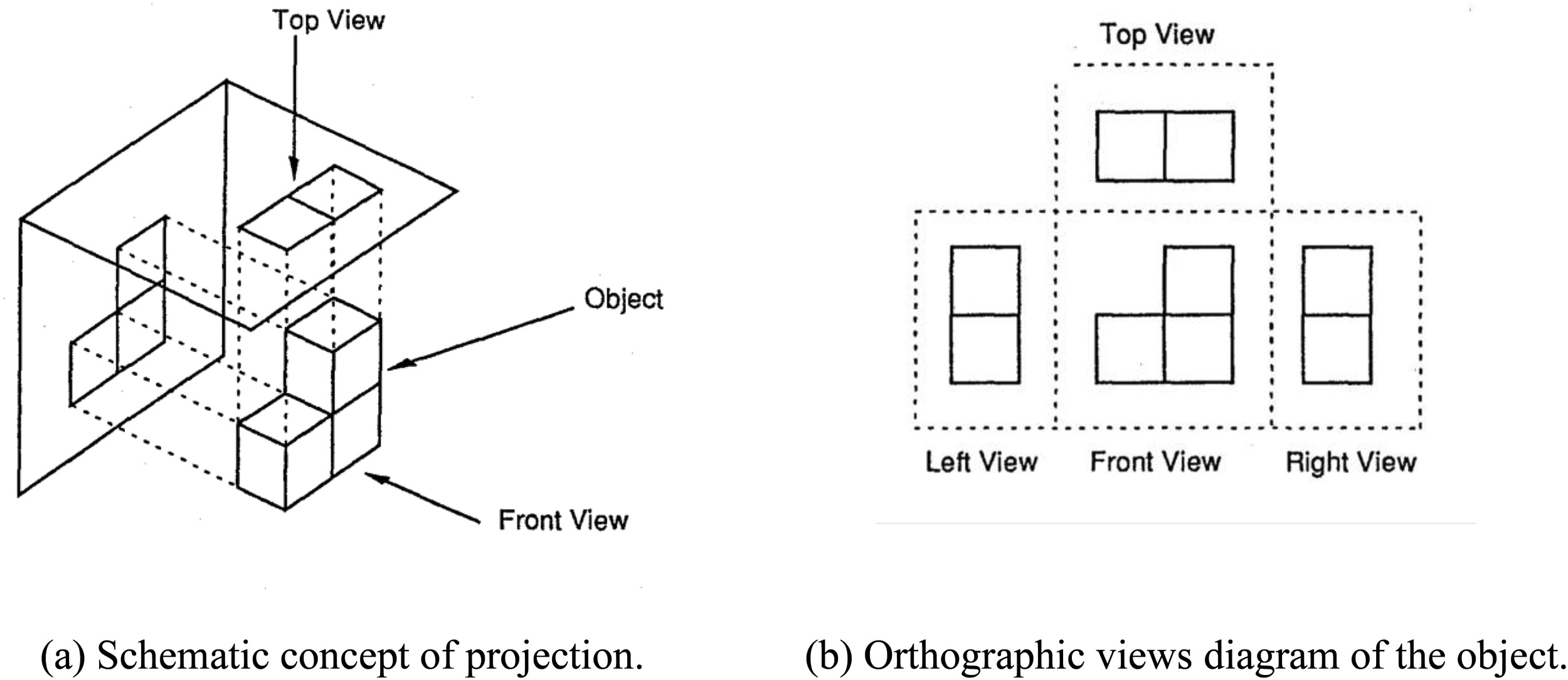
Orthographic projection is a fundamental concept in mechanical engineering, particularly useful in analyzing and designing various mechanical systems. Orthographic projection images can provide complete and precise information about the shape and size of an object.33 This concept finds practical application in areas such as robotics, where it aids in decomposing forces and analyzing motion.34 Orthographic projection is a method employed to depict 3D objects as a sequence of 2D “flat” drawings devoid of perspective with American projection (third angle) and European projection (first angle).35,36 As illustrated in Figure 2(a), the object is placed inside a viewing box and perpendicular projectors transfer its features to the front, top, and side principal planes. These planes are then conceptually rotated to lie on a single sheet to produce a coherent multiview drawing. Figure 2(b) presents the resulting orthographic diagram, with the top, front, left and right views.37
Figure 2. Diagrammatic representation of projection theory and corresponding orthographic viewpoints.37
Orthographic projection can simplify complex problems in mechanical engineering by reducing the dimensions considered.38 For example, when designing a gearbox casing, orthographic views, such as the front, top, and side projections allow engineers to accurately represent hole placements, shaft alignments, and surface details that would be difficult to interpret from a 3D model alone. This clarity supports precise manufacturing and reduces the risk of design misinterpretation. The orthographic components are independent, which helps isolate the effects of individual loads or displacements on the overall system.39 The orthographic principle supports the mathematical foundation of orthographic projection in mechanical engineering. This principle states that the projection of a vector onto a subspace is the closest point in the subspace to the original vector, and this is achieved by minimizing the squared distance between the vector and its projection. This minimization leads to a set of linear equations that can be solved to find the projection coefficients. These coefficients are then used to construct the projected vector, which represents the most significant components of the original vector relevant to the engineering analysis.40

Methodology

Study context and participants

This study employs a qualitative research methodology to explore how hand engineering drawing on orthographic projection supports VHS students in their future careers from an industrial perspective. This research is a qualitative approach to understanding deeply41 and we conducted semi-structured interviews with professionals from the largest mechanical and automotive industries. The participating industrial practitioners were employed at large-scale mechanical and automotive companies operating in Indonesia, primarily located on the island of Java. These companies include both multinational corporations and national manufacturers engaged in high-volume production, component design, and automotive research and development. Their operational scales range from mass production facilities serving global markets to specialized design and prototyping units.
The perspectives shared by these practitioners reflect the demands of large-scale manufacturing environments, where precision, standardization, and communication efficiency are critical. For instance, the emphasis placed by respondents on mastering orthographic projection aligns with the complex documentation and coordination required in large production systems. This may differ from the needs of Small-to-Medium Enterprises (SMEs), where more flexible and less formalized design processes are often used. Recognizing this distinction, we have noted in the discussion that future research could expand on this study by comparing the views of practitioners from SMEs or other specialized industry segments.
Participants in this study were selected using purposive sampling, which enabled the researchers to obtain targeted, relevant data to effectively address the research questions.42 Industrial practitioners were identified through LinkedIn by evaluating their current job positions within relevant industries. Initially, 15 potential Industry Practitioner (IP) respondents from prominent automotive and manufacturing technology companies in Indonesia were contacted through direct messaging and email invitations. Of these candidates, eight responded positively and scheduled interviews. However, due to professional commitments and scheduling conflicts, only five respondents ultimately participated in the interviews, while three did not follow through. Using targeted samples allows for a more focused and in-depth examination of complex phenomena, Jumbe and Meyrick43 highlight that a smaller, carefully selected sample can yield nuanced insights into participant experiences that might be overlooked in larger samples. Such an approach facilitates a deeper understanding of the subtleties inherent in participants’ perspectives and responses. The final sample comprised of senior engineers, section head production, research and development, design engineer, and trainer. One of the study participants, who works as a mechanical trainer, explained that their role includes supervising and evaluating the technical skills of mechanics, many of whom are VHS graduates. In this context, orthographic projection is an essential skill that enables graduates to read technical drawings, interpret component assemblies, and perform repairs or modifications with accuracy. The demographic of IP is shown in Table 1.
Table 1. Demographic profiles of IP interviewed.
IDGenderAge (Years)Academic LevelAcademic BackgroundPositionWork Experiences in YearIndustry Specialize
IP 1Male34Bachelor's DegreeMechanical EngineeringSection Head of Production10Mechanical Engineering
IP 2Male35Bachelor's DegreeMechanical EngineeringResearch and Development10Mechanical Engineering
IP 3Male40Master's DegreeManagement EngineeringSenior Engineer12Automotive Engineering
IP 4Male45Master's DegreeMechanical EngineeringMechanic Trainer15Automotive Engineering
IP 5Female28Bachelor's DegreeMechanical EngineeringDesign Engineer5Mechanical Engineering

Data collection

The data were gathered in 2024 through semi-structured interviews conducted at prominent automotive and manufacturing technology companies in Java, Indonesia. These interviews offered the opportunity to investigate important topics while enabling participants to articulate their thoughts freely and experience42 through open-ended questions specifically formulated to elicit comprehensive and detailed responses, as summarized in Table 2. Interviews were conducted using video conferencing through Zoom and Microsoft Teams based on the availability and preferences of the participants to ensure that all responses were effectively recorded. The duration of the interviews was around 50 to 60 min for each session.
Table 2. Interview questions categorized by aspect and sub-aspect of orthographic projection competency in vocational education.
NoAspectSub AspectQuestion
1Relevance of Orthographic ProjectionImportance in Engineering WorkQ1: How important is the orthographic projection of engineering drawings in supporting mechanical and automotive engineering work?
  Impact on Other Technical SkillsQ8: Do you think learning orthographic projection drawing affects other technical skills in the industry? Can you give specific examples?
  Career RecommendationsQ9: What are your recommendations for orthographic projection hand drawing to support students’ future career prospects?
  Relevance of Manual DrawingQ2: Is it still relevant to learn by hand drawing in vocational schools in the first semester?
2Orthographic Projection CompetencyUnderstanding 3D ObjectQ3: Do you think learning engineering drawing by hand, especially on orthographic projection in 3D drawing understanding, helps students in industrial work?
  Projection PrincipleQ4: Do you think learning engineering drawing by hand, especially orthographic projection on projection principles, can help students in industrial work?
  Interpreting ViewsQ5: Do you think that by learning engineering drawing by hand, especially in orthographic projection, the ability to represent 3D drawings in 2D can support job prospects in the industry?
  Geometric ConstructionQ6: Do you think that learning engineering drawing by hand, especially in orthographic projection and the ability to construct geometry, can support job prospects in the industry?
  International Standards (First and Third Angle)Q7: Can learning hand-drawn engineering drawings, especially the orthographic projection of European and American views, help students in their industrial work?

Data analysis

The present study utilized thematic analysis, following the procedures outlined by Neuendorf,44 to examine the collected data. Semi-structured interviews were conducted via Zoom and Microsoft Teams, depending on participants’ availability and preference. All interviews were video recorded with informed consent and transcribed verbatim for analysis. The coding and analysis were performed using ATLAS.ti version 25, which supported the systematic organization and categorization of qualitative data. A total of 13 initial codes were generated through a combination of open and axial coding. Open coding was used to segment the data into meaningful units, while axial coding identified patterns and relationships among these codes. Three independent coders were involved in the analysis process. To ensure the reliability of the coding, a cyclical and iterative approach was adopted, where coders reviewed, discussed, and refined the codes and emerging themes. The inter-coder agreement was assessed using Fleiss’ kappa, in accordance with McHugh,45 which is appropriate for evaluating consistency among multiple coders. The analysis continued until a consensus agreement exceeding 70% was achieved, with the final inter-coder agreement reaching 70.6%.45 The resulting themes were carefully refined to accurately reflect the participants’ perspectives and experiences.

Ethical considerations

Ethical approval was obtained from the relevant institutional review board from the Faculty of Engineering at Universitas Negeri Semarang with No.B/5181/UN37.1.5/KP.15/2025. Participants were informed about the purpose of the study, assured of their anonymity and confidentiality, and provided with informed consent forms before the interviews. Participation was voluntary, and participants could withdraw from the study at any time without any consequences.

Results

The thematic analysis of the interview transcripts revealed substantial insights into how hand engineering drawing on orthographic projection supports vocational high school students in their future careers, particularly from an industrial perspective. Three main themes emerged: Foundational Technical Skills, Career Readiness and Skills Application, and Cognitive and Analytical Growth.
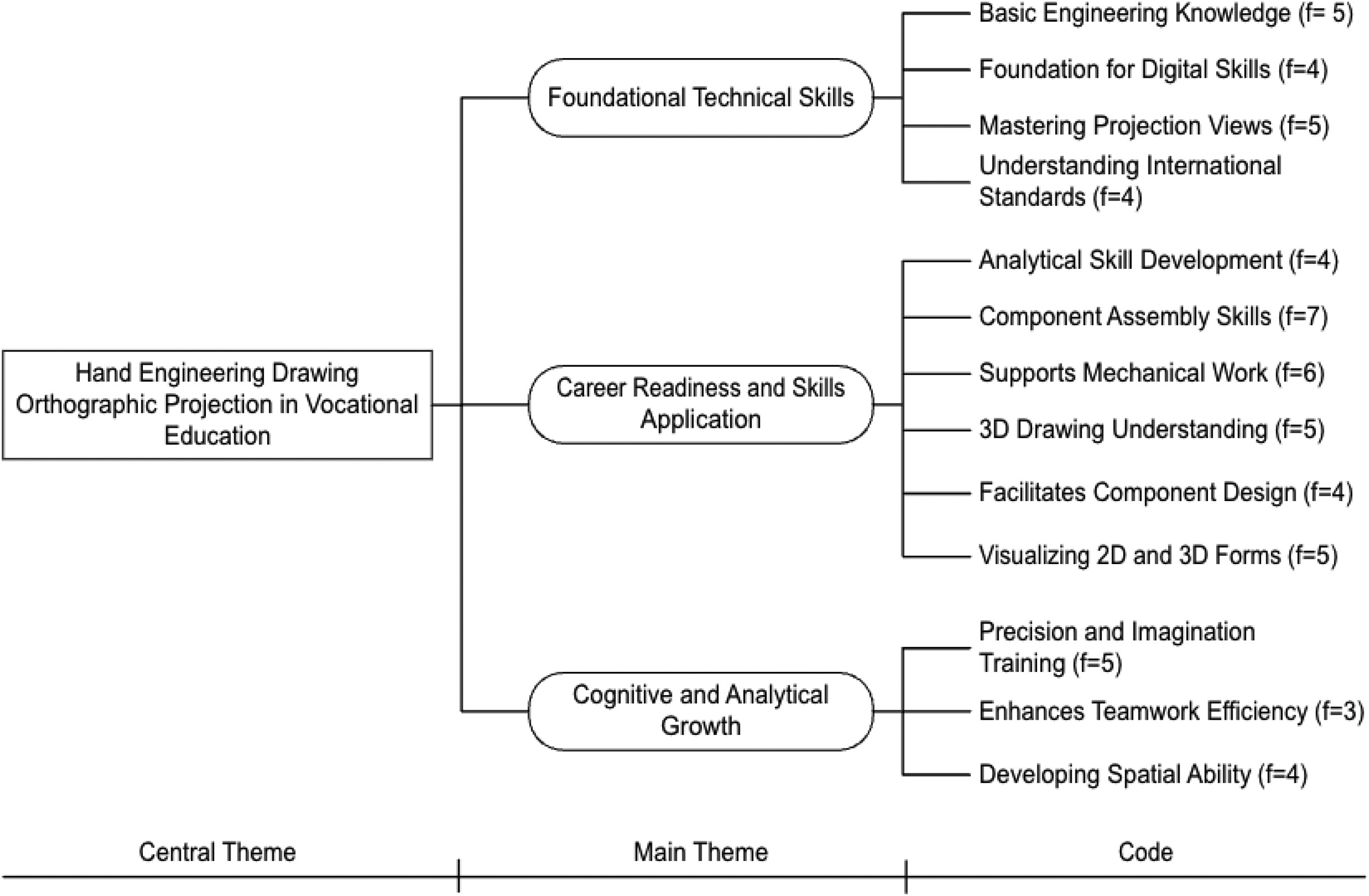
Based on the findings in Figure 3 and representative transcripts in Table 3, the importance of orthographic projection engineering drawing skills for VHS students in their future careers has been identified through thematic analysis.
Figure 3. Initial thematic maps based on interview.
Table 3. Representative transcripts for codes.
NoCode (s)Transcript
1Basic Engineering KnowledgeHand drawing in orthographic projection builds the basic understanding of mechanical parts. If students skip this, they’ll struggle later, even with software. It's the backbone of design thinking in engineering (IP1).
We see recruits who lack basic drawing skills struggle to interpret designs. Those with orthographic knowledge, even manual, adapt faster to technical roles in production (IP4).
Manual orthographic drawing makes students aware of structure, alignment, and dimensioning. It's not just a school subject. It's core to engineering logic (IP5).
2Foundation for Digital Drawing SkillsWithout understanding projection, you can’t expect someone to jump into SolidWorks or AutoCAD. Manual drawing is like learning grammar before writing essays in a new language (IP2).
Those who understand hand-drawn orthographic projections find it easier to grasp digital workflows. It forms a smooth bridge to modern tools (IP3).
Digital tools are powerful, but the human thought process behind the design starts with paper. Hand drawing strengthens that foundation (IP5).
3Mastering Projection ViewsIn our industry, drawing multiple views is non-negotiable. New hires must be fluent in top, front, and side projections. Manual training helps them see those views in their mind (IP1).
Manual orthographic drawing develops their attention to detail. Without mastering projections, components can’t be communicated clearly to machinists or designers (IP2).
Students who practice multiple views can produce precise work. They catch inconsistencies early because they know what to expect from each angle (IP4).
4Understanding International StandardsThe orthographic drawing includes ISO standards, line thickness, and hidden lines. If students know them from school, they quickly adjust to our documentation protocols (IP3).
There's less time wasted on retraining if they already follow standard conventions. Manual drawing enforces discipline that digital shortcuts often miss (IP4).
When we collaborate globally, our drawings must follow standards. Those familiar with orthographic standards don’t need to be micromanaged; they speak the same language (IP5).
5Analytical Skill DevelopmentManual drawing forces students to think step-by-step. They analyze structure, symmetry, and function while drafting, which builds strong analytical thinking (IP1).
Breaking complex parts into views trains the mind to dissect problems logically. That's an essential trait in diagnostics and quality control roles (IP2).
Orthographic drawing isn't just about lines. It's about logic. Students who understand how to convert a real object into 2D views are naturally better at problem-solving (IP3).
6Component Assembly SkillsWhen students can draw how parts fit together, they understand more than just design. They grasp functionality. That's valuable on our assembly lines (IP1).
Orthographic drawing teaches how individual components relate spatially. That skill is crucial when assembling complex machinery (IP3).
Those who’ve practiced drawing assemblies manually are better at spotting potential misfits. It translates into fewer errors during the actual assembly of IP5.
7Support Mechanical WorksIn our maintenance team, having new workers who can read and draw orthographic views makes repairs work much easier (IP2).
Sometimes, we work with old blueprints or incomplete digital files. Manual drawing skills help young technicians reconstruct missing parts or adjust designs on-site (IP4).
We once had a trainee who sketched a missing bracket from a broken machine. That kind of practical drawing ability is rare but very useful (IP5).
83D Drawing UnderstandingOrthographic projection helps them think in 3D. Even with CAD, spatial thinking matters, students with manual drawing experience navigate 3D tools more intuitively (IP1).
Students who’ve visualized objects in 2D learn faster in 3D modeling tasks. They don’t need as much trial and error (IP3).
Manual practice helps them see the shape in their minds before modeling. That speeds up concept development and reduces errors (IP4).
9Facilitates Component DesignSketching ideas by hand is still a big part of early-stage design. Students who can quickly visualize a part manually are more valuable during concept work (IP2).
Orthographic drawing allows designers to test ideas on paper before committing to digital tools. It encourages creative thinking (IP4).
Those who master hand drawing approach component design with deeper consideration. They think more about proportions and functions (IP5).
10Visualizing 2D dan 3D formsManual orthographic projection enhances their ability to rotate parts and switch between 2D and 3D perspectives mentally. That's key in quality inspection, too (IP1).
This visualization skill lets them catch potential flaws early. It improves efficiency and reduces mistakes in both modeling and manufacturing (IP3).
Whether on paper or screen, shifting between flat drawings and mental models is an engineering superpower. Manual drawing builds that from the start (IP5).
11Precision and Imagination TrainingOrthographic drawing requires patience and precision. Students develop fine motor skills and learn to work within tight tolerances, something machines can’t teach (IP2).
When students imagine a machine part and draw it precisely, they train creative and technical muscles. That duality is fundamental in product design (IP4).
We value creativity but also need control. Manual drawing disciplines students to balance imagination with engineering accuracy (IP5).
12Enhance Teamwork EfficiencyWhen someone can sketch an idea quickly, meetings move faster. Manual drawing helps team members communicate visually, especially across departments (IP1).
We encourage even our senior engineers to use hand sketches to explain problems. It's faster than digital tools in brainstorming sessions (IP3).
Being able to draft a quick orthographic sketch in a team setting avoids misinterpretations. It's a practical communication tool that saves time (IP5).
13Developing Spatial AbilityWe often find students with strong manual drawing backgrounds excel in roles requiring spatial reasoning. They mentally construct parts before touching software (IP2).
Spatial ability is critical in layout design and machine configuration. Orthographic projection exercises strengthen this ability better than just watching videos or using software (IP3).
Manual orthographic work trains their eyes and brain to see beyond the flat surface. That makes a big difference in design accuracy (IP4).

Foundational technical skills

Manual orthographic drawing provides essential foundational technical skills for students’ future careers. Interviewees emphasized that hand engineering drawing, specifically orthographic projection, provides essential foundational skills for mechanical and automotive engineering careers. The frequency of mentions of basic engineering knowledge (5 times) underscores its perceived importance as a core educational component. Respondents such as IP1 highlighted that orthographic projection is foundational for understanding mechanical structures essential for roles in automotive and mechanical industries. IP4 and IP5 further stressed that mastering manual drawing skills accelerates adaptability and effectiveness in technical roles. Furthermore, mastering projection views is a fundamental skill that vocational students must have to support future jobs as engineers, mechanics, technicians, or operators.
Foundation for Digital Drawing Skills was also frequently emphasized (4 times). IP2 emphasized that manual drawing underpins competent use of CAD software, likening it to learning grammar before writing essays. IP3 and IP5 reinforced this idea, suggesting manual drawing facilitates smooth transitions to digital platforms, enhancing adaptability. Mastering Projection Views, identified through multiple mentions (5 times), is recognized as essential for the accurate interpretation and creation of engineering drawings. IP1 and IP2 specifically emphasized its importance in clear communication and precision in industrial settings, with IP4 noting it helps students quickly identify inconsistencies
Additionally, understanding international standards (4 times) was highlighted as crucial for engaging effectively in a global industrial environment. as IP3, IP4, and IP5 indicated familiarity with standards like ISO reduces onboarding time and increases new workers’ autonomy in global collaborative contexts, emphasizing discipline and consistency in drawing practices. Students will be able to compete for jobs in the engineering industry more widely in this way. For example, the ability to hand draw engineering drawings as the foundation for digital skills has been mentioned 4 times. Interviewees agreed that students who have mastered orthographic projection hand drawing will learn digital drawing faster.

Career readiness and skills application

This robust theme frequently mentioned how these skills translate directly into industrial applications. Codes under this theme, such as component assembly skills and support mechanical work, were each mentioned 7 and 6 times, indicating a strong link between educational practices and workplace requirements. Practitioners IP1, IP3, and IP5 emphasized the practical advantage of understanding how components interconnect, significantly reducing assembly errors. Support mechanical works underscored practical advantages, especially in maintenance and troubleshooting roles. IP2, IP4, and IP5 highlighted instances where orthographic skills directly contributed to efficient repairs and accurate interpretation of legacy documentation. Analytical Skill Development was mentioned four times, highlighting how manual drawing promotes systematic thinking and logical analysis. IP1, IP2, and IP3 explained that this fosters critical problem-solving abilities crucial for diagnostic and quality-control roles.
The ability to visualize 2D and 3D forms and 3D Drawing Understanding (5 times) was noted as particularly valuable for interpreting and creating engineering drawings, which are everyday tasks in the engineering sector. IP1, IP3, and IP4 articulated the benefits of manual orthographic projection in enhancing spatial comprehension, reducing modeling errors, and accelerating the transition to digital 3D platforms. IP1, IP3, and IP5 underscore the ability to mentally rotate and visualize components, which is fundamental for accurate quality control and detailed design processes. Facilitates Component Design, which was mentioned four times, confirmed the critical role of manual orthographic skills during conceptual design phases, emphasizing creativity, innovation, and functionality.

Cognitive and analytical growth

Based on Figure 3, the hand engineering drawing on Orthographic projection supports cognitive and analytical growth. Precision and imagination training (5 times) and developing spatial ability (4 times) point to the cognitive benefits of learning hand drawing. IP2, IP4, and IP5 noted manual orthographic drawing uniquely balances meticulousness in technical accuracy with creative design thinking. These skills enhance students’ ability to perform tasks requiring high precision and creative problem-solving, which are essential in the technical and engineering fields. Moreover, it is a foundational skill crucial for roles demanding robust spatial reasoning, accurate mental visualization, and enhanced performance in technical and design tasks.
Orthographic projection in engineering drawing also enhances teamwork efficiency through courses and tasks developed by teachers in the class, which is mentioned 3 times. IP1, IP3, and IP5 identified quick, clear manual sketches as powerful tools for effective visual communication, reducing misunderstandings, and enhancing productivity within team settings. Respondents highlighted how manual sketches facilitate more interactive discussions and enable immediate feedback among team members, promoting smoother collaboration and faster decision-making.

Discussion

The results revealed that hand engineering drawing significantly impacts vocational education by providing a solid foundation of technical skills, enhancing career readiness, and fostering cognitive growth. These aspects are discussed below, reflecting on how they support students’ transition into industrial careers.
A strong foundation in engineering principles, including the proficiency to comprehend and analyze engineering drawings, is needed for success in any professional vocation. The recurring focus on this feature highlights its vital function in students’ education. For instance, in a more expansive job market like engineering, individuals are typically hired for roles that primarily demand specialized knowledge and skills.4648 Furthermore, acquiring knowledge about various projection perspectives and adhering to international standards equips students with the skills required to thrive in both local and global industrial careers.49 Third-angle projection is primarily used in the United States and Canada, while first-angle projection is commonly applied across Europe and much of the rest of the world. According to Greed,50 both first angle and third angle projections are recognized as having equal status and are approved internationally. ISO Standard 1101:2004 presents all figures in first-angle projection, with dimensions and tolerances given in millimeters. Mastery of these international standards enables students to meet the expectations of both local and global industries, thereby enhancing their employment prospects.
Integrating hand-drawn orthographic projection in engineering education is pivotal for developing foundational technical skills essential for mechanical and automotive engineering careers. Interviewees emphasized that manual drafting fosters a deep understanding of mechanical structures, with IP1 highlighting its role in comprehending complex designs. This aligns with Tiwari et al.,51 who asserts that engineering drawings are crucial for visualizing and interpreting technical objects, thereby facilitating technical exchanges. Furthermore, proficiency in manual drawing significantly enhances adaptability and effectiveness in technical roles, as noted by IP4 and IP5. This foundational skill set is vital for traditional engineering practices and serves as a precursor to mastering digital tools. IP2 likened manual drawing to learning grammar before writing essays, emphasizing its importance before learning digital drawing. Brink et al.52 support this by indicating that a solid grounding in manual drafting facilitates smoother adaptation to CAD environments, enhancing overall design proficiency.
Moreover, the integration of hand drawing and contemporary digital methods caters to the changing requirements of the industrial sector. Have53 states that hand drawing has additional uses in design education; visually seeing and thinking are important skills requiring active instruction in any drawing course program. This refers to studies by McLaren's,54 which states that students should first learn to draft with paper and pencil before progressing to CAD. According to Jafini,55 design can build and improve students’ critical thinking through product development. In addition to critical thinking, creativity could be enhanced when students learn engineering drawing. By acquiring knowledge, critical thinking, and creativity in these areas, students become skilled in the fundamental principles of engineering drawings and proficient in utilizing sophisticated software that improves drawing accuracy and productivity.
Computer technologies are currently and will continue to be an increasingly efficient working tool. However, there appears to be no alternative to the inherent neurological connection between the human brain and hand, evident in the remarkable capabilities and potential underlying tool utilization and development.56 Practitioners interviewed in this study emphasized that hand drawing offers cognitive and practical benefits that digital tools alone cannot fully replicate. They noted that manual techniques strengthen spatial visualization, deepen the understanding of projection principles, and encourage greater conceptual clarity during early ideation stages. Additionally, the ability to quickly sketch and communicate design ideas in real time remains essential, especially in collaborative settings or during troubleshooting. Therefore, we still need to let students do engineering hand drawing alongside digital tools to provide space for their critical thinking and creativity to develop and to support them in working confidently with modern technologies.
The industrial practitioners in this study viewed digital tools as essential components of modern engineering workflows, particularly for advanced modeling, precision, and documentation. However, they consistently emphasized that digital tools are best understood and applied when grounded in strong manual drawing skills. Practitioners such as IP2 and IP5 highlighted that hand drawing develops fundamental design thinking, fine motor control, and projection logic, which are crucial before transitioning to CAD-based environments. As noted in the discussion, digital tools are not seen as replacements but as complementary technologies that build upon manual skills. Manual sketching remains highly valued for early-stage ideation, real-time communication in meetings, and troubleshooting, especially in collaborative and fast-paced settings (IP1, IP3, IP5). Therefore, from the practitioners’ perspective, digital tools enhance but do not substitute the foundational role of manual orthographic projection in engineering practice.
For enhancing career readiness and practical application, the immediate application of acquired abilities to job-related tasks is a crucial indicator of the efficacy of education. Diraso et al.57 explain that students’ proficiency in the topic is anticipated to result in successful career paths in engineering and technical vocational education. For example, specific competencies developed in engineering or vocational education support student career preparedness.58 Before analyzing the model, like numerical investigation as an effective method,11,59,60 the industry needs to design the model of vehicle components to meet the requirements. Furthermore, interviewees stated that proficiency in component assembly and comprehension of mechanical interconnections are directly relevant to positions in manufacturing and maintenance. This aligns with Timings,61 who states that engineering drawings enable detailed comprehension and interpretation of technical components, facilitating accurate assembly and maintenance processes. Interviewees highlighted that manual drawing helps entry-level professionals minimize assembly errors by understanding how parts fit together (IP1, IP3). It also supports maintenance and repair tasks, especially when working with legacy blueprints or incomplete documentation (IP2, IP5). Furthermore, those with strong manual drawing skills can detect design flaws and suggest improvements early in prototyping (IP3). These examples show how manual orthographic projection enhances accuracy, problem-solving, and job readiness in real industrial settings. The immediate relevance of these abilities guarantees that students are prepared for employment upon finishing their education, hence minimizing the necessity for significant on-the-job training.
Orthographic projection fosters cognitive and analytical growth by training precision, encouraging imagination, improving team communication, and strengthening spatial skills. IPs explained that manual drawing requires students to focus on accuracy and fine motor control while also engaging creativity, as they visualize and sketch mechanical parts (IP2, IP4, IP5). This combination supports both technical rigor and innovative thinking. In team settings, quick hand-drawn sketches help engineers explain ideas clearly, reduce miscommunication, and accelerate meetings and problem-solving, particularly in cross-department collaboration and design reviews (IP1, IP3, IP5). Practitioners noted that students with manual drawing skills often mentally construct parts before using CAD, leading to better layout planning and machine configuration (IP2, IP3, IP4). These insights align with research showing that orthographic drawing engages brain regions responsible for spatial and executive function more effectively than digital-only tasks.62 Drawing practice also improves spatial visualization and mental rotation, which are key for interpreting complex designs and avoiding costly errors.63,64 Together, these findings affirm that orthographic drawing is a powerful tool for developing the thinking processes essential to engineering problem-solving.
Engineering projects frequently necessitate not only technical proficiency but also inventive problem-solving capabilities. Hand drawing improves cognitive skills, particularly spatial visualization, essential for converting 3D items into 2D drawings.29,65 These skills enhance students’ ability to perform tasks requiring high precision and creative problem-solving, which are essential in the technical and engineering fields. This is corroborated by studies indicating that technical drawing increases students’ mental rotation ability, a key component of spatial skills.66 These talents are necessary for engineers who frequently require the ability to imagine intricate components and systems before their physical development, and this is relevant to creativity, which belongs to 4C twenty-first-century skills. Therefore, hand drawing indirectly prepares students to survive in the twenty-first century.
Several instructional strategies can be applied to enhance students’ orthographic projection skills. Strategies include experiential learning through hands-on sketching of authentic mechanical parts to build spatial understanding. Project-based tasks have students design and iteratively refine components from manual sketches to 3D-printed models. In a structured sketch-to-CAD progression, learners begin with manual sketching and then adopt digital tools. These strategies align with industry practices and support the development of spatial ability, visual literacy, and design thinking. Similarly, Fan and Xia67 emphasized the importance of disciplinary background in shaping students’ spatial visual cognition and problem-solving skills. Contero et al.68 and Katsioloudis et al.69 further highlighted that integrating freehand sketching with digital modeling enhances mental rotation and spatial visualization. Marji et al.70 found that combining CAD learning with real modeled objects significantly improved orthographic drawing performance among Indonesian students. Setiyawan et al.71 highlighted the value of using 3D printed object to enhance understanding of orthographic projection in vocational education.
Moreover, spatial ability underpins roles that demand accurate mental visualization and strong performance in technical and design tasks. This is supported by research demonstrating that spatial skills instruction improves STEM course grades and retention.72 Orthographic projection in engineering drawing also enhances teamwork efficiency through courses and tasks developed by teachers in the class. IP1, IP3, and IP5 identified quick, clear manual sketches as powerful tools for effective visual communication, reducing misunderstandings, and enhancing productivity within team settings. Respondents highlighted how manual sketches facilitate more interactive discussions and enable immediate feedback among team members, promoting smoother collaboration and faster decision-making. This aligns with findings that visualization of engineering products is crucial in effective communication and collaboration during the design and development process.73
We propose future research directions that include exploring the long-term career trajectories of VHS graduates, examining the potential integration of hand drawing with modern digital tools, and analyzing the broader applicability of these skills across diverse fields. Industrial practitioners emphasized that while advanced technologies like CAD and 3D modeling are essential for modern design and manufacturing, orthographic projection remains foundational. Practitioners noted that a solid understanding of projection principles supports the effective use of digital tools and enhances spatial reasoning and design accuracy. As industries evolve, orthographic drawing is expected to shift from being a primary tool to a conceptual foundation that underpins digital workflows. Future research is expected to examine VHS graduates’ hand-drawing skills in terms of career growth. Besides, their adaptability to new technology supports their job in the industry. The vocational education curriculum and pre-service teachers in vocational education, particularly in engineering drawing, are expected to adapt to technological advancements to enhance students’ understanding. For example, manual drawing techniques can be integrated with modern technology. The new drawing style embraces traditional plain paper and flat electronic tablet devices,74 exemplified by Shapr3D, a sketching and 3D modeling app with an intuitive interface that enables control and actions through a combination of fingers, thumb, and stylus.7577 Additionally, 3D printing can be incorporated into learning media to meet the needs of technical drawing subjects to make lessons more engaging with prototype projects. This blended approach ensures that new entrants are not only skilled in using digital tools but also understand the fundamental principles of geometry and visualization necessary for interpreting and verifying complex designs.
However, implementing a curriculum that effectively integrates both manual and digital orthographic projection also presents several challenges. Many vocational schools, particularly in rural or underfunded regions, face limited access to digital infrastructure and software licenses, which restricts consistent use of CAD tools. Additionally, teacher training remains a significant hurdle, as many instructors are proficient in manual drawing but require skill improvement to adopt and teach digital methods confidently. Finally, curriculum time constraints often limit the opportunity to deliver comprehensive instruction in both domains. These limitations suggest the need for phased implementation strategies, blended learning approaches, and ongoing professional development to ensure VHS students gain both foundational manual skills and exposure to digital practices in engineering drawing.
The findings of this study align with and extend global research on the pedagogical and cognitive value of orthographic projection in engineering education. Awuor et al.9 in Taiwan demonstrated that spatial ability significantly influences learning outcomes in orthographic projection, particularly in understanding and applying concepts, and that AR technologies can support these skills effectively. Marji et al.70 in Indonesia found that integrating real modeled objects with CAD instruction significantly improved student performance, suggesting that tactile and visual engagement enhances comprehension of projection principles. Lukačević et al.78 in Croatia reported higher brain activity when interpreting orthographic projections compared to isometric views during CAD modeling, reinforcing the importance of orthographic drawing in developing visuospatial reasoning. Kosse and Sanadeera21 in Australia highlighted skill gaps caused by over-reliance on CAD and the resulting inability of students to interpret projection views or apply geometric tolerances, supporting the argument that manual drawing remains foundational. These studies support the current work's emphasis on the cognitive, perceptual, and applied benefits of mastering orthographic projection and underscore the need for pedagogical models that combine manual and digital methods to address varied learning and industry contexts.
While this study focuses on the relevance of hand-drawing skills in mechanical engineering, the applicability of these foundational abilities extends to other fields, such as architecture, civil engineering, and industrial design. In these disciplines, visualizing, conceptualizing, and communicating intricate ideas through precise manual drawings remains a critical skill. For instance, hand-drawing supports the early stages of design and planning in architecture and civil engineering, enabling professionals to sketch and refine concepts rapidly. Similarly, industrial design relies on hand drawing to develop product concepts and communicate design intent effectively. Not mastering orthographic projection can lead to serious implications, including miscommunication between design and manufacturing teams, safety risks due to inaccurate interpretations of technical drawings, and costly design errors. Complementing this foundation, recent studies show that the role of emerging technologies related AR and VR applications, and 3D modelling tools enhance spatial understanding, engagement, and performance in engineering drawing courses.7981 Moreover, Artificial intelligence (AI) can serve as an instructional assistant, a source of formative feedback, and a learning analytics resource for both teachers and students,82,83 thereby strengthening learning processes and outcomes. Additionally, integrating 3D CAD modeling with 3D printing effectively translates engineering drawings into tangible prototypes. These affordances support a balanced integration of emerging technologies with manual drawing competencies, complementing rather than replacing foundational drawing skills. In fields where precision and clarity are paramount, the inability to accurately represent and interpret multi-view drawings may compromise both project quality and operational safety. Future research can further validate their significance and explore how these skills contribute to innovation and problem-solving in broader contexts by illustrating the versatility of hand-drawing skills across diverse technical and creative professions.

Limitation

This study offers meaningful insights into how orthographic projection is valued by industry practitioners (IP) in the vocational education context. However, several limitations should be acknowledged. First, the small sample of five professionals, while purposefully selected from major firms and diverse roles, may not fully represent the broader industrial landscape. Second, the study's focus on the Indonesian TVET system may limit the transferability of findings to countries with different educational and industrial contexts. Third, the exclusive focus on industry perspectives, without triangulation from teachers or students, restricts a fuller understanding of how orthographic projection is taught and learned in vocational schools. Future research should address these limitations by including a larger and more diverse sample across industries and regions. Incorporating educator and student perspectives would also help triangulate findings and enrich understanding of classroom practices, curriculum alignment, and learning outcomes.

Conclusion

This study underscores the enduring value of hand engineering drawing on the orthographic projection in vocational education, particularly its role in preparing students for successful careers in the industrial sectors. We found three themes derived from experts who had already experienced the benefits of hand engineering drawing in their careers and practices. By fostering a deep understanding of fundamental technical skills, career readiness, and skills application, as well as developing cognitive and analytical abilities, vocational education programs can significantly contribute to the readiness and success of future careers. This alignment between educational outcomes and industry requirements is crucial for building a competent, efficient, and innovative workforce. Thus, working collaboratively with someone with experience in the field could help engineering schools’ curricula get updated with current demands and needs. Integrating traditional hand drawing skills with modern digital tools prepares students to meet the evolving demands of the industrial sector, promoting adaptability and proficiency in both manual and digital realms. Our study has limitations; it involves a few participants from two industry specializations and only focuses on the Indonesian TVET system. Further research can explore their perspectives and ideas regarding engineering curricula with more experts and industry specializations, and even comparing TVET system from different regions or countries.

Acknowledgements

This research was conducted as part of a doctoral study at the Linz School of Education, Department of Education, Johannes Kepler University. The author is also affiliated with the Mechanical Engineering Department, Faculty of Engineering, Universitas Negeri Semarang. Financial support for this study was provided by OeAD – Austrian Agency for Education and Internationalisation, the Austrian Federal Ministry of Education, Science and Research, and the Indonesian Ministry of Education, Culture, Research, and Technology (Kemendikbud Dikti) under grant number MPC-2023-03053. This publication is funded by the Johannes Kepler University Open Access Publishing Fund and the federal state of Upper Austria.

Ethical approval

Ethical research permission was obtained from the institutional review board (IRB) at the Faculty of Engineering, Universitas Negeri Semarang with ethical letter number: B/5181/UN37.1.5/KP.15/2025.

Informed consent

For the realization of the research, permission (consent) was sought from industry practitioners. Participation in the study was voluntary. The data was collected, saved and analyzed anonymously.

Consent to publish

All authors have read and approved the final version of the article.

Declaration of conflicting interests

The authors declared no potential conflicts of interest with respect to the research, authorship, and/or publication of this article.

Funding

The authors disclosed receipt of the following financial support for the research, authorship, and/or publication of this article: The Austria Ministry of Education, and Kemendikbud Dikti Indonesian Ministry of Education. The Open Access Funding of this work is supported by Johannes Kepler University Open Access Publishing Fund and the Federal State Upper Austria, (grant number MPC-2023-03053).

ORCID iDs

Data availability statement

The datasets used and analysed in the current study are available from the corresponding author on reasonable request. The current data are used and generated for the dissertation project of the corresponding author as the doctoral candidate.

References

1. Olazaran M, Albizu E, Otero B, et al. Vocational education–industry linkages: Intensity of relationships and firms’ assessment. Stud Higher Educ 2019; 44: 2333–2345.
2. Muladi, Wibawa AP, Moses KM. A study of the impact of cooperation between vocational high school and industries in Malang City. J Phys Conf Ser 2018; 1028: 012077.
3. Moses KM, Muladi M, Wibawa AP. The linkage between vocational schools and industries cooperation a comparison in developed and developing countries. 2017.
4. Wong K-T, Hosshan H, Hanafi HF, et al. Augmented reality (AR): An assistive technology for special education needs. J Adv Res Appl Sci Eng Technol 2023; 35: 97–105.
5. Directorate of Population and Labour Statistics. Labor force situation in Indonesia February 2024. 1st ed. 2024.
6. Sunyoto S, Setiyawan A. Entrepreneurship education in vocational schools in Indonesia. In: Education at the intersection of globalization and technology. IntechOpen, 2021.
7. Setiyawan A, Priyanto, Prasetya TA, et al. Usability evaluation of assignment and monitoring information learning system of internship students based on SMS Gateway with Raspberry Pi. IOP Conf Ser Earth Environ Sci 700. Epub ahead of print 1 March 2021.
8. Guney D. The importance of computer-aided courses in architectural education. Procedia Soc Behav Sci 2015; 176: 757–765.
9. Awuor NO, Weng C, Matere IM, et al. The effect of 3D-stereogram mobile AR on engineering drawing course outcomes among first-year vocational high schoolers with different spatial abilities: A Bloom’s taxonomy perspective. Inter Learn Environ 2022; 36: 2725–2743.
10. Mujiarto M, Djohar A, Komaro M, et al. The Development of Multimedia Engineering Drawing Animations for Increasing Vocational High School Students Competency in Indonesia. In: Proceedings of the 5th UPI International Conference on Technical and Vocational Education and Training (ICTVET 2018), Paris, France, Atlantis Press, 2019. Epub ahead of print 2019.
11. Bahatmaka A, Wibowo MY, Ghyfery AA, et al. Numerical approach of fishing vessel hull form to measure resistance profile and wave pattern of mono-hull design. J Adv Res Fluid Mech Therm Sci 2023; 104: 1–11.
12. Kriswanto, Bayu Setiawan MA, Hidayat Al-Janan D, et al. Power optimization of the horizontal axis wind turbine capacity of 1 MW on Various parameters of the airfoil, an angle of attack, and a pitch angle. J Adv Res Fluid Mech Therm Sci 2023; 103: 141–156.
13. Pratiwi I, Wicaksono D, Wibowo AA, et al. The relationship of traders’ activities to the quality of city park (case study: Taman Sampangan Semarang). IOP Conf Ser Earth Environ Sci 2022; 969: 012066.
14. Setiyawan A. Wireless engine diagnostic tool based on internet of things (IoT) with PiOBD-II using Raspberry on Honda Jazz VTEC. J Phys Conf Ser 2022; 2406: 12028.
15. Sorby SA. Developing 3-D spatial visualization skills. Eng Des Graphics J 1999; 63: 21–32.
16. Sorby SA, Baartmans BJ. The development and assessment of a course for enhancing the 3-D spatial visualization skills of first year engineering students. Journal of Engineering Education 2000; 89: 301–307.
17. Souppez J-BR. Engineering employability skills: Students, academics, and industry professionals perception. Int J Mech Eng Educ. Epub ahead of print 20 November 2023.
18. Gummaluri VSSS. Postdigital concerns relating to teaching and learning of machine drawing. Int J Mech Eng Educ 2024; 52: 479–499.
19. Jianwu LW, Yew LS, On LK, et al. Artificial intelligence-enabled evaluating for computer-aided drawings (AMCAD). Int J Mech Eng Educ 2024; 52: 3–31.
20. Romero G, Maroto J, Martínez ML, et al. Technical drawings and virtual prototypes. Int J Mech Eng Educ 2007; 35: 56–64.
21. Kosse V, Senadeera W. Innovative approaches to teaching engineering drawing at tertiary institutions. Int J Mech Eng Educ 2011; 39: 323–333.
22. Ding Q, Zhao Y. Mechanical engineering students at Dalian Jiaotong University should keep learning hand-drawing courses. Front Educ Res 5. Epub ahead of print 2022.
23. Elsbach KD, Stigliani I. Design thinking and organizational culture: A review and framework for future research. J Manage 2018; 44: 2274–2306.
24. Ullman DG, Dietterich TG, Stauffer LA. A model of the mechanical design process based on empirical data. Artif Intell Eng Des Anal Manuf 1988; 2: 33–52.
25. Simon HA, Newell A. Human problem solving: The state of the theory in 1970. Am Psychologist 1971; 26: 145–159.
26. Lee C. Information processing and moral problem solving. Comput Econ 2021; 57: 911–922.
27. Ullman DG, Wood S, Craig D. The importance of drawing in the mechanical design process. Comput Graph 1990; 14: 263–274.
28. Lufler RS, Zumwalt AC, Romney CA, et al. Effect of visual–spatial ability on medical students’ performance in a gross anatomy course. Anat Sci Educ 2012; 5: 3–9.
29. Kozhevnikov M, Kosslyn S, Shephard J. Spatial versus object visualizers: A new characterization of visual cognitive style. Mem Cognit 2005; 33: 710–726.
30. Galman SMA. On solving mathematical problems the spatial-visual ways. J Appl Math Phys 2019; 07: 559–566.
31. Sweller J. Element interactivity and intrinsic, extraneous, and germane cognitive load. Educ Psychol Rev 2010; 22: 123–138.
32. Lopez S. Impact of cognitive load theory on the effectiveness of microlearning modules. Euro J Educ Pedagogy 2024; 5: 29–35.
33. Darmawan FA, Purnawan P, Sukandar A. Penerapan model pembelajaran guided discovery learning Pada Materi Proyeksi Ortogonal. J Mech Eng Educ 2019; 6: 245–250.
34. Strang G. Introduction to Linear Algebra. Wellesley-Cambridge Press, 2016.
35. Mujiarto M, Komaro M, Djohar A. Multimedia engineering drawing animations to improve vocational high school Students’ technical drawing concepts. AL-ISHLAH: Jurnal Pendidikan 2022; 14: 931–946.
36. Khumaedi M, Widjanarko D, Setiadi R, et al. Evaluating the impact of audio-visual Media on learning outcomes of drawing orthographic projections. Int J Educ Pract 2021; 9: 613–624.
37. Pillay HK. Cognitive load and mental rotation: Structuring orthographic projection for learning and problem solving. Instr Sci 1994; 22: 91–113.
38. Mujiarto, Djohar A, Komaro M. A design of innovative engineering drawing teaching materials. IOP Conf Ser Mater Sci Eng 2018; 306: 012090.
39. Beer FP, Johnston ER, Dewolf JT, et al. Mechanics of materials. McGraw-Hill Education, 2020.
40. Meyer CD. Matrix analysis and applied Linear Algebra. Society for Industrial and Applied Mathematics, 2000.
41. Bakker A. Design research in education: A practical guide for early career researchers. In: Bakker A (eds) Design research in education: A practical guide for early career researchers. London: Routledge, 2019. Epub ahead of print 2019.
42. Denscombe M. The good research guide for small scale research projects. 2010. Epub ahead of print 2010.
43. Jumbe S, Meyrick J. Contrasting views of the post-bariatric surgery experience between patients and their practitioners: A qualitative study. Obes Surg 2018; 28: 2447–2456.
44. Neuendorf KA. Content analysis and thematic analysis. In: Advanced research methods for applied psychology. Abingdon, Oxon; New York, NY: Routledge, 2018, pp.211–223.
45. McHugh ML. Interrater reliability: The kappa statistic. Biochem Med (Zagreb) 2012; 22: 276–282.
46. Academy B. The right skills: Celebrating skills in the arts, humanities and social sciences. The British Academy London, 2017.
47. Greaves L. What do graduates do? 2021/22: Insights and analysis from the UK’s largest higher education survey. Prospects.
48. Edge J, Martin E, McKean M. Getting to work: Career skills development for social sciences and humanities graduates. In: Retrieved from The Conference Board of Canada, 2018. http://www.conferenceboard.ca/e-library/abstract.aspx
49. Sukandar A, Hasan B, Suartini T. Measuring technical drawing capability through online learning as a basic competency for vocational students. Journal of Engineering Education Transformations 2020; 34: 1–6.
50. Green P. Introduction. In: The geometrical tolerancing desk reference. Elsevier, 2005, pp.3–5.
51. Tiwari AS, Bhagat KK, Lampropoulos G. Designing and evaluating an augmented reality system for an engineering drawing course. Smart Learn Environ 2024; 11: 1.
52. Brink H, Kilbrink N, Gericke N. Teach to use CAD or through using CAD: An interview study with technology teachers. Int J Technol Des Educ 2023; 33: 957–979.
53. Have R, van den T M. The Role of Hand Drawing in Basic Design Education in The Digital Age. In: International Conference on Engineering and Mathematics (ENMA), Bilbao, SPain, 2012.
54. McLaren SV. Exploring perceptions and attitudes towards teaching and learning manual technical drawing in a digital age. Int J Technol Des Educ 2008; 18: 167–188.
55. Martin-Erro A, Dominguez Somonte M, Espinosa Escudero MdM. The role of sketching in engineering design and its presence on engineering education. In: 10th International Technology, Education and Development Conference, Valencia, IATED, 2016, pp.3465–3471.
56. Mełges . The significance of freehand drawing in the teaching process in general construction project classes. Czasopismo Techniczne 2015; 2015: 203–211.
57. Diraso DK, Manabete SS, Amalo K, et al. Evaluation of students’ performance in technical and engineering drawing towards an effective career choice in engineering and technical and vocational education. Int J Educ Res Dev 2013; 2: 89–97.
58. Markman AO, Christiansen SH, Du X. Exploring engineering students’ Perception of their career preparedness in a systemic PBL context in Denmark.
59. Setiyawan A, Fitriyana DF, Bahatmaka A, et al. Diesel engine performance using Pertamina Dex and Biodiesel (B30) on RPM and fuel consumption. IOP Conf Ser Earth Environ Sci 2023 1203: 012010.
60. Setiyawan A, Novianto A, Afkar NBA, et al. Diesel engine performance test using solar-dex and biodiesel (B30) on power and torque. IOP Conf Ser Earth Environ Sci 2022; 969: 012034.
61. Timings RL (ed). Basic engineering technology. Elsevier. Epub ahead of print 1988.
62. Lukačević F, Becattini N, Škec S. Differences in engineers’ brain activity when CAD modelling from isometric and orthographic projections. Epub ahead of print 2022.
63. Merzdorf HE, Jaison D, Weaver MB, et al. Sketching assessment in engineering education: A systematic literature review. J Eng Educ 2024; 113: 872–893.
64. Katsioloudis PJ, Jovanovic V. Spatial visualization ability and impact of drafting models: A Quasi experimental study. Eng Design Graphics J (EDGJ) 78.
65. Sorby SA. Educational research in developing 3-D spatial skills for engineering students. Int J Sci Educ 2009; 31: 459–480.
66. Ogunkola B, Knight C. Does technical drawing increase students’ mental rotation ability? Cogent Education 2018; 5: 1489209.
67. Fan Y, Xia X. Students’ spatial and visual literacies. FormAkademisk 16. Epub ahead of print 31 December 2023.
68. Contero M, Naya F, Company P, et al. Improving visualization skills in engineering education. IEEE Comput Graph Appl. Epub ahead of print 2005.
69. Katsioloudis P, Dickerson D, Jovanovic V, et al. Use of dynamic visualizations for engineering technology, industrial technology, and science education students: Implications on ability to correctly create a sectional view sketch. J Technol Educ 28. Epub ahead of print 15 November 2016.
70. Marji MS, Musta’amal AH, Chidozie CC, et al. An action research on the effect of using real modeled object in teaching orthographic drawing concepts on Students’ performance. Jurnal Cendekia : Jurnal Pendidikan Matematika 2023; 7: 1192–1200.
71. Setiyawan A, Lavicza Z, Cahyono AN, et al. Innovative Media for teaching and learning engineering drawing: Opportunities for future learning and research. Int J Eng Educ 2025; 41: 398–408.
72. Sorby S, Veurink N, Streiner S. Does spatial skills instruction improve STEM outcomes? The answer is ‘yes’. Learn Individ Differ 2018; 67: 209–222.
73. Ivanov V, Pavlenko I, Evtuhov A, et al. Visualization of engineering products. In: 2024, pp.21–28.
74. Omorkulov A, Maripov A, Eshbaev M, et al. Use of the graphic tablet in the art and educational university. Art and Design Review 2021; 09: 19–26.
75. Evans M, Aldoy N. Digital design sketching using the tablet PC. The Design Journal 2016; 19: 763–787.
76. Keskeys P. Apps for architects: Sketch on a touchscreen drawing board with Shapr3D. https://architizer.com/blog/practice/tools/architects-app-of-the-week-shapr3d/.
77. Setiyawan A, Manggalasari LC, Prasetya TA, et al. Development of hydraulic cylinder excavator learning media based on augmented reality with Shapr 3D. J Phys Conf Ser 2111. Epub ahead of print 1 November 2021.
78. Lukačević F, Becattini N, Škec S. Differences in engineers’ brain activity when CAD modelling from isometric and orthographic projections. Epub ahead of print 18 October 2022.
79. Ghosh L, Ravichandran R. Emerging technologies in vocational education and training. J Digital Learn Educ 2024; 4: 41–49.
80. Sakr A, Abdullah T. Virtual, augmented reality and learning analytics impact on learners, and educators: A systematic review. Educ Inf Technol (Dordr) 2024; 29: 19913–19962.
81. Ilanković N, Živanić D, Gašić V. The shift to 3D education in mechanical engineering: Adapting to generation Z visualization needs. Int J Mech Eng Educ. Epub ahead of print 21 March 2025.
82. Chiu TKF. The impact of generative AI (GenAI) on practices, policies and research direction in education: A case of ChatGPT and Midjourney. Inter Learn Environ 2024; 32: 6187–6203.
83. Chiu TKF. Empowering K-12 education with AI. London: Routledge, 2024. Epub ahead of print 5 December 2024.