In the past few decades, there have been significant advances in automation, digitisation, machine learning, artificial intelligence and other technology (
Makridakis, 2017). Rapid advances in artificial intelligence, also referred to as machine intelligence, have expanded what is now possible with automation and robotics (
Frank et al., 2019). These developments have changed manufacturing industries, with automation changing or replacing many manual labour roles. For example, in Australia, as recently as the 1990s, manufacturing was the largest industry sector with 15% of the workforce. Today, it employs 7%, less than six other industry sectors (
Department of Jobs and Small Business (DJSB), 2018).
Developments in technology have not only changed the jobs available to us but also changed the nature of work performed. Jobs have become increasingly service-focused and cognitively complex and demanding. A large proportion of employees are now working as knowledge workers or in a service context. For example, the
US Central Intelligence Agency (2017) estimates that 63% of the world’s GDP is created through the service industry. Research by the
Australian Bureau of Statistics (ABS) (2011,
2017) shows that from 1997 to 2017 there has been a significant increase in white-collar jobs in Australia, consisting of community and personal services workers, professionals and managers with professionals representing almost 25% of the Australian workforce (
DJSB, 2018). Clerical and administrative workers have experienced the greatest decline in Australia over the last 5 years, with advertised vacancies around half the number in 2007, and a similar trend for machinery operators and drivers (
DJSB, 2018).
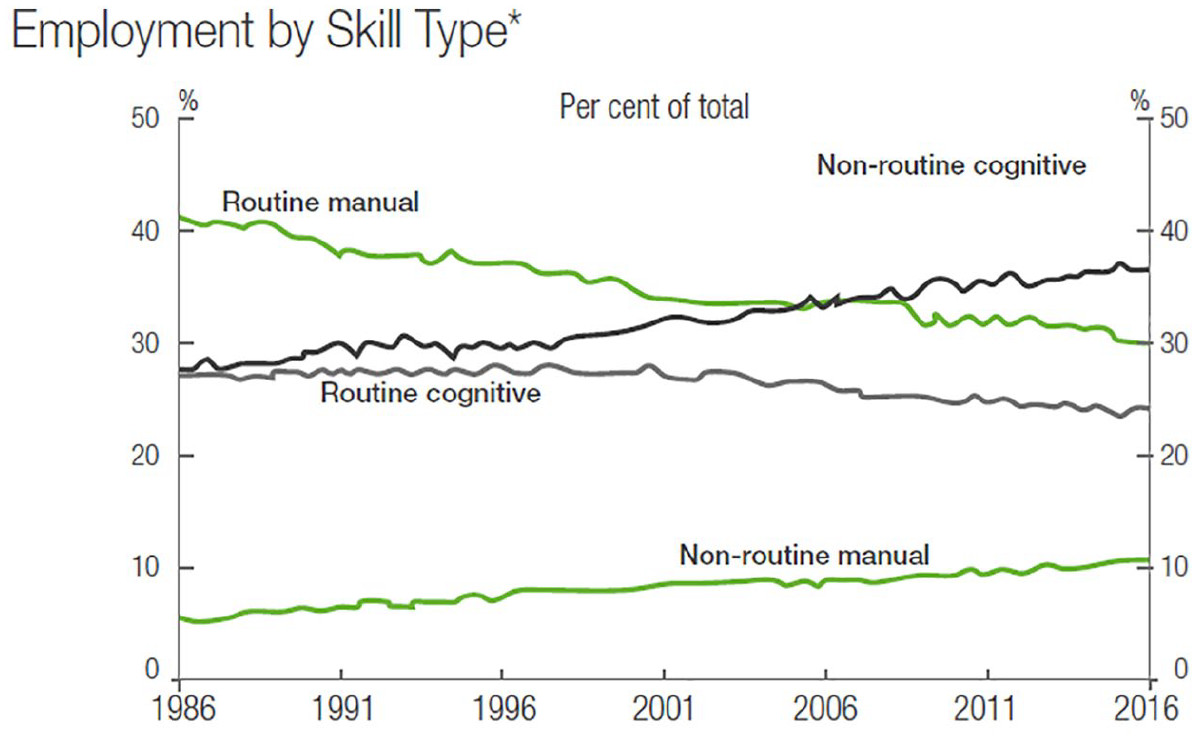
Figure 2 displays the changes in employment by skill type in Australia since the mid-1980s, which clearly shows the decline in routine work and the increase in non-routine work, both cognitive and manual (
DJSB, 2018).
Technological advances have enabled the workforce to access unlimited amounts of online information, to rapidly complete routine cognitive tasks (e.g. via data analysis software), to deliver services in-person or remotely (e.g. remote education) and to have dynamic collaborations with individuals or teams across different time zones around the world. Overall, technology has increasingly set the pace and method of work, even in industries which traditionally had far greater decision latitude – such as finance, science, education and health.
2.1. Negative impact on mental health
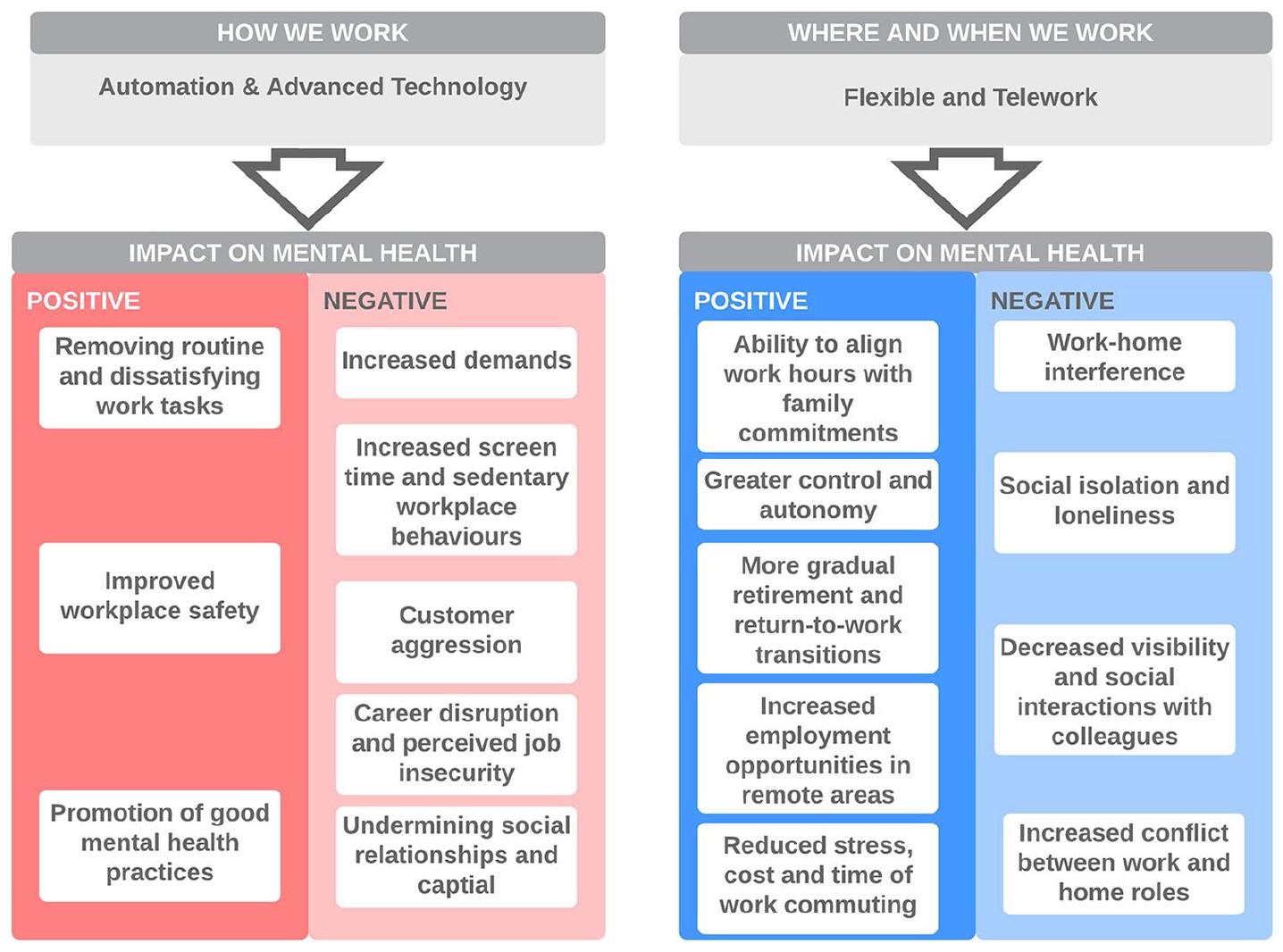
This section examines the evidence for the impact of these changes on the mental health of employees. We look at how the four changes explored above (types of jobs, types of tasks, pace and breadth of work, and career pathways and patterns) affect characteristics of the workplace at the individual and group or collective level and the negative effect on mental health. We then explore how, if designed and implemented effectively, changes in technology could improve workplace mental health.
Technology in workplaces is typically designed to increase productivity and improve organisational outcomes, with often little consideration of the impact on employees. For example, the pervasive presence of technology can produce a ‘norm of responsiveness’ which has been linked to increased perceived demands, unrealistic performance and productivity expectations, and feelings of increased mental exhaustion (
Perlow, 2012). Studies have shown that technology can accelerate work pace to the extent of increasing employee stress, overload, exhaustion and burnout (
Barley et al., 2011;
Chesley, 2014;
Maier et al., 2015;
Murray and Rostis, 2007;
Su and Mark, 2008). For example, in a recent study (
Chesley, 2014), technology use in a nationally representative survey of US employees was linked to higher levels of workplace strain and distress through increased work pace, multitasking and work interruptions.
Barley et al. (2011) also found that increased email use was associated with employee strain through increasing work demands. The study found that employees reported feeling pressure to respond to emails even if it required them to take work home or to work outside of their paid hours.
The pervasive use of technology in the workplace is also accompanied by an increase in screen time and sedentary workplace behaviour (
Waters et al., 2016;
Yang et al., 2017) which has been linked to poorer physical health outcomes, such as the increased likelihood of developing physical health problems like diabetes, heart and cardiovascular disease, musculoskeletal disorders and obesity, often with concurrent mental health issues (
Duncan et al., 2012;
Ford and Caspersen, 2012;
Wilmot et al., 2012). Prolonged screen time and sedentary workplace behaviours have also been found to be directly linked to mental health issues including increased self-reported symptoms of depression and anxiety (
Machav et al., 2017).
Organisations are also increasingly using artificial intelligence technologies to complete work previously performed by humans. For example, many organisations now use automated ‘intelligent self-service’ systems, designed to enable the customer or client to co-produce the service, with the assumption that customers have the skills, training or support to do so. Examples include ordering food via mobile phone apps, checking in baggage at the airport, booking accommodation online and using self-service checkouts at the supermarket. While many customers appreciate the convenience and time saved, the systems do not always function as designed and are generally only useful for standard customer requests and needs. As a result, it is not uncommon that in many service roles, when the customer or client interacts with the employee, customers are more likely to experience high levels of frustration, anger and often thwarted expectations (
Groth and Grandey, 2012). This increases the demands employees experience, as they are likely to have to manage customer mistreatment and engage in emotional labour (
Groth et al., 2019). These additional demands, both internal and external, can significantly deplete personal resources and resilience and place employees at greater risk of burnout and poorer mental health (
Schaufeli et al., 2009), as well as increasing employee withdrawal behaviours such as increased sick leave (
Nguyen et al., 2016), turnover (
Goodwin et al., 2011), and employee sabotage against customers such as abruptly ending a service call (
Wang et al., 2011).
There is also research that perceiving technological change such as advances in artificial intelligence and the ‘disruption’ of the traditional career pathway as a threat to one’s job security can negatively impact employee well-being (
Brougham and Haar, 2018). Common reasons for employee resistance to workplace technological change include anxiety that artificial intelligence technologies will create services which replace one’s job function, such as retail self-checkouts and driverless vehicles, and the fear of not having the skills needed for the work of the future (
Brougham and Haar, 2018;
Vieitez et al., 2001), which may be exacerbated with an ageing workforce. Employees who believe that smart technology, artificial intelligence, robotics and algorithms could replace their job also report higher levels of depression and cynicism (
Brougham and Haar, 2018) as well as state and trait anxiety (
Vieitez et al., 2001). Similarly, a recent study found that employees who believe that technological change posed a threat to their job security also reported experiencing more anxiety-related mental health problems (
McClure, 2018).
In addition to the effects on individual employees’ experiences of work, technology can also deplete the quality of interpersonal relationships between employees and the social capital within organisations. For many employees, the interactions within an organisation are increasingly mediated by systems and technology. For example, we log work health and safety issues on a portal; we do not call a person and emails are generated by systems accounts with ‘do not reply’ and no contact information. This is likely to be particularly detrimental when employees most need support.
The evidence is clear that social support and being part of a supportive community in the workplace is important (
Grant et al., 2010). A review of 14 longitudinal studies found that high psychological demands and low social support were the strongest and most consistent factors associated with an increased risk of depression (
Netterstrom et al., 2008). In addition, low work-related social support is associated with an increased likelihood of mental health problems and/or prolonged sickness absence (
de Lange et al., 2003). A prospective cohort study of 9631 male employees of France’s national gas and electricity company found that low satisfaction with social relations and low social support at work was associated with a 10%–26% increase in sickness absence which persisted over 6 years (
Melchior et al., 2003). Poor work relationships have been found to be associated with an increased risk of poor mental health and reduced physical health. In contrast, positive human interactions have been associated with healthier patterns of cardiovascular, immunological and neuro-endocrine responses (
Heaphy and Dutton, 2008).
Overall, technology is negatively impacting mental health in the workplace in many ways by increasing demands, reducing resources and changing how employees view the future, which all have hidden and direct costs to employers and employees. Considerable research now highlights that work factors such as poor job design, high job demand, low job control and high effort–reward imbalances are associated with a greater risk of developing common mental health conditions (
Harvey et al., 2017). Job design theories such as the job characteristics model (
Hackman and Oldham, 1980) and Job Demands and Resources theories (
Schaufeli et al., 2009) stipulate that, to enhance mental health, we need to design jobs that have resources to help balance or respond to high demands. Resources such as control, support, high-quality feedback and learning opportunities are all positively associated with work-related well-being. Fortunately, there are many ways in which technology can, and has been, used to successfully design work to help safeguard the mental health of employees. We now review the ways in which automation and advances in technology have had a positive impact on workplace mental health and employee well-being.
2.2. Positive impact on mental health
When well-designed and implemented to consider the impact on how people do their work, technology systems can function to reduce demands. When automation alleviates cognitively taxing work such as literature searches as well as repetitive administrative tasks such as data entry tasks, employees may experience less fatigue and spend more time on autonomous, creative, deep-thinking work or engage in meaningful interactions with customers and clients. For example, nurses can spend less time recording and filing patient data and more time providing quality care to their patients. Household, Income and Labour Dynamics in Australia (HILDA) survey data show that the most easily automatable job tasks, such as assembly line work and data entry, were also the tasks employees rated as least satisfying to complete (
AlphaBeta, 2017). Automation has the potential to reduce job dissatisfaction and potentially enhance well-being by freeing up time for employees to use their creative, transferable and non-automated skills.
Automation has also improved workplace safety and reduced the risk of physical workplace injuries (
Horton et al., 2018). In most countries including Australia, automation has replaced many physically dangerous and tedious tasks previously completed by hand such as repetitive heavy lifting work (
Horton et al., 2018). The decrease in physical workplace injuries should simultaneously reduce the likelihood of employees incurring psychological problems stemming from such injuries, including the mental health sequelae of injuries, poor motivation to return to work, isolation, frustration and anger (
Duncan et al., 2012;
Ford and Caspersen, 2012;
Wilmot et al., 2012).
Technology can also promote good mental health practices. One of the major benefits from recent advances in technology is eHealth and proactive workplace mental health interventions. In the past decade, research has proliferated in eHealth where interventions are supported by electronic and technological processes and digital communication. eHealth interventions with evidence-based therapeutic techniques can support and create significant improvements for those with common mental health conditions such as depression and anxiety. For example, meta-analytic evidence suggests that mindfulness-based eHealth interventions can reduce symptoms of common mental health conditions among employees (
Stratton et al., 2017). Similarly, another recent review and meta-analysis found that digital mental health interventions delivered in the workplace can improve psychological well-being and work effectiveness among employees (
Carolan et al., 2017).
An additional benefit of eHealth interventions is providing accessible and easily disseminated material to workplaces regardless of their size or geographical location. For example, a cluster randomised controlled trial (RCT) of 24 Fire and Rescue and Hazmat Stations across NSW found that a training programme delivered completely online enhanced psychological resilience, a feature of a mentally healthy workplace (
Petrie et al., 2018), among active first responders at 6-month follow-up along with overall mindfulness, optimism, active coping and seeking support from others (
Joyce et al., 2019).
Another example of a proactive workplace mental health initiative delivered solely online is mental health training for managers. A recent RCT (
Gayed et al., 2019) found that an online manager training programme resulted in significant improvements in managers’ confidence and led to changes in responsive and preventive behaviours of initiating conversations and redesigning work that are important in creating a mentally healthy working environment for staff. This type of online mental health training appears to be an effective and scalable way to improve managers’ confidence and workplace practices around mental health to support the mental health needs of their direct report employees.
However, technology is not only affecting the work we do but also creating opportunities to change where and when we work. The next section examines these changes and evidence on how they may influence mental health.