Intended for healthcare professionals
Open access
Research article
First published online March 4, 2026

Text as data for crisis-early warning: A comparative assessment of NLP methods for conflict prediction

Abstract

Natural language processing (NLP) tools have been applied successfully in improving predictions in a wide range of research areas. However, what works in one area may not work in conflict research. This paper therefore seeks to offer an initial assessment of the most prominent NLP methods for conflict prediction tasks. It evaluates the performance of features extracted from a conflict dictionary, two sentiment dictionaries, a word-scaling approach, dynamic topic models and a transformer model on a classical conflict prediction task. The results highlight the importance of considering different NLP approaches, depending on the availability of text sources and other predictor variables.

Introduction

The promise that accurately predicting the next crisis or conflict holds has long motivated researchers. Particularly with recent advancements in computational power, more easily available data sources, and improved statistical modeling techniques, this area of conflict research has received increased attention from academics and policymakers alike. However, even though there have been significant improvements in recent years, models that reliably and accurately predict conflict onset, escalation, or severity still leave room for improvement.
One approach that has produced promising results is the inclusion of predictive features extracted from text data (Boussalis et al., 2022; Chadefaux, 2014; Mueller and Rauh, 2018, 2022). These efforts have mostly focused on using one natural language processing (NLP) approach, namely topic modeling (Blei et al., 2003; Blei and Lafferty, 2006). However, NLP encompasses a multitude of different approaches, many of which offer promising methods to extract information from texts, that could be used for conflict prediction (Maerz and Puschmann, 2020).1 Furthermore, the findings from the 2022 conflict prediction competition hosted by the political Violence and Impacts Early-Warning System team have underlined the importance of using diverse sets of features and modeling techniques in improving forecasts (Vesco et al., 2022).
Hence, in this paper, I seek to contribute to these efforts by highlighting how different NLP methods can be used to extract features for conflict prediction and by providing a comprehensive assessment of how these features perform across different text corpora as well as feature combinations. I create features based on CrisisWatch reports and BBC Monitoring newspaper articles, using a conflict dictionary (Häffner et al., 2023), two sentiment dictionaries (Dunphy, 1974; Hutto and Gilbert, 2014), a word-scaling approach (Benoit and Laver, 2003), and a transformer model (Hu et al., 2022). These features are then used in a true out-of-sample prediction task where I seek to predict conflict severity—operationalized as the logarithm of fatalities—for a given country month, up to 6 months into the future, based on Uppsala Conflict Data Program Georeferenced Event Dataset (UCDP GED) data (Hegre et al., 2017). I also assess their predictive performance in comparison with other features commonly used for prediction tasks. These “traditional”—socio-economic, conflict history, political, and societal—features will serve as baseline models.
The rest of the article is structured as follows. First, I will give an overview of how conflict prediction has progressed over time and highlight the broad spectrum of approaches applied. Second, commonly used NLP techniques and how they could support prediction efforts are discussed. Next, I go into more technical details on how these NLP approaches can be used to extract relevant features from text data. I also outline the prediction task, outcome variable, and other variables used in the baseline models. This is followed by a discussion of the results and what one can learn from this comprehensive assessment of NLP methods for conflict prediction.

Literature

Predicting conflicts has long been a key area of interest for scholars of international relations, conflict researchers, and policy-makers. Given the important role that prediction could play in preventing conflicts and the high stakes associated with it, this longstanding interest is not surprising. However, for a long time, these efforts were limited in their scope through constraints in computational power as well as limited data availability. Hence, early efforts to forecast or predict conflict were mostly limited to strategic analyses of individual cases (see e.g. Azar et al., 1977; de Mesquita et al., 1985; Raphael, 1982) and employed, from a current viewpoint, rather simple modeling approaches (Choucri, 1974; Choucri and Robinson, 1978; Rummel, 1969).
With better availability of data on political violence (see e.g. Azar, 1980; Boschee et al., 2018; Hegre et al., 2019) as well as improvements in modeling techniques (see e.g. Schrodt, 1991), researchers started to undertake more systematic approaches to this problem. Early efforts in this regard sought to model country-level conflict risk on a global level using newly available data sources and contemporary statistical approaches. The promises these advances held spurred a proliferation of attempts to provide reliable crisis early warning tools and approaches; these included government-supported (see e.g. Goldstone et al., 2010) and independent academic efforts (Brandt et al., 2011; King and Zeng, 2001; Schneider et al., 2011; Weidmann and Ward, 2010).
A wide range of modeling approaches has been employed in this regard, using game theory (de Mesquita, 2010), agent-based modeling (Cederman, 2003; Lemos et al., 2013), and simulations (Brandt et al., 2014), as well as machine learning, ensemble modeling techniques, and deep learning methods (Brandt et al., 2022; Montgomery et al., 2012; Walterskirchen et al., 2024). The range of outcome variables to predict has been similarly large, with researchers trying to predict genocide and mass killings (Goldsmith et al., 2013; Koren, 2017; Mayersen, 2020; Scharpf et al., 2014), interstate disputes (Gleditsch and Ward, 2013), leadership changes (Beger et al., 2014; Ward and Beger, 2017), political instability (Bowlsby et al., 2019), protest (Pinckney and Daryakenari, 2022), armed conflict (Hegre et al., 2013; Tikuisis et al., 2013; Ward et al., 2013) or its duration (Pilster and Böhmelt, 2014).
A lot of effort has also focused on finding better variables (or features) to improve the prediction of conflict. Using theoretical-driven approaches to identify features of importance has been important in this regard. Hegre et al. (2016) investigate how different socio-economic pathways can affect conflict likelihood depending on development trajectories. Gohdes and Carey (2017), for example, investigate how the killing of journalists can serve as an indicator for future levels of repression in a country. The presence of militias has also been found to be an important feature in predicting strategic mass killings (Koren, 2017). In their article Blair et al. (2017) investigate how to use local-level survey data to improve predictions. Online material has also become an increasingly popular source to extract features for prediction tasks. Oswald and Ohrenhofer (2022) employ Wikipedia metadata to derive features for their forecasting model. Similarly, Timoneda and Wibbels (2022) use metadata extracted from Google Trends to predict protest dynamics. Zeitzoff (2011) investigates how social media can be probed to gain insights into micro-dynamics of conflict. Recently, including unstructured data, in the form of newspaper articles, has also been shown to be a viable avenue for extracting relevant features for crisis early warning. Chadefaux (2014) uses the frequency of conflict-related reporting and Mueller and Rauh (2018, 2022) apply topic modeling to newspaper articles to provide more reliable forecasts. Similarly, Boussalis et al. (2022) use topic models to analyze diplomatic correspondence to predict militarized interstate disputes. Moving away from topic models, Häffner et al. (2023) introduce an approach to create conflict dictionaries that can be applied to text corpora, which can be used for prediction tasks.
However, while there have been important advances in the accuracy and reliability at which conflicts can be predicted, given the high stakes involved, there is still room for improvement. This has also been underlined by the findings of the recent prediction competition hosted by the VIEWS team (Hegre et al., 2019, 2022; Vesco et al., 2022). They highlight the importance of using diverse modeling approaches, in terms of both the model architecture and features used.

Natural language processing and conflict prediction

Building on the promising developments in the area of text-as-data approaches, in this article, I seek to contribute to the growing literature on conflict prediction in two ways. First, I provide an overview and guidelines on how to generate features for prediction tasks from some of the most common and widely used NLP tools. Second, I provide a comparative assessment of the predictive power of these features.
As outlined above, the focus on NLP tools is motivated by previous research demonstrating the promise of incorporating information extracted from textual data in conflict prediction models. In line with them, I argue that reports and newspaper articles include relevant information about current and future dynamics of conflict in a country. Such reports are generally written by experts with pertinent background knowledge. Additionally, these experts often spend many years covering their areas and are able to gain deep insights over the span of their careers, giving them the ability to better contextualize developments and events. Nonetheless, accessing this information is not a trivial matter and there are many different approaches to doing so. Furthermore, given the ongoing discussions on what makes variables good predictive features2 and the broad spectrum of available NLP approaches, it is not a priori clear what techniques lead to suitable features for conflict prediction.
Therefore, it is important to assess not only how these different approaches fare in comparison with each other, but also in comparison with other variables, traditionally used in conflict prediction. While there are many NLP methods available, there are four groups of NLP techniques that are commonly used and have also been applied in conflict research: topic models, (sentiment) dictionaries, document scaling, and most recently bidirectional encoder representations from transformers (BERT) models. Topic models are an attempt to identify coherent themes across a large corpus of documents. They can be employed to identify central themes in a document or be used to model how topic compositions change over time. Applying them to newspaper articles or conflict reports can highlight how the focus of reporting changes and can serve as an indicator of underlying conflict risk. If reporting is increasingly covering conflict-related topics it could serve as a warning signal for future developments.3 And indeed this has been shown to work by Mueller and Rauh (2018, 2022). They were able to show that including features extracted from newspaper articles through a dynamic latent Dirichlet allocation topic modeling (Blei et al., 2003; Blei and Lafferty, 2006) approach can significantly improve conflict prediction models. Similarly, Boussalis et al. (2022) show how extracting features from private information in the form of diplomatic cables can improve forecasts of militarized interstate disputes.
Sentiment dictionaries, lists of words with positive or negative connotations, have also been shown to be a useful approach in the study of conflict. These dictionaries aim to quantify the underlying tonality or polarity of a given document. With regard to conflict, one could expect that higher polarity and a more negative tone in reporting could highlight rising conflict tendencies. While sentiment dictionaries have not yet been used, to the best of my knowledge, as features in conflict prediction, they have been used to study armed groups in conflict settings. Greene and Lucas (2020) applied a standard sentiment dictionary in order to shed light on non-state armed group relationships. They were successful in identifying rivalries and alliances between Hezbollah and other non-state armed groups based on Hezbollah-produced and disseminated documents. Also focusing on non-state armed groups, Macnair and Frank (2018) analyzed the tonality of ISIS propaganda magazines to identify changes in rhetoric, also including the level of hostile language towards other non-state armed groups. Relatedly, Häffner et al. (2023) take the general idea of a sentiment dictionary but use deep neural networks trained on conflict reports and conflict event data to automatically create objective (model-driven) conflict dictionaries. They were able to show that such a dictionary is well suited to identifying documents that are associated with higher levels of conflict.
Document scaling techniques are also widely used NLP methods. They attempt to position documents relative to each other based on a given (supervised) or an undefined (unsupervised) dimension. Many of these techniques produce scores that can be understood as a measure of how similar documents are. Wordscores (Benoit and Laver, 2003) and Wordfish (Slapin and Proksch, 2008) are well-known examples in political science for the two different approaches (supervised and unsupervised). In conflict research, one could assume that conflict reports that are similar to each other also reflect similar conflict tendencies, particularly in supervised settings, where the scaling technique has been trained on conflict occurrence. There have also been attempts to leverage a hybrid approach to gain insights in the area of political science and conflict research. Watanabe (2020), for example, is able to classify newspaper articles for their polarity with regard to the state of the economy with a semi-supervised latent semantic scaling approach. Trubowitz and Watanabe (2021) employed a similar approach. The authors were able to automatically identify how adversarial or friendly the relationship between the US and other countries is by using New York Times news summaries.
Probably the most advanced NLP technique currently are transformer models. A particularly useful implementation of transformers is BERT models. These models are trained on millions of documents and are able to achieve a highly complex level of language representation and understanding. Furthermore, they are rather flexible and can be used for a variety of tasks. Their performance can be further improved when they are trained for specific domains. Hu et al. (2022) is such an example of a BERT model for the specific area of conflict research. However, given their complex and sophisticated architecture, they require vast amounts of computational power. This may explain why they currently have not been employed for the task of conflict prediction.
I create features generated by all these four approaches and evaluate their performance in a prediction task. The next section will outline how the prediction task is defined, describe the text feature extraction methods in more detail, and give an overview of the more structural features used as baselines to compare the text features with.

Research design

This section introduces the main datasets and features for the prediction models, the NLP approaches as well as the machine learning models used to generate the predictions.4

Datasets

The prediction models contain variables from six different sources and include text data as well as variables capturing conflict dynamics and socio-economic and socio-political trends. I use two different text sources for the NLP methods: (1) newspaper articles from the BBC Monitoring (BBC) Dataset (from 2013 to 2020); and (2) expert-written CrisisWatch country reports (2003–2020) from the International Crisis Group. CrisisWatch reports are short, monthly descriptions of conflict-related trends for each country and are freely accessible online.5 The BBC Data consist of all newspaper articles produced and collected by the BBC Monitoring team, which includes BBC articles but also translations of other international media reporting. It also includes expert reports and analyses, relatively similar to CrisisWatch (CW) reports.6 As the time period for which I have text data available is different for CW and BBC, I build one dataset that contains features from CW including data from 2003 to 2020 and one dataset that contains features from BBC texts including data from 2013 to 2020.7
In order to predict monthly (log) fatalities, I use the UCDP GED (Sundberg and Melander, 2013)8 that contains “individual events of organized violence (phenomena of lethal violence occurring at a given time and place)” that are geo-coded as precisely as possible. In addition, I use the UCDP GED Dataset to extract actor-related features. For the UCDP GED and all following datasets, I extract variables from 2003 until 2020 and either aggregate or interpolate them to a country-month level. As many machine learning methods do not allow for missing observations and timesteps, instead of dropping these observations, I use the Multiple Imputation by Chained Equations approach with the lightgbm algorithm to impute the missing values.9
Features related to civil society and political liberties are taken from the Varieties of Democracy Datset (Coppedge et al., 2023).10 The public repository for the Rulers, Elections, and Irregular Governance dataset (Bell et al., 2021)11 is utilized for election and leadership variables. Finally, I use the ethnic power relations (EPR) Power Access Data and Conflict Database12 for power access and information on conflict history. The reader is referred to the Online Appendix for an overview of all variable names as well as which variable is used for which model.

Extracting text features

The two goals I pursue with this paper are on the one hand to test whether the inclusion of text features can boost predictive performance and on the other hand to identify which text feature extraction method outperforms the other. Therefore, I extract text features employing the following approaches: dictionary approaches (general-purpose as well as conflict-specific), topic models, BERT models, and word scaling techniques. I first build several benchmark models including a variety of structural and (socio-)political variables commonly used for modeling conflicts and in a second step add the textual features. As the text models have different underlying assumptions regarding the nature of texts, different preprocessing techniques are applied. The reader is referred to the Online Appendix for preprocessing steps regarding BERT models, topic models, and word scaling techniques.13

Dictionary-based features

As mentioned above, I include two general-purpose sentiment dictionaries and two (for each document corpus separately) conflict-specific dictionaries based on an approach suggested by Häffner et al. (2023). Dictionary approaches usually rely on a set list of words and rules that are assigned positive or negative values to calculate a (sentiment) score per document. For Vader (Valence Aware Dictionary and Sentiment Reasoner) (Hutto and Gilbert, 2014) and the HGI4 (Harvard General Inquirer) (Dunphy, 1974) dictionary, these are words that generally tend to have positive or negative connotations and are manually collected and maintained. Following the approach proposed in Häffner et al. (2023) I create an Objective Conflict Dictionary from the CrisisWatch and BBC corpora by automatically extracting words that are associated with more or less conflict from a deep neural network trained on UCDP conflict events. The dictionaries contain words that are positively (and negatively) correlated with log fatalities as well as their relative feature importance score. Consequently, it is a context-specific dictionary that aims to measure overall conflict intensity but the words do not bear any inherent positive or negative meaning.
Ultimately all dictionaries are applied to the CrisisWatch and BBC texts and the resulting features are obtained by aggregating the positive and negative values. All positive and negative word scores of a document are summed up and the resulting sum is divided by document length. Note that this is not the only way to calculate document scores, but most scores account for document length. The Python library Loper and Bird (2002) and Pysentiment2 have been applied respectively to calculate the Vader and HGI4 sentiment scores.

Document scaling features

I also apply the popular Wordscores (Laver et al., 2003) text-scaling technique. Similar to dictionary approaches, text-scaling also relies on a bag-of-words representation of language. Documents that use similar language (measured as word frequencies) should also be closer in content. While there are different scaling methods, Wordscores belong to the supervised machine learning techniques and require reference texts as inputs. I apply Wordscores to both corpora of conflict reports. As with all text features, I train the Wordscores model on a separate subset of the respective documents (the training window) and in each corpus match it with the corresponding fatalities as reference scores. Those references are then used to predict the positions of the remaining texts. As before with the (sentiment) dictionary approach, I determine how closely those scores are aligned with fatalities and use them as features in the models to predict fatalities.

Topic model features

As Mueller and Rauh (2018) already demonstrated that the inclusion of features from topic models (TM) improves the predictive performance of models, I also include features from topic models in the prediction models. Topic models belong to the unsupervised machine learning methods and can be applied to reduce the high dimensionality of texts. I use relatively few topics (K = 5, 10, and 15 topics respectively) as I do not want to focus on single events and rather extract more general topics. Similar to Mueller and Rauh (2018), I include the share of each topic per country on a monthly level. However, I implement dynamic topic models (Blei and Lafferty, 2006) rather than standard topic models to account for changes in the distribution of topics over time as well as changes in their composition.

BERT-models features

Bidirectional encoder representations from transformers models are based on transformer models (Vaswani et al., 2017) and are considered the current state-of-the-art in NLP; they have produced impressive results in a variety of research areas. They often outperform traditional models as they are trained on massive corpora and leverage the attention algorithm that allows them to focus only on important parts of a sentence. These models can model language on a high level as they obtain positional information about a word as well as its relation to other words in a sentence.
There are different ways to include transformer models into prediction models. The most straightforward is to use an already pre-trained transformer model for sentiment classification and simply apply this model to the documents. The resulting sentiment scores can be included in the prediction model in the same way as the scores from the dictionary approaches. Another approach is to finetune a transformer model on the corpus (training dataset) by directly predicting log fatalities from raw texts. I rely on the newly released ConfliBERT on huggingface14 and finetune it on log fatalities. As transformer models usually are designed to solve classification tasks, the final layer of the transformer model has to be transformed to solve a regression task. However, the final activation function cannot simply be linear as output values need to be strictly positive (fatalities usually are only positive numbers) and I adjust the activation function accordingly.

Model specifications

For each prediction task (t + 1, …, t + 6) I build an independent prediction model that directly predicts the logarithm of monthly fatalities (on a country level) for the next 1–6 months (direct multi-step forecasting). In order to model the time dependencies, I lag all input features. As I have different time periods available for each text source, I estimate all models for the CrisisWatch dataset and the BBC dataset separately and compare each to how they perform once different text features are added (Table 1).
Table 1. Model specifications.
CategoryFeaturesData
Text modelsDictionaries, WordscoresCrisisWatch, BBC Monitoring
 Topic Models, BERT 
Conflict trendLagged Target VariableUCDP GED Fatalities
Structural modelConflict HistoryConflict History Features
  (GROWup, UCDP GED)
 Socio-PoliticalCivil Society and Political Variables
  (V-Dem and REIGN)
REIGN, Rulers, Elections, and Irregular Governance; UCDP GED, Uppsala Conflict Data Program Georeferenced Event Dataset; V-Dem, Varieties of Democracy Datset.
This results in a large number of models, since I explore how different text features are able to complement or supplement different categories of base features. In total, I trained 78 (39 BBC and 39 CW) models for the six prediction tasks.15 For the BBC (CW) models, the time period from 2013 (2003) until 2019 is used to train the models while the year 2020 is the hold-out sample to test the prediction models. For all specifications, a Random Forest model is trained, by employing hyperparameter optimization and cross-validation, and the best-performing model is selected.16 As a robustness check, I also estimate all models with gradient-boosted decision trees (XGBoost) to rule out that patterns are due to a certain modeling algorithm. In contrast to traditional cross-validation, I cannot randomly split the dataset into train and validation sets as when modeling time dependencies, future values might be used to predict past ones. Therefore, I employ a sliding window approach. For the hyperparameter optimization of the Random Forest model, I use the number of trees and the maximal depth as hyperparameters and employ Bayesian optimization with 30 trials to find the optimal parameter constellations. With regards to the maximal depth, I test configurations between 2 and 32. For the number of regression trees, I test constellations between 100 and 1000. As I train a model for each forecast horizon for all 140 models, I refrain from reporting all ideal hyperparameters for each model but rather report the general trends. For both the BBC and the CW corpus, the smallest depth, namely 2, was chosen in most cases as the ideal hyperparameter. The results for the number of trees vary more, but also, in this case, smaller trees are more frequently chosen. To avoid cross-contamination between the training and test sets I predict only the second half of 2020 as lagged input features are used in the models. Following the prediction task, I evaluate the performance of the models using mean squared error (MSE) and R2 values for each of the prediction steps. Thereby, I can evaluate which text features can add the most to the more traditional approaches to conflict prediction.

Descriptive statistics

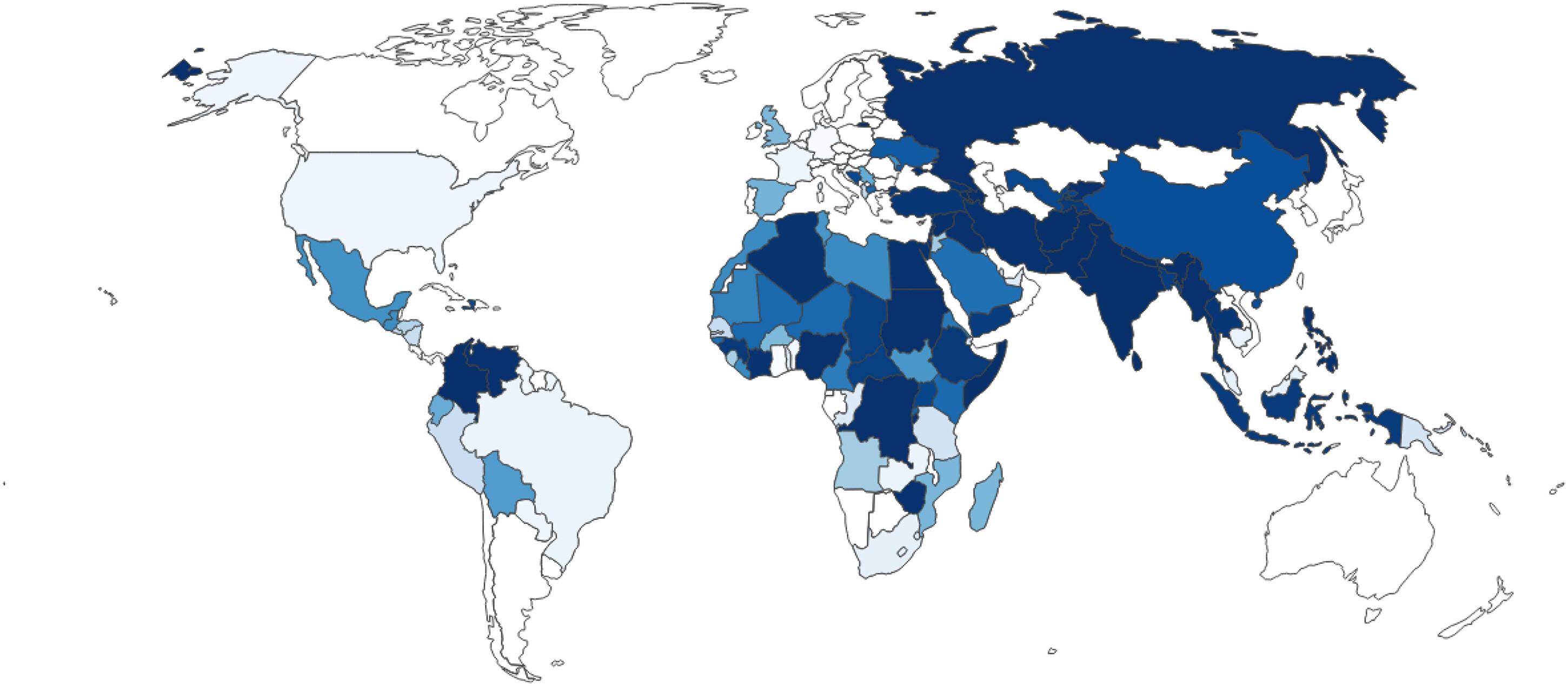
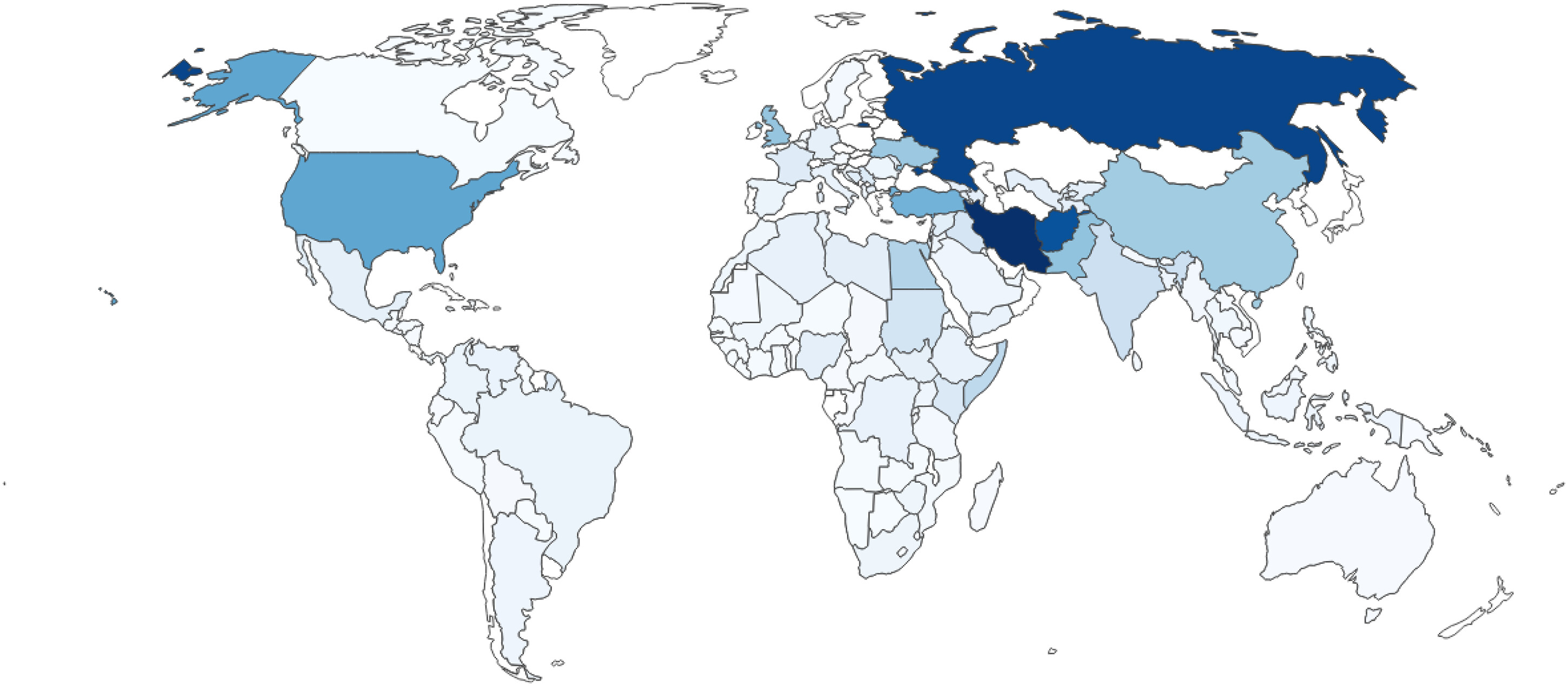
Before describing and comparing the model results, this section will provide more information on the text corpora as well as some descriptive statistics for the text features and the target variable. The two corpora are very different with regard to the following aspects. The CW corpus is considerably smaller. There is only one report for each country-month observation’ consequently, there are approximately 14,000 reports. The BBC corpus contains 1,365,150 newspaper reports; consequently, more computing power is needed to process the texts. However, after combining the two text corpora with the UCDP GED Dataset (Sundberg and Melander, 2013), the total number of observations is around twice as large for the CW data (with 23,773 observations) compared with the BBC data (13,284 observations). The relatively short time period that I can cover with the BBC data may pose a problem as conflicts are relatively rare and could potentially bias the results in favor of CrisisWatch reports. Another difference is the country coverage. Figure 1 and 2 show the coverage and the relative frequency of countries in the CW and the BBC corpus respectively.17
Figure 1. CrisisWatch country coverage.
Figure 2. BBC monitoring country coverage.
Darker blue indicates a higher share of reports concerning a country and lighter blue tones show a lower share. While the CW corpus shows a more equal distribution in the number of countries covered by reports, the BBC corpus shows a different picture: A large majority of reports concern Iran (9.6%), Russia (8.9%) and Afghanistan (8.3%). Although CrisisWatch also focuses more on countries with conflict-related events, the reporting is not dominated by a few countries. The last difference is the different styles and contents of the texts. While the CW reports are short, technical and rather “choppy” descriptions of conflict events, the BBC articles are newspaper articles and therefore less technical with more emphasis on readability and flow of language. Examples for a CW report can be found in the Supplementary Material; however, sharing BBC Monitoring newspaper articles is not possible for proprietary reasons.18 I am interested in investigating which kind of text data can add more value to a prediction task and whether it is necessary to construct large resource-intense newspaper corpora for conflict prediction.
Tables 2 and 3 show the summary statistics for the textual features and the target variable, UCDP GED fatalities, for the BBC and the CW corpus respectively. The textual features from the dictionaries include negative and positive values while the BERT and Wordscores features are strictly positive as they were trained to mimic the characteristics of fatalities.
Table 2. Descriptive statistics for CrisisWatch data.
VariableCountMeanStandard deviationMinimum25%50%75%Maximum
Fatalities (log)237731.051.880.000.000.001.529.04
OCODI237730.040.09−0.640.000.000.080.69
HGI23773−0.070.28−1.00−0.200.000.001.00
VADER23773−0.330.54−1.00−0.930.000.001.00
BERT237731.061.930.000.000.001.228.63
Wordscore237730.660.540.000.001.061.101.35
BERT, Bidirectional Encoder Representations from Transformers; HGI, Harvard General Inquirer; OCODI, Objective Conflict Dictionary; VADER, Valence Aware Dictionary and sEntiment Reasoner.
Table 3. Descriptive statistics for BBC data.
VariableCountMeanStandard deviationMinimum25%50%75%Maximum
Fatalities (log)132841.051.930.000.000.001.399.04
OCODI132840.010.03−0.10−0.010.000.020.16
HGI132840.200.18−0.750.060.200.321.00
VADER132840.020.37−1.00−0.180.000.231.00
BERT132841.031.720.000.000.091.338.09
Wordscore132841.040.440.001.151.201.241.60
BERT, Bidirectional Encoder Representations from Transformers; HGI, Harvard General Inquirer; OCODI, Objective Conflict Dictionary; VADER, Valence Aware Dictionary and sEntiment Reasoner.

Model results

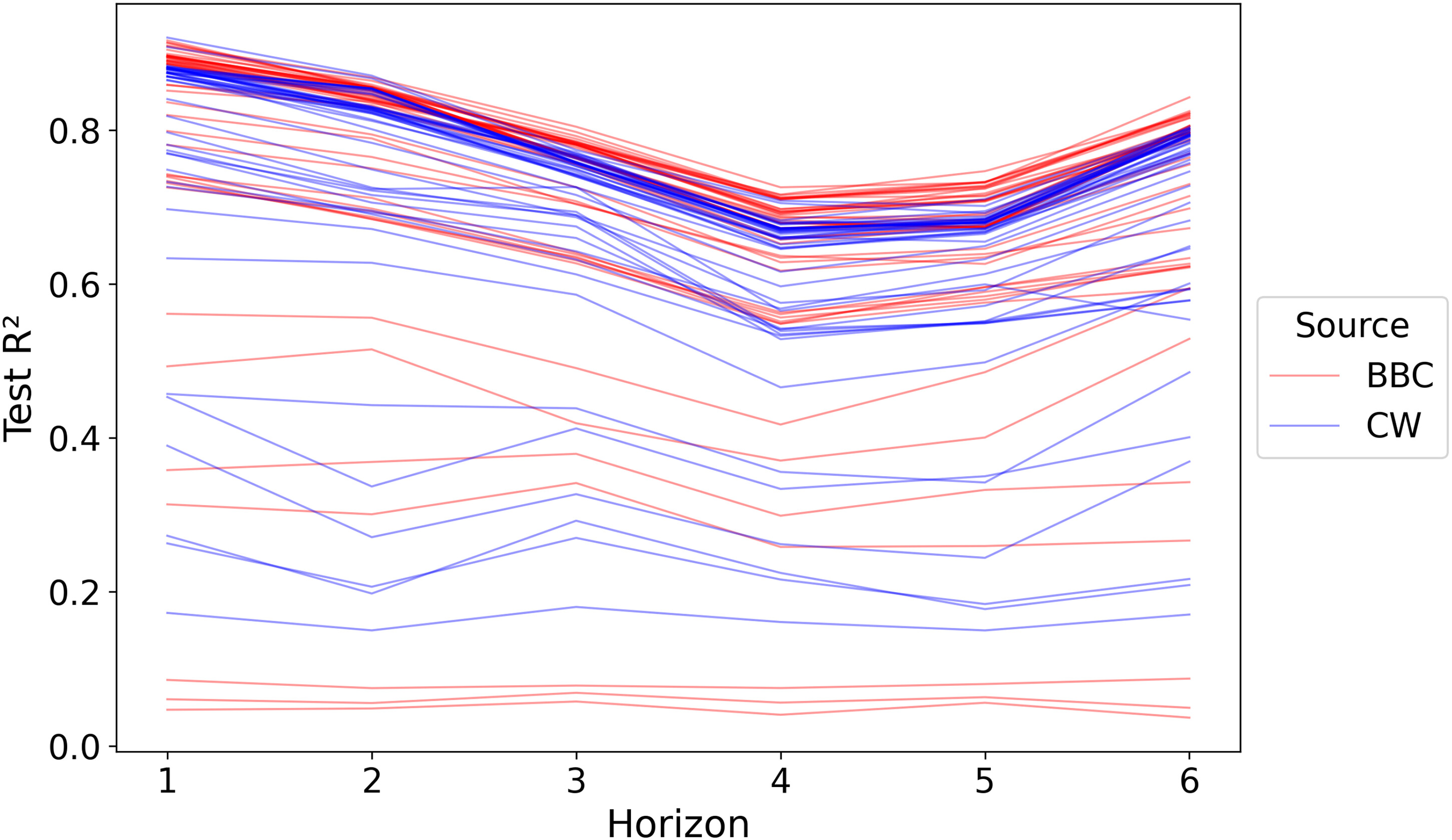
Figure 3 gives a general overview of the performance of all 468 models separated by which text corpus is being used. As can be seen in the figure, the performance of models varies vastly. However, two general trends can be identified: first, despite the shorter training window, owing to the limited availability of articles, BBC models tend to perform slightly better. BBC models achieve the highest overall R2 for each timestep; however, some of the BBC models are also among the worst models. Second, predicting further into the future is more difficult than predicting the next month. The better performance of models for t + 6 is not a general trend but a result of t + 4 and t + 5 being more violent months and hence more difficult to predict.19
Figure 3. Overview and comparison of model performance for BBC and CrisisWatch data. Note: Each line shows the performance (R2) of one of the Random Forest prediction models for each of the six timesteps.
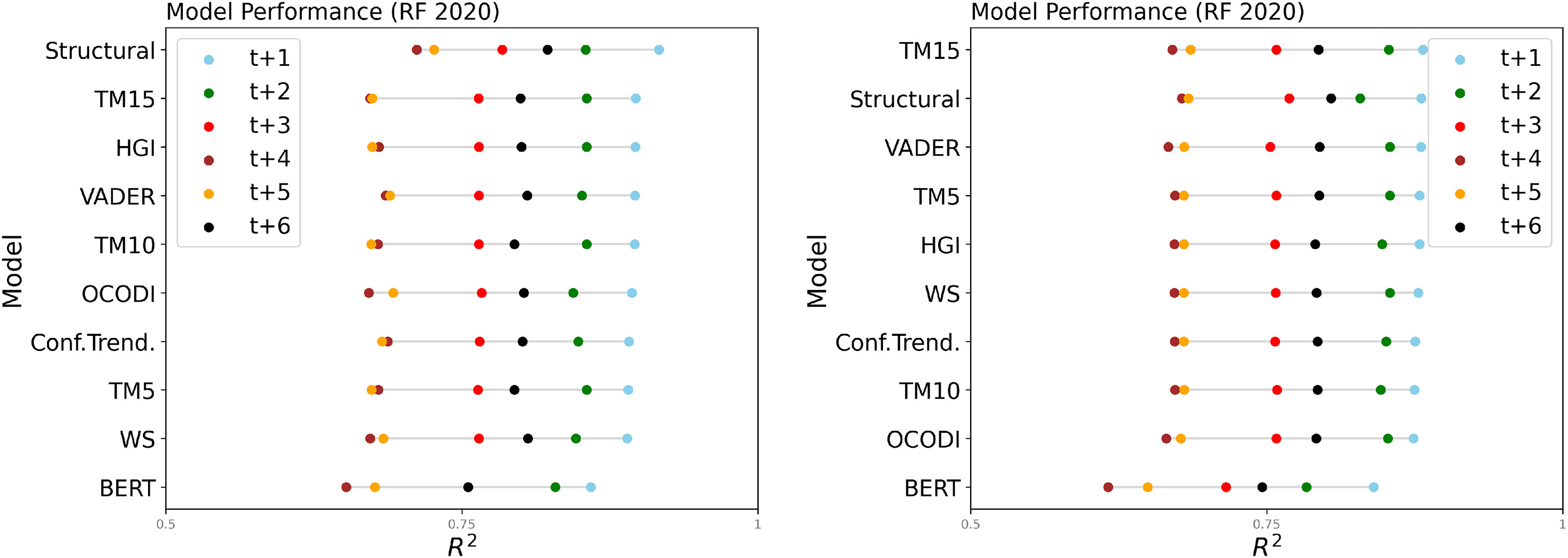
However, which groups of models tend to perform better and which text features add the most are more important questions. To answer them, I first have to establish the baselines with which the text features can be compared. Figure 4 (left) shows the performance of the two baseline model categories, Conflict Trend and the Structural model, in addition to all text features for both text corpora. As both baseline models include the lagged target variable, I expect them to achieve good performance metrics. Indeed, it can be seen that the two baseline models outperform all of the text features with R2 ' between 0.8 and 0.9. Although both models achieve very similar performance metrics, the Structural model outperforms the Conflict Trend model over all time steps in the BBC data. Interestingly, for the CW data, Conflict Trends only outperforms the Structural model in t + 2.
Figure 4. Text features and baseline models (BBC data, left; CrisisWatch data, right).
After establishing the baselines, I can now turn to the performance of the text features. In Figure 4, in addition to the two baselines, I see the performance of models using only the different text features. As standalone features, no text feature can beat the baseline models; however, this was expected. Among all text features, it is not surprising that a transformer-based model achieves the best performance with an R2 close to 0.8. It is impressive to achieve such a performance only on information contained in texts. Nonetheless, all features from NLP methods that are directly linked to the target variable (BERT, OCODI, Wordscores) reach acceptable levels of R2. Features that are not directly linked to the target, general-purpose dictionaries, and topic models (TM15),20 achieve a considerably lower performance. For the Vader and HGI dictionaries, this comes as less of a surprise but given the good performance of topic models shown by Mueller and Rauh (2022), these results are unexpected.
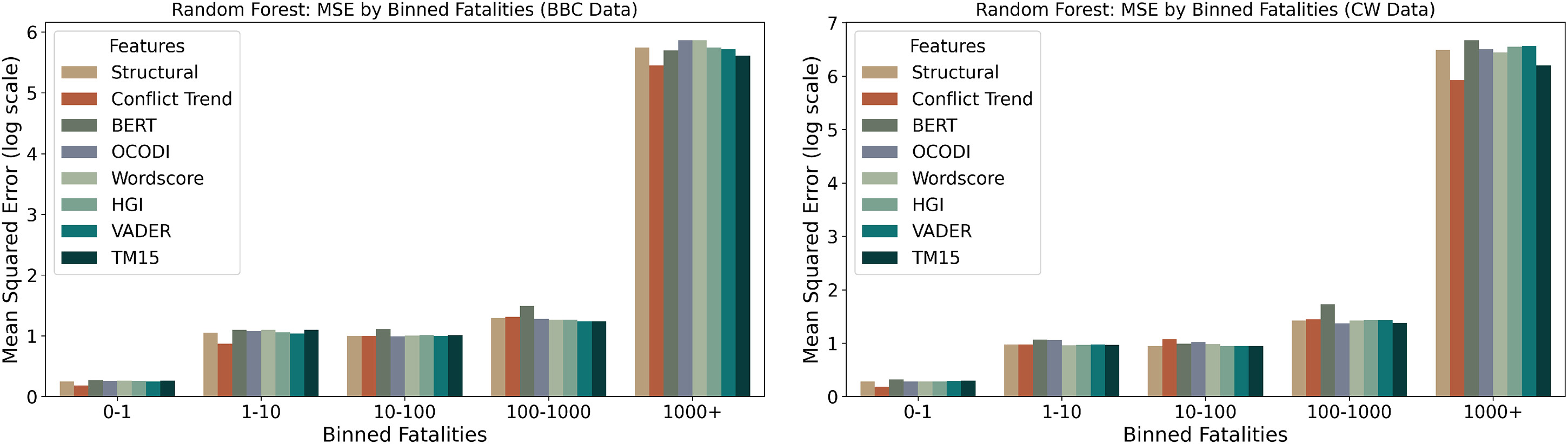
Next, I compare how these models perform across the distribution of fatalities. Figure 5 shows the model performance for each of these models across different bins of the outcome variable.
Figure 5. Model performance by binned fatalities (BBC, left; CrisisWatch, right). Note: As the models are predicting the log of fatalities, the mean squared error (y-axis) is shown on the log scale for easier visualization. The bins, however, were back-transformed to unlogged fatalities to be more interpretable.
Across both datasets, a clear trend emerges of the MSE increasing substantially with higher fatality bins, reflecting the greater difficulty of accurately predicting large-scale events. For both datasets, models based on structural features and conflict trends are often exhibiting the lowest MSE across most bins, particularly in the lower and intermediate fatality ranges. Somewhat surprisingly, models relying on textual features do not display markedly higher errors, with maybe the exception of BERT, which has slightly higher errors in the middle three bins. This holds true across datasets and even in the highest fatality bin (1000+).21 Notably, the relative performance of models remains stable between the two datasets, although overall MSE values are somewhat higher in the BBC data. These results suggest that there is not a huge difference between models, even for rare, high-severity events.
Since the goal of this paper is to improve our understanding of how text features can complement traditional conflict prediction models, next I investigate which NLP approach adds the most to the baseline models. In Figure 6 we can see the results when combining each of the text features with the conflict trends variables. As a reference, the figures also include the results for the conflict trends and the structural models. For both datasets, the results are very similar and it becomes apparent that text features are no silver bullet. The differences in performance are marginal. Simply adding text features to prediction models does not significantly improve their predictive performance. Although most text features increase the performance in comparison with the Conflict Trend baseline model, the Structural model outperforms all models on the BBC data and is only slightly beaten by the TM15 model in the CW data. However, again, the differences in performance are marginal. Interestingly, the text features that did not perform well as standalone features (Topic models, general-purpose dictionaries, and Wordscore), better complement the baseline models. It comes as a surprise that BERT is the only text feature that does not seem to complement existing approaches well. Although BERT is the best (standalone) text feature, it does not improve the baseline models. This may be because BERT can capture conflict trends reasonably well only from texts, but cannot help explain additional variability beyond that. Unsupervised or general-purpose approaches seem to capture latent information that is not directly correlated with conflict trends but can add to conflict history.
Figure 6. Improving upon the baseline models (BBC, left; CrisisWatch, right). Note: All Random Forest models include the lagged target (t − 1 to t − 6) variable as features. Hence, e.g. BERT includes the BERT features and the Conflict Trends features, as I wish to investigate how much the individual text features can add.
In the Online Appendix, I provide tables that display the R2 (and MSE) for all models over the whole forecast horizon for both the Random Forest as well as the XGBoost models. These results warrant a discussion of the tradeoff between performance gains and computational costs. Some text processing techniques are more computationally expensive than others. In particular, transformer models require sophisticated IT infrastructure, while applying off-the-shelf dictionaries is comparatively inexpensive. While the high computational cost for transformer models seems worth the gains in performance when there are no other features available, the performance drop-off when using them to complement other features suggests focusing on computationally cheap methods, like sentiment dictionaries or Wordscores, when computational power is limited. Topic models, on the other hand, while also computationally expensive, particularly when implementing dynamic topic models as I do here, can complement the baseline models well and the increased computational cost seems to be warranted. While these considerations should not be the only factors guiding the choice of NLP approach, it is important to keep in mind that increased complexity and computational cost of a model does not necessarily translate to increased performance in all settings.
Overall, text features seem to capture ongoing conflict dynamics and appear to have the potential to complement traditional input features for prediction models. However, on a global level with conflict history available, I have shown that few features can supplement conflict trends as predictors. The results and the findings by Mueller and Rauh (2022) point in the direction that text features could add more to predictions of conflict onset in cases where there is no conflict history (the so-called hard case problem) instead of global-level conflict intensity. Although further research is needed to systematically identify the conditions and cases in which text features can improve existing conflict prediction models, this paper is a first attempt to provide an overview of the potential benefits of using text features for crisis early warning models. Other interesting areas of further research might be to extend this evaluation to a more granular level, meaning to move beyond the country-month level. In general, it is advisable to use a high-quality newspaper corpus. The challenges associated with constructing such a newspaper corpus, however, are plenty, especially concerning country coverage and the challenge of constructing a diverse corpus consisting not only of articles from one international newspaper agency.

Conclusion

Conflict prediction continues to be a challenging task. However, the potential benefits of anticipating the next conflict or crisis continue to motivate researchers to improve upon existing approaches. In particular, the multifaceted and dynamic nature of conflicts, coupled with challenges related to data, human behavior, and the importance of contextual factors, contributes to the ongoing difficulty in accurately predicting when and how conflicts will arise.
However, with recent advancements in computational performance and wider and easier access to new data sources through the internet, researchers have been able to improve the predictive performance of models. Applying natural language processing methods to large corpora of text documents stands out as one promising direction to improve upon these efforts even more. In particular, conflict reports and newspaper articles could be helpful in this regard, as they include relevant information about current and future dynamics of conflict in a country.
Therefore, in this article, I examined strategies to extract features from text data for out-of-sample conflict prediction using different NLP techniques, providing an overview of the most popular NLP approaches and presenting a comparative assessment of their benefits for crisis-early-warning models. I do so by applying topic models, dictionary approaches, a document scaling method, and transformer models to two text corpora (CrisisWatch reports and BBC Monitoring news articles) and investigate how well these features can help predict conflict intensity. While text features alone cannot reach the same predictive performance as using conflict trends or other structural data, some of them, particularly transformer models, reach acceptable levels of performance, considering that these predictions are based on text data alone. I find that the integration of NLP methods for conflict prediction underscores the potential of leveraging textual data to enhance the accuracy and depth of forecasting models. Although NLP is not a silver bullet, the findings reveal that incorporating NLP tools can offer valuable insights and can complement and, depending on the context, even supplement alternative approaches. This is underlined by the results, showing that including text features in the prediction models improves their performance, even if only marginally. Building on this, training NLP models, specifically models that can be fine-tuned on conflict data (e.g. BERT or OCODI), on the residuals of structural models may be a natural next step, as this could enable each approach to capture unique information and further enhance the predictive power of traditional models.22 I sought to identify the most effective NLP approach based on the nature of text sources and the availability of other structural variables. The assessment of various NLP methods on distinct corpora, encompassing general newspaper articles and expert-authored CrisisWatch reports, emphasizes the need for a tailored approach that aligns with the specific characteristics of the data at hand. Furthermore, increased model complexity and computational cost does not always translate into better performance and, depending on the context, applying a simpler NLP approach may save computing time at no expense of performance. With no single NLP approach outperforming the others, these results underline the importance of continuously investigating new approaches and their applicability to conflict prediction.
Crucially, this research sheds light on the complementarity of NLP features with traditional structural variables like socio-economic indicators, conflict history, and political indicators. The synergy between these approaches reinforces the idea that a holistic understanding of conflict prediction requires the integration of a diverse set of data sources and modeling approaches. Given the importance of improving conflict prediction models, I hope that this study can serve as an initial step toward assessing the efficacy of different NLP methods. While I evaluated how well models fare at predicting conflict intensity, future research looking at how different text features could help predict outbreaks or escalations of violence, in line with findings by Mueller and Rauh (2022), could prove beneficial.
Finally, natural language processing, and machine learning more generally, are fast-developing research areas that have seen an immense boost in popularity in recent years. Particularly the new Generative Pre-trained Transformer model family is evolving rapidly, with impressive results in many different areas. However, currently, there is no straightforward or intuitive way to apply these generative models for prediction tasks on tabular data. While they may be helpful in prediction adjacent tasks, their usefulness for generating features for conflict prediction is limited for now. Moving forward, continued assessment in different contexts will be essential to evaluate future approaches and improve the accuracy of conflict prediction.

Acknowledgments

The Center for Crisis Early Warning (Kompetenzzentrum Krisenfruherkennung) is funded by the German Federal Ministry of Defense and the German Federal Foreign Office. The views and opinions expressed in this article are those of the authors and do not necessarily reflect the official policy or position of any agency of the German government. I gratefully acknowledge the computing time granted by the Institute for Distributed Intelligent Systems and provided on the GPU cluster Monacum One at the Bundeswehr University Munich to fine-tune the BERT models. The empirical analysis for the revised manuscript was enabled by resources provided by the National Academic Infrastructure for Supercomputing in Sweden, partially funded by the Swedish Research Council through grant agreement no. 2022-06725. I want to especially thank Sonja Häffner for her substantial contribution to the initial draft of this paper. All remaining errors are my own. I would also like to thank Christoph Dworschak, Christian Oswald, and the participants of the CCEW Symposium 2023 for their comments and helpful feedback.

Funding

The author received no financial support for the research, authorship, and/or publication of this article.

ORCID iD

Footnotes

1. NLP techniques such as sentiment analysis, document scaling, or transformer models, have already been applied in conflict research or have proven to be helpful in improving predictions in research areas outside of political science (see e.g. Mittal et al., 2022).
2. The question of whether variables that are statistically associated with an outcome variable are also improving prediction results is strongly debated. Arguments have been made both for more theory-guided variable selection (see e.g. Blair and Sambanis, 2020, 2021; Chiba and Gleditsch, 2017) and for more model-driven feature selection (Beger et al., 2021; Colaresi and Mahmood, 2017; Ward et al., 2010). This is a debate that is also not limited to political science (see e.g. Lo et al., 2015) and is a central issue in machine learning, particularly with regards to feature selection and engineering techniques.
3. The reverse should also hold true. If reporting increasingly focuses on conflict-unrelated topics, this could indicate an easing of tensions in a given country.
4. All analysis steps were performed in the programming language Python (version 3.10). For the sake of reproducibility, an overview of all libraries and their respective versions is included in the Replication Package. The code and the data can be found online at xyz.com. The text-preprocessing steps for the NLP approaches can be found in the Appendix.
5. https://www.crisisgroup.org/crisiswatch.
6. The categories BBC Monitoring includes are reports, round-ups, programme summaries, news alerts, and insights. For more information visit https://monitoring.bbc.co.uk/.
7. Owing to the proprietary nature of the BBC Monitoring Dataset, I had to limit the analysis to this timeframe.
8. https://ucdp.uu.se/downloads/.
9. As I try to include features that match the coverage, only a fedw observations need to be imputed, and hence, using an imputation approach should not affect the results. For more details see the python miceforest package https://pypi.org/project/miceforest/.
10. https://www.v-dem.net/vdemds.html.
11. https://github.com/OEFDataScience/REIGN.github.io.
12. https://growup.ethz.ch/rfe.
13. I provide additional analyses for all text features in the Online Appendix.
14. https://huggingface.co/snowood1/ConfliBERT-scr-uncased.
15. As a model is estimated for each prediction timestep, in total I train 468 Random Forest models, not including the different setups estimated for the hyperparameter optimization.
16. I use Random Forest models as tree-based models are generally a good fit for predictions on tabular data and can handle non-linearities natively (Grinsztajn et al., 2022).
17. CrisisWatch texts are always written for a specific country, and countries are matched accordingly. BBC Monitoring articles are assigned to countries based on the metadata provided by BBC. For each article, there are up to four countries listed in the data. To avoid inflating and duplicating information, I assign articles based on the first country listed, since this is generally the country the text is mostly in reference to.
18. For further information, the reader is referred to the BBC Monitoring website: https://monitoring.bbc.co.uk
19. The Second Nagorno–Karabakh War took place mostly in October (t + 4) 2020 and the Tigray War started in November (t + 5) 2020, resulting in exceptionally large numbers of fatalities, which were difficult to predict for all models. For more information, the reader is referred to the Online Appendix.
20. I only display the topic model (TM) with k = 15 here, since it is the best performing of the three.
21. It has to be noted that there are not many observations in the 1000+ bin, hence this may not be too representative.
22. I thank the reviewer for suggesting this promising extension.

Data availability statement

Replication code and data for this article are available via Harvard Dataverse at https://doi.org/10.7910/DVN/MNT4UQ. However, the BBC Monitoring news articles are proprietary and cannot be shared.

References

Azar EE (1980) The Conflict and Peace Data Bank (COPDAB) project. The Journal of Conflict Resolution 24(1): 143–152.
Azar EE, McLaurin RD, Havener T, et al. (1977) A system for forecasting strategic crises: Findings and speculations about conflict in the Middle East. International Interactions 3: 193–222.
Beger A, Dorff CL, Ward MD (2014) Ensemble forecasting of irregular leadership change. Research and Politics 1: 1–7.
Beger A, Morgan RK, Ward MD (2021) Reassessing the role of theory and machine learning in forecasting civil conflict. Journal of Conflict Resolution 65: 1405–1426.
Bell C, Besaw C, Frank M (2021) The rulers, elections, and irregular governance (reign) dataset. One Earth Future.
Benoit K, Laver M (2003) Estimating Irish party policy positions using computer wordscoring: The 2002 election – a research note. Irish Political Studies 18(1): 97–107.
Blair RA, Blattman C, Hartman A (2017) Predicting local violence: Evidence from a panel survey in Liberia. Journal of Peace Research 54: 298–312.
Blair RA, Sambanis N (2020) Forecasting civil wars: Theory and structure in an age of “big data” and machine learning. Journal of Conflict Resolution 64: 1885–1915.
Blair RA, Sambanis N (2021) Is theory useful for conflict prediction? A response to Beger, Morgan, and Ward. Journal of Conflict Resolution 65: 1427–1453.
Blei DM, Lafferty JD (2006) Dynamic topic models. In: Proceedings of the 23rd International Conference on Machine Learning - ICML ‘06, Pittsburgh, PA, USA.
Blei DM, Ng AY, Jordan MI (2003) Latent Dirichlet allocation. The Journal of Machine Learning Research 3: 993–1022.
Boschee E, Lautenschlager J, O’Brien S, et al. (2018) ICEWS Weekly Event Data. Available at: https://dataverse.harvard.edu/dataset.xhtml?persistentId=
Boussalis C, Chadefaux T, Salvi A, et al. (2022) Public and private information in international crises: Diplomatic correspondence and conflict anticipation. International Studies Quarterly 66(4): sqac056.
Bowlsby D, Chenoweth E, Hendrix C, et al. (2019) The future is a moving target: Predicting political instability. British Journal of Political Science 50: 1405–1417.
Brandt PT, D’Orazio V, Khan L, et al. (2022) Conflict forecasting with event data and spatio-temporal graph convolutional networks. International Interactions 48(4): 800–822.
Brandt PT, Freeman JR, Schrodt PA (2011) Real-time, time-series forecasting of political conflict. Conflict Management and Peace Science 28: 41–64.
Brandt PT, Freeman JR, Schrodt PA (2014) Evaluating forecasts of political conflict dynamics. International Journal of Forecasting 30: 944–962.
Cederman L-E (2003) Modeling the size of wars: From billiard balls to sandpiles. American Political Science Review 97(1): 135–150.
Chadefaux T (2014) Early warning signals for war in the news. Journal of Peace Research 51: 5–18.
Chiba D, Gleditsch KS (2017) The shape of things to come? Expanding the inequality and grievance model for civil war forecasts with event data. Journal of Peace Research 54: 275–297.
Choucri N (1974) Forecasting in international relations: Problems and prospects. International Interactions 1: 63–86.
Choucri N, Robinson TW (1978) Forecasting in International Relations: Theory, Methods, Problems, Prospects. Cambridge, MA: W. H. Freeman.
Colaresi M, Mahmood Z (2017) Do the robot: Lessons from machine learning to improve conflict forecasting. Journal of Peace Research 54: 193–214.
Coppedge M, Gerring J, Knutsen CH, et al. (2023) V-Dem country-year dataset v13. Varieties of Democracy (V-Dem) Project. Available at: https://www.v-dem.net/data/the-v-dem-dataset/country-year-v-dem-fullothers-v13/.
de Mesquita B (2010) The Predictioneer’s Game: Using the Logic of Brazen Self-interest to See and Shape the Future. New York, NY: Random House.
de Mesquita B, Newman D, Rabushka A (1985) Forecasting Political Events: The Future of Hong Kong. Yale University Press.
Dunphy DC (1974) Harvard IV-4 Dictionary General Inquirer Project. Sydney, Australia: University of New South Wales.
Gleditsch KS, Ward MD (2013) Forecasting is difficult, especially about the future: Using contentious issues to forecast interstate disputes. Journal of Peace Research 50: 17–31.
Gohdes AR, Carey SC (2017) Canaries in a coal-mine? What the killings of journalists tell us about future repression. Journal of Peace Research 54: 157–174.
Goldsmith BE, Butcher CR, Semenovich D, et al. (2013) Forecasting the onset of genocide and politicide: Annual out-of-sample forecasts on a global dataset, 1988–2003. Journal of Peace Research 50: 437–452.
Goldstone JA, Bates RH, Epstein DL (2010) A global model for forecasting political instability. American Journal of Political Science 54: 190–208.
Greene KT, Lucas C (2020) Once more, with feeling: Using sentiment analysis to improve models of relationships between non-state actors. International Interactions 46(1): 150–162.
Grinsztajn L, Oyallon E, Varoquaux G (2022) Why do tree-based models still outperform deep learning on tabular data? Advances in Neural Information Processing Systems 35: 507–520.
Häffner S, Hofer M, Nagl M, et al. (2023) Introducing an interpretable deep learning approach to domain-specific dictionary creation: A use case for conflict prediction. Political Analysis 31(4): 1–19.
Hegre H, Allansson M, Basedau M (2019) ViEWS: A political violence early-warning system. Journal of Peace Research 56: 155–174.
Hegre H, Buhaug H, Calvin KV, et al. (2016) Forecasting civil conflict along the shared socioeconomic pathways. Environmental Research Letters 11: 054002.
Hegre H, Karlsen J, Nygård HM, et al. (2013) Predicting armed conflict, 2010–2050. International Studies Quarterly 57: 250–270.
Hegre H, Metternich NW, Nygård HM, et al. (2017) Introduction: Forecasting in peace research. Journal of Peace Research 54: 113–124.
Hegre H, Vesco P, Colaresi M (2022) Lessons from an escalation prediction competition. International Interactions 48(4): 521–554.
Hu Y, Hosseini MS, Skorupa Parolin E, et al. (2022) Conflibert: A pre-trained language model for political conflict and violence. In Proceedings of the 2022 Conference of the North American Chapter of the Association for Computational Linguistics: Human Language Technologies, 10–15 July 2022, Seattle, USA.
Hutto C, Gilbert E (2014) Vader: A parsimonious rule-based model for sentiment analysis of social media text. In: Proceedings of the International AAAI Conference on Web and Social Media, 1–4 June 2014, Ann Arbor, Michigan, USA, vol. 8, pp.216–225.
King G, Zeng L (2001) Improving forecasts of state failure. World Politics 53: 623–658.
Koren O (2017) Means to an end: Pro-government militias as a predictive indicator of strategic mass killing. Conflict Management and Peace Science 34: 461–484.
Laver M, Benoit K, Garry J (2003) Extracting policy positions from political texts using words as data. The American Political Science Review 97(2): 311–331.
Lemos CM, Coelho H, Coelho H, et al. (2013) Agent-based modeling of social conflict, civil violence and revolution: State-of-the-art-review and further prospects. EUMAS 1113: 124–138.
Lo A, Chernoff H, Zheng T, et al. (2015) Why significant variables aren’t automatically good predictors. Proceedings of the National Academy of Sciences 112: 13892–13897.
Loper E, Bird S (2002) Nltk: The natural language toolkit. CoRR: 214–217. cs.CL/0205028.
Macnair L, Frank R (2018) Changes and stabilities in the language of Islamic State magazines: A sentiment analysis. Dynamics of Asymmetric Conflict 11(2): 109–120.
Maerz SF, Puschmann C (2020) Text as data for conflict research: A literature survey. In: Deutschmann E, Lorenz J, Nardin LG, Natalini D, Wilhelm AFX (eds) Computational Conflict Research, Computational Social Sciences. Cham: Springer International, 43–65.
Mayersen D (2020) Predicting genocide and mass killing. Journal of Genocide Research 23: 81–104.
Mittal S, Chauhan A, Nagpal CK (2022) Stock Market Prediction by Incorporating News Sentiments Using Bert. Cham: Springer International, pp.35–45.
Montgomery JM, Hollenbach FM, Ward MD (2012) Improving predictions using ensemble Bayesian model averaging. Political Analysis 20: 271–291.
Mueller H, Rauh C (2018) Reading between the lines: Prediction of political violence using newspaper text. American Political Science Review 112: 358–375.
Mueller H, Rauh C (2022) The hard problem of prediction for conflict prevention. Journal of the European Economic Association 20(6): 2440–2467.
Oswald C, Ohrenhofer D (2022) Click, click boom: Using Wikipedia data to predict changes in battle-related deaths. International Interactions 48(4): 678–696.
Pilster U, Böhmelt T (2014) Predicting the duration of the Syrian insurgency. Research & Politics 1: 1–10.
Pinckney J, Daryakenari BR (2022) When the levee breaks: A forecasting model of violent and nonviolent dissent. International Interactions 48(5): 997–1026.
Raphael TD (1982) Integrative complexity theory and forecasting international crises: Berlin, 1946–1962. Journal of Conflict Resolution 26: 423–450.
Rummel RJ (1969) Forecasting international relations: A proposed investigation of three-mode factor analysis. Technological Forecasting 1: 197–216.
Scharpf A, Schneider G, Nöh A, et al. (2014) Forecasting of the risk of extreme massacres in Syria. European Review of International Studies 1: 50–68.
Schneider G, Gleditsch NP, Carey S (2011) Forecasting in international relations: One quest, three approaches. Conflict Management and Peace Science 28: 5–14.
Schrodt PA (1991) Prediction of interstate conflict outcomes using a neural network. Social Science Computer Review 9: 359–380.
Slapin JB, Proksch S-O (2008) A scaling model for estimating time-series party positions from texts. American Journal of Political Science 52(3): 705–722.
Sundberg R, Melander E (2013) Introducing the ucdp georeferenced event dataset. Journal of Peace Research 50(4): 523–532.
Tikuisis P, Carment D, Samy Y (2013) Prediction of intrastate conflict using state structural factors and events data. Journal of Conflict Resolution 57: 410–444.
Timoneda JC, Wibbels E (2022) Spikes and variance: Using google trends to detect and forecast protests. Political Analysis 30(1): 1–18.
Trubowitz P, Watanabe K (2021) The geopolitical threat Index: A text-based computational approach to identifying foreign threats. International Studies Quarterly 65(3): 852–865.
Vaswani A, Shazeer N, Parmar N, et al. (2017) Attention is all you need. CoRR: 1–15. abs/1706.03762.
Vesco P, Hegre H, Colaresi M, et al. (2022) United they stand: Findings from an escalation prediction competition. International Interactions 0(0): 1–37.
Walterskirchen J, Häffner S, Oswald C, et al. (2024) Taking time seriously: Predicting conflict fatalities using temporal fusion transformers. SocArXiv: 1–21.
Ward MD, Beger A (2017) Lessons from near real-time forecasting of irregular leadership changes. Journal of Peace Research 54: 141–156.
Ward MD, Greenhill BD, Bakke KM (2010) The perils of policy by P-value: Predicting civil conflicts. Journal of Peace Research 47: 363–375.
Ward MD, Metternich NW, Dorff CL (2013) Learning from the past and stepping into the future: Toward a new generation of conflict prediction. International Studies Review 15: 473–490.
Watanabe K (2020) Latent semantic scaling: A semisupervised text analysis technique for new domains and languages. Communication Methods and Measures 15(2): 81–102.
Weidmann NB, Ward MD (2010) Predicting conflict in space and time. Journal of Conflict Resolution 54: 883–901.
Zeitzoff T (2011) Using social media to measure conflict dynamics: An application to the 2008–2009 Gaza conflict. Journal of Conflict Resolution 55(6): 938–969.

Supplementary Material

Please find the following supplemental material available below.

For Open Access articles published under a Creative Commons License, all supplemental material carries the same license as the article it is associated with.

For non-Open Access articles published, all supplemental material carries a non-exclusive license, and permission requests for re-use of supplemental material or any part of supplemental material shall be sent directly to the copyright owner as specified in the copyright notice associated with the article.