Introduction
As an evolving and widely debated concept, literacy encompasses a variety of meanings. The operational definitions of the United Nations Educational, Scientific and Cultural Organization (UNESCO
, 2004) point to “the ability to read and write with understanding a simple statement related to one's daily life” and to “the ability to identify, understand, interpret, create, communicate and compute using printed and written materials associated with varying contexts” (pp. 12–13). In everyday language, illiteracy is generally understood as the inability to read and write but also as the absence of knowledge of a particular subject (
Cambridge University Press, n.d.), implying that a person can be considered literate in one field and illiterate in another.
Sociocultural perspectives of literacy tend to take a critical view of the operational definitions that focus exclusively on literacy as an individual attribute. Instead, they propose a refocusing on literacies as social practices that are purposeful, embedded in a given cultural context, changeable over time, and whose uses and meanings are shaped by relations of power (
Barton & Hamilton, 2000;
Street, 1984,
2012a). As
Sacré (2023) indicates, illiteracy does not necessarily imply a positive or negative attribute. However, in the specific case of writing and reading, and especially after the Enlightenment movement and the Reading Revolution, literacy has become a means of social mobility and emancipation, and its denial to certain social groups, namely, women, has reinforced it as a criterion of inequality and exclusion (
Heinemann & Monzó, 2021;
Sacré, 2023).
Postcolonial critical pedagogy perspectives have been linking the current views on illiteracy to the persistence of notions of human hierarchy and to the narratives of inevitability, which give illiteracy a negative connotation, understanding it as the result of personal, intellectual, or cultural failings, rather than objective structural limitations and inequalities (
Heinemann, 2017;
Heinemann & Monzó, 2021). In the same vein, the idea that oral societies, not founded on written communication, are less advanced and in need of education continues to determine how those who cannot read or write are perceived (
Ong, 2009;
Street, 2012b).
In today's societies, largely established around written communication, it is estimated that 754 million adults are not able to read or write (UNESCO Institute for Statistics [
UIS], 2023a). The reasons for illiteracy are varied and can include the lack of access to formal education, early school leaving, poor-quality education, or the predominance of oral traditions in some communities (
Adami, 2008;
Plutzar & Ritter, 2008).
In Europe, the proportion of adults without any level of schooling (measured as the proportion of adults whose educational attainment corresponds to Level 0 of the International Standard Classification of Education [ISCED]) is marginal, estimated at less than 2% for the EU27 (
Eurostat, 2020). However, differences between Europe- and foreign-born populations are noteworthy. The unschooled population among the Europe and foreign born accounts for 0.6% and 3%, respectively (
Eurostat, 2020). This may be due to the disruptive effect of migration on individual educational trajectories but also because of the intrinsic characteristics of current migratory movements, which tend to include a wider range of countries, and a more heterogenous composition of the migrant population in terms of their sociodemographic characteristics (
Barroso, 2024;
D’Agostino, 2022). Migratory experiences and journeys, in all their diversity, tend to activate some kind of illiteracy. A person who is literate in one context may experience disqualification and be declared illiterate in another, especially when learning a new language or alphabet (
Blommaert et al., 2006). If there has been no reading or writing learning in the language of origin, learning a new language often takes place at the same time as basic literacy acquisition (
Elvias Carreras, 2009;
Fall, 2020;
Sierra Rodríguez & Peláez-Paz, 2017).
In the current global context of migration, many individuals have an extensive multilingual repertoire prior to migration, which is then expanded through the multiplicity of linguistic contacts occurring during the journey and in the migration experience, with or without the use of written language (
Amoruso, 2022;
D’Agostino, 2022;
D’Agostino & Mocciaro, 2021). But what seems to be a constant element in the construction of the social category of the low-literate migrant, in the context of a multiplicity of profiles, is the recognition that there is a dominant language determining the exclusion of those who do not use it proficiently, with illiteracy reflecting power imbalances in multilingual worlds (
Heinemann & Monzó, 2021;
Sacré, 2023).
Women account for approximately half of the worldwide migration and around half of the immigration to Europe (
International Organization for Migrations [IOM], 2023). They represent an increasingly diverse group in terms of educational and occupational profiles but also in terms of motivations for migrating (
Boyd, 2021;
Fleury, 2016). In recent years, skilled female migration has been rising in Europe (
Christou & Kofman, 2022). However, the changing nature of female migration has also led to a slight increase in the proportion of lower-educated immigrant women (
Barroso, 2024). The overrepresentation of women in the world's population without basic writing and reading skills, estimated at 63% (
UIS, 2023b), may be reflected in Europe's migrant population. This process has long been acknowledged by community organizations, who often target women in their actions to promote migrants’ integration, language learning, and literacy (
Elvias Carreras, 2009;
Sierra Rodríguez & Peláez-Paz, 2017), recognizing the specific challenges of learning to read and write for those who are at the intersection of gender and migration. Not having received any formal education in the country of origin owing to poverty and/or gender conditionings, having a poor command of the language of the destination country, having demanding family roles, and being in a vulnerable socioeconomic condition are some of the obstacles faced by migrant women accessing or engaging in literacy learning (
Elvias Carreras, 2009;
Sierra Rodríguez & Peláez-Paz, 2017).
Critical perspectives on language learning programs for immigrants have identified their ambivalent implications. On the one hand, especially in cases where there is state funding, the learning promoted by the hegemonic literate community enhances the reproduction of structures of oppression against the immigrant population (
Heinemann, 2017;
Heinemann & Monzó, 2021). As
Heinemann (2017) denotes, they may even resemble the civilizing missions of the colonial period, by imposing, through language learning, the norms that enable integration (see also
Blommaert et al., 2006). On the other hand, the understanding of literacy as a means of changing mentalities and promoting social change implies that the learning process is also a vehicle of liberation (
Freire, 1979), which enables individuals to explore new life possibilities, otherwise inaccessible, and to reclaim individual agency (
Heinemann & Monzó, 2021;
Sacré, 2023).
Acquisition of literacy, as a process that extends beyond the (de)codification between orality and writing, involves a change in the way the individual perceives oneself and apprehends the world (
Freire, 1970,
1979,
1981). This idea supports the views of adult education and literacy acquisition as empowering endeavors, which can change individual social locations, promote inclusion, and enhance self-worth. Literacy and self-enhancement are positively associated, with evidence showing that individuals engaged in literacy acquisition show increased social awareness, self-confidence, capacity to negotiate power in everyday life, and higher social and political participation (
Ghose & Mullick, 2012;
Iñiguez-Berrozpe et al., 2020;
North, 2017;
Olomukoro & Adelore, 2015). However, the historical stigmatization of illiteracy renders self-deprecation a characteristic of those unable to read and write, who often internalize the negative attributes of illiteracy, viewing themselves as less valuable (
Freire, 1970;
Quigley, 2017).
In this article, I discuss the coexistence of self-deprecation and self-enhancement in the process of literacy acquisition, as an expression of the ambivalences experienced by migrant women learning to read and write in the host country. The article begins with the presentation of the theoretical framework, with a focus on the uses of self-deprecation and self-enhancement. In the second section, I present the methodology, participants of the study, and research setting. In the findings section, after presenting the observed self-enhancing effects of literacy, I discuss three manifestations of self-deprecation derived from the data: disclosure, infantilization, and humor. I conclude with the discussion and limitations of the study.
Self-Deprecation and Self-Enhancement
Self-deprecation can be broadly understood as undervaluing, depreciating, or belittling individual abilities or capacities. A considerable stream of studies on self-deprecation focuses on its cognitive dimension, analyzing it as an expression of negative self-concept (
Owens, 1994;
Owens & Gary, 2019;
Owens et al., 2001). In the field of adult education, research focusing on the effects of dispositional barriers in the decision to engage or withdraw from education incorporate this view of self-deprecation (
McGivney, 1993). Dispositional barriers are understood as learner's attitudes, perceptions, and motivations towards education (
McGivney, 1993), and they can be manifested via perceptions of low ability, internalized negative perceptions of self-worth, low self-confidence, or beliefs that one is too old to return to school (
McGivney, 1993;
Norman & Hyland, 2003;
Roosmaa & Saar, 2017). These obstacles could be more significant in determining adult learners’ engagement than, for instance, situational barriers, such as lack of time, difficulties with transportation to the learning site, or unavailable childcare facilities (
McGivney, 1993). The effects of the dispositional barriers were found to be particularly challenging for adults of disadvantaged backgrounds, immigrants, low-skilled individuals, women, or persons with linguistic vulnerabilities (
McGivney, 1993;
Roosmaa & Saar, 2017).
Another stream of research on self-deprecatory behavior has focused on its use as a discursive resource to achieve specific outcomes, emphasizing the role of context to interpret why some individuals undervalue themselves or their abilities when they interact with others.
Speer (2019) highlighted the need to reconcile the cognitive and linguistic dimensions in the analysis of self-deprecation, by showing that apart from dispositional interpretations, self-deprecatory comments can be explained as communicative practices applied in specific contexts of interaction. Similarly,
Kim (2014) claimed that self-deprecation can be perceived either as dispositional, resulting from personality traits and individual attributes; situational, emerging only under certain circumstances and varying according to the social setting; and interactional, as a tool to respond to a variety of interactional objectives. Through the analysis of self-deprecatory language in Korean and Japanese speakers, the author argued that self-deprecation is employed as a conversational tool to maintain the relationship between the speakers during the interaction, which is shaped by culture and social context (
Kim, 2014). The crucial role of cultural norms is also supported by evidence on the meanings and variations of self-enhancement.
Cai et al. (2011), for instance, argued that country variations in the measures of explicit self-enhancement are more a result of cultural differences than of differences in self-regard.
The idea that self-enhancement and self-deprecation can coexist is not new in literature.
Preuss and Alicke (2017) showed how individuals can assess self-enhancement in the context of self-criticism of their past actions.
Wilson and Ross (2001) and
Ross and Wilson (2002) applied the temporal self-appraisal theory to demonstrate that it is common for individuals to enhance their present selves by disparaging their past selves, viewing their present self as an improved version of who they were in the past. Referring to cultural differences,
Cai et al. (2011) showed that the encouragement of modesty or self-criticism can, in fact, result in self-improvement, higher motivation, or increased self-esteem in some contexts.
Ambivalences in the uses and meanings of self-deprecation are also noted in comedy and humor studies’ scholarship (
Beale, 2020;
Crawford, 2003;
Gilbert, 2004;
Mills, 2011;
Russel, 2002;
Tomsett, 2018). In this field, the relationship between gender and self-deprecation, and particularly, the use of self-deprecatory humor as a resource for female humorists and stand-up comedians, has been widely discussed. Self-deprecation is presented as an emancipatory tool, enabling women to fight social norms by exposing the stereotypes they are often subjected to but also as a means of reproducing and reinforcing discriminatory attitudes based on gender (
Beale, 2020;
Crawford, 2003;
Russel, 2002;
Tomsett, 2018).
I argue that self-deprecation and self-enhancement take part in the literacy learning experience as a form of acknowledging weaknesses and strengths, challenging established social norms, and promoting change.
Methodology
This study is based on ethnographic fieldwork in a local association for the integration of immigrants in Madrid, Spain, and on interviews with the teachers and learners in the association's adult literacy classes. For 4 months, from February to May 2022, I observed one adult literacy class comprising four women learners, one teacher, and two master's students undergoing a teacher traineeship in the association. I also conducted semi-structured interviews with the teacher, the two trainees, and three of the four learners. One of the learners was not interviewed because of her discomfort in speaking Spanish. In the case of the teachers and trainees, the interviews focused on learning methods, classroom dynamics, and their own lives and professional and voluntary experiences. Regarding the learners, the focus was on their life trajectories, particularly on their educational and literacy journeys and on their lived experiences as immigrant women learning to read and write.
Additionally, I observed one gender-mixed literacy class in the same association and interviewed the teacher of this group. The class comprised the teacher and four students (three males and one female). The observation consisted of one single lesson, to become acquainted with the other literacy groups in the association.
Inevitably, the analysis also draws from my personal experience as a volunteer teacher in a similar course in a different region in Spain, from 2015 to 2017. Although my teaching experience does not form the empirical basis of this study, the analysis of my observations was often contrasted with memories of specific episodes of that time and even with some materials kept on file, such as diaries or lesson summaries, which I often consulted. This enabled me to identify similarities between two different teaching contexts and to reflect on possible social patterns in the interactions and reactions I observed.
Initially, the research protocol established with the association determined a nonparticipant form of observation, which would allow me to be physically present in the classroom, making observations and taking notes, without significantly interfering with the learning dynamics. However, from the first day of observation, I was called to participate in the interactions, whether by helping the teacher assisting the students, or by the students themselves, who constantly engaged with me, asked me questions, and acknowledged my presence. Being a racialized immigrant woman myself, I often navigated between several roles during the interactions, being viewed as a university researcher, a literacy teacher, a racialized woman, an immigrant, or a mother, often challenging my and their visions of the “other.”
The data comprised field notes written after each class, the transcription of five audio-recorded interviews, and the written account of the two interviews that were not audio-recorded at the request of the interviewees. The analysis adopted an inductive approach using thematic analysis. It started with the iterative reading of the observation notes, transcriptions, and interview notes. After obtaining a comprehensive understanding of the data, I followed an open-coding procedure that enabled the identification of patterns and initial themes emerging from the participants’ narratives and observed interactions. Related codes were then connected and structured into overarching themes reflecting the relationships between the initial themes and general patterns among the data. Finally, the themes were defined, described, and interpreted in a narrative expressing the ambivalences of literacy acquisition for migrant women.
Along with interviews and interview notes, field notes were an essential part of the analysis. Going beyond the descriptive accounts of the observations, they also included my interpretations and perceptions as a researcher (
Altheide, 1987). Therefore, in the analysis of the findings, I used both interview quotations and excerpts from my field notes to illustrate and support my arguments.
The study received the approval of the Ethical Committee of the Autonomous University of Madrid (CEI-117-2354). All participants were informed of the objectives of the study and implications of participating. Written consent was obtained from the teachers and trainees. Oral consent was obtained from the students who were unable to sign.
Participants and Setting
The organization under study is a local association in the region of Madrid, which offers language courses to different segments of the migrant population. In addition to courses of Spanish as a foreign language at all levels, it also provides literacy classes. Created by language teachers and professors, the association developed its own literacy learning method for non-Spanish-speaking adults, based on Freire's motivation-driven methodology. By decision of its directors, the association receives no public funding for its activities, relying instead on the contributions of its members. As indicated by
Heinemann (2017), this strategy has the disadvantage of relying on voluntary work but offers a high degree of independence regarding format and contents.
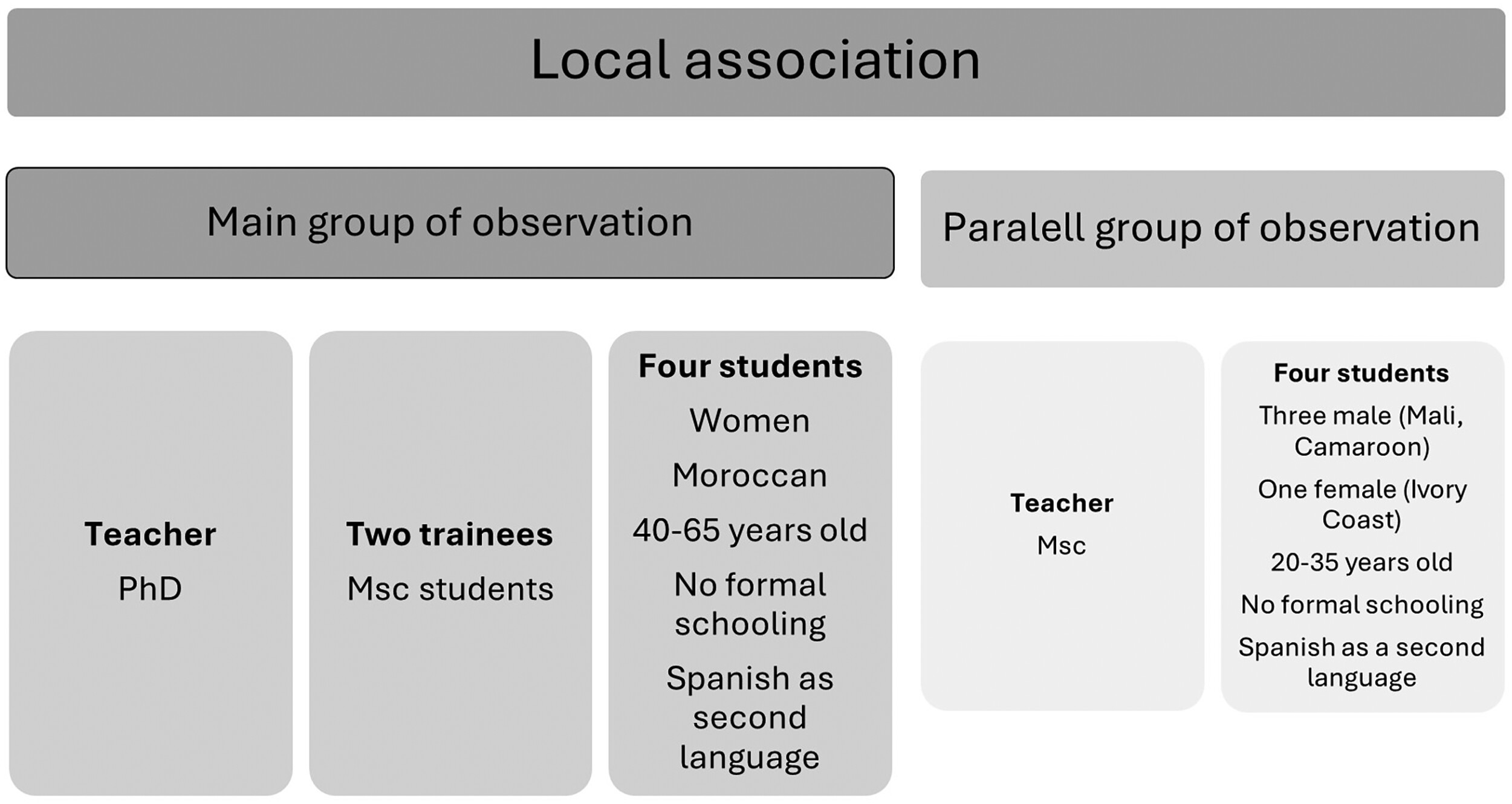
The main observation group comprised the teacher and the four students of the literacy-level course—all women. The teacher, who worked voluntarily in the association, held a PhD and had several years of professional experience in foreign-language teaching. She combined her work as a volunteer teacher with a paid part-time job as an administrative assistant. In the first weeks of observation, two trainees provided support to the class. Both were pursuing university studies of Spanish as a foreign language, and this teaching experience was part of their final grade work. The adult learners were all Moroccan women, older than 40, who had been living in Spain for more than 20 years. All of them had a good oral command of the Spanish language, although two of them presented some linguistic vulnerabilities in grammar and pronunciation. They all had paid work experience as domestic workers, carers, and cooks in restaurants, although with several discontinuities over time. Two were married with children, one was single without children, and the other was a widow with children and grandchildren (
Figure 1). None of them had attended school as children. They had never learned to read or write in any language, not even in their mother tongue. In the host country, their lack of basic literacy is further accentuated because they are not native speakers. At the time of conducting this study, they were learning to read and write in Spanish, in a dual learning process involving literacy acquisition and language learning.
The second observation group comprised a volunteer teacher, unemployed and holding a master's in foreign language teaching; three men younger than 25, born in Mali and Cameroon; and one woman younger than 30 from the Ivory Coast. The men were single and without children, and the woman had a child in her home country (
Figure 1). As in the previous group, they were learning to read and write in Spanish, while also learning the language. The analysis presented in this article focuses exclusively on the first observation group.
Findings
Becoming Literate: Identity, Self-Enhancement, and Empowerment
According to
Frankel et al. (2016), literacy refers to a dynamic, socioculturally situated set of developing skills and practices. Even when considering technical definitions of literacy, such as the ability to associate a sound with a written code, the exact moment at which this capacity is fully acquired is hardly identifiable. Nevertheless, becoming literate presupposes an identity change for adult learners, not only because of a noteworthy change in individual abilities but also—and especially—because literacy is a social achievement (
Scribner, 1984), providing abilities that facilitate a shift to the social category of literates.
In societies where most individuals know how to read and write, illiteracy is not immediately apparent in social interactions. Instead, it is manifested through participation in “socially organized activities with written language” (
Scribner, 1984, p. 8) and observable in events that are “mediated by written texts” (
Barton & Hamilton, 2000, p. 10). Consequently, on several occasions on a daily basis, those who cannot read and write must present themselves as not literate to justify why they cannot perform basic everyday tasks, such as filling out a form. In a society designed for literate individuals, being unable to read and write not only is restrictive but also denies—to some extent—the right to anonymity in everyday life and social interactions. This generates feelings of inadequacy, shame, and self-deprecation that ultimately support the view of literacy as a value judgment (
Knoblauch, 1990).
One of the interviewees, M., was particularly disturbed when recalling the feelings of shame and misfit each time she had to complete a form in a public service. In fact, these feelings were shared by most individuals I have encountered in adult literacy classes.
When I was asked to fill out a form, even if it was just to put my name in, I had to say I couldn’t and ask for help. It made me feel so ashamed. (Interview with M., 51 years old)
To prevent social embarrassment, a common reported strategy is to learn to copy the name and address from identification cards, even without making sense of textual characters. Overall, if a person is not perceived as nonliterate, the negative social categorizations associated with illiteracy are not part of the interaction.
I learned how to copy the name and address from my ID card, so that I wouldn’t have to ask for help when I had to fill out a form. (Interview with F., 42 years old)
In the literacy acquisition process, as the coding of sounds into text gradually consolidates and reading comprehension begins to develop, the empowering and self-enhancing dimension of learning becomes evident. This was the case with the women studied, who often commented on how the basic learning about a few letters and sounds enabled them to act with greater autonomy beyond the scope of family life, offering numerous possibilities for engagement and participation in public life. The effects of literacy acquisition are visible in everyday actions, such as the ability to independently use public transport and access public spaces such as health centers, hospitals, or administration offices, solely by decoding simple written messages. They also recognize feeling more confident engaging in simple daily interactions with people outside their immediate social circle. Similarly, when literacy lessons begin producing results and learners acknowledge the development of their reading and writing skills, they realize their potential and start to envision greater possibilities for the future. Therefore, even at its early stages, literacy acquisition induces considerable self-enhancement.
Earlier, I would only take an underground train with next-station announcements. I was afraid I would alight at the wrong station and get lost. When I learned the first letters and words, even when I couldn’t read the entire word, I knew it was the station where I had to alight. … Now I go almost everywhere without that fear. (Interview with M., 51 years old)
In the middle of the class, B., the teacher, asked me if M. had told me about her recent achievement: she had completed a form independently at a health center. I congratulated M., who shared that she had to write her name, phone number, and address, and then tick one or two options. She told the woman who was attending her that as she was a student, it would take her a while to complete the form. (Fieldwork notes, Class 10)
I used to go to another school, but it was a more advanced level, for people who could read and write. I was there for two years, but nothing registered in my mind…. Here, yes. She [the teacher] evokes the best in us. Now I’m starting to read; earlier, I couldn’t…What are my plans? Let's see if I can learn to write well, quickly, without looking, so that I can take a nursing course…. As soon as I can write well, I will do it. (Interview with F., 42 years old)
However, while reading and writing abilities are self-enhancing in everyday social practices, the learning process is often accompanied by manifestations of self-deprecation, which, in the collected data, are distinguished into three categories: disclosure, infantilization, and humor.
“Don’t Mind Me. I’m Dumb”: Self-Deprecation as Disclosure
One of the most observable expressions of self-deprecation appears right during the initial interaction, when learners present themselves as unintelligent, whether through a physical gesture or explicitly via words.
When N. arrives, the classroom is already occupied by two colleagues, one teacher, two trainees, and myself. It is the first time we meet. … When she sits and starts looking at the exercise, she turns to me and hits her head with her fist, saying she has a hard head. The teacher immediately says she does not, but this gesture would be repeated several times during the class to express that she is not intelligent. … The teacher then mentions to me that N. has difficulties holding the pencil and drawing circles. They have been working intensely on developing that competence, but progress is slow compared to other learners. (Fieldwork notes, Class 1)
F. is constantly justifying her mistakes: “Don’t mind me,” “I don’t know what's going on with me today.” “What a fool I am!” She frequently repeats these remarks in all classes. B. [the teacher] replies persistently: “Yes, I do mind you.” “Take a breath and try again.” “You are not a fool, this is actually very difficult.” (Fieldnote notes, Class 8)
This form of personal deprecation occurs in every class, with all learners. When introducing themselves or when performing difficult tasks, learners often present themselves as “dumb” to lower other's expectations and alleviate discomfort of failure. More than an expression of negative self-regard and internalized undervaluation, this form of self-deprecation is also a form of self-disclosure. Since most people tend to assume everyone knows how to read and write, irrespective of different languages, alphabets, or educational levels, for those who do not, there is often a need for self-disclosure of the condition of illiteracy, to justify possible limitations and inabilities.
“I Look Like a Child With All These School Supplies”: Literacy, Infantilization, and Self-Deprecation
Another common manifestation of self-deprecation comes in the form of self-infantilization. The education of adults is often subject to practices of infantilizing the learners, by means of using learning materials designed for children, which include infantile themes or templates (
Illeris, 2003,
2006). The lack of pedagogical materials adapted to the adult population means that many of the organizations working with low-literacy adults develop their own materials and teaching method. This is the case with the association under analysis, which produces its own pedagogic resources. In the class observations, it was possible to observe that infantilization was consciously avoided by the teacher, for instance, by asking the students what exercises they would like to do or which contents they would like to address. Even so, some elements persist in the literacy process, leading to infantilization, and these are often incorporated in the adult learners’ discourses and practices.
N. asks for a pencil.
“I have lots of them. I look like a child with all these pens, pencils, erasers… this is what happens when you don’t go to school when you are a child,” says F., while opening the yellow pen-case with a sort of teddy-bear image, and exhibiting her school supplies. (Fieldwork notes, Class 8)
Additionally, in the interviews, the accounts of the experience of adult learning are often made with reference to what was not learned during childhood and resorting to belittling remarks about their current ages.
I’m already old, but I’m learning a bit. … When I was six or seven years old, my friends would go to school and I would wait outside the school gate for them, so that we could play. I wanted to go to school. I would ask my parents “Take me to school as well,” but we were too many [siblings]. (Interview with M., 51 years old)
“Studying To Become a Doctor Is Very Hard”: Social Consciousness and Self-Deprecating Humor
Finally, I observed that self-deprecation emerged very often in the form of humor.
When the class finishes, F. stands up and says out loud: “I am tired. I have studied a lot today. Well, after all, studying to being a doctor is very hard.” … She laughs and confirms it was a joke. (Fieldwork notes, Class 1)
The word was “cajones.” The students started laughing because it sounded like a swear word. One student added to the general laugh by stating that she avoids saying “unicorn” for the same reason. She shared that she prefers to say “that kind of horse with a horn.” (Fieldwork notes, Class 11)
While I am helping M. with her exercise, I hear B. laughing loudly. She had just corrected a mistake by F., to which she replied, “I’ve screwed up” (La he cagado). (Fieldwork notes, Class 13)
The first example indicates ironic humor, where the joke lies in contrasting educational extremes: on the one hand, learning to read and write, which could be considered basic education, and, on the other, studying to become a doctor, which is an advanced level of education, generally known for being extremely demanding. However, at the same time, the joke is about ironizing the perceived difficulty of learning to read and write; it also jokes around the idea that her career aspirations, which include taking a nursing course, are limited because she is a migrant woman learning to read and write at this age. Again, this expression of self-deprecation in the form of humor acts as a possible transgression of social norms that determines the unlikeliness of pursuing a skilled career for someone who is a migrant and is not schooled.
The other two examples, which occur often in class, refer to jokes where the self-deprecation lies in the mispronunciation of specific words and which reflects the stereotype immigrant with a linguistic vulnerability. Yet, at the same time, it also denotes a total mastery of the language, particularly of swear words and alternative applications, without which the joke would be impossible.
Discussion
In line with previous research (
Ghose & Mullick, 2012;
Iñiguez-Berrozpe et al., 2020;
North, 2017;
Olomukoro & Adelore, 2015), this study shows that literacy acquisition is a self-enhancing process, manifested via increased autonomy, enhanced self-confidence, and greater participation in everyday social practices. Furthermore, by identifying three concrete manifestations of self-deprecation, the results also illustrate how literacy acquisition often involves situations of disempowerment and acknowledgment of individual vulnerabilities.
The first form of self-deprecation manifested when learners presented themselves as unintelligent. This type of self-deprecating behavior is often identified in adult education scholarship and interpreted as a dispositional form of self-deprecation, in a Bourdieuian sense, taking place when low-educated adults internalize external negative attributions (
Freire, 1970;
Norman & Hyland, 2003;
Quigley, 2017). As
Preuss and Alicke (2017) argued, self-enhancement is limited in the appraisal of concrete tasks. Literacy classes are mostly based on specific exercises that may highlight individual weaknesses. Therefore, the possibilities of self-enhancement in this learning situation are reduced.
However, as the findings also suggest, self-deprecation implies more than a negative self-representation. The disclosure function of self-deprecation (
Beale, 2020;
Crawford, 2003) was evident when the learners introduced and referred to themselves.
Crawford (2003) argued that more than a form of self-deprecation, the depreciative way women talk about themselves in everyday conversations indicates a form of self-disclosure aimed at obtaining intimacy and building a “community of shared understandings about life's absurdities” (p. 1421). In the classroom context, apart from the exchanges between classmates, there were also interactions with the teacher and—in this case—the researcher. When these learners were unable to answer a question correctly or complete an exercise, self-deprecation served to put this apparent inability into context and alleviate their unease in the face of the teacher and of myself. My positionality in the observation setting was not irrelevant to this disclosure need. While it is true that my condition as a racialized immigrant woman brought us closer and made it easier to establish the empathy necessary to create a safe environment, it is also true that my high level of education created a significant distance between us. Therefore, disclosure also served the purpose of mutually defining ourselves in that context. By presenting themselves as unintelligent, they were safeguarding against social expectations they could not meet. It may be understood as a facet of impression management, as theorized by
Goffman (2007,
1982), to avoid embarrassment and preserve dignity. In this sense, they were managing expectations and ensuring they would be treated in accordance with their competence, also avoiding potentially uncomfortable situations.
The second form of self-deprecation identified was self-infantilization. Learning to read and write remains largely associated with childhood. Therefore, it is not surprising that infantilizing may occur. From the learners’ perspective, more than reproduction and compliance with something imposed by external actors, the practice of self-deprecation by self-infantilizing may be interpreted as a means of reconciling with the experiences that were not lived in childhood but are being lived in adult life, in what can be considered the coping and reassuring functions of self-deprecation (
Russel, 2002;
Tomsett, 2018). At the same time, following
Beale (2020) and
Russel (2002), self-infantilizing could be also interpreted as a way of contesting stereotyped norms, namely, the ones that associate basic learning with childhood or that establish that adults should not use infantile material.
Finally, the third form of self-deprecation identified was humor. The examples presented show that the use of self-deprecating humor may be viewed as a particular type of “comic relief” enabling female learners to recognize and laugh at failures they share with each other (
Beale, 2020, p. 152). However, as the analysis of self-deprecating humor shows, these expressions of apparent devaluation were also effective for exhibiting concrete abilities—namely, language fluency that enables joke creations, or knowledge, such as being conscious of their unfavorable social positioning and limited scope of social mobility—while still aspiring for a better job, social participation, and a better life. In that sense, the results are in line with the literature on gender and comedy, particularly with
Russel (2002),
Mills (2011), and
Tomsett (2018), who indicated that the act of telling the joke establishes, in the first place, the superiority of the teller. Or as
Gilbert (2004) posited, learners are evidently “wise enough to play the fool.”
In line with
Kim’s (2014) results, the findings here show that self-deprecation can be simultaneously dispositional, resulting from the internalized attributes that the current knowledge societies with a widespread written culture assign to those who cannot read nor write, but also situational and interactional, standing out in the adult learning setting as acts that either do not exist or assume different forms outside of the classroom. But apart from indicating different meanings and uses of the act of self-deprecation, the findings show that, in the literacy acquisition process, self-enhancement and self-deprecation coexist. While becoming literate is viewed as something to look forward to and rewarding, it also implies overcoming different types of barriers and recognizing that certain skills are missing. These two dimensions are intrinsically related and express the ambivalence experienced by migrant women learning to read and write in the host country and the complexities of changing social roles and identity through education.
Globally, illiteracy is a gendered phenomenon, with more girls and women worldwide being excluded from formal education than boys and men, mainly due to different social expectations regarding the returns on the investment in the education of boys and girls (
Hanemann & Scarpino, 2015). When individual trajectories are marked by migration, women experience greater difficulties in accessing education and language learning in adult life, mostly due to their assigned gender roles and family responsibilities (
Cheung & Phillimore, 2017;
Spencer & Cooper, 2006). The life trajectories of the women who participated in this study were marked by these two structural disadvantages: owing to their gender and social class, they could not go to school during childhood; and migration and gender roles delayed their entry into literacy learning in adulthood. Their lived experiences as adult learners are also marked by stereotypes about the abilities of women and immigrants. As such, overcoming the different types of barriers and engaging in adult education as migrant women challenges established social norms based on gender, migration, class, family, age, and their intersections. It is in this disruptive context that self-enhancement and self-deprecation should be understood.
Conclusion
By focusing on the case of adult migrant women learning to read and write in the host country, this study encourages a thorough discussion of literacies in contemporary societies, considering the different social markers that adult learners introduce to the learning context and how these shape their learning experiences and outcomes. In the current globalized, dynamic societies, where knowledge plays a central role, it is paramount to debate how literacies are viewed, acquired, learned, and practiced.
In the concrete case of self-enhancement and self-deprecation dynamics, the analysis demonstrates the importance of exploring their multiple meanings and applications, including—but transcending—dispositional explanations and considering their interrelationships and simultaneity in the literacy acquisition context. Apart from providing new evidence to the fields of adult education and literacy, this study aims to foster the discussion of ambivalence in adult education and literacy acquisition. This remains a hitherto under-explored topic in the literature.
Acknowledging that the learning experience can hold both valuing and devaluing expressions is important to devise support strategies for adult learners in general, and for migrant women learners in particular, because the intersection of gender and migration creates specific ways of experiencing literacy. This acknowledgment and further discussions have implications in terms of both understanding and framing the motivations for withdrawal from education but, above all, for supporting and sustaining the continuity of literacy acquisition in times of greater difficulty. This is relevant for practitioners, learners, and researchers.
The situated nature of the study was relevant for exploring the coexistence of self-deprecation and self-enhancement. Nevertheless, further research in different learning settings and contexts and with participants of different sociodemographic characteristics is strongly encouraged for comprehensively understanding the ambivalence in adult literacy acquisition.