Introduction
Cute babies have been used in advertising for many years to influence our consumer choices (
Cook, 2005). By framing the child as glorified and immeasurable, emotional arguments are made to which parents are encouraged to respond by consuming the corresponding products (
Sjöberg, 2013); thus, the economic and emotional spheres, such as those encompassing parents and children, are strongly interconnected (
Cook, 2012;
Zelizer, 2005).
Smiling down at us from billboards around the world or looking up at us from magazines, these babies have usually been anonymous. Social media has, however, fundamentally changed the ways in which we obtain information, communicate and interact (
Lindgren, 2017)—and even more so how we are targeted by commercial messages through influencer markets and how we are persuaded what to wish for (
De Veirman et al., 2019;
Petersson McIntyre, 2020). Selling lifestyle commodities with babies has therefore also moved into this new arena.
Influencer culture has sprung from a digital culture that has its own ecology and economy, in which visual narratives, gazes and consumer culture are intertwined (
Abidin, 2018). Ordinary internet users can become microcelebrities (
Senft, 2013) or influencers and can gather a substantial number of followers on their social media platforms by visually and publicly displaying their personal lives online (
Marwick, 2015). A successful influencer operates on several platforms and curates an authentic, interacting persona that blurs the boundaries between public and private (
Jorge et al., 2021). Today, influencers function as a new form of marketing communication—also referred to as ‘influencer marketing’—in which they launch products or services for companies (
Abidin, 2018). Activities that were previously considered private or unlaboured work have thus become part of a flourishing digital economy that has enabled the emergence of entrepreneurship within neoliberal culture (
Berryman and Kavka, 2017;
Jorge et al., 2021;
Petersson McIntyre, 2020). Influencers create a feeling of closeness and intimacy, like that between friends, and their reviews of products are packaged in a personalised format, with the intimacy functioning as a qualification for the promoted goods themselves (
Berryman and Kavka, 2017;
Leaver et al., 2020).
Many influencers have included their children as content, and the practice of
sharenting describes parents sharing experiences of parenting, upbringing, child development and child behaviours with other parents online (
Blum-Ross and Livingstone, 2017). Sharenting can also be understood as a desire to stage one’s identity as a parent in relational terms (
Holiday et al., 2020), although there is a difference between sharenting through images published on social media to an intimate network or community and sharenting in order to extend one’s online brand by including children as content. For the influencer, showing ultrasounds, a growing belly, childbirth and everyday life with a baby is a way to broaden the brand from a focus on, for example, fashion or training, to a lifestyle brand that opens up new target groups and new business opportunities (
Abidin, 2015). The anonymous child from print magazine advertisements and billboards has, in influencer culture, been replaced by the child of an influencer, with a name and a persona.
Several researchers have discussed sharenting in relation to self-representation (
Archer, 2019;
Holiday et al., 2020;
Jorge et al., 2021), the representation of children (
Choi and Lewallen, 2018), privacy and children’s rights (
Blum-Ross and Livingstone, 2017;
Steinberg, 2017) and have highlighted the problem of children being publicised on social media long before they have reached an age at which they can reasonably question it (
Leaver, 2017). This paper has a somewhat different focus and directs its attention to how images of the children of influencers are used and function as digital capital (
Coulter, 2020)—as tools to build relationships between consumers and products and thereby shape influencer markets. The impact this may have on childhood in the digital era is also discussed, together with the changing ties between childhood, labour and value.
Literature review
The relationship between the economic and emotional spheres is crucial for influencer culture. Intimacy and being perceived as authentic are among the cornerstones of the influencer market (
Maares et al., 2021;
Marwick, 2013) and, building on interviews with female influencers and bloggers,
Petersson McIntyre (2020) demonstrated how they constantly balance performing as authentic with maintaining their privacy, including in relation to publishing images of their children. Intimacy is thus a prerequisite for keeping followers and especially for gaining business (see also
Leaver et al., 2020).
These findings are similar to
Jorge et al.’s (2021) qualitative study of 11 Portuguese mummy and family influencers, which revealed how sharenting is strongly intertwined with monetisation and how success is based on appearing to be authentic. The relationship with consumption is also illustrated by
Archer (2019), who investigated how both influencer ‘mumpreneur’ bloggers and everyday mothers are motivated to share their children’s images and stories, how they justify it and how their choices often reflect commercial imperatives and interests. In research examining how pregnant women ‘perform’ their pregnancies on Instagram, there is also a strong relationship to the economy, and they are often ‘explicitly positioned in the service of the unborn child’s needs … and legitimized through demonstrations of expert knowledge and responsibility’ (
Tiidenberg and Baym, 2017: 6).
Leaver (2017) examined the public sharing practices of celebrity and influencer parents and noted that influencers are often seen as credible and genuine and as authentic online voices, meaning that they also create an emotional framework for information, taste and values related to what parenting should include.
Central to the current paper is
Abidin’s (2015) work on babies as micro-microcelebrities—children under 4 years old inheriting fame and exposure from their influencer mothers in Singapore.
Abidin (2015) demonstrated how these mothers, in a deliberately commercial form of sharenting, use and frame their children for advertorials, using social media accounts in the child’s name. In a later article about YouTube families,
Abidin (2017) argued that the work done by children within the family’s social media account falls outside the legal framework for child labour. Children’s rights and labour in the influencer industry were also scrutinised in a content analysis of three preschool YouTubers, which examined their presence on the screen, and
Abidin (2020) emphasised the need for greater transparency in the terms of contracts, labour and parental management.
In her ground-breaking book
Pricing the Priceless Child, Zelizer (1985) showed how children’s value changed historically in the 19th and early 20th centuries in the United States. From a previous and obvious acceptance of children contributing financially to the household as workers, there was, due to political, economic and cultural factors, a shift to the sacred, emotionally priceless child. As
Jijon (2020) has emphasised, this was not valid for everyone, and many children continued working, especially in the global South. The idea of a childhood free from labour is, however, widespread and institutionalised (
Jijon, 2020;
Peleg, 2018), which also demonstrates how the economy is strongly linked to moral stances (
Zelizer, 2005). However,
Coulter (2020) argued that the ties between childhood, labour and value are perhaps again shifting in digital culture (cf.
Burroughs and Feller, 2020).
Cook (2012: 55) stated that Zeilzer’s work is often interpreted as a dichotomy between the economic and sacred values of childhood but insisted that ‘it is the relationship between these, not the favouring of one over the other, that enables further inquiry’. In a similar way,
Zelizer (2012) noted the importance of studying practices in different settings and raised the question of how the tension between commercialisation and sacralisation is maintained in the 21st century.
Building on this prior research, the aim of the current study is to explore how images of infants function as a tool for building relationships between consumers and products and thereby create and shape influencer markets. This is important for understanding the implications of commercialisation for the children of influencers in the digital era and for their childhoods. The following question is of particular interest:
• How does the relationship between the commercialisation and sacralisation of children appear in the setting of Scandinavian influencer culture on Instagram?
Methodology
The data for this study was drawn from a previous study of 10 Scandinavian influencers’ Instagram accounts. Instagram is a mobile app for iOS and Android for sharing photos and short videos, which is used worldwide by more than 600 million people daily (
Instagram, n.d.); users can also view, comment on and like posts shared by their friends. The overall aim of the previous study was to examine influencers’ parenting on social media and how the discourses about children, parenting, the right to privacy, consumption and everyday life are presented, challenged and consolidated through language and visual expression (
Ågren, 2020).
The participants were selected from ranked lists
1 of the 20 most prominent influencers in Sweden, Norway and Denmark who had become parents between spring 2017 and spring 2019, using the number of subscribers as an indicator of both the person’s popularity and the revenue that their images could generate (
Abidin, 2018). The 10 people chosen had between 90,000 and 900,000 followers each on Instagram. They had all been active influencers before becoming parents, and their accounts on Instagram were mainly about exercise, lifestyle or fashion. With the exception of one account, the participants were all women; six were from Sweden, two from Denmark and two from Norway. The data was generated through public, social processes and so-called social media data, and no communication with the participants took place (
Ess and Hård af Segerstad, 2019). A total of 1,246 posts (images, short films and captions) from the 10 influencers were collected from spring 2017 to spring 2019, but only posts with infants were included in the analysis material—a total of 551 items. The material was studied online from the child’s birth until he or she was 6 months old. The posts were date-marked and coded manually (for more details, see
Ågren, 2020).
The analysis is based, both methodologically and theoretically, on critical visual discourse analysis (
Rose, 2016). Images in social media can be understood as forms of both cultural artefacts and social practice that initiate multiple relationships. Text and images are also intertextual, linked to chains and contexts of similar phenomena, layouts and stories (
Senft and Baym, 2015).
Rose (2016) maintained that an image has four overlapping locations where meaning is made: the production of the image, the image itself, how the image circulates and, finally, the site at which it is viewed by a wider audience. A critical view of images also follows three modalities or dimensions related to technology: how the image is made, its composition and the social, cultural and political context in which it is viewed and used (
Rose, 2016: 24–47). The analysis in this article focuses mainly on three interconnected nodes: the image itself (including captions), the producer (who took the picture) and the audience (how the images are addressed). The aim is to demonstrate how images of children work as tools to build relationships between consumers and products. The selected excerpts show recurring themes and phenomena that shape influencer culture and that occurred with all 10 influencers studied. The number of images categorised, and words used in the captions are presented in each section of the results.
The research followed the research ethics guidelines adopted for use in the humanities and social sciences in Sweden (
Swedish Research Council, 2021). The emergence and development of digital platforms and social media have created new methodological and ethical challenges (
Ess and Hård af Segerstad, 2019).
Harris (2016) discussed the complexities that arise regarding visual online material and problematised the distinction between what is considered public and what is considered private (see also
Jordan, 2014). In parallel with this, there is discussion underway in childhood research regarding how children can be deidentified in pictures in research publications (e.g.,
Allen, 2005;
Sparrman, 2005).
Markham (2012) emphasised the researcher’s obligation to protect participants’ privacy in mediated research contexts, and
Bergviken Rensfeldt et al. (2019) underlined how ethical considerations should be situated—that is, that ethical issues are distributed between different aspects of the research project and are dependent on different actors, whether it be the analytical focus, methodological choices or participants (cf.
Warfield et al., 2019). They also claimed that, in situated ethics, ‘reflective judgment needs to be a prominent feature throughout the research process that is also adaptive and dependent on the situation’ (
Bergviken Bergviken Rensfeldt et al., 2019: 198). Since no consent to use the images was given by the influencers and to avoid double exposure of the child—in which the researcher exposes the child in order to illustrate a phenomenon—no names, references to accounts, URLs or pictures are used herein. Inspired by
Markham (2012), the images in the analysis are described in text, and only the captions, emojis and hashtags are reproduced in their originals (cf.
Tiidenberg and Baym, 2017). Names are replaced by an X, and a further ethical strategy is to conceal the influencers by translating the Scandinavian languages into English (
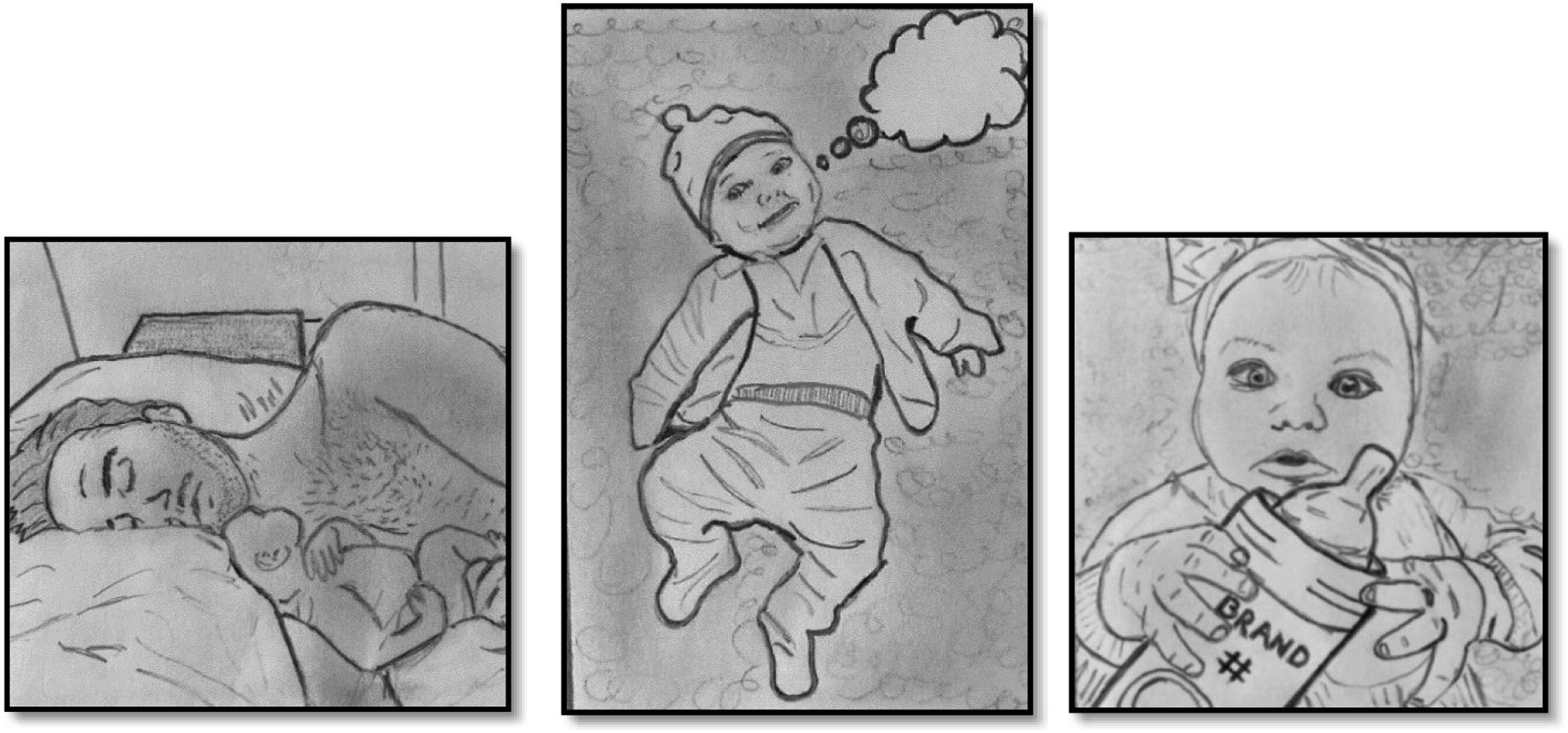
Bergviken Bergviken Rensfeldt et al., 2019). To still offer the reader a sense of what these types of images look like, the researcher has created a simulated illustration for each category. The sketches summarise the category’s overall content and image aesthetics.
Infants as digital capital
To demonstrate how the image of a child is used as digital capital, the analysis is organised into three categories that show how the intimacy and the feeling of authenticity are built up. In the first category, the new-born child is presented; this is followed by a category with storytelling of family life and the reconfiguring of the child’s agency for adult entertainment. The last category contains posts that are marked as ‘branded content’ or ‘paid collaboration’ (see sketches). The focus is on highlighting the emotional work being done through the images and captions, which is the foundation of influencer culture (
Figure Categories 1–
3).
The sacred child
A two-day-old baby sleeps surrounded by creamy white blankets, with small flowers hinted at the edge of the image. The photo is taken in profile and only half the face of the baby is visible. One of the baby’s arms rests just below the chin. The image has almost the shape of a uterus, in which the baby rests in a narrow crevice in the middle.
Caption (translated from Danish): You are finally here and my heart overflows. Welcome to the world, my love! #wholeness #gratitude
During the infant’s first weeks of life, the posts from the influencers are filled with images with consistent content: the children are at the centre of the picture and are portrayed undressed or wrapped in blankets, surrounded by soft fabrics, duvets from a bed or cuddly towels. The babies are asleep or resting, looking at the viewer. The captions signal love, happiness and the experience of ‘wholeness’, attributing to the child divine qualities, such as ‘our angel’ or ‘our piece of heaven’. Sometimes, images with older siblings or pets also appear, and then the caption talks about how the family is ‘complete’ or how it is ‘the most beautiful moment on Earth’. The colours alternate between airy, sheer pink and sterile grey-black tones that interact with the lighting. The logic of the images in this category is consistent and follows the romantic portrayal of children as innocent and cute that has dominated the visual arts and visual culture in the Western world since the 18th century (
Higonnet, 1998).
Several images also display the child with the parent; these have the same type of visual framing, with soft light and bright colours, but the focus is not solely on the child, but also on parenthood. A recurrent composition is the mother and the child, breastfeeding and undressed. The mother has her gaze directed towards the child or she is tenderly kissing the child’s head. The captions are characterised by heart emojis, love messages or life— ‘for you, I would do anything’. A variant is the mother who, in profile, lifts her child high in the air or holds it head-to-head. These images are often taken towards the light, as if to enhance motherhood and happiness. The composition is recognisable from the Madonna and Child (
Higonnet, 1998) and signals security and care. Another common type of post contains images in which the infant and a parent—usually the father—sleep together.
The image displays a new-born and a father together, sleeping in a bed with pink sheets. Their upper bodies are bare, but the sheets hide their intimate parts. The father lies on his side and holds the child, who rests in his armpit (see sketch 1).
Caption (translated from Norwegian): ❤ Happiness has no limit. ❤ We will ALWAYS protect you. ❤
The adult body here forms a wall of safety around the child, and the caption ‘we will always protect you’ reinforces the idea of the vulnerable, innocent child. Overall, the posts in this category demonstrate family values and boundless love for a sacred child. The captions are generally addressed to the child and combined with intimate scenes—often from the bedroom—and, with the bare skin of both child and adult, the images indicate privacy and authenticity.
The agentive child
Through their emergent parenthood, the influencers can broaden their brand and reach a new target audience (
Abidin, 2015), but a cute baby does not itself generate income. After the first pictures of the new-born baby, in which happiness and love are manifested and the layout in general exudes perfection, another type of image is displayed. Followers see a tired mother with no make-up, in her pyjamas or with breastmilk on her shoulder. Recurring images demonstrate messy interiors with laundry everywhere or an attempt to cook and breastfeed at the same time. The captions are about multi-tasking, lack of sleep, being ‘owned’ or the longing for space, regularly followed by asking if ‘anyone recognises themselves’. This is often accompanied by blinking or laughing smileys, as if to indicate that most things are said in jest, but it is nevertheless hinted that parenting can also be demanding and arduous. Through this everyday mode of address and the sense of intimacy in both text and images, the conditions are also created for recognition and a sense of credibility among followers (
Ågren, 2020; see also
Holiday et al., 2020;
Jorge et al., 2021;
Leaver, 2017).
In addition to these pictures, the posts in this category also demonstrate how influencers start to create narratives of everyday events, problems or shortcomings around their children as a way to involve their followers. A method for this storytelling is to ascribe various emotions to the child and thereby create a kind of dramaturgy—a sequence of actions that tell something more than one picture alone could. This is sometimes done by long texts describing an event, but more commonly in short videos that advertise a new vlog post and in which the parent has a ‘conversation’ with the child about something. The camera focuses on the child, who rests on a bed or sits on the floor. The layout and enactment of the images seem less elaborate, and the focus of the videos (and the images, where they appear) is the interaction with the parent. The films often begin with the parent saying something about what they should do today; the child then ‘responds’ with a speech bubble above their head in which the viewers can read about the child’s feelings about the plans: ‘exciting!’ ‘Scary!’ or ‘I don’t want to!’ (see sketch 2). The speech bubbles may also reveal that the child thinks the opposite of what the parent thinks or that he or she knows the answer to something that the parent is wondering about. Six out of the 10 influencers in the data use speech bubbles more or less frequently. These are also used to create small scenes, such as a mother running around searching for the car keys, with the child ‘hiding’ them, tricking the parent and telling the viewers—in a speech bubble—that ‘I know where they are’. Another common scene is when the child is about to sleep:
The scene takes place in the bedroom. The light is dimmed. The mother, dressed in soft clothes, puts her four-month-old baby in the crib.
Mother: (whispers) Goodnight, sleep tight my darling (looks at the camera and addresses the followers) and for many hours.
Child: (still in bed, but two cartoon devil horns suddenly emerge from the child’s forehead; a speech bubble pops up in which is written) Don’t think so, I’m going to be up all night, he he (translated from Swedish).
These types of short video have a comic character; the child is given a persona and is in alliance with the viewer in the sense that the parent ‘plays unaware’ of what is going on in the child’s head. By framing wakeful nights and tiredness as funny stories, the influencer can create both recognition and laughter. If the child cries or is angry about something, the parent can be questioned through a speech bubble: ‘Why do you never come to see me—hello!?!’ or ‘My diaper is full!’ The captions are about ‘mother of the year’, describe the situation being ‘not as dangerous as it looks’ or contain shameful emojis. There is a clear tension between what the image shows and what the caption says—by shaming herself yet jokingly portraying herself as the ‘mother of the year’ or by letting the child ‘say’ that the action is wrong, viewers’ potential criticisms of the crying child are pre-empted.
In this category, the viewers not only get cute images of sleeping babies, but also ‘become familiar’ with the child. Through narratives, such as longer stories or speech bubbles, the influencers create a dramaturgy, and the child is assigned the role of being mischievous, scared, demanding or angry. These everyday scenes in humorous settings create a relationship with the followers, and the children are presented as being individuals with their own wills.
The commodified child
Leaver (2017) asserted that the image aesthetics that influencers use in paid collaborations are very similar to their usual images, making it difficult for followers to differentiate between sponsored and non-sponsored material. It should also be noted that the parent is rarely seen in such pictures, with the focus on the child as the mediator of the advertising message.
The picture shows a sleeping child, just a few weeks old, surrounded by soft blue blankets. The child is naked, except for a diaper, on which the brand is clearly shown.
Caption (translated from Swedish): It’s still quite lovely when they sleep ❤ Don’t miss my latest vlog where you get a great story about our first diaper change, and I give tips on how to keep your and the baby’s skin smooth. For all you worried parents, [Brand] has a skin school that is great, if you are wondering about red dots or rashes. The best and softest diapers for the softest skin!
The layouts of the advertorials have the same aesthetic as those in the first category described—the sacred child, the sweet, naked baby—but the captions are not about love, but rather about the importance of buying the right kind of diaper, washing powder or soft clothing to best protect your baby. A common image is infants on soft surfaces surrounded by diapers, baby oil and other baby products. The address to followers is direct: ‘I am so concerned that X should get the very best’ or ‘If you also think it’s hard to change a diaper in the middle of the night, swipe up to take advantage of a great offer.’ In these examples, the child is just an accessory, together with others, justifying the content. Care and security are central, and the product is embedded in everyday events (cf.
Jorge et al., 2021); similar examples of images of an innocent child in need of security are used in advertising for child insurance.
The mother is naked in the bathtub, and the baby rests on her chest. She holds her arm over the infant’s buttocks so that no intimate body parts are displayed. Around them are lighted candles, towels in soft, brown-beige colours and different bottles of beauty products. The mother looks at the camera with a serious face.
Caption (translated from Danish): You have to practice water safety in the bath at home! Swipe up to take advantage of a great offer.
The frame with the images of bare skin, together with captions and narratives about everyday life and a personal address, create recognition and a feeling of closeness and intimacy, such as that between friends. The influencer here becomes both a mouthpiece for child safety and an advertiser of a company’s products (cf.
Leaver, 2017;
Tiidenberg and Baym, 2017). The captions often end with words like ‘Swipe up to take advantage of the offer, enter code XX20.’ With a simple swipe of the finger, the viewer can directly buy the goods being advertised at a discounted price, and the influencer has thus created a successful advertising collaboration.
Advertisements in print magazines or on TV have often used children’s bodies as visual objects to attach certain values and ideas to the marketed products and to create narratives (
Sjöberg, 2013). Likewise, several influencers in the collected data use the discourse of a competent, active child to convey their message. In these images, the children are dressed in strong, bright colours and are fully engaged in playing, messing around or exploring the product being marketed. What is interesting, however, is that the captions emphasise the influencer’s and/or the child’s opinions about the products. ‘We both love this water bottle, it is the absolute safest’, ‘X refuses to eat any food other than this baby food, it is the best and most nutritious’ or ‘X refuses to wear anything other than the soft cotton from [
brand]’ (see sketch 3 for an example). Framed like this, the children themselves emerge as agents, as people who make their own choices. The product is presented as objectively tested, and it is the child’s experience or feelings about the product that become the guarantor of quality and the selling argument (cf.
Abidin, 2015).
Infants can also be used in advertising that does not really have to do with children at all, as in the next example. Here, the mother has a collaboration with a company that sells cookies, and she embeds the advertising in a narrative that includes the child.
A mother and a two-month-old child are lying next to each other on a carpet. The camera is held above them so that the viewer sees them from above.
Mother: (looks into the camera) Today, we are going to talk about friends.
Child: (in a white dress and with fingers in his mouth, whining a little; a speech bubble pops up) But I don’t have any friends!
Mother: (replies to the speech bubble) No, not yet. But when you do get your first friend, then it’s important to be kind and share your stuff. And this company (holds the biscuit package in front of the camera), which mum really likes, has a collaboration with an organisation that works against bullying, and now they have made biscuits that you can share.
(During the mother’s talk, the child looks outside the camera’s field of view, chattering a little and starting to move)
Mother: My point is you have to share.
Child: (whines, starts crying, and a speech bubble pops up) No! (another one follows) No no no!
Mother: (laughs, looks into the camera) It’s really hard to share, but you have to do it. (the child now cries and screams) It takes a while to learn to share, but we are practising. (laughter)
Caption (translated from Swedish): In a paid collaboration with [Brand]. I try to teach X that it is important to share and be a good friend. A little early, maybe, but the sooner the better.
This story suggests that, if you buy the advertised cookies and share them, you will become a good friend. Consumption, as well as values surrounding childhood and friendship, are here related to moral stances (cf.
Zelizer, 2005). Notable is that the child’s resistance is the core of the narrative, and through the speech bubbles, the child is assigned agency that fits the parents’ storytelling. The examples in this category illustrate how children become symbols of products, but also how they are assigned competence to decide the quality of a product.
Discussion
Influencers’ success is largely based on them presenting themselves as authentic, creating a feeling of intimacy and revealing parts of their daily lives to their followers (
Jorge et al., 2021). Sharing their parenthood thus becomes an obvious part of the job and is also a way to broaden their brand with new business collaborations (
Abidin, 2015). The analysis in this paper demonstrates how the emotional work is done through images and captions. In the first category, the immeasurable value of a new-born child—and of family ideals—is created. Many images are taken in the bedroom, and the people displayed are undressed, sleeping or concentrating on each other. Since the focus and appeal in the captions is mostly directed towards the child, the viewers are invited to take part in something private and intimate, which deepens the relationship with the followers.
As the baby grows, the fans and followers become ‘familiar’ with the child through narratives in everyday contexts, as presented in Category 2. The child is assigned agency in these posts, but it is not from the child’s perspective, but rather on the parents’ terms and with the purpose of entertaining other adults. Further, a persona is attributed to the child that increases the experience for the followers of knowing the child. The sharing of—sometimes demanding—parenthood also creates a special relationship of trust, like that between friends. The infants thus function as digital capital for building relationships between consumers and products in influencer markets. The personal mode of address strengthens the relationship with followers, whereupon the collaborations with brands and advertising for products appear more credible (
Abidin, 2015); intimacy therefore functions as a qualification of the promoted goods themselves (
Petersson McIntyre, 2020).
In the last category, with posts marked ‘branded content’, the child emerges as an actor and as the one who chooses the product, thus taking responsibility from the adult. Overall, the child functions as a commodity, structured in a framework around consumption and used in narratives to strengthen the parent’s brand and as an extended symbol of the parent (
Holiday et al., 2020;
Leaver et al., 2020). The relationship between the commercialisation and sacralisation of children is thus intimately intertwined in the digital age and in the setting of Scandinavian influencer culture on Instagram.
The children of influencers are born into a culture in which consumption and visibility are the norm and in which the camera, followers and advertising collaborations are a constant companion. As part of a neoliberal culture in which privacy, motherhood and entrepreneurship are interwoven, the children are on the very bottom step, doing labour by just existing. Their bodies, emotions and needs become one commodity among many in the influencer market, and these findings suggest that there is an urgent need for a legal framework for child labour in social media (cf.
Abidin, 2017). Currently, many countries have only limited regulations to protect children’s rights online, and France is one of the few that have passed laws to regulate working hours and ensure that the children themselves receive the compensation that is paid. Parents must seek prior government authorisation before their child can engage in online activities that amount to a labour relationship, and the law also enshrines the ‘right to be forgotten’, meaning that platforms will be obliged to take down content upon the child’s request (
Library of Congress, 2020). Several researchers have illustrated how influencers struggle to navigate and balance a child’s right to privacy in general, even before using them in commercial content (
Jorge et al., 2021;
Leaver et al., 2020;
Petersson McIntyre, 2020).
Influencers are often seen as influential voices on various issues (
Leaver, 2017), and the ways in which they share images, use their children in advertising and create discourses around childhood therefore become accepted or even normative. Adults’ exposure of children in contexts that are initiated and controlled by those adults thus requires careful consideration, continuous discussions and ethical reflections (
Leaver et al., 2020;
Ågren, 2020). There is also a need for more research investigating the child’s experiences with sharenting (
Gaëlle and Verswijvel, 2019).
Research ethics regarding visual online material and images of children in research also requires further discussion and investigation (
Harris, 2016;
Sparrman, 2005). For this article, no images from the influencers’ accounts are displayed; instead, an alternative approach to presenting images has been used that still captures the meanings of the posts (cf.
Tiidenberg and Baym, 2017). The present study nevertheless offers valuable insights into how children function as digital capital in influencer culture and how the ties between childhood, labour and value have taken on new meaning.