Introduction
Collaborative efforts between industry and universities can address complex challenges, particularly in financial sustainability, innovation, and graduate employability (
Marques et al., 2024;
McGann et al., 2019). Common collaborations include R&D, graduate hiring, guest lectures, sharing facilities, consultancies, and academic entrepreneurship (
Bui and Takuro, 2024;
de Wit-de Vries et al., 2019;
Kotiranta et al., 2020). This paper examines the co-design of courses and curricula as a novel, under-researched form of university-industry collaboration. While such collaboration is growing, it remains less common than R&D or work placements and therefore presents distinct challenges. Framing curriculum co-design as a change process, we apply change management theory to analyse the transition from an academic-driven “push” to an industry-led “pull” model in higher education. Our central research question is: what are the key challenges and benefits of implementing an ‘industry pull' rather than an ‘academic push’ model in curriculum design?
Drawing on a qualitative case study of the iEd Hub - a Pillar 3 Human Capital Initiative in Ireland - we contribute to both the theory and practice of education innovation. First, we demonstrate the relevance of change management models to university-industry collaboration, highlighting the dynamics of resistance, engagement, and coalition-building. Second, through interviews with academic and industry stakeholders, we provide insight into the relational and operational complexities of curriculum co-design. We suggest that co-design may function not only as a pedagogical strategy, but as a strategic transformation in targeted areas such as STEM, reflecting a broader shift in the evolving role of higher education.
The relationship between universities and industry can be mutually beneficial: universities provide a talent pipeline, while industry helps shape graduate readiness (
Dasgupta, 2020;
Moretti, 2004). To align educational outcomes with workforce needs, initiatives such as work placements and co-designed curricula have emerged (
Bermejo et al., 2021). Yet, traditional models centred on an ‘academic push’ may no longer suffice in all cases (
Rakwoska and De Juana-Espinosa, 2021). Scholars increasingly call for collaborative, demand-driven approaches to enhance employability and close skills gaps (
Rohrbeck and Arnold, 2009;
Saguy, 2011;
Tanius and Susah, 2015). As
Saguy (2011, p. 1879) asserts, ‘moving from “push” to “pull” requires creating an innovation ecosystem beyond single university boundaries.’
Others highlight the importance of a more integrated approach, ensuring that graduates develop transferable (or ‘transversal’) skills that enable them to adapt both vertically - progressing through different roles within an organisation - and horizontally, transitioning across organisations and sectors (
Davey and Harney, 2023). Whether focusing on the immediate needs of industry or adopting a broader societal perspective, many scholars advocate for a more holistic approach to higher education that fosters graduate adaptability, equipping them for long-term career success in an increasingly dynamic labour market (
Davey and Harney, 2023).
Wider policy frameworks echo this call. The World Economic Forum and European Commission advocate for ‘market-aligned courses’ and ‘demand-driven knowledge exchange’ (
European Commission, 2021;
Gann et al., 2018). Ireland’s Human Capital Initiative (HCI) Pillar 3 supports such shifts through reskilling and graduate conversion programmes in priority areas like life sciences and business (
HEA, 2019). These initiatives also stress transversal skills such as adaptability, communication, and ethical problem-solving as critical to long-term career success (
Davey and Harney, 2023).
This case study examines the iEd (industry Education) Hub, a ‘Pillar 3’ project involving academia and industry stakeholders to enhance graduate skills. A consortium with ‘high relational involvement,’ this initiative brings together academic and industrial representatives to work on specific projects in programme design and development (
Perkmann and Walsh, 2007: 5). The qualitative design, including in-depth interviews with fourteen stakeholders, explores the complexities of this collaboration.
We highlight the features, challenges, and implications of industry-university collaboration and, using change management perspectives, examine the transition from an academic-driven to an industry-led model in curriculum design. In so doing, we contribute to the body of knowledge on academia-business cooperation and education innovation in two ways. First, by conceiving of university-industry collaboration in course design as an example of “change” to be proactively managed, this research applies change management models to showcase their applicability and usefulness in transitioning from an academic push to an industry pull approach in certain circumstances. Secondly, in exploring in-depth interviews we gain greater understanding of the different perspectives and motivations of two groups of academic and industry stakeholders, an understanding which is important if university-industry collaborative efforts are to be successful.
Change management frameworks, grounded in social psychology and business ethics, provide insights into planned change dynamics, including stakeholder engagement and resistance. The iEd Hub exemplifies small-scale, project-based change, characterised by clear intent, defined objectives, and a cross-sectoral team structure (
Karasvirta and Teerikangas, 2022). This initiative, while modest in scale, is deliberately structured to bridge institutional and sectoral divides in programme development.
Accordingly, the central question guiding this study is: What are the key challenges and benefits of implementing an ‘industry pull’ rather than an ‘academic push’ model in higher education curriculum design? The paper proceeds as follows: we first present a literature review on planned change, structured around a three-part conceptual framework. We then explore international perspectives on university-industry collaboration, followed by a description of our methodology and case context. Finally, we present and analyse findings from stakeholder interviews.
Conceptual framework: A synthesis of change management models
Change management is an aspect of organisational psychology encompassing behaviour modification, motivation, leadership, and communication (
Burnes, 2020;
Galli, 2019;
Lawson and Price, 2003). Typically conceptualised through models, processes, or sequences of steps - whether consecutive, cyclical, or intermittent -change management is less a theoretical framework and more a structured approach or set of practices (
Philips and Klein, 2023). Underpinning change management are theories drawn from social and organisational psychology, business ethics and organisational development which provide foundational insights into how individuals and groups are motivated and how they respond to change. Various change management models exist in business literature, with Kubler-Ross, Lewin, Kotter, McKinsey’s 7S, and ADKAR being among the most widely cited. Despite their differences, these models share commonalities and typically follow a recognisable process for managing planned organisational change.
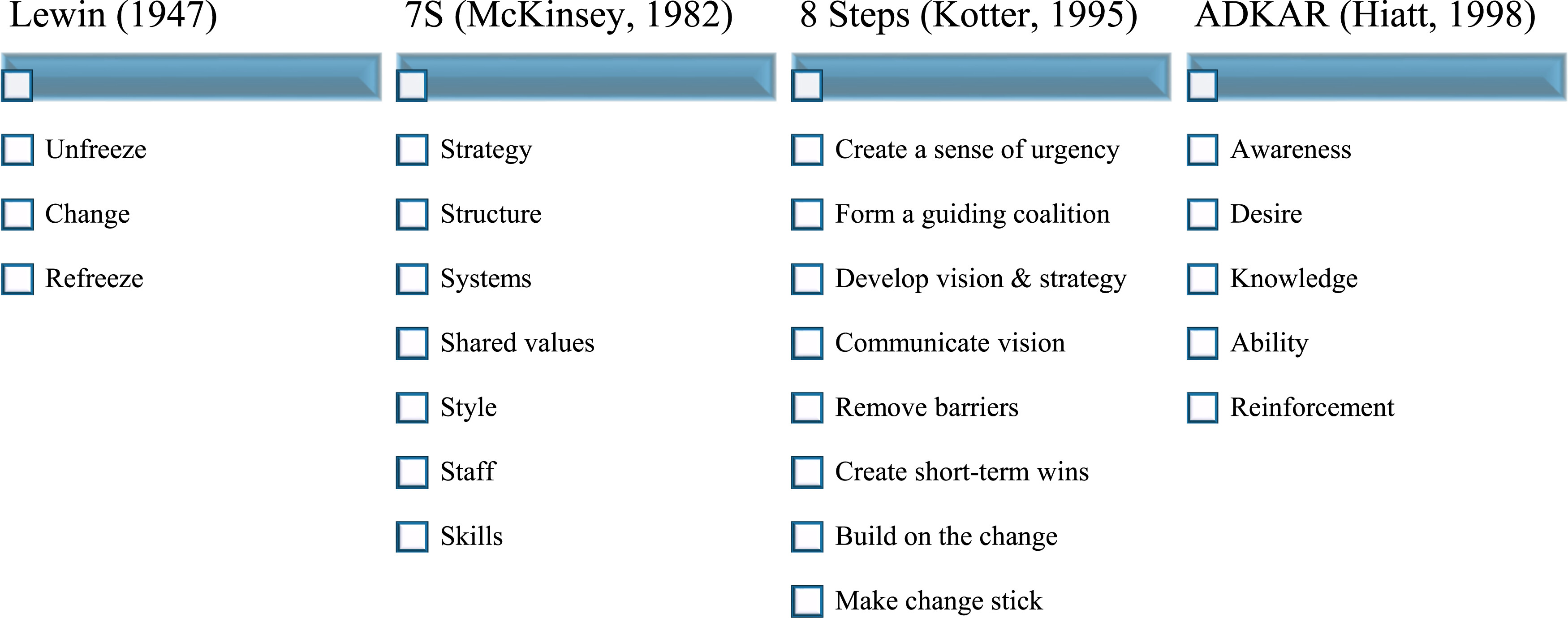
Figure 1, below, summarises four key change management models.
Early change models, such as Lewin’s Change Theory (1947), focused on stabilising change, using the metaphor of ‘unfreezing’ and ‘refreezing’ to make change relatively secure.
Kubler-Ross’s (1969) five-stage model of grief was later applied to organisational settings to explain how individuals process change, particularly in response to disruption. These early models often framed change as disruptive or negative, requiring stability mechanisms to mitigate resistance, but by the time of
Kotter’s (1996) eight-step change model, change was increasingly being conceptualised as positive, aspirational, and – crucially - constant (
Appelbaum et al., 2012;
Armenakis and Bedeian, 1999;
Keulen and Kroeze, 2014). Models such as ADKAR (
Hiatt, 2006) and McKinsey’s 7S framework (
Waterman and Peters, 1982), similarly framed change as an opportunity for growth, emphasising stakeholder involvement, vision development, and resistance management as critical success factors.
The creation or appreciation of a sense of urgency or need for change forms a core aspect of most models of planned change. The ‘burning platform’ metaphor depicts a situation in which there is uniform understanding that change is imperative rather than optional, although such situations of broad agreement are – in reality - rare (
Connor, 1993). The McKinsey 7S Framework emphasises that successful organisational change requires a clear understanding of its rationale and urgency, achieved through alignment across
strategy,
structure,
systems,
shared values,
style,
staff, and
skills (
Waterman and Peters, 1982). Kotter’s first step, create a sense of urgency, similarly reinforces that urgency and clarity are crucial for overcoming inertia and ensuring effective change. ADKAR’s ‘Awareness’ and ‘Desire’ stages stress the importance of individuals recognising the need for change and embracing it (
Balluck et al., 2020).
Change models also consistently emphasise the importance of forming strong coalitions. Kotter’s second step
building a guiding coalition reflects this principle. Research suggests that a well-structured change team with authority, expertise, and credibility is fundamental to driving transformation (
Karasvirta and Terrikangas, 2022: 167). In the 7S model, elements such as
shared values and
style (leadership) are essential for fostering coalitions, ensuring alignment among key influencers, while
structure and
staff help identify and mobilise change agents. ADKAR’s
awareness and
desire stages highlight the need for stakeholder buy-in by creating understanding and motivation for change. Effective communication is embedded in 7S through
style and
systems ensuring clarity and consistency, while ADKAR’s
awareness,
knowledge, and
reinforcement stages focus on sustaining engagement and long-term adoption. Both models underscore that leadership, alignment, and clear communication are fundamental to securing stakeholder support and ensuring successful change implementation.
Ensuring that change is sustained is also a recurring theme. Kotter’s final three steps -securing short-term wins, sustaining momentum, and embedding change in culture - closely parallel Lewin’s ‘change’ and ‘refreeze’ phases, which describe the consolidation of new behaviours (
Lewin, 1948). The 7S framework and the ADKAR Model both emphasise the importance of sustaining, embedding, and celebrating change to ensure long-term success. ADKAR’s
reinforcement stage ensures ongoing commitment through feedback, incentives, and leadership support. Embedding change requires strategic alignment (
7S: strategy and
systems) and capability-building (
ADKAR: knowledge and
ability), ensuring individuals can confidently adapt to new ways of working. Celebrating success is crucial in both models, with 7S (
shared values,
style) and ADKAR (
reinforcement) highlighting the role of recognition and positive reinforcement in sustaining momentum. Both frameworks underscore the necessity of systematic reinforcement, leadership commitment, and cultural integration to prevent regression and secure lasting transformation.
These recurring themes across frameworks - urgency and vision, coalition-building, and sustaining change - form the basis for our conceptual framework. To structure the analysis, we summarise these models into three overarching dimensions:
• Novelty, Need and Vision
• Engagement and Coalitions
• Implementing and Sustaining the Change
By applying these dimensions to our case study of the iEd Hub, we examine curriculum co-design as a form of planned organisational change. This framing enables us to explore how stakeholder motivations, resistance, and engagement influence the success of university-industry collaboration in curriculum development.
Literature review: international perspectives on university-industry collaboration in course design
The literature provides various perspectives on university industry collaboration including some of the issues, challenges and best practices.
Rohrbeck and Arnold (2009) identified cultural barriers between industry and academia such as divergent goals, different languages and assumptions, institutional barriers such as different perceptions of what the ‘product’ was or should be, and operational barriers like insufficient coordination and project management (
Rohrbeck and Arnold, 2009: 4). One of the cultural assumptions noted was around time and efficiency as, “…in industry - reaching results fast - is generally regarded as desirable…in academia, the assumptions are often opposite” (p. 5).
Differences in how universities and corporations are structured were also found to be a barrier to success for collaborative efforts. In addressing these challenges,
Rohrbeck and Arnold (2009) propose that a separate unit of organisation bringing academia and industry together helps, but only if coupled with frequent opportunities for communication, clear information sharing and defined deliverables.
In a multi-country study into university-industry collaboration,
Marques et al. (2024) applied social exchange theory, asking how benefits and costs are perceived by the parties involved. The specific context here was overall university-industry engagement including research, student placements and academics carrying out consultancy work. Here, the perceived costs for academics outweighed the benefits of collaborating with industry due to cumbersome administrative processes. They suggested that Higher Education Institutions design better reward systems to foster university-industry collaboration and ensure that it is attractive to academic parties.
In a series of workshops and focus groups,
Awasthy et al. (2020) explored the current state of industry/academia research engagement in Australia. Participants agreed that collaboration could be complicated and required best practice approaches to get closer to a solution so that the various parties could benefit from the collaboration. Barriers such as trust and mindset were seen as the hardest to overcome, and one suggestion put forward was clear stakeholder identification, engagement and “to establish a partner evaluation method in order to ensure the selection of partners who have genuine interest and commitment, and adequate resources to support {the project}” (p. 55). Further best practice suggestions were to understand the different motivations between academia and industry and ensure everyone is on the same page with what is trying to be achieved, establishing channels for communication and understanding the crucial role of leadership:
In a case study design,
Mahalingam (2024) explored the successes and challenges of industry involvement in curriculum design at university level. This “Industry-Driven Collaboration” framework involved industry experts, faculty members and programme leaders and was designed “to bridge the gap between academic programmes and industry needs”. The key lessons from the initiative that were identified through the case study were the need to involve industry experts early, allow more time for workshops, sharing templates like gap analysis in advance and ensure clear communication among stakeholders. The project under research here was successful in improving employability among graduates and ensuring course content adapts to the fast-changing environment.
Azevado, Apfelthaler and Hurst (2012) focused specifically on the competencies identified by industry as needed for business and management graduates. They addressed what they saw as “the lack of alignment between the competencies developed in business education programmes versus those needed in early industry jobs” (p. 13).
Benneworth and Charles (2005) described how universities should work closely with industries to address skills shortages and promote innovation and linked this to regional development.
Röpke (1998) focused on the importance of the ‘entrepreneurial university’ which has a responsibility to respond to societal demands:
The traditional division of labour and functions between academic science and academic teaching and industry {…} is in question. As the university crosses traditional boundaries through linkages with the economic system, it must devise ways to make it able to communicate with each other. (2014, p. 1)
Focusing on industry-university collaboration in course design,
Bermejo et al. (2021) developed a curriculum development model applied to two engineering postgraduate programmes, which could be generalised to other contexts. The model emphasises continuous improvement and iterative feedback from all stakeholders, including students, teachers, and industry representatives. This approach ensures that the curriculum remains relevant and aligned with industry needs, effectively bridging the gap between academic offerings and industrial requirements.
In light of growing interest in the shift from academic push to industry pull in some areas of curriculum design, this study examines how such transitions are perceived and managed within the context of a university-industry collaborative project. The literature on change management offers a framework for understanding the dynamics at play when diverse stakeholders - academic and industry partners - are involved in a project aimed at reshaping some educational programmes. As the traditional ‘push’ approach of academia gives way to market-driven demands in some sectors or areas of activity such as STEM, navigating this shift requires effective strategies and a nuanced understanding of the associated challenges. By exploring how various stakeholders perceive the integration of industry-driven needs into course design, this research will assess the extent to which change management approaches can help align goals, mitigate resistance, and ensure the success of the collaboration. Furthermore, the study will analyse the potential barriers to implementation, providing insights into how change management models can not only facilitate this process but also anticipate and address setbacks. Against this backdrop, the research question guiding this inquiry is:
What are the key challenges and benefits experienced by academic and industry stakeholders in applying an ‘industry pull’ rather than ‘academic push’ model in higher education curriculum design?
Methodology
The focus of this paper is to explore the experiences and perceptions of stakeholders involved in a collaborative change event. Qualitative case study methodology allows participants to discuss the events from their perspectives and enables the researcher to identify common themes (
Eisenhardt, 1989;
Yin, 2009).
The single case study approach involved fourteen stakeholders from organisations closely associated with the project. These stakeholders were categorised into three groups: academic stakeholders from two university institutions (“Internal/Academic”), industry representatives situated within the universities (“Internal/industry”), and industry representatives from the life sciences sector and employer organisations (“External/Industry”). Details are shown in
Table 1, below.
Semi-structured interview questions were developed based on key aspects of change management, with the alignment between emerging themes and the theoretical framework naturally leading to a deductive approach. This organisational case study, conducted over 6 months, involved analysing semi-structured interview transcripts, observations, and organisational documents.
NVivo14 software facilitated qualitative data analysis. Thematic analysis, whereby transcripts are scanned for emerging themes, was deemed the most suitable approach. Through an iterative process of reading and coding, emergent themes were identified (
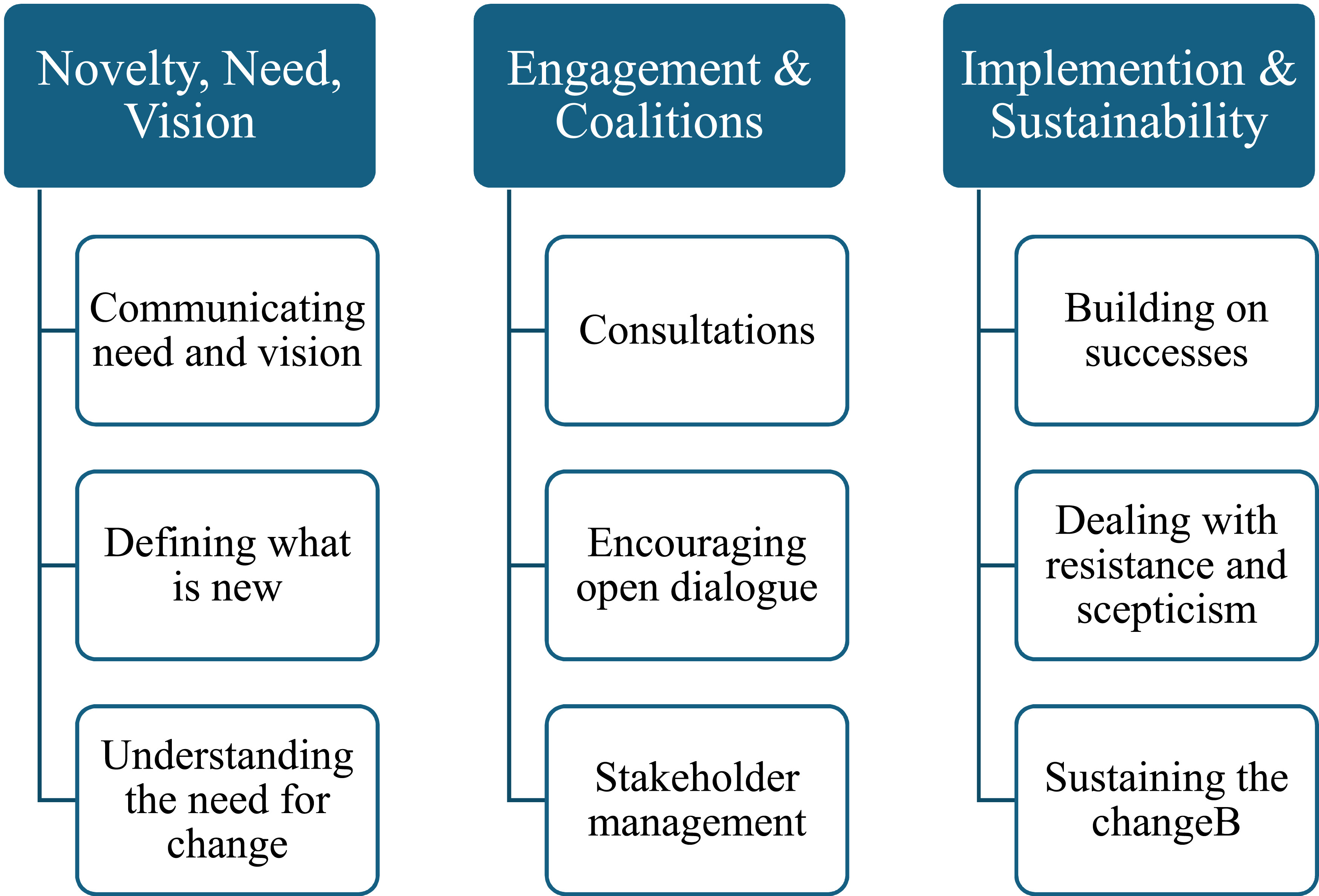
Boyatzis, 1998). The research combined inductive (data-driven) and deductive (theory-driven) approaches, as themes were coded and mapped onto broad change management headings. This resulted in three overarching parent themes and ten sub-themes or ‘child' codes. Given the small sample size, the flexibility of thematic analysis was advantageous, allowing codes and themes to emerge from the initial theory (
Hsieh and Shannon, 2005;
Miles and Huberman, 1994).
Figure 2, below, illustrated the thematic mapping.
Case study details: the iEd Hub
This case study examines the experiences of stakeholders engaged in a multidisciplinary change initiative spanning two higher education institutions in the south of Ireland. The initiative centres on the development and implementation of an innovative approach to course design, led by the iEd Hub, an externally funded consortium established in 2021.
The first institution, University College Cork (UCC), is a leading Irish university with a structured organisational framework comprising multiple academic units. Within UCC, the project is being implemented across two colleges: Medicine & Health and Business & Law. The second institution, Munster Technological University (MTU), is a public technological university with six campuses across Cork and Kerry, where the Faculty of Engineering and Science is actively involved in the initiative.
The iEd Hub seeks to enhance graduate employability by equipping students with the skills required for careers in the (bio)pharmaceutical and medical technology sectors. The consortium brings together UCC, MTU, and several pharmaceutical and medical technology companies in a collaborative effort supported by the Irish government’s Human Capital Initiative (HCI). Through this partnership, stakeholders work towards the co-design and implementation of educational programmes that align with the evolving demands of both emerging enterprises and established corporations.
A key governance structure within the iEd Hub is the Executive Steering Group (ESG), which provides strategic oversight and direction for the project and, in change management terms, functions as the guiding coalition. Comprising senior academic leaders from the participating universities alongside experienced industry professionals, the ESG ensures alignment with sectoral needs and institutional priorities. The iEd Hub also engages a diverse network of stakeholders, including representatives from academia, industry, and government bodies. These include organisations such as IDA Ireland, Enterprise Ireland (EI), the Irish Business and Employers Confederation (IBEC), Cork County Council, Cork City Council, and Cork Chamber. This extensive collaboration underscores the initiative’s commitment to fostering industry-academic partnerships that drive innovation in higher education and workforce development.
From a change management perspective, several aspects of this consortium are particularly novel within a university context. First, industry partners play a central role in identifying essential skills and shaping how they are taught, representing a shift from an academic-led approach to an industry-driven model. While limited to one specific context, a change of this type can have ideological implications and, consequently, potential for resistance and concern about private sector involvement and its potential impact on academic independence (
Davey and Harney, 2023;
Giroux, 2002;
Slaughter and Leslie, 1997). That having been acknowledged, the practical benefits of closer university-industry cooperation are evident in the popularity of the courses and the high employability rates of graduates from iEd Hub programmes. Industry collaboration ensures curricula remain aligned with evolving workforce demands, equipping graduates with job-relevant skills that enhance their employability. As
Saguy (2011) observes, fostering trust-based relationships between academia and industry can enhance teaching, learning, and social responsibility (p. 1875).
The second distinctive aspect of the iEd Hub’s approach is the recruitment of lecturers with significant industry experience. These faculty members provide students with practical insights and up-to-date knowledge of real-world challenges, thereby strengthening the relevance of education to the job market (
Saguy, 2011). In addition to their subject-matter expertise, they bring valuable professional networks, facilitating internships, industry projects, and career opportunities for students. Research by
Hora and Lee (2020) demonstrates that faculty with industry experience are more attuned to workplace skills requirements, emerging technologies, and industrial developments (p. 26). Moreover, lecturers who combine professional experience with pedagogical expertise can play a crucial role in fostering ‘soft’ skills such as teamwork, problem-solving, and communication, all of which are increasingly valued by employers (
Hora and Lee, 2020: 1).
Findings
The aim of this research was to explore the case study of an academic-industry consortium project through the lens of change management. The objective was to explore the key challenges and benefits experienced by academic and industry stakeholders in applying an ‘industry pull' rather than ‘academic push’ approach to skills development. Data were collected in the form of interviews with stakeholders with direct involvement with the project. This chapter presents the findings from these interviews
Novelty, need, vision
This theme encapsulates change management literature as it pertains to the nature of change, its novelty, and the rationale behind it. Throughout the interviews, participants identified the primary shift as greater involvement and engagement of industry in identifying skills needs and designing appropriate courses. The transition from an academic-driven approach to industry-led input was regarded as the most significant change: “Industry engaging with the early stage of the design of the program, I thought this was novel…I thought this was clever” (IA1) and “It’s looking to get industry’s pull rather than the university pushing something out, which would be typical” (IA3).
Industry representatives appreciated being involved from the outset, expressing positivity about the quality of engagement and communication: “{we were} working together, were looking at the skills of the future…we were being proactive and not reactive” (II2) and “I felt that there was a listening piece, which was important” (EI1).
Another novel aspect was the multidisciplinary nature of the project and the inclusion of industry professionals as lecturers. This was seen as bridging the gap between academia and industry. Stakeholders noted the positivity of involving multiple disciplines and departments.
While the change itself was understood, the vision and goals were less clear, particularly among academics. Some expressed that communication of the vision could have been clearer: “I had some {initial cynicism} towards the actual need and whether it was clear” (IA1) and “There was no communication plan and we arrived at the project team…nobody knew we were coming…nobody knew what we were working on…nobody knew what {the vision} was…but that wouldn’t be unusual for any project team in a university” (IA3). There was, however, an acknowledgment that developing a vision is a process, with the important thing being a positive outcome. Industry participants generally demonstrated more clarity and positivity regarding the goals: “the people I dealt with and they explained what they wanted, what their vision was, why we need to achieve that” (E12).
The sense of urgency or need was perceived differently by the two groups. Academics were less certain, viewing the urgency in terms of aligning academic qualifications with industry requirements. While collaboration with industry was not new, strengthening engagement in curriculum design was less frequently implemented. One academic noted that the need is there, but “nobody necessarily wants to tackle it because maybe it’s not…a burning issue” (IA1). Another acknowledged that engagement with industry around course design can be superficial: “Every program will say that they’ve engaged with industry and how much of that engagement is real and tangible and actually feels like engagement is, I would say highly questionable” (IA5).
From the industry side, the urgency was more strongly expressed, especially around the employability of graduates and the need for transversal, ‘soft’ or business skills often lacking among recent STEM graduates. Competencies such as emotional intelligence, resilience, and critical thinking were seen as urgently required, with one external industry partner noting, “Communication should be a staple of every course… what I what I’ve seen over time is the different generations coming into the workforce and their skills are different skill set that are needed” (EI1).
There was a recognition that the skills needed in the future workplace will be foundational, cross-functional, and personal or ‘soft’ skills, which need to be integrated into technical programmes. One noted that “industry are telling us they need people who are ethical problem solvers, able to join the dots…make sound value-based judgements” (EI4). All participants highlighted the urgency of bridging the gap between technical skills and business or communication-related competencies. This sentiment was a common and unifying theme across the entire group. Industry wanting better communicators was keenly felt, for example, “…excellent technical people generally are very single minded” and don’t always have the interpersonal skills needed to succeed in the workplace (IA6).
Engagement and coalitions
How engagement and communication were perceived by participants provides insight into strengths and areas for improvement. Positivity within the project team at the outset was noted by several participants from both academia and industry: “There was an incredible amount of work put in by a few people…there’s a lot of people genuinely trying to make positive progress…I found this refreshing” (IA1). The diverse and interdisciplinary nature of the project team and its partners was seen as positive and novel in the context of university/industry collaboration. The appointment of Industry Liaison Officers to communicate between academia and industry was noted as useful: “The fact that we had an industry liaison officer in both universities as part of the project was helping to create that expectation and the management of them as external industry stakeholders” (IA3).
However, there was a general sense that as time went by, the frequency and quality of communication ebbed, with scope for closer engagement within and external to the project team. One industry partner noted they “would like to see more proactive engagement” (EI2). There was almost consensus regarding the need for more formalised communication of updates, progress, and developments: “Many {industry and academic} stakeholders feel feel that they haven’t been fully engaged, that they hear things second hand” (IA4).
While there was broad agreement that relationships were positive, representation diverse, and initial communication beneficial, whether this amounted to collaboration rather than cooperation was questioned: “I see it more as a mechanism for cooperating with industry, I’m less sure if we could describe it as collaboration” (IA2). Some reservations were expressed about what could be achieved by communicating in an ad hoc way with a limited number of industry representatives: “There is an oversimplification of a narrative that if we get six people together in a room, we can get an answer” (IA5).
Difficulties in bringing different groups together with varying motivations, identities, and interests were also acknowledged and that for collaboration to be effective, outcomes must be greater than the sum of individual parts. The idea of developing something unique about the project team rather than individuals with different expertise working together was identified as a stumbling block: “Collaboration is often bandied about…but if you lose your identity within that process and you lose part of your unique selling points, it can lead to major conflicts” (IA2).
“You need a coalition of the willing to be involved, but you can’t have everybody delivering little bits of everything because you don’t develop areas of expertise and you end up with collaboration just for the purpose of being involved, which isn’t collaboration” (IA3).
A final aspect of coalition building and stakeholder engagement raised was the differing levels of involvement of industry partners. While some companies were more responsive and actively involved, others were less so. Greater analysis of what different partners add to the project was suggested: “It would have been good to sit back at the senior level and think about how do we engage certain stakeholders, why are some more engaged and those that aren’t, why aren’t they? What could we do differently there?” (AP6). The balance between engaging the most influential stakeholders and those who could contribute meaningfully was also discussed: “Even if they really like what you’re doing, they’re not going to have time to influence anything. What you want is kind of a person below that” (IA6). It was felt that more strategic stakeholder engagement would be beneficial to “ensure that the right expertise are in the room and there’s a broad representation” (II2).
Implementing and sustaining
The stage at which successful implementation of the change can take place involves recognising and overcoming resistance, removing barriers or impediments and embedding change into the institutional culture in so far as is possible. This could refer to Kotter’s 7th and 8th steps about consolidating gains and anchoring change, as well as Lewins ‘re-freezing’. ADKAR’s model speaks of reinforcement; ensuring new practices are maintained.
Resistance, scepticism and the barriers presented by organisational politics were raised by several participants. Some of these were communication based, others operational. The project experienced early resistance within both universities, and the team ultimately failed to overcome internal resistance to delivering a key component of the original project plan, resulting in a pivot to a changed plan, with reduced reliance on resistant stakeholders. This pivot allowed the endeavour to proceed (progressing from a stalled status), although with an outcome that is likely to be less impactful, profitable and sustainable.
A key frustration was the slow institutional momentum at the university level, with bureaucratic processes hindering efficiency. Academics and industry representatives noted challenges in getting new initiatives approved and navigating operational hurdles. However despite this, there was broad acceptance of the slower pace as part of decision-making in large institutions: “Of course, the public university is quite bureaucratic, not necessarily known for agility and timeliness” (IA1) and “They {the universities} have been doing things the same way for 40 years, they’re not really willing to change” (IA3).
There was general acknowledgment that university-industry collaboration in course design raised questions about the role of universities in developing human capital and that there was likely to be a gap between industry requirements and what universities could teach: “Is it the role of universities to provide the full skill sets for industry or is it about creating good rounded citizens, holistic citizens, able to critically analyse?” (IE1). One academic participant recognised that the demands of industry are naturally one-dimensional but that the role of universities was to develop people in a more holistic way “If we listen to industry, they want scientists, they want an engineer, they want a business and they want nothing else” (IA5).
These sorts of broad, values-based sources of tension were identified not as expressed areas of resistance to be overcome, but as largely understandable inevitabilities to be managed. The move from academic push to industry pull was certainly seen as important in some contexts but these contexts ought to be limited rather than appliable in any widespread sense. Generally, the industry participants were less aware of these sorts of challenges and were less likely to identify any areas of resistance to or scepticism around the project goals. However, there was ready acknowledgement of what employers were looking for and why, along with appreciation for the rigour that universities need to maintain:
“Industries are trying to meet short term needs, you know. …yes, we want employable graduates. But it shouldn't be down to just purely the universities to supply them like a ready -made product. That's not what university education is for.” (EI4)
Celebrating and embedding initial successes was crucial and the development of multidisciplinary courses and the employability of the first cohort were seen by all as key successes. However, there was a feeling that these successes were not celebrated enough: “It’s disappointing that because there is a lot to be said for {these courses} which should be a shining light in terms of instructional design” (IA4). The MSc Programme developed by the iEd Hub was considered by all participants to represent a major success, with high student enrolment and successful placements: “The MSc Programme developed by the iEd Hub was considered by all as ‘the jewel in the Crown'” (II1).
A key concern for academic participants was the sustainability of the project as it transitioned from being externally funded to self-sustaining. One aspect of this conversation focused on communication, differentiation, and marketing as ways to better embed the project into wider university structures. Several participants felt that increased awareness of the project’s successes would boost confidence in the feasibility of multidisciplinary or industry/academia collaborations more broadly. As one participant noted, “the university hopefully will realize that multidisciplinary programmes can be put together, they can be successful” (II1). Another added, “It has certainly reduced doubt about the potential that these things can work” (IA1).
Broadening the focus to stay competitive in the international market was deemed necessary. While collaboration with local industry partners was valuable, it was seen as too limiting if sustaining the change was to be made possible: “Our graduates, our national fora, our international standards, each of those have an equal voice… and that’s important to {consider} because if we are to be globally competitive, we are producing graduates for the global market, not just the local pharmaceutical companies” (IA2).
From the industry side, the message on sustaining the change centred on whether goals had been achieved, whether these were celebrated, and what could be learned. Participants highlighted the clear benefits of industry involvement in developing university courses and the need to maintain channels for ongoing collaboration. One participant stated, “The future is only this type of setup - this is what we need to stick with and evolve… having that collaboration and actually maintaining good connections” (EI4). Another suggested, “more regular communication links {are needed} just keep us more in the loop of things that are happening” (EI3).
Overall, there was a perception that identifying challenges and opportunities is essential for the project’s sustainability and to encourage future university/industry collaboration. The key successes achieved during the four-year project should be built upon, with visibility of vision and goals maintained and structures for communication between industry and academia put in place. The focus on relationships, stakeholder engagement, and the formation of a guiding coalition to drive the change were seen as valuable and worth maintaining. However, expanding stakeholder engagement to include former students and alumni, international industry representatives, and other institutions was identified as necessary for sustaining the changes going forward. As one participant put it, “Collaboration between industry and academia, that relationship is established and it continues…it will be easier the next time around because we’ve learned how to work together” (EI3).
Discussion and conclusion
The purpose of this case study was to explore how different project stakeholders view and experienced the shift from academic push to industry pull in course design using a change management framework. We asked what, if anything, a change management perspective might add in terms of ensuring the success of the project. This section will present an analysis of the findings in light of the literature and the change management frameworks.
In defining the vision, understanding and recognising the need for change, two dominant themes emerge from the interviews. First, the change itself in terms of what was new, or novel, was well understood; quality engagement with industry both on the identification of skills needs for university graduates and in teaching through industry-experienced lecturing staff. Second, while the change itself was recognised, the sense of need or urgency around it was felt differently by academic as opposed to industry stakeholders. While industry partners were focused on specific skills development and having job-ready graduates - and this need was clearly felt - academic participants voiced more trepidation.
It is likely that academics, identifying strongly with the university’s traditional educational values, may feel less urgency and more resistance to change compared to industry partners, who prioritise job-ready skills and practical outcomes. This ‘difference in knowledge background’ between academics and industry (
de-Wit-De-Vries et al., 2019: 1240) need not be an issue to solve, but rather to recognise and to incorporate into communication strategies. In line with
Awasthy et al.’s (2020) and
Mahalingam’s (2024) work into such collaborations, communication and leadership is key. Furthermore, on a practical level and regardless of differing identities, maintaining rigour in academic processes is essential in any university-industry collaboration, even if that takes time. The key is for both parties to be made aware of each other’s differing perspectives where possible. Similarly, within the diverse and multidisciplinary project team we saw some issues of role clarity emerging from the different identities and affiliations. These were typical, and mirror similar experiences of multi and interdisciplinary academic collaboration studies (
Dritsakis et al., 2019;
Roncaglia, 2016;
Shanableh et al., 2022).
The second key aspect of change management concerns coalition building and stakeholder engagement, encompassing both the formation of a guiding coalition to drive change and broader communication with stakeholders throughout the project. Initially, coalition building was viewed positively, with industry-academia consultations, industry liaison officers, and skills needs assessments regarded as innovative and valuable. Over time however, engagement was perceived to have declined, with participants highlighting challenges related to divergent identities, motivations, and working practices. A more sustained focus on fostering shared goals and long-term collaboration was identified as necessary. Additionally, the establishment of formalised communication channels was recognised as essential for ensuring continuity of engagement both within the project team and externally with industry partners. Expanding stakeholder engagement to include additional universities, students, and alumni was also suggested as a means of further strengthening these partnerships.
The findings align with established change management principles, which emphasise the importance of stakeholder alignment and commitment. While early engagement efforts were largely successful, perceptions of diminishing participation over time reflect common challenges in sustaining stakeholder involvement (
Freeman, 2010;
Richardson, 2015). This underscores the necessity of ongoing communication, shared objectives, and formal stakeholder analysis as critical elements of project management (
Miller and Oliver, 2015). In the context of university-industry collaboration, a structured and systematic stakeholder analysis is particularly valuable in maintaining alignment throughout the process.
The third key theme concerns the implementation and sustainability of change, encompassing resistance management, the removal of barriers, the recognition of short-term successes, and the prevention of setbacks. Institutional scepticism within academia was identified, stemming both from a lack of engagement with project objectives and procedural complexities inherent within university structures. Participants emphasised the need for greater recognition of initial achievements as a means of reinforcing commitment and morale.
Marques et al. (2024) suggest that highlighting the tangible benefits of change—whether for individuals, institutions, students, or society—is integral to sustaining engagement (
Benneworth and Charles, 2005;
Quélin et al., 2017). As higher education institutions navigate transitions towards greater sustainability, collaboration with industry remains a crucial factor in this process (
Marques et al., 2024: 2).
Overall, this study demonstrates the applicability of change management models in the context of university-industry collaboration. By conceptualising the shift from an academic-led to an industry-driven approach as a strategic change process, these models offer insights into managing stakeholder engagement, resistance, and coalition building. The experiences of academic and industry stakeholders suggest that a more proactive change management approach from the outset could mitigate setbacks and reduce resistance. Furthermore, recognising the differing motivations of these groups highlights the importance of tailored communication and leadership strategies that acknowledge these distinctions, thereby enhancing the effectiveness of change initiatives. Finally, the challenge of sustaining long-term stakeholder engagement reinforces the need for continuous coalition building, formalised communication strategies, and sustained motivation towards shared objectives, offering valuable insights for future change management practices