Intended for healthcare professionals

Abstract

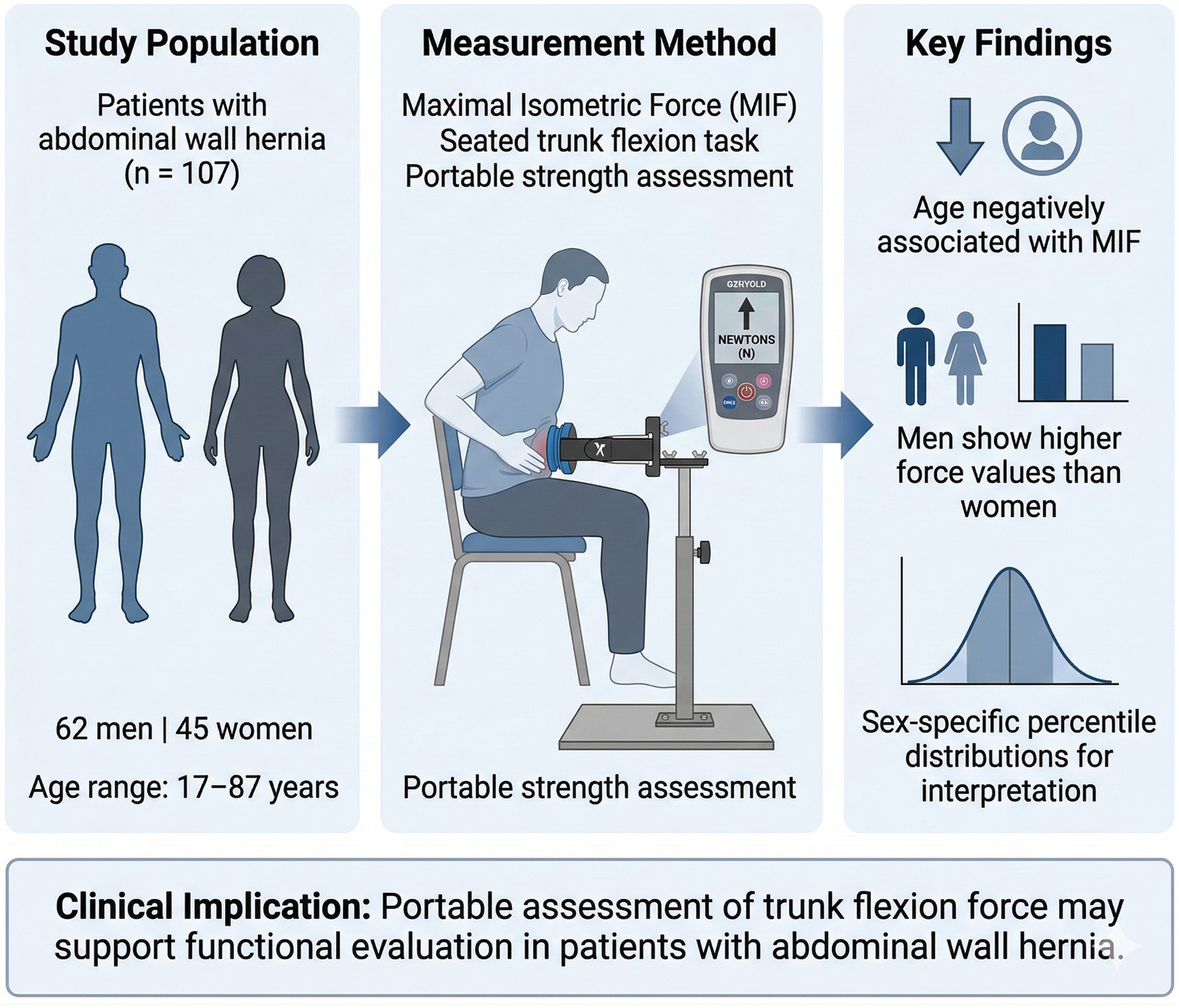
This cross-sectional study examined associations between sociodemographic variables and maximal isometric force (MIF) in patients with abdominal wall hernia and established preliminary reference values. A total of 107 patients (62 men, 45 women; median age: 58 years (IQR: 47–67)) underwent standardized assessment of MIF during a seated isometric trunk flexion task. Median MIF was 164.9 N (IQR: 125.8–227.3), with higher values in men than women (207.7 (154.8–263.3) N vs 126.3 (100.0–173.4) N; p < 0.001). MIF was negatively correlated with age (ρ = −0.388, p< 0.001) and positively correlated with body mass (ρ = 0.540, p < 0.001) and height (ρ = 0.656, p < 0.001), while BMI showed no association (ρ = 0.145, p = 0.112). In a multivariable model (adjusted R2 = 0.499), age (β = −0.007; p< 0.001) and sex (female vs male: β = −0.249; p = 0.001) were independently associated with MIF. These findings indicate that maximal isometric force is primarily influenced by age and sex, supporting direct force assessment and the interpretation of sex-specific percentile values in this population.
Graphical abstract

Get full access to this article

View all access and purchase options for this article.

References

1. Strigård K, Clay L, Stark B, et al. Giant ventral hernia-relationship between abdominal wall muscle strength and hernia area. BMC Surg 2016; 16: 50. https://doi.org/10.1186/s12893-016-0166-x
2. Sánchez Arteaga A, Gil Delgado JL, Feria Madueño A, et al. Impact of incisional hernia on abdominal wall strength. BJS Open 2024; 8(3): 040. https://doi.org/10.1093/bjsopen/zrae045
3. Garcia Moriana AJ, Sanchez Arteaga A, Tallon Aguilar L, et al. P-064 correlation between abdominal wall strength and diameter of hernia in patients with incisional hernia. Br J Surg 2023; 110(2): znad080.200. https://doi.org/10.1093/bjs/znad080.200
4. Vieira S, Dibai-Filho AV, Brandino HE, et al. Abdominal muscle strength is related to the quality of life among older adults with lumbar osteoarthritis. J Bodyw Mov Ther 2015; 19: 273–277.
5. Criss CN, Petro CC, Krpata DM, et al. Functional abdominal wall reconstruction improves core physiology and quality-of-life. Surgery 2014; 156: 176–182.
6. Gil Delgado JL, Reverte Pagola G, Pecci Barea FJ, et al. Physical activity and exercise interventions in abdominal wall hernia patients: impact on quality of life and health outcomes—a systematic review and meta-analysis. Am J Phys Med Rehabil 2025; 104(6): 519–526. https://doi.org/10.1097/PHM.0000000000002657
7. Gunnarsson U, Johansson M, Strigård K. Assessment of abdominal muscle function using the biodex system-4. Validity and reliability in healthy volunteers and patients with giant ventral hernia. Hernia 2011; 15: 417–421.
8. Abdelhalim NM, Radwan NL, Ibrahim MM, et al. The efficacy of isokinetic strength training versus core stability training on the trunk muscle strength and quality of life after surgical repair of incisional hernia in adolescents. Turk J Phys Med Rehabil 2022; 68: 501–508.
9. Forrester SE, Yeadon MR, King MA, et al. Comparing different approaches for determining joint torque parameters from isovelocity dynamometer measurements. J Biomech 2011; 44: 955–961.
10. Househam E, McAuley J, Charles T, et al. Analysis of force profile during a maximum voluntary isometric contraction task. Muscle Nerve 2004; 29: 401–408.
11. Meldrum D, Cahalane E, Conroy R, et al. Maximum voluntary isometric contraction: reference values and clinical application. Amyotroph Lateral Scler 2007; 8: 47–55.
12. Verbrugghe J, Agten A, Eijnde BO, et al. Reliability and agreement of isometric functional trunk and isolated lumbar strength assessment in healthy persons and persons with chronic nonspecific low back pain. Phys Ther Sport 2019; 38: 1–7.
13. Clark DJ, Patten C, Reid KF, et al. Muscle performance and physical function are associated with voluntary rate of neuromuscular activation in older adults. J Gerontol A Biol Sci Med Sci 2011; 66: 115–121.
14. Thompson BJ, Ryan ED, Herda TJ, et al. Age-related changes in the rate of muscle activation and rapid force characteristics. Age 2014; 36: 839–849.
15. Kumar Malviya DV, Kumar Sainia DT, Kishor Parmar DK, et al. Demographic study in operated patients with inguinal hernia. Surg Rev Int J Surg Trauma Orthopedics 2019; 5: 20–26.
16. Arhos EK, Poulose BK, Di Stasi S, et al. Individuals with a ventral hernia who report moderate to high fear have worse functional performance than those with low fear. Hernia 2024; 28: 643–649.
17. García Moriana AJ, Sánchez Arteaga A, Gil Delgado JL, et al. Evaluation of rectus abdominis muscle strength and width of hernia defect in patients undergoing incisional hernia surgery. Hernia 2023; 27: 919–926.
18. Geissler D, Lison A, Schulze C. Relation of anthropometric measures and indices to isokinetic trunk strength – a retrospective analysis. Dtsch Z Sportmed 2023; 74: 205–213.
19. Geissler D, Lison A, Schulze C. Relevance of body weight adaptation and modern obesity-defining parameters in the analysis of isokinetic trunk strength in people with obesity - a retrospective analysis. Clin Obes 2025; 15: e12736.