Intended for healthcare professionals
Restricted access
Research article
First published online May 31, 2016

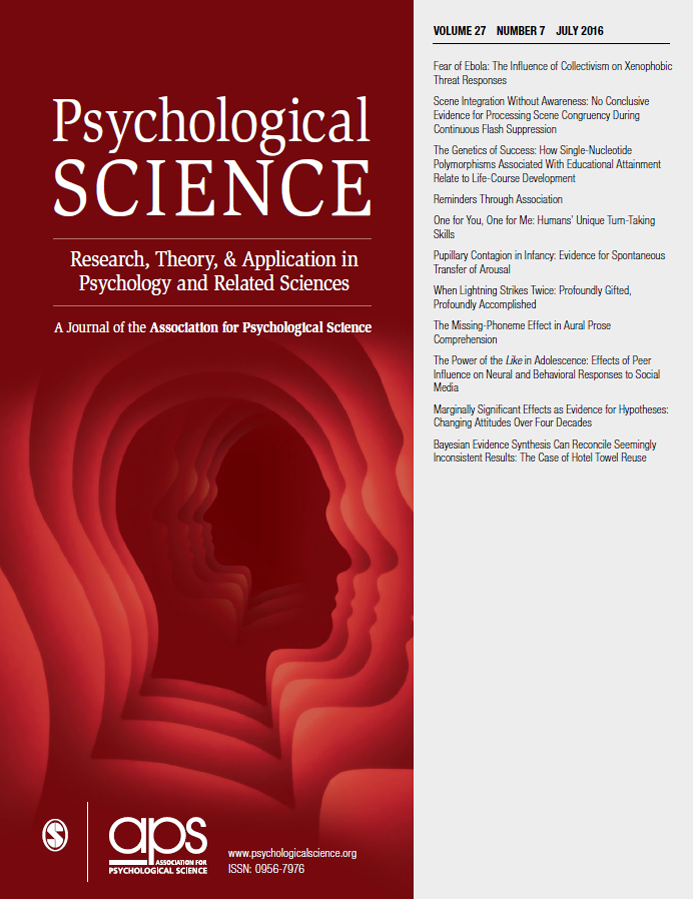
The Power of the Like in Adolescence: Effects of Peer Influence on Neural and Behavioral Responses to Social Media

Abstract

We investigated a unique way in which adolescent peer influence occurs on social media. We developed a novel functional MRI (fMRI) paradigm to simulate Instagram, a popular social photo-sharing tool, and measured adolescents’ behavioral and neural responses to likes, a quantifiable form of social endorsement and potential source of peer influence. Adolescents underwent fMRI while viewing photos ostensibly submitted to Instagram. They were more likely to like photos depicted with many likes than photos with few likes; this finding showed the influence of virtual peer endorsement and held for both neutral photos and photos of risky behaviors (e.g., drinking, smoking). Viewing photos with many (compared with few) likes was associated with greater activity in neural regions implicated in reward processing, social cognition, imitation, and attention. Furthermore, when adolescents viewed risky photos (as opposed to neutral photos), activation in the cognitive-control network decreased. These findings highlight possible mechanisms underlying peer influence during adolescence.

Get full access to this article

View all access and purchase options for this article.

Open practices

  • Open Materials
All materials have been made publicly available via Open Science Framework and can be accessed at https://osf.io/atj4d. The complete Open Practices Disclosure for this article can be found at http://pss.sagepub.com/content/by/supplemental-data. This article has received the badge for Open Materials. More information about the Open Practices badges can be found at https://osf.io/tvyxz/wiki/1.%20View%20the%20Badges/ and http://pss.sagepub.com/content/25/1/3.full.

References

Baird A. A. (2012). The terrible twelves. InZelazo P. D., Chandler M., Crone E. (Eds.), Developmental social cognitive neuroscience (pp. 191–207). New York, NY: Psychology Press.
Blakemore S. J., Mills K. L. (2014). Is adolescence a sensitive period for sociocultural processing? Annual Review of Psychology, 65, 187–207.
Blasi G., Goldberg T. E., Weickert T., Das S., Kohn P., Zoltick B., . . . Mattay V. S. (2006). Brain regions underlying response inhibition and interference monitoring and suppression. European Journal of Neuroscience, 23, 1658–1664.
Braams B. R., van Duijvenvoorde A. C., Peper J. S., Crone E. A. (2015). Longitudinal changes in adolescent risk-taking: A comprehensive study of neural responses to rewards, pubertal development, and risk-taking behavior. The Journal of Neuroscience, 35, 7226–7238.
Brenhouse H. C., Andersen S. L. (2011). Developmental trajectories during adolescence in males and females: A cross-species understanding of underlying brain changes. Neuroscience & Biobehavioral Reviews, 35, 1687–1703.
Bressler S. L., Menon V. (2010). Large-scale brain networks in cognition: Emerging methods and principles. Trends in Cognitive Sciences, 14, 277–290.
Brown B. B., Bakken J. P., Ameringer S. W., Mahon S. D. (2008). A comprehensive conceptualization of the peer influence process in adolescence. New York, NY: Guilford Press.
Campbell-Meiklejohn D. K., Bach D. R., Roepstorff A., Dolan R. J., Frith C. D. (2010). How the opinion of others affects our valuation of objects. Current Biology, 20, 1165–1170.
Casey B. J. (2015). Beyond simple models of self-control to circuit-based accounts of adolescent behavior. Annual Review of Psychology, 66, 295–319.
Chein J., Albert D., O’Brien L., Uckert K., Steinberg L. (2011). Peers increase adolescent risk taking by enhancing activity in the brain’s reward circuitry. Developmental Science, 14(2), F1–F10.
Choudhury S., McKinney K. A. (2013). Digital media, the developing brain and the interpretive plasticity of neuroplasticity. Transcultural Psychiatry, 50, 192–215.
Cohen G. L., Prinstein M. J. (2006). Peer contagion of aggression and health risk behavior among adolescent males: An experimental investigation of effects on public conduct and private attitudes. Child Development, 77, 967–983.
Cox R. W. (1996). AFNI: Software for analysis and visualization of functional magnetic resonance neuroimages. Computers and Biomedical Research, 29, 162–173.
Haruno M., Kawato M. (2006). Heterarchical reinforcement-learning model for integration of multiple cortico-striatal loops: fMRI examination in stimulus-action-reward association learning. Neural Networks, 19, 1242–1254.
Huang G. C., Unger J. B., Soto D., Fujimoto K., Pentz M. A., Jordan-Marsh M., Valente T. W. (2014). Peer influences: The impact of online and offline friendship networks on adolescent smoking and alcohol use. Journal of Adolescent Health, 54, 508–514.
Izuma K., Adolphs R. (2013). Social manipulation of preference in the human brain. Neuron, 78, 563–573.
Jenkinson M., Beckmann C. F., Behrens T. E. J., Woolrich M. W., Smith S. M. (2012). FSL. NeuroImage, 62, 782–790.
Klucharev V., Hytönen K., Rijpkema M., Smidts A., Fernández G. (2009). Reinforcement learning signal predicts social conformity. Neuron, 61, 140–151.
Lenhart A. (2015). Teens, social media & technology overview 2015. Retrieved from the Pew Research Center Web site: http://www.pewinternet.org/2015/04/09/teens-social-media-technology-2015/
Manago A. M., Graham M. B., Greenfield P. M., Salimkhan G. (2008). Self-presentation and gender on MySpace. Journal of Applied Developmental Psychology, 29, 446–458.
Mars R. B., Neubert F., Noonan M. P., Sallet J., Toni I., Rushworth M. F. S. (2012). On the relationship between the “default mode network” and the “social brain.” Frontiers in Human Neuroscience, 6, Article 189.
Meshi D., Morawetz C., Heekeren H. R. (2013). Nucleus accumbens response to gains in reputation for the self relative to gains for others predicts social media use. Frontiers in Human Neuroscience, 7, Article 439.
Mills K. L. (2014). Effects of Internet use on the adolescent brain: Despite popular claims, experimental evidence remains scarce. Trends in Cognitive Sciences, 18, 385–387.
Pfeifer J. H., Iacoboni M., Mazziotta J. C., Dapretto M. (2008). Mirroring others’ emotions relates to empathy and interpersonal competence in children. NeuroImage, 39, 2076–2085.
Schott B. H., Minuzzi L., Krebs R. M., Elmenhorst D., Lang M., Winz O. H., . . . Düzel E. (2008). Mesolimbic functional magnetic resonance imaging activations during reward anticipation correlate with reward-related ventral striatal dopamine release. The Journal of Neuroscience, 28, 14311–14319.
Seeley W. W., Menon V., Schatzberg A. F., Keller J., Glover G. H., Kenna H., . . . Greicius M. D. (2007). Dissociable intrinsic connectivity networks for salience processing and executive control. The Journal of Neuroscience, 27, 2349–2356.
Sherman L. E., Rudie J. D., Pfeifer J. H., Masten C. L., McNealy K., Dapretto M. (2014). Development of the Default Mode and Central Executive Networks across early adolescence: A longitudinal study. Developmental Cognitive Neuroscience, 10, 148–159.
Sisk C. L., Foster D. L. (2004). The neural basis of puberty and adolescence. Nature Neuroscience, 7, 1040–1042.
Smith A. R., Chein J., Steinberg L. (2014). Peers increase adolescent risk taking even when the probabilities of negative outcomes are known. Developmental Psychology, 50, 1564–1568.
Steinberg L. (2008). A social neuroscience perspective on adolescent risk-taking. Developmental Review, 28, 78–106.
Tamir D. I., Mitchell J. P. (2012). Disclosing information about the self is intrinsically rewarding. Proceedings of the National Academy of Sciences, USA, 109, 8038–8043.
Yarkoni T., Poldrack R. A., Nichols T. E., Van Essen D. C., Wager T. D. (2011). Large-scale automated synthesis of human functional neuroimaging data. Nature Methods, 8, 665–670.
Zaki J., Ochsner K. (2009). The need for a cognitive neuroscience of naturalistic social cognition. Annals of the New York Academy of Sciences, 1667, 16–30.

Supplementary Material

Please find the following supplemental material available below.

For Open Access articles published under a Creative Commons License, all supplemental material carries the same license as the article it is associated with.

For non-Open Access articles published, all supplemental material carries a non-exclusive license, and permission requests for re-use of supplemental material or any part of supplemental material shall be sent directly to the copyright owner as specified in the copyright notice associated with the article.