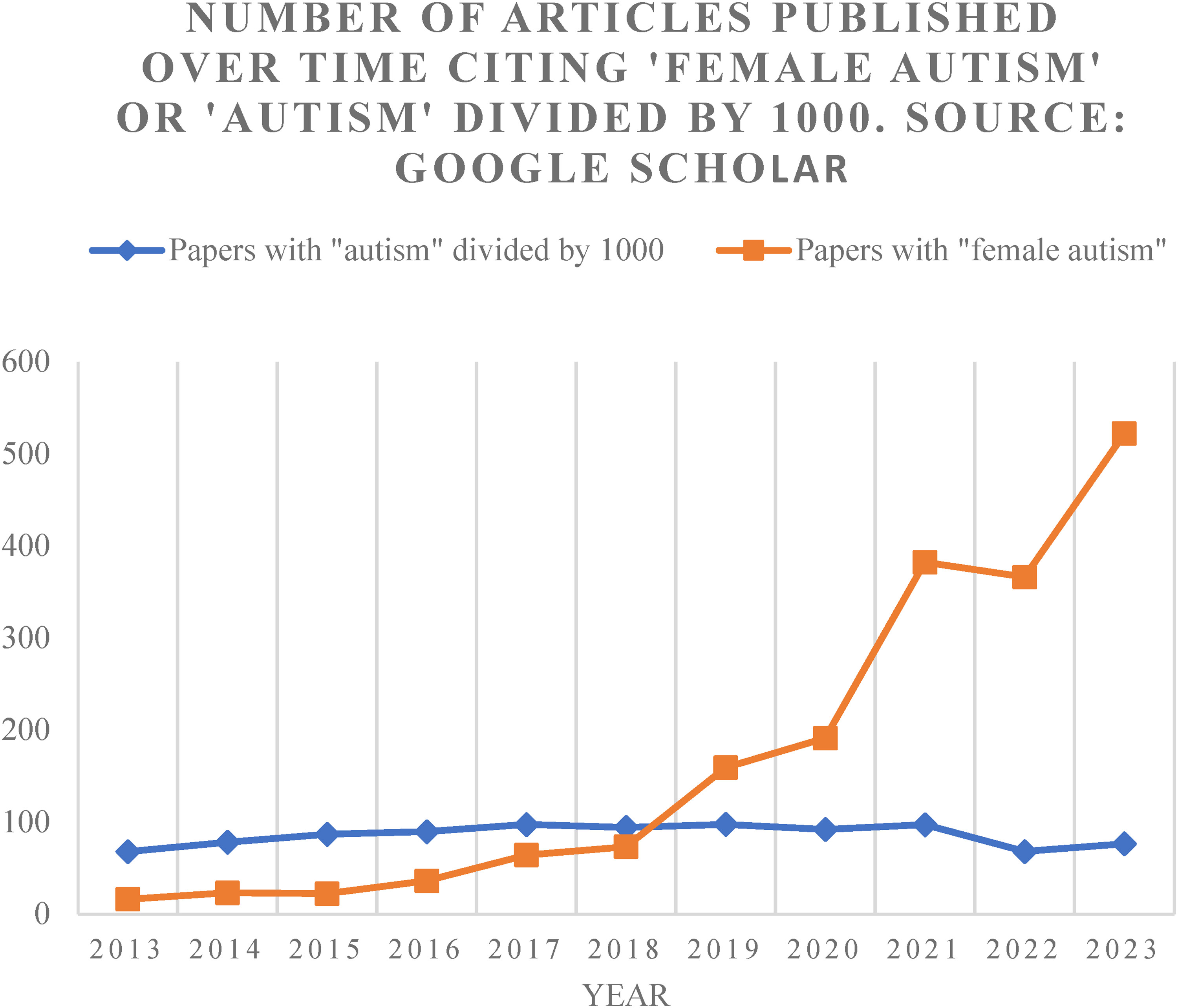
Autism in women and girls is a topic of increasing research and clinical salience. Literature searches reveal a marked increase in recent years of publications on the subject of “female autism” relative to interest in “autism” generally (Figure 1). Calls for greater awareness of autism in women and girls have been followed by a proliferation of public research initiatives (e.g., the questionably titled Autism in Pink project;
National Autistic Society, 2014) and self-help books targeting a new audience of “Aspie girls” (e.g.,
Brown, 2012). The idea of a distinct “female autism phenotype” (
Allely, 2019) shows signs of diffusion into popular culture; for example, the graphic novel,
Camouflage: The Hidden Lives of Autistic Women (
Bargiela & Standing, 2019), co-authored by a clinical psychologist and researcher in the field.
We begin from the premise that autism is a category of shifting boundaries, shaped by sociocultural context, evolving in interaction between the medical–psychiatric paradigm, the diagnosing and the diagnosed, and wider cultural currents (
Shapira & Granek, 2019). We situate the emergence of female autism as an iteration of this evolution, before outlining the value of discourse analysis to a feminist troubling of the concept, with a focus specifically on its construction in professional practices.
Our analysis makes no claims about the ontological status of female autism. Instead, we are interested in how the term is represented, and in the relationship between construct and what
Chapman (2020, p. 808) terms “real-world structures and practices.”
Hacking (2007) wrote about autistic people as “moving targets” whose subjectivity is shaped by, and in turn shapes, how autism is classified through what he refers to as a “looping effect”: dominant understandings of autism feed into the medical–scientific practices, experts and institutions regulating what counts as autism; these practices in turn influence how autism is understood, lived, and culturally represented. The creation of new identity categories, such as female autism, enables groups or individuals identifying with a given label to call for greater recognition, understanding, and acceptance (
Gillespie-Lynch et al., 2020), and to influence how the category is understood (e.g., autistic researchers, writers, and advocates such as Robyn Steward and Sarah Hendrickx, both affiliated with the UK National Autistic Society, and Temple Grandin—all authors of source material suggested by respondents in this study). In the looping effect, such developments “from below” feed into psychological and medical discourse. Diagnostic concepts assume the status of scientific “truths.” The evolution and contested expansion of the concept of autism over time can become obscured if understood in terms of a simple linear progress narrative.
Although the concept of autism has come to be widely accepted within Western healthcare provision, significant conceptual and empirical problems have been identified, including an absence of biological markers, lack of consensus with regard to what autism “is,” the heterogeneity of presentations clustered under the autism umbrella, and the lack of explanatory or predictive power offered by autism as a concept (
Runswick-Cole et al., 2016), leading to a refiguring of autism “as a post-medical, primarily political grouping” (
Chapman, 2020, p. 808). Revisions of diagnostic criteria over time, including the shift to autism as a “spectrum,” have sparked warnings of “diagnostic inflation” (
Batstra & Frances, 2012). Referral rates for autism diagnosis in the UK increased 787% between 1998 and 2018, with a significantly greater increase in diagnosis of females compared to males during this period (
Russell et al., 2022).
A number of social, (bio)political, and material drivers for the evolution of autism as a category can be posited. Dominant neoliberal agendas in ableist societies place emphasis on individuals to evidence “difference” or “deficit” in order for adaptations and support to be put in place. Thus, diagnostic labels work to distinguish “worthy” recipients of welfare and other forms of material support, significant in the context of austerity politics in the UK (
Runswick-Cole et al., 2016). For those marginalised by Western neoliberal societies that prize self-marketing and (certain) interpersonal skills (
Timimi & McCabe, 2016;
Whitmer, 2019), diagnosis can challenge personal “failure” narratives (
Seers & Hogg, 2023, p. 14) and offer exemption from societal expectations, including gender rules (
Russell, 2021). Yet arguably at a cost, as the expansion of diagnostic categories narrows conceptualisations of normative ways of being (
Brossard & Chandler, 2022;
Russell, 2021).
We recognise the gendered contours of autism as a construct (
Moore et al., 2022). The concept of female autism inevitably “others” women: “male autism” does not have the same currency; the “maleness” of autism is taken for granted, in line with the overrepresentation of man as the norm (e.g.,
Goodley et al., 2020;
King, 2004). Autism has historically been gendered male; the “extreme male brain” theory (
Baron-Cohen, 2002) being an obvious example, deconstructed in feminist disability scholarship (
Bumiller, 2008). It is worth noting that existing research presents a conceptually and empirically mixed picture of the existence and nature of sex or gender differences in autism (
Strang et al., 2020). For example, research differs on whether “camouflaging” is more characteristic of females (
Hull et al., 2020;
Pearson & Rose, 2021).
We see female autism as a fundamentally essentialist category: an ideological union of biologically determined sex difference and autism as presumed brain-based neurodevelopmental difference (
Bumiller, 2008;
Moore et al., 2022). In keeping with a history of othering women through seeking bio-medical explanations for variation from male norms (
Radtke, 2017), research on female autism has pointed to “hormone abnormalities” (
Ingudomnukul et al., 2007) or “sex differences in brain structure” (
Beacher et al., 2012). Qualitative research exploring the experiences and perspectives of women and girls diagnosed with autism has often called for greater recognition of the particularities of gendered experiences, while accepting a priori the paradigm of autism as a neurodevelopmental condition (e.g.,
Bargiela et al., 2016). Neuroqueer scholarship has sought to trouble the essentialising of gender and its intersections with neurodivergence (e.g.,
Egner, 2019;
Shapira & Granek, 2019). However, with some exceptions—
Russell (2021) argued that autism works to sanction pariah femininity, while
Moore et al. (2022) highlighted the perpetuation of rape myths in the female autism “vulnerability” narrative—critical engagement with female autism as a social construct is underdeveloped.
Foucauldian discourse analysis (FDA) is particularly suited to a feminist analysis of female autism in relation to power, institutions, and governmentality (
Macleod & Durrheim, 2002). Foucault was interested in how the psy-disciplines categorise people in ways that impose a “law of truth” (
Vakirtzi & Bayliss, 2013, p. 373). Subjectified as “different” or “disordered,” through diagnosis, individuals are fixed into power relations within institutions, such as the educational, health, and social care systems (
Yates, 2015).
While autobiographical accounts of autistic women (e.g.,
Davidson, 2007) and the voices of research participants and researchers who identify as autistic may influence from below how female autism is conceptualised (e.g.,
Hendrickx, 2015;
Steward, 2013), professionals are likely to be among the most powerful social actors in shaping its hegemonic constructions (
Harper, 1995). Professionals determine how many women and girls receive the diagnosis, and with it, access to services and support, but potentially also exposure to stigma and discrimination. Clinical practices influence the discourses available to people in constructing their identities, with wide ranging consequences for power and agency (
Loomes, 2017;
Shapira & Granek, 2019). Autism diagnosis can be experienced as providing nonblaming explanations for marginalisation (
Punshon et al., 2009). However, the internalisation of autism as explanation, legitimised by psy-professionals’ expertise, depoliticises a person's experience through relegating adversity and ableist social structures to the status of mere contextual factors (
Loomes, 2017). Our critical orientation to diagnostic practices is concerned with troubling the locating of explanations for the marginalisation many people experience within the diagnosed person (understanding this as in keeping with neoliberal ideology that reframes effects of social inequalities and ableist/patriarchal structures as individual traits or deficits).
Critiquing a concept like female autism is a thorny undertaking. We recognise that autism is a valued part of many people's identity, and that professionals promoting the diagnosis of female autism intend to help. Deconstructing female autism is not about invalidating very real experiences of difference or difficulty, nor is it to criticise individual professionals: FDA assumes we are all constrained by the possibilities of available discourses (
Edley, 2001) and is interested in their effects, seeking to unpick ramifications of particular ways of understanding and categorising people, to think critically about what is gained, what is lost, and for whom (
Parker, 1992). With these aims in mind, our research questions were:
1.
How is female autism constructed in professional practices?
2.
What possibilities do these constructions allow or disallow?
3.
What implications do these constructions have for women and girls?
Method
A Foucauldian discourse analysis was undertaken of professional-generated texts on female autism. Data were sought from professionals working clinically with people who have an autism diagnosis (e.g., nurses, psychiatrists, psychologists, speech and language therapists). The study was advertised through UK-based social media and email distribution lists for professional groups, an online community for autism professionals, and by asking respondents to circulate the research advertisement among colleagues. Professionals were asked for generic descriptions of female autism they used in clinical reports and/or resources on female autism they recommended to service users or other professionals.
Ethics
Ethical approval was obtained from the University of Leicester’s Psychology Research Ethics Committee. The Ethics Committee agreed professionals providing data should not be regarded as participants, as they were supplying existing descriptions and resources as opposed to being interviewed for their views. Nevertheless, respondents were given information sheets that explained the purposes of the study and the reason texts on female autism were being requested. The design of the study followed recommendations from the British Psychological Society’s
Ethics Guidelines for Internet Mediated Research (
BPS, 2021).
Contextualising the data set
Data were provided directly via 10 professionals (seven psychologists, two nurses, one speech and language therapist), with some respondents collating resources from other colleagues in their networks. We also identified resources from professionals’ recommendations on online forums. Recruitment was limited to UK-based respondents because although there might be broad shared ways of thinking about autism internationally, differing sociopolitical and service contexts will shape its social construction (
O’Dell et al., 2016). All data were English language, many were created by UK-based authors/organisations, with some from other English-speaking countries. See
Table 1 for a summary of the data collected.
Texts judged closest to those generated by professionals in clinical practice (i.e., text used in clinical reports), or which represented common currency in professional discourses (judged by the number of recommendations by respondents, or the degree to which the content of the text appeared across different sources), were prioritised for analysis.
Analysis
The analysis, informed by
Parker (1992) and
Willig (2013), was underpinned by social constructionist epistemological assumptions, meaning categories such as female autism were not regarded as describing “objective realities” (
Georgaca, 2013). Rather, we viewed the construction and application of categories as being situated within the knowledge politics of the psy-disciplines, shaped by broader social and power structures (
O’Reilly & Lester, 2017). Our analysis sought to take seriously
Hook's (2001) critique that discourse analysis approaches often neglect historical contextualisation and the role of materiality both “in and outside” of the text.
Foucault himself did not develop FDA, but a central feature of his work was on how power “ebbs and flows” in “disciplinary societies” as a form of governmentality (
Foucault, 1977). Here, the psy-disciplines function as a technology of domination, the “expert gaze” determining the “normal” from the “pathological.” Foucault was also concerned with “technologies of self,” whereby subjects transform their own bodies, minds, and lifestyle in accordance with dominant discourse (
Foucault, 1988). Our analysis looked for the operation of both technologies and how they function within texts on female autism, shaping practice and the construction of femininity, difference, and distress.
We first coded the data to identify and group into themes the different ways in which female autism as a discursive object was constructed across texts. Extracts representing themes were then analysed by connecting constructions of female autism to wider discourses, attending to congruence and tensions between discourses, identifying the functions of the constructions in specific discursive contexts, examining what opportunities for speech or action were made possible or legitimate, and considering implications for subjectivity and power relations.
Findings and discussion
Three interconnected themes were developed:
1.
The progress story: Female autism as medical advance, gender equality issue, and key to personal flourishing.
2.
Female autism as expansion of autism and the reach of the expert gaze.
3.
Female autism as reinforcing gender binaries and hegemony.
“Progress”
This theme is about the ways in which the identification and investigation of female autism as a distinct diagnostic profile is framed as progress: an improved professional knowledge, benefiting a previously neglected group. A number of discourses are at play in these constructions. The first is a discourse of medical–scientific advancement. Female autism is constructed as signifying both continuity and change within the history of autism.
1. In 1944, Hans Asperger (trs. Frith 1991) wrote that the “contact disturbances”
2. experienced by the girls in his group were “reminiscent of autism” without
3. showing the “fully formed” autism seen in the boys. Similarly, today an ASC
4. [Autism Spectrum Condition] explanation for autism-like difficulties in girls is
5. often discounted because their behaviour conflicts with the stereotype of ASC
6. core characteristics and associated features.
Extract 2 (original author unknown; provided by two contributors from separate organisations who utilised the text in clinical reports):
1. Although autism has historically been considered a predominantly male
2. condition, there is now a growing awareness that the condition manifests
3. itself differently and more subtly in females.
Connecting female autism “today” (Extract 1, Line 3) with the foundational case studies of Asperger (Extract 1, Line 1) gives a history and heritage to female autism and its underrecognition. Placing female autism in autism's origin story adds legitimacy to the concept. Labelling autism as a “historically … predominantly male condition” (Extract 2, Line 1) marks the male-centric understanding as outdated. “Growing awareness” (Extract 2, Line 2) invokes a positivist narrative of the history of science as a linear accumulation of knowledge (
Niiniluoto, 2019). Distinction between past and present, out-of-date and up-to-date, establishes binary positions for professionals: at the forefront of developing knowledge, or stuck in the past. “More subtly” (Extract 2, Line 3) reinforces this, suggesting that the “aware” clinicians are more skilled, for they can identify subtle differences. Connecting the discounting of “an ASC explanation” with professionals having stereotypes (Extract 1, Line 5) draws on discourses about “good” science being free from bias. Referring to “the stereotype” protects the category of autism itself from critique, locating the problem instead with its application by the unskilled/biased professional.
A second discourse around gender equality is drawn on to support the idea of female autism as progress.
1. Girls with an ASD are often undiagnosed, because original diagnostic criteria
2. have a boy bias. The criteria were created by actually examining mainly boys,
3. and the girls can be very different. I think we all know “neuro-typical” boys
4. and girls are very different in their social, communication and behaviour.
Extract 4 (nasen, 2016, p. 14):
1. These are early days in identifying gender-related ASC differences for girls
2. and women, and therefore while new pathways of inquiry have opened up,
3. evidence is currently sparse, fragmented and inconclusive. As professionals
4. and researchers working together with girls and young women with ASC, we
5. need to work towards clarity and consensus.
6. Girls and women with ASC need to be recognised, enabled and effectively
7. equipped so they can make the life choices they choose and benefit from
8. them. It is their human right.
Female autism is constructed as underdiagnosed due to a “boy bias” in diagnostic practices (Extract 3, Line 2). This rests on a binary understanding of gender, articulated in common sense terms: “we all know” boys and girls are “very different” (Extract 3, Lines 3–4). Evoking feminist–empiricist critiques of medicine as male-normed (
Gergen, 2001;
Wigginton & Lafrance, 2019), an activist position is created for professionals advocating the recognition of female autism. In Extract 4, the moral argument for female autism as a gender equality issue reaches its apotheosis as a matter of human rights (Line 8).
This morally loaded human rights discourse enters at a point where the promise of scientific advancement seems fragile, the evidence base “inconclusive” (Extract 4, Line 3). Yet describing the evidence as “currently sparse” (Extract 4, Line 3) suggests more confirmatory evidence will complete the picture. Scepticism about the validity of female autism is discouraged by a morally charged call for “consensus” (Extract 4, Line 5) in the interests of the girls and women who “need to be recognised” (Extract 4, Line 6). Implicit in these constructions is an argument for the involvement of educational, health, or social care services, to ensure that women and girls with autism, positioned as potential service users, are “recognised” by the expert gaze and then “enabled and effectively equipped” (Extract 4, Lines 6–7).
1. …understanding, regulating and managing their emotions is absolutely
2. crucial to autistic girls’ happiness in adult life. It is key to feeling well, happy
3. and together and to accessing opportunities. It's the difference between being
4. a contained, emotionally functioning adult, or being stranded in their bedroom
Extract 5, written by the headteacher of a specialist school, draws on individualistic positive psychology discourses in constructing happiness as a matter of “understanding, regulating and managing” emotions (Extract 5, Line 1), of shaping the self in accordance with expert advice. Under this disciplinary gaze, the subject can understand herself (Extract 5, Line 1), be “contained” and “emotionally functioning” (Extract 5, Line 4); yet unrecognised as autistic, anxious, and bedroom-bound (Extract 5, Lines 4–5), she cannot be “happy,” or access “opportunities” (Extract 5, Lines 2–3). Positive psychology discourses about personal flourishing tie into a wider neoliberal economic context of competitively accessed opportunities, in which an individual's worth is measured by their potential to contribute economically, and in which educational, health, and social care services are tasked with “equipping” individuals to meet these expectations (
Clegg & Lansdall-Welfare, 2020).
Expanding autism
Mallett and Runswick-Cole (2016) have written of the commodification of autism. The narrative of female autism as progress talks the language of feminist empiricism, scientific neutrality, and human rights, whilst opening new markets: for researchers, expert diagnosticians, training providers, and specialised services catering to the needs of this newly recognised cohort of hitherto overlooked girls and women. Our second theme is about how this market expansion is underpinned by the ways in which female autism extends the reach of autism. Through constructions of female autism, the expert gaze identifies women and girls who, on the surface, may seem similar to female peers, and differ from stereotypes of autism.
Extract 6 (Olley Edwards, a woman identifying with Asperger syndrome, in Gould's, 2017, presentation):
1. The autism spectrum is vast and beautifully complex, some individuals are
2. easily identified, but for others their autism is a prism, it is present, but yet it
3. remains transparent until the appropriately trained clinician shines their
4. knowledge and light onto it, it is only then that the colours and complexities
5. can be seen and understood.
In this vivid imagery, autism is unseen until the clinician “shines” the light of knowledge (Extract 6, Lines 3–5), a special, revelatory power. This knowledge-power is the preserve of the “appropriately trained” (Extract 6, Line 3), and so requires an infrastructure of professionals and institutions to invest in, develop, and disseminate training.
Extract 7 (nasen, 2016, p. 4):
1. Appropriate diagnosis, therefore, relies on very experienced clinicians who
2. are “able to see and think beyond the lists of criteria in the various
3. classification systems currently available” (Gould and Ashton-Smith 2012).
The identification of female autism is presented as a highly skilled activity: from the vantage point of “very experienced clinicians,” it is possible to see “beyond” the diagnostic criteria (Extract 7, Lines 1–2), to detect female autism where the presentation looks different to existing classification systems. Opposing positions are again formed: the skilled professional, experienced, able to see versus the inexperienced professional, constrained by the criteria. Framing this as a question of experience and skill delegitimises the voice asking, “If we are going beyond the criteria for ‘autism,’ are we still talking about ‘autism’?” Even if one were to see autism as something other than a biomedically valid diagnostic category—a social kind, or a serial collective (e.g.,
Chapman, 2020)—arguably, the continued expansion of autism's boundaries presents challenges to its utility as a descriptor: the risk that diagnostic inflation devalues the currency.
1. Just because the girls aren’t obsessed with Thomas the Tank Engine or lining
2. things up in neat rows doesn’t mean they are not on the spectrum. Just
3. because they can make eye contact, have a reciprocal conversation with
4. someone for five minutes doesn’t mean they are not autistic. It means the
5. girls have learned how to have a conversation. Society needs to redefine what
“Thomas the Tank Engine,” “eye contact” … these stereotypes are jettisoned as not applicable to girls with autism (Extract 8, Lines 1–4): the rules have changed. A distinction is created between what autism “is” and what “society” thinks autism is (Extract 8, Lines 5–6); a parallel distinction between the expert's insight and others’ stereotyped assumptions. To “redefine” autism to better capture women and girls (Extract 8, Line 5) means redrawing the boundary, expanding autism.
Extract 9 (from clinical reports):
1. Girls may be more able to follow social rules through observation and girls
2. may mask their difficulties by learning to copy behaviour i.e., using skills
3. based on intellect rather than social intuition.
Female autism as a “copied” way of being invokes gendered tropes of femininity as masque and artifice (
King, 2004). The construction of “masking” as characteristic of female autism requires separating “normal” social learning from the “copying” perceived as symptomatic of female autism: the differentiation between “intellect” and “intuition” (Extract 9, Line 3) creates distinct autistic and nonautistic processes underpinning behaviour which may look on the surface very similar. How does one distinguish between intellect-based and intuition-based behaviour? The tools of expertise.
One such tool is the Camouflaging Autistic Traits Questionnaire (CAT-Q;
Hull et al., 2019). Extract 10 is a sample of items from its “masking” and “assimilation” components.
1. 1. Monitor face and body to appear relaxed
2. Adjust face and body to appear interested in others
3. Aware of impression made on others
4. Feel the need to put on an act
5. Performing, not being oneself in social situations
The CAT-Q is interesting for several reasons. The very concept of camouflaging suggests “otherness”—a disguise to blend into the environment—in military parlance, a means of hiding from “the other side.” This otherness is in tune with representations of autism as alien (
Hacking, 2009), of autistic
Women From Another Planet (
Kearns Miller, 2003), and indeed, of woman as “other” (
King, 2004). In line with medical–scientific discourse, the administration of the questionnaire reveals the “truth.”
The CAT-Q is freely available under a Creative Commons license and can be reproduced and altered. In the article on its development and validation (
Hull et al., 2019), the 7-point Likert scale is described as ranging from “strongly disagree” to “strongly agree.” In the version of the CAT-Q provided by a contributing clinician, the poles of the scale had been altered to “never” and “always,” with a midpoint of “about half the time,” implying camouflaging can be quantified based on the proportion of time someone might mask or assimilate. If it became accepted that someone might be “pretending to be normal” (
Bargiela et al., 2016, p. 3281) some of the time, then the threshold for diagnosis drops. Indeed,
Hayes et al. (2021) noted the explaining away of contradictory evidence by recourse to the concept of masking in diagnostic decision-making in autism assessment teams—particularly when diagnosing women and girls. Numerical scoring allows expert measures to sustain an “illusion of objectivity,” as has been highlighted in relation to the Autism Diagnostic Observation Schedule (ADOS) (
Timimi et al., 2019). Yet what the responses signify is highly subjective, necessitating a number of value judgements: whether a “normal” way of being is to never (or always) behave in a certain way, whether it is an issue if someone camouflages only half the time, what consideration is given to context, or motivation.
Items presented as signs of masking (Extract 10, Lines 1–3) might, in some contexts, be cultivated as interpersonal skills (therapists are trained to be aware of and consciously adapt their nonverbal communication). Yet the language of monitoring and adjusting (Extract 10, Lines 1–2) evokes mechanistic discourses, tapping into tropes of autism as robotic (
Lilley, 2011), implying that monitoring and adjusting
should be intuitive, below the level of conscious awareness. “Being oneself” (Extract 10, Line 5) is positioned as the optimal, “natural” way to be. This connects to the fetishisation of “authenticity” and the expression of “true self” in late capitalist individualistic society (
Whitmer, 2019). The implication is that nonautistic people can be their authentic selves without the “need to put on an act” (Extract 10, Line 4). The camouflage hypothesis, integral to the narrative that women and girls with autism are “missed” by professionals (
Allely, 2019), creates a catch-all, whereby if a woman or girl acts in a way which does not appear autistic on the surface, this in itself may signify autism, if reframed as compensatory camouflaging.
King (2004, p. 33) has written of the paradox of femininity: “regarded as the most ‘natural’ of the genders … it also requires the most artifice to be considered successful, whilst those that are unsuccessful or refuse to take part in it are regarded as ‘unnatural.’” Perhaps the most successful mask is that which conceals its artifice to appear “natural”: the social performance equivalent of a “no make-up” make-up look. This speaks to the double binds and multiple standards women are meant to live up to (
Hirji, 2021), and raises questions about how female autism might serve the policing of these standards.
Seers and Hogg (2023, p. 7) describe the exhaustion resulting from masking as an “existential depletion … incurred through the act of rigid self-management, whereby the need to manage the self, and the social expectations of others … may serve as a latent reminder of ‘defectiveness.’” In this respect, female autism seems an exemplification of the contradictory pressures of contemporary femininity (
Alexandersson & Kalonaityte, 2021;
Bordo, 2008;
Gunby et al., 2020).
Reinforcing gender hegemony
Within the progress narrative, the development of female autism as a concept is constructed, in a feminist empiricist framing, as advancing gender equality. However, from a feminist social constructionist position, implications of female autism are concerning. This third theme deconstructs the ways in which female autism acts to reinforce hegemonic gender.
In some respects, female autism is constructed as departing from stereotypical femininity:
Extract 11 (Gould, 2017):
1. In society females are expected to be social in their communication but they
2. do not “do social chit-chat or make meaningless comments to facilitate social
In Extract 11, autistic women buck the societal expectation that women should be socially amenable (Line 1). If disliking “chit-chat” (Extract 11, Line 2) or other stereotypical gendered expectations is a sign of female autism, women's resistance to gendered norms risks being pathologised (
Russell, 2021): through punishing the pariah feminine, hegemonic femininity is reinforced (
Schippers, 2007).
Yet in other respects, fundamental to the construction of female autism is its characterisation as distinctly
female, asserting a binary, essentialist conceptualisation of gender. Gendered tropes fuse with “disorder” discourses, shaping the ways autistic women and girls are constructed. This was seen in the way in which the camouflage hypothesis constructs autistic women and girls as “copying” and “performing” rather than behaving “naturally” (the trope of female artifice meets the trope of autism as robotic). A similar fusing happens in relation to emotionality.
Extract 12 (a point on female presentation included by a clinician in reports):
1. Relating very strongly to other people's emotions/taking on other people's
Constructing female autism as being highly sensitive to others’ mental states (Extract 12, Lines 1–2) is in striking contrast to dominant framings of autistic people as rational subjects, with difficulties understanding, let alone adopting, others’ emotions. Although arguably more consistent with double empathy theory's challenge to dominant theory of mind deficit understandings of autism (
Milton, 2012), as well as writing on the intensity of neuroqueer subjective experience (
Walker, 2021), we note how the departure from traditionally understood (male) autism may be given credibility by the invocation of gendered discourses in which orientation to relationships (
Mahalik et al., 2005) and emotionality (
King, 2004) are coded female. It is implied in Extract 13 that females with autism may be
oversensitive to emotion. This echoes the trope of female hysteria, which has a long lineage in medicine (
Showalter, 1993) and connects to patriarchal constructions of women as impressionable and weak (
Prentice & Carranza, 2002), constructions which also underlie the “female autistic vulnerability” narrative.
Extract 13 (Gould, 2017):
1. Safety for women can be a major issue.
2. Many are vulnerable to both verbal and sexual abuse in their attempt to fit
4. Women and girls cannot imagine risk—so do it anyway.
Rates of abuse of autistic women are high (
Dike et al., 2023). However, positioning autistic women as vulnerable to abuse naturalises patriarchal and ableist narratives: female as the “weaker” sex combined with gendered associations between disability and physical or psychological weakness (
Hirschmann, 2013). Reproduced in different forms across accounts of female autism, the vulnerability discourse is problematic for the ways in which it locates causes of abuse or victimisation within the “vulnerable” autistic girl/woman (their attempts to “fit into society” [Extract 13, Lines 2–3], their lack of consideration of “risk” [Extract 13, Line 4]), shifting blame from perpetrators and the wider societal factors (misogyny, rape culture) which endanger all women's safety, and placing responsibility for averting victimisation on women (
Moore et al., 2022;
Warner, 2009). The operation of oppression and victim-blaming is simultaneously reinforced and shielded from scrutiny (
Boyle, 2003).
Drawing upon hegemonic gender discourses, constructions of female autism act to regulate gender by presenting female autism as characteristically female while narrowly defining what is characteristically female, in ways which reproduce gendered stereotypes.
Extract 14 (from clinical reports):
1. Girls are often more socially aware and socially driven, and so more likely to
2. seek out play and interaction opportunities (whilst often being “led” by peers
3. rather than initiating activities themselves). They may have one special friend
4. with whom they share an intense, sometimes dependent, relationship. As
5. they grow in self-awareness and recognition of their “differences,” girls may
6. take greater pains to avoid drawing attention to themselves, for example by
7. being quiet, well behaved and compliant at school.
Extract 15 (Gould, 2017, section on “special interests and routines”):
1. Males are more hyperactive and aggressive and have interests in technical
3. Females are more passive and collect information on people rather than
5. The interests of women and girls in the spectrum are similar to those of other
6. girls—animals, soaps, celebrities, fashion.
The quietness of female autism (Extract 14, Line 7) matches gendered constructions of femininity as passive rather than active. This then functions as an explanation in the narrative as to why autism in women and girls is missed: an explanation set in their femininity. Female autism is constructed as differing from typical male presentations in sociability and interest in other people (Extract 14, Line 1; Extract 15, Line 3). The construction of the “special friend” (Extract 14, Line 3) acts to resolve the tension between gendered discourses of female sociability and dominant understandings of autism, in which difficulties with sociability are a core characteristic: friendship is problematised as “intense” and “dependent” (Extract 14, Line 4), rebranded as akin to a “special interest” symptom of female autism.
Indeed, the positions available for autistic girls in Extracts 14 and 15 are defined by the subordinate loci of hegemonic femininity (
Schippers, 2007): “dependent” (Extract 14, Line 4), “led” by others (Extract 14, Line 2), “compliant” (Extract 14, Line 7), “passive” (Extract 15, Line 3), with interests which reproduce gender stereotypes (Extract 15, Line 6). The male traits described (Extract 15, Lines 1–2) are consistent with hegemonic masculinity (
Schippers, 2007) and the theory of the “male brain” as systematising, “technical,” and rational (
Baron-Cohen, 2002).
When female autism is flexible (“subtle”) enough that symptoms are present in both behaviours that fit gendered expectations and those that do not, there is little escape from the diagnostic gaze, as any form of gendered behaviour, normative or non-normative, potentially becomes a symptom: if someone is not stereotypically feminine, perhaps she has an autistic male brain; if someone appears similar to female peers, perhaps she is too similar, trying too hard, masking.
Conclusions
Our analysis problematises the marketing of female autism in terms of medical–scientific progress, the advancement of gender equality, and the promise of personal flourishing, tracing the way it expands the concept of autism and the gaze and power of the expert. While previous critical scholarship has focused on pariah femininity and the sanctioning of nonconformity with gendered expectations (
Russell, 2021), our analysis demonstrates that constructions of female autism also enact disciplinary power and reinforce hegemonic gender in other ways. We see contradiction in a feminist–empiricist positioning of female autism as being associated with gender equality, when its construction serves to police the parameters of femininity. Concurrently autistic women's femininity is framed as an inauthentic state of being, reduced to a mask used to conceal autism, which is further naturalised as masculine.
We have offered interpretations about how the different discourses might set up various subject positions in relation to what
Foucault (1997) referred to as “games of truth.” This has included the effects for women and girls who might seek out and come to make sense of experiences of marginalisation and otherness through the lens of female autism, and also the effects on psy-professionals, who are cast as the experts able to see past the “inauthenticity” of performances of femininity. Female autism is constructed as a condition only recognisable to highly competent professionals; as something requiring specialist training, new measures and resources, all of which support the continued commodification of autism (
Mallett & Runswick-Cole, 2016). The production of technologies (
Foucault, 1988;
Hacking, 2007) associated with this construct has coevolved, with diagnosis being framed as a gender equality issue and a medical advancement. Inevitably, well-meaning professionals who care about their clients, gender equality, and wanting to be competent at their jobs will be influenced by these discourses and the proliferation of measures and resources that uncritically advocate the expansion of what it means to be neurodivergent. Female autism becomes a fetishised commodity and practitioners become embedded in this game of truth, regarding recognition and management of female autism as an opportunity for supporting personal flourishment, which can be situated in the lexicon of positive psychology with its “promise of happiness” (
De La Fabián & Stecher, 2017). Whilst the label might be experienced as explanatory and central to many women's identity, would “female autism” be necessary if instead we were to “widen the ways all women (indeed, all people) are allowed or expected to behave” (
Russell, 2021, p. 88)?
Critical reflections
Focusing on texts provided by UK-based clinicians meant that the discursive map presented is necessarily culture-bound, worth emphasising given the universalising claims of the autism industry (
Timimi et al., 2019). Notably absent in submitted sources was text on intersectionalities of autism and intellectual dis/ability. The gender ratio in autism diagnosis appears to be closer for people labelled as intellectually disabled (
Loomes et al., 2017). The “new kind” of autistic female is often described as “intellectually able” (
Russell, 2021), a narrative perhaps underpinned by a conceptualisation of the intellect-based skills required for the social performance of camouflage acting to exclude people with intellectual disability from representation. A person's behaviour, emotional expression, and performance of femininity will also be impacted by gendered–racial and class stereotypes and norms (
Kearl, 2021,
Krazinski, 2023), whilst unequal access to financial resources limits opportunities to pursue an autism diagnosis (
Collins, 2016).
Our analysis was interpretive; others would read the texts in different ways, and may well arrive at different conclusions. FDA is not immune to critique itself: the discourses written about are as much produced through the analysis as “discovered,” the writing as susceptible to reification and mystification as any “expert” practice, and in drawing out texts’ underlying meanings, there is a danger these appear static, ignoring the dynamics of how a text is received, how ideas may not only be taken up but resisted (
Parker, 1994). We analysed hegemonic constructions of autism in professional networks—so the voices of people identifying as autistic and how they may utilise or problematise female autism narratives have not been our focus here, but may usefully be explored in future research.
This leads to further questions around what purpose the research serves:
Botha (2021) reflected on the role identity plays in the research process itself when studying autism, with researchers needing to navigate the boundaries between academic, activist, and advocate positions. Highlighting the ways female autism is constructed in professional practices comes with the understanding that we are all constrained by the available discourses, enmeshed in the same institutional and social power structures (
Parker, 1994). By problematising female autism, we do not want to undermine those women who seek diagnosis for help and the promise of a better life. Instead, we hope the current paper helps practitioners to reflect on how best to serve the well-being of women by taking the claim seriously that female autism is embedded in wider gender politics, and thus its potential to reproduce gendered power, inequality, and distress. After Yates, who wrote that one objective of Foucauldian critique is “that the people who administer the lives of others, the people whose social position is associated with particular regulated ways of directing the conduct of disabled people find their actions problematic in new ways” (
Yates, 2015, p. 103), we wish to question how experiences of difference or difficulties categorised as female autism are understood, what assumptions, ideologies, and biopolitics underpin these understandings, what is being medicalised and with what consequences.
Acknowledgements
The authors are grateful to everyone who helped to advertise the study, and to the professionals who provided texts and recommended resources. The first author would like to thank Professor Sami Timimi and Dr Ceri Jones for constructive discussion of an earlier version of the manuscript.
Ethical considerations
Ethical approval was obtained from the University of Leicester’s Psychology Research Ethics Committee.
Declaration of conflicting interests
The authors declared no potential conflicts of interest with respect to the research, authorship, and/or publication of this article.
Funding
The authors received no financial support for the research, authorship, and/or publication of this article.