Intended for healthcare professionals
Open access
Review article
First published online March 30, 2026

Immunophenotypic characterization and clinical relevance of passage number in umbilical cord mesenchymal stromal cells: A review

Abstract

Umbilical cord mesenchymal stromal cells (UC-MSCs) are emerging as leading stem cells in regenerative medicine due to their high proliferative capacity, potent immunomodulatory effects, and non-invasive collection. However, the absence of standardized guidance on optimal passage number and tissue-specific characterization criteria limits clinical translation, raising concerns about variability in potency, genomic stability, and safety. This review synthesizes evidence on how in vitro passaging alters UC-MSC properties, including purity, proliferation, senescence, genomic integrity, differentiation, and immunomodulation. Preclinical data suggest that UC-MSCs tolerate extended passaging better than MSCs derived from other sources, with several functional attributes preserved up to later passages. Clinical evidence indicates that early to middle passages (P3–P5) achieve the best balance between scalability and therapeutic efficacy. We further propose an updated immunophenotypic framework incorporating tissue-specific positive and negative markers to enhance clinical-grade characterization. Establishing harmonized passage guidelines and potency assays is essential to maximize reproducibility, safety, and the translational potential of UC-MSC therapies.
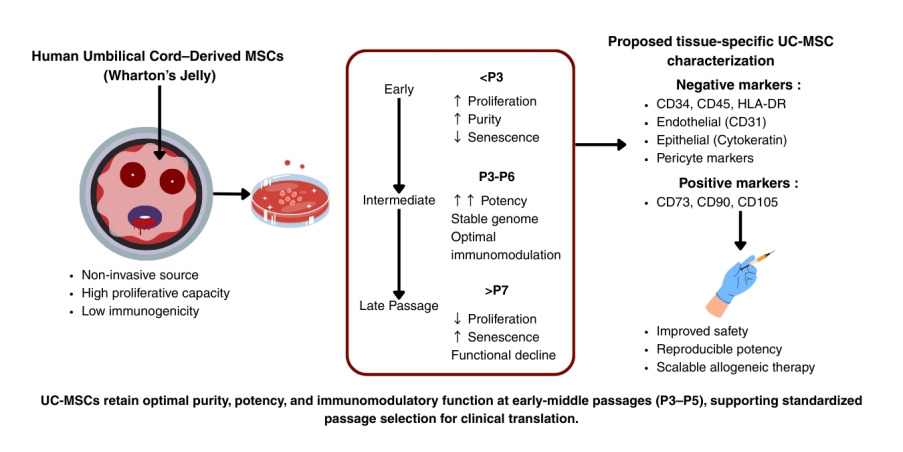
Graphical Abstract

Introduction

Umbilical cord-derived mesenchymal stromal cells (UC-MSCs) have gained recognition as promising stem cells in regenerative medicine, attributed to their high proliferative and differentiation potential coupled with low immunogenicity and immunomodulatory properties1. UC-MSCs modulate major immune effectors and exert anti-inflammatory effects through both cell-to-cell contact and the secretion of bioactive factors2. Leveraging these properties, the clinical applications of UC-MSCs encompass a diverse range of diseases, including autoimmune disorders, neurological injuries, and age-related degeneration35. With the increasing use of UC-MSCs in clinical trials, it is imperative to ensure consistent cell quality and safety for clinical-grade preparations. This goal can be partly achieved through the standardization of cell characterization protocols that support regulatory compliance, product reproducibility, as well as therapeutic efficacy and safety6.
A critical factor influencing the characteristics of UC-MSCs is the number of cell passages during in vitro expansion. Studies have demonstrated that cell passage numbers influence biological properties, including immunophenotype, proliferation rate, differentiation potential, genetic stability, cytokine secretion, and immunomodulatory effects as a result of in vitro aging7,8. Despite this, international guidelines on optimal passage selection for therapeutic use remain absent, and most studies evaluate MSCs properties at a single passage rather than across successive passages7. This lack of harmonization introduces risks of inconsistent product quality, variable therapeutic potency, and challenges in regulatory approval, thereby limiting clinical translation.
Moreover, the immunophenotypic profiling that is defined by the expression of surface markers remains the most widely accepted criterion for MSCs identification and validation9. The immunophenotypic characterization of human MSCs is delineated according to the guidelines established by the International Society for Cellular Therapy (ISCT), which stipulates that MSCs should express positive markers and lack negative markers to maintain their purity and lack of non-MSCs population10. Yet, the current MSCs positive markers exhibit overlaps with fibroblast profiles and do not necessarily constitute indicators of their clinical functionality11,12. Moreover, negative marker identification has largely been limited to the exclusion of hematopoietic and immune cell populations10. While current MSCs characterization guidelines provide a useful framework for standardization that facilitates comparisons across studies, the concerns about the sufficiency for clinical decision-making raise as these guidelines may not fully capture the complexity of MSCs identity and function, which require further refinement and standardization13.
In this review, we critically evaluate the effect of passage numbers on the biological characteristics and functional suitability of UC-MSCs in clinical implications, while proposing additional immunophenotypic markers that can be integrated into updated characterization guidelines for UC-MSCs. By addressing these gaps, we aim to clarify the relationship between passage-dependent alteration in UC-MSCs and their therapeutic potency to facilitate the development of standardized and clinically relevant criteria for clinical-grade UC-MSCs characterization and application.

Methodology

This narrative review examines the impact of passage number on the biological and functional properties of umbilical cord mesenchymal stem cells (UC-MSCs). A targeted search of the PubMed database was conducted for peer-reviewed articles published within the last five years using keywords including “umbilical cord,” “Wharton’s jelly,” “mesenchymal stem cells,” “mesenchymal stromal cells,” “passage number,” and “immunomodulation.” To minimize selection and reporting bias, all eligible articles meeting the search criteria were considered regardless of country of origin, study design, sample size, or direction of findings. Studies were included based on their relevance to UC-MSC expansion, passage-dependent characteristics, and immunomodulatory outcomes. Data from both preclinical and clinical studies were qualitatively synthesized to identify recurring themes, consensus, and existing knowledge gaps regarding passage-associated changes.

Umbilical cord mesenchymal stromal cells (UC-MSCs)

Stem cells are defined by their capacity for self-renewal and differentiation. Their developmental potential, or “potency,” ranges from totipotent zygotes, which can form all embryonic and extraembryonic tissues, to pluripotent embryonic stem cells (ESCs) and induced pluripotent stem cells (iPSCs), which can differentiate into cells of all three germ layers but not placental tissue. In contrast, mesenchymal stromal cells (MSCs) and hematopoietic stem cells (HSCs) are multipotent, restricted to specific lineage differentiation14,15. Although pluripotent stem cells hold great therapeutic promise, their clinical use is limited by risks of tumorigenicity, immunogenicity, and ethical concerns related to embryo-derived ESCs16,17. MSCs, by comparison, present a more practical alternative. They can be readily isolated from adult and perinatal tissues, demonstrate reduced tumorigenic risk, and possess low immunogenicity due to minimal expression of MHC-II and co-stimulatory molecules, features that enable their safe allogeneic application18,19.
Among MSC sources, the umbilical cord (UC) has gained particular attention as it is obtained from postnatal tissue usually discarded as medical waste, making it a non-invasive and ethically acceptable source20. UC-MSCs can be isolated from four main compartments: Wharton’s Jelly (WJ), perivascular region (PV), sub-amnion, and amnion membrane21 (Fig. 1). Of these, WJ is the most widely studied; fibroblast-like cells with MSC characteristics were first reported from this tissue22. WJ-MSCs are advantageous over other types of stem cells due to their high proliferation rate, non-invasive sources, strong stemness, broad multilineage differentiation potential, and strong immunomodulatory properties, which lowers the risk of rejection, reinforcing their suitability for clinical translation23,24.
Figure 1. Graphical illustration of the umbilical cord showing the arteries and vein, as well as the four main compartments: the amnion membrane, Wharton’s jelly, sub-amnion, and perivascular region. This illustration was created by the authors using Canva Pro.

Clinical-grade isolation and expansion protocols

The translation of UC-MSCs from research to therapeutic use requires isolation and expansion strategies that are safe, reproducible, and GMP-compliant. Two main approaches are commonly employed: explant culture and enzymatic digestion, each shaping heterogeneity and influencing passage-dependent outcomes.
Explant culture relies on MSC migration from tissue fragments, with outgrowth typically observed within 8-10 days. It is simple, cost-effective, and avoids enzyme-induced stress, often yielding cultures of higher purity and reduced heterogeneity at early passages25,26. However, tissue detachment and floating fragments can reduce yields, though refinements such as pre-incubation and anchoring devices have improved adherence and proliferation27,28.
Enzymatic digestion accelerates isolation by degrading the extracellular matrix, enabling earlier proliferation (6–8 days) and higher initial cell numbers. This efficiency is primarily attributed to the use of enzymes including collagenase, hyaluronidase and trypsin, which effectively break down the UC tissue components25,29. Yet, enzyme exposure can compromise viability, and early passages frequently show heterogeneous populations with increased hematopoietic contamination30. Optimizing digestion time, enzyme concentration, and seeding density is therefore essential to preserve quality31.
Hybrid protocols, combining short enzymatic digestion with explant culture, aim to balance yield and purity while minimizing enzymatic stress. Although promising, their applicability to GMP-grade production remains under investigation32. Standardizing isolation protocols will be critical to ensure that passage-dependent findings can be consistently reproduced across laboratories and translated into GMP-compliant therapies.

Immunophenotypic characterization of UC-MSCs

The International Society for Cell and Gene Therapy (ISCT) set forth minimal criteria in 2006 to define MSCs, which include (a) adherence to the plastic surface under culture conditions; (b) absence of hematopoietic and vascular epithelial cell surface markers (CD14, CD19, CD34, CD45, and HLA-DR) and positive expression of mesenchymal markers (CD73, CD90, CD105); (c) capacity for multilineage differentiation in vitro; (d) self-renewal ability and minimal immunogenicity10. While these criteria provide a consensus on the general MSC definition, these criteria were initially established for BM-MSCs, a relatively uniform source primarily composed of MSCs and hematopoietic stem cells33. MSCs from different tissue sources carry dissimilar immunophenotypes that are excluded from current guidelines34. Although ISCT had presented amendments and suggestions on immunosuppressive properties, tissue origin and nomenclature13, a tissue-specific guideline should be proposed to fully capture cellular heterogeneity, functional diversity, and safety requirements, including additional markers and functional assays to better define clinically relevant MSCs populations35.
In MSC therapy, UC-MSCs have emerged as the second most frequently utilized MSCs in clinical trials36. In line with this effort, the ISCT has recently published ISO standardization documents focused on the biobanking of MSCs from Wharton’s Jelly and bone marrow, underscoring the importance of tissue-specific guidance in ensuring quality, consistency, and clinical translatability37. Compared to bone marrow, UC tissue offers a more diverse cellular environment which presents additional challenges for isolation and characterization38. Leukocytes, endothelial cells, and epithelial markers such as cytokeratin and cell-cell junctions have been detected in UC-MSC isolates, indicating cellular heterogeneity during isolation27,39. Enhanced identity profiling and negative selection of non-MSC markers should be implemented to minimize non-MSC contamination from the cord lining.
Therefore, a specific marker panel is proposed based on the latest consensus MSC definition and guidelines for MSC therapy, allowing for a comprehensive and detailed identification of UC-MSCs (Table 1). Among the markers listed, CD90, CD105, CD73 and CD45 are the canonical markers for MSC identification from any source40. Aligned with the encouragement of tissue-specific immunophenotyping, endothelial and epithelial markers as well as pericyte markers are included in this proposed panel to allow accurate UC-MSCs identification as a perinatal MSC source with minimum biological contamination39,41,42.
Table 1. Canonical and proposed cell surface markers for UC-MSCs characterization.
MarkersThresholdPurpose/justificationReferences
ISCT mesenchymal markersCD90a≥ 95%To define MSC phenotype.Dominici et al.10
CD105a≥ 95%
CD73a≥ 95%
Hematopoietic markersCD45a≤ 2%To exclude hematopoietic/immune cells.Dominici et al.10
Endothelial markersCD31≤ 2%To exclude vascular endothelial
cells.
Nagamura-Inoue and He41
Epithelial markersCytokeratins (CK7, CK8, CK19, CK4, CK13, CK3/12)≤ 2%To exclude epithelial
contamination from UC
lining.
Garzón et al.39
cell-cell junctions
(DSP/ZO1)
≤ 2%
Pericyte markerCD146VariableEnriched in perinatal or
primitive MSCs.
Li et al.42
a
Canonical markers for MSC identification.

Biological advantages of UC-MSCs

A key advantage of UC-MSCs lies in their youthful origin. As postnatal cells are minimally exposed to environmental stress, UC-MSCs circumvent donor age-related decline seen in autologous bone marrow-derived (BM-MSCs) and adipose-derived MSCs (AD-MSCs), in which cellular senescence, reduced growth kinetics, and altered secretome profiles compromise therapeutic efficacy4345. Studies consistently report that UC-MSCs exhibit a shorter population doubling time and higher expansion potential than adult MSC sources46. UC-MSCs also demonstrate potent immunomodulatory activity, mediated through direct cell-cell interactions and secretion of anti-inflammatory cytokines, making them attractive for the treatment of immune-mediated disorders47. Compared with BM-MSCs, UC-MSCs display enhanced ability to suppress T-cell proliferation, modulate macrophage polarization, and reduce pro-inflammatory cytokine release48.
The richness of the secretome released by UC-MSCs further enhances the regenerative capacity. These secretomes of UC-MSCs is rich in hepatocyte growth factor (HGF), vascular endothelial growth factor (VEGF), fibroblast growth factor-2 (FGF2), brain-derived neurotrophic factor (BDNF), and tissue inhibitor of metalloproteinase (TIMP), among others, compared with adult MSCs46,49. These factors regulate the immune system, promote tissue regeneration, angiogenesis, and anti-inflammatory effects, underscoring their broad therapeutic potential. However, studies have indicated that the composition and potency of secretome may decline with extensive passaging, as reflected in cellular senescence and metabolic changes8,50,51. Therefore, maintaining low passage of UC-MSCs or optimizing culture conditions is essential to preserve the paracrine activity. Taken together, the proliferative resilience, immunomodulatory strength, and robust paracrine signaling of UC-MSCs make them a particularly attractive cell source for regenerative medicine, including applications in neurodegenerative, autoimmune, cardiovascular, and musculoskeletal diseases5,52. Maintaining these properties during large-scale expansion is critical for clinical translation. Thus, the influence of passage number on these advantageous characteristics warrants further examination.

Passage number: Definition and its biological effects

Subculturing, or passaging, refers to the transfer of cells into new culture vessels to sustain proliferation and prevent nutrient depletion and contact inhibition53 (Fig. 2). Regular passaging is essential in large-scale MSC manufacturing, ensuring sufficient yields for clinical dosing, maintaining culture purity, and preserving functional potency54. Without timely passaging, cultures undergo growth arrest and senescence, compromising therapeutic applicability55.
Figure 2. Schematic overview of the cell culture expansion workflow illustrating cell growth and propagation across multiple culture plates. This illustration was created by the authors using Canva Pro.
For clinical translation, enzymatic detachment methods must balance efficiency with cell integrity. Recombinant enzymes such as TrypLE are widely adopted due to their xeno-free formulation, low cytotoxicity, and ease of inactivation25,56. Accutase, although capable of gentle detachment, has been linked to reduced viability and higher apoptosis rates in UC-MSCs57,58. Optimization of enzyme concentration, incubation time, and cell density is critical, as excessive enzymatic exposure alters surface marker expression, impairs adhesion, and reduces immunomodulatory function59,60. Thus, both the timing of passage and the parameters of enzymatic digestion directly affect the viability and functionality of UC-MSCs.
Passage phases are generally classified into three ranges: early passage (P1–P3), representing primary expansion and initial characterization; middle passage (P4–P6), typically considered optimal for clinical and preclinical use; and late passage (≥P7), often studied for safety and senescence6164. Most GMP-compliant protocols restrict expansion to P6, as this range achieves clinically relevant yields while minimizing functional decline.
Evidence from BM-MSCs shows that functional alterations accumulate with prolonged culture. For example, extracellular vesicles derived from mid-passage BM-MSCs (P5) demonstrated superior tendon-healing effects compared to late-passage cells (P12)65. Similarly, immunomodulatory profiles vary with passage; Connard et al.66 reported comparable T-cell suppression across passages, though cytokine secretion shifted at P6 and P9. These findings highlight that both therapeutic potency and secretome composition are passage-dependent. Importantly, donor age appears to affect MSC tolerance to passaging. Autologous BM-MSCs from elderly donors often display senescence as early as P367,68, limiting their scalability. In contrast, UC-MSCs are more resilient, with stable morphology, proliferation, and immunophenotype reported until ≥P1069. This resilience underscores their potential as a scalable allogeneic product, provided that passage-dependent changes in purity, proliferation, senescence, genomic stability, differentiation capacity, and immunomodulation are carefully characterized.

Impact of increasing passage number

Understanding how these characteristics evolve across early, middle, and late passages is essential to determine the optimal passage range for clinical applications. The following subsections provide current evidence on how passaging shapes each of these properties and highlight the implications for manufacturing and therapeutic use of UC-MSCs.

Effect of passage number on purity

The purity of MSC preparations is a critical determinant of safety and therapeutic efficacy, as contaminating cell types such as endothelial or epithelial cells may introduce immunogenicity or pro-inflammatory responses10. In UC cultures, early passages often contain heterogeneous populations. For instance, De Bruyn et al.70 reported that up to 31% of UC-MSC primary isolates (P1) were contaminated by endothelial cells, but these contaminants declined substantially after subsequent passages. Similarly, supplementation with defined culture media and repeated passaging selectively expands MSCs, reducing non-MSC populations71,72.
Phenotypically, UC-MSCs across passages consistently maintain the canonical ISCT marker profile (CD73, CD90, CD105 positive; CD34, CD45, HLA-DR negative), with no significant deviations reported even at higher passages63,73. However, studies suggest that middle passages (P3–P5) display enhanced purity, evidenced by increased proportion of cells expressing MSC-associated markers such as CD90 and CD105, coupled with a reduction in cells expressing the endothelial marker CD3174.
Collectively, available data indicate that passaging not only sustains but can improve UC-MSC purity by progressively eliminating non-MSC contaminants. Nonetheless, systematic cross-passage analyses of both MSC and non-MSC markers, for instance, endothelial, epithelial, and hematopoietic remain limited. Establishing standardized marker panels for purity assessment across passages will be essential to ensure consistency in clinical-grade UC-MSC preparations.

Proliferative capacity across passages

Proliferation refers to the capacity of UC-MSCs to divide and expand in culture, a property that is essential for producing the high cell numbers required for therapy. Clinically, systemic administration often demands doses of 105-107 MSCs/kg, which translates into billions of cells per patient75. Achieving these numbers requires extended in vitro expansion, making proliferative capacity a critical determinant of scalability and function. Proliferative capacity is typically measured by population doubling time (PDT), cumulative population doublings (CPD), and expression of stemness-associated genes such as SOX2, c-MYC, and NANOG76,77. Across studies, UC-MSCs consistently show strong proliferation from early through middle passages. The shortest PDT and greatest fold expansion occur at P4–P5, indicating peak growth efficiency at this stage73,78. This trend likely reflects cellular adaptation to in vitro conditions. Proliferative stability appears robust across UC compartments; Wharton’s Jelly, perivascular, and membrane-derived MSCs display comparable growth rates from P1 to P879.
Long-term analyses confirm sustained expansion, with UC-MSCs continuing to accumulate CPDs up to P20, though functional monitoring is required to detect the onset of senescence80. Importantly, middle-passage cells are not only faster growing but also exhibit elevated stemness marker expression, reinforcing their proliferative advantage79. Clinically, UC-MSCs expanded to P5 under human platelet lysate supplementation can yield 1011-1012 cells sufficient for multiple therapeutic doses while preserving immunological properties81,82. Thus, proliferation is the foundation of UC-MSC clinical scalability. Evidence indicates that middle passages (P3–P5) strike the optimal balance, combining rapid expansion, high stemness, and stable phenotype, thereby enabling the generation of clinically relevant cell doses.

Onset of senescence with serial passaging

Despite their high proliferative capacity, UC-MSCs undergo replicative senescence after a finite number of divisions. Senescence negatively impacts stemness, proliferation, differentiation, migration, and cytokine secretion, thereby limiting therapeutic potency8,83. Senescence is regulated mainly through the p53/p21 and p16/Rb signaling pathways, and can be detected by morphological changes, molecular markers, and functional decline84.
Morphologically, UC-MSCs maintain spindle-shaped fibroblast-like features through early (P3) and middle passages (P5), but progressively adopt an enlarged, flattened phenotype in late passages (≥P7)73,85. Some studies, however, report delayed senescence, with typical morphology retained until ≥P18, reflecting donor and culture-dependent variability79,86.
Molecular signatures confirm these trends, where late-passage UC-MSCs exhibit reduced expression of OCT4/ POU5F1, NANOG, SOX2, and telomerase activity, alongside increased levels of p16, p21, and p5387,88. Functional assays reveal declining proliferation and cumulative cell yield beyond P10–P12, consistent with activation of senescence pathways. Senescence-associated β-galactosidase (SA-β-Gal) activity also rises significantly in passages ≥P14, correlating with p21 upregulation62,86,89,90. Epigenetic modulation has shown promise in delaying senescence, with low-dose histone deacetylase inhibitors (e.g., trichostatin A, largazole) maintaining self-renewal and proliferative activity89,91. Taken together, UC-MSCs retain their proliferative and functional phenotype during early and middle passages but undergo progressive senescence in late passages, manifested by morphological changes, stemness suppression, and senescence marker activation. Their relative resilience compared to BM-MSCs where senescence may appear as early as P3 in aged donors67, supports their feasibility for scaled allogeneic use but underscores the need for strict passage monitoring to ensure clinical viability.

Genomic stability across passages

Genomic stability refers to the preservation of chromosomal structure and integrity during in vitro culture, a prerequisite for ensuring the safety of UC-MSCs in clinical applications. Prolonged ex vivo expansion increases the risk of DNA replication errors, chromosomal abnormalities, and mutational events, raising concerns of tumorigenic transformation92,93.
Evidence suggests that UC-MSCs display strong resilience to genomic instability across multiple passages. Blázquez-Prunera et al.94, demonstrated that UC-MSCs retained a normal diploid karyotype up to P8 under xeno-free conditions. Similarly, other studies reported normal chromosomal numbers and absence of malignant transformation even at very late passages (≥P15)62,95. Comparative analyses also indicate that UC-MSCs are more genomically stable than BM-MSCs, in which donor age and extended culture more readily induce aneuploidy96. Collectively, these findings highlight that UC-MSCs maintain genomic integrity across early and middle passages, and in many cases beyond, reinforcing their suitability for clinical expansion. Nonetheless, systematic monitoring of karyotype and genome-wide alterations remains essential, particularly when scaling production for therapeutic use.

Passage-dependent differentiation capacity

The differentiation capacity of UC-MSCs underpins their therapeutic efficacy, as this capacity represents the MSCs stemness that correlates to the paracrine signaling mechanisms in tissue regeneration97. Passage number directly influences this capacity by modulating stemness, mitochondrial function, and membrane properties.
In general, early to middle passages preserve robust trilineage potential, whereas late passages exhibit functional decline. For osteogenesis, middle-passage UC-MSCs (P3–P8) show increased expression of RUNX2 and BGLAP, enhancing bone-forming ability79, while osteogenic differentiation decreases sharply at P15, likely due to senescence-associated mitochondrial dysfunction98100. Interestingly, increased membrane capacitance in mid-passage UC-MSCs correlated with upregulation of COL1A1, further promoting osteogenesis101. Adipogenic and chondrogenic differentiation generally follow similar trends, declining in late passages, although occasional studies report increased adipogenesis at P1598. Beyond trilineage capacity, disease-relevant differentiation has also been explored. Cardiogenic markers such as GATA4 peak at P7, while NKX2-5 expression rises at P14, indicating passage-dependent variability in cardiac differentiation102. For neural induction, UC-MSCs are commonly used at P3–P5, though enhanced neurogenic differentiation has been reported at P10–P1163.
Paracrine signaling is also passage-dependent. VEGF, FGF, KGF, and HGF secretion increases from P2 to P6, supporting angiogenesis and tissue repair103. Moreover, IL-17 expression peaks at P4–P5, potentially enhancing homing and migration to sites of injury104,105. Together, these findings indicate that middle passages (P3–P6) are optimal for preserving trilineage and paracrine function. Late passages may retain certain specialized differentiation capacities, for instance, cardiogenic and neurogenic, but supporting evidence remains limited and requires further study.

Changes in immunomodulatory function with passaging

The immunomodulatory function of UC-MSCs is a cornerstone of their therapeutic utility, enabling them to suppress inflammatory responses and promote immune tolerance. Mechanisms include inhibition of T-cell proliferation, modulation of Th1/Th17 activity, and enhancement of Treg populations, primarily through cytokine secretion106,107. Passage number significantly influences these effects. Early (P2) and middle-passage (P5) UC-MSCs show comparable immunosuppressive activity, effectively inhibiting Th1/Th17 cells and enhancing Tregs. However, these functions decline in late passages (≥P8), with diminished T-cell suppression and reduced Treg induction88,108.
Cytokine profiling provides mechanistic insight. Early to middle passages sustain high levels of TGF-β and IL-10, key mediators of immunosuppression109,110. IFN-γ expression peaks around P4, coinciding with optimal immunomodulatory activity, before declining at later passages105,111. IFN-γ also regulates lipid mediators such as ceramide-1-phosphate and phosphatidylcholine, which support immune cell modulation112. These strongly highlight that UC-MSCs have the strongest immunomodulatory capacity during early and middle passages, with progressive decline at later stages. This pattern mirrors clinical observations of reduced efficacy in prolonged culture, underscoring the importance of passage monitoring when manufacturing UC-MSC therapies.
In summary, cumulative evidence indicates that serial passaging exerts measurable and passage-dependent effects on the biological attributes of UC-MSCs, including culture purity, proliferative kinetics, senescence onset, genomic integrity, differentiation potential, and immunomodulatory properties. These characteristics collectively determine the safety, scalability, and therapeutic potency of UC-MSCs, underscoring the importance of identifying an optimal passage range for clinical translation. However, the translational significance of these in vitro observations can only be fully appreciated when considered in the context of clinical studies. Passage number is a critical variable in manufacturing workflows, with direct implications for regulatory compliance, therapeutic efficacy, and dosing feasibility in systemic applications. To bridge experimental insights with clinical practice, the subsequent table summarizes evidence from clinical trials that have employed UC-MSCs at defined passage stages across diverse organ systems and disease indications, thereby contextualizing laboratory findings within real-world therapeutic outcomes (Table 2).
Table 2. Summary of clinical trials utilizing UC-MSCs across different passage numbers and their therapeutic indications across organs and systems.
Organ / systemDiseasesPassage usedOutcomesReferences
GraftAcute GvHDP3–P4
P3–P5
P4
aGvHD improved
11/19 patients achieved complete responses.
4/19 patients achieved partial responses.
↓ Liver enzyme levels
↑ Overall liver function
Wu et al.113
Chen et al.114
Zhang et al.115
SkinChronic skin ulcerP3↓ Wound size and healing timeHashemi et al.116
 PsoriasisP48/17 patients achieved ≥ 40%, 6/17 achieved >75%, and 3/17 achieved >90% improvements in PASI score.Cheng et al.117
 Atopic dermatitisP6↑ Corneometer values
↓ TEWL level
Kim et al.118
BladderHemorrhagic cystitisP3–P5↓ Remission time in resolving gross hematuriaWang et al.119
ColonUlcerative colitisP430/36 patients recorded ↓ ulcer formation & severe inflammatory mucosa.
Improved Mayo & IBDQ Score
Hu et al.120
LiverDiabetes Mellitus Type IP4↑ HbA1c, C-peptide
↓ PPG levels, daily insulin dosage
Hu et al.121
P3Improved C-peptide levelCarlsson et al.122
Diabetes Mellitus Type IIP4–P6
P3–P5
P4
↓ HbA1c, glucose level, glycated hemoglobin, systemic inflammation, T lymphocyte counts
↑ C-peptide level and beta cell function.
↑ C-peptide production, HbA1c level
50% patients showed sustained improvement up to 2 years.
50% patients showed only short-term improvement.
↓ Blood glucose, glycosylated hemoglobin, incidence of diabetic complications, insulin & oral hypoglycemic agents requirement
↑ C-peptide, pancreatic islet β-cell function
Liu et al.123
Guan et al.124
Hu et al.125
 P4↑ Insulin reduction, glucose infusion rateZang et al.126
 P4No serious adverse events were reported during 24-week follow-upLian et al.127
Acute-on-chronic liver failure (ACLF) associated with hepatitis B virus (HBV) infectionP4↑ Survival rate & overall liver function
↓ MELD scores
Shi et al.128
Primary biliary cirrhosisP4↓ Serum ALP & GGT levelsWang et al.89
Decompensated liver cirrhosisP3–P4↓ Ascites volume
↑ Liver function
Zhang et al.129
Liver cirrhosis caused by autoimmune diseaseP2–P5↓ MELD score, bilirubin
↑ Albumin, prothrombin time, across follow-up (6 months–2 years)
Liang et al.130
Brain and nervous systemSpinal cord injuryP3
P4
13/16 patients response in incomplete SCI while none in complete SCI
↑ Motor/sensory function, bowel/bladder control & ADL scores
↑ Total ASIA scores
Liu et al.131
Awidi et al.3
P6–P87/10 patients recorded
↑ Movement, self-care ability & muscular tension
↑ Maximum urinary flow rate & maximum bladder capacity
↓ Residue urine volume, maximum detrusor pressure
Cheng et al.132
Hypoxic ischemic encephalopathyP3–P5
P3
↑ Neurological function, cognition ability, emotional reaction & extrapyramidal function
↑ Neurological, neuroradiological & neurophysiological findings
Xie et al.133
Kabataş et al.134
HeartMyocardial infarctionP3↑ Myocardial viability (PET) & perfusion within the infarcted territory (SPECT)
↑ LVEF & ↓ LVESV & LVEDV at 18 months
Gao et al.135
Chronic stable heart failure with reduced ejection fractionP5–P6↑ LVEF, New York Heart Association functional class & Minnesota Living with Heart Failure QuestionnaireBartolucci et al.61
Immune systemSystemic lupus erythematosusP2–P5
P2–P4
↓ SLEDAI score, levels of serum ANA, anti-dsDNA antibody, serum albumin, & complement C3
↑ Peripheral Treg cells
Re-established balance between Th1- and Th2
↓ SLEDAI & BILAG scores
↑Renal function
↓ Proteinuria & serological markers (C3, albumin, ANA, anti-dsDNA)
Sun et al.136
Wang et al.119
Multiple sclerosisP2–P3
P4
↓ Disability scores
↓ HLA-B, inflammation-related genes
Th1 → Th2
↓ EDSS score & relapse occurrence
Th1 → Th2
Li et al.137
Jamali et al.138
 P5↓ EDSS score
↑ Overall function
Riordan et al.139
Sjögren’s syndromeP2–P5↓ SSDAI, VAS score
↑ Unstimulated salivary flow rate
Xu et al.140
BoneKnee osteoarthritisP5↓ WOMAC total outcomes after 3 & 6 monthsMatas et al.141
 P5↓ WOMAC & Pain VAS scoreMatas et al.142
AgingAging frailtyP5↓ PCS of SF-36 & inflammatory cytokines
↑ EQ-VAS score & functional mobility test
at 6-month follow-up
Zhu et al.143
ADL: Activity of Daily Living, ALP: Alkaline Phosphatase, ANA: Antinuclear Antibody, ASIA: American Spinal Injury Association, BILAG: British Isles Lupus Assessment Group, EDSS: Expanded Disability Status Scale, EQ: EuroQol, GGT: Gamma-glutamyltransferase, HbA1c: Hemoglobin A1c, IBDQ: Inflammatory Bowel Disease Questionnaire, LVEDV: Left Ventricular End-diastolic Volume, LVEF: Left Ventricular Ejection Fraction, LVESV: Left Ventricular End-systolic Volume, MELD: Model for End-Stage Liver Disease, PASI: Psoriasis Area & Severity Index, PCS: Physical Component Summary, PET: Positron Emission Tomography, PPG: Postprandial Plasma Glucose, SF-36: 36-Item Short Form Survey, SLEDAI: Systemic Lupus Erythematosus Disease Activity Index, SPET: Single-photon Emission Computed Tomography, SSDAI: Sjögren’s Syndrome Disease Activity Index, TEWL: Transepidermal Water Loss, VAS: Visual Analogue Scale, WOMAC: Western Ontario and McMaster Universities Osteoarthritis Index.

Prospects and perspectives

UC-MSCs represent a promising cell source in regenerative medicine, owing to their high proliferative capacity, potent immunomodulatory effects, and encouraging outcomes across diverse clinical indications. Evidence consistently indicates that passage number critically impacts their biological attributes, including proliferation, senescence onset, genomic stability, differentiation potential, and immunomodulatory activity. Early to middle passages (P3–P5) generally provide the optimal balance between safety, potency, and scalability. However, the primitive state of UC-MSCs suggests that slightly later passages may also be feasible under tightly controlled conditions.
Despite this potential, several limitations remain. Available data in the literature are confounded by heterogeneity in donor characteristics, isolation protocols, and culture conditions, while many preclinical and clinical studies report outcomes at single passage points rather than across sequential passages. Moreover, incomplete reporting of passage numbers in clinical trials, together with the absence of globally accepted guidelines, restricts the ability to define universal benchmarks for UC-MSC manufacturing and application.
Future research should prioritize systematic evaluation of UC-MSCs across successive passages using validated potency assays such as flow cytometry-based immunophenotyping, cytokine profiling, or functional immunosuppression assays to establish quantitative correlations between in vitro characteristics with therapeutic efficacy. In addition, integrating advanced multi-omics platforms could provide a deeper insight into passage-dependent molecular shifts, enabling the identification of predictive potency markers relevant to clinical outcomes. In parallel, harmonized international guidelines for UC-MSC culture, passage selection, and reporting are urgently needed to ensure reproducibility, regulatory compliance, and patient safety. Eventually, bridging regulatory frameworks with real-world clinical observations will ultimately refine the balance between cell yield and functional quality, advancing UC-MSC-based regenerative therapies from laboratory optimization to reliable bedside implementation. As clinical translation advances, it becomes evident that both therapeutic success remains the ultimate benchmark, highlighting the need to define efficacy through validated functional outcomes instead of passage count alone. By addressing these challenges, the field can move toward standardized, evidence-based practices that unlock the full therapeutic potential of UC-MSCs in regenerative medicine.

Conclusion

Among various types of MSCs, UC-MSCs possess several unique properties that render them favorable for regenerative therapy. UC-MSCs have high proliferation capacity, trilineage differentiation capacity and immunomodulatory activity. Middle passages generally provide an optimal balance between potency, stemness and safety, supporting more reliable therapeutic outcomes in various clinical indications. However, several pre-clinical studies reported that UC-MSCs can maintain these properties and support specialized differentiation, which requires a standardized validation to determine the clinically acceptable expansion limits. Establishing systematic and evidence-based guidance on passage number will be important for regulatory decision-making and for ensuring consistent safety and efficacy in future UC-MSCs therapies.

Acknowledgments

The authors sincerely thank their respective institutions for providing academic support and access to scholarly resources throughout the preparation of this review. We gratefully acknowledge Yakin Splendor Global Holding Berhad for its support and encouragement, which facilitated the collaborative efforts among authors working across different entities. We also extend our appreciation to colleagues and experts who contributed valuable insights and constructive feedback that helped improve the quality of this manuscript. The author(s) acknowledge the use of Grammarly (Grammarly Inc.), an AI-assisted editing tool for improving spelling, grammar, clarity and readability, during the preparation of the manuscript. After the use of the tool, author(s) have reviewed and edited the text and takes full responsibility for the final content. No scientific content, data, analyses, or interpretations were generated, modified, or influenced using artificial intelligence. The authors take full responsibility for the accuracy, originality, and integrity of the work.

Ethical considerations

Not applicable

Statement of informed consent

There are no human subjects in this article and informed consent is not applicable.

Declaration of conflicting interests

The authors declared the following potential conflicts of interest with respect to the research, authorship, and/or publication of this article: The authors are employees of Yakin Splendour Sdn Bhd., Yakin Health Management Sdn Bhd., and Yakin Medic Sdn Bhd., which operate in the field of stem cell technologies. This study was funded by Yakin Splendour Sdn Bhd. The funder had no role in the conceptualization, design, data interpretation, writing, or conclusions of this review. The authors declare no additional financial or non-financial competing interests related to this work, which is intended solely for academic knowledge dissemination.

Funding

The authors disclosed receipt of the following financial support for the research, authorship, and/or publication of this article: This study was funded by Yakin Splendour Sdn Bhd.

ORCID iDs

Footnote

Statement of human and animal rights This article does not contain any studies with human or animal subjects.

Data availability statement

The original contributions presented in the study are included in the article; further inquiries can be directed to the corresponding author.

References

1. Shang Y, Guan H, Zhou F. Biological characteristics of umbilical cord mesenchymal stem cells and its therapeutic potential for hematological disorders. Front Cell Dev Biol. 2021;9:570179.
2. Drobiova H, Sindhu S, Ahmad R, Haddad D, Al-Mulla F, Al Madhoun A. Wharton’s Jelly mesenchymal stem cells: a concise review of their secretome and prospective clinical applications. Front Cell Dev Biol. 2023;11:1211217.
3. Awidi A, Al Shudifat A, El Adwan N, Alqudah M, Jamali F, Nazer F, Sroji H, Ahmad H, Al-Quzaa N, Jafar H. Safety and potential efficacy of expanded mesenchymal stromal cells of bone marrow and umbilical cord origins in patients with chronic spinal cord injuries: a phase I/II study. Cryotherapy. 2024;26(8):825–31.
4. Mebarki M, Abadie C, Larghero J, Cras A. Human umbilical cord-derived mesenchymal stem/stromal cells: a promising candidate for the development of advanced therapy medicinal products. Stem Cell Res Ther. 2021;12(1):152.
5. Ju Y, Yi L, Li C, Wang T, Zhang W, Chai W, Yin X, Weng T. Comparison of biological characteristics of human adipose- and umbilical cord- derived mesenchymal stem cells and their effects on delaying the progression of osteoarthritis in a rat model. Acta Histochem. 2022;124(6):151911.
6. Rebelatto CLK, Boldrini-Leite LM, Daga DR, Marsaro DB, Vaz IM, Jamur VR, de Aguiar AM, Vieira TB, Furman BP, Aguiar CO, Brofman PRS. Quality control optimization for minimizing security risks associated with mesenchymal stromal cell-based product development. Int J Mol Sci. 2023;24(16):12955.
7. Carmona-Luque M, Ballesteros-Ribelles A, Millán-López A, Blanco A, Nogueras S, Herrera C. The effect of cell culture passage on the efficacy of mesenchymal stromal cells as a cell therapy treatment. J Clin Med. 2024;13:2480.
8. Liu J, Ding Y, Liu Z, Liang X. Senescence in mesenchymal stem cells: functional alterations, molecular mechanisms, and rejuvenation strategies. Front Cell Dev Biol. 2020;8:258.
9. Amati E, Perbellini O, Rotta G, Bernardi M, Chieregato K, Sella S, Rodeghiero F, Ruggeri M, Astori G. High-throughput immunophenotypic characterization of bone marrow- and cord blood-derived mesenchymal stromal cells reveals common and differentially expressed markers: identification of angiotensin-converting enzyme (CD143) as a marker differentially expressed between adult and perinatal tissue sources. Stem Cell Res Ther. 2018;9(1):10.
10. Dominici M, Le Blanc K, Mueller I, Slaper-Cortenbach I, Marini F, Krause D, Deans R, Keating A, Prockop Dj, Horwitz E. Minimal criteria for defining multipotent mesenchymal stromal cells. The International Society for Cellular Therapy position statement. Cytotherapy. 2006;8(4):315–17.
11. Fan C, Liao M, Xie L, Huang L, Lv S, Cai S, Su X, Wang Y, Wang H, Wang M, Liu Y, et al. Single-cell transcriptome integration analysis reveals the correlation between mesenchymal stromal cells and fibroblasts. Front Genet. 2022;13:798331.
12. Ullah M, Liu DD, Thakor AS. Mesenchymal stromal cell homing: mechanisms and strategies for improvement. iScience. 2019;15:421–38.
13. Wright A, Arthaud-Day ML, Weiss ML. Therapeutic use of mesenchymal stromal cells: the need for inclusive characterization guidelines to accommodate all tissue sources and species. Front Cell Dev Biol. 2021;9:632717.
14. Bahir B, Choudhery MS, Hussain I. Hypoxic preconditioning as a strategy to maintain the regenerative potential of mesenchymal stem cells In: Choudhery M, editor. Regenerative Medicine. London (UK): IntechOpen; 2020.
15. Zakrzewski W, Dobrzyński M, Szymonowicz M, Rybak Z. Stem cells: past, present, and future. Stem Cell Res Ther. 2019;10(1):68.
16. Yamanaka S. Pluripotent stem cell-based cell therapy—promise and challenges. Cell Stem Cell. 2020;27(4):523–31.
17. Volarevic V, Markovic BS, Gazdic M, Volarevic A, Jovicic N, Arsenijevic N, Armstrong L, Djonov V, Lako M, Stojkovic M. Ethical and safety issues of stem cell-based therapy. Int J Med Sci. 2018;15(1):36–45.
18. Li Y, Jin M, Guo D, Shen S, Lu K, Pan R, Sun L, Zhang H, Shao J, Pan G. Unveiling the immunogenicity of allogeneic mesenchymal stromal cells: challenges and strategies for enhanced therapeutic efficacy. Biomed Pharmacother. 2024;180:117537.
19. Dzobo K. Multipotent human mesenchymal stem/stromal cells: an updated review on historical background, recent trends and advances in their clinical applications, 2021.
20. Vasques JF, Chimeli-Ormonde L, Gubert F, Mendez-Otero R, Pimentel-Coelho Pedro M. Umbilical cord-derived cells: applications in neurological disorders. In: Rezaei N, editor. Comprehensive Hematology and Stem Cell Research. 1st ed. Oxford: Elsevier; 2024, p.283–301.
21. Chetty S, Yarani R, Swaminathan G, Primavera R, Regmi S, Rai S, Zhong J, Ganguly A, Thakor AS. Umbilical cord mesenchymal stromal cells—from bench to bedside. Front Cell Dev Biol. 2022;10:1006295.
22. McElreavey KD, Irvine AI, Ennis KT, McLean WH. Isolation, culture and characterisation of fibroblast-like cells derived from the Wharton’s Jelly portion of human umbilical cord. Biochem Soc Trans. 1991;19(1):29S.
23. Yang C, Wu M, You M, Chen Y, Luo M, Chen Q. The therapeutic applications of mesenchymal stromal cells from human perinatal tissues in autoimmune diseases. Stem Cell Res Ther. 2021;12(1):103.
24. Soleymani M, Motiee E-S, Karbasi S, Basiri A. Evaluation of the effects of decellularized umbilical cord Wharton’s Jelly ECM on polyhydroxy butyrate electrospun scaffolds: a new strategy for cartilage tissue engineering. Mater Today Chem. 2024;39:102145.
25. Chu W, Zhang F, Zeng X, He F, Shang G, Guo T, Wang Q, Wu J, Li T, Zhong ZZ, Sun L, et al. A GMP-compliant manufacturing method for Wharton’s Jelly-derived mesenchymal stromal cells. Stem Cell Res Ther. 2024;15(1):131.
26. Kestendjieva S, Chervenkov M, Oreshkova T, Mourdjeva M, Stoyanova E. Mesenchymal stromal/stem cells isolated by explant culture method from Wharton’s Jelly and Subamnion possess similar biological characteristics. App Sci. 2024;14:8036.
27. Todtenhaupt P, Franken LA, Groene SG, van Hoolwerff M, van der Meeren LE, van Klink JMM, Roest AAW, de Bruin C, Ramos YFM, Haak MC, Lopriore E, et al. A robust and standardized method to isolate and expand mesenchymal stromal cells from human umbilical cord. Cytotherapy. 2023;25(10):1057–68.
28. Mori Y, Ohshimo J, Shimazu T, He H, Takahashi A, Yamamoto Y, Tsunoda H, Tojo A, Nagamura-Inoue T. Improved explant method to isolate umbilical cord-derived mesenchymal stem cells and their immunosuppressive properties. Tissue Eng Part C Methods. 2014;21(4):367–72.
29. Varaa N, Azandeh S, Khodabandeh Z, Gharravi AM. Wharton’s Jelly mesenchymal stem cell: various protocols for isolation and differentiation of hepatocyte-like cells; narrative review. Iran J Med Sci. 2019;44(6):437–48.
30. García-Muñoz E, Vives J. Towards the standardization of methods of tissue processing for the isolation of mesenchymal stromal cells for clinical use. Cytotechnology. 2021;73(3): 513–22.
31. Chu W, Zhang F, Zeng X, He F, Shang G, Guo T, Wang Q, Wu J, Li T, Zhong Z, Liang X, et al. Development of a GMP-compliant separation method for isolating Wharton’s Jelly derived mesenchymal stromal cells from the umbilical cord, 2023.
32. Attaelmanan GA, Khalil HB. Assessment of umbilical cord mesenchymal stem cell cultivation using fetal bovine serum or platelet lysate. Cureus. 2025;17(1):e78044.
34. Calcat-I-Cervera S, Sanz-Nogués C, O’Brien T. When origin matters: properties of mesenchymal stromal cells from different sources for clinical translation in kidney disease. Front Med. 2021;8:728496.
35. Smolinska A, Bzinkowska A, Rybkowska P, Chodkowska M, Sarnowska A. Promising markers in the context of mesenchymal stem/stromal cells subpopulations with unique properties. Stem Cells Int. 2023;2023:1842958.
36. Kabat M, Bobkov I, Kumar S, Grumet M. Trends in mesenchymal stem cell clinical trials 2004-2018: is efficacy optimal in a narrow dose range? Stem Cells Transl Med. 2020;9(1):17–27.
37. Maličev E, Jazbec K. An overview of mesenchymal stem cell heterogeneity and concentration. Pharmaceuticals. 2024;17:350.
38. Roura S, Pujal J-M, Gálvez-Montón C, Bayes-Genis A. The role and potential of umbilical cord blood in an era of new therapies: a review. Stem Cell Res Ther. 2015;6(1):123.
39. Garzón I, Alfonso-Rodríguez CA, Martínez-Gómez C, Carriel V, Martin-Piedra MA, Fernández-Valadés R, Sánchez-Quevedo MC, Alaminos M. Expression of epithelial markers by human umbilical cord stem cells. A topographical analysis. Placenta. 2014;35(12):994–1000.
40. Renesme L, Cobey KD, Lalu MM, Bubela T, Chinnadurai R, De Vos J, Dunbar R, Fergusson D, Freund D, Galipeau J, Horwitz E, et al. Delphi-driven consensus definition for mesenchymal stromal cells and clinical reporting guidelines for mesenchymal stromal cell– based therapeutics. Cytotherapy. 2025;27(2):146–68.
41. Nagamura-Inoue T, He H. Umbilical cord-derived mesenchymal stem cells: their advantages and potential clinical utility. World J Stem Cells. 2014;6(2):195–202.
42. Li J, Wu M, He L. Immunomodulatory effects of mesenchymal stem cell therapy in chronic kidney disease: a literature review. BMC Nephrology. 2025;26:107.
43. Choudhery MS, Badowski M, Muise A, Pierce J, Harris DT. Donor age negatively impacts adipose tissue-derived mesenchymal stem cell expansion and differentiation. J Transl Med. 2014;12:8.
44. Patel AA, Mohamed AaH, Rizaev J, Mallick AK, Qasim MT, Abdulmonem WA, Jamal A, Hattiwale HM, Kamal MA, Ahmad F. Application of mesenchymal stem cells derived from the umbilical cord or Wharton’s Jelly and their extracellular vesicles in the treatment of various diseases. Tissue Cell. 2024;89:102415.
45. Massaro F, Corrillon F, Stamatopoulos B, Dubois N, Ruer A, Meuleman N, Bron D, Lagneaux L. Age-related changes in human bone marrow mesenchymal stromal cells: morphology, gene expression profile, immunomodulatory activity and miRNA expression. Front Immunol. 2023;14:1267550.
46. Petrenko Y, Vackova I, Kekulova K, Chudickova M, Koci Z, Turnovcova K, Kupcova Skalnikova H, Vodicka P, Kubinova S. A comparative analysis of multipotent mesenchymal stromal cells derived from different sources, with a focus on neuroregenerative potential. Sci Report. 2020;10(1):4290.
47. Mebarki M, Moine-Picard C, Enjaume-Rauch R, Laurent-Puig A, Suissa A, Feyants V, Larghero J, Cras A. Pooling umbilical cord-mesenchymal stromal cells derived from selected multiple donors reduces donor-dependent variability and improves their immunomodulatory properties. Stem Cell Res Ther. 2025;16(1):252.
48. Hori A, Takahashi A, Miharu Y, Yamaguchi S, Sugita M, Mukai T, Nagamura F, Nagamura-Inoue T. Superior migration ability of umbilical cord-derived mesenchymal stromal cells (MSCs) toward activated lymphocytes in comparison with those of bone marrow and adipose-derived MSCs. Front Cell Dev Biol. 2024;12:1329218.
49. Shin S, Lee J, Kwon Y, Park KS, Jeong JH, Choi SJ, Bang SI, Chang JW, Lee C. Comparative proteomic analysis of the mesenchymal stem cells secretome from adipose, bone marrow, Placenta and Wharton’s Jelly. Int J Mol Sci. 2021; 22(2):845.
50. Cañas-Arboleda M, Galindo CC, Cruz-Barrera M, Herrera K, Beltrán K, Rodríguez A, Rotter B, Camacho B, Salguero G. Comprehensive analysis of secretome and transcriptome stability of Wharton Jelly mesenchymal stromal cells during good manufacturing practice-compliant production. Cytotherapy. 2025;27(1):107–20.
51. Chouaib B, Haack-Sørensen M, Chaubron F, Cuisinier F, Collart-Dutilleul P-Y. Towards the standardization of mesenchymal stem cell secretome-derived product manufacturing for tissue regeneration. Int J Mol Sci. 2023;24(16):12594.
52. Yea JH, Kim Y, Jo CH. Comparison of mesenchymal stem cells from bone marrow, umbilical cord blood, and umbilical cord tissue in regeneration of a full-thickness tendon defect in vitro and in vivo. Biochem Biophys Rep. 2023;34:101486.
53. Freshney RI. Subculture and cell lines. In: Freshney RI, editor. Culture of Animal cells. New York: Wiley; 2005, p.199–216.
54. Jiang T, Xu G, Wang Q, Yang L, Zheng L, Zhao J, Zhang X. In vitro expansion impaired the stemness of early passage mesenchymal stem cells for treatment of cartilage defects. Cell Death & Disease. 2017;8(6):e2851.
55. Ricardo R, Phelan K. Trypsinizing and subculturing mammalian cells. J Vis Exp. 2008;16:755.
56. Lagerwall C, Shahin H, Abdallah S, Steinvall I, Elmasry M, Sjöberg F, El-Serafi AT. Xeno-free workflow exhibits comparable efficiency and quality of keratinocytes isolated from human skin biopsies. Regen Ther. 2021;18:401–407.
57. Lai TY, Cao J, Ou-Yang P, Tsai CY, Lin CW, Chen CC, Tsai MK, Lee CY. Different methods of detaching adherent cells and their effects on the cell surface expression of Fas receptor and Fas ligand. Sci Rep. 2022;12(1):5713.
58. Nakao M, Nagase K. Harvesting methods of umbilical cord-derived mesenchymal stem cells from culture modulate cell properties and functions. Regen Ther. 2024;26:80–88.
59. Coccini T, Spinillo A, Roccio M, Lenta E, Valsecchi C, De Simone U. Human umbilical cord mesenchymal stem cell–based in vitro model for neurotoxicity testing. Curr Protoc. 2022;2(4):e423.
60. Wang J, Gao S, Zhao Y, Fan T, Zhang M, Chang D. Manufacture and quality control of human umbilical cord-derived mesenchymal stem cell sheets for clinical use. Cells. 2022;11(17):2732.
61. Bartolucci J, Verdugo FJ, González PL, Larrea RE, Abarzua E, Goset C, Rojo P, Palma I, Lamich R, Pedreros PA, Valdivia G, et al. Safety and efficacy of the intravenous infusion of umbilical cord mesenchymal stem cells in patients with heart failure: a phase 1/2 randomized controlled trial (RIMECARD trial [Randomized clinical trial of intravenous infusion umbilical cord mesenchymal stem cells on cardiopathy]). Circ Res. 2017;121(10):1192–1204.
62. Lian J, Lv S, Liu C, Liu Y, Wang S, Guo X, Nan F, Yu H, He X, Sun G, Ma X. Effects of serial passage on the characteristics and cardiac and neural differentiation of human umbilical cord Wharton’s Jelly-derived mesenchymal stem cells. Stem Cells Int. 2016;2016:9291013.
63. Tian L, Wang W, Li X, Chen Y, Song Q, Yuan L, Hao T, Gu J, Dong J. Whole transcriptome scanning and validation of negatively related genes in UC-MSCs. Heliyon. 2024;10(6):e27996.
64. Kureel SK, Mogha P, Khadpekar A, Kumar V, Joshi R, Das S, Bellare J, Majumder A. Soft substrate maintains proliferative and multi-lineage potential of human mesenchymal stem cells on long term expansion. bioRxiv 2018:364059.
65. Hayashi Y, Yimiti D, Sanada Y, Ding C, Omoto T, Ogura T, Nakasa T, Ishikawa M, Hiemori K, Tateno H, Miyaki S, et al. The therapeutic capacity of bone marrow MSC-derived extracellular vesicles in Achilles tendon healing is passage-dependent and indicated by specific glycans. FEBS Lett. 2022;596(8):1047–58.
66. Connard SS, Linardi RL, Even KM, Berglund AK, Schnabel LV, Ortved KF. Effects of continuous passage on the immunomodulatory properties of equine bone marrow-derived mesenchymal stem cells in vitro. Vet Immunol Immunopathol. 2021;234:110203.
67. Alves-Paiva RM, do Nascimento S, De Oliveira D, Coa L, Alvarez K, Hamerschlak N, Okamoto OK, Marti LC, Kondo AT, Kutner JM, Bortolini MAT, et al. Senescence state in mesenchymal stem cells at low passages: implications in clinical use. Front Cell Dev Biol. 2022;10:858996.
68. Plakhova N, Panagopoulos V, Cantley MD, Trainor LJ, Hewett DR, Clark KC, Gardiner J, Yong A, Lee C, Horvath N, Croucher PI, et al. Age-related mesenchymal stromal cell senescence is associated with progression from MGUS to multiple myeloma. Leukemia. 2025;39(6):1464–75.
69. Yang Y, Zhang W, Wang X, Yang J, Cui Y, Song H, Li W, Li W, Wu L, Du Y, He Z, et al. A passage-dependent network for estimating the in vitro senescence of mesenchymal stromal/stem cells using microarray, bulk and single cell RNA sequencing. Front Cell Dev Biol. 2023;11:998666.
70. De Bruyn C, Najar M, Raicevic G, Meuleman N, Pieters K, Stamatopoulos B, Delforge A, Bron D, Lagneaux L. A rapid, simple, and reproducible method for the isolation of mesenchymal stromal cells from Wharton’s Jelly without enzymatic treatment. Stem Cells Dev. 2010;20(3):547–57.
71. Javazon EH, Beggs KJ, Flake AW. Mesenchymal stem cells: paradoxes of passaging. Exp Hematol. 2004;32(5):414–25.
72. Česnik AB, Švajger U. The issue of heterogeneity of MSC-based advanced therapy medicinal products-a review. Front Cell Dev Biol. 2024;12:1400347.
73. Widowati W, Gunanegara RF, Rizal R, Widodo WS, Amalia A, Wibowo SHB, Handono K, Marlina M, Lister INE, Chiuman L. Comparative analysis of Wharton’s Jelly mesenchymal stem cell (WJ-MSCs) isolated using explant and enzymatic methods. J Phys Conf Ser. 2019;1374(1):012024.
74. Padhiar C, Muthuchamy M, Dhanraj A, Raghavan S, Abhaya M, Wilson A. Sequential passage and characterization of mesenchymal stem cells derived from single and pooled human umbilical cord tissue. J App Biol Biotech. 2023;11(5):81–90.
75. Shan Y, Zhang M, Tao E, Wang J, Wei N, Lu Y, Liu Q, Hao K, Zhou F, Wang G. Pharmacokinetic characteristics of mesenchymal stem cells in translational challenges. Signal Transduct Target Ther. 2024;9(1):242.
76. Bhat S, Viswanathan P, Chandanala S, Prasanna SJ, Seetharam RN. Expansion and characterization of bone marrow derived human mesenchymal stromal cells in serum-free conditions. Sci Report. 2021;11(1):3403.
77. Lindström HJG, Friedman R. Inferring time-dependent population growth rates in cell cultures undergoing adaptation. BMC Bioinformatics. 2020;21(1):583.
78. Cooper K, SenMajumdar A, Viswanathan C. Derivation, expansion and characterization of clinical grade mesenchymal stem cells from umbilical cord matrix using cord blood serum. Int J Stem Cells. 2010;3(2):119–28.
79. Semenova E, Grudniak MP, Machaj EK, Bocian K, Chroscinska-Krawczyk M, Trochonowicz M, Stepaniec IM, Murzyn M, Zagorska KE, Boruczkowski D, Kolanowski TJ, et al. Mesenchymal stromal cells from different parts of umbilical cord: approach to comparison & characteristics. Stem Cell Rev Rep. 2021;17(5):1780–95.
80. Audet RG, Lee EE, Diller RB, Tabor AJ, Kellar RS, McFetridge P, Gurel M. Birth tissue-derived mesenchymal stromal/stem cell isolation and assessment. OBM Transplant. 2020;4(2):112.
81. Li S, Wang Y, Guan L, Ji M. Characteristics of human umbilical cord mesenchymal stem cells during ex vivo expansion. Mol Med Rep. 2015;12(3):4320–25.
82. Smith JR, Pfeifer K, Petry F, Powell N, Delzeit J, Weiss ML. Standardizing umbilical cord mesenchymal stromal cells for translation to clinical use: selection of GMP-Compliant medium and a simplified isolation method. Stem Cells Int. 2016;2016:6810980.
83. Bustos ML, Huleihel L, Kapetanaki MG, Lino-Cardenas CL, Mroz L, Ellis BM, McVerry BJ, Richards TJ, Kaminski N, Cerdenes N, Rojas M, et al. Aging mesenchymal stem cells fail to protect because of impaired migration and antiinflammatory response. Am J Respir Crit Care Med. 2014;189(7):787–98.
84. Qin Y, Liu H, Wu H. Cellular senescence in health, disease, and lens aging. Pharmaceuticals. 2025;18:244.
85. Xu X, Wu F, Zhang Q, Xu S, Ying X, Fang X, Pan R, Jin Y. Comparative effects of umbilical cord mesenchymal stem cell treatment via different routes on lipopolysaccharide-induced acute lung injury. Front Biosci. 2024;29(6):217.
86. Scheers I, Lombard C, Paganelli M, Campard D, Najimi M, Gala JL, Decottignies A, Sokal E. Human umbilical cord matrix stem cells maintain multilineage differentiation abilities and do not transform during long-term culture. PLoS ONE. 2013;8(8):e71374.
87. Jin HJ, Kwon JH, Kim M, Bae YK, Choi SJ, Oh W, Yang YS, Jeon HB. Downregulation of melanoma cell adhesion molecule (MCAM/CD146) accelerates cellular senescence in human umbilical cord blood-derived mesenchymal stem cells. Stem Cells Transl Med. 2016;5(4):427–39.
88. Wang L, Zhang H, Chen J, Xue X, Chen Y, Gao T, Xie Y, Mai X, Wang B. Senescence screening of mesenchymal stromal cells by morphology-based deep learning senescence analysis. Biomed Signal Process Control. 2025;104:107549.
89. Wang L, Li J, Liu H, Li Y, Fu J, Sun Y, Xu R, Lin H, Wang S, Lv S, Nie ZH, et al. A pilot study of umbilical cord-derived mesenchymal stem cell transfusion in patients with primary biliary cirrhosis. J Gastroenterol Hepatol. 2013;28(S1):85–92.
90. Abouelnaga H, El-Khateeb D, Moemen Y, El-Fert A, Elgazzar M, Khalil A. Characterization of mesenchymal stem cells isolated from Wharton’s Jelly of the human umbilical cord. Egyptian Liver J. 2022;12(1):2.
91. Hu Q, Khanna P, Ee Wong BS, Lin Heng ZS, Subhramanyam CS, Thanga LZ, Sing Tan SW, Baeg GH. Oxidative stress promotes exit from the stem cell state and spontaneous neuronal differentiation. Oncotarget. 2018;9(3):4223–38.
92. Musiał-Wysocka A, Kot M, Majka M. The pros and cons of mesenchymal stem cell-based therapies. Cell Transplant. 2019;28(7):801–12.
93. Neri S. Genetic stability of mesenchymal stromal cells for regenerative medicine applications: a fundamental biosafety aspect. Int J Mol Sci. 2019;20(10):2406.
94. Blázquez-Prunera A, Díez JM, Gajardo R, Grancha S. Human mesenchymal stem cells maintain their phenotype, multipotentiality, and genetic stability when cultured using a defined xeno-free human plasma fraction. Stem Cell Res Ther. 2017; 8(1):103.
95. Panwar U, Mishra K, Patel P, Bharadva S, Vaniawala S, Shah A, Vundinti BR, Kothari SL, Ghosh K. Assessment of long-term in vitro multiplied human Wharton’s Jelly-derived mesenchymal stem cells prior to their use in clinical administration. Cells Tissues Organs. 2021;210(4):239–49.
96. De Marco Zompit M, Stucki M. Mechanisms of genome stability maintenance during cell division. DNA Repair. 2021;108:103215.
97. García-Guerrero CA, Fuentes P, Araya MJ, Djouad F, Luz-Crawford P, Vega-Letter AM, Altamirano C. How to enhance MSCs therapeutic properties? An insight on potentiation methods. Stem Cell Res Ther. 2024;15(1):331.
98. Zhao Q, Zhang L, Wei Y, Yu H, Zou L, Huo J, Yang H, Song B, Wei T, Wu D, Zhang W, et al. Systematic comparison of hUC-MSCs at various passages reveals the variations of signatures and therapeutic effect on acute graft-versus-host disease. Stem Cell Res Ther. 2019;10(1):354.
99. Casorati B, Zafferri I, Castiglioni S, Maier JA. Replicative senescence in mesenchymal stem cells: an in vitro study on mitochondrial dynamics and metabolic alterations. Antioxidants. 2025;14(4):446.
100. Guo Q, Zhai Q, Ji P. The role of mitochondrial homeostasis in mesenchymal stem cell therapy—potential implications in the treatment of osteogenesis imperfecta. Pharmaceuticals. 2024;17:1297.
101. Simpkins LLC, Tsai T, Egun E, Adams TNG. Electrical phenotyping of aged human mesenchymal stem cells using dielectrophoresis. Micromachines. 2025;16:435.
102. Shi-jie L, Liu Y, Jian-Chun L, He X, Liu C, Guang-wei S, Guo X, Xiao-jun M, Li H. Proliferation, stemness and cardiac differentiation properties of umbilical cord Wharton’s Jelly-derived mesenchymal stem cells during the continuous passages. J Hard Tissue Biol . 2013;22(2):261–66.
103. Ren H, Sang Y, Zhang F, Liu Z, Qi N, Chen Y. Comparative analysis of human mesenchymal stem cells from umbilical cord, dental pulp, and menstrual blood as sources for cell therapy. Stem Cells Int. 2016;2016:3516574.
104. Ma T, Wang X, Jiao Y, Wang H, Qi Y, Gong H, Zhang L, Jiang D. Interleukin 17 (IL-17)-induced mesenchymal stem cells prolong the survival of allogeneic skin grafts. Ann Transplant. 2018;23:615–21.
105. Erol Bozkurt A, Sel FA, Suleymanoğlu M, Demirayak G, Kuruca DS, Oğuz FS. The cytokine levels of cord blood- and Wharton’s Jelly-derived mesenchymal stem cells from early to late passages. Cell Biochem Biophys. 2024;82(4):3345–50.
106. Erçelen N, Karasu N. A perspective on UC-MSC treatment in severe and critically severe covid-19 patients. 21 Century Pathol. 2022;2(3):115.
107. Vohra M, Arora S. Mesenchymal stem cells—the master immunomodulators. Explor Immunol. 2023;3:104–22.
108. Yang M, Lin J, Tang J, Chen Z, Qian X, Gao W-Q, Xu H. Decreased immunomodulatory and secretory capability of aging human umbilical cord mesenchymal stem cells in vitro. Biochem Biophys Res Commun. 2020;525(3):633–38.
109. Miyake K, Azuma N, Rinoie C, Maeda S, Harada A, Li L, Minami I, Miyagawa S, Sawa Y. Regenerative effect of umbilical cord-derived mesenchymal stromal cells in a rat model of established limb ischemia. Circ J. 2022;87:412–20.
110. Mun CH, Kang MI, Shin YD, Kim Y, Park YB. The expression of immunomodulation-related cytokines and genes of adipose- and bone marrow-derived human mesenchymal stromal cells from early to late passages. Tissue Eng Regen Med. 2018;15(6):771–79.
111. Zhang J, Lu Y, Mao Y, Yu Y, Wu T, Zhao W, Zhu Y, Zhao P, Zhang F. IFN-γ enhances the efficacy of mesenchymal stromal cell-derived exosomes via miR-21 in myocardial infarction rats. Stem Cell Res Ther. 2022;13(1):333.
112. Priyadarshani P, Van Grouw A, Liversage AR, Rui K, Nikitina A, Tehrani KF, Aggarwal B, Stice SL, Sinha S, Kemp ML, Fernández FM, et al. Investigation of MSC potency metrics via integration of imaging modalities with lipidomic characterization. Cell Report. 2024;43(8):114579.
113. Wu KH, Chan CK, Tsai C, Chang YH, Sieber M, Chiu TH, Ho M, Peng CT, Wu HP, Huang JL. Effective treatment of severe steroid-resistant acute graft-versus-host disease with umbilical cord-derived mesenchymal stem cells. Transplantation. 2011;91(12):1412–16.
114. Chen GH, Yang T, Tian H, Qiao M, Liu HW, Fu CC, Miao M, Jin ZM, Tang XW, Han Y, He GS, et al. [Clinical study of umbilical cord-derived mesenchymal stem cells for treatment of nineteen patients with steroid-resistant severe acute graft-versus-host disease]. Zhonghua Xue Ye Xue Za Zhi. 2012;33(4):303–306.
115. Zhang Y, Li S, Wang G, Peng Y, Zhang Q, Li H, Zhang J, Wang G, Yi S, Chen X, Yang Y, et al. Mesenchymal stem cells for treatment of steroid-resistant acute rejection after liver transplantation. Liver Res. 2017;1(2):140–45.
116. Hashemi SS, Mohammadi AA, Kabiri H, Hashempoor MR, Mahmoodi M, Amini M, Mehrabani D. The healing effect of Wharton’s Jelly stem cells seeded on biological scaffold in chronic skin ulcers: a randomized clinical trial. J Cosmet Dermatol. 2019;18(6):1961–67.
117. Cheng L, Wang S, Peng C, Zou X, Yang C, Mei H, Li C, Su X, Xiao N, Ouyang Q, Mo XM, et al. Human umbilical cord mesenchymal stem cells for psoriasis: a phase 1/2a, single-arm study. Signal Transduct Target Ther. 2022;7(1):263.
118. Kim YJ, Ahn HJ, Lee SH, Lee MH, Kang KS. Effects of conditioned media from human umbilical cord blood-derived mesenchymal stem cells in the skin immune response. Biomed Pharmacother. 2020;131:110789.
119. Wang D, Li J, Zhang Y, Zhang M, Chen J, Li X, Hu X, Jiang S, Shi S, Sun L. Umbilical cord mesenchymal stem cell transplantation in active and refractory systemic lupus erythematosus: a multicenter clinical study. Arthritis Res Ther. 2014;16(2):R79.
120. Hu J, Zhao G, Zhang L, Qiao C, Di A, Gao H, Xu H. Safety and therapeutic effect of mesenchymal stem cell infusion on moderate to severe ulcerative colitis. Exp Ther Med. 2016;12(5):2983–89.
121. Hu J, Yu X, Wang Z, Wang F, Wang L, Gao H, Chen Y, Zhao W, Jia Z, Yan S, Wang Y. Long term effects of the implantation of Wharton’s Jelly-derived mesenchymal stem cells from the umbilical cord for newly-onset type 1 diabetes mellitus. Endocr J. 2013;60(3):347–57.
122. Carlsson PO, Espes D, Sisay S, Davies LC, Smith CIE, Svahn MG. Umbilical cord-derived mesenchymal stromal cells preserve endogenous insulin production in type 1 diabetes: a Phase I/II randomised double-blind placebo-controlled trial. Diabetologia. 2023;66(8):1431–41.
123. Liu X, Zheng P, Wang X, Dai G, Cheng H, Zhang Z, Hua R, Niu X, Shi J, An Y. A preliminary evaluation of efficacy and safety of Wharton’s Jelly mesenchymal stem cell transplantation in patients with type 2 diabetes mellitus. Stem Cell Res Ther. 2014;5(2):57.
124. Guan LX, Guan H, Li HB, Ren CA, Liu L, Chu JJ, Dai LJ. Therapeutic efficacy of umbilical cord-derived mesenchymal stem cells in patients with type 2 diabetes. Exp Ther Med. 2015;9(5):1623–30.
125. Hu J, Wang Y, Gong H, Yu C, Guo C, Wang F, Yan S, Xu H. Long term effect and safety of Wharton’s Jelly-derived mesenchymal stem cells on type 2 diabetes. Exp Ther Med. 2016;12(3):1857–66.
126. Zang L, Li Y, Hao H, Liu J, Cheng Y, Li B, Yin Y, Zhang Q, Gao F, Wang H, Gu S, et al. Efficacy and safety of umbilical cord-derived mesenchymal stem cells in Chinese adults with type 2 diabetes: a single-center, double-blinded, randomized, placebo-controlled phase II trial. Stem Cell Res Ther. 2022;13(1):180.
127. Lian XF, Lu DH, Liu HL, Liu YJ, Yang Y, Lin Y, Xie F, Huang CH, Wu HM, Long AM, Xiao SS, et al. Safety evaluation of human umbilical cord-mesenchymal stem cells in type 2 diabetes mellitus treatment: a phase 2 clinical trial. World J Clin Cases. 2023;11(21):5083–96.
128. Shi M, Zhang Z, Xu R, Lin H, Fu J, Zou Z, Zhang A, Shi J, Chen L, Lv S, He W, et al. Human mesenchymal stem cell transfusion is safe and improves liver function in acute-on-chronic liver failure patients. Stem Cells Transl Med. 2012;1(10):725–31.
129. Zhang Z, Lin H, Shi M, Xu R, Fu J, Lv J, Chen L, Lv S, Li Y, Yu S, Geng H, et al. Human umbilical cord mesenchymal stem cells improve liver function and ascites in decompensated liver cirrhosis patients. J Gastroenterol Hepatol. 2012;27(suppl 2):112–20.
130. Liang J, Zhang H, Zhao C, Wang D, Ma X, Zhao S, Wang S, Niu L, Sun L. Effects of allogeneic mesenchymal stem cell transplantation in the treatment of liver cirrhosis caused by autoimmune diseases. Int J Rheum Dis. 2017;20(9):1219–26.
131. Liu J, Han D, Wang Z, Xue M, Zhu L, Yan H, Zheng X, Guo Z, Wang H. Clinical analysis of the treatment of spinal cord injury with umbilical cord mesenchymal stem cells. Cytotherapy. 2013;15(2):185–91.
132. Cheng H, Liu X, Hua R, Dai G, Wang X, Gao J, An Y. Clinical observation of umbilical cord mesenchymal stem cell transplantation in treatment for sequelae of thoracolumbar spinal cord injury. J Transl Med. 2014;12:253.
133. Xie B, Gu P, Wang W, Dong C, Zhang L, Zhang J, Liu H, Qiu F, Han R, Zhang Z, Yan B. Therapeutic effects of human umbilical cord mesenchymal stem cells transplantation on hypoxic ischemic encephalopathy. Am J Transl Res. 2016;8(7):3241–50.
134. Kabataş S, Civelek E, İnci Ç, Yalçınkaya EY, Günel G, Kır G, Albayrak E, Öztürk E, Adaş G, Karaöz E. Wharton’s Jelly-derived mesenchymal stem cell transplantation in a patient with hypoxic-ischemic encephalopathy: a pilot study. Cell Transplant. 2018;27(10):1425–33.
135. Gao LR, Chen Y, Zhang NK, Yang XL, Liu HL, Wang ZG, Yan XY, Wang Y, Zhu ZM, Li TC, Wang QH, et al. Intracoronary infusion of Wharton’s Jelly-derived mesenchymal stem cells in acute myocardial infarction: double-blind, randomized controlled trial. BMC Medicine. 2015;13(1):162.
136. Sun L, Wang D, Liang J, Zhang H, Feng X, Wang H, Hua B, Liu B, Ye S, Hu X, Xu W, et al. Umbilical cord mesenchymal stem cell transplantation in severe and refractory systemic lupus erythematosus. Arthritis Rheum. 2010;62(8): 2467–75.
137. Li JF, Zhang DJ, Geng T, Chen L, Huang H, Yin HL, Zhang YZ, Lou JY, Cao B, Wang YL. The potential of human umbilical cord-derived mesenchymal stem cells as a novel cellular therapy for multiple sclerosis. Cell Transplant. 2014;23(suppl 1): S113–22.
138. Jamali F, Aldughmi M, Atiani S, Al-Radaideh A, Dahbour S, Alhattab D, Khwaireh H, Arafat S, Jaghbeer JA, Rahmeh R, Abu Moshref K, et al. Human umbilical cord-derived mesenchymal stem cells in the treatment of multiple sclerosis patients: phase I/II dose-finding clinical study. Cell Transplant. 2024;33:9636897241233045.
139. Riordan NH, Morales I, Fernández G, Allen N, Fearnot NE, Leckrone ME, Markovich DJ, Mansfield D, Avila D, Patel AN, Rodriguez JP, et al. Clinical feasibility of umbilical cord tissue-derived mesenchymal stem cells in the treatment of multiple sclerosis. J Transl Med. 2018;16(1):57.
140. Xu J, Wang D, Liu D, Fan Z, Zhang H, Liu O, Ding G, Gao R, Zhang C, Ding Y, Bromberg JS, et al. Allogeneic mesenchymal stem cell treatment alleviates experimental and clinical Sjögren syndrome. Blood. 2012;120(15):3142–51.
141. Matas J, Orrego M, Amenabar D, Infante C, Tapia-Limonchi R, Cadiz MI, Alcayaga-Miranda F, González PL, Muse E, Khoury M, Figueroa FE, et al. Umbilical cord-derived mesenchymal stromal cells (MSCs) for knee osteoarthritis: repeated MSC dosing is superior to a single MSC dose and to hyaluronic acid in a controlled randomized phase I/II trial. Stem Cells Transl Med. 2019;8(3):215–24.
142. Matas J, García C, Poblete D, Vernal R, Ortloff A, Luque-Campos N, Hidalgo Y, Cuenca J, Infante C, Cadiz MI, Figueroa FJ, et al. A phase I dose-escalation clinical trial to assess the safety and efficacy of umbilical cord-derived mesenchymal stromal cells in knee osteoarthritis. Stem Cells Transl Med. 2024;13(3): 193–203.
143. Zhu Y, Huang C, Zheng L, Li Q, Ge J, Geng S, Zhai M, Chen X, Yuan H, Li Y, Chen LM, et al. Safety and efficacy of umbilical cord tissue-derived mesenchymal stem cells in the treatment of patients with aging frailty: a phase I/II randomized, double-blind, placebo-controlled study. Stem Cell Res Ther. 2024;15(1):122.