Intended for healthcare professionals
Free access
Research article
First published online December 10, 2023

Frayer Model for Vocabulary Development
The majority of children and adolescents with developmental language disorders (DLD) have goals for developing vocabulary. The Frayer Model is a graphic organizer created by Dorothy Frayer and colleagues (1969) to enable students to determine or clarify the meaning of unfamiliar vocabulary words. It can be used before students read a text to give them the background knowledge; during reading to observe the use of the vocabulary in a context; and after reading a text, to allow students to evaluate their ideas about the vocabulary. While the Frayer model has typically been used to introduce new terminology, it can be used to determine students’ prior knowledge about a concept or term before planning a lesson.
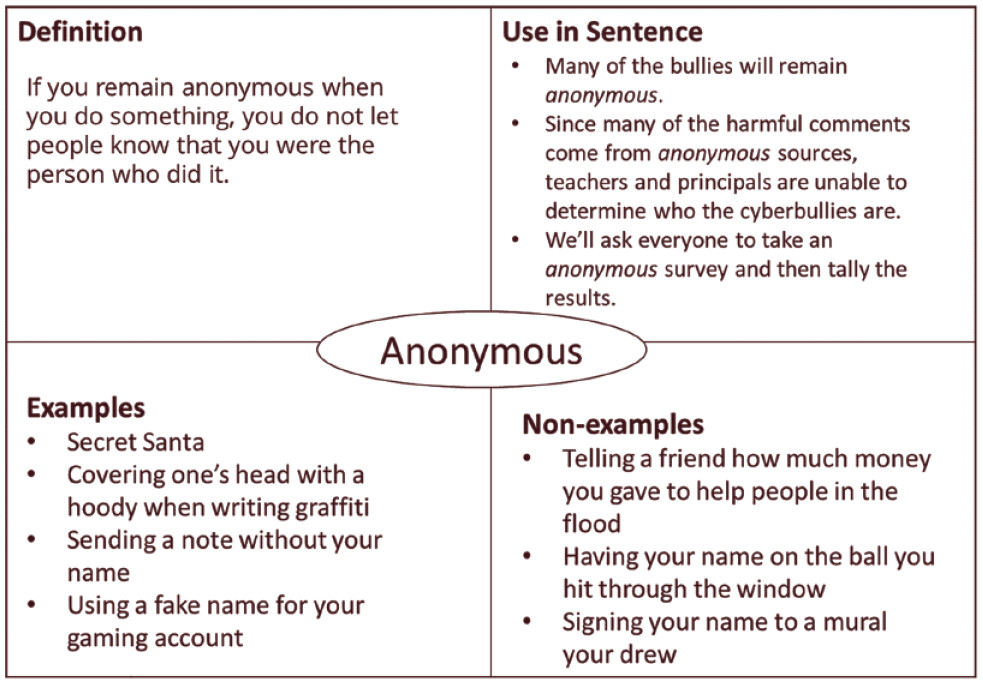
The Frayer Model includes a four-square chart with a circle in the center (see example in Figure 1). A vocabulary word is put in the circle. Each of the four squares has a heading, for example, definition, characteristics (essential characteristics/non-essential characteristics), application, image/drawing, examples, non-examples, use in sentence, facts, synonyms, antonyms. Every chart will have a definition and/or a sentence using the word. The other squares have associated concepts. This tool allows learners to gain a better understanding of difficult words through clarification and analysis.
Figure 1. Template for the Word Anonymous
The first template introduced typically includes boxes for a definition, then a picture or sentences in which the word is used, and then examples and non-examples of the word. Students must determine the definition of the concept. They can use their textbooks or a variety of resources to develop a definition that is clear, concise, and easy to understand. The teacher or clinician helps the students to determine the characteristics or attributes of this concept. Finally, the students determine what the concept is and what it is not. Students are encouraged to generate their own examples and discuss their findings with the class.
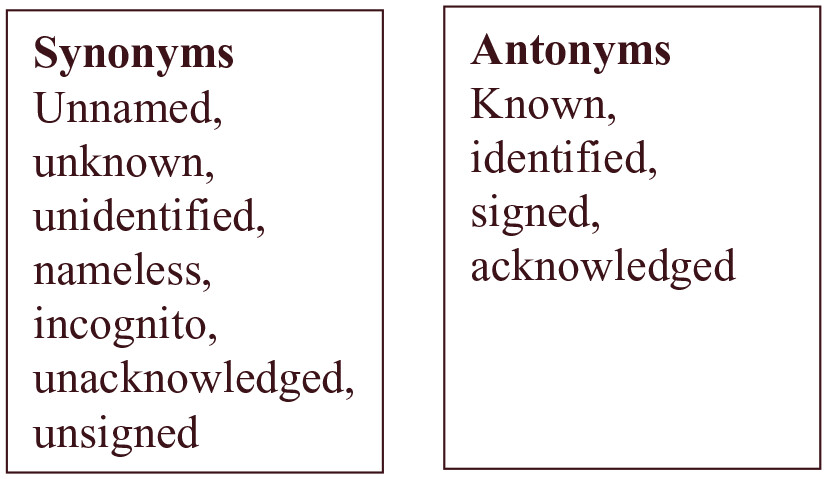
The instructor uses a think-aloud to model the process of using the framework to analyze the word and determine its meaning. Eventually, the instructor wants students to be able to complete a chart in small groups. The instructor should give a user-friendly definition of the word. The Collins Dictionary and Thesaurus provides user-friendly definitions, synonyms, antonyms, and example sentences (https://www.collinsdictionary.com/us/dictionary/english). The chart in Figure 1 is based on a lesson middle school students were doing on the topic of cyberbullying. The sentences with the word anonymous were in the text. After discussing the meaning of anonymous, the instructor asked the students to generate examples of something or someone that was anonymous and non-examples of anonymous. Students were then asked to generate their own sentences with anonymous. When students exhibit an understanding of anonymous by giving examples and non-examples and using the word appropriately in sentences, the squares for examples and non-examples can be exchanged with squares for synonyms and antonyms, for example,
The instructor can reverse the process by completing the information in the four squares and asking the students to determine the word that belongs in the middle circle (mammal). See Figure 2.
Figure 2. Template for the Word Mammal
The teacher or clinician should demonstrate how to complete the graphic organizer by talking through what they are doing and how they are coming up with the information they enter into the different sections. They should teach students how to use textbooks and other subject matter materials to generate and discuss the information for each section. As students engage in learning activities and class discussions, they can clarify and deepen their understanding of the concept or term. They can revisit their original Frayer Model and make refinements to the operational definition, characteristics, examples, and non-examples. The graphic organizers can be added to a vocabulary wall for students to refer to. Students should be encouraged to use these new words in conversation and in their writing.

Reference

Frayer D. A., Frederick W. C., Klausmeier H. G. (1969). A schema for testing the level of concept mastery [Technical Report No. 16]. University of Wisconsin.