Introduction
Anti-Black racism is not new. It is deeply embedded in institutions, policies, and practices, and shapes thinking and action. Black people have been enslaved and colonized, forcibly taken from their ancestral lands, and the lasting effects of centuries of colonization and enslavement are still being felt today. Anti-Black racism must be understood within the context of antiblackness that scholars such as Angela Davis, Ibram Kendi, Isabel Wilkerson, Michael J. Dumas, and others have written about and advocated against and other forms of oppression for years. For centuries, Black people have been subjected to violence and what
Dei (2020) calls scourges of antiblackness. While this Special Issue of the Journal of School Leadership focuses on education and schooling, the struggle of Black people for justice is in all areas and aspects of society. Antiblackness intersects with other aspects of identity. As
Audrey Lorde (1984) asserts, “There is no thing as a single-issue struggle because we do not live single-issue lives.”
Globally, anti-Black racism, xenophobia, racism, white supremacy, white nationalism, anti-Semitism, and other forms of discrimination and exclusion are on the rise. As Western societies become more diverse due to demographic shifts, there appears to be a ramping up of hate and bigotry, and ways that racism is manifesting itself. Regardless of the forms it takes, racism must be named and challenged. Socially constructed, racism is normal, and an ingrained feature of the social fabric of society which looks ordinary and natural to people in the dominant culture (
Delgado & Stefancic, 2000;
Kendi, 2019). The murder of George Floyd, an unarmed Black man in the United States has given rise to social protests globally and a collective conscience to challenge hate, white supremacy, and anti-Black racism. It is imperative that educators not only challenge this phenomenon, but also pay attention to the mechanisms of racial oppression and white supremacy. While these conditions have pushed epistemological issues and uncertainties for educators (
Fallace, 2017), there are possibilities for reflection, action, and healing as we seek to critically engage in anti-oppressive practices in order to create transformative possibilities for ourselves and others (
Kumsa et al., 2014). Understanding this embodiment is important in examining how anti-Black racism, colonialism, and white supremacy are manifested in day-to-day schooling policies and practices (
Doret & Gordon, 2018).
Antiblackness and anti-Black racism reside within institutions as well as ideologies of whiteness, white supremacy, and fear of the Black body (
Kendi, 2019). If Black students are to achieve their full potential in education systems and schools, it is important that educators examine how Black learners are impacted by systemic anti-Black racism and antiblackness, and how these practices are perpetuated (
Ohito, 2016). Research in Canada, the United States, England, and other Western countries continue to show high drop-out rates for Black students (
Goux et al., 2017;
James & Turner, 2017). This lack of success for Black students must be understood within systems of oppression instead of pathologizing of Black bodies and marginalization of communities. It is important that educators reflect on their educational philosophy and practices when it comes to the education and schooling of Black children. The tropes of antiblackness and anti-Black racism, racial hierarchy, and negative stereotypes that keep some people marginalized must be challenged. In this regard, the everyday practices of educators and ways in which their practices perpetuate anti-Black racism and antiblackness must be questioned. Black students suffer from low expectations, hyper policing of their bodies, streamed in classes below their academic abilities, harsh discipline, pathologizing of Black families and cultures (
Gillborn, 2018;
Kendi, 2019;
Mosley et al., 2020). Challenging anti-Black racism is paramount so that it does not remain at the intellectual realm, but translates into practice. When activism and advocacy translate into real change in the lives of students, educators come to see new possibilities for practice, and are held accountable for their actions.
In this article, we critically explore ways that educators (school leaders and teachers) can act on their agency—collectively and individually to challenge anti-Black racism in education and schooling. We draw on research that we have conducted in Canada and the United States with school leaders and teachers, but most importantly our embodied experiences as Black educators in K-20 education. As Black educators, we have lived the experiences of antiblackness and anti-Black racism, and posit this knowledge as valued and valuable in forming insights and delineating meaning. As
Dei (2020) argues antiblackness and anti-Black racism is about our knowledge and history and what counts as knowledge and whose history counts.
The authors of this article are two Black scholars from Canada and the United States who are faculty leaders in two large universities. Our experiences include teaching in public schools and educational programs, and working with teachers and school administrators, taught in teacher education and leadership preparation programs, lead departments and faculties of education. We are both immigrants to Canada and the United States from the Caribbean and have been involved in education and schooling where we have experienced anti-Black racism in various forms. As we look ahead at our collective futurities and possibilities, it is important that we collaborate in our communities, schools, and all spaces to bring about the change to which we aspire (i.e., challenging and disrupting the manifestations and impact of anti-Black racism in education and schooling).
The article is organized as follows: First, we examine the ways in which antiblackness and anti-Black racism are manifested in education and schooling; second, we share theoretical framing—critical race theory (CRT)—that has guided our research and thinking; Third, we highlight aspects of our research from which we have gained valuable insights on the possibilities and challenges of addressing anti-Black racism in education; and lastly, we posit a framework and actions that teachers and school leaders can employ as they challenge anti-Black racism in everyday practice. It is not enough to theorize. Theory and ideas must be connected to actions and practice espoused as praxis
Freire (2018).
Antiblackness and Anti-Black Racism
In society at large as well as institutions, Black people are subject to oppression in the form of anti-Black racism, perpetuated through antiblackness within spaces.
Dumas (2016) argues that
antiblackness does not signify a mere racial conflict that might be resolved through organized political struggle and appeals to the state and to the citizenry for redress. Instead, antiblackness marks an irreconcilability between the Black and any sense of social or cultural regard. The aim of theorizing antiblackness is not to offer solutions to racial inequality, but to come to a deeper understanding of the Black condition within a context of utter contempt for, and acceptance of violence against the Black. (p. 13)
Wilderson (2010) suggests that the question of being Black revolves around two fundamental questions: “What does it mean to suffer?” and “How does one become free of suffering?” (p. 126). As Black scholars who embrace the embodiment of Blackness, claim to the fullest of our African ancestry, walk in the spirit and light of our ancestors as descendants of the enslaved, live and work in spaces that continue to harm and traumatize Black people, we understand what it means to suffer. In this article however, we focus on ways to become free and more specifically ways for Black students to become free in the spaces that they learn. In the ontological polarity of the West, antiblackness draws its energy from the positioning of Blackness situated at the bottom of the polarity (
Kline, 2017). In many ways, Black people are positioned as having no history prior to slavery and this myth is perpetuated through pedagogy and curriculum, thereby cutting off Black students from the rich history and knowledge which they come from.
Kline (2017) argues further that antiblackness is also about power and is revealed through practices, forms, and apparatuses; and ways that “anti-Black racism have historically developed, changed, and reassembled/reterritorialized in relation to state power, national identity, philosophical discourse, biological discourse, political discourse, and so on” (p. 66).
Some scholars argue that as discourses of equity, inclusion, and diversity abound in the United States and other Western countries trying to grapple with their racist histories and current demographic shifts, there is a strain against the dark (
Busey & Coleman-King, 2020;
Sexton, 2008;
Wilderson, 2010). In this social and political contexts, Black youth, families, and communities struggle to make sense of what are widely regarded in Black cultural spaces as cases of (anti-)Black suffering and death are on the rise (
Dumas, 2016). The killing of George Floyd, Breonna Taylor, and Ahmaud Arbery in 2020 in the United States, as well as the killings of Black people in Canada and other countries is furtherance of the fear that Black people experience in these spaces. Over 400 years of injustice in the United States, Canada, and other Western countries there is a collective rage about social injustices that continue to plague society. The world has been transfixed by the unrest in the United States amid video footage of brutal clashes between the police and protesters during marches and vigils in Mr. Floyd’s memory.
Dumas (2016) argues that while most educational researchers and practitioners acknowledge and lament the killing of and violence against Black people as examples of racism or (multi)cultural insensitivity, or the enactment of white supremacy, there has been little theorizing in education on the specificity of anti-Black racism, or the broader terrain of antiblackness. Tackling antiblackness is about challenging the position of Black person as socially dead, in other words, denied humanity thus ineligible for full citizenship and regard within the polity (
Patterson, 1982).
Anti-Black racism is a form of racism that is directed against Black people and their resistance to such oppressions (
Benjamin, 2011). The legacy of anti-Black racism and the ongoing denial of Black people of their basic humanity reflects the “afterlife of slavery” that continually situates Black peoples as objects of fetish and force (
Sexton, 2010,
2015).
Dumas (2016) argues that analyses of racial(ized) discourses and policy processes in education must grapple with cultural disregard for and disgust with blackness.
Doret and Gordon (2018) suggest that the fear of Blackness is implicated in the day-to-day practices of education and schooling.
Dumas (2016) notes:
theorization of antiblackness allows one to more precisely identify and respond to racism in education discourse and in the formation and implementation of education policy…. I contend that deeply and inextricably embedded within racialized policy discourses is not merely a general and generalizable concern about disproportionality or inequality, but also, fundamentally and quite specifically, a concern with the bodies of Black people, the signification of (their) blackness, and the threat posed by the Black to the educational well-being of other students. (p. 12)
The continued fear of Black youth reveals the persistence of anti-Black racism that continues in the new millennium to plague the socio-political body (
Doret & Gordon, 2018). Anti-Black racism is not limited to particular time periods or projects. Anti-Black racism is systemic, pervasive, and productive (
Feagin, 2013). As we examine the impact of anti-Black racism
Sexton (2010) calls for the disruption of the Black/White binary and suggests that anti-Black racism is not just about White on Black racial oppression, but also includes the relationship that other groups have to Black people.
Education and schooling continues to be site of antiblackness and anti-Black racism. Black students and families are often constructed as the problem, pathologized, students bear the brunt of harsh school discipline, and families are not perceived as resourceful and knowledgeable. In the United States, some fought against integration of schools; and most recently we have witnessed the under-resourcing of schools in predominantly Black communities. In Canada, and provinces such as Ontario research continue to show that Black students are not achieving well due to systemic racism and anti-Black racism in particular (
James & Turner, 2017;
Turner, 2019). While it is important for educators to pursue equity initiatives, access programs, and other inclusion strategies, it is also critical for educators to interrogate policies that contribute to the displacement of Black educators, particularly in the United States and the destruction of school communities that affirm Black humanity (
Brown & Brown, 2020;
Tillman, 2004). Anti-Black racism continues to be pervasive, systemic, and productive in education and schooling in many countries and affect students negatively (
Feagin, 2013). As
Sonn and Greene (2006) argue, oppressive social systems negatively affect the identities of subjugated people, as well as their education and well-being.
Dumas (2016) and other scholars warn of the celebration of diversity particularly in education, despite the absence of Black bodies and Black students in the building and in higher academic tracks. If Black students are to achieve their full potential antiblackness and anti-Black racism must be fully understood and challenged.
Challenging anti-Black racism is connected to other critical theories and practices such as decolonization and decolonial education (
Absolon, 2019;
Battiste, 2013;
Lopez, 2021) social justice education (
Bell, 2007;
Hahn Tapper, 2013). and culturally responsive leadership (
Jean-Marie et al., 2009;
Khalifa et al., 2016;
Lopez, 2016). It is important that educators find synergies and convergences between critical approaches, as well as points of departure, while intentionally addressing anti-Black racism.
Theoretical Framing—Critical Race Theory
We draw on critical race theory (CRT) to support, frame, and theorize our research and thinking about race and racism in education and schooling and to inform analysis of findings from our research. We are writing this at a juncture in time in the United States when some national leaders and policymakers feel threatened by, and are calling for the banning of CRT in public education. CRT is a race-conscious approach to examining inequities that impact people of color, supports a narrative approach, centralizes voices, experiences, and perspectives of racialized people, and uses a race-conscious approach to assess social, political, economic and legal norms, systems, institutions and practices (
Ladson-Billings & Tate, 1995). There are many ways of thinking about CRT as a framework for analyzing our experiences as Black educators. CRT recognizes race as a social construct constantly shaped by political forces and provides a framework through which racial subjugation can be named and challenged. CRT grew out of the legal profession and defines ways in which knowledge is produced, offers a framework by which systemic racism can be challenged, highlighting ways racism currently operates above and beyond any overly racist expressions (
Crenshaw et al., 1995).
Delgado and Stefancic (2000) posit that:
Critical race theory begins with a number of basic insights. One is that racism is normal, not aberrant, in American society [and many would argue, many societies of the West as well as emerging economies]. Because racism is an ingrained feature of our landscape, it looks ordinary and natural to persons in the culture. Formal notions of equal opportunity—rules and laws that insist on treating Blacks and Whites alike, can thus remedy only the more extreme and shocking forms of injustice, the ones that do stand out. It can do little about the business-as-usual forms of racism that people of color confront everyday and that account for much misery, alienation, and despair (p. xvi).
CRT acknowledges that society is not race-neutral but structured in ways that directly and indirectly sustain white supremacy and perpetuate the exclusion of, disadvantage and exploitation of people of African-descent and their communities. Critical race theorists argue that the majority of racism remains hidden beneath a veneer of normality and it is only the more crude and obvious forms of racism that are seen as problematic by most people (
Gillborn, 2015). CRT is not a one-dimensional approach to the issue of race, but recognizes that oppressed people can experience oppression through various aspects of their identities. “For all of its emphasis on the central role of racism in shaping contemporary society, many CRT scholars are keen to explore how raced inequities are shaped by processes that also reflect, and are influenced by, other dimensions of identity and social structure” (
Gillborn, 2015, p. 278). As the body of literature on CRT contends, inequalities and inequities by race and social class were created and maintained through institutionalized structures. As such, dominant narrative about the inherent inferiority of people of color and the normative superiority of White people (
Dixson & Rousseau Anderson, 2018) continue to permeate all aspect of society.
Methodological Approaches
As researchers, we conducted research with school leaders and teachers in Canada and the United States. In Canada, as part of two larger studies conducted with school leaders in public education in the Greater Toronto examining experiences of school leaders (
Lopez, 2016;
Lopez, 2021) approach to equity and diversity in education and schooling, a total of twenty-seven school leaders (secondary and elementary) were interviewed utilizing purposeful and convenient sampling. Both studies employed research methodology. Data were collected through narrative inquiry (
Clandinin & Connelly, 2000) and semi-structured interviews (
Corbin & Strauss, 2008). Participants participated in semi-structured interviews, with open-ended questions and provided space to deeply and critically reflect on their experiences as well as possibilities to improve practice. Qualitative researcher allows participants to make sense of their lived experiences and researchers to make meaning of the data (
Denzin & Lincoln, 2011). A stated purpose of both research was to gain insights that would support the professional development and capacity building of school leaders as they respond to increasing diversity in schools and challenge the continued marginalization and oppression of some students. Findings from both research provided valuable knowledge base on the praxis and actions needed to disrupt systemic racism and forms of oppression, and ways school leaders can be supported in this effort. Similar to research in the extant literature discussing issues of race was sometimes traumatic for Black school leaders, while there was avoidance for most White school leaders.
In the United States, as part of a longitudinal research project on cultural competence (
Jean-Marie et al., 2016) in 45 middle and high schools, surveys of students, parents and teachers, documents analysis, and interviews with a purposeful sampling of 14 Black and White school leaders were conducted. A corollary purpose was to draw on the results to support professional development to increase principals’ shared understanding of how to deal with issues of equity and challenge inequities in the education system. To the latter, identified as early adopters of equity-focused practices from the low/medium/high categories of middle and high schools, principals were interviewed using a phenomenological research design (
Merriam, 2009). The interview protocol focused on exploring leadership capacity, social context of cultural competence, and the challenges and nuances of developing an equity responsive climate. The qualitative findings reveal included the notion that the development of cultural competence is a lifelong process premised on a commitment to critical reflection and continuously seeking greater cultural awareness; persistence of school leaders to nurture cultural inclusiveness within the schools they are called to serve, and dismantling practices and policies that perpetuate marginalization of Black, Indigenous and People of Color (BIPOC).
Framework for Action
As anti-Black racism continues to be a troubling phenomenon in education and schooling, in this article, we argue that practices of teachers and school leaders must change in order for Black students to achieve their full potential.
Dumas (2016) suggests that:
It is important for educators to acknowledge that antiblackness infects educators’ work in schools, and serves as a form of (everyday) violence against Black children and their families. This acknowledgment is different from a broad stance against intolerance or racism, or an admission of the existence of White privilege. Teachers, administrators, and district leaders should create opportunities to engage in honest and very specific conversations about Black bodies, blackness, and Black historical memories in and of the school and local community (p. 17).
Addressing anti-Black racism in schools cannot be an “add-on” to “teachers” and school leaders’ practices, but must be embedded in ongoing practice. Educators must draw on their agency to unlearn, learn, relearn and reframe. Drawing on the narratives and stories of Black and White school leaders, and our lived experiences as Black professors of educational leadership, teacher education, and former public school teacher and administrator, we offer the following framework as a possibility for educators—administrators and teachers to challenge anti-Black racism.
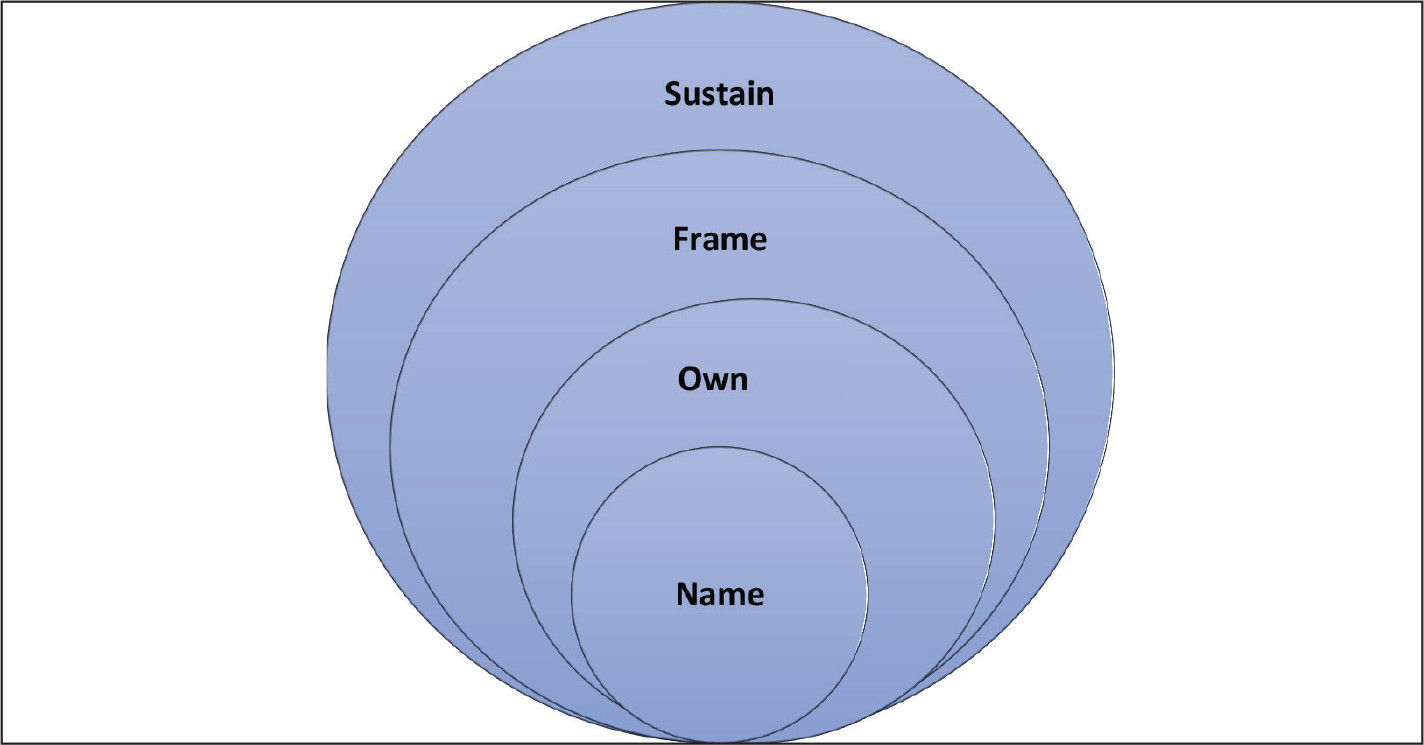
The key tenets of the framework are
Name, Own, Frame, and
Sustain (NOFS). We believe that issues must be named, understood and acknowledged before actions can be taken to change. See
Figure 1 - Framework to Address Anti-Black Racism in Schools. Educators can utilize this framework individually in their own sphere of influence, or with others collectively. System change is achieved through collective efforts (
Hopkins, 2008). We suggest the first step that teachers and school leaders who are interested in challenging injustices and anti-Black racism can actively engage in is to
Name anti-Black racism as a critical issue in education and schooling. Since the social uprising to the death of George Floyd, Breonna Taylor, and Ahmaud Arbery, anti-Black racism has gained prominence in the discourse and many have come to realize that the equity, diversity, and inclusion efforts have not adequately addressed the challenges faced by Black students in schools. If the issue is not named, it cannot be addressed. Research show that teachers and school leaders are predominantly White while the student population is increasing in diversity (
Clayton, 2011;
Evans, 2007;
Normore et al., 2007). It is also well documented in the research that many White folks are uncomfortable talking about race (
Jean-Marie & Mansfield, 2013;
Singleton, 2014). This is the reason why anti-Black racism must be named and not subsumed in equity and inclusion discourses. Diversity, equity and inclusion efforts are important; however, the marginalization of Black students through antiblackness and anti-Black racism cannot be left up to diversity, equity, and inclusion (DEI) efforts alone.
In Naming anti-Black racism, practitioners must come to understand the conceptualization of antiblackness and anti-Black racism and how these are manifested in everyday schooling practices. Educators must examine their positionality, engage in self-reflection, and come to understand what they need to learn and unlearn. It is not the responsibility of Black people to teach others how to engage in anti-oppression education, while at the same time experiencing the pain, trauma, and suffering of antiblackness and anti-Black racism.
Second, it is critical to own the issue (i.e., denial and lack of understanding about antiblackness and Anti-Black racism). We argue that by Owning the issue, educators place themselves in a position to examine not only their silence and complicity, but that of others. Owning it means claiming responsibly for agency and acting upon that agency individually and with others. Once educators own the issue they begin to think about a) how they are complicit, and b) possible actions. Through owning, change in practice can be achieved. For example, in order for harsh discipline given to Black students by way of suspensions and other forms of punishment to be stopped teachers and school administrators must own that there is a problem. The harm done to Black children and families must be named and educators take responsibility and act.
Thirdly by
Framing, educators are intentional and purposeful in their actions. They begin to look for spaces in their work to actively challenge anti-Black racism. This includes the school milieu, curriculum, pedagogy, assessment and evaluation, school discipline, their approach when dealing with members of the Black community and so forth. Whiteness must be decentered in curriculum and pedagogy and education system as a whole (
Ohito, 2016). This requires commitment, resources, and trust. Trust has to be built up with Black communities (
Warren, 2005). Space must be created for Black students to talk about how they feel and their experiences of trauma in the school setting; educators must be willing to listen, and say “I see and I hear you.” There has to be intentionality in dismantling practices and policies that are racist in the school, in the district or in the school board. There must be intentionality to reframe and enact policies to address anti-Black racism, and invite Black students and communities to actively participate in the process. Framing requires moving beyond performative actions that to not lead to lasting and sustainable change in the lives and experiences of students.
Black students and parents have called for language such as “disadvantaged,” “at-risk,” “underprivileged” that perpetuate deficit notions and stereotypes of Black students and their families to be removed from discourse in texts and schools. Discourse about Black students should be affirming, and speak to their knowledge and excellence. Pedagogy and curriculum must affirm their history and the greatness that existed on the continent of Africa before the colonizers arrived and enslaved its people. When anti-Black racism is Named, Owned, and Framed an action plan must be developed to execute and Sustain. Actions to challenge anti-Black racism in schools cannot remain with a willing few committed staff. Lasting change and success require systemic and whole system change from the classrooms to the school board or school district. Evaluation and accountability must be built into practice. Without accountability, initiatives become random acts and are not sustainable. When educators know that they are being held accountable, actions will be more intentional and thoughtful.
Finally, the work of addressing anti-Black racism must be
Sustained to have the desired impact. This requires collective effort as no one person can undo four hundred years of oppression by themselves in a semester or a term. While dislodging anti-Black racism from education and schooling is urgent, it is still a journey—longer for some, shorter for others. On this journey it is not enough to prove injustice, people must see how they themselves are being unjust (
Soltani, 2017). It is important to have critical friends inside and outside of education. One of the strategies that we posit to support restoration of capacity in educators (
Lopez, 2021) is collaborative mentorship (CM) (
Lopez, 2013). Collaborative mentorship involves working with others in the area or who understands the work in order to deepen understanding or to co-labour about difficult issues. Collaborative mentorship can be useful to educators challenging anti-Black racism seeking to embed and sustain themselves and their work. It involves developing critical understanding of anti-Black racism, finding space and time to dialog, sharing resources with colleagues and building own inventory of resources, ongoing reflection and agency, and engaging with the tensions involved with critical education practice. Collaborative mentorship disrupts the notion of expert and protégé, and instead invite people to co-labor together to solve problems. Space is created for people be become vulnerable, but not traumatized as they wrestle with these important issues. It is grounded in the notion that mentoring for diversity and equity is a dialogical mentoring relationship between mentor and mentee that creates space to work through tensions and digresses from conventional mentoring relationships that center protégé and expert. Collaborative mentorship involves, sharing back and forth of ideas, opinions, and feelings between mentee and mentor. Acknowledging the emotional and professional risks involved in this kind of work is important for educators to sustain their efforts in pursuing diversity and equity in their practice. The journey of equitable education is fraught with challenges that may entice some educators to give up in the face of what may seem to be insurmountable odds (
Solomon & Levine-Rasky, 2003).
Educators are encouraged to acknowledge, embrace the tensions involved in the work, engage in courageous conversations, and thoughtful reflection. Sustaining the journey involves learning how to deal with resistance and collaborate with allies and co-conspirators. To say that you are anti-racist and to actually do the work that is needed will require people to make sacrifices . . . tokenistic gestures will not bring about systemic change (
Soltani, 2017).
Name, Recognize Own, Frame, and
Sustain (NOFS) is intended to be an iterative and generative process. We recognize that educators in schools, school districts, and school board might be at different levels of understanding and knowledge. There is space in the NOFS framework for educators to make sense of their own context and devise actions that will enhance their unique conditions and that of their students and colleagues. While this article focuses on leaders in schools, we know that anti-Black racism is not limited to students and is experienced by Black faculty and staff at all levels of education. It is the hope that this framework assists all those in education and schooling embed and sustain practices and policies that challenge anti-Black racism.
Conclusion
Systemic inequities continue to permeate our society through the veil of antiblackness. In society, Black people are over-policed, over-surveilled, and under-protected in communities of color. This too occurs globally. Since last summer, the world has been transfixed by the unrest in the United States and globally amid video footage of brutal clashes between the police and protesters during marches and vigils in George Floyd’ and Breaonna Taylor’s memory. In solidarity, the global demonstrations were inspired by the demonstrations in the United States to call for an end to racism and police brutality in their own countries. Tens of thousands turned out in Australia, Kenya, Britain, France, Brazil, Germany, and other nations in support of U.S. protests against the death of George Floyd, while denouncing racism in their own countries.
As we were transfixed of the depictions of antiblackness events last summer, is this the tipping point of an awakening to ensure justice and equality prevail for all? As educators and leaders, do we have the vision and the will to deeply engage about access, equity, and social justice in our teaching/curriculum, research, service engagement, and community work. The quintessential threat to our democracy such as the elevation of white supremacy must be resisted. What history reveals about past and present social movements is that the ideology of white supremacy is at worst comfortable, and at best familiar to many well-meaning people. There is an urgency to advance equity and justice in education, policy, and public debate, critical for systemic change. As a global nation of people, we represent diverse contexts, racially and ethnically, and other demarcations. Addressing antiblackness and anti-Black racism centers on creating deep expertise about eradicating inequities and to secure the constant renewal of advancing freedom and human rights worldwide. The resulting public reckoning and social unrest not only in the United States but globally urgently calls for us to examine oppressive structures—in our classrooms, curricula, systems, policies, and even in our research and practice. Integrating anti-racist pedagogy in justice work is paramount. This shift is premised on making racialized power relations explicit while also attending to deconstructing the social construction of race, and analyzing interlocking systems of oppression that serve to marginalize some groups while privileging others.
The NOSF framework offers how educators and school leaders can engage in anti-racist education—examining our own knowledge base, unpacking where bias may lie, revising course materials and practices, and being both vulnerable and courageous enough to have tough conversations in our classrooms. Advancing equity and justice in education, policy, and the public debate is critical for systemic change. The resulting public reckoning and social unrest not only in the United States but globally urgently calls for examining oppressive structures—in our classrooms, curricula, systems, policies, and in research and practice.
In our continued research on social justice, our focus is on integrating anti-racist pedagogy in justice work. This shift is premised on making racialized power relations explicit while also attending to deconstructing the social construction of race, and analyzing interlocking systems of oppression that serve to marginalize some groups while privileging others.