




Integrating artificial intelligence in supporting students with disabilities in higher education: An integrative review
Abstract
Introduction
Inclusive education and artificial intelligence
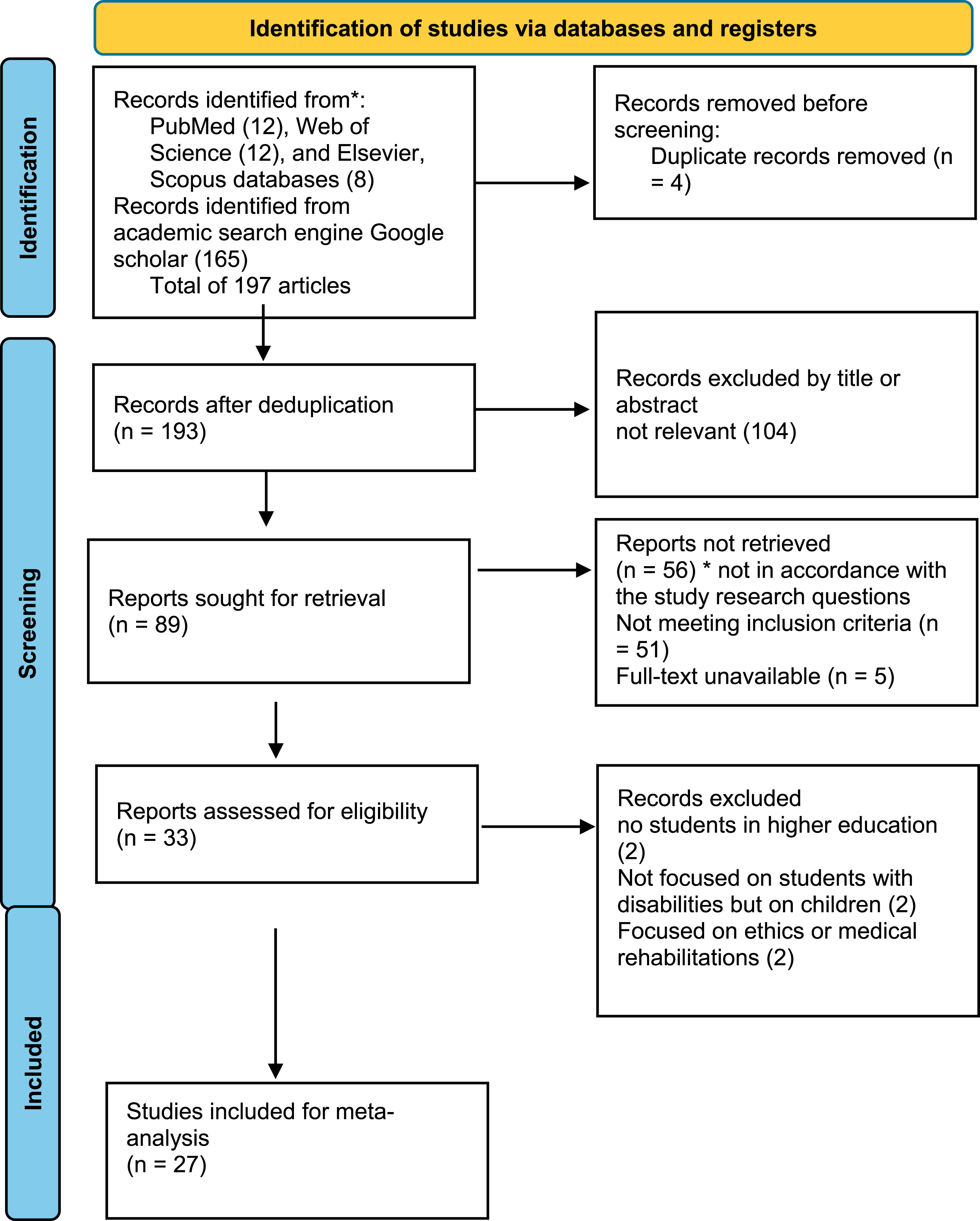
Methods and procedures
(“AI-powered assistive technology” OR “artificial intelligence”) AND (“disability” OR “students with disabilities” OR “special needs”) AND (“higher education” OR “university” OR “college”) AND (“accessibility” OR “academic accessibility” OR “inclusion”) AND (“academic performance” OR “learning outcomes” OR “student achievement”) AND (“inclusivity” OR “inclusive education” OR “inclusive learning”) AND (“learning tools” OR “adaptive learning tools” OR “assistive technology tools”) AND (“speech-to-text” OR “screen readers” OR “text-to-speech” OR “assistive devices”) AND (“adaptive learning systems” OR “personalized learning tools”).
| Inclusion criteria: |
| Peer-reviewed journal articles, conference papers, reports, or dissertations |
| Published between 2020 and 2024 |
| Written in English |
| Examined AI-powered assistive technologies (e.g., speech recognition, AI screen readers, |
| predictive text, adaptive learning platforms) |
| Targeted students with physical, sensory, cognitive, or learning disabilities in higher education |
| Exclusion criteria: |
| They focused on K-12 education or non-higher education settings |
| They assessed traditional (non-AI) assistive technologies |
| They lacked sufficient methodological details on AI tools and outcomes |
Data extraction and analysis
| Study | Study Type | AI Tool | Disability Type | Key Findings |
|---|---|---|---|---|
| Parashar et al., 2023 | Conceptual review | AI animation tools, AI-powered tutors, and AI-powered grading software for personalized learning, feedback, and assessment. | Diverse linguistic needs of students | The study highlights that AI technologies, particularly animation tools, can improve accessibility and individualize instruction, helping students with disabilities learn at their own pace and receive personalized feedback, thus improving their educational outcomes. |
| Hofman et al., 2020 | Comparative analysis | Computerized adaptive learning (CAL) | Students with diverse learning needs. | The study concludes that the Urnings algorithm overcomes the drawbacks of the ERS by providing known standard errors, allowing statistical inference, and addressing issues such as score variance inflation, thus providing a more reliable approach to tracking student progress in adaptive learning systems. |
| Panjwani-Charani and Zhai, 2023 | Systematic Literature Review | BESPECIAL, Elo Rating System, “Sammy” Chatbot, LEAF Learning Environment Framework, SAMCares | Students with Specific Learning Disorders | AI-driven adaptive learning algorithm dynamically adjusts difficulty levels based on student performance. This system benefits students with general learning disabilities by ensuring they engage with educational content which enhances retention and motivation. |
| Ristad et al., 2024 | Qualitative exploration | The Collaboration Forum Workshops | Students of disabilities | The study finds that professionals often lack the knowledge and cooperation needed to include students with disabilities in higher education, with unclear responsibilities and ignorance hindering effective decision-making and leading to avoidance of inclusive actions. |
| Hadi Mogavi et al., 2021 | Qualitative study (content analysis of social media) | ChatGPT | Students with diverse learning needs | The study finds a dichotomy of opinions about ChatGPT: some users see it as a tool to increase students' self-efficacy and motivation to learn, while others express concerns about potential over-dependence, superficial learning and the erosion of critical thinking skills. |
| Song and Xie, 2024 | Literature review | Assistive technology | Students with disabilities | Students with disabilities face significant challenges in accessing complex, scholarly non-text content, even when alternative text formats are provided. The most persistent barrier identified is the lack of understandability, which, despite being a core principle of accessibility, remains largely unaddressed in many academic and policy contexts. |
| Nacheva and Czaplewski, 2024 | Comparative analysis | Intelligent Tutoring Systems, AI-powered visual tools | Students with disabilities | Studies indicate ITS improve engagement, knowledge retention, and skill acquisition |
| Addy et al., 2023 | Review | Generative AI (e.g., ChatGPT, Bard, Claude, Copilot); AI-Powered Writing Assistants | Multi-language learners, students from marginalized linguistic communities, students with disabilities, and low-income students | These tools help to improve written communication by suggesting grammar, restructuring sentences and generating content, thus promoting equality in academic participation. |
| Mulaudzi and Hamilton, 2024 | Qualitative explanatory case study | AI tools for personalized learning, including AI-assisted teaching methods | Not explicitly stated, but relevant to students requiring personalized learning, including those with learning disabilities | Successful adoption of AI in higher education depends on user acceptance, perceived usefulness and ease of use. Both students and faculty need training to balance AI tools with traditional teaching. Institutions need to develop ethical AI policies and implement AI literacy programs. |
| Faruqui et al., 2024 | Applied research with controlled trials | AI-powered chatbot and virtual assistant (SAMCares) using Large Language Models (LLaMa-2 70B) and Retriever-Augmented Generation (RAG) | Students with learning disabilities, cognitive impairments, and students needing personalized learning support | SAMCares provides real-time, contextual and adaptive learning support by interacting in a chat-like environment and retrieving course-specific knowledge. The system improves accessibility by allowing students to upload additional study materials for personalized support. Its effectiveness will be tested through controlled trials and feedback. |
| Yunusov et al., 2024 | Mixed methodology (quantitative and qualitative) | AI-driven learning analytics, Adaptive Learning, Predictive Analytics, and Automated Assessment | Multiple Disabilities | AI is improving personalized education, adaptive learning and automated assessment. However, challenges such as privacy, ethical concerns and the digital divide need to be addressed to ensure inclusiveness and accessibility in higher education. |
| Zhang and Zhang, 2024 | Quantitative research study | AI for teaching support, classroom management, personalized learning, and digital skill enhancement | College students | AI improves classroom management, enhances digital literacy, creates inclusive learning environments, personalizes teaching methods and strengthens teacher-student relationships. However, challenges such as digital literacy gaps and effective integration of AI into teacher training need to be addressed. |
| Abid et al., 2024 | Quantitative research study | Various AI technologies | The research does not specifically focus on types of disabilities but rather investigates the broader category of students with disabilities. | Encourage AI developers to consider accessibility and transition to employment. |
| Toyokawa et al., 2023 | Case study | LEAF (LA-enhanced AR learning) learning analytics system | Students with ADHD | The study identified specific learning behaviors from students' learning logs and highlighted both the challenges and potential of integrating AI into inclusive education, emphasizing the importance of human involvement in guiding educational practice. |
| Zingoni et al., 2021 | Usability study | BESPECIAL | Students with dyslexia | Preliminary results from around 700 dyslexic students reveal the key challenges they face, which will inform the final implementation of BESPECIAL, an AI and VR-based platform designed to alleviate these difficulties. |
| Gupta and Chen, 2022 | Experimental investigation | Sammy chatbot | Disadvantaged students | The study found that chatbots offer opportunities to support students in an accessible, interactive and confidential way, particularly benefiting those who are disadvantaged and have different learning needs. |
| Ghulam et al., 2024 | Qualitative (faculty perception study) | Machine Learning and Natural Language Processing to develop adaptive learning environments and enhance educational tasks | The study does not specifically address any disability types but focuses on faculty perception. | The study finds that AI can enhance personalized learning, automate administrative tasks and create interactive learning experiences. It also highlights concerns about data confidentiality and ethical issues and stresses the importance of balancing technological innovation with human principles such as equity and inclusivity in education. |
| Lister et al., 2021 | Case study (participatory research) | Virtual assistant | Students with disabilities | The study highlights the importance of participatory design in creating AI solutions that address the specific needs and concerns of disabled students, with the aim of reducing barriers and improving equity in education. |
| Xiao et al., 2021 | Design-based research | Artificial intelligence is used to create personalized training models, predict student development, and analyze student information for personalized education | The study does not specifically address any disability types but focuses on personalized education for a diverse range of students, which could be applied to students with disabilities as part of individualized learning approaches | The study finds that AI can enhance personalized learning, automate administrative tasks and create interactive learning experiences. It also highlights concerns about data confidentiality and ethical issues and stresses the importance of balancing technological innovation with human principles such as equity and inclusivity in education. |
| Šumak et al., 2024 | Analytical review | Intelligent tutoring systems, chatbots, robotics, learning analytics dashboards, adaptive learning systems, and automated assessments | Students with various disabilities | The study identifies both the challenges and benefits associated with AI-based educational tools, emphasizing their potential to enhance inclusive education by supporting diverse learners. |
| Pierrès et al., 2024 | Systematic literature review | AI educational technologies (EdTech) such as AI tools that provide personalized learning and feedback | Students with disabilities | The review identifies a lack of ethical consideration in AI EdTech for students with disabilities and highlights eight potential risks, concluding that ethical reflection, greater involvement of disabled people in AI development and careful adoption are needed to mitigate these risks. |
| Halkiopoulos and Gkintoni, 2024 | Systematic literature review | AI-powered tools designed for Personalized Learning (PL) and Adaptive Assessment (AA) | Students with diverse learning needs | The review highlights that AI can improve student performance, engagement and motivation, but also points to challenges such as bias and discrimination. It emphasizes the need for empirical validation, bias reduction in algorithms, and careful consideration of ethical issues such as privacy in AI-based education systems. |
| Babo et al., 2024 | Quantitative research study | Generative Artificial Intelligence (GAI) tools used for personalized learning, content creation, and individualized assessment | Students with disabilities | The study finds that students value the personalized learning, efficient content creation and individualized assessment offered by GAI, but are concerned about ethical considerations, lack of control over content, over-reliance on AI and reduced interpersonal engagement. Students agree that GAI is likely to disrupt the educational process in higher education. |
| Ahmad et al., 2024 | Exploratory investigation | Augmented Reality, Big Data, and Virtual Reality | The study addresses students with diverse learning needs, including differences in learning styles, talents, interests, and cultural backgrounds, without specifying a particular disability type. | The study highlights that the integration of Industry 4.0 technologies can provide personalized learning experiences that cater to diverse student profiles, promoting inclusivity and equity in education by adapting to the diverse needs of students. |
| Denisova and Lekhanova, 2018 | Experience-based case study | The study does not specifically focus on AI tools but discusses a support algorithm used to coordinate activities for disabled students in higher education. | Students with disabilities | The study highlights the effectiveness of a coordinated support system that facilitates career guidance, education and employment for students with disabilities, and emphasizes the importance of creating tailored conditions to enhance their success and integration into society. |
| Chang et al., 2023 | Conceptual paper | AI Chatbots such as ChatGPT | Students with disabilities | The study proposes three key pedagogical principles for the use of AI chatbots in education: goal setting (prompting), self-assessment and feedback, and personalization. It argues for the role of AI in promoting student self-regulation through data-driven learning analytics, with the aim of improving SRL and the ethical use of AI tools in education. |
| Alshahrani et al., 2024 | Semi-systematic literature review | Application of AI tools within the higher education | The review does not specifically address a particular disability type | The review highlights the lack of empirical evaluation of the added value of AI and institutional readiness and emphasizes the need for a socio-technical approach that balances the benefits and social considerations of AI in education. |
Thematic frequency
AI technology used
Results
Results
| AI application | Primary functionality | Impact on accessibility, personalization, or integration |
|---|---|---|
| Text-to-Speech (TTS) Tools | Converts written text into spoken audio | Enhances access for students with visual or print disabilities (Accessibility) |
| Speech Recognition | Converts speech into written text | Assists students with motor disabilities or dyslexia in note-taking (Accessibility) |
| Chatbots & Virtual Assistants | Provides on-demand academic support and information | Supports real-time help and information access (Institutional Integration) |
| AI-Powered Learning Analytics | Monitors engagement and performance trends | Enables personalized feedback and early intervention (Personalized Learning) |
| Adaptive Learning Platforms | Adjusts learning content to student pace and needs | Offers differentiated instruction for diverse learners (Personalized Learning) |
| Computer Vision-Based Tools | Enables gesture or gaze-based interaction | Supports non-verbal communication or control (Accessibility) |
| AI Proctoring Systems | Monitors student behaviour during exams | Raises equity concerns; needs careful adaptation for mental health conditions |
| Natural Language Processing (NLP) | Analyses written content for tone, clarity, comprehension | Helps design better alternative texts and summaries (Accessibility) |
Discussion
Personalized learning
Benefits of AI-driven assistive technology in supporting students with disabilities
| AI tool | Function | Example implementation | Most effective for disabilities | Impacts/Benefits | Limitations | Studies |
|---|---|---|---|---|---|---|
| Speech-to-Text Software | Converts spoken language to text | AI-powered note-taking (e.g., Otter.ai, Google Live Transcribe) | Hearing impairments, physical disabilities | Supports students with hearing impairments by providing real-time lecture transcription | Struggles with background noise & accents | Neha et al., 2024 |
| Screen Readers | Reads text aloud for visually impaired users | JAWS, NVDA, VoiceOver | Visual impairments, dyslexia | Enhances accessibility for students with low vision or blindness | Limited interpretation of complex layouts | Vistorte et al., 2024 |
| AI-Driven Assessment Tools | Automated grading, adaptive feedback | AI-based essay scoring & plagiarism detection | All disabilities | Reduces grading bias and provides personalized feedback | Potential bias in grading creativity | Yunusov et al., 2024 |
| Computerized adaptive learning: Elo Rating System | Adjusts difficulty levels dynamically based on student performance, ensuring a personalized learning experience. | AI-driven adaptive learning platforms in higher education that modify content in real-time according to learner progress. | Learning disabilities (e.g., dyslexia, ADHD), cognitive impairments, students with varied learning paces, and neurodivergent learners | Provides personalized learning paths based on individual performance, enhancing engagement and effectiveness. | May not account for emotional or motivational factors in learning; effectiveness depends on the quality of the AI model and dataset diversity | Hofman et al., 2020 |
| Intelligent Tutoring Systems and AI-powered virtual tutors, as well as AI-driven chatbots and virtual assistants | Personalized learning assistance | Chatbot tutors (e.g., Sammy, Duolingo AI) | Cognitive disabilities, ADHD | Serve as 24/7 tutors answering questions and providing resources. Offers immediate help and encourages social interaction without revealing personal identities. Chatbots can provide additional materials like video tutorials, images, or audio instructions. | Can lack emotional understanding | Nacheva and Czaplewski, 2024; Deng and Lin, 2023; Gupta and Chen, 2022; Hadi Mogavi et al., 2024; Rane, 2023; Tlili et al., 2023 |
| SAMCares t | AI-powered adaptive learning hub that personalizes educational experiences based on cognitive and emotional needs. | Integrates AI-driven analytics to assess learning patterns and provide tailored educational support. | All disabilities | This tool can address and adapt to the varied educational needs of students, reflecting our commitment to enhancing the quality and accessibility of learning experiences in higher education | Requires continuous AI training and refinement to ensure accurate personalized support; potential data privacy concerns | Faruqui et al., 2024 |
| LEAF | Learning environment framework that provides e-learning tools and analytics. | Includes BookRoll, a digital learning material browsing system, and LogPalette, a group of learning analytics (LA) dashboard modules that analyze and visualize learning behavior. | All disabilities | LEAF is a learning environment framework that includes BookRoll, an e-learning material browsing system that allows learners to view digital learning materials anytime and anywhere, and a group of LA dashboard modules (LogPalette) that analyze and visualize the logs learned using BookRoll. | Effectiveness depends on student engagement with the platform; requires training for optimal use | Toyokawa et al., 2023 |
| BESPECIAL | Machine learning-based classification model to assist students with dyslexia. | Provides personalized tools and strategies to enhance learning accessibility for students with dyslexia in higher education. | Students with Specific Learning Disorders | A machine learning-based classification model to support university students with dyslexia with personalized tools and strategies | May not fully accommodate variations in dyslexia severity; AI-based classifications require regular accuracy validation | Zingoni et al., 2024 |
| “Sammy” | AI chatbot designed as an intelligent and inclusive tutor. | Experimental chatbot platform that assists students by providing academic support and guidance | All disabilities | It is a chatbot, an experimental platform to investigate the design opportunities of using chatbots as an intelligent and inclusive tutor | Limited to pre-programmed responses; may struggle with complex queries or nuanced learning needs | Gupta and Chen, 2022 |
Challenges in adopting AI-driven assistive technology to support students with disabilities
Best practices
Teacher training and AI literacy
Ethical AI design
User-centered development
Ethical AI solutions
Limitations
Conclusions
Declaration of conflicting interests
Funding
ORCID iDs
Data availability statement
References
Cite
Cite
Cite
Download to reference manager
If you have citation software installed, you can download citation data to the citation manager of your choice
Information, rights and permissions
Information
Published In

Keywords
Rights and permissions

Data availability statement
Article versions
Authors
Metrics and citations
Metrics
Publication usage*
Total views and downloads: 5355
*Publication usage tracking started in December 2016
Publications citing this one
Receive email alerts when this publication is cited
Web of Science: 4 view articles Opens in new tab
Crossref: 3
- Beyond the algorithm: unpacking the hidden labour and professional expertise in ‘automated’ special education technologies
- Artificial Intelligence Integration in Radiation Therapy Education: A Multi‐Modal Approach
- Reframing AI governance in education: insights from the social model of disability
Figures and tables
Figures & Media
Tables
View Options
View options
PDF/EPUB
View PDF/EPUBAccess options
If you have access to journal content via a personal subscription, university, library, employer or society, select from the options below:
I am signed in as:
View my profileSign out

I can access personal subscriptions, purchases, paired institutional access and free tools such as favourite journals, email alerts and saved searches.
loading institutional access options
AAATE members can access this journal content using society membership credentials.
AAATE members can access this journal content using society membership credentials.
Alternatively, view purchase options below:
Purchase 24 hour online access to view and download content.
Access journal content via a DeepDyve subscription or find out more about this option.
