Intended for healthcare professionals
Free access
Editorial
First published online September 17, 2024

Bypassing Prescribers and Pharmacists: Online Purchasing of Semaglutide and Tirzepatide “For Research Purposes”

Abstract

Unscrupulous manufacturers provide consumers with ways to circumvent access controls by purchasing drug products outside the legitimate prescription drug supply chain. Manufacturers are selling vials containing semaglutide and tirzepatide to consumers without a prescription for “research purposes only” and/or “not for human consumption,” but frequently without the supplies and knowledge they would need to dissolve the active ingredient, draw it up into a syringe, and inject it into the body. Avoiding prescribers allows consumer access to products where the risk may outweigh the benefits and quality standards may not be met. It also makes it difficult to prevent drug interactions or perform adequate patient monitoring and follow-up.

Legitimate Semaglutide and Tirzepatide Products Are Scarce and Expensive

Semaglutide is a glucagon-like peptide-1 (GLP-1) agonist while tirzepatide is both a GLP-1 and gastric inhibitory polypeptide (GIP) agonist.1,2 The United States Food and Drug Administration (FDA) approved semaglutide and tirzepatide for weight loss and hemoglobin A1c reduction.1,2 They might also improve other obesity-related diseases such as cardiovascular disease, obstructive sleep apnea,3 infertility,4 and nonalcoholic fatty liver disease.1,2,5 Demand for these prescription products has outpaced supply, resulting in shortages, and the price point of ~$1000 per month6 has prevented many patients who could benefit from being able to afford the medication.
When an FDA-approved drug product is in shortage or patients require a particular dose or formulation unavailable commercially, compounding pharmacies can help fill that market gap.7 Patients need a valid prescription, and compounding pharmacies must ensure good manufacturing practices for their products. However, when searching online for compounding pharmacies, consumers are coming across “peptide” sellers in their searches and subsequently in their social media feed. In essence, the peptide sellers’ websites state that the products are either “not for human consumption” or “for research purposes only,” circumventing regulations protecting consumers. These tactics follow other manufacturers that have pierced the vulnerable medication supply chain, such as including undisclosed prescription drugs in dietary supplements and selling synthetic cannabinoids as “bath salts” (even though the sellers and buyers know the real purpose is to achieve a stimulant high not to put in in bathwater).8,9
In this editorial, we focus on manufacturers that are using one of these legal loopholes to market and sell medications such as “semaglutide” and “tirzepatide” directly to consumers without a prescription, the clinical implications of circumventing the legitimate drug market, and how health professionals can protect their patients through direct and indirect action.

Our Assessment of Websites Online That Sell Semaglutide or Tirzepatide Products
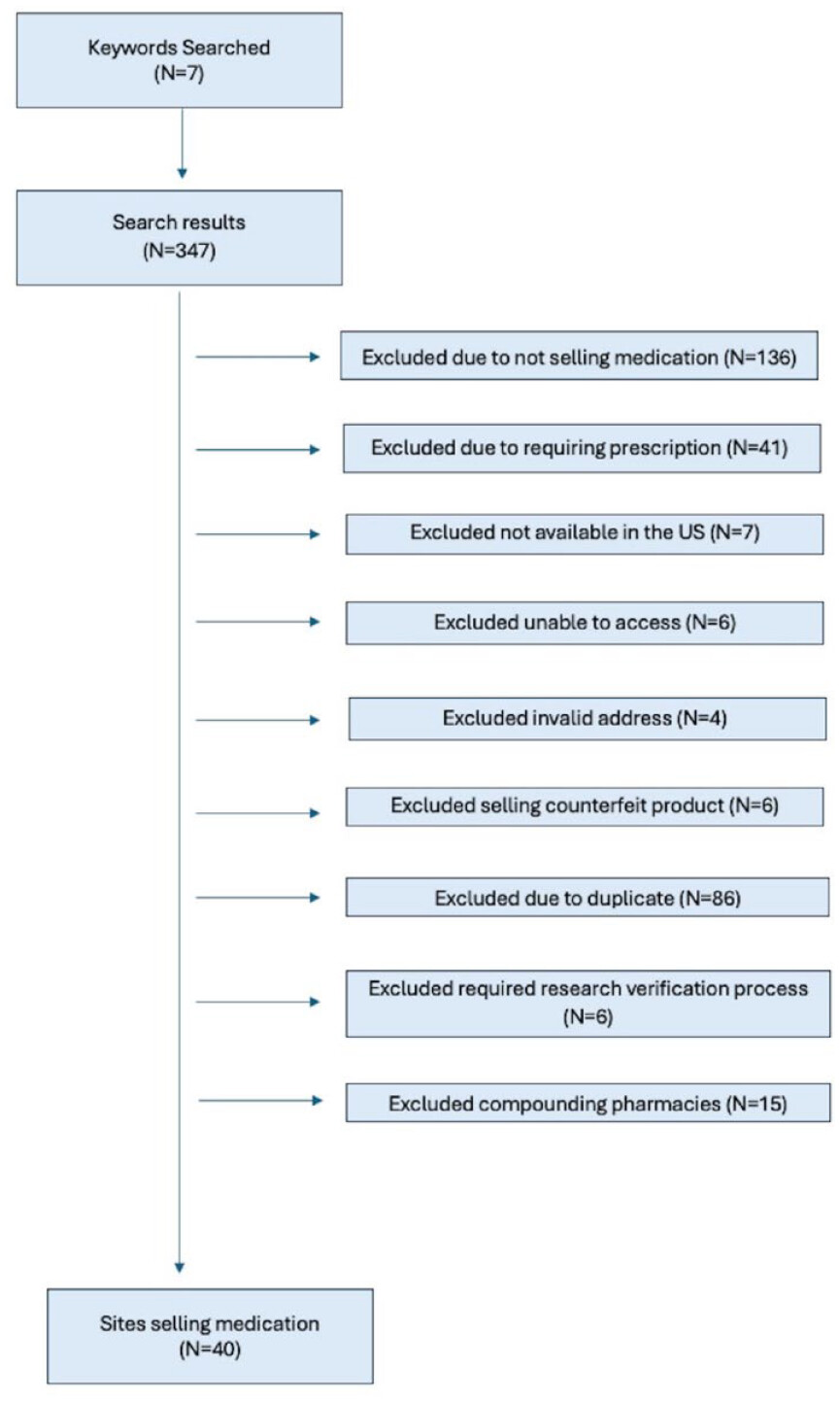
Given the perceived concern about distribution of active pharmaceutical ingredients directly to consumers, the authors conducted a review of implicated companies to further understand the scope of concern. We searched Google using 4 phrases:
“Buy [Ozempic or Mounjaro] without prescription”
“Buy [Ozempic, tirzepatide, Peptides] online cheap”
“Cheap GLP-1 agonist peptide buy”
“Semaglutide peptide or tirzepatide peptide buy”
We assessed websites consecutively until we found 40 that did not meet our a priori exclusion criteria. Websites were excluded if they did not sell GLP-1 or GIP medications, required a prescription, would not ship to the United States, had an invalid address, were inaccessible, were a legitimate compounding pharmacy, or sold the FDA-approved version (or a counterfeit version made to look like the innovator product). Figure 1 describes the results of our search and the reasons that we excluded most websites.
Figure 1. Flow diagram of sites searched and those included in our analysis.

Loophole Assessment

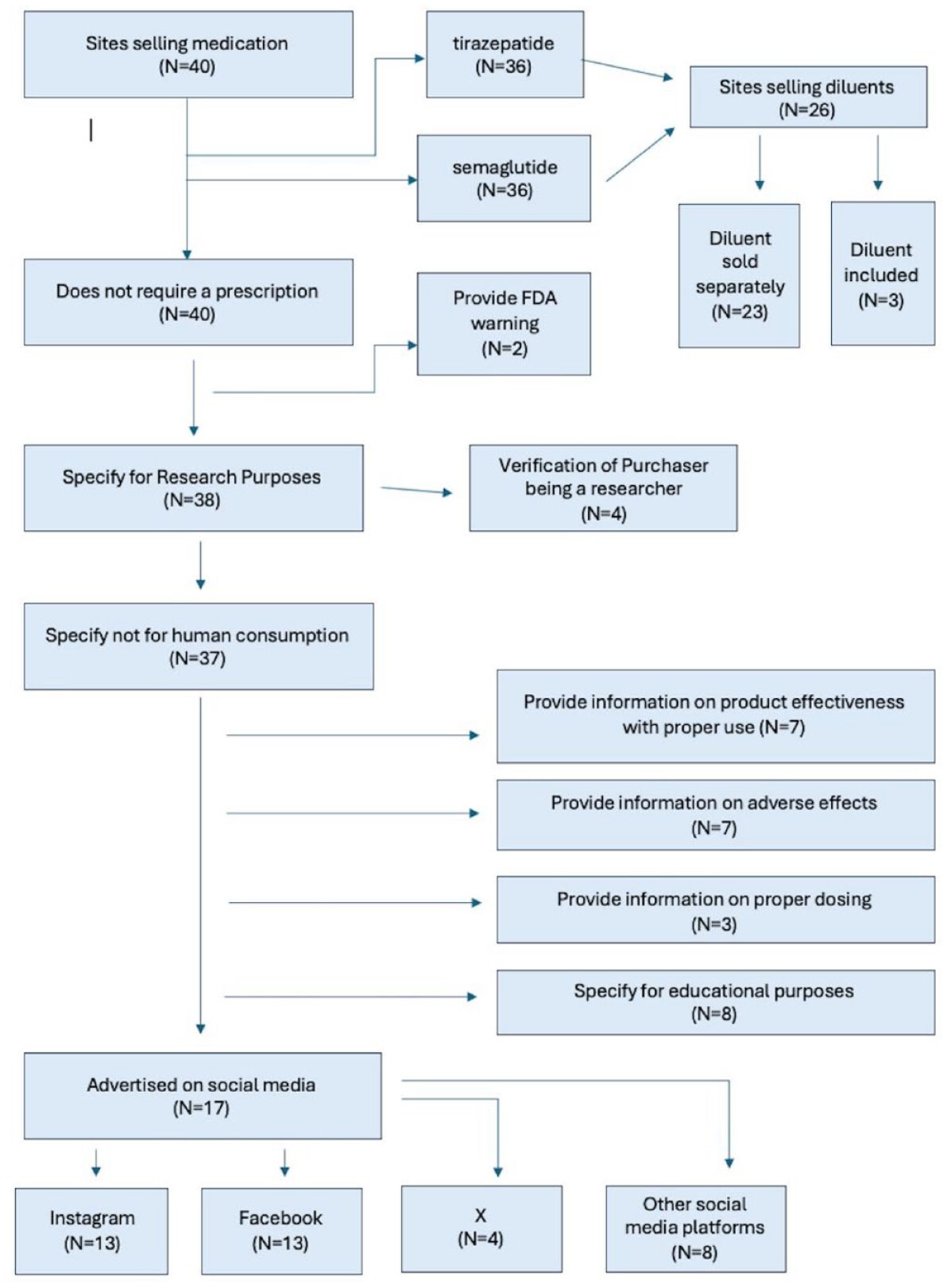
Figure 2 summarizes what we learned about these companies using a legal loophole to sell their semaglutide or tirzepatide products to consumers. Most of the websites sold both semaglutide and tirzepatide, and none required a prescription. Thirty-eight sites sold the products “for research purposes,” but only 4 sites asked the purchaser to check a box stating that they were a researcher. No site required the purchaser to verify they were researchers, the product was being shipped to an actual research facility, or to identify the research project they were conducting. No proof of age was required to purchase these products. Thirty-seven sites specified that the product was “not for human consumption,” although 17 sites provided us with targeted advertising on social media platforms once we performed these internet searches. Figure 3 provides representative screenshot excerpts from 1 website and 2 Facebook targeted ads. Many targeted ads on social media had consumer testimonials in the comments section stating or suggesting non-research human use of the products, which the companies did not refute.
Figure 2. Characteristics of peptide websites.
Figure 3. Excerpts from testimonial comments on GLP-1/GIP products sites: (a) from “unewlife.com” website; (b) from Facebook advertisement from Hydro Research; (c) from Facebook advertisement from Research Purpose Labs; and (d) from Facebook advertisement from Ultra Pure Bioscience.

Safety Assessment

When consumers purchase these vials containing lyophilized semaglutide or tirzepatide powder, they are effectively on their own. Only 3 sites included the diluent needed to dissolve the active pharmaceutical ingredients; the other required consumers to find the correct diluent and purchase it separately. Only 3 sites told consumers how to dose the products, the rest leaving them to figure that out independently. None of the sites showed consumers how to reconstitute products, draw them up, or properly inject them into the body. None of the sites provided the expiration date of products dissolved in sterile water for injection and/or bacteriostatic water. Only 7 sites provided clinical trial information on effectiveness or adverse events. When sites provided consumer information, they used another legal loophole, specifying that this information was for “educational purposes” only. The average costs of 5 mg of semaglutide and tirzepatide products are $181 and $203, respectively, although a wide range of doses is sold at variable prices from site to site.
While our assessment was focused on semaglutide and tirzepatide, we also identified 11 sites selling retatrutide products as well. Retatrutide is an experimental weight loss active pharmaceutical ingredient without proof of acceptable efficacy and safety in humans, showing just how far the sellers are willing to take this charade.

Health Implications for Consumers

Quality Issues and Product Access

Patients can have inconsistent effects if the amount of active ingredient varies from vial to vial, either from poor manufacturing or degradation during storage. Some sites offered additional discounts if larger quantities were purchased up front, but those products then need to be appropriately stored in consumers’ homes. Administering too high of a dose due to poor quality control during vial filling, improper dissolution of the powder, or inaccurate filling of the syringe can lead patients to experience significant nausea and vomiting.1,2 Heavy metal contamination in poorly manufactured products can pose significant health risks when used chronically.10 Microbial contamination due to poor manufacturing, improper storage, or the selection of an incorrect expiration date can lead to skin and skin structure infections. For example, using sterile water for injection as the diluent will have a beyond use date of only a day after reconstitution in a nonsterile environment.11 These products could be intentionally adulterated with other synthetic chemicals such as other weight loss ingredients or contamination from improper cleaning of equipment when companies manufacture products with different active ingredients. Finally, improper injection techniques or injecting non-dissolved drugs can lead to infections, bleeding, tissue damage, or inconsistent effects.12 Sharing syringes or needles is associated with the risk of hepatitis B and C as well as HIV,1,2 but sites do not provide those warnings to consumers purchasing the products. Consumers must locate and purchase their own syringes and needles.
The issues of product sterility and the accuracy of the included dose are not just theoretical. In a recent assessment, lyophilized peptide samples for semaglutide products were purchased from US Chem Labs, Semaspace, and Biotech Peptides.13 Sterility was assessed at an ISO 14644-1-certified microbiology laboratory and the active ingredient quantified by high-performance liquid chromatography and mass spectrophotometry. One sample had elevated presence of endotoxin (8.95 EU/mg), indicating possible contamination. Product purity levels ranged from 7% to 14%, which is different than the promised ~99% purity. The measured semaglutide content was 29% to 39% higher than promised on the label, which could lead to excessive dosing and accentuated adverse events. Equally important is that 3 other products were purchased from weightcrunchshop.com, puremedsonline.com, and genius-pharmacy.com but never arrived. The purchaser was asked to pay additional fees ranging from $650 to $1200 to clear customs, which was said to be fraudulent by custom agencies.13

Bypassing Health Professional Issues

Bypassing prescribers and pharmacists to access these products comes with substantial patient risks. People who are underweight with eating disorders would be denied a prescription for semaglutide or tirzepatide products from licensed prescribers but can still purchase these “peptide” products without a prescription. Teenage women might be especially susceptible because a lack of sufficient calories can prevent menstruation and a lack of proper nutrients can cause deficiencies.14 In addition, the FDA approved semaglutide and tirzepatide1,2 based on clinical trials in patients with elevated body weights who often had comorbid conditions. It is unknown whether the balance of benefits to risks is still positive in a younger, thinner, and healthier population. Semaglutide and tirzepatide can cause hypersensitivity reactions, increase the risk of developing pancreatitis and diabetic retinitis, and acute kidney injury.1,2 Younger patients could potentially have more years of exposure over a lifetime, and the long-term safety of these products is not well known. The phentermine-fenfluramine combination (Phen-Fen) was not known to cause heart valve damage for many years after commercial use.15 Patients on other blood glucose-modifying drugs can have an accentuated risk of hypoglycemia by starting semaglutide or tirzepatide,1,2 but pharmacists are not able to detect drug interactions for undisclosed products. Accessing active pharmaceutical ingredients that are not FDA-approved, such as retatrutide, is especially risky, given the lack of adequate safety and efficacy data.

What Can Health Professionals Do?

Close the Loophole and Support the FDA

We were able to readily find 40 sites selling these “peptides” to consumers, but the FDA has not warned most of them to date. In October 2023, the FDA published a warning letter for US Chem Labs.16 The letter cited several violations, including misbranding, selling unapproved drug products, and falsely marketing products as “research chemicals only,” when other areas of the website show they are intended for human use. As of June 2024, US Chem Labs was still selling GLP-1 products despite the FDA warning letter stating that action must be taken within 15 days. This lack of follow-through to force compliance with FDA requirements has also been observed in the dietary supplement industry. In 2018,17 the FDA identified experimental synthetic stimulants (β-methylphenethylamine, methylsynephrine, and octodrine) in dietary supplement products for increasing energy and weight loss and issued 31 warning letters. By January 2022,18 9 products were still available for consumers. Fifty-six percent of the 9 products still contained at least 1 FDA-prohibited stimulant, and 1 contained 3 prohibited ingredients. Unfortunately, when the FDA finds clear violations of its regulations and its imposed warnings are not immediately complied with voluntarily, it cannot force rapid compliance.
Even if the FDA eventually forces US Chem Labs to stop selling unapproved drug products, whether they can stop sellers who are savvier with their advertising is unclear. There are already sites that are steering conversations out of the comments section and behind invitation only, password-protected chat platforms (Figure 3d). Improved regulations should close this loophole and explicitly hold companies selling drugs for research purposes to a higher standard in verifying the purchasing entity’s identity as a researcher and the legitimacy of the research institution with legal penalties for malfeasance. Researchers or research institutions found diverting drugs purchased for research purposes to consumers should face similar penalties.
However, more regulations will only be effective if coupled with reasonable FDA oversight. The FDA is well funded for functions like approving new drugs, devices, and diagnostic tests that are paid for, in part, by manufacturer user fees.19 The user fees are negotiated between the industry and the FDA, with underlying taxpayer funding for these services maintained and unable to move to other purposes. Taxpayers are solely expected to fund all other FDA functions from food safety to counterfeit products and dietary supplements. This part of the FDA is withering on the vine and has neither the workforce nor the funding to adequately protect the public. Legislative support for the FDA is key to protecting human health.
Health professional organizations and patient safety advocate groups should jointly advocate for sensible tightening of regulations surrounding the sale of research products to consumers. They also need to advocate for a more in-depth assessment of the FDA to determine the minimum funding levels to truly meet its charges and then support legislative action to secure those funds. There are many competing priorities for health professional organizations time, but few that matter as much to our patients’ health. Health professionals need to be the agitators to get these organizations to put product safety and the defense of our legitimate drug supply on their radar.

Alerting Consumers

In the meantime, prescribers and pharmacists need to proactively ask about products that patients might buy outside of the traditional legitimate supply chain. We need to warn patients that accessing non-FDA-approved products carries real health risks. We need to explain why these risks exist and that it is difficult for patients to ensure they are getting a quality product and that they are using them properly. To amplify this messaging outside of the hospital, clinic, or pharmacy counter, we need to develop messaging that resonates with media outlets to disseminate it broadly. Finally, we need to advocate for a health care system that does not leave so many without access to legitimate drug treatments and pushes people to look for alternatives that circumvent their prescribers and pharmacists.

Declaration of Conflicting Interests

The authors declared no potential conflicts of interest with respect to the research, authorship, and/or publication of this article.

Funding

The authors received no financial support for the research, authorship, and/or publication of this article.

ORCID iD

References

1. Novo Nordisk. Ozempic (semaglutide) [package insert]. Published January 2020. Accessed June 28, 2024. https://www.accessdata.fda.gov/drugsatfda_docs/label/2020/209637s003lbl.pdf
2. Eli Lilly and Company. Zepbound (tirzepatide) [package insert]. Published November 2023. Accessed June 28, 2024. https://www.accessdata.fda.gov/drugsatfda_docs/label/2023/217806s000lbl.pdf
3. Sultana R, Sissoho F, Kaushik VP, Raji MA. The case for early use of glucagon-like peptide-1 receptor agonists in obstructive sleep apnea patients with comorbid diabetes and metabolic syndrome. Life (Basel). 2022;12(8):1222.
4. Jensterle M, Janez A, Fliers E, et al. The role of glucagon-like peptide-1 in reproduction: from physiology to therapeutic perspective. Hum Reprod Update. 2019;25(4):504-517.
5. Nevola R, Epifani R, Imbriani S, et al. GLP-1 receptor agonists in non-alcoholic fatty liver disease: current evidence and future perspectives. Int J Mol Sci. 2023;24(2):1703.
6. Boyer L, Sherrell Z; Healthline. Can I buy mounjaro online without insurance: costs, discounts, and where to buy. Published June 27, 2024. Accessed June 28, 2024. https://www.healthline.com/health/how-much-is-mounjaro-without-insurance#_noHeaderPrefixedContent
7. FDA. Compounding laws and policies. Published September 10, 2020. Accessed June 28, 2024. https://www.fda.gov/drugs/human-drug-compounding/compounding-laws-and-policies
8. White CM. Continued risk of dietary supplements adulterated with approved and unapproved drugs: assessment of the US Food and Drug Administration’s tainted supplements database 2007 through 2021. J Clin Pharmacol. 2022;62(8):928-934.
9. White CM. The Pharmacologic and clinical effects of illicit synthetic cannabinoids. J Clin Pharmacol. 2017;57(3):297-304.
10. White CM. Dietary supplements pose real dangers to patients. Ann Pharmacother. 2020;54(8):815-819.
12. Martin P. Subcutaneous administration. Nurseslabs. Published July 2, 2024. Accessed July 5, 2024. https://nurseslabs.com/subcutaneous-administration/#:~:text=Risk%20of%20localized%20infection%20at%20the%20injection%20site%3A
13. Ashraf AR, Mackey TK, Schmidt J, et al. Safety and risk assessment of no-prescription online semaglutide purchases. JAMA Netw Open. 2024;7:e2428280.
14. Chen L, Lu Y, Zhou YF, et al. The effects of weight loss-related amenorrhea on women’s health and the therapeutic approaches: a narrative review. Ann Transl Med. 2023;11(2):132.
15. Surapaneni P, Vinales KL, Najib MQ, Chaliki HP. Valvular heart disease with the use of fenfluramine-phentermine. Tex Heart Inst J. 2011;38(5):581-583.
16. FDA. Center for Drug Evaluation and Research. US Chem Labs-669074-02/07/2024. Published 2024. Accessed June 28, 2024. https://www.fda.gov/inspections-compliance-enforcement-and-criminal-investigations/warning-letters/us-chem-labs-669074-02072024
17. Cohen PA. The FDA and adulterated supplements—dereliction of duty. JAMA. 2018;1(6):e183329.
18. Cohen PA, Avula B, Katragunta K, Khan I. Recalls, availability, and content of dietary supplements following FDA warning letters. JAMA. 2022;328(4):393-395.
19. White CM. Why is the FDA funded in part by the companies it regulates? The Conversation. May 13, 2021. Accessed August 26, 2024. https://theconversation.com/why-is-the-fda-funded-in-part-by-the-companies-it-regulates-160444