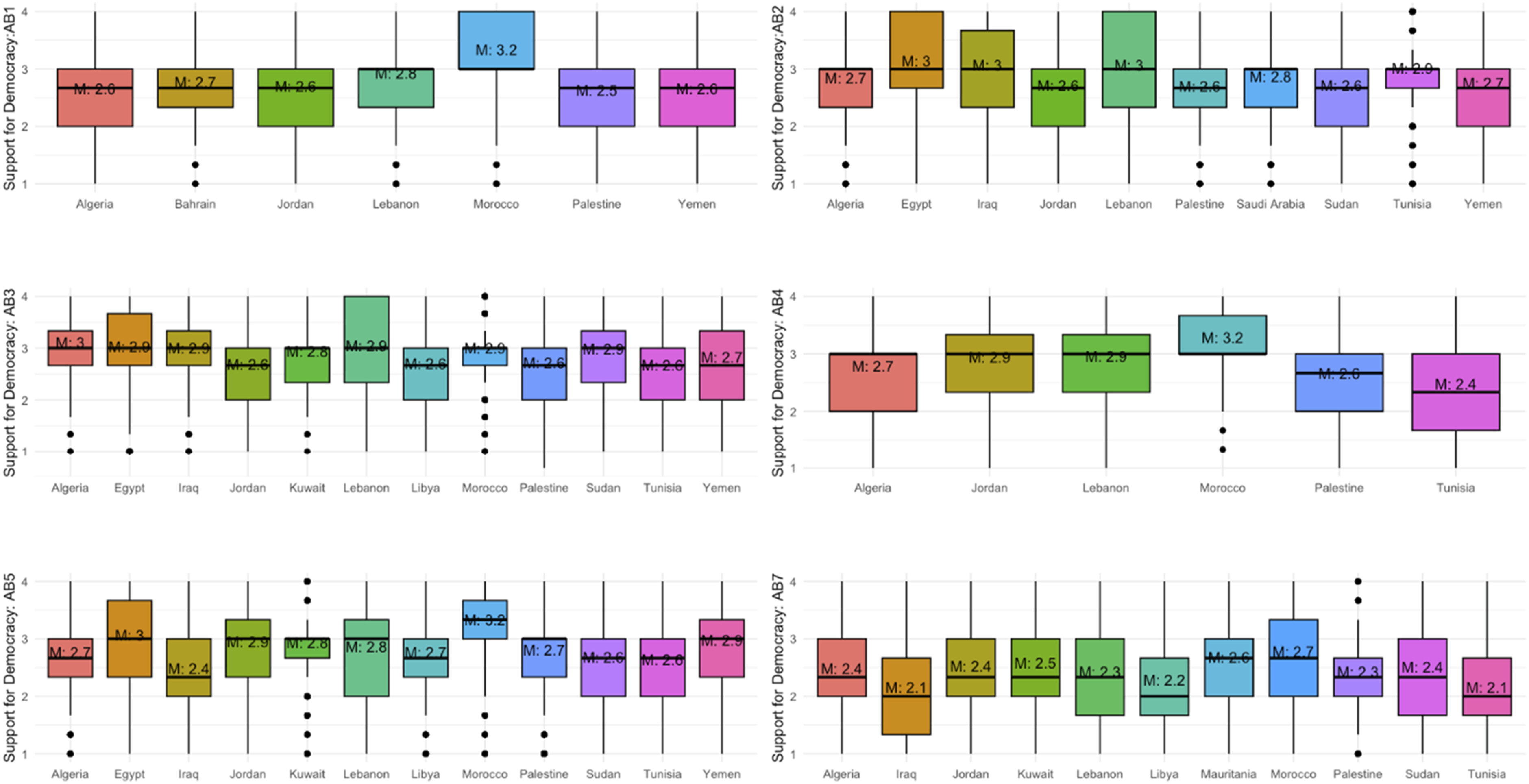
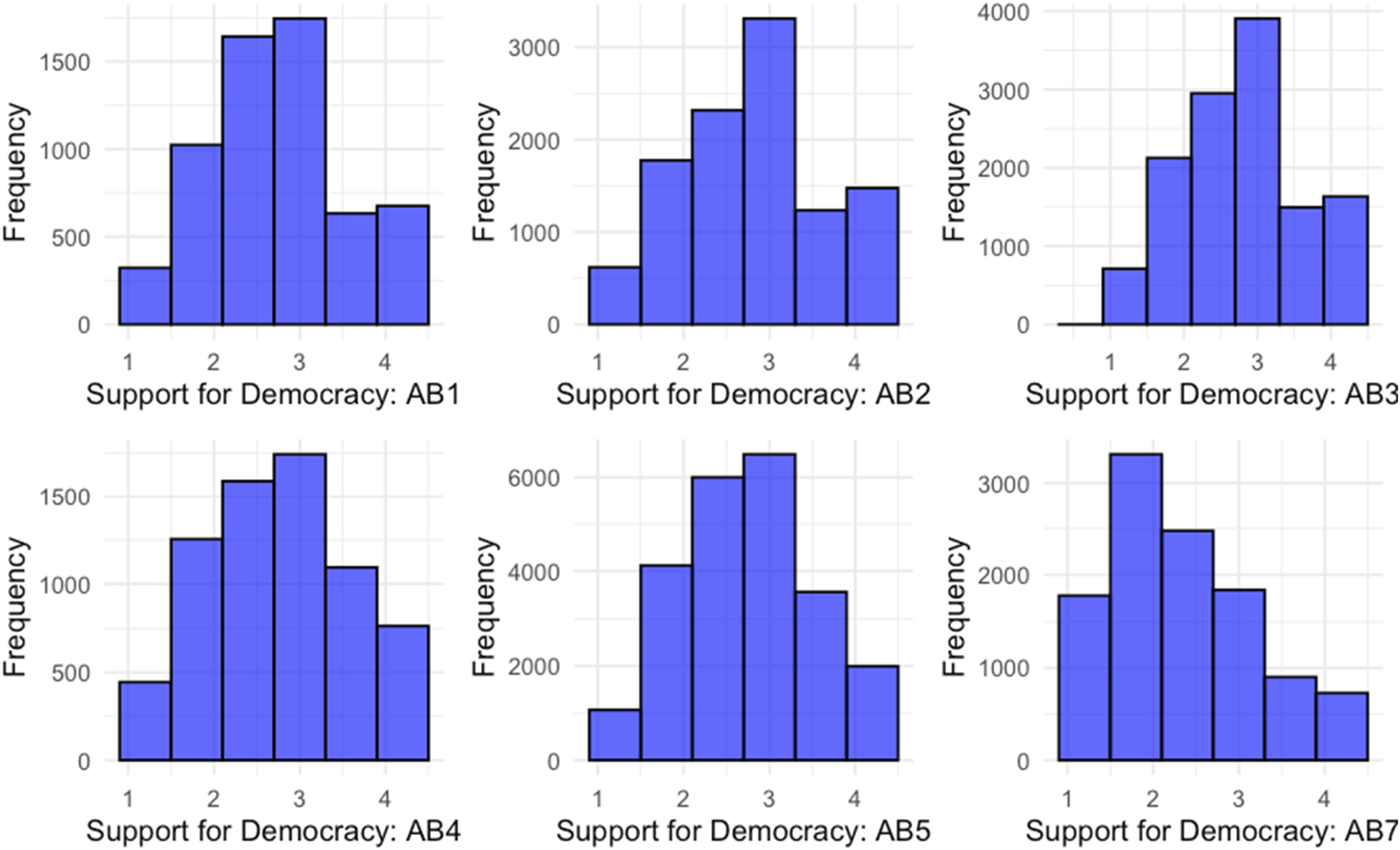
This section presents the results from pooled regression models analyzing data from Arab Barometers 1 through 5 and 7, with results reported at a 95 percent confidence interval. First, we discuss the positive association between political engagement on social media and support for democracy. Second, we look at the negative relationship between political engagement on social media and the internet and support for democracy. Subsequently, we examine these relationships across various political regimes, utilizing multilevel models. Finally, predicted means are visualized.
Social Media as Undermining Democracy Support
Drawing on data from AB 7,
Table 2 showcases how political engagement on social media, its interplay with two government-related variables (deference to government and trust in government), and other socioeconomic factors influence individual support for democracy. The interaction terms are informed by theories such as social learning and self-censorship, which propose that the negative relationship between social media engagement and democracy support may vary, becoming more pronounced at higher levels of government support.
The findings suggest a robust association, indicating that individuals who rely on social media for political information and expression of political opinions are more likely to hold anti-democratic leanings. Furthermore, the table highlights key interaction effects. First, politically engaged individuals on social media who endorse the notion of supporting government decisions unconditionally tend to be more inclined against democracy compared to those who challenge this belief. Second, individuals who trust the government and utilize social media for political information and opinion expression also exhibit a tendency to be less supportive of democracy than those who harbor distrust toward the government.
Drawing on previous research (
Noh et al. 2023), we conducted two additional interaction tests involving two government-support-related variables: the support for government index and overall satisfaction with government. Detailed results are provided in
Table 1 of Appendix D, demonstrating that satisfaction with government performance is another modifier; individuals satisfied with the government and politically engaged via social media tend to be less supportive of democracy than their dissatisfied counterparts. Furthermore, politically engaged social media users who support the government often exhibit a lower regard for democracy than those who do not support the government. Additionally, we conducted statistical tests without these interaction terms and kept four government-related variables as separate predictors are provided results in
Table 2 of Appendix D, where the results remain significant.
Tables 1 and
2 also highlight additional variables such as gender, education, and interest in politics correlating with democratic support. Both tables offer evidence that an interest in politics is commonly found among those favoring democratic governance. This observation aligns with prior research (
Bratton and Mattes 2001). The underlying implication is that democracy is unlikely to thrive without an engaged and politically attentive citizenry.
Our study primarily focuses on the political utilization of internet and social media, recognizing their multifaceted influence on public opinion. Therefore, we conducted additional tests to explore if the discovered patterns regarding the relationship between online political engagement and democracy support extend to general forms of social media usage. To this end, we use survey questions on individual internet use, daily social media use, and the use of social media for breaking news from AB 1–5 and 7. The findings presented in
Appendix E align with our expectation that simply using social media for general purposes does not necessarily correlate with democratic attitudes. Except for Model 8, which indicates that those who use social media as their primary source for breaking news show a correlation, all other general social media/internet use variables are nonsignificant in major models. Consistent with prior studies, typical individuals are less inclined to engage with political matters (
Downs 1957), potentially leading to a lack of exposure or apathy towards manipulative techniques employed by authoritarian governments. What is crucial is the level of political engagement on these platforms. Those who utilize social media to seek out political information and articulate their perspectives on such matters are more susceptible to encountering authoritarian narratives and undergoing social learning influenced by these regimes.
Social Media Engagement and Support for Democracy Across Regimes
Given previous research showing that the impact of Internet use on political opinions is influenced by government filtering and institutional context, we also examine whether the relationship between political engagement on social media/internet and support for democracy varies by levels of democracy in Middle East. For instance,
Wagner et al. (2017) found that the influence of digital forums on perceptions of openness and transparency depends on institutional context. Based on the analysis of Latin American countries, their study reveals that digital information consumption significantly predicts external political efficacy, with a stronger effect in more democratic countries. Similarly,
Wagner and Gainous (2013) studied the effect of Internet use on political opinions in Middle East and found that in countries with lower levels of government filtering, Internet use increased political knowledge, participation, and perceptions of the U.S. and the West, while reducing trust in government. In contrast, countries with higher Internet filtering showed no significant effects.
To investigate how different levels of democracy influence the relationship between individual support for democracy and political engagement on social media, we merge six country-level variables on democracy levels and political regimes to our survey data. These variables include five indices from the Varieties of Democracy (V-Dem) project, which capture various dimensions of democracy, and the Regimes of the World (RoW) classification, which categorizes political regimes based on V-Dem data. The six variables are as follows: the electoral democracy index, which measures the extent to which political leaders are chosen through free, fair, and meaningful elections; the liberal democracy index, which emphasizes liberal democratic elements such as civil liberties, the rule of law, judicial independence, and checks on executive power; the participatory democracy index, which assesses the degree of citizen participation beyond voting, including mechanisms of direct democracy, civil society engagement, and decentralized governance; the deliberative democracy index, which gauges the quality of political deliberation, focusing on rational discourse, informed debate, and respectful dialogue among political actors; the egalitarian democracy index, which measures the extent of political equality and efforts to reduce social, economic, and political inequalities within the democratic process; and the Regimes of the World (RoW), which classifies political regimes globally into four categories: liberal democracy, electoral democracy, electoral autocracy, and closed autocracy. Among the countries surveyed by the Arab Barometer, most are classified as either closed autocracies or electoral autocracies, with Tunisia being the only country categorized as an electoral democracy.
After merging these country-level variables to the AB surveys, we first explore the effect of these six variables on the internet-support for democracy nexus in main models in
Table 1 that shows positive role of political engagement on internet in support for democracy based on the AB 3 and AB 4 data. We develop interaction models where all political engagement on internet variables are interacted with each of the six democracy levels and political regimes variables, translating into six tables, each table showing one country-level democracy variable. To account for a within country differences, we developed multilevel models where categorical country variable is a grouping variable for a random effect. This allows models to account for differences across countries, while interactions allow to capture if relationship between online political engagement and support for democracy changes across various political regimes. All results are presented in
Tables 1–6,
Appendix F. The findings indicate that the slight positive effect of obtaining political information diminishes when democracy levels are considered, while the slight positive relationship between expressing political opinion on the internet and support for democracy remains. Notably, this effect is marginally stronger in countries with lower liberal, participatory, deliberative, and egalitarian democracy scores. These results suggest that in countries with lower democracy scores, individuals may rely on the internet as an alternative platform for advocating democratic change and reforms, whereas this need might appear less urgent in countries with higher democracy levels. This aligns with our expectations that the internet initially served as an alternative source of information in Middle East, particularly in earlier years, before authoritarian regimes increasingly took control of online spaces. However, these differences are minimal due to relatively small variations in democracy levels among the countries surveyed by the AB.
Next, we move to exploring negative relationship between support for democracy and online political engagement and its interactions with government-support variables illustrated in
Table 2. Using six country-level democracy indices and political regimes data from V-dem, we develop three-way interaction models and present results in
Tables 1–6 of Appendix G. Except for Model 4 in
Table 4 where political expression on media is negative but no significant, all other models show that political engagement on social media and its interactions with the deference to the government and trust in government variables remain statistically significant at 95 percent interval. All tables show that the relationship between political engagement on social media and support for government interaction terms and support for democracy doesn’t change significantly across democracy levels and regime categorizations.
Additionally, we examined the relationship between political engagement on social media and support for democracy across different political regimes and levels of democracy, without including interactions between political engagement on social media and support for government variables. To do this, we interacted two online political engagement variables (SM Political Information and SM Political Expression) with six different democracy levels and political regimes, presenting the results in
Tables 7 and 8 of Appendix G. With the exception of Model 6 in
Table 8, where SM Political Expression is not significant, both SM Political Information and SM Political Expression remain significant across all models. However, the interactions of SM Political Information and SM Political Expression with democracy levels and political regimes are nonsignificant, suggesting that the relationship between political engagement on social media and support for democracy does not vary significantly across different political regimes.
Finally, we estimated multilevel models, treating political regime types as a grouping variable to assess whether the Y-intercepts differ across country groups. The full models are presented in Model 9 of
Appendix G.
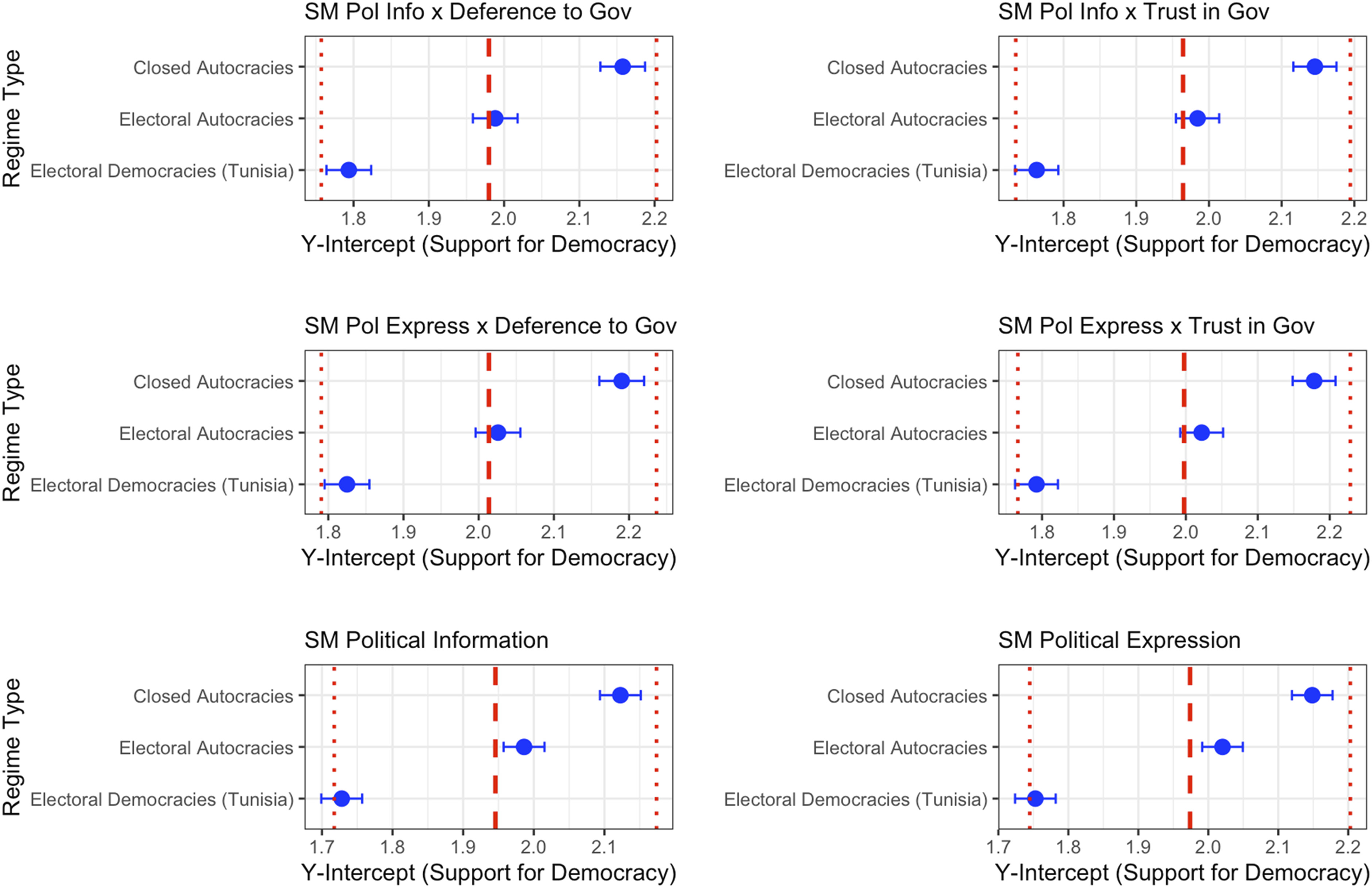
Figure 3 visualizes the Y-intercepts based on six models, four of them interaction (between online political engagement and deference to government and trust in government) models and two of them without interactions. While we included regimes of world variable as country-level variable (L2) in multilevel models, the categorical country name variable was not included as its inclusion prevented models from converging because of high collinearity. The red dashed lines show the fixed effects intercept, middle being average and the left and right being lower and upper bounds, respectively.
Figure 3 suggests that each political regime group exhibits a slightly different baseline level of support for democracy. To obtain total intercept for each group, we added fixed effects intercept (representing overall average intercept) and random effects intercept (group-specific deviation). By comparing the total intercepts for the three groups, we found that while the group intercepts vary, the differences are relatively small. The fact that the group intercepts are not significantly different from the fixed effects intercept implies that most of the variation in the outcome is driven by individual-level differences within groups rather than differences between the groups themselves.
Overall, results suggest that group-level effects are minimal, which is why the focus remains on standard linear models presented in main analysis. This is largely because most of the countries included in the AB surveys exhibit similar characteristics regarding their levels of democracy. They are predominantly authoritarian. As a result, group-level effects—whether based on democracy levels or regime types—do not significantly contribute to explaining the relationship between social media engagement and support for democracy. Therefore, the individual-level linear models in the main analysis better capture the dynamics of the relationship between online political engagement and support for democracy.
Predicted Mean for Negative Association
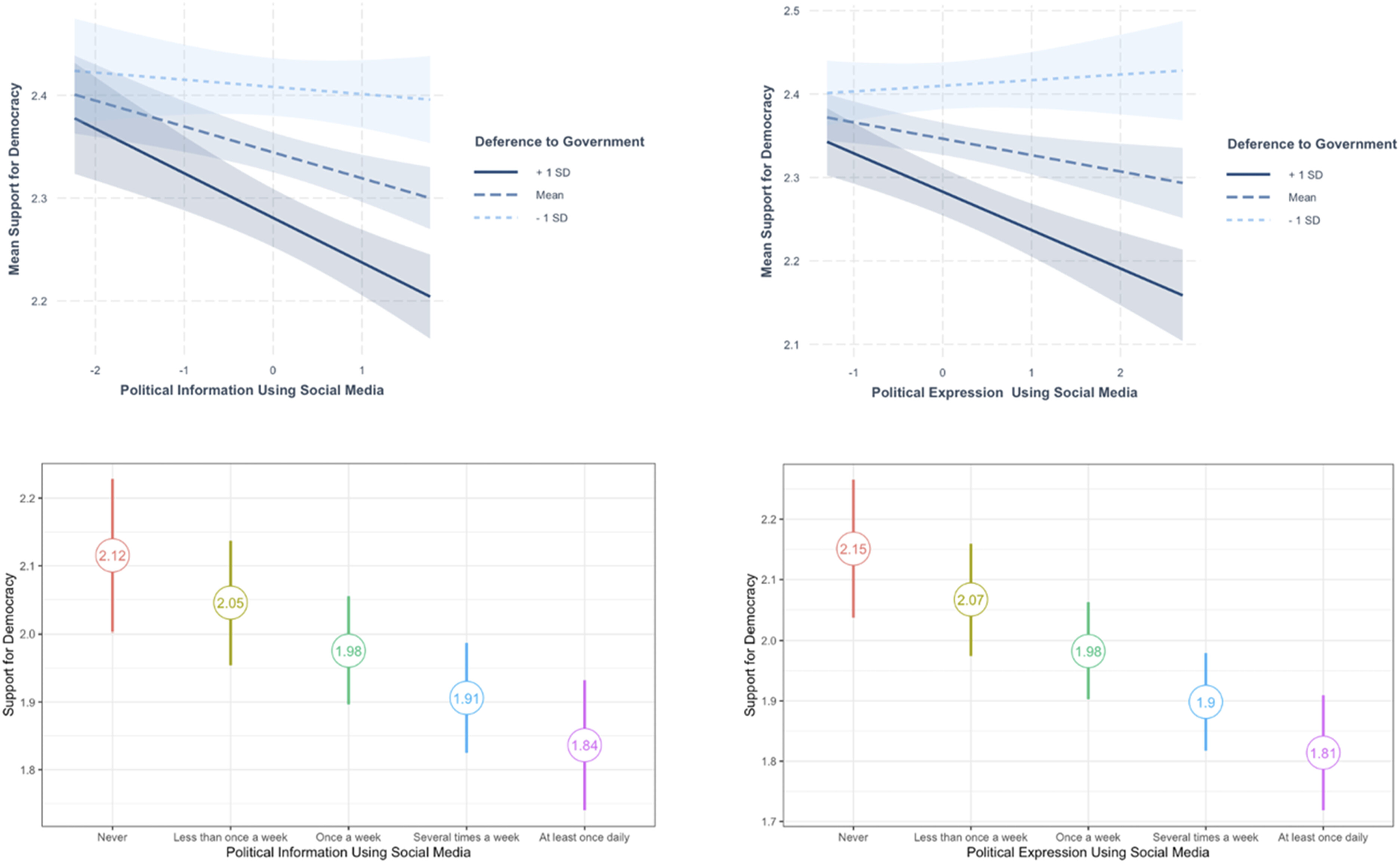
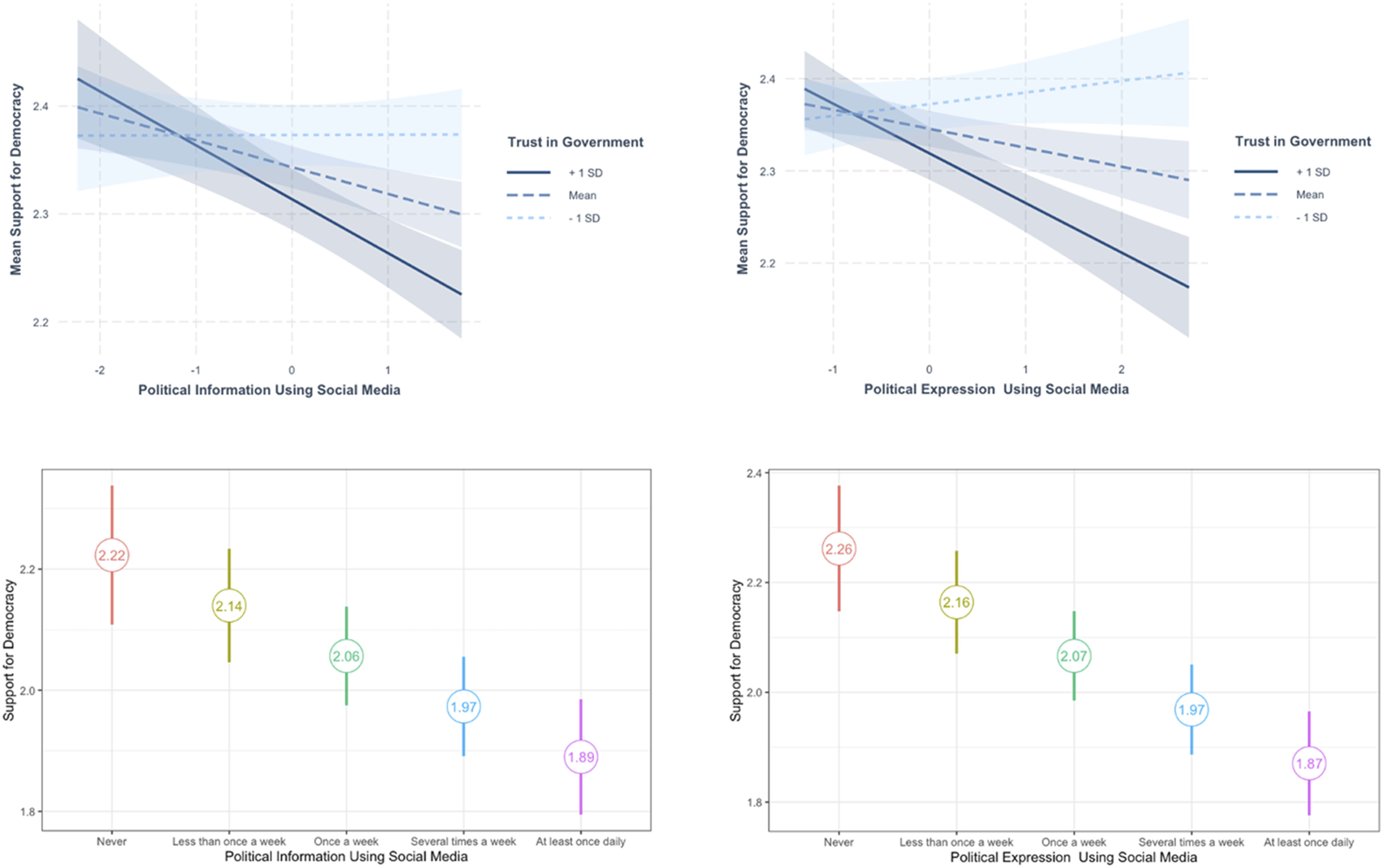
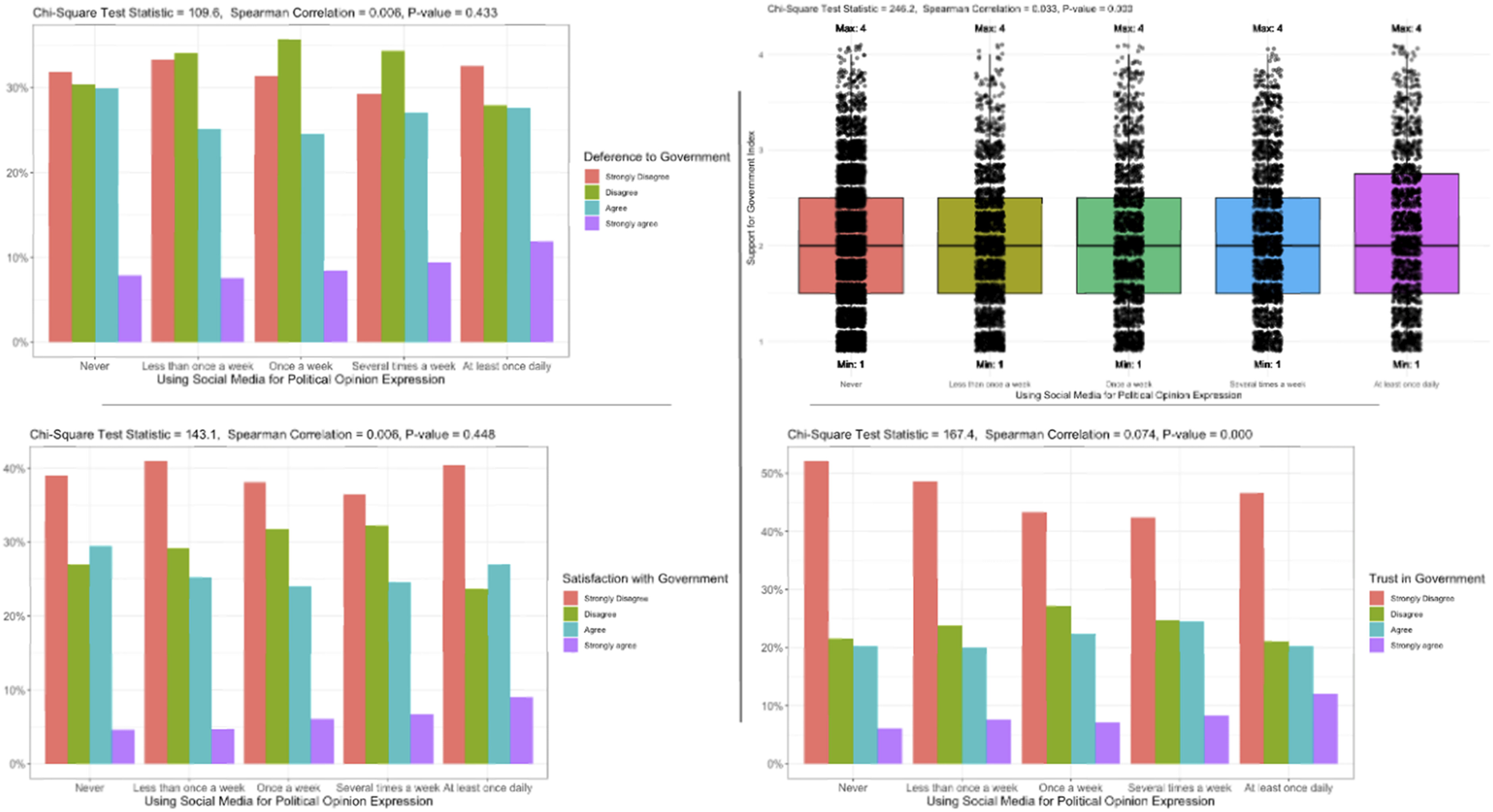
Next, we illustrate the mean predicted support for democracy at the lowest and highest levels of two key independent variables: social media-based political information and political expression, along with their interplay with four government-related variables—deference to government, trust in government, satisfaction with government, and support for government. All predictions are based on full models and are visualized with 95% confidence intervals in
Figures 4–
5 and
Figures 1–2 of Appendix H. Each figure is organized into four quadrants, with the lower graphs displaying the main effects of political information and political expression via social media, and the upper graphs showing how these effects are modified when interacting with a government-related variable.
Figure 4 depicts the conditional average support for democracy based on the frequency of social media use for political information and political expression. The lower graphs of the figure demonstrate a negative correlation between two key independent variables and dependent variable: frequent social media users for political news and political expression exhibit lower democratic support. Specifically, daily social media users for political information and political expression show a 0.28 and 0.34 decrease, respectively, in democratic support compared to non-users. The top plots of
Figure 4 suggest that among users of social media for political information and political expression, the degree of support for democracy varies significantly depending on their attitudes toward government decisions. Those who consume political information via and express political opinion on social media and also agree that governmental decisions should be upheld regardless of personal views are more inclined to disapprove of democracy, unlike their counterparts who challenge the notion of unconditional governmental support. Those who use social media to gather political information and express political opinion but do not subscribe to the idea of unconditional support for government decisions are relatively supportive of democratic governance.
Figure 5 illustrates a similar negative association: a higher frequency of social media use for political information and political expression correlates with a lower support for democracy. Individuals engaging with social media for political information and political expression on a daily basis demonstrate a 0.33 and 0.39 reduction in support for democracy compared to those who refrain from using social media for such purposes. The upper section of
Figure 5 elucidates the influence of trust in government on this dynamic: Individuals who ingest political information and share political viewpoints through social media and maintain a high level of government trust tend to be more skeptical of democracy compared to those social media users with lower government trust.
In summary,
Figures 4–
5 illustrate that individuals who frequently use social media for political information and expression are generally less supportive of democratic principles, suggesting a potential inclination towards social learning of authoritarian values via social media platforms. This negative correlation between the use of social media for political engagement and support for democracy becomes more pronounced when factoring in governmental attitudes, suggesting self-censorship. Additionally, we carried out additional analyses by sub-setting our data based on the values of four government-related moderating variables and presented the results in
Appendix I. The results are consistent with the moderating role of the government-related moderating variables. These results could imply an authoritarian takeover of social media platforms where users are more likely to digest authoritarian narratives because of their deference to, trust in, support for, and satisfaction with authoritarian governments.