The intersection of personality and culture has long intrigued various disciplines, having gained renewed attention with the advancements in psychometrics as a means to study personality traits as well as progression in the use of quantitative methods to study intercultural relations. This paper investigated the relationship between Hofstede’s cultural dimensions and the Big Five personality traits across 22 countries. It did so with the goal of testing hypotheses on whether Hofstede’s cultural dimensions significantly relate to the Big Five traits and whether countries sharing cultural similarities exhibit similar personality trait scores. The findings produced here highlight a substantial link between certain cultural dimensions (specifically, Masculinity, Power Distance, Individualism, and Uncertainty Avoidance) and the Big Five traits, while dimensions such as Long-Term Orientation and Indulgence did not significantly correlate with personality traits. Through regression and cluster analyses, this study confirmed that countries grouped based on cultural dimensions showed similar personality trait scores.
Introduction
The conceptualization of collective mental characteristics within populations is not novelty. Debate persists, however, on whether differences in national character stem from nature or nurture. The historical interplay between personality and culture evolved through philosophers, anthropologists, and psychologists, with cross-cultural psychology carrying the torch for international understanding.
Already in the 18th century, philosophers like Hume, Montesquieu, and Kant explored “national character” (Bessell, 2023; Goody, 2007), but it was in the 20th century that anthropologists largely embraced the idea of national character, especially after World War II when they aided the U.S. government in understanding enemy nations' psyches. “National character” was defined as relatively enduring traits among adults (Inkeles & Levinson, 1954). Despite its decline in Anglophone anthropology, the study of national character has persisted in cross-cultural psychology (Gelbrich et al., 2023; Peabody, 1985).
In recent times, there has been a renewed interest regarding the interplay between personality and culture (Allik et al., 2023; McCauley et al., 1999). Among psychologists in particular, systematic and quantitative research into both culture and personality has paved the way for a fresh approach to connecting these concepts, enriching the fields of anthropology and psychology. Regarding personality, this shift involves embracing a trait-based viewpoint over the psychoanalytic models favoured by early personality and culture theorists. On the cultural front, it entails identifying shared cultural dimensions instead of relying on distinct portrayals of each unique ethos. These new theoretical perspectives are rooted in data, which are increasingly accessible in the modern digital era.
Personality Dimensions, Culture, and the Five-Factor Model
The realm of personality captivates psychologists, who seek to understand individual intricacies. The early 20th century ushered in psychoanalysis, delving into unconscious influences and early experiences, shaping discussions on personality and culture (Erikson, 1959/1980). Yet criticisms arose (Eysenck, 1952; Lilienfeld et al., 2000), eroding psychoanalysis' dominance.
Contemporary personality psychology embraces the trait approach, evaluating enduring dispositions. In this regard, the resurgence of the Five-Factor Model (FFM) marked a pivotal shift (Digman, 1997; McCann et al., 2020; Tupes & Christal, 1992). The Five-Factor Model (FFM), also referred to as the 'Big Five’, provides an empirical framework for categorizing personality traits into five major dimensions: neuroticism (or emotional stability), extraversion, openness (or intellect/imagination), agreeableness, and conscientiousness (Digman, 1997; McCrae & John, 1992). In essence, this model presents an empirical abstraction of the interconnectedness among personality traits.
Initially identified through peer rating scales (Tupes & Christal, 1992), the Big Five traits have been corroborated across self-reports, questionnaires (Costa & McCrae, 1988), personality disorder symptom clusters (Clark & Livesley, 2002), and trait descriptive adjectives (Saucier, 1997). This comprehensive model encapsulates the concept of “personality” within psychology, facilitating the integration and organization of diverse measures and viewpoints.
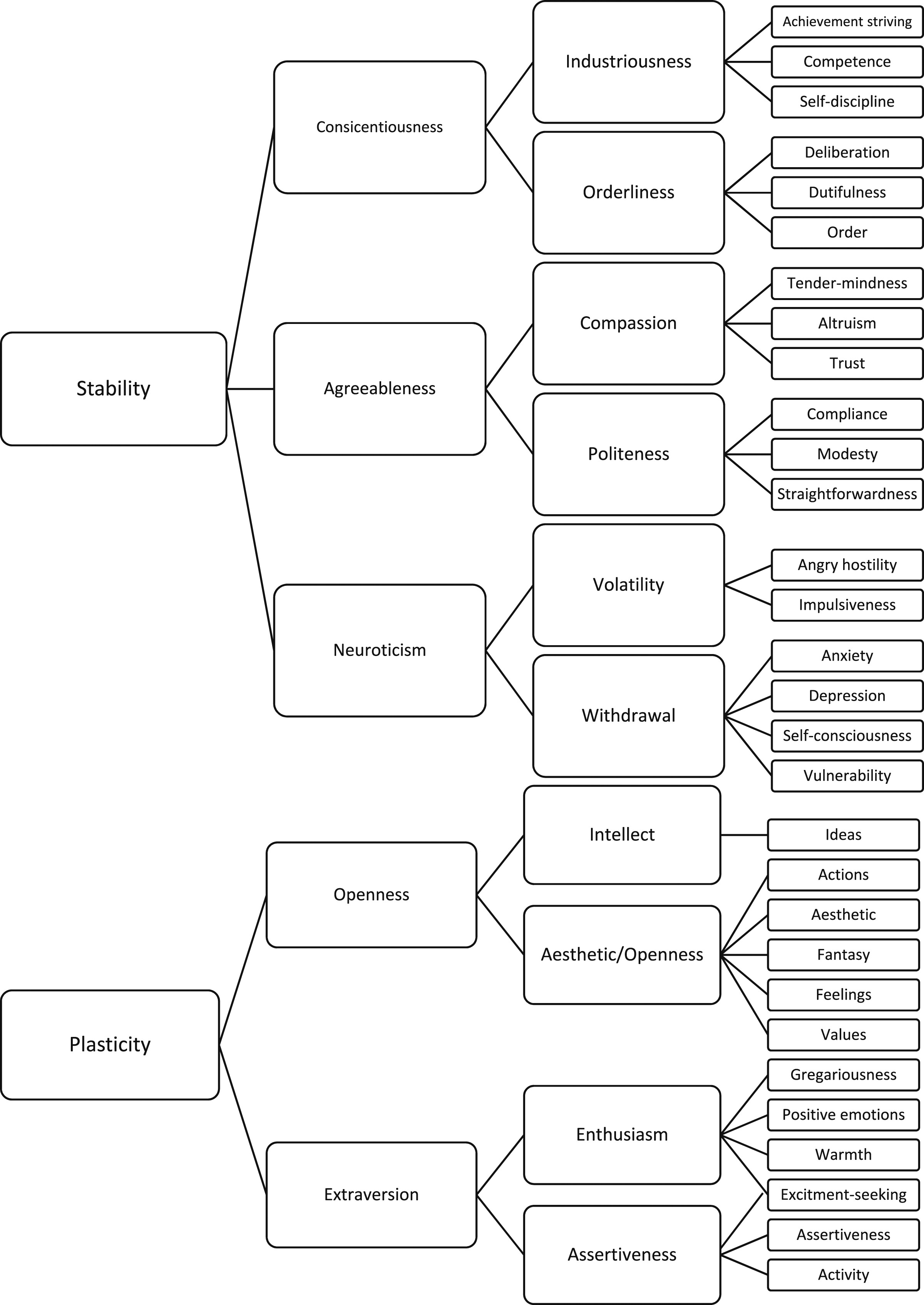
Figure 1 presents a synthesized hierarchical personality structure resulting from multiple sources of personality psychology research, while Table 1 offers essential conceptual definitions for each meta-trait, the Big Five, and their respective facets. It is worth emphasising that the hierarchical depiction in Figure 1 pointedly oversimplifies the intricate nature of human personality by omitting cross-loadings. This simplification (that bears didactical motivation) implies traits beneath one meta-trait cannot relate to those beneath another. Yet, the reality of human personality is more nuanced and interconnected, especially below the level of the Big Five (Costa & McCrae, 1992; DeYoung, 2010). McCrae and Costa (2003) contend that personality traits, partly innate, transcend cultural boundaries. This shift refocuses on how personality traits and culture interact, influencing behaviour at individual, group, and societal levels. Thus, any biological model of personality should consider these cross-connections for accuracy.
Maintenance of objectives, interpretations, and strategies from disruption by impulses
Plasticity
Creation of new objectives, interpretations, and strategies
Big five
Extraversion
Describes an energetic demeanour toward life, which engenders features such as sociability, assertiveness and positive emotionality
Neuroticism
On one extreme entails emotional stability. On the other, implies negative emotionality
Openness
Implies the breadth, originality, and complexity of person’s mental abilities and experiential life
Conscientiousness
The impulse to be driven and industriousness
Agreeableness
Proclivity to concurrence with others usually manifested through altruism, trust, and modesty
Facets
Assertiveness
Drive towards a goal
Enthusiasm
Gratification of attainment of actual or imagined goal
Volatility
Proactive behaviour to avoid or eradicate threats
Withdrawal
Represented through anxiety and/or depression
Intellect
Development of logical patterns in abstract and semantic information
Openness to experience
Spatial and temporal correlational patterns in sensory and perceptual information
Industriousness
Represented through dutifulness and delayed gratification
Orderliness
Obedience to rules to avoid chaos
Compassion
Represented through empathy, i.e. emotional attachment to and concern for others
Politeness
Suppression of aggressive behaviour and avoidance of or norm-violating conduct
Theoretical Framework
Cultural Dimensions in the Literature
There is myriad interpretations when it comes to culture, but debating their merits is beyond the scope of this paper. Herein, Hofstede’s definition of culture (1980), which underscores it as the shared mental programming distinguishing groups, is adopted because it emphasizes the collective and commensurable nature of culture, manifested in behaviours, and their variable occurrence. However, there has been a lot of research done on the dimensions of national cultures before Hofstede’s contribution.
In the latter half of the 20th century, scholars pondered the societal issues likely to generate distinct cultural dimensions. Notably, George P. Murdock’s Human Relations Area Files (Murdock, 1957) offered anthropological insights by classifying traditional and nonliterate societies. Alternatively, a linear classification of societies from traditional to modern based on economic and technological advancement emerged, echoing 19th- and 20th-century evolutionism. It is also worth noticing the rise of multiple dimensions models, such as Aberle and others’ (Aberle, 1950) nine functional prerequisites of a society, Parsons and Shils' (1951) five pattern variables, Kluckhohn and Strodtbeck’s (1961) five value orientations, and Douglas' (1970) two cosmologies. These models represent subjective efforts to categorize complex realities, but none of them have empirical support at modern societal levels. The first scholar able to empirically determine dimensions of culture at the society level was the psychologist Raymond B. Cattell, who applied factor analysis to country-level data, yielding 12 unclear factors, primarily influenced by economic development (Cattell et al., 1979). Another breakthrough in the study of national cultures was produced by Richard Lynn, who in the 1970s and 1980s introduced dimensions like “anxiety,” “neuroticism,” and “extraversion” into the study of national cultures (Lynn & Hampson, 1975). However, since Hofstede’s pioneering “Culture’s Consequences” (1980), surveys have become common tools in the study dimensions of national cultures (e.g., Levine et al., 2019; Rothmann et al., 2019; Sanchez-Runde et al., 2020), which has pointed to a shift in the paradigm regarding research on cultural dimensions and has confirmed the relevance of Hofstede’s work.
Hofstede’s examination of national cultural disparities hinged upon a multinational corporation, IBM, and its database collected from subsidiaries in 71 countries. These records encompassed employee attitude surveys conducted between 1967 and 1973, totalling approximately 117,000 questionnaires. The surveys aimed to extract both fundamental values and situational attitudes. Given IBM’s tightly structured organization and consistent corporate culture, employees across different countries were matched in all aspects except nationality. The questionnaires were administered in 20 languages, with slight adaptations, and the database focused on identically stratified samples of employees from 40 countries, chosen for their sizable workforce.
Hofstede’s research identified four cultural dimensions from the analysis of this data (1980, 2011). The first dimension, power distance, gauges the extent to which individuals within organizations and institutions accept unequal power distribution. This dimension focuses on a bottom-up perspective of power management, that is, power distance is measured based on the extent to which less powerful members of organizations and institutions accept and expect that power is distributed unequally. The second dimension, uncertainty avoidance, measures a culture’s willingness to tolerate ambiguity, affecting its comfort in unstructured situations. In other words, uncertainty-avoiding cultures act to mitigate potential uncertainty via strict regulations and security measures, and, on the philosophical and religious level, by a belief in absolute Truth. The third dimension, individualism versus collectivism, reflects the integration of individuals into groups within a society. In individualist societies, people are more self-centred whereas in collectivist societies individuals look after each other in exchange for loyalty. Lastly, the fourth dimension, masculinity versus femininity, examines the emotional role distribution between genders. The assertive pole has been called “masculine” and the modest, caring pole “feminine.”
These dimensions were justified theoretically based on their alignment with standard analytic issues identified by Inkeles & Levinson, 1954, highlighting the relation to authority, conception of self, and primary dilemmas or conflicts (Inkeles, 1997). Subsequent studies using the IBM questionnaire have supported and expanded upon these dimensions, demonstrating their enduring validity and relevance.
Hofstede’s subsequent work in the 1980s (Hofstede & Bond, 1988) introduced a fifth dimension: long-term versus short-term orientation. This dimension, based on a study of students in 23 countries, assesses values such as thrift and perseverance associated with long-term orientation, and respect for tradition and social obligations linked to short-term orientation. While the four primary dimensions have been extensively validated over time, the fifth dimension’s scores are only available for a subset of countries covered by the original four.
Correlating Personality and Cultural Dimensions
When delving into the study of personality, the comparison centres on individuals, whereas in the study of culture, the focus tends to shift towards larger groups. Hofstede (1995) metaphorically employed flowers, bouquets, and gardens to illustrate the comparison of individuals, organizational cultures, and national cultures. However, contextual social psychologists (Verkuyten, 2023) have highlighted the ecological and compositional fallacies of assuming that group characteristics mirror those of group members. These fallacies become more pronounced with higher levels of aggregation. This contrast resembles comparing trees to forests. Analogous to the ecological fallacy, confusion can arise when comparing individuals based on societal data, while the reverse ecological fallacy involves evaluating societies using indices designed for individual attributes (Hofstede, 2001, p. 16).
The recent wave of renewed interest in exploring the relationship between personality and culture has put forward the notion that personality can be influenced by culture, though there is debate over how deeply and which parts of personality are most affected (Allik et al., 2023). Despite being beyond the scope of this paper, the logical and methodological challenges in studying the culture-personality relationship, such as defining personality, assessing traits, making cross-cultural comparisons, and conducting causal analyses must be acknowledged herein.
Several models describing the relationship between culture and personality, and these subtleties are relevant especially when it comes to interpretation of the data. Whilst some models suggest that cultural environments can shape the expressions of personality only to a certain extent, as the core traits themselves remain stable and universal across different cultures (Allport, 1966), other models propose that the opposite is true, namely that personality traits of individuals can shape the cultural environment (Gosling, 2008; Marcus et al., 2006). Between these two approaches are the perspectives arguing that culture and personality mutually influence each other (Mendoza-Denton & Mischel, 2007), or even the understanding that culture and personality are in fact inseparable aspects of human expression influenced by language and cultural sign systems (Shweder, 1999).
When it comes to methods, it is crucial to transition from broad, undefined queries regarding the interaction between personality and culture to more specific, testable questions as a significant improvement (Allik et al., 2023). However, due to limitations on the possibility of direct manipulation of personality traits or cultural institutions, research in this area tends to be mostly observational. Therefore, causal relationships must be inferred from observed associations, requiring careful construct validation.
This discussion is relevant because it underscores the complexity of studying the relationship between personality and culture, highlighting the need for precise, methodologically sound approaches to discern the nuanced ways in which individual traits and societal norms influence each other. Understanding these dynamics is crucial for developing accurate theories and for applying these insights in real-world settings, such as in organizational management, educational systems, and cross-cultural communications.
In this study, the understanding is that culture and personality mutually influence each other. This notion serves as a starting point to examine the interplay between personality and culture, illustrating how, for example, personality traits like openness, agreeableness, and neuroticism can be influenced by overarching cultural dimensions such as collectivism versus individualism, power distance, and uncertainty avoidance. This inquiry into the dynamic interplay between culture and personality is critical for developing a more holistic understanding of human behaviour within different cultural contexts, and for identifying the underlying mechanisms that drive these interactions, thereby contributing to the broader fields of psychology, anthropology, and intercultural relations.
The challenge, however, lies in reconciling personality dimensions with cultural dimensions that operate on distinct levels. Attempts have been made to measure culture dimensions in individuals, particularly in the case of individualism-collectivism, yielding inconsistent outcomes (Oyserman et al., 2002; Radke et al., 2020). Alternatively, personality traits can be measured at the culture level, either through ratings of national character or expert evaluations of cultural ethos using personality descriptors. Such descriptors indicate the mean trait levels within individuals from a specific culture, representing a form of cultural adaptation to ecological conditions.
To assess the relationship between personality and culture dimensions, McCrae (2002) analysed correlations between the NEO-PI-R personality factors and Hofstede’s culture scores across various countries. These correlations highlighted significant associations between personality and cultural dimensions. Moreover, ecological factor analysis supported the meaningfulness of cross-cultural comparisons of personality factors, paralleling similar analyses conducted on IBM culture dimensions (Hofstede, 2001). The correlations reveal intriguing connections between two sets of data collected from diverse sources and periods. While caution must be exercised in inferring causal relationships, these findings open avenues for investigating the interplay between personality and cultural dimensions.
Accordingly, this paper is set out to respond to the overarching research question ‘How do Hofstede's cultural dimensions correlate with the Big Five personality traits across different nations, and what are the implications of these relationships for understanding cultural influences on personality?’. It does so by testing two hypotheses that try to reconcile personality and cultural dimensions, namely:
H1.There is a statistically significant relationship between Hofstede’s cultural dimensions and the Big Five personality traits.
Given the significant associations identified between Hofstede’s cultural dimensions and the Big Five personality traits, H1 hypothesizes that specific cultural dimensions such as Masculinity, Power Distance, Individualism, and Uncertainty Avoidance will significantly predict corresponding Big Five personality traits across different countries. This hypothesis is informed by existing literature that suggests cultural contexts can shape individual personality traits (McCrae, 2003; Hofstede, 2001). The substantial link between certain cultural dimensions and the Big Five traits, to be tested through regression analysis, underscores this premise, highlighting the influence of cultural contexts on individual dispositions.
H2.Countries grouped together on the basis of Hofstede’s cultural dimensions will exhibit close personality traits scores.
H2 expands upon the foundational understanding that while individual personalities are unique, they are also products of their cultural environments. The literature, referencing the works of Hofstede and the empirical studies that followed, suggests that culture significantly impacts personality. In this sense, H2 builds upon findings that note the patterns of personality traits alignment with cultural dimensions (Hofstede, 1980; McCrae & Costa, 1997). This hypothesis, to be tested through hierarchical and K-means clustering, serves to empirically test and extend these conceptual frameworks by identifying concrete groups of countries that share both cultural and personality profiles, thereby illustrating the real-world applicability of theoretical propositions.
By addressing the aforementioned research question operationalized through two hypotheses, this paper contributes to the field by providing a nuanced examination of the interplay between Hofstede’s cultural dimensions and the Big Five personality traits across a diverse set of countries. The findings discussed herein not only corroborate but also refine existing theories by identifying specific cultural dimensions that have a statistically significant predictive power over certain personality traits, and by demonstrating the empirical clustering of countries based on these cultural and personality alignments, which has been less explored in prior research.
The next sections will outline the adopted methods in this study, present results and discuss findings pointing to potential causal pathways, albeit acknowledging their complexity and incompleteness.
Methods
Sample and Procedure
The data for this research was collected from an extensive online personality survey conducted in English, and it involved a worldwide sample of N = 585,560 individuals. The original dataset comprised N = 619,150 respondents from various countries worldwide. The data was accumulated through a university website dedicated to personality research that attracted volunteers by offering brief but instant feedback based on the Five Factor Model. On average, participants spent 20–30 minutes on the site. Prior to participating, every respondent was informed about the time-consuming nature of the questionnaire and its usage for research purposes. They were also made aware that careless responding could compromise the data’s usefulness. Notably, no personal or traceable data, including socio-economic status such as education or occupation, was collected or stored. The dataset is openly accessible to readers at https://osf.io/tbmh5/. The study adhered to ethical guidelines provided by the National Committee for Ethics and the Psychological Department at the University of Gothenburg, and the research methods were approved by the Pennsylvania State University at the time of data collection. The data solely consists of anonymous questionnaire responses provided by active volunteers (Johnson, 2014).
From the original data set of 619,150, I selected respondents in countries which had sample sizes of N >1,000, a limit where factor loadings start to stabilize (Hirschfeld et al., 2014). This resulted in a total of 22 countries; representing many parts of the world (see Table 3 below for a full list of countries and their scores for both the Big 5 and the Hofstede’s cultural dimensions). The sample consisted of 43% male (N = 55,334) and 57% female (N = 75,268) respondents, with an average age of 28.0 years (SD = 9.2).
Table 2. Overview of the variables that provide the best improvement in model fit as well as their correlation with cultural dimensions.
aCorrelation is not significant at the 0.10 level (2-tailed).
Table 3. Overview of the scores for both the Big 5 and the Hofstede’s cultural dimensions.
Countries (prox. To cluster’s centroid)
O
C
E
A
N
PDI
IDV
MAS
UAI
LOT
IND
Cluster 1
India (2,19)
66,91
81,49
85,39
89,07
87,89
77
48
56
40
51
26
Albania (2,34)
66,18
82,01
82,89
87,81
86,81
90
20
80
70
61
15
Hong Kong (2,49)
66,56
79,33
81,23
84,23
85,22
68
25
57
29
61
17
Germany (2,95)
63,94
80,43
87,36
84,91
86,89
35
67
66
65
83
40
China (3,07)
62,4
78,29
82,2
84,94
87,65
80
20
66
30
87
24
France (3,19)
65,11
80,61
90,08
86,34
85,45
68
71
43
86
63
48
Mexico (3,85)
64,87
83,26
85,6
84,47
86,86
81
30
69
82
24
97
Romania (4,19)
59,62
82,88
87,62
86,59
92,34
90
30
42
90
52
20
Std. Div. (Range)
2,45 (7,29)
1,71 (4,97)
3,03 (8,85)
1,73 (4,83)
2,21 (7,12)
Cluster 2
Canada (1,13)
68,77
80,62
83,99
87,92
84,8
39
80
52
48
36
68
New Zealand (1,19)
67,43
79,07
84,59
88,29
84,1
22
79
58
49
33
75
South Africa (1,77)
68,57
80,72
85,33
88,46
86,9
49
65
63
49
34
63
Australia (1,79)
68,44
81,52
84,74
88,97
84,4
38
90
61
51
21
71
UK (2,20)
70,74
79,96
84,86
88
81,54
35
89
66
35
51
69
Ireland (2,21)
69,91
81,27
86,18
89,35
82,13
28
70
68
35
24
65
Norway (2,51)
63,55
79,06
88,42
89,17
84,05
31
69
8
50
35
55
Philippines (2,55)
70,29
81,67
84,22
86,53
83,84
94
32
64
44
27
42
Malaysia (2,64)
68,91
79,36
80,92
85,29
84,94
100
26
50
36
41
57
USA (2,69)
67,03
82,4
81,76
87,95
87,32
40
91
62
46
26
68
Netherlands (2,76)
62,51
80,57
87,43
88,67
85,46
38
80
14
53
67
68
Sweden (2,83)
63,54
78,8
88,39
88,92
84,67
31
71
5
29
53
78
Singapore (3,41)
69,62
80,29
81,28
85,9
82,52
74
20
48
8
72
46
Finland (4,06)
67
75,15
88,94
84,71
80,17
33
63
26
59
38
57
Std. Div. (Range)
3,27 (11,12)
1,86 (7,73)
2,60 (8,02)
1,48 (4,65)
2,85 (12,17)
NOTE: O = openness; C = conscientiousness; E = extraversion; A = agreeableness; N = neuroticism; PDI = power distance; IDV = individualism; MAS = masculinity; UAI = uncertainty avoidance; LOT = long-term orientation; IVR = indulgence.
Big 5 scores are averaged per country.
Measurements
The personality questionnaire used was the IPIP-NEO-120, an open-source adaptation of the widely used original NEO-PI-R (Costa & McCrae, 2008; Goldberg et al., 2006). The IPIP-NEO measures 30 facet-traits with 120 items and is based on the publicly available international personality item pool (IPIP) (Goldberg et al., 2006). IPIP-NEO-120 has demonstrated an overall ICC correlation profile with NEO-PI-R of r = .98 (Maples et al., 2014). Each facet-trait is composed of 4 items measured on a 1–5 scale, and each of the five trait factors is in turn composed of six facet-traits. The mean Cronbach’s alpha reliability for the five trait factors was high (N = 0.90, E = 0.89, O = 0.81, A = 0.85, C = 0.90). Country belonging was formulated as, “Please indicate the country to which you feel you belong the most, whether by virtue of citizenship, length of residence, or acculturation”.
Although there are data available for 36 countries regarding their mean scores of the NEO-PI-R/3 (Allik et al., 2017), the country mean scores in personality for each country were particularly calculated in this study by averaging the scores for the Big Five personality traits (see Table 3 below). By calculating country mean scores, personality measures across different populations could be standardized, facilitating comparisons. The applicability of the country mean scores in personality can be justified on the basis of Big 5’s demonstrated cross-cultural validity. The overall assumption was that personality traits would show similar patterns across countries and would vary little in terms of aggregate country levels, meaning less than 5% variance explained by country. This is especially the case in studies like this one involving many different countries or regions that differ not only in language but also in cultural values, religion, political regime, and economic development (Allik & Realo, 2017). The assumption was based on recommendations from standardized effect-sizes in meta-analyses (Gignac & Szodorai, 2016).
Hofstede’s cultural dimension scores (Hofstede, 1980; Hofstede & Bond, 1988) were the result of a meticulous and well-structured research conducted at IBM during the 1960s and 1970s, comprising over 100,000 individuals from over 70 countries. Hofstede employed multivariate analysis to explore the relationships between the responses from different countries. He also utilized factor analysis to identify the underlying dimensions of culture that accounted for the variations in the data. These dimensions were further validated through additional surveys and studies, ensuring their reliability and relevance in understanding cultural differences (Hofstede, 2001).
Statistical Analysis
In this exploratory analysis, I have chosen to set the level of significance at α = 0.10 to accommodate the nature and objectives of the research. As the primary aim of this study is to identify potential trends and patterns, I recognize the need for a more lenient threshold to allow for the detection of any emerging associations between variables, thereby increasing the likelihood of capturing important relationships that might have been overlooked at a more traditional α = 0.05 level.
To test hypothesis 1, I employed multiple regression analysis to investigate the relationship between the Big 5 personality traits and Hofstede’s cultural dimensions across diverse countries. This approach allows for a comprehensive exploration of the complex and multidimensional nature of both constructs while considering their interdependencies. The independent variables included the scores on the five personality traits, while the dependent variables consisted of the six cultural dimensions. Prior to analysis, data were screened for missing values, outliers, and normality assumptions. Collinearity diagnostics were examined to ensure the independence of predictors. Multiple regression models were fitted using the “Enter” method, allowing all independent variables to enter the model simultaneously. The statistical significance of the beta coefficients, along with their effect sizes (e.g., standardized beta coefficients), were evaluated to determine the strength and direction of the relationships. Additionally, the overall fit of the regression models was assessed using R-squared values, indicating the proportion of variance in cultural dimensions explained by the Big 5 personality traits. Statistical significance was set at p = .10. All analyses were performed using IBM SPSS version 28.0.1.1 (14).
Then, to test hypothesis 2, I ran first a hierarchical cluster analysis to explore the patterns of similarity in the dataset. This allowed me to identify groups of countries that exhibited similar profiles in terms of Hofstede’s cultural dimensions. Following up, I performed a K-means cluster analysis to further refine the findings and obtain more robust cluster solutions. K-means assigned each country to a specific cluster based on its proximity to the cluster’s centroid. By running both multiple regression, hierarchical cluster and K-means cluster analyses, I was able to gain a more comprehensive understanding of the country groupings, identifying countries that consistently fell within the same clusters in both hierarchical and K-means analyses.
In the study a Square Euclidean Distance metric was favoured due to its straightforward interpretation in representing the geometric distance between personality profiles in multidimensional space. Although both personality and culture dimensions are derived from factor analysis, the choice of Euclidean metrics was deemed appropriate for finite-dimensional spaces (like Hofstede’s dimensions and the Big 5), as it provides a natural metric for measuring distances between data points representing personality traits/cultural dimensions. Different from Pearson’s r, which measures linear correlation, Euclidean distance effectively captures the absolute differences between personality profiles/cultural dimensions, suitable for clustering analyses where these distinctions are crucial.
Results
H1 – There is a Statistically Significant Relationship between Hofstede’s Cultural Dimensions and the Big Five Personality Traits
A regression analysis was conducted to predict Hofstede’s cultural dimensions (Masculinity, Power Distance, Individualism, Uncertainty Avoidance, Long-Term Orientation, and Indulgence) from the personality traits of openness, conscientiousness, extraversion, agreeableness, and neuroticism. The combined results showed that the personality traits collectively had a statistically significant prediction on Masculinity (F(5, 16) = 5.799, p = .003, R2 = .644), Power Distance (F(5, 16) = 3.915, p = .017, R2 = .550), Individualism (F(5, 16) = 3.528, p = .024, R2 = .524) and Uncertainty Avoidance (F(5, 16) = 7.286, p < .001, R2 = .695). However, the analysis suggests that the personality traits were not statistically significant predictors of Long-Term Orientation (F(5, 16) = 1.894, p = .151, R2 = .372) or Indulgence (F(5, 16) = 1.468, p = .255, R2 = .314). Posterior stepwise regression analyses using a combination of forward selection and backward elimination were run to investigate which of the personality traits were significant predictors (p < .10) in each of the cultural dimensions. Table 2 below illustrates the variables that provide the best improvement in model fit as well as their correlation with cultural dimensions.
H2 – Countries Grouped Together on the Basis of Hofstede’s Cultural Dimensions Will Exhibit Close Personality Trait Scores
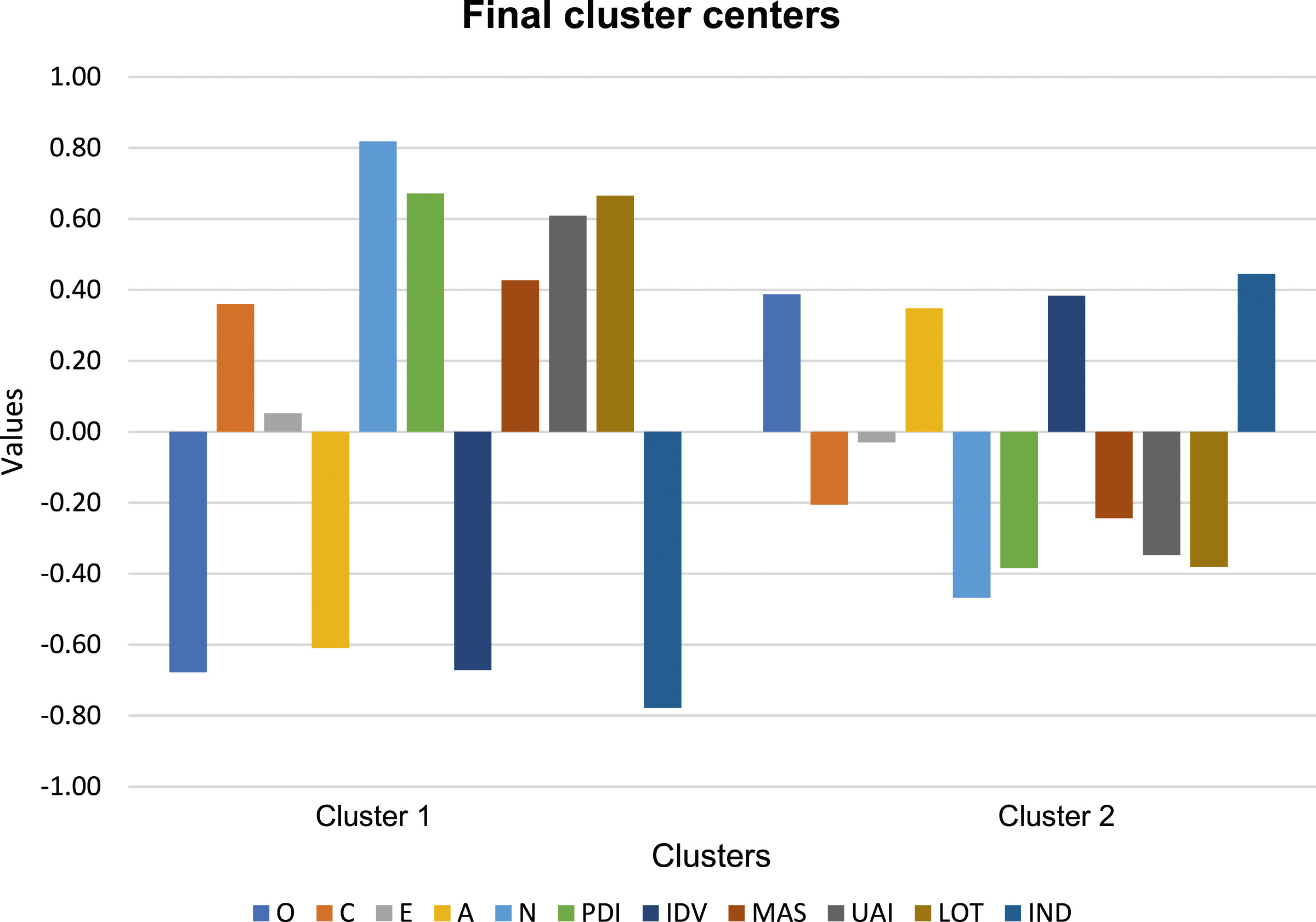
First scores were standardized. A hierarchical cluster analysis was run based on the Z-scores and identified two groups of countries that exhibited similar profiles in terms of Hofstede’s cultural dimensions and the Big 5 personality traits. These findings were then further refined via K-means cluster analysis, which assigned each country to a specific cluster based on its proximity to the cluster’s centroid. The cluster profiles were analyzed to understand the characteristics of each group. Figure 2 below demonstrates that countries in Cluster 1 exhibited high scores in conscientiousness, neuroticism, power distance, masculinity, uncertainty avoidance and long-term orientation, coupled with low scores in openness, agreeableness, individualism and indulgence. In contrast, Cluster 2 displayed higher scores in openness, agreeableness, individualism and indulgence, coupled with low scores in conscientiousness, neuroticism, power distance, masculinity, uncertainty avoidance and long-term orientation.
Figure 2. Scores of clustered countries across Hofstede’s cultural dimensions and Big 5 personality traits.
Table 3 below presents the mean scores for both the Big 5 and the Hofstede’s cultural dimensions, confirming the hypothesis that countries grouped together on the basis of Hofstede’s cultural dimensions will exhibit close personality trait scores. As it is possible to see, in cluster 1, the variation between highest and lowest personality trait scores is under 10 points, and in cluster 2, it is slightly over 10 points.
Discussion
The interplay between culture and personality is multifaceted and contributes to a person’s behaviour, attitudes, and beliefs (Berry, 2002; Bullough et al., 2022, Rosselli et al., 2022). People’s socialized culture can impact their personality traits, directly or indirectly, as emphasized by McCrae and Costa (1997), who point out culture’s role in shaping social norms, practices, and institutions, thus influencing personality development.
Triandis and Suh (2002) theorize that collectivist cultures, characterized by close ties between individuals, shared responsibilities, and group harmony, often foster personality traits like agreeableness and conscientiousness. Conversely, cultures that score high on uncertainty avoidance, which reflects the society’s tolerance for uncertainty and ambiguity, can lead to higher levels of neuroticism. These are examples of the relationship between cultural dimensions and personality traits. They are generalizations, though, and may not apply to every individual within a culture. More precise descriptions of personality traits require nuanced and individual-level research (Ebert et al., 2022), being rather an issue to be addressed on an individual level (Svane, 2004).
To that end, this study aimed at performing a more nuanced analysis of the cultural dimensions of a number of countries in light of their personality scores. In a way, the findings discussed herein echo the research by Schmitt and others (Schmitt, 2007) as well as Mõttus and others (Mõttus, 2020), who argued that cultural dimensions and personality traits are closely interlinked, with the former potentially influencing the latter. This is demonstrated in this paper by the fact that countries grouped together on the basis of Hofstede’s cultural dimensions have exhibited close personality traits scores – in cluster 1, the variation between highest and lowest personality trait scores is of under 10 points, and in cluster 2, it is slightly over 10 points. Thus, this study also aligns with Hofstede’s (1980) proposition that cultural dimensions can provide an effective framework for understanding cross-cultural differences in personality traits.
In the analysis of personality factors, national scores are not haphazard occurrences. Instead, they align with well-defined and relatively consistent variations in national value systems, which are regarded as manifestations of distinct national cultures. Consequently, the self-reported assessments of the five personality factors encompass not only individual variations in personality but also encompass a shared element that resonates among respondents from a given country. This common element can be attributed to one or more of the following three factors: (a) Genetic influences lead to systematic variations in the distribution of personality factors among different national populations; (b) As children grow up in a particular country, they tend to develop common personality traits; and (c) National cultures influence individuals' responses to a personality assessment (Hofstede & McCrae, 2004). Nonetheless, countries with inhabitants of various ethnicities (USA and UK, e.g.) are still able to produce stable and recognizable national culture scores proves that explanation, which suggests that explanation (a) above is insufficient by itself and has to be considered together with explanations (b) and (c). The understanding that there are inherent temperamental differences among ethnic groups leading to cultural variations remains a valid scientific hypothesis for studying cultural distinctions, though. The caveat here is the need to acknowledge socio-cultural influences and consider multiple factors influencing behavior (Allik & McCrae, 2004; A A Zaid et al., 2020).
Cluster 1
Generally speaking, high scores in conscientiousness and neuroticism might suggest higher levels of orderliness, discipline, and emotional sensitive. Likewise, low scores in openness and agreeableness may be manifested in lower levels of creativity, openness to new ideas and cooperation (McCrae & Costa, 2003).
In the case of the countries comprising cluster 1 (Albania, India, Germany, France, Hong Kong, China Romania and Mexico), the high score in conscientiousness could suggest that these nations place strong emphasis on organization, self-discipline, and adherence to rules and norms, which dovetails nicely with characteristics such as appreciation of stability and predictability over experimentation (a result of low openness scores) and prioritization of own interests over the needs and preferences of others (a trademark of low agreeableness levels).
Countries like Albania, India and China tend to present hierarchical societies where people have their own “place” which needs no further justification (De Mooij, 2021) and there is high appreciation for official titles and positions, leading to a centralized control system (Huang et al., 2021). It is no coincidence that these three countries – as well as others in cluster 1 – also score high in power distance, as the results of this study suggest a positive correlation between the two dimensions. Polarized subordinate-superior relationships, with limited defence against potential power abuse by superiors have been noted (Ström, 2020) as a trademark of nations with high power distance scores, which can also be observed in some of the cluster 1 countries.
By and large, societies that can be described as traditional, hierarchical, and focused on stability and conformity to social norms tend to score high in power distance, masculinity, uncertainty avoidance, and long-term orientation, but score low in individualism and indulgence (as it is the case for Cluster 1 countries, Figure 1 above). These nations are not only likely to have strong hierarchical structures with clear authority figures, as discussed in the previous paragraph, but also value traditional gender roles and may resist changes to established practices and norms. The gender gap has been widely discussed (Farrell, 2005; Hausmann et al., 2009) and it is difficult to deny its existence. Indeed, the gender role-play game has been observed to impact, for example, migration tendencies in Albania (Stecklov et al., 2010), labour market in Mexico (Gurría, 2021) and negatively influencing egalitarian sex-role attitudes in both Germany (Bauernschuster & Rainer, 2012) and China (Cooke, 2023). Not by accident, all countries found in cluster 1.
Furthermore, people are more likely to act in ways that benefit their larger social groups, and there is an emphasis on long-term planning and stability (Kordzadeh & Ghasemaghaei, 2022; Schwartz, 1999). The focus on conformity and restraint may lead to a more conservative (Hofstede et al., 2010) and risk-averse approach to life (Beugelsdijk et al., 2018; Inglehart & Baker, 2000). Understanding these cultural dimensions helps in comprehending the societal norms and behaviours that shape interactions within this particular cultural context.
Cluster 2
Largely, societies that score high in individualism and indulgence but score low in power distance, masculinity, uncertainty avoidance, and long-term orientation can be described as egalitarian, flexible, and focused on immediate gratification and personal autonomy (Hofstede, 1980). This description dovetails nicely with the personality scores cluster 2 countries have demonstrated (namely, Canada, New Zealand, South Africa, Australia, UK, Ireland, Norway, Philippines, Malaysia, USA, Netherlands, Sweden, Singapore and Finland). High levels of openness and agreeableness but low scores in conscientiousness and neuroticism can be manifested through open-mindedness, friendliness, and emotionally stability. A more relaxed and less structured approach to life and responsibilities can be the perceived outcomes (McCrae & Costa, 2003).
Nations such as Canada and Norway are known for being egalitarian, flexible and focused on personal autonomy. The same goes for Australia, Finland and Sweden, for example (Espig et al., 2021). Scandinavian nations, in particular, are renowned for their focus on egalitarian principles, flexibility, and personal autonomy. They tend to demonstrate flexibility through, for example, immigrant and refugee integration into their societies (Breidahl, 2017). This flexibility has yielded societies with high levels of equality and personal freedom (Hilson, 2008). A strong focus on egalitarianism and personal autonomy are also observed in the Nordic way of dealing with gender roles (Atchison, 2016).
Another country in cluster 2, the Netherlands is known for its progressive policies on issues such as drug consumption and the sex industry, which could be explained by the country’s high individualism and indulgence scores as well as low levels of long-term orientation that suggests a culture with a strong orientation towards immediacy, valuing quick results over long-term commitments (Barker, 2022). The UK and the USA, also members of cluster 2, score high on individualism and indulgence but low on power distance, masculinity, uncertainty avoidance, and long-term orientation. Not surprisingly they are symbols of the capitalist world where people are supposed to look after themselves and there is an expectation that in doing so power can be acquired regardless of who you are (Hofstede, 2011).
The examples above demonstrate how cultural characteristics of these countries are intertwined with their personality scores. High levels of openness are directly connected with low uncertainty avoidance scores, which is manifested by people’s willingness to explore unconventional paths. Likewise, high levels of agreeableness have an impact on low masculinity scores, which is reified by the citizens’ friendliness and nurturing qualities. Low levels of conscientiousness and neuroticism can be linked to high indulgence and low long-term orientation scores, which lead to people being more permissive, flexible and short-term oriented. In sum, understanding the relationship between these cultural and psychological dimensions helps in comprehending the societal norms and behaviours that shape interactions within the particular cultural context of the countries in cluster 2.
Conclusion
The paper investigates the relationship between Hofstede’s cultural dimensions and the Big Five personality traits across 22 countries. It does so with the goal to respond to the overarching research question ‘How do Hofstede’s cultural dimensions correlate with the Big Five personality traits across different nations, and what are the implications of these relationships for understanding cultural influences on personality?’ which has been operationalized through the testing of two hypotheses on whether Hofstede’s cultural dimensions significantly relate to the Big Five traits and whether countries sharing cultural similarities exhibit similar personality trait scores.
The findings produced herein have highlighted a substantial link between certain cultural dimensions (precisely, Masculinity, Power Distance, Individualism, and Uncertainty Avoidance) and the Big Five traits, while Long-Term Orientation and Indulgence did not significantly correlate with personality traits. The use of regression and cluster methods to confirm that countries grouped based on cultural dimensions showed similar personality trait scores, provides a multi-dimensional approach to understanding culture-personality relationships, which is a step beyond simple correlational studies typically found in the literature. In this sense, this paper contributes to the field by providing a nuanced examination of the interplay between Hofstede’s cultural dimensions and the Big Five personality traits across a diverse set of countries, which helps to refine existing theories by identifying specific cultural dimensions that have a statistically significant predictive power over certain personality traits, and by demonstrating the empirical clustering of countries based on these cultural and personality alignments.
By demonstrating significant links between specific cultural dimensions and the Big Five traits, this study corroborates existing theories on the influence of cultural contexts on individual dispositions. At the same time, the non-significant correlations pointed out in this paper prompt intriguing questions about the extent of cultural impact on these particular personality facets. In this sense, this research not only advances our understanding of the interplay between culture and personality but also paves the way for future inquiries exploring the nuanced mechanisms underpinning these relationships in diverse global contexts.
Limitations
The data used in this study concerning the Big 5 personality traits was collected on the internet. Internet surveys raise concerns about respondent control and identification. Participants actively located the site and completed questionnaires with feedback as the sole incentive. Despite substantial numbers of respondents per country, self-selection biases may hinder sample representativeness. Similar respondent ages and gender ratios bolster study validity for cross-country comparisons.
Another significant issue concerning the internet survey was its limited scope to English-speaking participants. Firstly, this might indicate higher socio-economic status and younger age, particularly in non-English speaking nations, potentially influencing country-specific trait levels. Secondly, this could undermine validity due to English not being the native language for many samples. Yet, individuals with weak English skills are unlikely to actively seek out an extensive English internet survey. Additionally, the IPIP-NEO employs reader-friendly, concise items, mitigating language barriers (e.g., “...yell at others,” “...seek adventure,” “...tell the truth”).
Furthermore, although Hofstede’s model has been widely adopted in the study of intercultural relations, one needs to be aware of its shortcomings. Perhaps the most obvious one is the risk of incurring oversimplifications of complex cultural realities, leading to stereotyping. Individual variations within cultures (e.g., subcultures, religion) may not be captured and transformations over time (e.g., globalization and migration trends) might not be accounted for.
Finally, one significant limitation of this study stems from the temporal gap between the cultural data originally collected by Hofstede nearly half a century ago and the more recent collection of personality data. While Hofstede’s cultural dimensions have been foundational in cross-cultural research, providing a comparative framework for understanding cultural differences, it is essential to acknowledge that cultures are dynamic entities subject to change over time. This study, by relying on Hofstede’s historical data, implicitly assumes the stability of cultural dimensions across decades, which may not fully reflect the contemporary cultural landscapes influenced by globalization, technological advances, and shifting societal values. Although various studies have demonstrated a considerable degree of stability in Hofstede’s dimensions over time, this assumption may not hold universally across all countries and cultures. Therefore, future research should aim to incorporate contemporary cultural data to validate and refine the relationship between cultural dimensions and personality traits, ensuring that the findings remain relevant and accurately reflective of current cultural contexts.
Future Research
Assuming the connections between cultural dimensions and personality traits drawn in this paper are robust, further research could delve into examining causal relationships. Experimental studies could explore how personality influences culture within smaller groups or entities, which would potentially mitigate the risk of oversimplification and undue generalizations large-scale studies might experience. It is essential to note, however, that societies operate at a broader scale, so the outcomes of such studies may or may not universally apply at larger scales.
Although studies with an experimental design produce invaluable knowledge, future research should also explore extended immersion in a cultural environment, especially during childhood where personality traits are malleable to a larger extent. Migration studies (with focus on acculturation issues) become crucial here, particularly as many immigrant groups maintain their ethnic identity through several generations in a new country. If one were to hypothesize that personality traits mostly reflect genetic variations, then residing in a new country should not bear a major impact on these traits. However, if culture plays a pivotal role in shaping traits and most immigrants do assimilate into the new culture, successive generations should increasingly resemble the host country’s profile. These are issues that could be explored adopting an ethnographic approach whereby the researcher could go about investigating how certain traits are usually expressed in a given culture.
Acknowledgments
The author extends his appreciation to Professor Jon Anthony Johnson for the sharing of his IPIP-NEO data repository, instrumental in facilitating this research.
Declaration of Conflicting Interests
The author(s) declared no potential conflicts of interest with respect to the research, authorship, and/or publication of this article.
Funding
The author(s) received no financial support for the research, authorship, and/or publication of this article.
A A Zaid M., Wang M., Adib M., Sahyouni A., T F Abuhijleh S. (2020). Boardroom nationality and gender diversity: Implications for corporate sustainability performance. Journal of Cleaner Production, 251(1), 119652. https://doi.org/10.1016/j.jclepro.2019.119652
Aberle D. F., Cohen A. K., Davis A. K., Levy M. J. Jr., Sutton F. X. (1950). The functional prerequisites of a society. Ethics, 60(2), 100–111. https://doi.org/10.1086/290705
Allen T. A., DeYoung C. G. (2017). Personality neuroscience and the five factor model. In Widiger T. (Ed.), Oxford handbook of the fivefactor model, 319, 52.
Allik J., Church A. T., Ortiz F. A., Rossier J., Hřebíčková M., de Fruyt F., Realo A., McCrae R. R. (2017). Mean profiles of the NEO personality inventory. Journal of Cross-Cultural Psychology, 48(3), 402–420. https://doi.org/10.1177/0022022117692100
Allik J., McCrae R. R. (2004). Toward a geography of personality traits: Patterns of profiles across 36 cultures. Journal of Cross-Cultural Psychology, 35(1), 13–28. https://doi.org/10.1177/0022022103260382
Allik J., Realo A. (2017). How valid are culture-level mean personality scores? In Church A. T. (Ed.), The Praeger handbook of personality across cultures: Trait psychology across cultures (pp. 193–224). Praeger/ABC-CLIO.
Allik J., Realo A., McCrae R. R. (2023). Conceptual and methodological issues in the study of the personality-and-culture relationship. Frontiers in Psychology, 14(1), 1077851. https://doi.org/10.3389/fpsyg.2023.1077851
Barker K. L. (2022). How values shape attitudes: The Stigma of sex work in Amsterdam. Doctoral Dissertation, The Chicago School of Professional Psychology.
Bauernschuster S., Rainer H. (2012). Political regimes and the family: How sex-role attitudes continue to differ in reunified Germany. Journal of Population Economics, 25(1), 5–27. https://doi.org/10.1007/s00148-011-0370-z
Bessell S. (2023). Sustainability, knowledge and social identity: Commonalities, conflicts and complexities in coastal communities in Tasmania, Australia. In Valuing the Past, Sustaining the future? Exploring Coastal societies, childhood (s) and local knowledge in times of global transition (pp. 139–160): Springer International Publishing.
Beugelsdijk S., Kostova T., Kunst V. E., Spadafora E., Van Essen M. (2018). Cultural distance and firm internationalization: A meta-analytical review and theoretical implications. Journal of Management, 44(1), 89–130. https://doi.org/10.1177/0149206317729027
Breidahl K. N. (2017). Scandinavian exceptionalism? Civic integration and labour market activation for newly arrived immigrants. Comparative Migration Studies, 5(1), 2–19. https://doi.org/10.1186/s40878-016-0045-8
Bullough A., Guelich U., Manolova T. S., Schjoedt L. (2022). Women’s entrepreneurship and culture: Gender role expectations and identities, societal culture, and the entrepreneurial environment. Small Business Economics, 58(2), 985–996. https://doi.org/10.1007/s11187-020-00429-6
Cattell R. B., Graham R. K., Woliver R. E. (1979). A reassessment of the factorial cultural dimensions of modern nations. The Journal of Social Psychology, 108(2), 241–258. https://doi.org/10.1080/00224545.1979.9711638
Clark L. A., Livesley W. J. (2002). Two approaches to identifying the dimensions of personality disorder: Convergence on the five-factor model. In Costa P. T., Widiger T. A. (Eds.), Personality disorders and the five-factor model of personality (pp. 161–176). American Psychological Association.
Cooke F. L. (2023). Changing lens: Broadening the research agenda of women in management in China. Journal of Business Ethics: JBE, 184(2), 375–389. https://doi.org/10.1007/s10551-022-05105-1
Costa P. T., McCrae R. R. (1988). Personality in adulthood: A six-year longitudinal study of self-reports and spouse ratings on the NEO personality inventory. Journal of personality and social psychology, 54(5), 853–863. https://doi.org/10.1037//0022-3514.54.5.853
Costa P. T., McCrae R. R. (1992). Normal personality assessment in clinical practice: The NEO Personality Inventory. Psychological Assessment, 4(1), 5–13. https://doi.org/10.1037/1040-3590.4.1.5
Costa P. T., McCrae R. R. (2008). The revised NEO personality inventory (NEO-PI-R). The SAGE Handbook of Personality Theory and Assessment, 2(3), 179–198. https://doi.org/10.4135/9781849200479.n9
DeYoung C. G., Weisberg Y. J., Quilty L. C., Peterson J. B. (2013). Unifying the aspects of the Big Five, the interpersonal circumplex, and trait affiliation. Journal of Personality, 81(5), 465–475. https://doi.org/10.1111/jopy.12020
Ebert T., Gebauer J. E., Brenner T., Bleidorn W., Gosling S. D., Potter J., Rentfrow P. J. (2022). Are regional differences in psychological characteristics and their correlates robust? Applying spatial-analysis techniques to examine regional variation in personality. Perspectives on Psychological Science: A Journal of the Association for Psychological Science, 17(2), 407–441. https://doi.org/10.1177/1745691621998326
Espig A., Mazzini I. T., Zimmermann C., de Carvalho L. C. (2021). National culture and innovation: A multidimensional analysis. Innovation & management review, 19(4), 322–338.
Farrell W. (2005). Why men earn more: The startling truth behind the pay gap and what women can do about it. CreateSpace Independent Publishing Platform, ISBN: 1542751292.
Gignac G. E., Szodorai E. T. (2016). Effect size guidelines for individual differences researchers. Personality and Individual Differences, 102(9), 74–78. https://doi.org/10.1016/j.paid.2016.06.069
Goldberg L. R., Johnson J. A., Eber H. W., Hogan R., Ashton M. C., Cloninger C. R., Gough H. G. (2006). The international personality item pool and the future of public-domain personality measures. Journal of Research in Personality, 40(1), 84–96. https://doi.org/10.1016/j.jrp.2005.08.007
Hirschfeld G., Brachel R. V., Thielsch M. (2014). Selecting items for Big Five questionnaires: At what sample size do factor loadings stabilize? Journal of Research in Personality, 53(5), 54–63. https://doi.org/10.1016/j.jrp.2014.08.003
Hofstede G. (1995). Multilevel research of human systems: Flowers, bouquets and gardens. Human Systems Management, 14(3), 207–217. https://doi.org/10.3233/hsm-1995-14304
Hofstede G. (2011). Dimensionalizing cultures: The Hofstede model in context. Online readings in psychology and culture, 2(1), 8. https://doi.org/10.9707/2307-0919.1014
Hofstede G., Hofstede G. J., Minkov M. (2010). Cultures and organizations - software of the mind: Intercultural cooperation and its importance for survival. McGraw-Hill.
Hofstede G., McCrae R. R. (2004). Personality and culture revisited: Linking traits and dimensions of culture. Cross-Cultural Research, 38(1), 52–88. https://doi.org/10.1177/1069397103259443
Hofstede G. H., Bond M. H. (1988). The Confucius connection: From cultural roots to economic growth. Organizational Dynamics, 16(9), 5–21. https://doi.org/10.1016/0090-2616(88)90009-5
Huang L. Y., Yang Lin S. M., Hsieh Y. J. (2021). Cultivation of intrapreneurship: A framework and challenges. Frontiers in Psychology, 12(1), 731990. https://doi.org/10.3389/fpsyg.2021.731990
Inglehart R., Baker W. E. (2000). Modernization, cultural change, and the persistence of traditional values. American Sociological Review, 65(1), 19–51. https://doi.org/10.2307/2657288
Inkeles A., Levinson D. J. (1954). National character: The study of modal personality and sociocultural systems. In Lindzey G. (Ed.), Handbook of social psychology (2, pp. 977–1020). Addison-Wesley.
Johnson J. A. (2014). Measuring thirty facets of the Five Factor Model with a 120-item public domain inventory: Development of the IPIP-NEO-120. Journal of Research in Personality, 51(1), 78–89. https://doi.org/10.1016/j.jrp.2014.05.003
Kordzadeh N., Ghasemaghaei M. (2022). Algorithmic bias: Review, synthesis, and future research directions. European Journal of Information Systems, 31(3), 388–409. https://doi.org/10.1080/0960085x.2021.1927212
Levine B. R., Harrington J. R., Uhlmann E. L. (2019). Culture and work. Handbook of Cultural Psychology, edited by Cohen D., Kitayama S. The Guilford Press. p, 630.
Lilienfeld S. O., Wood J. M., Garb H. N. (2000). The scientific status of projective techniques. Psychological Science in the Public Interest: A Journal of the American Psychological Society, 1(2), 27–66. https://doi.org/10.1111/1529-1006.002
Lynn R., Hampson S. L. (1975). National differences in extraversion and neuroticism. British Journal of Social & Clinical Psychology, 14(3), 223–240. https://doi.org/10.1111/j.2044-8260.1975.tb00175.x
MacCann C., Jiang Y., Brown L. E., Double K. S., Bucich M., Minbashian A. (2020). Emotional intelligence predicts academic performance: A meta-analysis. Psychological Bulletin, 146(2), 150–186. https://doi.org/10.1037/bul0000219
Maples J. L., Guan L., Carter N. T., Miller J. D. (2014). A test of the international personality item pool Representation of the revised NEO personality inventory and development of a 120-item IPIP-based measure of the five-factor model. Psychological Assessment, 26(4), 1070–1084. https://doi.org/10.1037/pas0000004
Marcus B., Machilek F., Schütz A. (2006). Personality in cyberspace: Personal web sites as media for personality expressions and impressions. Journal of personality and social psychology, 90(6), 1014–1031. https://doi.org/10.1037/0022-3514.90.6.1014
McCrae R. R. (2002). Cross-cultural research on the five-factor model of personality. Online readings in psychology and culture, 4(4), 1. https://doi.org/10.9707/2307-0919.1038
Mendoza-Denton R., Mischel W. (2007). Integrating system approaches to culture and personality: The cultural cognitive-affective processing system. In Kitayama S., Cohen D. (Eds.), Handbook of cultural psychology (pp. 175–195). Guilford Press.
Mõttus R., Wood D., Condon D. M., Back M. D., Baumert A., Costantini G., Epskamp S., Greiff S., Johnson W., Lukaszewski A., Murray A., Revelle W., Wright A. G., Yarkoni T., Ziegler M., Zimmermann J., Zimmermann J. (2020). Descriptive, predictive and explanatory personality research: Different goals, different approaches, but a shared need to move beyond the Big Few traits. European Journal of Personality, 34(6), 1175–1201. https://doi.org/10.1002/per.2311
Oyserman D., Coon H. M., Kemmelmeier M. (2002). Rethinking individualism and collectivism: Evaluation of theoretical assumptions and meta-analyses. Psychological Bulletin, 128(1), 3–72.
Radke H. R., Kutlaca M., Siem B., Wright S. C., Becker J. C. (2020). Beyond allyship: Motivations for advantaged group members to engage in action for disadvantaged groups. Personality and Social Psychology Review: An Official Journal of the Society for Personality and Social Psychology, Inc, 24(4), 291–315. https://doi.org/10.1177/1088868320918698
Rosselli M., Uribe I. V., Ahne E., Shihadeh L. (2022). Culture, ethnicity, and level of education in Alzheimer's disease. Neurotherapeutics: The Journal of the American Society for Experimental NeuroTherapeutics, 19(1), 26–54. https://doi.org/10.1007/s13311-022-01193-z
Rothmann S., Weiss L. A., Redelinghuys J. J. (2019). Cultural, national, and individual diversity and their relationship to the experience of meaningful work. The oxford handbook of meaningful work (pp. 429–446).
Saucier G. (1997). Effects of variable selection on the factor structure of person descriptors. Journal of personality and social psychology, 73(6), 1296–1312. https://doi.org/10.1037//0022-3514.73.6.1296
Schmitt D. P., Allik J., McCrae R. R., Benet-Martínez V. (2007). The geographic distribution of big five personality traits: Patterns and profiles of human self-description across 56 nations. Journal of Cross-Cultural Psychology, 38(2), 173–212. https://doi.org/10.1177/0022022106297299
Stecklov G., Carletto C., Azzarri C., Davis B. (2010). Gender and migration from Albania. Demography, 47(4), 935–961. https://doi.org/10.1007/BF03213734
Paulo Rocha, PhD is a Senior researcher at the Centre for Intercultural Communication in VID Specialized University. His academic background is rooted in law and social sciences, and he has a track record of academic publications on topics such as offender rehabilitation, interagency collaboration, and intercultural communication. Over the years, Dr. Rocha has taught and mentored students at various universities and actively contributed to several funded projects. He is currently the leader of a master's programme on intercultural work and is editor-in-chief for intercultural communication at the Journal of Intercultural Communication.
Cite
Cite
Cite
OR
Download to reference manager
If you have citation software installed, you can download citation data to the citation manager of your choice
Differential personality predictors and contextuality in human rights support: how the Big-Five personality model predicts support for human rights in a post-ethnic conflict society
Impact of personality traits on activities of daily living in patient-reported outcomes one and six months after total knee arthroplasty: a cohort study
Peculiar Relations of Life Expectancy with Economics according to the Preston Curve and with Cultural Values according to the Hofstede Dimensions in Former Soviet Union and Yugoslavia Countries
I can access personal subscriptions, purchases, paired institutional access and free tools such as favourite journals, email alerts and saved searches.