Intended for healthcare professionals
Restricted access
Research article
First published online January 19, 2023

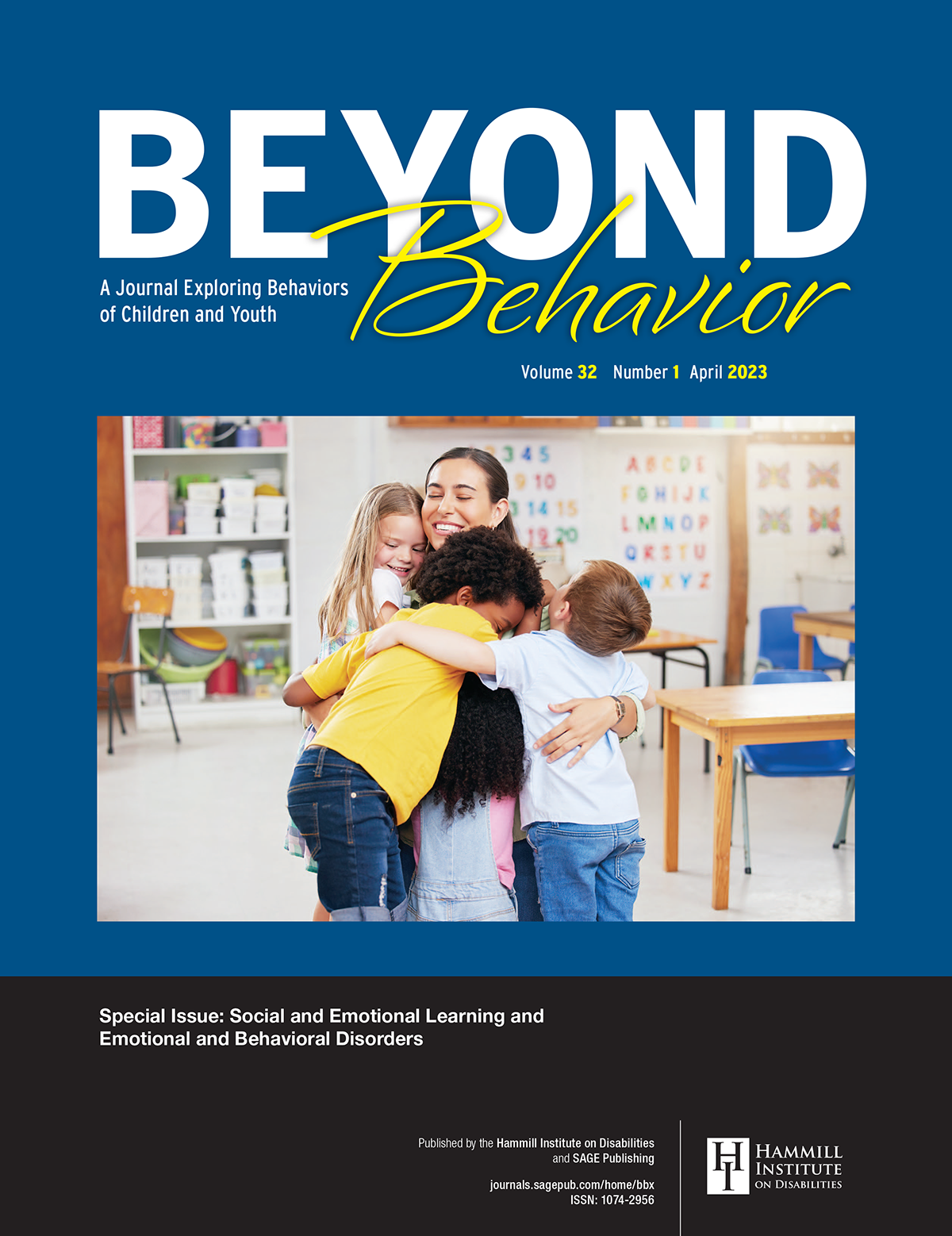
Welcome to Our Class! Building Classroom Rapport to Support the Development of Social and Emotional Learning Skills

Abstract

In this article, we describe practical, usable ways teachers can build rapport with students, particularly students with and at risk for emotional and behavioral disorders. By establishing rapport, teachers can increase the effectiveness of the social and emotional learning curriculum and interventions delivered. Specifically, the warm welcomes, transitions, emotion checks, two by 10, and optimistic closures strategies are described.

Get full access to this article

View all access and purchase options for this article.

References

Bennett N., Dunne E., Carré C. (2000). Skills development in higher education and employment. Taylor & Francis.
Buck G. L. (1999). Smoothing the rough edges of classroom transitions. Intervention in School and Clinic, 34, 224–227. https://doi.org/10.1177/105345129903400406
Collaborative for Academic, Social, and Emotional Learning. (2019). SEL 3 signature practices playbook: A tool that supports systemic SEL. https://schoolguide.casel.org/uploads/2018/12/CASEL_SEL-3-Signature-Practices-Playbook-V3.pdf
Collaborative for Academic, Social and Emotional Learning. (2020). What is SEL? https://casel.org/what-is-sel/
Durlak J. A., Weissberg R. P., Dymnicki A. B., Taylor R. D., Schellinger K. (2011). The impact of enhancing students’ social and emotional learning: A meta-analysis of school-based universal interventions. Child Development, 82, 405–432. https://doi.org/10.1111/j.1467-8624.2010.01564.x
Embry D. D., Biglan A. (2008). Evidence-based kernels: Fundamental units of behavioral influence. Clinical Child and Family Psychology Review, 11, 75–113. https://doi.org/10.1007/s10567-008-0036-x
Ennis R. P., Evanovich L., Losinski M., Jolivette K., Kimball K. (2019). Behavioral, academic, and social characteristics of students with EBD served in a residential facility. In Landrum T. J., Cook B. G., Tankersley M. (Eds.), Advances in learning and behavioral disabilities (vol.40, pp. 93–112). Emerald Insight.
Frisby B. N., Housley Gaffney A. L. (2015). Understanding the role of instructor rapport in the college classroom. Communication Research Reports, 32(4), 340–346. https://doi.org/10.1080/08824096.2015.1089847
Frisby B. N., Martin M. (2010). Instructor-student and student-student rapport in the classroom. Communication Education, 59, 146–164. https://doi.org/10.1080/03634520903564362
Frymier A. B., Houser M. L. (2000). The teacher-student relationship as an interpersonal relationship. Communication Education, 49, 207–219. https://doi.org/10.1080/03634520009379209
Gage N. A., Scott T., Hirn R., MacSuga-Gage A. S. (2018). The relationship between teachers’ implementation of classroom management practices and student behavior in elementary school. Behavioral Disorders, 43, 302–315. https://doi.org/10.1177/0198742917714809
Greenberg M. T., Weissberg R. P., O’Brien M. U., Zins J. E., Fredericks L., Resnik H., Elias M. J. (2003). Enhancing school-based prevention and youth development through coordinated social, emotional, and academic learning. American Psychologist, 58, 466–474. https://doi.org/10.1037/0003-066X.58.6-7.466
Gresham F. M. (2000). Assessment of social skills in students with emotional and behavioral disorders. Assessment for Effective Intervention, 26(1), 51–58. https://doi.org/10.1177/073724770002600107
Hamre B. K., Pianta R. C. (2001). Early teacher–child relationships and the trajectory of children’s school outcomes through eighth grade. Child Development, 72, 625–638. https://doi.org/10.1111/1467-8624.00301
Hemmeter M. L., Snyder P. A., Fox L., Algina J. (2016). Evaluating the implementation of the Pyramid Model for promoting social-emotional competence in early childhood classrooms. Topics in Early Childhood Special Education, 3, 133–146. https://doi.org/10.1177/0271121416653386
Hirn R. G., Scott T. M. (2014). Descriptive analysis of teacher instructional practices and student engagement among adolescents with and without challenging behavior. Education and Treatment of Children, 37, 589–610. https://doi.org/10.1353/etc.2014.0037
Hovland M. (2008). GRR to conquer classroom management. New Teacher Advocate, 18, 1–3.
Jennings T., Minnici A., Yoder N. (2019). Creating the working conditions to enhance teacher social and emotional well-being. In Osher D., Mayer M., Jagers R., Kendziora K., Wood L. (Eds.), Keeping students safe and helping them thrive (pp. 210–239). Praeger/ABC-CLIO.
Jones S. M., Bailey R., Brush K., Kahn J. (2017). Kernels of practice for SEL: Low-cost, low-burden strategies. Harvard Graduate School of Education.
Kern L., Clemens N. H. (2007). Antecedent strategies to promote appropriate classroom behavior. Psychology in the Schools, 44(1), 65–75. https://doi.org/10.1002/pits.20206
Lawson G. M., McKenzie M. E., Becker K. D., Selby L., Hoover S. A. (2019). The core components of evidence-based social emotional learning programs. Prevention Science, 20, 457–467. https://doi.org/10.1007/s11121-018-0953-y
Mahoney J. L., Weissberg R. P., Greenberg M. T., Dusenbury L., Jagers R. J., Niemi K., Schlinger M., Schlund J., Shriver T. P., VanAusdal K., Yoder N. (2021). Systemic social and emotional learning: Promoting educational success for all preschool to high school students. American Psychologist, 76, 1128–1142. https://doi.org/10.1037/amp0000701
Mashburn A. J., Pianta R. C., Hamre B. K., Downer J. T., Barbarin O. A., Bryant D., Burchinal M., Early D. M., Howes C. (2008). Measures of classroom quality in prekindergarten and children’s development of academic, language, and social skills. Child Development, 79, 732–749. https://doi.org/10.1111/j.1467-8624.2008.01154.x
Pianta R. C., Belsky J., Vandergrift N., Houts R., Morrison F. J. (2008). Classroom effects on children’s achievement trajectories in elementary school. American Educational Research Journal, 45, 365–397. https://doi.org/10.3102/0002831207308230
Prather-Jones B. (2011). “Some people aren’t cut out for it”: The role of personality factors in the careers of teachers of students with EBD. Remedial and Special Education, 32, 179–191. https://doi.org/10.1177/0741932510362195
Rosenkoetter S. (1986). Teaching mainstreamed children to manage daily transitions. Teaching Exceptional Children, 19, 20–23. https://doi.org/10.1177/004005998601900104
Simonsen B., Fairbanks S., Briesch A., Myers D., Sugai G. (2008). Evidence-based practices in classroom management: Considerations for research to practice. Education and Treatment of Children, 31, 351–380. https://doi.org/10.1353/etc.0.0007
Smith S. C., Higbee T. S. (2020). Effects to behavioral skills training on teachers conducting the recess-to-classroom transition. Journal of Behavior Education, 30, 624–640. https://doi.org/10.1007/s10864-020-09395-1
Speelman C. (2005). Skill acquisition: History, questions, and theories. In Speelman C., Kinser K. (Eds.), Beyond the learning curve: The construction of mind (pp. 26–64). Oxford University Press.
Svinicki M., McKeachie W. J. (2011). McKeachie’s teaching tips: Strategies, research, and theory for college and university teachers (13th ed.). Wadsworth.
Thelen P., Klifman T. (2011). Using daily transition strategies to support all children. Young Children, 66(4), 92–98.
Van Loan C. L., Garwood J. D. (2020). Facilitating high-quality relationships for students with emotional and behavioral disorders in crisis. Intervention in School and Clinic, 55, 253–256. https://doi.org/10.1177/1053451219855740
Webb N., Barrett L. O. (2014). Student views of instructor-student rapport in the college classroom. Journal of the Scholarship of Teaching and Learning, 14(2), 15–28. https://doi.org/10.14434/josotl.v14i2.4259
Wilson J. H., Ryan R. G., Pugh J. L. (2010). Professor–student rapport scale predicts student outcomes. Teaching of Psychology, 37(4), 246–251. https://doi.org/10.1080/00986283.2010.510976
Wlodkowski R. J., Ginsberg M. B. (1995). Diversity & motivation: Culturally responsive teaching. Jossey-Bass higher and adult education series. Jossey-Bass education series, Jossey-Bass social and behavioral science series. Jossey-Bass.