Intended for healthcare professionals
Free access
Research article
First published online February 17, 2015

Examining Queer Elements and Ideologies in LGBT-Themed Literature: What Queer Literature Can Offer Young Adult Readers

Abstract

This paper retrospectively examines a collection of lesbian, gay, bisexual and trans* (LGBT)-themed books discussed by lesbian, gay, bisexual, trans*, queer, and questioning (LGBTQQ) and ally students and teachers across 3 years of an out-of-school reading group. Through a textual content analysis of a sub-set of these books, we examine what queer literature looks like, identifying qualities it shares, and considering particular resources and possibilities it offers readers that are distinct from the broader category of LGBT-themed literature.

Introduction

For several years, we have argued for making literature with lesbian, gay, bisexual, trans*, queer, and questioning1 (LGBTQQ) characters and themes available to young people in schools. Recognizing that most schools do not yet support these opportunities, we initiated an out-of-school reading group with LGBTQQ and allied youth and their teachers to make this literature accessible to young people and to understand how such discussions might happen and what they might afford readers. Participating in and analyzing the talk that occurred in this book discussion group allowed us to identify and distinguish between LGBT-inclusive and queer discourses and to understand potentially oppressive and liberatory dimensions of each (Blackburn & Clark, 2011). LGBT-inclusive discourses often reinforce heteronormativity and binary constructions of sex and gender: that is, the social understanding that there are two distinct genders, women and men, that are synonymous with two distinct sexes, female and male, and that the expectation of being a woman (female) is to desire men (males), both emotionally and sexually, and vice versa. Because of this, LGBT-inclusive discourses may provide only a “sentimental education” (Britzman, 1995, p. 158) to readers, one that insists that gay and lesbian people are just like straight people and thus erases significant differences among people. Alternatively, a queer approach strives to suspend sexual and gender identities rather than underscore them (Jagose, 1996), interrogating heteronormativity by acknowledging a variety of genders, sexes, and desires, as well as foregrounding the sexual, thereby challenging the notion of what counts as normal among them (Blackburn & Clark, 2011). Given the understandings of LGBT-inclusive and queer discourses we gleaned in this prior analysis, we determined to look more closely at the texts that were selected and read in this book discussion group to explore what ideological and literary elements (Galda & Beach, 2001; Stephens, 1992) might further distinguish types of LGBT-themed literature.
The book discussion group, then, provides background for the focus of this analysis of the texts that were read in that group. That group, which included the first two authors, met at a local center serving LGBTQQ youth. Teacher participants came from a local teacher inquiry group committed to combating homophobia in schools through literature (Blackburn, Clark, Kenney, & Smith, 2010). Youth participants were initially invited by these teachers and often came from their schools’ gay-straight alliances (GSAs). Over time, youths directly invited peers, and some participants came from other schools beyond those of the initially invited teachers; moreover, some youths unaffiliated with schools but affiliated with the center also came to the group. Over 3 years of meeting, from October 2006 to July 2009, 32 people participated in the group, 22 youths and 10 adults. Across the 3 years, we met 20 times to discuss 24 texts, most of which were novels. Focal texts were always selected collaboratively. Both youths and adults brought recommendations for readings to the groups. Frequently, someone in the group—youth, adult, or both—had already read a text and thought others might enjoy it. In all cases, however, adults deferred to youth book selections.
It was after the group stopped meeting that we made a deliberate turn away from the voices of the group to look explicitly at texts. More specifically, we conducted a textual content analysis of a subset of the books read in the group. The subset comprised books we now understand to be queer. Through this analysis, we strive to answer the following research questions:
Research Question 1: What does queer literature look like? That is, what qualities do queer books share?
Research Question 2: What particular resources do queer books offer that are distinct from the broader category of literature with LGBT themes?
Analyzing these texts allowed us to understand and name the ideological and textual features of queer literature so that when such texts are read in schools, educators are better equipped to use them to model uses of language and other literary tools to critique and counter beliefs and ideologies (Galda & Beach, 2001), especially existing invisible ideologies of heterosexism, misogyny, and homophobia (Martino, 2009; Pascoe, 2007).

Conceptual Framework

To focus our analysis, we first had to identify which of the 24 texts that were read across the 3 years of this book discussion group were queer, a task that was more complicated than we initially imagined. Cart and Jenkins (2006) are, to our knowledge, the only scholars to date who have developed a heuristic of young adult (YA) literature with gay/lesbian/queer content. In their foundational work with respect to gay, lesbian, and queer YA literature, Cart and Jenkins relied on Bishop’s (1982) work in which she categorized African American children’s literature into social conscience books, melting pot books, and culturally conscious books. Using this as a model, Cart and Jenkins strove to “create a model specific to GLBTQ content in YA fiction using category descriptors that reflect post-Stonewall GLBTE history and experience to describe the evolution of YA literature with GLBTQ content from 1969 through 2004” (p. xix). Thus, they arrived at the following categories: homosexual visibility (HV), gay assimilation (GA), and queer consciousness/community (QC). It is this last category that seemed most likely to inform our effort to identify queer literature. It might even seem that we could just find the books that we had read that were, according to Cart and Jenkins, QC.
Their review, however, did not include all of the texts we shared because some of our texts are outside of the time period they reviewed (1969-2004) and other of our texts are outside of the parameters of what is conventionally considered “young adult.” That is, even though our books were selected, read, and discussed by young adults, they were not marketed to young adults. Moreover, upon a closer analysis of the Cart and Jenkins model, we came to understand that they were using queer as an umbrella term to reference LGBTQQ people in the early 21st century. As such, what they categorize as QC is not necessarily what we would categorize as queer, which is, as we say above, less of an underscoring of classifications based on sexual identities and gender expressions, like LGBTQQ, and more of a suspension of such classifications and an interrogation of norms associated with them. Therefore, where a QC book requires that there be more than one or two LGBTQQ character(s) and that those characters support one another in some way, it does not require that a character experiences his or her sexual identity fluidly or that he or she expresses her or his gender in multiple and variable ways, as examples. If a book does the former whether or not it does the latter, Cart and Jenkins would categorize it as QC; and we would agree with this categorization. If, however, a book does the latter whether or not it does the former, we would categorize it as Q. We understand all of these categories as ideological, as we discuss next.

Ideology

From our study of Cart and Jenkins (2006), we learned a significant distinction among their three categories mentioned above: HV, GA, and QC. The three suggest a loose chronology, with HV being of the 1970s and 1980s, GA being of the 1990s, and QC being of the early 21st century. More reliable, though, is what distinguishes the categories conceptually. In HV literature, a character comes out or is outed as gay or lesbian and this outing is the “dramatic substance” of the story (p. xx). GA literature includes “people who ‘just happen to be gay’ in the same way that someone ‘just happens’ to be left-handed or have red hair” (p. xx). QC literature, however, represents “GLBTQ characters in the context of their communities of GLBTQ people and their families of choice” (p. xx). As such, each of these categories is distinguished by ideologies, or “way[s] of viewing the world” (McCallum, 1999, p. 263) and, in this case, LGBTQQ people in it. Therefore, consider a book in which the only character to come out or be outed as gay lives a lonely life until he or she is killed or kills himself or herself, a storyline not atypical in the early HV literature. Such a book conveys an ideology, or way of viewing the world, in which being gay and out (or outed) is a pretty miserable existence. Even if the author’s intent is to conjure pity among straight people rather than fear among gay people, readers understand that being gay in this world comes with dire consequences. According to Stephens (1992), ideologies are inevitably communicated through texts, both explicitly and implicitly. Therefore, for example, literature in the QC category allows readers to view LGBTQQ people in worlds where their identities matter, but rather than these people being isolated, they are connected with others who share these important identities. We recognize these ideological distinctions both within and among texts as significant in coming to understand ways of selecting, reading, and discussing queer texts, which include QC texts. Therefore, next we needed to understand what might ideologically distinguish queer texts. For this, we turned to queer theory.

Queer Concepts

As we state above, queer is not the lumping together of lesbian, gay, bisexual, and transgender, although it does pay particular attention to sexual and gender identities such as these (Jagose, 1996). Rather, it is the suspension of these classifications (Pinar, 1998). Queer theorists recognize sexual and gender identities as social, multiple, variable, shifting, and fluid; and while they allow for movement among such identity categories (Britzman, 1997), they advocate for movement outside of these categories as well. By rejecting categories of identity, queer theorists interrogate and disrupt notions of normal, with particular respect to sexuality and gender (Tierney & Dilley, 1998), but not limited to these identities. It is these two key ideas—that is, understanding sexual and gender identities in complicated ways and valuing disruptions of norms—which we discuss next and focus on throughout this article.
Foundational to understanding sexual and gender identities in complicated ways is the belief that these identities are not essential or even developmental but instead are poststructural. Essentialism “ascribes a fundamental nature or a biological determinism to humans” (Leistyna, Woodrum, & Sherblom, 1996, p. 336), a view that Leistyna et al. characterize as “monolithic and homogenizing” (pp. 336-337). Still, this view is, according to Sears (1998), the “most common view of sexuality . . . [that is] sexuality as a universal human trait” (p. 83). From an essentialist perspective, identity is understood in singular and stable terms and as essential to one’s being. It may take some time for one to recognize and claim it, but an individual’s identity is there all along, and it will continue to be there throughout one’s life. A developmental perspective is not really a break from an essentialist one as much as it is a complication of it. In both essential and developmental approaches, it is understood that one develops one’s identity over time in a mostly linear fashion toward a true identity. What distinguishes the essentialist model from the developmental model is emphasis. When one embraces an essentialist notion of identity, one emphasizes the true, core, inherent identity and glosses over the process of getting to it. When one embraces a developmental model of identity, the reverse is true; that is, one focuses on the processes of coming to an identity, which is assumed but not discussed as fixed. According to Lesko (2001), the “developmental framework [is] often discussed as stages of cognitive, psychosocial, or pubertal growth” (p. 7). The poststructural approach, however, is more complex than either the essentialist or developmental approaches, and, indeed, a rejection of both. Lesko argues, “poststructural interpretations aim to provide alternative understandings and ideas . . . beyond the hierarchical and oppositional” (p. 17). With this notion of identity, there is no assumed true identity. Rather, a person, or here a character, experiences emotional and sexual desires, engages in sexual acts, and performs gender, but these cannot be captured with a single, stable sexual or gender identity. Instead, sexual and gender identities are understood as multiple, variable, and even, at times, conflicting.
The disruption of norms is a key tenet of queer theory. By norms, we mean social norms, which, according to Merriam-Webster, are “standards of proper or acceptable behavior.” In the context of queer theory, such standards are at least interrogated and more likely disrupted, focusing specifically on the disruption of sexual and gender norms, such as the binary between heterosexual and homosexual or that between man and woman. This goal and focus are grounded in the understanding of sexual and gender identities as social, multiple, variable, shifting, and fluid and the expectation of movement among and beyond such identity categories (Britzman, 1997). Queer theorists’ disruptions of norms are not limited to sexuality and gender, though. For example, in this study, the disruption of normative notions of families, homes, and time, stood out to us as characteristic of these queer novels.
Understanding queer in this way challenged us to consider whether, in queer literature, characters’ sexual and gender identities were represented as stable and essential or as something more complex. It also provoked us to examine whether norms, including those defined by sexual and gender binaries, notions of families, conceptions of homes, and even time, were disrupted.

Literary Elements

Just as queer theory guided our analysis, so too did scholarship on children’s and YA literature. We turned to this scholarship not because all of the literature we studied is marketed for children or young adults—it is not, as we mention above—but because it was selected, read, and discussed by yougn adults. The decision to select, read, and discuss literature marketed to adults with young adults and then use scholarship focused on literature marketed for children and young adults to guide our analysis of literature marketed to adults may seem misguided, but it is solidly grounded in Lesko’s (2001) conceptualization of adolescence. Lesko rejects the notion that adolescents are “deficient, a little crazy, controlled by hormones,” immature, and in transition (p. 189), and therefore incompetent to read books marketed for those older than they are. Instead, she proposes that “growth and change” are not limited to adolescents, instead they are “recursive . . . occurring over and over as we move into new situations” (p. 196). She also asserts that people, including adolescents, can hold “opposing identities simultaneously” (p. 197) so that they might be “simultaneously mature and immature, old and young, traditional and innovative” (p. 196). Accordingly, she argues for “concrete practices in which youth demand and exercise adultlike responsibilities” (p. 199). We assert that working with youth to select, read, and discuss books marketed to people older than they are is one such concrete practice. Furthermore, analyzing those books with insights we have gleaned from work with youth is one way of “work[ing] to improve youths’ life conditions without the hierarchy of adult over youth” (p. 13). With this in mind, we turned to scholarship on children’s and YA literature, which guided and informed our attention to literary elements.
In some cases, scholars pointed us directly to particular literary elements. Cadden (2000), for example, directs us to pay attention to mode and naïve narrators, and McCallum (1999) emphasizes the importance of focalization. It was our interest in sexuality and gender, though, that brought us to Stephens, with McCallum (McCallum & Stephens, 2010) and Romören (Romören & Stephens, 2002), who, helped us understand the significance of metonymic configurations. Similarly, it was our interest in time (Blackburn & Clark, 2014) that provoked us to consider flashback and foreshadowing. It is worth noting that we did not consider every instance of these or any other literary elements. Rather, we focused, in particular, on literary elements that served to convey the experiences of characters being and becoming queer. Next, we discuss each of the focal literary elements.

Mode

Mode is typically understood as a circle or compass, divided into quadrants including irony, comedy, romance, and tragedy, with comedy opposite tragedy and romance opposite irony (Cadden, 2010). Cadden (2000) asserts that most children’s literature is romantic and/or comedic with little movement beyond or between these. The problem with this, he claims, is that these modes do not provide much room for change by either the protagonists or the readers. Alternatively, he argues, irony and tragedy are more likely to produce change as a result of provoking cognitive dissonance and discomfort—unsettled by those feelings, the reader is pushed to engage the dialectic tensions posed by the competing values, ideas, and beliefs. Because Cadden’s interest in dissonance and discomfort aligns with queer theory’s tenet of disrupting norms, we, too attended to ironic and tragic modes, in particular, in our analysis of literature.

Focalization

Focalization is when some part of the story, perhaps a scene, event, or character, is described through the point of view of a character, who has unique beliefs and values which shape his or her interpretation and thus representation of the story. A character might be focalizing, that is, representing the scene, event, or character; or a character might be focalized, that is, represented through the eyes of a different character (McCallum, 1999). McCallum (1999) asserts that characters make their beliefs and values explicit through focalization, constructing themselves as ideologues and providing a range of ideologies from which readers can choose. There may be few or many focalizers in any novel. The more focalizers there are, the more polyphonic, or mulitvoiced, it is. A consequence of such a text is that it invites readers to align themselves with any number of ideologies (Cadden, 2000). Cadden (2000) argues that texts with multiple focalizers are the most ethical because they refrain from arguing for one clearly defined ideology. Building from Cadden’s argument, we assert that such texts are also the most queer because they avoid a single, static ideology and, instead, offer multiple and, at times, conflicting ideologies.

Naïve and unreliable narrators

Of course, some ideologies are meant to be resisted or suspect. Consider focalizations offered by naively unreliable characters or narrators. A naïve narrator (Cadden, 2000) is one who is “believable and challengeable,” often less “sophisticated” or “confident,” and thus, offers the reader, through her or his naïve discourse, a contestable view of the world (pp. 149-150). The contestability of naïve narrators contributes to the multivoicedness of the narration (Cadden, 2000) and, we assert, to the ideological diversity and queerness of a text.

Metonymic configurations

We also looked at metonymic configurations (McCallum & Stephens, 2010; Romören & Stephens, 2002); that is, the way in which patterns of behaviors, which are marked by gender, sexuality, and other normalized constructions, are “built up through the simple fictive practice of developing conflict and/or thematic implication through interactions amongst diverse and contrasting characters (often character stereotypes)” (p. 220). As Romören and Stephens (2002) describe, for example, a character’s behavior may be “marked by attributes which prompt readers to instantiate a schema for hegemonic masculinity” (p. 220), or other generalized practices. In the case of such a male character, he not only fulfills a story function but also is “apt to function as a metonym for hegemonic masculinity” in relation to other characters “performing different kinds of masculinity” as they “enter the novel’s configuration of gendered behaviors” (p. 220). Romören and Stephens note that both masculine and feminine metonymic configurations are possible as are other relational patterns, including father/son, mother/son, school situations, sports, and so on.

Flashbacks and foreshadowing

Finally, we examined flashbacks and foreshadowing, as temporal disruptions (Genette, 1980), particularly when those temporal disruptions mattered in the experiences of a character being or becoming queer. Bae and Young (2008) define a flashback as that which “tells (or shows) what has happened in the past with respect to the present” and foreshadowing as that which “presents what will happen in the future with respect to ‘now’ in the story” (p. 156). Such literary devices have a heterochronous effect; that is, they effectively disrupt time (Lemke, 2008). Heterochrony is when there is a change or distortion in processes aligned with time, or in Lemke’s (2008) words, it is the “intersection of processes and practices which have radically different inherent timescales” (pp. 25-26), with timescales meaning how long any given process takes. The notion of chronotope is foundational to the idea, and chronotope references both time and space, or, in Bakhtin’s (1981) words, chronotope is the “intrinsic connectedness of temporal and spatial relationships that are artistically expressed in literature” (p. 84). Multiple chronotopes can exist within one novel and are “mutually inclusive” and “dialogical” (Bakhtin, 1981, p. 252) with one another. With this in mind, we are conceptualizing heterochrony as a time-space (McCallum, 1999) in literature that is artistically distorted. Such an artistic distortion might carry throughout a novel or be captured in a particular scene. These literary elements that effectively disrupt normative notions of time in ways that inform readers’ understandings of queer characters play a significant role in queer texts.

Methods of Analysis

The critical literature on LGBT content in books for young adults (Cart & Jenkins, 2006) provided a starting point for this textual content analysis. Through our analysis, we came to agree with Cart and Jenkins (2006) that queer texts hold great promise, and that this promise lies in understanding these books both in terms of content as well as literary artfulness (p. 166). To start, we categorized our initial 24 books using Cart and Jenkins’s three categories of LGBT fiction: HV, GA, and QC. As we mention above, some of the books among our 24 were already categorized by Cart and Jenkins; in these cases, we used the categories that were assigned by them. Other books, however, were not; in those cases, we applied Cart and Jenkins’s heuristic to those books. In doing so, we came to understand a difference between what they call QC and what we were identifying as Queer (Q), as we discuss above. Thus, we narrowed the list to the five remaining texts: Alison Bechdel’s (2006)Fun home: A family tragicomic, Truman Capote’s (1994)Other Voices, Other Rooms, David Levithan’s (2005)Boy Meets Boy, Alice Walker’s (1982)The Color Purple, and Jeanette Winterson’s (1994)Written on the Body.Table 1 lists all 24 books read, Cart and Jenkins’s (2006) categorizations of seven of the texts, our characterizations of the remaining 17 texts, and annotations of the 5 focal texts.
Table 1. Texts and Characterizations.
Texts read with focal texts annotatedCart and Jenkins’s characteristicsOur characterizations
Levithan, D. (2003). Boy meets boy. New York, NY: Alfred A. Knopf.GA, QCQ
This book is about what the world might be like if homophobic values were greatly diminished and how the friendships and romantic relationships of Paul, a gay high school student, unfold in such an imaginary world.  
Chbosky, S. (1999). The perks of being a wallflower. New York, NY: MTV Books/Pocket Books.HV, GA 
Watts, J. (2001). Finding H.F. Los Angeles, CA: Alyson Books.QC 
Babcock, J. (2002). The tragedy of Miss Geneva flowers. New York, NY: Carroll & Graf. HV, QC
Wallace, K. (2004). Erik & Isabelle: Freshman year at Foresthill High. Sacramento: Foglight Press. HV, GA, QC
Wallace, K. (2005). Erik & Isabelle: Sophomore year at Foresthill High. Sacramento, CA: Foglight Press. HV, GA, QC
Sedaris, D. (1997). Holidays on ice. New York: Little, Brown. GA, QC
Plum-Ucci, C. (2002). What happened to Lani Garver? Orlando, FL: Harcourt.HV 
Peters, J. A. (2003). Keeping you a secret. New York, NY: Little, Brown, and Young Readers.HV, QC 
Bauer, M. D. (1994). Am I Blue? Coming out from the silence. New York, NY: HarperCollins.HV, GA, QC 
Moore, P. (2007). Hero. New York, NY: Hyperion. HV, GA, QC
Bechdel, A. (2006). Fun home. Boston, MA: Houghton Mifflin. HV, Q
This graphic memoir focuses on the author’s coming out as a lesbian and coming to terms with her father’s death in rural Pennsylvania.  
Smith, B. (2007). Selfish & perverse. New York, NY: Carroll & Graf. HV, QC
Sanchez, A. (2007). The God box. New York, NY: Simon &Schuster. HV, GA, QC
Tamaki, M. & Tamaki, J. (2008). Skim. Toronto, Ontario, Canada: Groundwood Books. HV
Newman, L. (1988). A letter to Harvey Milk. In A letter to Harvey Milk: Short stories (pp. 25-28). Ithaca, NY: Firebrand Books. HV
Walker, A. (1982). The color Purple. Orlando, FL: Harcourt. Q
This highly acclaimed epistolary novel centers on Celie, an African American woman in rural Georgia in the 1930s, and includes her intimate relationship with another woman.  
Flagg, F. (1987). Fried green tomatoes at the whistle stop café. New York, NY: McGraw-Hill. GA, QC
Goldman, S. (2008). Two parties, one tux, and a very short film about the grapes of wrath. New York, NY: Bloomsbury. HV, GA
Hartinger, B. (2003). Geography club. New York, NY: HarperTempest.HV, QC 
Chopin, K. (1976). The awakening. In B. H. Solomon (Ed.), The awakening and selected short stories of Kate Chopin (pp. 1-137). New York, NY: Signet Classics (Original work published 1899)  
Winterson, J. (1992). Written on the body. New York, NY: Vintage International. Q
This British novel tells the love story between the narrator, whose gender is never revealed, and a married woman.  
Capote, T. (1975). Other voices, other rooms. New York, NY: Vintage (Original work published 1948) Q
When Joel Knox is 12 years old, he moves from New Orleans to an isolated Louisiana community where he encounters a cast of characters fitting for a southern gothic novel, in this case, a semi-autobiographical one.  
Aarons, L. (1995). Prayers for Bobby: A mother’s coming to terms with the suicide of her gay son. New York, NY: HarperCollins. HV, QC
Note. GA = gay assimilation; QC = queer consciousness/community; Q = Queer; HV = homosexual visibility.
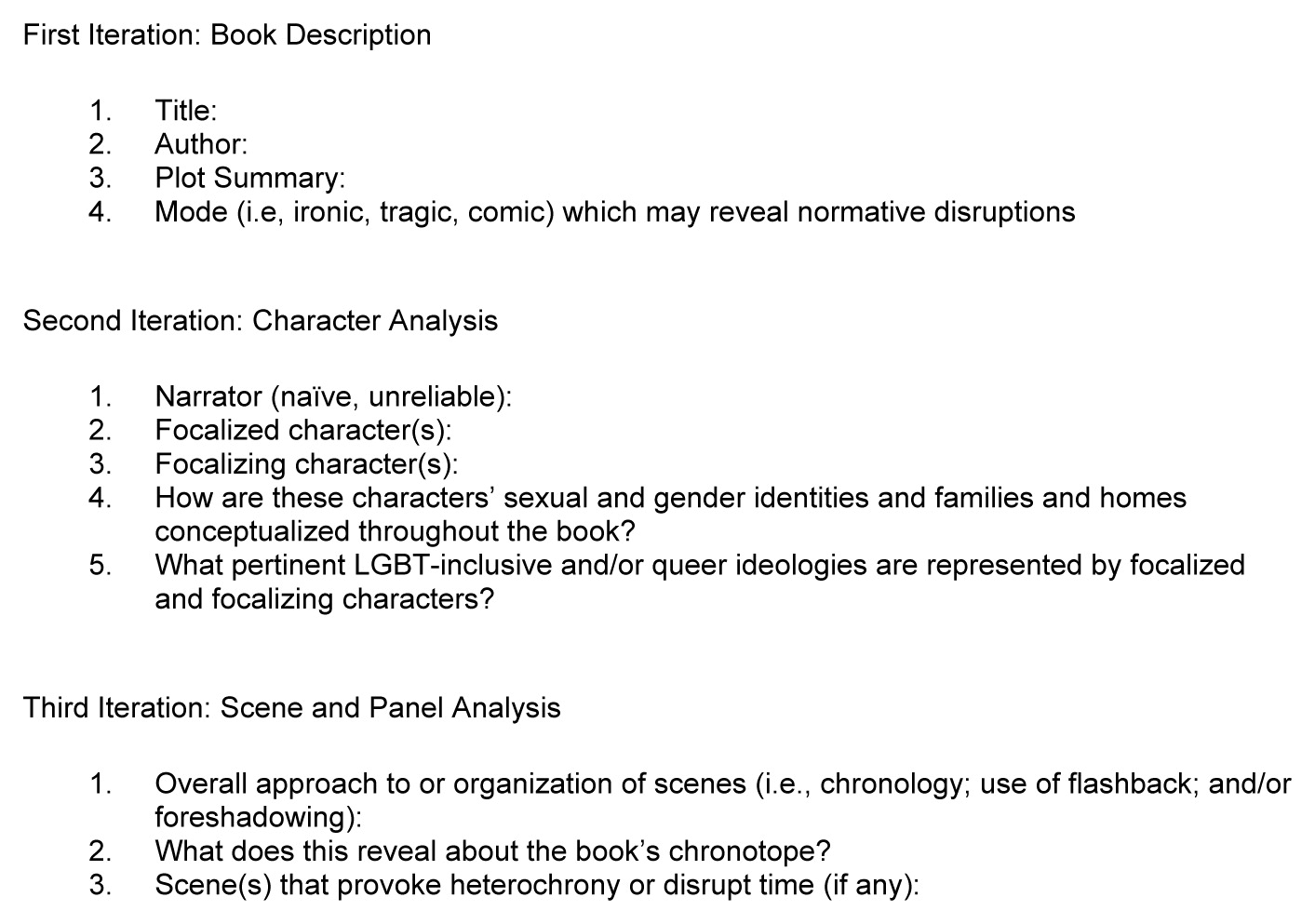
This initial, rough analysis lead us to categorize broadly these five remaining books as Queer—that is, as books in which characters experience sexual identity fluidly or express gender in multiple ways, or in which norms are disrupted. Like Cart and Jenkins (2006), however, we sought more nuanced understandings of what this meant in terms of these specific texts. Therefore, we engaged in several iterations of independently reading and rereading these five focal texts using our Book Analysis Tool (see Figure 1).
Figure 1. Three iterations of book analysis tools focused on describing the book, analyzing characters, and analyzing scenes and panels.
In our first iteration, we read each book to develop an initial Book Description, including constructing a plot summary and noting the literary mode(s) (Cadden, 2010) in each text. This allowed us to gauge our shared understandings of the texts and how they moved across literary mode, which connected to our interest in the disruption of norms. Next, we engaged in a Character Analysis of each book, noting the qualities of the narrator (e.g., naïve, unreliable; Cadden, 2000) and focalized and focalizing characters (McCallum, 1999). Given queer theory’s focus on fluidity in sexual identity and gender expression and the disruption of norms, we read with a focus on disruptions of sexual and gender norms as experienced by LGBTQQ characters in the contexts of families and homes. This left us with a thorough, shared understanding of all of the focalizing and focalized characters in each book, particularly in terms of normative and nonnormative constructions of sexuality, gender, families, and homes. Finally, to address our interest in time as a potential queer feature, we engaged in a third iteration of reading, this time with a focus on scenes and, in the case of Fun Home, panels. We noted shifts in time relative to the chronology of the narrative, as well as uses of flashback and foreshadowing. In the case of Fun Home, we paid special attention to shifts in how characters were rendered at different points in time, elements of time that were drawn into a panel (i.e., dates on photographs), and the ways that sequencing of panels either compressed long periods of time or drew out key moments over several panels. As we read, we noted the page numbers of specific lines, paragraphs, and panels for further analysis.
After iteratively applying the Book Analysis Tool to each text, we looked through all of our data (i.e., book descriptions, character analyses, and scene/panel analyses) to identify the specific ideologies that supported and contradicted our naming these books as queer. To do this, we created Cross Book Analysis tables in which we pulled together data related to specific concepts as they were manifested across each of the books. For example, Table 2 shows a sample excerpt from a Cross Book Analysis Table focused on conceptions of identities.
Table 2. Sample Excerpt From Cross Book Analysis Table.
Multiple and conflicting ideologiesBoy Meets BoyThe Color PurpleFun HomeOther Voices, Other RoomsWritten on the Body
Conceptions of Identity: Essential (E), Developmental (D), and Poststructural (PS)Paul and Infinite Darlene as fundamentally gay and trans*. “PAUL IS DEFINITELY GAY” (p. 8, E)
“ . . . few of us can remember what Daryl Heisenberg was like, since Infinite Darlene consumed him so completely” (p. 15, E)
Kyle’s identity is possibly more fluid, but maintained as bisexual through narrator, Paul:
Kyle—“But I wanted to be one or the other. With you, I wanted just to like you. Then, after you, I wanted to just like girls. But every time I’m with one, I think the other’s possible.” Paul—“So you’re bisexual.’ Kyle’s face flushes. ‘I hate that word,’ he tells me, slumping back in his chair. ‘It makes it sound like I’m divided.” . . . ’Do we really have to find a word for it? . . . Can’t it just be what it is? . . . “The world loves stupid labels” (p. 85, PS/E)
Celie’s shifting address from God to Nettie; developing gender identity as connected to other women; changing through her experiences; not fixed. “Dear Nettie, I don’t write to God no more, I write to you. . . Let ‘im hear me, I say. If he ever listened to poor colored women the world would be a different place, I can tell you” (p. 192, D)8 Panel Sequence:
Panel 1: Alison and her father driving in hearse, “Dad had taken me with him on a business trip to Philadelphia.”
Panel 2: Alison and her father in diner: “In the city, in a luncheonette . . . ”
Panel 3: Alison and her father viewing a delivery person entering through the door. “ . . . we saw a most unsettling sight.
Panel 4: The delivery person is a woman, dressed in jeans, plaid shirt, short hair, key ring on her belt loop. Alison and her father both stare. “I didn’t know there were women who wore men’s clothes and had men’s haircuts. But like a traveler in a foreign country who runs into someone from home—someone they’ve never spoken to, but know by sight—I recognized her with a surge of joy.
Panel 5: Alison and her father are shown up close, in profile, looking across the table at one another. “Dad recognized her too.” “Is that what you want to look like?”
Panel 6: A close up of the face of the deliver woman, with Alison’s face peering, wide-eyed, over the back of the booth. “What else could I say?” “No.”
Panel 7: Alison and her father are hand in hand, leaving the diner, her father looking ahead, but Alison looking back. “But the vision of the truck-driving bulldyke sustained me through the years . . . ”
Panel 8: Alison climbing into the family hearse, with her father holding the door. “ . . . as perhaps it haunted my father” (pp. 117-119, PS).
Joel’s shift in rejecting then embracing his sexuality; developing queer identity through rejection of his own feminine qualities and then, gradually, through identification with other characters, including his queer cousin, Randolph. Joel is described as “too pretty, too delicate and fair-skinned; each of his features was shaped with a sensitive accuracy, and a girlish tenderness softened his eyes, which were brown and very large” (p. 4) [In relationship to Randolph] “I am Joel, we are the same people” (p. 227, D)Shifting and indeterminate gender and sexual identity of the narrator: “But you are gazing at me the way God gazed at Adam and I am embarrassed by your look of love and possession and pride.” (p. 18, PS)
I phoned a friend whose advice was to play the sailor and run a wife in every port.” (p. 40, PS)
“I used to read women’s magazines when I visited the dentist. They fascinate me with their arcane world of sex tips and man-traps. I am informed by the thin glossy pages that the way to tell if your husband is having an affair is to check his underpants and cologne.” (p. 74, PS)
She kissed me and in her kiss lay the complexity of passion. Lover and child, virgin and roué. Had I ever been kissed before? I was as shy as an unbroken col. I had Mercutio’s swagger. p. 186, PS)
This was the woman I had made love with yesterday, her taste was fresh on my mouth, but would she stay? I quivered like a schoolgirl.” (p. 82, PS)“
Not the cat, the worm of doubt. Who do I think I am? Sir Launcelot? Louise is a Pre-Raphaelite beauty but that doesn’t make me a mediaeval knight.” (p. 159, PS)“
I went to pee behind a bush.” (p. 186, PS)
When data from across the books were viewed, side-by-side, we were able to note different ideologies related to characters’ sexual and gender identities (i.e., essential, developmental, and poststructural) by looking both within each text and across texts. Moreover, we were able to note the role that literary elements played in support of these queer concepts. Therefore, for example, we noted the role of a naïve narrator and a single focalizer in Boy Meets Boy, which contributed to our understanding of the identities of some characters in this text as essential. We found every element, in varying degrees, in each of these books. Our analysis of the queer concepts and literary elements in these books allowed us to understand better what makes these books queer, and what identifying these elements might afford in terms of reading and interpreting this literature, as we discuss next, in our findings.

Findings

Our analysis revealed that queer literature, as a category, is an important extension of Cart and Jenkins’s (2006) work, and that it is distinctive among and from LGBT-themed literature in the way that it offers multiple and conflicting ideologies related to sexuality and gender. These ideologies manifest themselves in queer elements, such as poststructural rather than essential or developmental identity construction of characters, and disruptions of norms as they pertain to sexuality, gender, families, homes, and time. This queering happens through literary elements, but the literary elements alone are not enough, for these are evident in all literary work. Instead, the literary elements on which we focus are working in service of queering, and in our analysis are limited to those that support complex understandings of sexual and gender identities and normative disruptions of families (Bernstein & Reimann, 2001), homes (Kentlyn, 2008), and time (Bakhtin, 1981; McCallum, 1999). We discuss these queer elements as they take shape in the books of focus, as well as the literary elements that work in conjunction with them, next.

Conceptions of Identities

Sexual and gender identities are often understood as essential, developmental, or poststructural. Even though queer theory is clearly aligned with poststructural understandings of identities, it is worth exploring each of these three conceptualizations of identities because each of the books includes at least one character who brings to life each of these three notions of identities. As such, none of these books is purely essential, developmental, or poststructural. The lack of purity is arguably more aligned with queering than pure poststructuralism in that it offers multiple, variable, and conflicting ideologies. That said, essential identities are more pronounced in some of the books, particularly Boy Meets Boy, whereas developmental identities are more pronounced in other books, like Other Voices, Other Rooms and The Color Purple, and poststructural identities are more pronounced in others, such as Fun Home and Written on the Body, as we discuss next.

Essential

Boy Meets Boy is a YA novel about a network of high school students, some linked by friendship, others by romance, and still others by tension. Narrated by Paul, and foregrounding the lives of his friends, Noah, Tony, Joni, Infinite Darlene and Kyle, the YA novel captures a somewhat ordinary series of high school days (e.g., hallway interactions, breakups and makeups, school dance), while also offering a slightly less ordinary setting in that most of Paul’s town is accepting and affirming of the sexual and gender diversity in the school, in contrast to the neighboring town where Tony lives with his homophobic parents. Essential conceptualizations of identities are evident in this book when Paul’s kindergarten teacher asserts, “PAUL IS DEFINITELY GAY” (p. 8). Paul did not know he was gay before that, but the understanding is that he was gay, is gay, and always will be gay. Being a gay young man is essential to the identity of the character Paul. This notion of identity development holds true across characters. Take, for example, Noah, Paul’s love interest. Noah’s sexual and gender identities are even more stable than Paul’s, as he is already out as a young gay man when readers (and Paul) meet him, and this identity never waivers.
Perhaps most contestable is Infinite Darlene’s sexual identity. The gender identity of Infinite Darlene, a male-to-female transsexual character, has developed and is now fixed. That is to say, as a transsexual character, Infinite Darlene’s “gender identity is different from [her] assigned sex at birth” (National Center for Transgender Equality, 2009), which was male. It is made very clear that she is a much happier and stronger person since rejecting her identity as a young man in favor of that as a woman when Paul states,
I don’t know when Infinite Darlene and I first became friends. Perhaps it was back when she was still Daryl Heisenberg, but that’s not very likely; few of us can remember what Daryl Heisenberg was like, since Infinite Darlene consumed him so completely. He was a decent football player, but nowhere near as good as when he started wearing false eyelashes. (pp. 15-16)
Still, Infinite Darlene’s sexual identity allows for more interpretation. During most of the book, when desire is revealed related to Infinite Darlene, it is a straight boy who is attracted to her. All we know about her desire is that she rejects him on the grounds that “he wasn’t her type” (p. 16). At the end of the book, there is a suggestion that Infinite Darlene is attracted to girls. Amber, a lesbian in the novel, considers this possibility with Paul, and a hint of confirmation is offered in the final scene when Infinite Darlene and Amber dance together: “I see Infinite Darlene whooping for joy as Amber attempts to dip her to the ground” (p. 185). A superficial read would be that Infinite Darlene’s desires shifted, but a closer read suggests that it is not that her desire shifts but that her peers’ understandings of her desire shifts. In other words, several characters in the book adhere closely to an essentialist model of identity development and thus may convey a monolithic ideology with little room for contestation or complication. The idea is we are who we are, even if we don’t know it yet.
The only possible exception to this appears in Kyle, Paul’s former boyfriend and emerging friend. Kyle explicitly states, “I still like girls. . . . And I also like guys” (p. 85), which may be understood as an essentially bisexual identity, which Paul suggests and then Kyle rejects saying, “Do we really have to find a word for it? . . . Can’t it just be what it is?” (p. 85). Paul says, “Of course” to Kyle, but wonders to himself whether this is true as, “The world loves stupid labels” (p. 85). This is the only character that presents a possible poststructural conception of identity. However, the representation is fleeting and less developed than the characters discussed above, which seems to eliminate it as a real possibility.
This understanding of identities as essential is maintained by Paul’s role as a naïve narrator (Cadden, 2000). Because the novel is told in the first-person and by Paul, everything we know is filtered through him. As an out, gay, young man, Paul knows a great deal about recognizing and negotiating homophobia. As readers, we believe him and trust him, especially in his recounting of his relationship with Noah, another out, gay, young man. He is questionable, however, because his filter is entirely that—gay and male. In focalizing the experiences of other characters, such as Infinite Darlene and Kyle, he fails to allow for their desires that do not resemble his own, that is, for Infinite Darlene’s possible attraction to Amber and Kyle’s fluid sexuality. While we see hints of the complexities of such relationships and desires, because the people in these relationships and experiencing these desires are focalized by Paul, Infinite Darlene, for example, gets inaccurately characterized as a “drag queen” and expected to be a feminine acting “girl”—one who is attracted to boys. The fact that Chuck isn’t Infinite Darlene’s “type” is understood by Paul as a simple “girl” rejecting “boy” dynamic, with no attention to the possibility that Infinite Darlene is a young trans woman who is attracted to girls, not boys. Similarly, Kyle gets described simply as “bisexual” (p. 85). A different narrator, perhaps a less naïve one, might have characterized both of these characters more accurately.

Developmental

The Color Purple and Other Voices, Other Rooms both suggest a developmental notion of identity. Although there is a relationship between essential and developmental conceptions of identity, the latter allows for complication, particularly the complication of ideologies conveyed by characters’ identities.
The Color Purple tells the story of a Black woman, Celie, living in the segregated south in the early part of the 20th century. In the opening of the novel, Celie is promised to Mr. _____, by her father, a substitution for the woman Mr._____ desires, her prettier sister, Nettie. The novel focuses on the unstable, abusive, and dysfunctional life that becomes Celie’s reality with Mr. _____, which heightens the importance of Celie’s relationships with individuals beyond her home (e.g., her correspondence with her sister living abroad, her relationship with God, her admiration for strong women like Sofia). Celie finds refuge in these relationships. Other Voices, Other Rooms is about a 13-year-old boy, Joel Knox, who at the opening of the novel has recently lost his mother and is en route to live with his father, who left his family when Joel was young. Joel’s new life at Skully’s Landing is spent forming relationships with his stepmother, Miss Amy, his cousin Randolph, and nearby twins, Idabel and Florabel, with most of his time spent with Idabel as they explore Noon City and venture into surreal time-spaces, like the local town fair.
Although identity as developmental is present in both novels, it is most explicit in Other Voices, Other Rooms. Over the course of this book, Joel develops a queer identity. It is worth noting that queer is a word that is used repeatedly throughout the book, but it means something different than how we are conceptualizing it in most of this article. In most of this article, we are using queer as it is conceptualized in queer theory; that is, the suspension of classification of gender and sexual identities and disruption of norms related to these identities. Such a conception of queer, though, was articulated first by de Lauretis in the early 1990s (de Lauretis, 1991), and this novel was published in 1948. During the time that the book was written, queer was used to mean odd or different with a decidedly negative connotation. Moreover, it had, by this time, been applied to homosexual men. It is this queer identity that Joel develops over the course of the book.
Early in the novel, Joel is described as “too pretty, too delicate . . . and a girlish tenderness softened his eyes” (p. 4). In other words, he is introduced as effeminate, but he explicitly conveys his repulsion to that which is not straight. Therefore, for example, when he meets the twins Idabel and Florabel, he initially rejects Idabel, who is decidedly masculine in favor of feminine Florabel:
Joel looked from one to the other, and concluded he liked Florabel the best; she was so pretty, at least he imagined her to be, though he could not see her face well enough to judge fairly. Anyway, her sister was a tomboy, and he’d had a special hatred of tomboys. (p. 33)
Therefore, not surprisingly, Joel finds “Holding hands with Randolph,” his gender nonconforming cousin, “obscurely disagreeable” (p. 85).
There is a shift, though, or a development in Joel’s desire. Later in the novel, Joel finds Idabel and her masculinity attractive. They are getting ready to swim and Joel conveys his reluctance to take his clothes off in front of Idabel because, in his words, “you’re a girl” (p. 131), to which Idabel responds,
Son . . . what you’ve got in your britches is no news to me, and no concern of mine: hell, I’ve fooled around with nobody but boys since first grade. I never think like I’m a girl; you’ve got to remember that, or we can never be friends. (p. 132)
With that, Joel undresses, and they swim. Afterwards, they are sitting out to dry when Joel “wanted to touch [Idabel], to put his arms around her, for this seemed suddenly the only means of expressing all he felt. Pressing closer, he reached and, with breathtaking delicacy, kissed her cheek” (p. 134). Here, Joel experiences and acts on his desire for Idabel. Perhaps he is attracted to Idabel because of her masculinity but acts on this attraction because he understands her to be a girl, thus making the attraction allowable, at least in his mind. It is not in hers as evident by her reaction: “She grabbed hold of his hair and started to pull,” which provoked a fight that ended in Idabel “astride” Joel, “her strong hands locked his wrists to the ground. She brought her red, angry face close to his: ‘Give up?’” (p. 135). Toward the end of the novel, Joel gives up his attraction to Idabel and connects with Randolph. He shouts to him, “I am Joel, we are the same people” (p. 227). Then Joel “took hold of [Randolph’s] coat-tail and steered him” down a path described as “Long, like a cathedral aisle” (p. 228), suggesting a sort of wedding between the two. Thus, readers get the impression that Joel was essentially queer but had to go through a process of development to come to terms with and claim that identity. The developmental model of characters’ identity development, then, does not allow for contestation regarding the identity, but it does allow for some complications along the way.

Poststructural

The other two books, Fun Home and Written on the Body, suggest a poststructural notion of character identity. Written on the Body details the love affairs of the narrator, who remains nameless and elusive of categorization in terms of gender throughout the novel. The narrator’s concealed gender is juxtaposed with intimate details of lovers—Jacqueline, Frank, Catherine, Inge, Bathsheba, Carlo, Judith, Estelle—all who came and went—all except, Louise. A beautiful love story between the narrator and the married Louise, unfolds and reveals the sometimes-turbulent nature of desire and the difficulties of loving someone who is terminally ill. Fun Home, Alison Bechdel’s graphic memoir, captures the author’s life over time, particularly her childhood and college years, as well as the early years of her parents’ marriage. Alison’s sexuality, gender and gratifying sexual experiences are juxtaposed with her father’s, who to the best of Alison’s knowledge, refrained from any public display of his sexuality and instead lived outwardly as a heterosexual husband. Situated in the “fun home,” or the family-owned funeral home, Bechdel’s memoir offers her reflections on, and analyses of, the marriage of her parents, her mother and father’s yearnings to have known love, desire, and companionship differently, and her own exciting journey to explore, experience and understand her sex, gender and sexuality.
Again, while the poststructural understanding of identity is evident in both novels, it is most clearly embodied in the narrator of Written on the Body, the primary focalizer in the novel. Through focalization, narrators invite readers to take up particular positions or roles to make the most sense of the text (Reimer, 2010). In this book, the narrator’s gender is unclear, it is not that the narrator is genderless. The author constructs the narrator in ways that suggest gender throughout the novel, just inconsistently, or perhaps, intentionally, consistently oppositional. The author constructed the narrator as a man by having the narrator engage in behaviors associated with men, like “pee[ing] behind a bush” (p. 186) and reading women’s magazines from an outsider’s point of view (p. 74). Other characters in the novel reference the narrator in masculine terms, like having Louise gaze at the narrator, “the way God gazed at Adam” (p. 18), not Eve, and having a friend advise the narrator to “play the sailor and run a wife in every port” (p. 40). Even the narrator compares himself or herself to famous males, such as Mercutio (p. 81) and Sir Launcelot (p. 159). Though none of these behaviors, references, or comparisons are limited to men, they conjure images of men in relation to the narrator. However, the author constructed the narrator as a woman as well. For example, the narrator describes himself or herself as “quiver[ing] like a school girl” (p. 82) and feeling like a “convent virgin” (p. 94). She or he also describes staring at a phone after Louise has hung up “the way Lauren Bacall does in those films with Humphrey Bogart” (p. 41), thus aligning the narrator with Lauren rather than Humphrey. Moreover, the implicit ambiguity of the narrator’s gender is made explicit when Louise says to the narrator, “When I saw you two years ago I thought you were the most beautiful creature male or female I had ever seen” (p. 84).
Moreover, there is the ambiguity of sexuality. Although the narrator is in a relationship with Louise, a married woman, for most of the novel, he or she references relationships with women, such as Jacqueline and Catherine, and men, like Crazy Frank and Brutus. Therefore, we cannot identify the narrator as either male- or female-attracted. There is even a time when the narrator describes dancing with Louise in this way: “We are dancing together tightly sealed like a pair of 50s homosexuals” (p. 73). The use of the word homosexuals suggests they are not gay, as this is a term that gay people generally reject on the grounds of its diagnostic history. And being “like” gay people rather than being gay people also suggests they are not gay. But this is not clear. Perhaps they are like gay people in the 50s but actually gay people in the contemporary setting of the novel.
The ambiguity of the narrator’s gender and sexual identities continually asks readers to shift their understanding of the focalizer to make the most sense of the novel, which contributes to the multiple ideologies and queerness of the book. In other words, Winterson, the author, crafted the narrator in ways that do not allow a single, stable understanding of him or her in terms of gender and sexual desire and behaviors. As such, there is no essential sexual or gender identity, but neither is there any development toward some true identity. Rather, there is a poststructural conception of sexual and gender identities. This conception offers the most interpretive space for multiple, variable, and conflicting ideologies.

Disruptions of Norms

In the books we analyzed, the disruption of norms was particularly pertinent in characters’ sexual and gender identities, authors’ characterizations of families and homes, and conceptualizations of time (Bakhtin, 1981; McCallum, 1999). These normative disruptions typically occurred in conjunction with particular literary elements, such as mode, focalization, naïve narrators, metonymic configurations, and flashback and foreshadowing as temporal elements that disrupt time. We discuss all of these, in relationship to these disruptions and to our focal novels, next.

Sexuality and gender

We understand the social norms related to sexuality to be heterosexuality and the norms related to gender to be cisgender, or the experience of one’s assigned sex at birth being the same as one’s lived gender identity. This understanding is aligned with our own life experiences and, generally speaking, the settings of the focal novels. In these books, the disruption of the sexual binary, that is, heterosexual versus homosexual, is often achieved through the disruption of the gender binary, that is, man versus woman. This is certainly the case in Written on the Body, as our above discussion of the narrator’s poststructural identities reveals. Because the author prevents readers from identifying the narrator as consistently man or woman, we, as readers, cannot label the narrator in sexual identity terms either. In other words, the disruption of the narrator’s gender is explicit while the disruption of the narrator’s sexuality is implicit.
Sexual norms are disrupted more explicitly in the other four books, although in different ways, depending on when and where they were set. The two novels that are set in the early 20th century in the U.S. south, Other Voices, Other Rooms, and The Color Purple, disrupt sexual norms through characters’ desires and/or actions rather than identifications. This is not surprising because identifications such as gay and lesbian are 20th-century constructs that increased in usage throughout the century and therefore were not very commonly used in the time periods during which these novels were set. Still, it is worth exploring the different ways we see sexual norms getting disrupted in queer literature.
In Other Voices, Other Rooms, sexual norms are disrupted almost exclusively through characters’ desire. Joel, for example, early in the novel, desires masculinity, in Idabel, who explains to Joel, “I never think like a girl; you’ve got to remember that, or we can never be friends” (p. 132). Then, later in the novel, Joel desires being with a man, as distinct from masculinity, in Randolph, when he imagines the wedding-like scenes that we described earlier. Similarly, Randolph disrupts sexual norms through desire rather than behavior when his lover Dolores and he meet Pepe Alvarez, the prizefighter, and both fall in love with him. Dolores and Pepe become lovers, ultimately, leave Randolph altogether, and Randolph’s love for Pepe is never embodied. Still, Randolph said, “It was different, this love of mine for Pepe, more intense than anything I felt for Dolores, and lonelier” (p. 147). Therefore, he is not jealous of Pepe for being a lover of Dolores, but neither is he jealous of Dolores for being a lover of Pepe. Instead, Randolph is jealous of Pepe because he is able to be attracted to Dolores with an intensity Randolph could never muster for her or any other woman.
Like Other Voices, Other Rooms, The Color Purple disrupts sexual norms through desire, but it also disrupts these norms through action. For example, although Celie is married to a man, she only seems to desire and share a relationship that is both sexual and romantic with women, really one woman: Shug Avery. Shug is not only Celie’s lover, but also the lover of Celie’s husband, Mr._____, who Shug calls Albert Johnson.2 Shug, as distinct from Celie, desires and has sexual relationships with both men, including a much younger man, and women, or at least Celie if not other women. Thus, both Celie and Shug effectively and explicitly disrupt norms associated with sexuality, that is, that they would, as women, each desire and share a sexual relationship with a man, more specifically, a husband.
Boy Meets Boy and Fun Home, both of which are set in closer to contemporary times, explicitly disrupt sexual norms through desire and action, but they also disrupt these norms through explicit identifications. Therefore, for example, Paul is the narrator and primary focalizer in Boy Meets Boy. He identifies as gay, and his desire for Noah and their behaviors align with this identification. The complicated part about recognizing the work this couple does with respect to disrupting sexual norms is that the norms of the book are quite different than the norms of even the norms of today. That is, there is no Boy Scouts of America surveying their membership to determine whether gay adults should be permitted to work alongside young people. Instead, in this novel, the Boy Scouts are disbanded in favor of the Joy Scouts, which welcome everyone. Still, when read in our current society, Paul and others in Boy Meets Boy disrupt the heteronormative expectation of young men identifying as straight, and being desirous of and sexually active with young women.
Similarly, Alison, in Fun Home, both claims and embodies a lesbian identity. In the memoir, Bechdel recognizes and articulates her desires for women, particularly Joan, her girlfriend in college. Interestingly, in this graphic novel, Alison’s father, Bruce, disrupts sexual norms more like Celie does in The Color Purple: that is, through desire and action, rather than through explicit identification as gay, even though he experienced desires for and engaged in sexual behaviors with men much later in the century, in the 1970s. Of course, there was still rampant homophobia during this time, but the significant distinction between the era of Bruce’s relationships with young men and that of Celie and Shug’s relationship is the possibility, even, of claiming a gay or lesbian identity. For Bruce, such a claiming was possible but he rejected that possibility. For Celie, such a claiming was not even an option.
Just as sexual norms were disrupted in all of these five books, so too were gender norms. In fact, the disruption of sexual norms was often underscored by the disruption of gender norms. And, in the case of The Color Purple, this disruption is underscored by layered focalization, that is, by the fact that characters, in this case Shug and Sofia, are focalized by Celie and Mr. _______, who have quite distinct understandings of what it means to be a man or a woman. Celie, as the writer of most of the letters in this epistolary novel, might be expected to be the only focalizer. But as evidenced below, Celie writes in her letter about what Mr. __________ said. In this way, he serves as another focalizer of Shug and Sofia:
 Mr.  ast me the other day what it is I love so much about Shug. He say he love her style. He say to tell the truth, Shug act more manly than most men. I mean she upright, honest, speak her mind and the devil take the hindmost, he say. You know Shug will fight, he say. Just like Sofia. She bound to live her life and be herself not matter what.
 Mr. think all this stuff is stuff men do. But Harpo not like this. What Shug got is womanly it seem like to me. Specially since she and Sofia the ones got it.
 Sofia and Shug not like men, he say, but they not like women either.
 You mean they not like you or me.
 They hold they own, he say. And it’s different. (p. 269)
Here, what it means to be masculine or feminine is disrupted by Mr._____ and Celie’s focalization of the characters Shug and Sofia. The defining features or behaviors are about character, such as honesty and forthrightness, as well as physicality, such as the willingness to engage in sexual relationships and physical fights.
Mr. _____ associates such character and physicality with men, an association that Celie troubles. Mr. ______ says that he loves these qualities that he considers masculine, raising an implicit question about Mr. ______’s adherence to sexual norms. This question is raised, too, when Shug focalizes him. Shug is talking to Celie, encouraging her to wear pants instead of a dress:
She [Shug] say, Times like this, lulls, us ought do something different.
Like what? I ast.
Wells, she says, looking me up and down, let’s make you some pants.
What I need pants for? I say. I ain’t no man. (p. 146)
Here, Celie conveys that she thinks only men can wear pants, and then she goes on to suggest that even if she wanted to wear pants, her husband would not allow it: “Mr. _____ not going to let his wife wear pants” (p. 146). In response, Shug tells Celie, “I used to put on Albert’s pants when he was courting. And he one time put on my dress . . . But he loved to see me in pants. It was like a red flag to a bull” (p. 147). In this account, Albert not only disrupts sexual norms by being impassioned by that which he understands as masculine, but he also disrupts gender norms by wearing a dress.
Perhaps more interestingly, the use of a metonymic configuration underscores the disruption of sexuality and gender. Early in the novel, both Celie and Mr. _____ are metonyms with Celie representing the expected patterns of behavior of women and Mr. performing hegemonic masculinity. She is modest, discreet, timid, compliant, and obedient; he is physically and verbally bullying and abusive, misogynistic, neglectful in relation to his wife and children, and so forth. As she comes to know Shug and Sofia, though, both of whom perform different ways of being a woman, Celie’s understandings of women and the associated behaviors gets disrupted, as do Mr. _____’s conceptions of masculinity through his interactions with Shug. In this way, gender norms are disrupted through metonymic configurations.
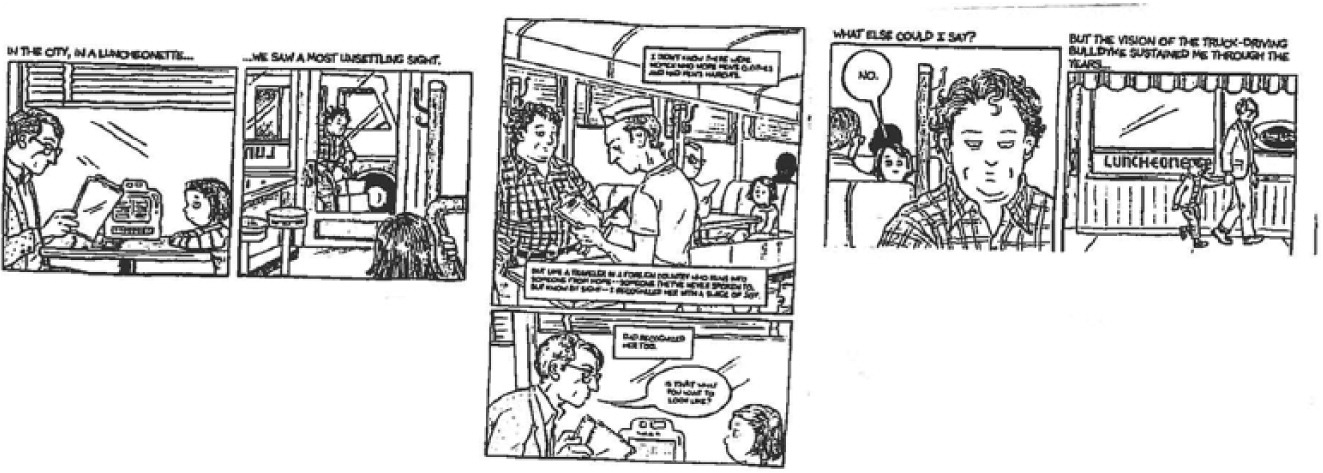
Fun Home; Other Voices, Other Rooms; and Boy Meets Boy disrupt gender norms in more decisive ways than the Color Purple and in more explicit ways than Written on the Body. That is, rather than women assuming some of the positive traits associated with men, or completely evading gender identification, some of the people in these books are men who actively perform womanhood, and vice versa, and other people in these books have been assigned the gender of man, for example, and reject this assignment to assume the gender of woman. It is not that there are not women who assume traits typically associated with men, and vice versa. There are. But there are also these more decisive gender disruptions. Therefore, for example, in Fun Home, there is a six-panel sequence in which Alison recounts her first time seeing a woman performing masculinity, if not manhood (see Figure 2).
Figure 2. Six sequential panels across three pages of Fun Home (pp. 117-119).
Note. The first two panels are at the bottom of one page, the second two comprise the entire next page, and the third pair of panels are at the top of the third page.
In the first two panels, we see Alison and her father, in profile, in a booth at a diner in Philadelphia, a city bigger than the town in which they live. Alison stares intensely into the distance, and her father studies the menu. The next panel offers Alison’s view: the doorway to the diner as a delivery is made. Bechdel recalls, “In the city, in a luncheonette . . . we saw a most unsettling sight.” The “unsettling sight” is the delivery person, a woman, dressed in jeans, plaid shirt, short hair, key ring on her belt loop—that is, a woman performing masculinity and thus disrupting normalized constructions of gender. In the third panel, Alison continues to study the delivery woman as, again, Bechdel recalls,
I didn’t know there were women who wore men’s clothes and had men’s haircuts. But like a traveler in a foreign country who runs into someone from home—someone they’ve never spoken to, but know by sight—I recognized her with a surge of joy.
In other words, seeing this woman disrupting gender norms invites Alison, too, to disrupt gender norms, an invitation which she receives enthusiastically. Her enthusiasm, though, is met with disdain in the next panel where she and her father are shown up close, in profile, looking across the table at one another, as Bechdel recalls, “Dad recognized her too,” and her father leans in, asking Alison, “Is that what you want to look like?” The next panel focuses tightly on the face of the delivery woman, as Alison peers, wide-eyed, over the back of the booth. Bechdel reflects, “What else could I say?” as the young Alison says to her father, “No.” The final panel shows Alison and her Father, hand in hand, leaving the diner, her Father looking ahead, but Alison looking back. And, although Alison does not explicitly claim masculinity in that moment, the impact of witnessing gender disruption on her younger self is clear, as Bechdel notes, “But the vision of the truck-driving bulldyke sustained me through the years . . . ” Similarly, there is a sequence of panels later in the book when Alison cross dresses in her father’s clothes and describes it as feeling “too good to actually be good” (p. 182). Therefore, while there is no reason to believe that Alison identifies as a man, it is clear that she is drawn to performing masculinity if not manhood.
These five queer novels, then, disrupt sexuality and gender norms in a variety of ways. One does this work by evading gender identification and thus calling into question sexual identification. Others disrupt norms associated with sexuality by representing same-sex desire and behavior and by having characters who explicitly claim nonheterosexual identities. These others also disrupt norms associated with gender with characters who assume some traits typically associated with the gender “opposite” theirs, characters who perform as the gender “opposite” theirs, and characters who reject their assigned gender in favor of their actual gender. Although they accomplish these disruptions in a variety of ways, all of them do this work, and it is imperative in literature if it is to be understood as queer.

Families and homes

We understand the social norms related to families and homes to be grounded in the fictional notion that all families comprise a father, mother, and their biological children and that such fictional families live together, but without anyone else, in a home, usually a house that they are working to own. All of the focal books disrupt such normative notions of families and homes, although in several different ways. Two of the books explicitly reject traditional notions of family, three of them celebrate alternative configurations of family, and two of them embrace a reconciliation of traditional and alternative families. (This totals seven rather than five books because we included two of the books in two categories.) Among these, there is much overlap between the disruption of families and the disruption of homes. Indeed, they are often intricately intertwined, as we present them here.
Both Fun Home and Written on the Body reject traditional notions of family. Here, we focus on Written on the Body because we discuss family in Fun Home in the reconciliation piece of this section. In Written on the Body, the narrator repeatedly rejects traditional families by rejecting the institution of marriage in both words and actions. The narrator asserts that marriage is the “flimsiest weapon against desire. You may as well take a pop-gun to a python” (p. 78). And, he or she confesses that he or she “used to think of marriage as a plate-glass window just begging for a brick” (p. 13), a brick she or he threw with some frequency: “I’ve been through a lot of marriages. Not down the aisle but always up the stairs” (p. 13). In fact, the entire book is focused on an intensely passionate relationship between the narrator and Louise, a married woman, who leaves the home she shares with her husband Elgin to be with the narrator. The narrator’s apparent disregard for families calls her trustworthiness into question. This is evident when he or she is focalized by a friend who says, in response to learning of the narrator’s relationship with Louise, “You bloody idiot . . . Another married woman” (p. 32). Here, families are constructed by marriage, but not at the exclusion of other constructions of family. Likewise, in this novel, normalized conceptions of family are disrupted through the use of metonymic configurations of heterosexual marriage, as represented through Louise’s husband, Elgin, in contrast to the relationship between Louise and the narrator. While their marriage is marked by all of the “normal” conventions, including “a wedding held in the Registry Office in Cambridge” (p. 34) and wedding rings, it is both sexless and loveless, leading Louise to reject Elgin for her lover, the narrator. And, while the narrator dismisses the institution of marriage, as we describe above, it is just this institution that forces Louise and the narrator apart due to Louise’s cancer and the fact that she can only gain access to the specialized medical treatment she needs if she stays with Elgin, who is a cancer researcher: “She would go with him to Switzerland and have access to the very latest medico-technology. As a patient, no matter how rich, she would not be able to do that. As Elgin’s wife she would” (p. 102). The narrator chooses to acquiesce to Elgin’s demands to leave to save Louise’s life. And, while marriage is the trump card that is used by Elgin, the narrator leaves, not out of respect for the institution of marriage or recognition of Elgin as Louise’s family, but out of love for Louise, reflecting a contrastive construction of family. These representations of family in combination with the shifting sexual and gender identities of the focalizing character challenge readers to grapple with which ideologies are meant to be resisted or suspect and which are to be embraced (Cadden, 2000), thus supporting the ideological openness and overall queerness of the novel.
Boy Meets Boy, The Color Purple, and Other Voices, Other Rooms all celebrate alternative configurations of family to various degrees. This is most developed and explicit in Other Voices, Other Rooms, as it is a prominent theme in the novel. As noted above, the book begins with the premise that Joel’s mother has died, and because just the two of them had lived together, and he is a minor (12 years old), he is now living with his aunt in New Orleans. So, from the beginning, Joel’s family is not a traditional one, but his aunt is his mother’s sister, and her children are his cousins. They are, in short, family, even if an extended one. Almost immediately, Joel’s aunt receives a letter from Joel’s estranged father asking Joel to come live with him. Still, this is family, even if farther from traditional.
But when he arrives at the place named in the letter, Skully’s Landing, Joel sees no evidence of his father in the decrepit mansion in an isolated Alabama community. He is greeted by Amy, who introduces herself as Joel’s father’s wife and therefore Joel’s stepmother, and Randolph, Amy’s first cousin and owner of Skully’s Landing. In other words, he is greeted by and comes to share a home with people who are only family by marriage to someone who Joel has never met before and meets only fleetingly in the novel. This feeling of being in the absence of family at Skully’s Landing is initially underscored by Randolph’s flamboyance, which Joel finds quite off-putting. Eventually, though, this flamboyance, an evolving understanding of Randolph’s homosexuality and cross-dressing, and Randolph’s declaration that
any love is natural and beautiful that lies within a person’s nature; only hypocrites would hold a man responsible for what he loves, emotional illiterates and those of righteous envy, who, in their agitated concern, mistake so frequently the arrow pointing to heaven for the one that leads to hell [are the things that allow Joel to accept his own homosexuality and accept Randolph as his alternative, queer family]. (p. 147)
His acceptance of a queer family is suggested in several scenes. For example, after Joel attempts to flee Skully’s Landing, he becomes ill and is returned to Skully’s Landing, where Randolph nurses him back to health. As he is recovering, he notices Randolph “blessedly near” (p. 206) and asks him whether he hates him for running away. In response, Randolph calls Joel, “baby” (p. 207), takes him in his arms and kisses his forehead, just as a parent might do. Once Joel recovers, he studies his maturing face in the mirror, and “All that displeased him was the brown straightness of his hair. He wished it were curly gold like Randolph’s” (p. 207). This might be understood as Joel wishing for a physical similarity that would suggest a biological or familial relation.
By the end of the novel, Joel rejects his dreams of straightness, as indicated by his refusal to reconnect with Idabel, the one person with whom he could imagine sharing a heterosexual relationship, but he never rejects his family of origin; rather, he is rejected by them. This is suggested when he is remembering his deaf cousin and how he used to taunt her,
But when he saw her again, why, he’d be so kind; he’d talk real loud so that she could hear every word, and he’d play those card games with her . . . But Ellen [his aunt] had never answered his letters. His own bloodkin. And she’d made so many promises. And she’d said she loved him. But she forgot. (p. 230)
In other words, Joel neither has an opportunity to reject his traditional family nor reconcile with it.
He does, however, have an opportunity to celebrate his alternative family, which he does when he reflects on what it is that makes a home a home. He learns what a home is from Little Sunshine, a local hermit and charm-maker, and Randolph, Joel’s uncle. Little Sunshine lives in a place Joel describes as old, slimy, evil-colored, wild, decaying, terrible, and strange, but, “it was his rightful home, [Little Sunshine] said, for if he went away, as he had once upon a time, other voices, other rooms, voices lost and clouded, strummed his dreams” (p. 100). Here, Little Sunshine teaches Joel that home, no matter how unappealing the house, is where one feels at peace. Later, Randolph teaches Joel that home is where people love you consistently as you are. It is after these lessons from Little Sunshine and Randolph that Joel comes to accept Skully’s Landing as his home, a place where he is at peace and surrounded by people who love him for who he is rather than a place provided for by his “bloodkin” (p. 230). Thus, Other Voices, Other Rooms disrupts typical notions of what counts as home.
Unlike Joel, Alison in Fun Home and Paul in Boy Meets Boy do not have to choose between their families of origin and families of choice. Here we focus on Fun Home because the focus on reconciliation with families of origin is much more pronounced than in Boy Meets Boy. As in Written on the Body, traditional families are rejected in Fun Home in that it centers on the ways that Alison’s traditional family causes the death of her Dad, Bruce. Bruce cannot be satisfied without “sex with teenage boys” (p. 17), which defies their traditional family, but neither can he escape his traditional family to create an alternative one. That he wishes for such an alternative family is evident in the several panels where Alison is “rooting through a box of family photos” (p. 100). In the box was an envelope “labeled ‘family’ in Dad’s handwriting” (p. 101). The photo was of the “yardwork assistant/babysitter, Roy” (p. 100) on vacation with the family, minus Alison’s mom, when Alison was 8, and Alison recalls that the children slept in one room while her Dad and Roy slept in an adjoining one. The image shows Roy stretched out on a bed, bathed in sunlight, dressed in only his underwear. The year, indicating Roy’s age of 17, has been ineffectively blotted out.
In this scene, the significance of a naïve narrator, as a literary element, stands out. We experience the narrator, drawn in her younger form, as Alison, to be more naïve than the narrator, in her older form (Bechdel), and thus, less reliable. Leading up to the aforementioned scene, on pages 94 to 95, for example, the older Bechdel, in narration around the panels, recounts Alison’s experience of meeting Roy, the young man who was a babysitter and household helper to the family. The younger Alison is represented, in the panels, gazing at Roy and being drawn to his masculine gender and wanting to present herself in a similarly masculine way. At the same time, her father is also shown gazing at Roy, but his interest is focused on Roy’s male sexuality and his interest in Roy as a possible lover, something to which the younger Alison seems fully unaware. Then, in the scene described above, we see the younger Alison, after her father’s death, finding and examining the photo of Roy. Here, the older Bechdel analyzes this series of panels, narrating how she, as an adult, now understands her father in terms of his sexual identity, as well as her younger self, in terms of her own sexual identity as a lesbian, and her “family,” as her father experienced these relationships. Because of the layered focalization coupled with the intersections of the naïve Alison and the mature Bechdel, we experience not a singular narrative point of view, but multiple and shifting perspectives and, hence, multiple ideologies.
That Roy was included on a family vacation, and that his photo appears in the box of family photos in an envelope that the Dad has labeled “family,” reveals Bruce’s desire to create an alternative family. Nothing actually comes of this desire, though, and the resulting tension only breaks when Alison’s Dad walks in front of a truck, killing himself. Although alternative families are not constructed within the book, that Alison might one day create her own alternative family is suggested when her girlfriend Joan “came home with [her] for a visit” (p. 225). In other words, there is promise that alternative families are possibilities, even though they were not possible for Bruce.
It is the reconciliation of family, though, that holds the most promise in Fun Home. Whether Alison creates an alternative family or not, the book suggests that she, as a lesbian, remains connected to her family of origin. To her, even if not to Bruce, her family “really [was] a family” (p. 17). And even her father, who caused the “chink in [her] family’s armor” (p. 95), she experienced as having provided “spiritual . . . paternity” when she “leapt . . . into the sea” of queerness (p. 232). That is to say, Alison’s relationship with her father, particularly in their shared queerness, facilitated the reconciliation of Alison, as a lesbian, to her family of origin. Even though once she comes out to her family and then returns to their home, she realizes, “Home, as I had known it, was gone” (p. 215), it is also clear that a different kind of home with her family of origin still exists.

Time

Just as normative notions of sexuality and gender and families and homes are disrupted, so too are normative notions of time. This is not a quality unique to queer texts, but it does seem to enhance the queer nature of already queer texts. We were particularly interested in scenes in which the chronotope (Bakhtin, 1981) or the time-space (McCallum, 1999) of the text is artistically distorted. Through these distortions, “normal” conceptions of time-space are suspended offering nonnormative renderings of time and space, which make these texts queer, as distinct from LGBT-inclusive texts. These queer conceptions of time are often rendered through literary elements, such as flashback and foreshadowing, as well as mode. As Cadden notes, “the romance or hero novel . . . is much more likely to offer the reader a multistranded narrative, or any sort of rearrangement of narrative time,” in contrast to the comedic mode (p. 305). Moreover, he asserts that “comedy and romance are at the heart of a conservative world view of returning to a previous order—things ‘go back to normal,’” whereas, “irony and tragedy are more upsetting” in that they are “modes of change—either random and absurd in the ironic or as the rebirth of a new order as in tragedy” (p. 306). The coupling of distortions of “normal” conceptions of time with the tragic or ironic mode reflects a confluence of queer and literary elements that mark the ideologies of these novels as queer.
This is most apparent in Other Voices, Other Rooms and Written on the Body and less so in The Color Purple. These books have generally linear storylines interrupted with surreal scenes that markedly disrupt the otherwise normative flow of time. Written on the Body, for example, follows a generally linear timeline, beginning in the spring of 1 year into the autumn of the following year. During these approximately 18 months, the narrator and Louise fall in love, which results in the narrator’s girlfriend leaving the narrator, and Louise leaving her husband, who is an oncologist. After the narrator and Louise enjoy some time together, the narrator learns, from Louise’s husband, that Louise has chronic lymphocytic leukemia. As described earlier, the narrator comes to believe that Louise’s chances of fighting the cancer will be improved if she goes back to her oncologist husband. Consequently, the narrator leaves Louise so she will go back to her husband. This is where the dramatic disruption in time occurs. Up until this point, there have been typical text breaks of a line throughout, but not anything more substantial. At this point, though, there is a blank page, followed by a chapter titled, “The Cells, Tissues, Systems and Cavities of the Body.” Even this chapter is broken into three sections. Then there is another chapter, “The Skin,” and then another, “The Skeleton,” which has two sections, and a fourth: “The Special Senses,” which has four sections. In this portion of the novel, the narrator explores Louise’s body both as a host of cancer, like when he or she says, “In the secret places of her thymus gland Louise is making too much of herself. Her faithful biology depends on regulation but the white T-cells have turned bandit” (p. 115), but also as her lover, so when he or she says, “Will you let me crawl inside you, stand guard over you, trap them as they come at you?” (p. 115). This portion of the novel invites readers fully into the narrator’s struggle to come to terms with understanding his or her lover in mortal, if not fatal, terms. In doing so, though, it propels us from the storyline. It is as if time and space are suspended. Then, though, after these chapters of suspension, readers are pushed back into the linear storyline, with the first word of the next page: “March” (p. 141). This word references the month and thus brings the reader right back into the timeline that composes most of the book. In this way, time is artistically distorted and then reinstated in Written on the Body.
Although all of the books use the ironic mode to disrupt expectations, to various degrees, Boy Meets Boy provides a clear illustration of this in relation to time and space. The book is romantic, no doubt. It is set in an almost hyperbolically gay-friendly town, and the storyline centers on Paul and Noah falling in love with each other. It is comedic as well, although less overtly so. But so too is it ironic in that there is incongruity between what is expected and what actually happens. Therefore, for example, the town is quite different than one might expect. Early on, it is described in this way:
There isn’t really a gay scene or a straight scene in our town. They got all mixed up a while back, which I think is for the best. Back when I was in second grade, the older gay kids who didn’t flee to the city for entertainment would have to make their own fun. Now it’s all good. Most of the straight guys try to sneak into the Queer Beer bar. Boys who love boys flirt with girls who love girls. And whether your heart is strictly ballroom or bluegrass punk, the dance floors are open to whatever you have to offer. (pp. 1-2)
Moreover, in this town, “P-FLAG (Parents and Friends of Lesbians and Gays) is as big a draw as the PTA” (p. 115). This gay-friendliness plays out in Paul’s school life as well. For example, early in the book, we learn that Paul has “always known [he] was gay, but it wasn’t confirmed until [he] was in kindergarten” (p. 8), when, according to Paul, “It was my teacher who said so,” as we mention above. When Paul asked his teacher about her comment on his report card, she explained, finally saying, “What you feel is absolutely right for you. Always remember that” (p. 9). Then, later, when Paul is in sixth grade, he collaborates with several students to form their elementary school’s first GSA. They do so not as a way to help gay students unify with straight allies in the face of the school’s homophobia, as one might expect, but to help the straight kids. In Paul’s words, “Quite honestly, we took one look around and figured the straight kids needed our help. For one thing, they were all wearing the same clothes. Also (and this was critical), they couldn’t dance to save their lives” (p. 12). Given such characterizations, one might conclude that we are, in reading this book, in some post-homophobic future, or in a sort of magical realism space where homophobia is absent.
If it were such a time-space, there would be nothing ironic about this book. But, it turns out that we, as readers, cannot ignore the expectations of homophobia. There are small things that signal this, like the mentioning of how it was worse back when Paul was in second grade and then remembering that the teacher’s comment was made before that and the GSA a couple of years after that. But there are also larger things. There is a time when Paul is tackled and called, “queer, faggot, the usual” when leaving a screening of Priscilla Queen of the Desert (p. 13). It is important to note that such homophobic language is named as usual, not exceptional, thus debunking any notion that this is a world of magical realism in which there is no homophobia. Such a debunking is underscored by Tony, who says to Paul: “The first time I met you . . . I honestly couldn’t believe that someone like you could exist, or even a town like yours could entirely exist” (p. 150). His disbelief is grounded in the expected homophobia embodied most prominently by his parents who before they “discovered he was gay, they wouldn’t let him shake hands with a girl” (p. 95), but now that they know he is gay, “they practically pimp him out the door . . . if he mentions he’s doing something with a girl—any girl” (p. 95). In other words, his parents would rather him be promiscuous, something they used to consider shameful, than homosexual. But such homophobia is not limited to people or places just beyond the town, where Tony’s parents live. Therefore, for example, Paul’s ex-boyfriend Kyle publically accuses Paul of making him gay. This would have no impact in a post-homophobia time-space or a magical one devoid of homophobia.
It is the mostly but not entirely not-homophobic nature of the town that puts this novel in the ironic mode. We, as readers, come into the book expecting homophobia, and we encounter something different than we expected, thanks to Paul’s description of the town, Paul’s kindergarten teacher, and Paul’s motivation for starting a GSA. Then, we come to expect an absence of homophobia in this time-space, but our expectations are disrupted, by verbal assaults outside a movie theater, Tony’s parents, and Kyle’s fear, as examples. In this way, Boy Meets Boy’s use of the ironic mode creates a jarring sense of time and space and thus offers multiple and conflicting ideologies around the conceptualization, embodiment, and enaction of homophobia.
Fun Home and Other Voices, Other Rooms disrupt normative flows of time with foreshadowing and flashback. Fun Home is a memoir, and, as such, the narrator/author, Alison/Bechdel, is often remembering and re-rendering events from her childhood as experienced, and focalized, by her younger self, but narrating these through her adult perspective. In addition, because of the multiple semiotic systems, images from the far past and the more recent past can be layered and then juxtaposed with narration in the present. This is vividly displayed in two panels on page 120 of the graphic novel, where Alison’s hands are shown holding more of the photos from the box marked “Family,” described earlier. In the first panel, Alison’s hand holds a single photo of her father when he was about the same age as Roy had been when he was both Bruce’s lover and Alison’s babysitter. In the photo, Bruce is seen posing in a women’s swimsuit, a towel wrapping his head and covering his hair. Bechdel, as narrator in the present, writes, “He’s wearing a women’s bathing suit. A fraternity prank? But the pose he strikes is not silly at all. He’s lissome, elegant” (p. 120). In the next frame, Alison’s hands are shown holding two photos, side-by-side. One show’s her father lounging in a men’s swimsuit, shirtless, wearing sunglasses, and smiling fully into the camera. The other shows the younger Alison, likewise smiling toward the camera. Here, Bechdel writes of the former image, “In another picture, he’s sunbathing on the tarpaper roof of his frat house just after he turned twenty-two. Was the boy who took it his lover?” (p. 120) and then of the latter, “As the girl who took this Polaroid of me on a fire escape on my twenty-first birthday was mine?” (p. 120). In this series of images, past and present come together, allowing the older Bechdel to look at images of the young Bruce and her younger self and recognize, through the layering of time, her father’s sexual identity relative to her own. The images and text provide both a flashback to Bechdel’s younger self, just coming out as lesbian, as well as a foreshadowing of that self, embodied in the younger Bruce, whom she is now able to recognize as gay. She draws the photos together, summarizing, “The exterior setting, the pained grin, the flexible wrists, even the angle of shadow falling across our faces—it’s about as close as a translation can get” (p. 120). Hence, Fun Home uses foreshadowing and flashback to show multiple ideologies through the layering of timescales through juxtaposition of text and images.

Discussion

Our analysis of Boy Meets Boy; The Color Purple; Fun Home; Other Voices, Other Rooms; and Written on the Body helped us to understand what distinguishes queer literature. The distinction is an ideological one; that is, queer literature offers multiple and conflicting ideologies around sexuality and gender through poststructural conceptions of identities and disruptions of norms that may be enhanced through the use of particular literary devices.
It is not, however, just about being LGBT-inclusive. In fact, one might argue that The Color Purple and Other Voices, Other Rooms are not LGBT-inclusive in that no one in The Color Purple or Other Voices, Other Rooms ever names themselves in such terms. For us to insist on such a criterion would demand that the books be anachronistic, as such identity markers were not claimed in the time periods in which the books are set. Furthermore, such an insistence would be in conflict with queer theory, as this theoretical disposition values a suspension rather than imposition of classification. In other words, it would be inappropriate to insist that for a book to be categorized as queer, it must first be categorized as LGBT-inclusive (Ryan & Hermann-Wilmarth, 2013; Smith, 2007).
It is tempting, though, to say that queer literature must offer poststructural conceptions of sexual and gender identities in one of the main characters. Or, more explicitly, it must include a significant character, if not main character, whose sexual and gender identities are represented as multiple, variable, and fluid. The book Written on the Body does this exquisitely in that readers cannot know the sexuality of the narrator and Louise because we never know the gender of the narrator. We, as readers, know that he or she has shared sexual relationships with both men and women, and we know that Louise married a man, but that those bits of information indicate the narrator is bisexual and Louise straight is interrogated throughout the novel. Moreover, Written on the Body is truly exceptional in this way. To require such suspension of sexual and gender classifications of queer literature would leave so few texts for consideration, particularly if we focus on literature marketed to young adults, that it would completely hinder the work we are trying to accomplish. That said, it was important to us that in each of these five books, there is a character, even if not a significant one, who we understood as experiencing and embodying sexuality and gender with some degree, albeit varying degrees, of multiplicity, variability, and fluidity. Our insistence on paying attention to the presence of such characters, no matter how fleeting, relates to the foundational work of Cart and Jenkins (2006). In their documenting of YA literature with gay/lesbian/queer content, they attend to the importance of the presence of gay characters in such fiction, even if such early depictions were flawed by “stereotypical characters and predictable plots centered on the inherent misery of gay people’s lives” (p. 17) and, in many cases, continue to be premised on “agonizing over whether to come out and suffering the slings and arrows of outrageous homophobia” (p. 134). Their work shows the evolution of such depictions over time and the increasing positive presence of LGBTQQ characters in LGBT-inclusive literature. Attending to the presence of poststructural conceptions of sexual and gender identities in characters, whether they are major or peripheral, positions our work to serve as an extension of Cart and Jenkins’s foundational work such that we might, together, support future examinations of queer literature as it continues to evolve.
Other significant features of this collection of queer literature, and we argue queer literature more broadly, is the disruption of norms related to sexuality and gender as well as those related to families and homes. These books disrupt norms related to sexuality and gender by evading gender identification and thus calling into question sexual identification, as in Written on the Body. They do it with particular respect to sexuality by representing same-sex desire and action, as in The Color Purple and Other Voices, Other Rooms, and having characters that explicitly claim nonheterosexual identities, as in Boy Meets Boy and Fun Home. With respect to gender, they disrupt norms with characters who assume some traits typically associated with the gender “opposite” theirs, as in Other Voices, Other Rooms and The Color Purple; with characters who perform as the gender “opposite” theirs, as in Fun Home; and characters who reject their assigned gender in favor of their actual gender, as in Other Voices, Other Rooms, and Boy Meets Boy. They disrupt norms related to families by explicitly rejecting traditional notions of family, as in Fun Home and Written on the Body; by celebrating alternative configurations of family, as in Boy Meets Boy, The Color Purple, and Other Voices, Other Rooms; and by embracing a reconciliation of traditional and alternative families, as in Boy Meets Boy and Fun Home. Intertwined with these disruptions of families are disruptions in homes. Thus, all of these books, again to varying degrees, and in various ways, disrupt norms defined by sexuality, gender, families, and homes. We understand this as imperative in literature if it is to be understood as queer.
In looking for other sorts of disruptions of norms, we were compelled by disruptions of time across the queer literature we studied. As we say above, we do not understand this to be a quality unique to queer literature, but we were impressed with how artistic distortions of time enriched the already queer nature of the books. These disruptions happened with surreal scenes inserted among otherwise linear stories, as in The Color Purple; Other Voice, Other Rooms; and Written on the Body. They also happened through the use of the ironic mode, as in Boy Meets Boy, and the use of foreshadowing and flashback in Fun Home and Other Voices, Other Rooms. We understand this feature not to be imperative in but rather enhancing of queer literature.
What is most important, though, is that these conceptualizations of identities and disruptions of norms have the effect of offering multiple and conflicting ideologies, particularly in relation to sexuality and gender. Sometimes, such ideologies are made available or at least made more visible through the use of literary devices, as is evident in the above discussion of time. In addition to mode, flashback, and foreshadowing, the use of focalization, the inclusion of naïve narrators, and the use of metonymic configurations can heighten readers’ attention to the queer and to the experience of characters being and becoming queer. Such heightened attention makes these ideologies more overtly visible and available to readers, which has implications especially for young adult readers, as we discuss below.
Therefore, what does queer literature look like? It offers multiple, variable, and conflicting conceptions of sexual and gender identities, including poststructural ones. It disrupts normative notions of sexuality, gender, families, and homes; and it disrupts other norms, too, in the case of these books, norms associated with time. Moreover, it uses a wide array of literary devices to accentuate the already queer nature of the text. Having identified what queer literature looks like, we now turn to what resources queer books might offer that are distinct from literature with LGBT themes, especially to young adult readers.

Implications

As we note in the opening of this article, making space for LGBTQQ literature in schools is still a challenge. Given these challenges, we initiated and facilitated an out-of-school book discussion group where we could privilege the reading and discussion of such literature with young people (Blackburn & Clark, 2011). That work allowed us to identify LGBT-inclusive and queer discourses evident in our talk and set the stage for our analysis, here, focused on the queer books that were read in that group and the specific ideological and literary elements in these books. While our earlier focus was on understanding types of discussions, our focus, here, is specifically on books, namely, queer literature.
This analysis allowed us to understand and name the multiple and conflicting ideologies that are manifest in queer literature, at least the five novels read by our group, and to characterize the key elements that make a book queer. Although these may not be evident in all queer literature, our analysis provides a framework for further analysis of contemporary, LGBT-themed YA literature (Clark & Blackburn, in press). And, while these particular books are not all sanctioned in schools, this analysis demonstrates that engaging with queer literature may provide critical resources to young adult readers by countering the invisible ideologies of heterosexism, misogyny, and homophobia that circulate in their daily lives (Martino, 2009; Pascoe, 2007). Understanding and naming the multiple and conflicting ideologies that are manifest in queer literature is one way to counter these forces. As McCallum and Stephens (2010) note, “literary discourse serves to produce, reproduce, and challenge ideologies” (p. 370). By reading such texts, even if not these particular texts, young people will at least experience narratives or characters who counter or critique these pervasive, normative ideologies.
While we recognize that reading and discussing queer texts in schools is not yet the norm, we know that scholars and educators are increasingly calling for and using queer and LGBT-themed texts in classrooms (see, for example, Carey-Webb, 2001; Hamilton, 1998; Schall & Kauffmann, 2003; Smith, 2007). Our hope is that this analysis will provide guidance, techniques, and even impetus for more teachers to do this work without unintentionally reinforcing heteronormativity. If teachers understand the ideological dimensions of queer literature, they can make ideologies of sexuality and gender explicit, inviting productive discussions of key issues such as “what ideologies are being depicted as the contemporary status quo, what are the problems with or limitations of those ideologies, and what are imagined as possible social or individual transformations of behaviors in opposition to them” (McCallum & Stephens, 2010, p. 370).
Examining texts for different conceptualizations of sexual and gender identities might invite students and teachers to interrogate assumed notions of identities as essential or even developmental. This might free a student who has been tagged as a fag or a dyke, even for years, of the burden of homophobia, even if only in his or her English language arts class. It might also liberate a student who has always understood himself or herself, and has always been understood by others, as straight, but who is struggling with a confusing attraction to a same-gender peer. In other words, exploring possibilities of sexual and gender identities that are multiple, variable, and fluid might alleviate some of the pressure of being or becoming someone who is socially acceptable and soothe the anxieties associated with being or becoming someone who is not. One could argue such an examination is supported by the Common Core Standards (National Governors Association Center for Best Practices & Council of Chief State School Officers, 2010), which challenge students to analyze “how complex characters (e.g., those with multiple or conflicting motivations) develop over the course of a text, interact with other characters, and advance the plot or develop the theme” (CCSS.ELA-Literacy.RL.9-10.3).
Studying texts for disruptions of sexuality and gender norms provides students with a wider array of ways of being in the world. This might mean reflecting on the options of being a girl who engages in some behaviors typically associated with boys, like playing football; being a girl who sometimes performs boyhood, perhaps through her dress; or being a boy who was assigned the sex of female when he was born. This full range of options calls into question the notion of there being any particular, right, gendered way of being in the world. Analyzing texts that complicate notions of families and homes also has something to offer students. For any of the many students who come from families that are anything other than a mother and father raising their biological children or homes that house such families, complicating notions of families and homes can be a relief. Literature can, in this way, serve as a mirror (Bishop, 1992), not because any family or home looks just like any particular student’s family or home, but because something other than that which is falsely understood as traditional, normal, or even ideal is made visible in the literature when teachers help students see it. Even students who are part of families who look very much like traditional nuclear families have something to gain by studying queer literature that offers alternative families and homes. For them, the literature serves as a window, rather than a mirror (Bishop, 1992), and they are educated by such a view. They come to know there are families and homes quite different than their own, providing them opportunities to value and respect alternative families, but also opening up options for possibilities of what their families might be as they come to shape their own. Of course, interrogations of other norms, like time, but also any number of things, serves a similar purpose, that is to inform students to a wide array of ideologies, or ways of viewing the world that may support, complicate, or even contradict their own, thus better preparing them for the diverse world in which they live. Again, one might argue that such analysis is aligned with the new Common Core Standards (National Governors Association Center for Best Practices & Council of Chief State School Officers, 2010), which require that students analyze “author’s choices concerning how to structure a text, order events within it . . . and manipulate time” (CCSS.ELA-Literacy.RL.9-10.5).
Paying attention to literary elements, too, aligns this approach with more mainstream notions of what gets taken up in English language arts classrooms, providing impetus for the inclusion of queer literature in classrooms. Of course doing this work will require that more teachers, especially English language arts teachers, become familiar with and knowledgeable of queer conceptual frameworks. However, several resources already exist that invite English teachers to take up different literary theoretical lenses in the classroom (Appleman, 2000; Soter, Faust, & Rogers, 2007), including queer theory (Smith, 2007). This analysis adds to and extends these prior works. Teachers of literature are expected, indeed required, to guide students in analyzing literary elements in texts, and tying queer concepts to literary elements may provide a sanctioned way into studying queer concepts and ideologies. For teachers, the requirement of literary analysis may give queer texts a way into the classroom when teachers know how to analyze queer texts. For students in such classrooms, the inverse might also be true. Perhaps LGBTQQ and ally students might find themselves drawn to literary studies when they are connected to queer concepts. Finally, for teachers and students, engaging with queer literature provides opportunities to exist and thrive in the realm of the queer, a space where multiple ideologies and conflicting ideologies around sexuality and gender can circulate and be considered, examined, embraced, or rejected by the reader, rendering the text more open and less settled, and the space of the classroom, as a whole, more queer.

Declaration of Conflicting Interests

The author(s) declared no potential conflicts of interest with respect to the research, authorship, and/or publication of this article.

Funding

The author(s) received no financial support for the research, authorship, and/or publication of this article.

Footnotes

1. We use a variety of acronyms throughout this article with the overall intention of inclusivity and precision. Here, we use lesbian, gay, bisexual, trans*, queer, and questioning (LGBTQQ) to describe people, and include the additional Q to capture the agency people have to question their identity status. We use LGBT or LGBTQQ to describe themes or books, omitting the additional Q as these objects do not have the agency of people. Finally, we use the term trans* to capture the broad diversity of noncisgender people, or people whose gender identities do not match the sex they were assigned at birth, who make up trans* communities.
2. We use Mr._____ when talking about him in the context of Celie and Albert when talking about him in the context of Shug. When necessary, we choose Mr. _____ above Albert as the novel is told more from Celie’s point-of-view than Shug’s.

References

Appleman D. (2000). Critical encounters in high school English: Teaching literary theory to adolescents. New York, NY: Teachers College Press.
Bae B. C., Young M. (2008). The use of flashback and foreshadowing for surprise arousal in narrative using a plan-based approach. Lecture Notes in Computer Science, 5334, 156-167.
Bakhtin M. M. (1981). Forms of time and of the chronotope in the novel. In Holquist M. (Ed.), The dialogic imagination: Four essays by M. M. Bakhtin (pp. 84-258). Austin: University of Texas Press.
Bechdel A. (2006). Fun home: A family tragicomic. Boston, MA: Houghton Mifflin.
Bernstein M., Reiman R. (Eds.). (2001). Queer families, queer politics. New York, NY: Columbia University Press.
Bishop R. S. (1982). Shadow and substance: Afro-American experience in contemporary children’s fiction. Urbana, IL: National Council of Teachers of English.
Bishop R. S. (1992). Multicultural literature for children: Making informed choices. In Harris V. (Ed.), Teaching multicultural literature in grades K-8 (pp. 37-54). Norwood, MA: Christopher Gordon.
Blackburn M. V., Clark C. T. (2011). Analyzing talk in a long-term literature discussion group: Ways of operating within LGBT-inclusive and queer discourses. Reading Research Quarterly, 46, 222-248.
Blackburn M. V., Clark C. T. (2014). How moments (and spaces) add up to lives: Queer and ally youth talking together about LGBTQ-themed books. In Compton-Lilly C., Halverson E. (Eds.), Time and space in literacy research. New York, NY: Routledge.
Blackburn M. V., Clark C. T., Kenney L. M., Smith J. M. (Eds.). (2010). Acting out: Combating homophobia through teacher activism. New York, NY: Teachers College Press.
Britzman D. P. (1995). Is there a queer pedagogy? Or stop thinking straight. Educational Theory, 45, 151-165.
Britzman D. P. (1997). What is this thing called love? New discourses for understanding gay and lesbian youth. In de Castell S., Bryson M. (Eds.), Radical in(ter)ventions: Identity politics, and difference/s in educational praxis (pp. 183-207). Albany, NY: State University of New York Press.
Cadden M. (2000). The irony of narration in the young adult novel. Children’s Literature Association Quarterly, 25, 146-154.
Cadden M. (2010). Genre as nexus: The novel for children and young adults. In Wolf S., Coats K., Enciso P., Jenkins C. (Eds.), The handbook of research on children’s and young adult literature (pp. 302-313). New York, NY: Routledge.
Capote T. (1994). Other voices, other rooms. New York, NY: Vintage.
Carey-Webb A. (2001). Literature and lives: A response-based, cultural studies approach to teaching English. Urbana, IL: NCTE.
Cart M., Jenkins C. (2006). The heart has its reasons: Young adult literature with gay/lesbian/queer content, 1969–2004. Lanham, MD: The Scarecrow Press.
Clark C. T., Blackburn M. V. (in press). Scenes of violence and sex in recent award-winning LGBT-themed young adult novels and the ideologies they offer their readers. Discourse: Studies in the Cultural Politics of Education.
de Lauretis T. (Ed.). (1991). Queer theory: Lesbian and gay sexualities [special issue]. Differences A Journal of Feminist Cultural Studies, 3,1-20.
Galda L., Beach R. (2001). Response to literature as a cultural activity. Reading Research Quarterly, 36, 64-73.
Genette G. (1980). Narrative discourse: An essay in method. Ithaca, NY: Cornell University Press.
Hamilton G. (1998). Reading Jack. English Education, 30, 24-43.
Jagose A. (1996). Queer theory: An introduction. Melbourne, Australia: University of Melbourne Press.
Kentlyn S. (2008). The radically subversive space of the queer home: “Safety House” and “Neighbourhood Watch” [Special Issue: Geographies of Sexuality and Gender Down Under]. Australian Geographer, 39, 327-337.
Leistyna P., Woodrum A., Sherblom S. A. (1996). Breaking free: The transformative power of critical pedagogy. Cambridge, MA: Harvard Educational Review.
Lemke J. L. (2008). Identity, development and desire: Critical questions. In Caldas-Coulthard C. R., Idema R. (Eds.), Identity trouble: Critical discourse and contested identities (pp. 17-42). London, UK: Palgrave Macmillan.
Lesko N. (2001). Act your age! A cultural construction of adolescence. New York, NY: Routledge Falmer.
Levithan D. (2005). Boy meets boy. New York, NY: Alfred A. Knopf.
Martino W. (2009). Literacy issues and GLBTQ youth. Queer interventions in English education. In Christenbury L., Bomer R., Smagorinsky P. (Eds.), Handbook of adolescent literacy (pp. 400-414). New York, NY: Guilford Press.
McCallum R. (1999). Ideologies in identity in adolescent fiction: The dialogic construction of subjectivity. New York, NY: Garland.
McCallum R., Stephens J. (2010). Ideology and children’s books. In Wolf S., Coats K., Enciso P., Jenkins C. (Eds.), The handbook of research on children’s and young adult literature (pp. 359-371). New York, NY: Routledge.
National Center for Transgender Equality. (2009). Transgender terminology. Washington, DC: Author. Retrieved from http://transequality.org/Resources/NCTE_TransTerminology.pdf
National Governors Association Center for Best Practices & Council of Chief State School Officers. (2010). Common core state standards for English language arts and literacy in history/social studies, science, and technical subjects. Washington, DC: Author.
Pascoe C. J. (2007). Dude you’re a fag: Masculinity and sexuality in high school. Berkeley: University of California Press.
Pinar W. (1998). Queer theory in education. Mahwah, NJ: Lawrence Erlbaum.
Reimer M. (2010). Readers: Characterized, implied, actual. Jeunesse: Young People, Texts, Cultures, 2(2), 1-12.
Romören R., Stephens J. (2002). Representing masculinities in Norwegian and Australian young adult fiction: A comparative study. In Stephens J. (Ed.), Ways of being male: Representing childhood in children’s literature and film (pp. 216-233). London, England: Routledge.
Ryan C. L., Hermann-Wilmarth J. M. (2013). Already on the shelf: Queer readings of award-winning children’s literature. Journal of Literacy Research, 45, 142-172.
Schall J., Kauffmann G. (2003). Exploring literature with gay and lesbian characters in the elementary school. Journal of Children’s Literature, 29(1), 36-45.
Sears J. T. (1998). A generational and theoretical analysis of culture and male (homo)sexuality. In Pinar W. (Ed.), Queer theory in education (pp. 73-106). Mahwah, NJ: Lawrence Erlbaum.
Smith J. M. (2007). Montana 1948: Crossing boundaries with queer theory. In Soter A. O., Faust M., Rogers T. C. (Eds.), Interpretive play: Using critical perspectives to teach young adult literature (pp. 161-171). Lanhan, MD: Rowman and Littlefield.
Soter A. O., Fasut M., Rogers T. C. (Eds.). (2007). Interpretive play: Using critical perspectives to teach young adult literature. Lanham, MD: Rowman and Littlefield.
Stephens J. (1992). Language and ideology in children’s fiction. New York, NY: Longman.
Tierney W. G., Dilley P. (1998). Constructing knowledge: Educational research and gay and lesbian studies. In Pinar W. (Ed.), Queer theory in education (pp. 40-60). Mahwah, NJ: Lawrence Erlbaum.
Walker A. (1982). The color Purple. New York, NY: Harcourt.
Winterson J. (1994). Written on the body. New York, NY: Vintage.

Biographies

Mollie V. Blackburn is a professor of adolescent literacy in the Department of Teaching and Learning at the Ohio State University. She is currently teaching an LGBT Literature course at a local queer-friendly high school. She also works with Caroline T. Clark to facilitate a teacher inquiry group to combat homophobia in schools and, with Lauren Kenney and Jill Smith, co-edited the book, Acting out: Teachers combating homophobia and becoming an activist community and Literacy research for political action and social change.
Caroline T. Clark is a professor of adolescent literacy in the Department of Teaching and Learning at the Ohio State University. Most recently, she worked with Mollie V. Blackburn to facilitate and document the work of a book discussion group with high school students discussing LGBT-themed young adult literature. Together, they also facilitate a teacher inquiry group to combat homophobia in schools through literature and film and, with Lauren Kenney and Jill Smith, co-edited the book, Acting out: Teachers combating homophobia and becoming an activist community and Literacy research for political action and social change.
Emily A. Nemeth is an assistant professor in the Department of Education at Denison University where she teaches courses on literacy, community engagement, and equity pedagogies.