


Identifying Reliable Diagnostic/Predictive Biomarkers for Rheumatoid Arthritis
Abstract
Introduction and objective:
Materials and methods:
Results:
Discussion:
Conclusions:
Introduction
Materials and Methods
Cell culture conditions
Cell viability
CRP enzyme-linked immunosorbent assay
Gene expression profiling microarray analysis (IMGM Laboratories, Germany)
Bioinformatics and statistical analysis
Messenger RNA isolation, reverse transcription and quantitative reverse transcription-polymerase chain reaction
| Genes | Primer sequences | Annealing temp (°C) | Amplicon (bp) |
|---|---|---|---|
| COL14A1 | 5′AGACGAGGTGGTGGTAGATG3′ 5′AGCAGTGTGGGCATAGATTG3′ | 56 | 106 |
| CXCL12 | 5′GACAAGTGTGCATTGACCCG3′ 5′CTCATGGTTAAGGCCCCCTC3′ | 58 | 173 |
| CYTL1 | 5′AGATCACCCGCGACTTCAAC3′ 5′GTACAGCCTGGGCAGGTATC3′ | 58 | 77 |
| HSPA6 | 5′AATCTGTCGCCCCATCTTCTC3′ 5′GCCCATAGCATAGCCCTGAC3′ | 59 | 174 |
| IFITM1 | 5′CGCCAAGTGCCTGAACATC3′ 5′GTCACAGAGCCGAATACCAGT3′ | 57 | 87 |
| IL-6 | 5′GGTACATCCTCGACGGCATCT3′ 5′GTGCCTCTTTGCTGCTTTCAC3′ | 59 | 81 |
| IL-7 | 5′GTGACTATGGGCGGTGAGAG3′ 5′GCTACTGGCAACAGAACAAGG3′ | 59 | 141 |
| MMP1 | 5′AGTGACTGGGAAACCAGATGCTGA3′ 5′GCTTGACCCTCAGAGACCTT3′ | 62 | 162 |
| MMP13 | 5′CGCGTCATGCCAGCAAATTCCATT3′ 5′GTTCCAGCCACGCATAGTCA3′ | 64 | 323 |
| TNFSF10 | 5′TGGGCATTCATTCCTGAGCA3′ 5′GGTTGTGGCTGCTCTACTCA3′ | 63 | 525 |
Results
| Gene | MTX FC | Description |
|---|---|---|
| ADAMTSL2 | Down | ADAMTS-like 2 (ADAMTSL2) |
| AKD1 | Up | Clone BRCAN2014229 |
| ANGPTL7 | Down | Angiopoietin-like 7 |
| ANKRD1 | Up | Ankyrin repeat domain 1 (cardiac muscle) |
| APLN | Down | Apelin (APLN) |
| ARHGAP32 | Down | Rho GTPase activating protein 32 (ARHGAP32) |
| BCAR4 | Down | Cancer anti-estrogen resistance 4 |
| CCDC81 | Up | Coiled-coil domain containing 81 |
| CCL5 | Down | Chemokine (C-C motif) ligand 5 (CCL5) |
| CCRN4L | Up | CCR4 carbon catabolite repression 4-like |
| CD248 | Up | CD248 molecule, endosialin (CD248) |
| CD274 | Down | CD274 molecule (CD274) |
| CD300A | Up | CD300a molecule (CD300A) |
| CH25H | Down | Cholesterol 25-hydroxylase (CH25H) |
| CHI3L2 | Down | Chitinase 3-like 2 (CHI3L2) |
| COL14A1 | Down | Collagen, type XIV, α1 (COL14A1) |
| CP | Down | Ceruloplasmin (ferroxidase) (CP) |
| CRHR2 | Down | Corticotropin releasing hormone receptor 2 (CRHR2) |
| CRTAC1 | Down | Cartilage acidic protein 1 (CRTAC1) |
| CRTAM | Down | Cytotoxic and regulatory T cell molecule (CRTAM) |
| CXCL12 | Down | Chemokine (C-X-C motif) ligand 12 (CXCL12) |
| CYTL1 | Down | Cytokine-like 1 (CYTL1) |
| DDIT4L | Down | DNA-damage-inducible transcript 4-like (DDIT4L) |
| DIO2 | Down | Deiodinase, iodothyronine, type II (DIO2) |
| DIO3 | Down | Deiodinase, iodothyronine, type III (DIO3) |
| DNAH10 | Up | Dynein, axonemal, heavy chain 10 (DNAH10) |
| ERVK13-1 | Up | Endogenous retrovirus group K13, member 1 (ERVK13-1) |
| ERVMER34-1 | Down | Endogenous retrovirus group MER34, member 1 (ERVMER34-1) |
| FAM20A | Down | Family with sequence similarity 20, member A (FAM20A) |
| FGFBP2 | Down | Fibroblast growth factor binding protein 2 (FGFBP2) |
| FLJ45950 | Down | cDNA FLJ45950 fis, clone PLACE7008136. [AK127847] |
| GALNTL2 | Down | UDP-N-acetyl-α-d-galactosamine:polypeptide N-acetylgalactosaminyltransferase-like 2 (GALNTL2) |
| GJB2 | Down | Gap junction protein, β2, 26 kDa (GJB2), mRNA [NM_004004] |
| GPR88 | Down | Homo sapiens G protein–coupled receptor 88 (GPR88) |
| HEATR7B1 | Up | HEAT repeat containing 7B1 (HEATR7B1) |
| HK2 | Down | Hexokinase 2 (HK2) |
| HLF | Up | Hepatic leukaemia factor (HLF) |
| HSPA6 | Down | Heat shock 70kDa protein 6 (HSP70B′) (HSPA6) |
| IFITM1 | Down | Interferon induced transmembrane protein 1 (9-27) (IFITM1) |
| IGFN1 | Up | Immunoglobulin-like and fibronectin type III domain containing 1 (IGFN1) |
| IL36A | Down | Interleukin 36, α (IL36A) |
| IL-6 | Down | Interleukin 6 (interferon, β2) (IL-6) |
| IL-7 | Down | Interleukin 7 (IL-7), transcript variant 1 |
| LAMTOR3 | Down | Late endosomal/lysosomal adaptor, MAPK and MTOR activator 3 (LAMTOR3) |
| LGALS8-AS1 | Down | LGALS8 antisense RNA 1 (non-protein coding) (LGALS8-AS1) |
| LOC649201 | Up | Paraneoplastic antigen like 6A-like (LOC649201) |
| MAFB | Down | v-maf musculoaponeurotic fibrosarcoma oncogene homolog B (MAFB) |
| MCHR1 | Down | Melanin-concentrating hormone receptor 1 (MCHR1) |
| MIR17HG | Down | MiR-17-92 cluster host gene (non-protein coding) (MIR17HG) |
| MMP1 | Down | Matrix metallopeptidase 1 (interstitial collagenase) (MMP1) |
| MMP13 | Down | Matrix metallopeptidase 13 (collagenase 3) |
| MSMP | Down | Microseminoprotein, prostate associated (MSMP) |
| NHLH1 | Up | Nescient helix loop helix 1 (NHLH1) |
| NPPC | Down | Natriuretic peptide C (NPPC) |
| NR3C2 | Up | Nuclear receptor subfamily 3, group C, member 2 (NR3C2) |
| OTP | Down | Homeobox (OTP) |
| PARK2 | Down | Parkinson protein 2, E3 ubiquitin protein ligase (Parkin) (PARK2) |
| RBM47 | Down | RNA binding motif protein 47 (RBM47) |
| RELT | Down | RELT tumour necrosis factor receptor (RELT) |
| RND1 | Down | Rho family GTPase 1 (RND1) |
| RPGR | Up | Retinitis pigmentosa GTPase regulator (RPGR) |
| SLC2A5 | Down | Solute carrier family 2 (facilitated glucose/fructose transporter), member 5 (SLC2A5) |
| SNORD103A | Up | Small nucleolar RNA, C/D box 103A (SNORD103A) |
| SPDYE3 | Up | Speedy homolog E3 (Xenopus laevis) (SPDYE3) |
| TCTEX1D1 | Up | Tctex1 domain containing 1 (TCTEX1D1) |
| TLR2 | Down | Toll-like receptor 2 (TLR2) |
| TMCO2 | Down | Transmembrane and coiled-coil domains 2 (TMCO2) |
| TNFSF10 | Down | Tumour necrosis factor (ligand) superfamily, member 10 (TNFSF10) |
| TREM1 | Down | Triggering receptor expressed on myeloid cells 1 (TREM1) |
| TRIML2 | Up | Tripartite motif family-like 2 (TRIML2) |
| TRPA1 | Down | Transient receptor potential cation channel, subfamily A (TRPA1) |
| VAV3 | Down | vav 3 guanine nucleotide exchange factor (VAV3), variant 1 |
| WDR33 | Up | WD repeat domain 33 (WDR33), transcript variant 1 |
| WDR66 | Up | WD repeat domain 66 (WDR66), transcript variant 1 |
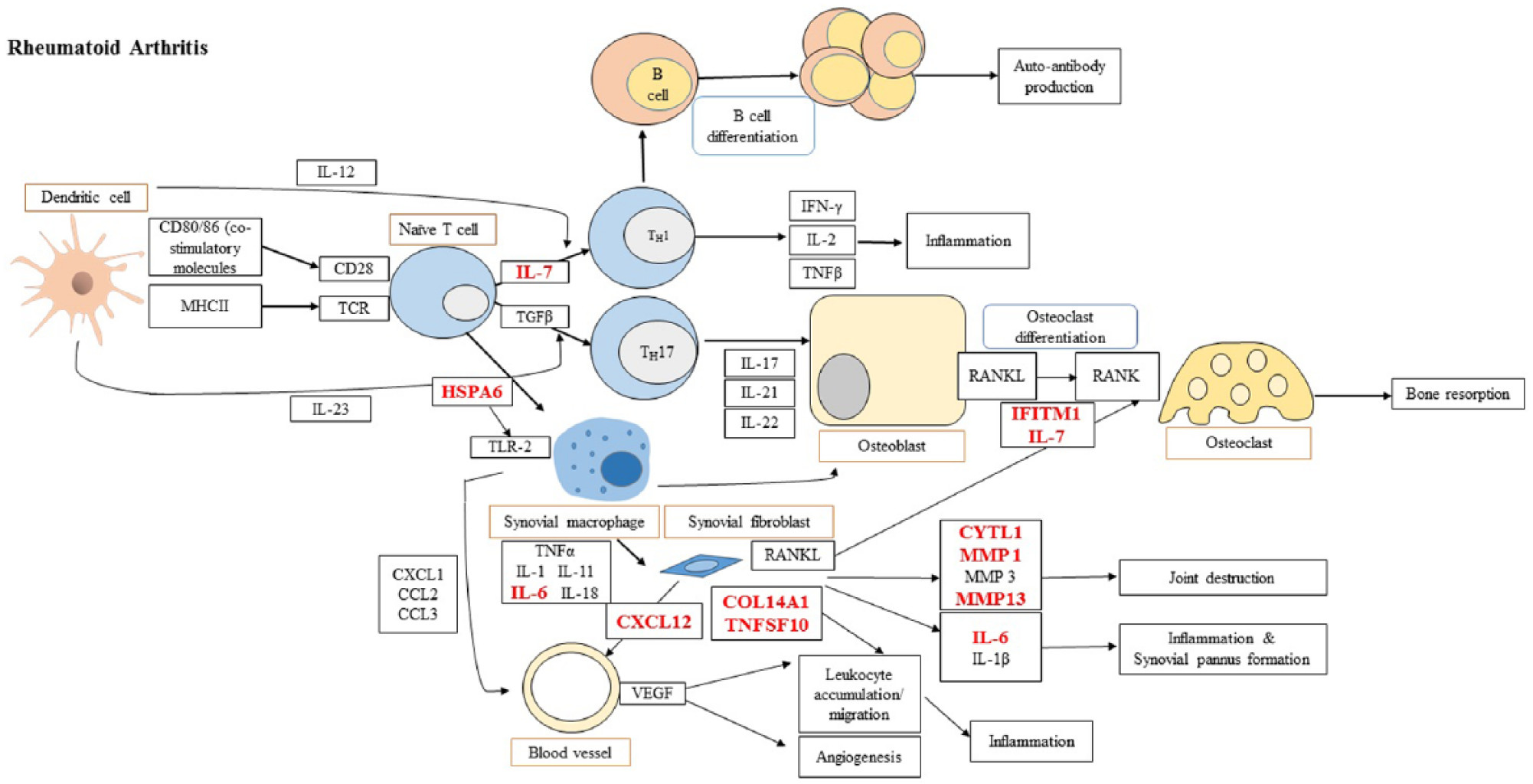
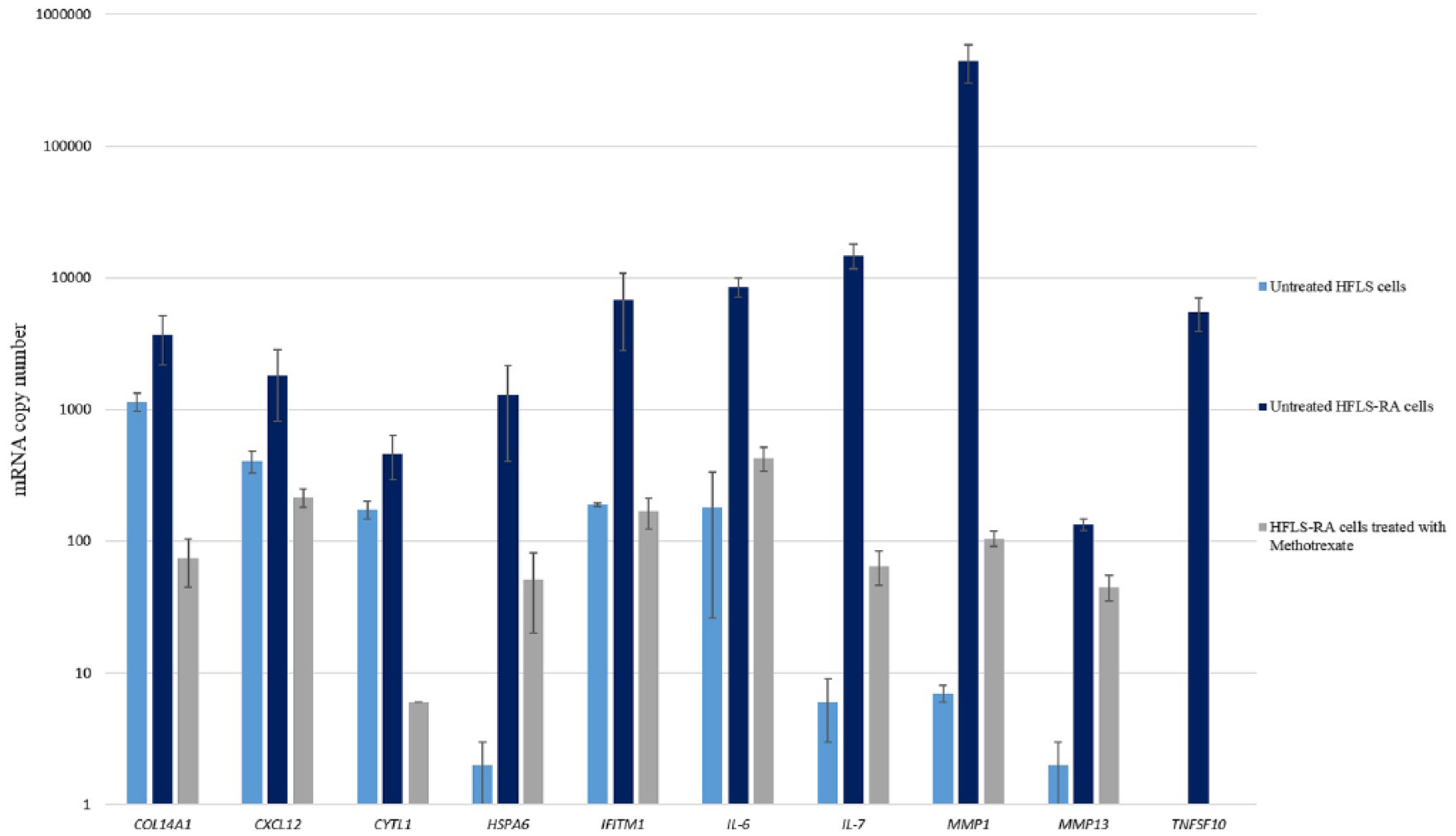
| Gene | Untreated HFLS cells | Untreated HFLS-RA cells | HFLS-RA cells treated with MTX |
|---|---|---|---|
| COL14A1 | 1145 ± 183 | 3676 ± 1498 | 75 ± 30 |
| CXCL12 | 407 ± 78 | 1820 ± 1011 | 216 ± 34 |
| CYTL1 | 175 ± 26 | 464 ± 172 | 6 ± 0 |
| HSPA6 | 2 ± 1 | 1287 ± 883 | 51 ± 31 |
| IFITM1 | 190 ± 6 | 6841 ± 4047 | 169 ± 45 |
| IL-6 | 181 ± 155 | 8504 ± 1403 | 428 ± 87 |
| IL-7 | 6 ± 3 | 14,840 ± 3214 | 65 ± 19 |
| MMP1 | 7 ± 1 | 444,768 ± 146,191 | 105 ± 14 |
| MMP13 | 2 ± 1 | 134 ± 13 | 45 ± 10 |
| TNFSF10 | 1 ± 0 | 5440 ± 1548 | 1 ± 0 |
Discussion
| Gene | Description | References |
|---|---|---|
| COL14A1 | COL14A1 codes for the α chain of type XIV collagen and is classified under the FACIT family. Increased accumulation of FACIT collagens has been implicated in the process of fibrosis which often occurs after injury or inflammation | Ansorge et al6 |
| CXCL12 | CXCL12 (stromal cell–derived factor 1) is an antimicrobial gene and codes for the ligand of the chemokine CXCR4 receptor. The role of this receptor/ligand complex has been highlighted in inflammation | Döring et al7 |
| CYTL1 | CYTL1 codes for a protein which is specifically present in bone marrow and cord blood cells that carry the CD34+ surface antigen. In vivo studies conducted have demonstrated that CYTL1 maintains cartilage homeostasis | Ai et al8 |
| HSPA6 | HSPA6 codes for the HSP70B′ protein which is not detected in most cells under normal conditions, however, is elevated under austere stress conditions and can also act in a cytoprotective manner depending on the cellular type and environment | Kuballa et al9 |
| IFITM1 | IFITM1 codes for a member of the IFN-induced transmembrane protein family. Studies have identified the role of this protein in the activation of IFN signalling pathways and its cell adhesion functions | Van Holten et al10 |
| IL-6 | IL-6 codes for a pleotropic cytokine which has a critical role in the pathophysiology of RA. It has been reported to be highly expressed in the synovium of patients with RA as it stimulates synovitis and joint destruction | Srirangan and Choy11 |
| IL-7 | IL-7 is involved in the proliferation and development of T cells along with differentiation of osteoclasts and RANKL production which leads to bone resorption | Churchman and Ponchel12 |
| MMP1 | MMP1 codes for a collagenase of the MMP family which has an important role in breaking down the ECM and has been implicated in processes such as tissue remodelling and RA | Green et al13 |
| MMP13 | MMP13 codes for a protease belonging to the M10 peptidase family of MMPs that is particularly involved in the cleavage of type II collagen which is a major constituent of joint cartilage | Jüngel et al14 |
| TNFSF10 | TNFSF10 codes for a cytokine belonging to the TNF family of proteins and selectively mediates apoptosis in malignant and abnormal cells, however, does not damage normal cells. | Morel and Audo16,17 |
Biomarkers for an early diagnosis of RA
MTX therapeutic biomarkers for RA
C-reactive protein
Conclusions
Acknowledgments
Declaration of conflicting interests:
Funding:
References
Cite
Cite
Cite
Download to reference manager
If you have citation software installed, you can download citation data to the citation manager of your choice
Information, rights and permissions
Information
Published In

Keywords
Rights and permissions

Authors
Author Contributions
Metrics and citations
Metrics
Publication usage*
Total views and downloads: 2632
*Publication usage tracking started in December 2016
Publications citing this one
Receive email alerts when this publication is cited
Web of Science: 14 view articles Opens in new tab
Crossref: 19
- Energy metabolism in health and diseases
- Glycolytic reprogramming shapes the histone acetylation profile of activated CD4+ T cells in juvenile idiopathic arthritis
- Pharmacoepigenetics
- Heart Failure in Rheumatoid Arthritis: Clinical Implications
- Glycolysis, a driving force of rheumatoid arthritis
- The Involvement of Glucose and Lipid Metabolism Alteration in Rheumatoid Arthritis and Its Clinical Implication
- Targeting fibroblast-like synoviocytes in rheumatoid arthritis
- HSPA6 and its role in cancers and other diseases
- Human Retinal Organoids Provide a Suitable Tool for Toxicological Investigations: A Comprehensive Validation Using Drugs and Compounds Affecting the Retina
- Translational Autoimmunity
- View More
Figures and tables
Figures & Media
Tables
View Options
View options
PDF/EPUB
View PDF/EPUBAccess options
If you have access to journal content via a personal subscription, university, library, employer or society, select from the options below:
I am signed in as:
View my profileSign out

I can access personal subscriptions, purchases, paired institutional access and free tools such as favourite journals, email alerts and saved searches.
loading institutional access options
Alternatively, view purchase options below:
Access journal content via a DeepDyve subscription or find out more about this option.
