When considering suitable indicators we must recognize that anti-pluralist parties typically seek to shore up their credentials as “regular democratic parties” in official party documents. For example, data from the Manifesto Project (
Volkens et al., 2019) show that such parties routinely pay lip service to democracy: The German far-right party AfD scores high (4.08) and the center-right party CDU low (0.74) on their measure of favorable mentions of democracy in 2017. Thus, party documents alone are not adequate.
Rhetoric in speeches and other events can be more authentic and revealing (
Maerz and Schneider 2021).
Maerz and Schneider (2019) compared 4,740 speeches from heads of government in 27 countries between 1999 and 2019, and found that leaders in autocratic countries use a substantially less democratic style of rhetoric than leaders of democratic countries.
Linz (1978) found that political parties that later seek to derail democracy are typically explicit with their true anti-pluralism also before they assume politically powerful positions. Unfortunately, the availability of party leaders’ recorded public speeches is unequal and biased towards developed countries with large media infrastructures, as well as towards the present. We therefore turn to measures on anti-pluralism in the V-Party data set to operationalize the Linzian indicators (
Lührmann et al., 2020a):
• Low commitment to the democratic process (v2paplur): “Prior to this election, to what extent was the leadership of this political party clearly committed to free and fair elections with multiple parties, freedom of speech, media, assembly and association?”
• Demonization of political opponents (v2paopresp): “Prior to this election, have leaders of this party used severe personal attacks or tactics of demonization against their opponents?”
•
Encouragement of political violence (v2paviol): “To what extent does the leadership of this party explicitly discourage the use of violence against domestic political opponents?”
4•
Disrespect for fundamental minority rights (v2paminor): “According to the leadership of this party, how often should the will of the majority be implemented even if doing so would violate the rights of minorities?”
5The V-Party dataset is based on 665 country experts assessing the identity of all political parties with a vote share of more than 5% in a legislative election between 1970 and 2019, across 169 countries (
Lührmann et al., 2020a). The data covers 1,955 political parties across 1,560 elections—or in total 6,330 party-election year units. Typically, more than four experts rated each country-year-question combination.
6 All items are measured on a five-point ordinal scale, and aggregated correcting for possible between-expert differences in scale use using V-Dem’s IRT model (
Marquardt and Pemstein 2018;
Marquardt et al., 2019;
Pemstein et al., 2020). Validation of the V-Dem approach of expert-coding has been extensive and positive. When constructing the API, we use the MM versions of the four Linzian indicators, while when using them directly, we take their OSP versions (
Coppedge et al., 2020) linearly rescaled onto [0,1] so that higher values indicate higher levels of anti-pluralism. For details see the SM.
Data validation
Since no other measure has yet captured the anti-pluralist traits of political parties, we assess
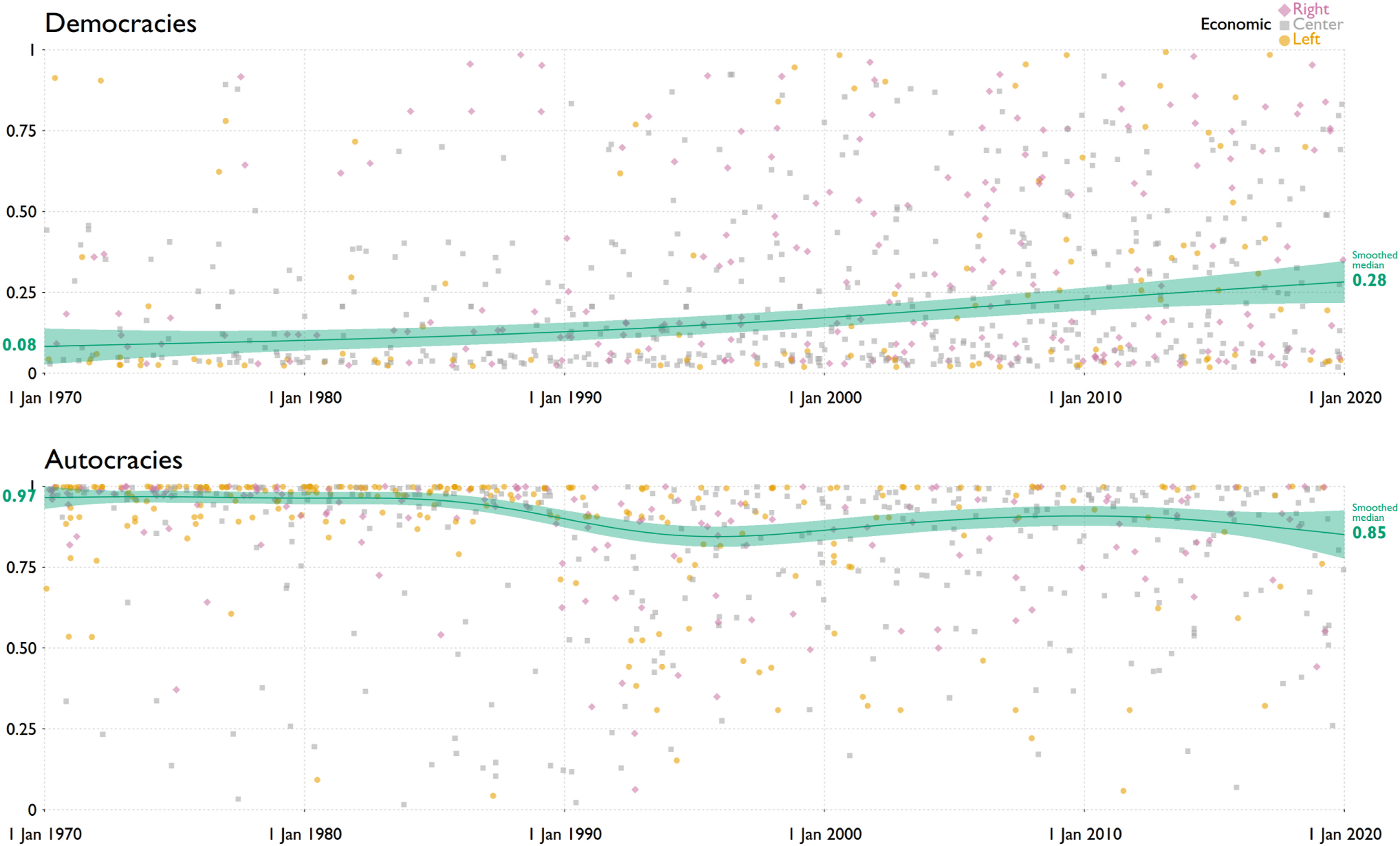
convergent validity by comparing the values on the API of ruling parties in democracies (top of
Figure 1) with the one in autocracies (bottom).
Reassuringly, this shows stark differences. The smoothed median score in 2019 was 0.28 in democracies and 0.85 in autocracies. The median governing party in democracies has become more anti-pluralist in recent decades, which is congruent with research showing that contemporary threats to democracy typically come from within the government (
Bermeo 2016). The median governing party in autocracies has become somewhat less anti-pluralist in the same period, reflecting the mimicking of multi-party elections in most autocracies (
Schedler 2002). This finding thus supports the not only the convergence but also the content validity of the new index.
To further assess the
content validity of the API, we explore some relevant cases.
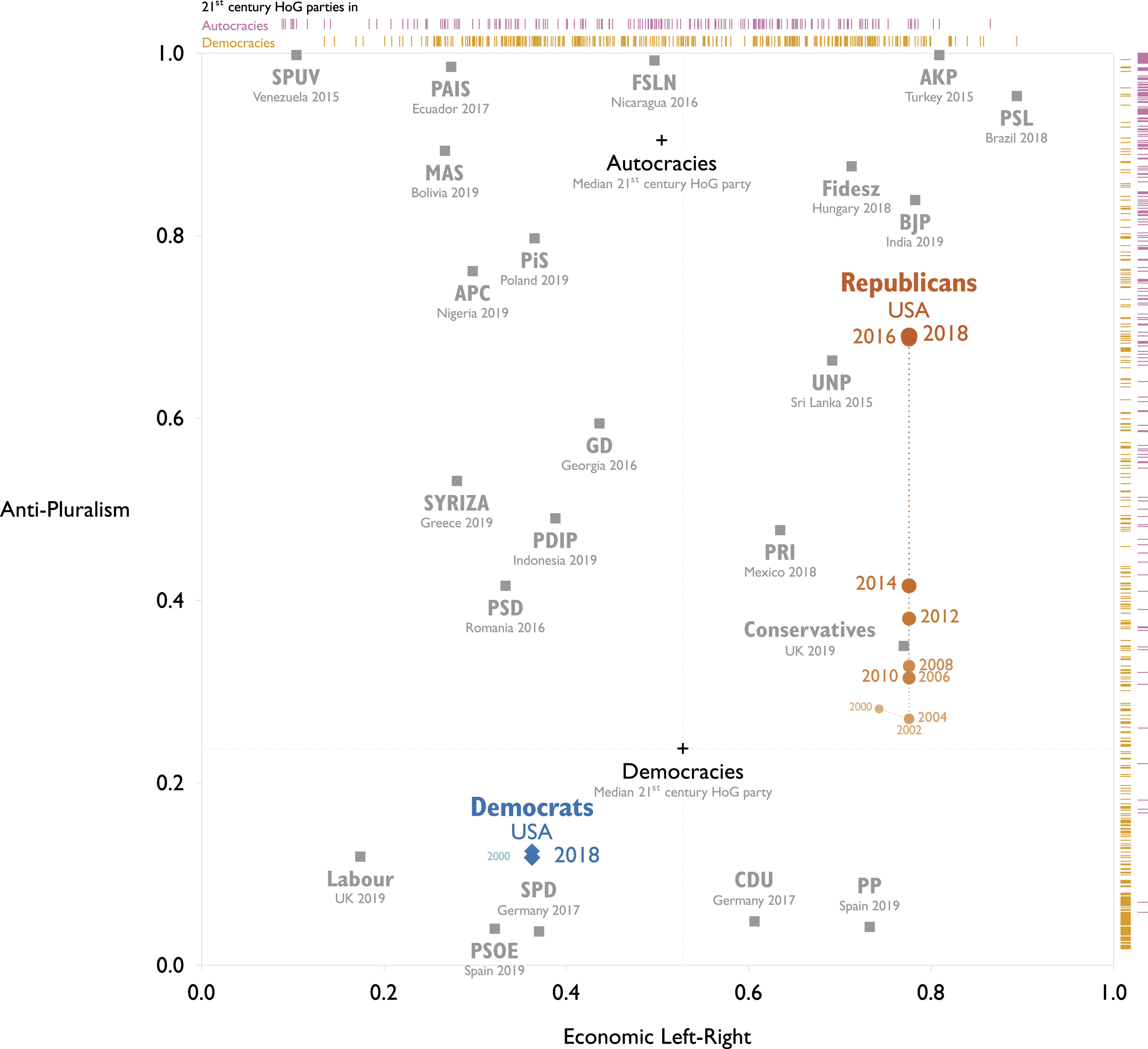
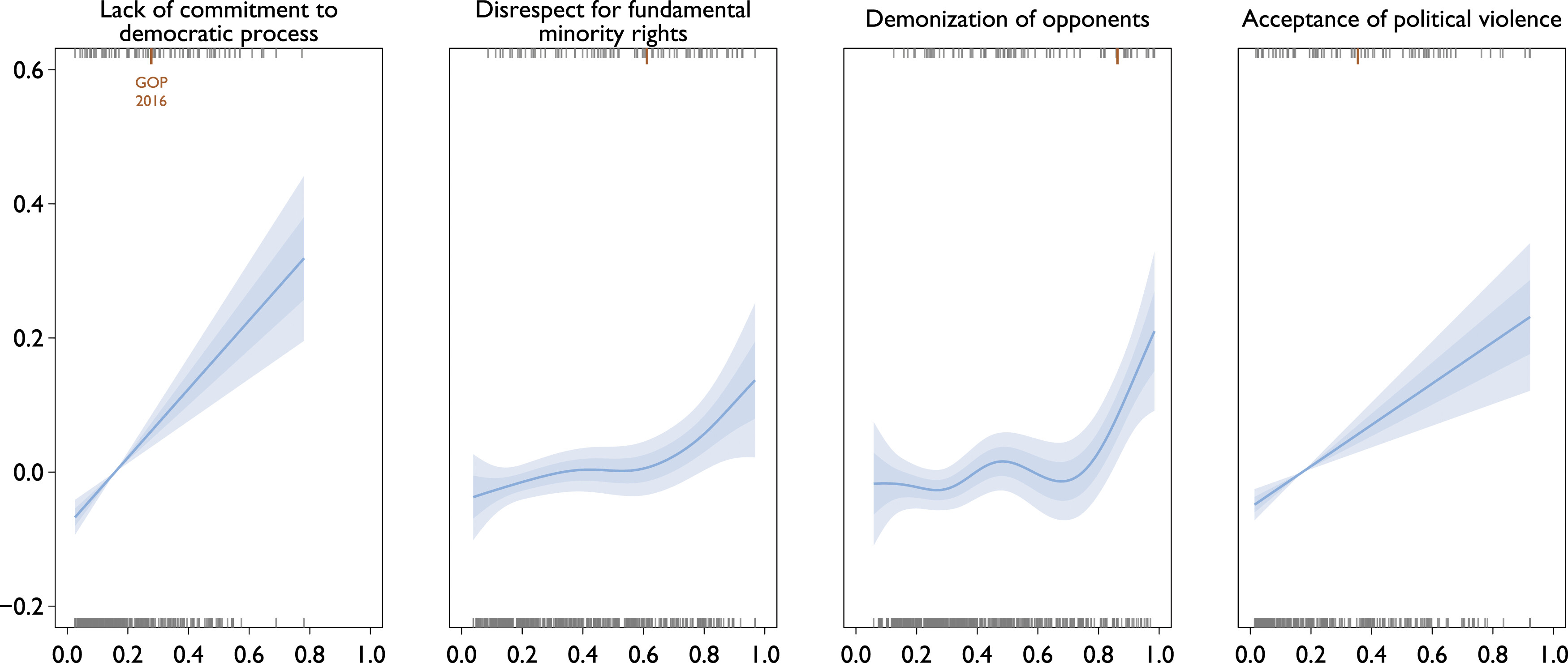
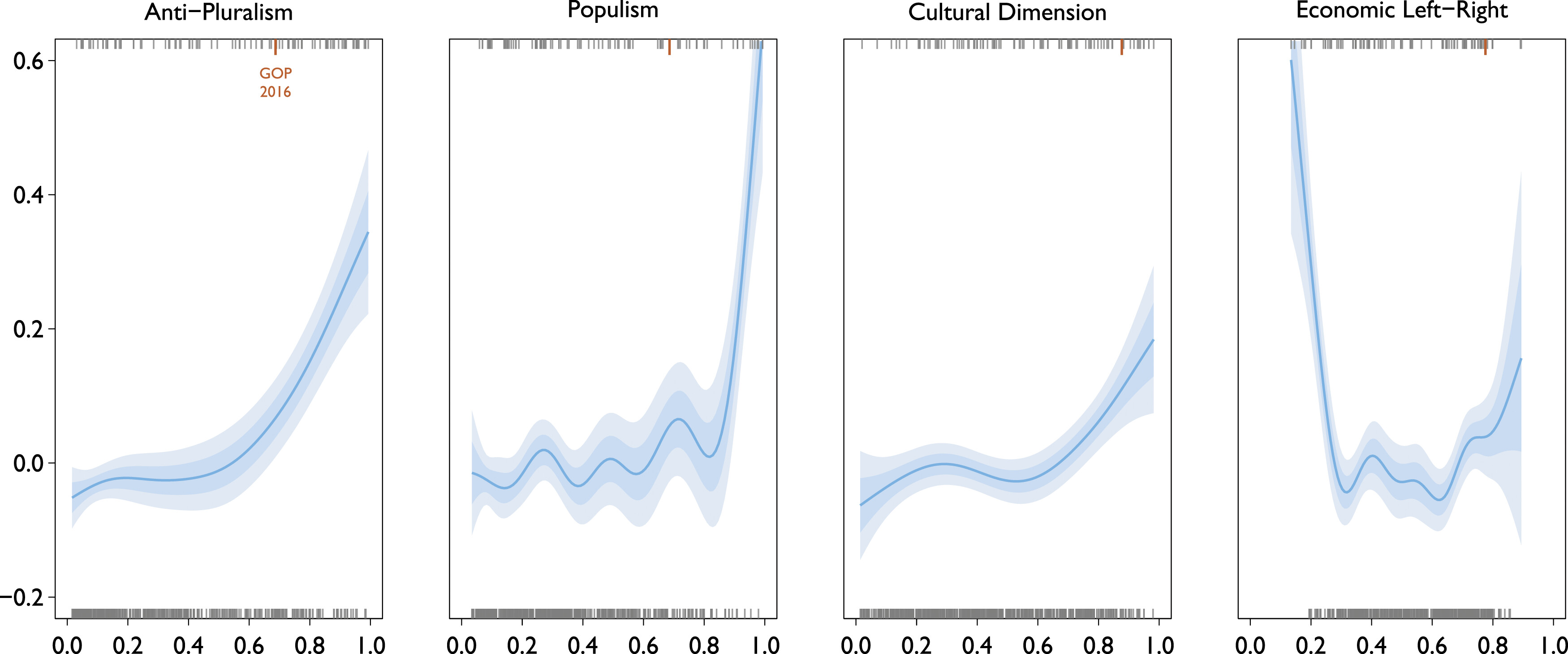
Figure 2 highlights the US Republican and Democratic parties on two dimensions: anti-pluralism and left-right positioning on economic policy, with other parties positioning at the last election in relief. The Republican party has not changed its left-right placement but moved strongly in an anti-pluralist direction reaching an API score of 0.69 in 2018. This reflects that Trump in his 2016 presidential campaign made personal, demonizing attacks on political opponents leading to a high score of 0.86 on the demonization indicator (see
Table 2).
7 He also condoned violence towards his political opponents, saying about Clinton that
“If she gets to pick her judges, nothing you can do, folks […] Although—the second amendment people—maybe there is”,
8 and towards protesters at his rallies. This is reflected in the score for the encouragement of violence (0.35,
Table 2).
Already by 2016, the rhetoric of GOP’s leaders was closer to autocratic ruling parties such as the Turkish AKP (1.0) and Hungarian Fidesz (0.88) than to typical center-right governing parties in democracies such as the Conservatives in the UK (0.35) or CDU in Germany (0.05).
9 The same holds for Bolsonaro (PSL, Brazil) whose rhetoric during the 2018 presidential campaign frequently demonized his opponents and promoted violence (
Hunter and Power 2019), reflected in PSL’s API of 0.95. Likewise, PiS, ruling in Poland since 2015, scored 0.80 on the API by the 2019 elections, reflecting for instance that the government-controlled media attacked and demonized PiS’ opponents and accused them of threatening traditional Polish values (
Markowski 2020).
The Greek SYRIZA is on an intermediate level of anti-pluralism (0.53 ahead of the 2015 election). SYRIZA accused opponents of being subservient to foreign powers and the international banking system (
Aslanidis and Rovira Kaltwasser 2016) and correspondingly did not score well in opponent demonization (0.60). In comparison, the leadership of Angela Merkel’s CDU made no known anti-pluralist statements or behaviors, which corresponds to a low API score of 0.05 in 2017.
Validating the relationship between anti-pluralism as indicated by the API and autocratization
Table 3 shows that when anti-pluralist parties gained power in democracies, 29% autocratized in the year after they won (or defended) office (see Group IV). After pluralists won office, only 6% autocratized (Group II) while most remained democratic (Group I), an outcome that was much less likely after the election of anti-pluralists (Group III). Meanwhile the result for Group I is not surprising.
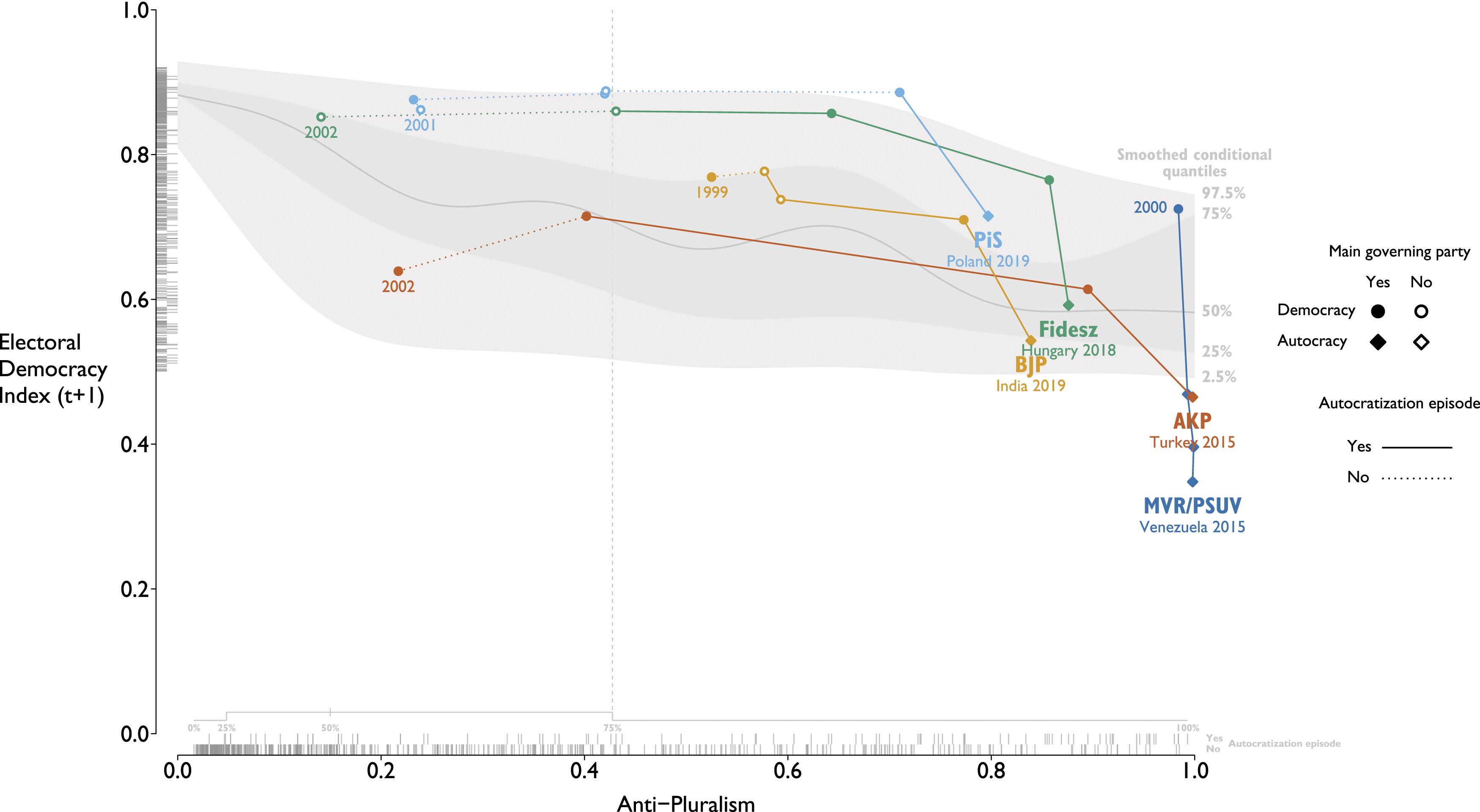
Figure 3 shows the relationship between the API of ruling parties (
x-axis) and the level of electoral democracy (
y-axis): the more anti-pluralist ruling parties become, the lower the level of democracy. When political parties move to the right of the dotted vertical line (at the API value of 0.43), they are considered anti-pluralists. Trajectories of selected
Group IV parties are highlighted. The Polish Law and Justice Party (PiS), the Hungarian Fidesz, and the Turkish Justice and Development Party (AKP) all started with scores in the pluralist part of the spectrum, while The Indian Bharatiya Janata Party (BJP) exhibited some level of anti-pluralism already in 1999. All four parties have become increasingly anti-pluralist and autocratization has followed.
The AKP increased its anti-pluralist traits between every election since its foundation. When Erdoğan came to power after the 2002 election, he had promised reforms that would enhance the separation of powers, the independence of the judiciary, increase the freedom of press, and strengthen the rule of law. However, Erdoğan have instead been cracking down on protesters (
Taspinar 2014), orchestrating prosecutions of political opponents, and describing the separation of powers as “an obstacle” that he would overcome by hollowing out the judiciary (
Karaveli 2016).
Polish PiS has gone from an API of 0.23 in 2005 when it first gained power, to 0.71 when it returned to power in 2015. This reflects its increasing nationalism, disrespect of minority rights, and demonizing of opponents (
Harper 2010: 24). Additionally, PiS has undermined the independence of the judiciary, checks and balances, as well as freedom of expression (
Markowski 2020). Meanwhile Poland’s EDI score declined from 0.89 in 2014 to 0.69 in 2019.
Hungary was an electoral democracy in 2010 when Fidesz won the elections and returned to power. The Orbán government has since placed constrains on civil society, restricted freedom of expression as well as academic freedom,
10 and blatantly demonized the opposition.
11 A substantial decline on the EDI followed, from 0.81 in 2010 to 0.49 by 2018.
The MVR/PSUV in Venezuela scored high on anti-pluralism (0.95) already in 1998 when Chávez won his first election. Venezuela then embarked on a drastic autocratization episode with its EDI score dropping from 0.72 in 1999 to 0.33 by 2015. After PSUV lost the 2015 legislative elections, Maduro (Chávez’s successor) stripped the parliament of power and designated the Supreme Court to take over the functions of the National Assembly (
Alarcon et al., 2016;
Corrales 2020).
Democracy has deteriorated since the BJP led by Narendra Modi became India’s governing party in 2014. India’s EDI declined from 0.69 then to 0.51 in 2019. A series of policies have diminished freedom of expression and academic freedom, and repression of civil society has increased along with persistent discrimination against Muslims (
Ganguly 2020;
Varshney 2019). This is reflected in BJP’s API of 0.84 in 2019.
However, not all countries autocratize with anti-pluralists in office (
Group III). In 137 cases, autocratization did not start in the year after an anti-pluralist came to power (lower rug on the right of
Figure 3). The median API in the group (0.68) is lower than in the group where anti-pluralism is followed by autocratization (0.77). This may indicate that a certain threshold is required for autocratization to start, which is an avenue for future research. Research indicates that stronger parliamentary and judicial oversight can help to prevent autocratization (
Boese et al. 2021). A moderately anti-pluralist party that did not substantially erode democracy was Forza Italia with an anti-pluralism score of 0.72 in 2001. Silvio Berlusconi then governed Italy in 2001-2006 and 2008-2011, and while he engaged in anti-pluralist rhetoric, the Italian institutions withstood the pressure and remained more or less intact (
Verbeek and Zaslove 2016).
A few elections (36) were followed by autocratization even though a pluralist party was in office (
Group II). For example, Citizens for European Development of Bulgaria (GERB) scored 0.13 on the API when gaining power in 2009. Yet, the quality of democratic institutions declined substantially from 2009 (EDI 0.72) to 2019 (EDI 0.59). GERB pursued an agenda of state capture putting loyal individuals in charge of media outlets, the Supreme Justice Council, and anti-corruption agencies (
Ganev 2018). A less pronounced autocratization process occurred in Chile under pluralist leadership from 2011 to 2019,
12 and in Israel (2010–2019).
13 In other cases, the pluralist party leader wining the elections was removed from office under dubious circumstances as with President Dilma Rousseff in Brazil in 2016 (
Chalhoub et al., 2017). Finally, some cases in this group registered only minor democratic declines under pluralist rule but more severe declines later under anti-pluralist rule, for instance in Hungary in 2007 and the United States in 2015.
We hope that the above conveys the construct and convergent validity of the API and its four indicators by that: (i) developments on the API correspond to real-life events; (ii) it captures anti-pluralist traits of ruling parties before they begin eroding democracy; (iii) the resolved data show developments over time; (iv) the measures of autocratization and anti-pluralist rhetoric capture distinct concepts.