Introduction
Fast-paced technological change has led to digital technology featuring prominently in family life, including as a medium for everyday language and literacy practices. Research evidences that young children regularly take part in digitally mediated activities at home, both alone and with their families (
Chaudron et al., 2018), such as watching television programs, playing with digital toys, reading e-books, interacting with friends and family via video calls, and finding information online (
Arnott et al., 2019;
Griffith and Arnold, 2019;
Ofcom, 2019;
Zhao and Flewitt 2020). These activities offer rich potential for early language and literacy (
Flewitt and Clark, 2020;
Flewitt et al., 2015) yet compared to older children’s digital media use, less is known specifically about the early language and literacy practices at home with technology of babies, infants and toddlers, and how these practices are embedded in very young children’s everyday lives at home. This review therefore focused on extant studies about 0-36-month-old children’s talk and literacy learning with digital technology at home and was used to inform the ESRC-funded Toddlers, Tech and Talk (TTT) project. TTT is an exploratory, collaborative study between Manchester Metropolitan University, Swansea University, Lancaster University, University of Strathclyde, and Queen’s University Belfast, exploring how the home lives of children aged under 3 years intersect with digital technologies in families across diverse minority and majority communities in the United Kingdom.
The paper begins by presenting the review aims and methodology, followed by definitions of digital technology and key themes in the literature relating to very young children’s language and literacy practices with diverse media at home, including the role of joint media engagement to support children’s talk and literacy with digital devices and the importance of the Home Literacy Environment (HLE). By reviewing the literature on this topic, gaps in knowledge are identified and areas for future research are proposed.
Methodology
This scoping review of literature was conducted to explore what evidence is available from empirical studies regarding how children aged from birth to 3 years develop early talk and literacy as they engage with diverse media at home, and how families mediate and under-threes’ digital media use at home. Following ethical approval from all participating universities, a review of literature was conducted to survey the landscape of empirical, peer-reviewed studies in English language that report on this field. To assist the review processes, we followed Preferred Reporting Items for Systematic Reviews and Meta-Analysis (PRISMA) guidelines (
Tricco et al., 2018).
Given that very young children’s communication is embedded in wider interactional practices, we began by developing and piloting a broad search strategy using Boolean terms: (“0-3” OR “Under 3*” OR “young child*” OR “toddler*” OR “infant*”) AND (“digital media” OR “digital technology” OR “digital*”) AND (“home*” OR “family”) published between 2000 and November 2022 (Search 1). NVivo qualitative data analysis software was used for systematicity and transparency of article selection, quality assessment and coding (
Varker et al., 2015). A subsequent search focusing on young children’s digital language and literacy practices was conducted in June 2024, covering the publication period 2000-June 2024 (Search 2). This second search included the Search 1 Boolean terms plus “language”, “talk”, “literacy”, “reading”, “phonics”, “writing”, “drawing” and “communication”.
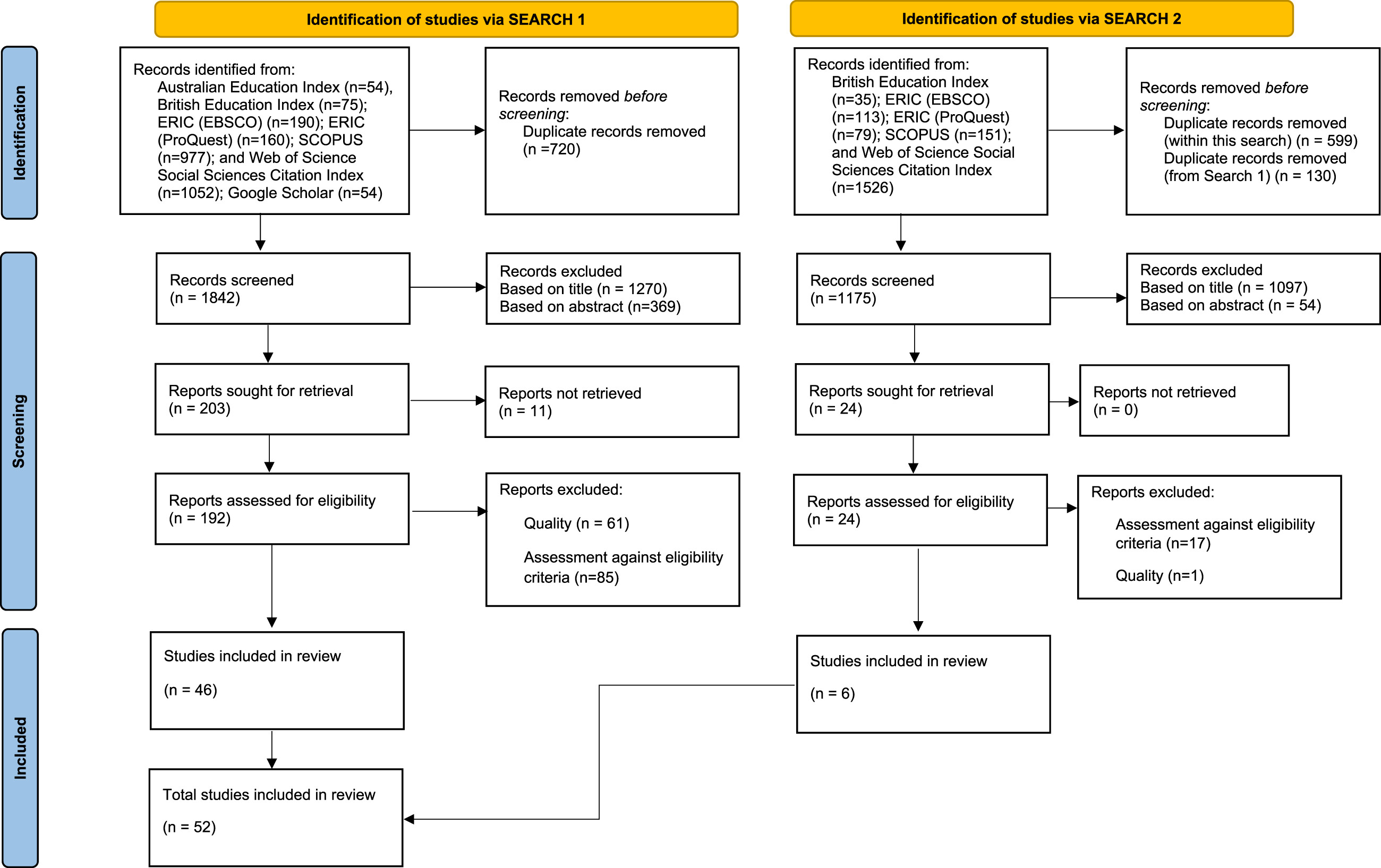
Both searches used six social science and education databases (Australian Education Index; British Education Index; ERIC (EBSCO); ERIC (ProQuest); SCOPUS; and Web of Science Social Sciences Citation Index), as well as Google and Google Scholar. The titles and abstracts of all studies were screened against the eligibility criteria (see
Table 1). Duplicates and ineligible papers were excluded (see
Figure 1), and the full texts were retrieved of all papers with insufficient detail in the title or abstract to inform eligibility decisions.
The papers’ quality was assessed using Critical Appraisal Skills Programme
(CASP) (2018) for qualitative studies, and Mixed Methods Appraisal Tool (MMAT) (
Pluye et al., 2011) for quantitative studies. These included consideration of formal research ethics approval processes having been followed by all reported studies. A 10% sample was independently assessed for quality by two researchers and procedures for applying the CASP and MMAT criteria were finetuned to ensure inter-rater agreement. This resulted in a final sample of 52 papers (46 from Search 1; 6 from Search (2) of high/medium quality (see Appendix 1).
Findings
During Search 1, 2562 papers were identified, comprising 2508 papers from database searches and 54 from Google, Google Scholar and reference lists of relevant articles. 720 duplicates were removed, and 1270 references were excluded based on scrutiny of their titles. 572 articles were assessed against title and abstracts and the remaining 192 full-text articles were read and assessed for eligibility, of which 146 papers were excluded following quality screening, resulting in a total of 46 studies in the final sample.
During Search 2 which focused on language and literacy, 1904 papers were identified and 599 were removed as duplicates. 1097 references were excluded following scrutiny of their titles and 54 following scrutiny of titles and abstracts. The remaining 24 full-text articles were assessed for eligibility. 18 of these were excluded following further eligibility and quality screening, resulting in a total of 6 additional papers from Search 2 and a total final sample for this scoping review of 52 published studies across multiple disciplines (See
Figure 1). Many of these report on child age ranges wider than 0-3 years. Of these, we excluded all papers where no findings specific to 0-3-year-olds were reported but retained papers where some findings were relevant to 0-3s but overlapped with findings about older children (See
Figure 2). Most of the resultant selection of papers adopted quantitative or mixed methods approaches, as reflected in our final sample: quantitative (n = 25); mixed methods (n = 9); qualitative studies (n = 11) (see
Appendix 3).
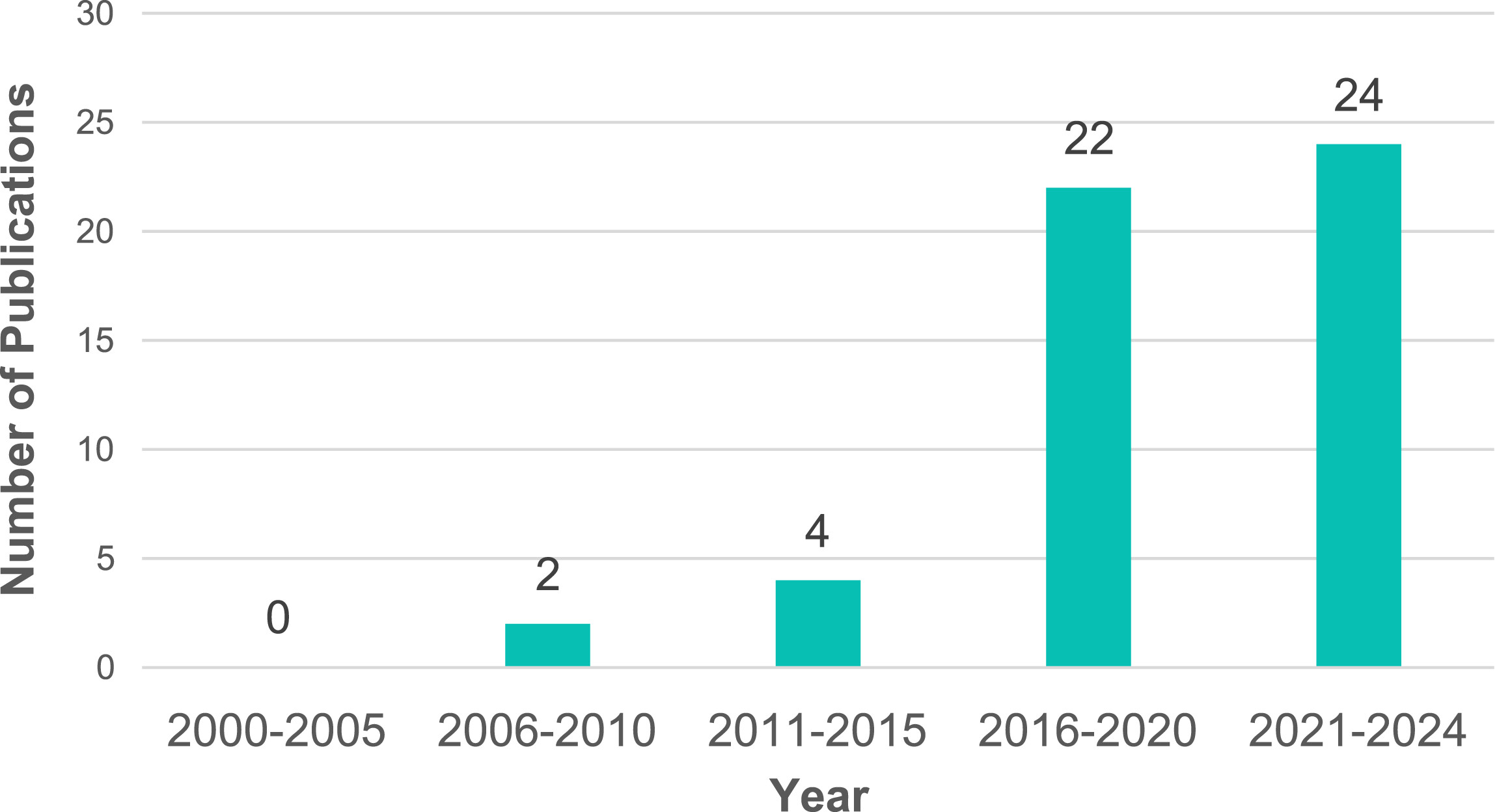
Having applied the eligibility and quality criteria in a systematic manner, no papers published 2000-2005 were eligible for inclusion. Our final sample included two papers published 2006–2010, four published 2011–2015; 22 published 2016–2020 and 24 published 2021-June 2024, indicating significant incremental growth of research in this field over time (see
Figure 3).
Coding strategy
The coding strategy for analysis was developed iteratively during regular meetings, using Main Codes and Child Codes (see
Appendix 2). Code definitions were agreed, overlapping codes were merged, and a 2% sample was coded by two researchers to maximize inter-rater agreement. Discrepancies were discussed and coding definitions were refined prior to coding the full sample using NVivo qualitative data analysis software.
Defining digital technology
In the literature, ‘digital technology’ is used as a broad term that encompasses multiple systems and devices using electronic and computerized technology for communication, entertainment, and gaming (
Teichert et al., 2021). These take many tangible (e.g. laptops, smartphones, tablets, cameras, and electronic toys) and less tangible forms (e.g. the internet and artificial intelligence) (
Huber et al., 2018: 821). Some digital devices have screens whilst others do not, yet all are ‘firmly positioned as cultural tools’ that shape how children experience and make sense of the world, including children’s early language and literacy (
Johnstone et al., 2022: n. p.).
Chronological overview
Many papers in the final 2016-2020 sample deployed qualitative methodologies or mixed methods and socio-cultural, ecological, and/or multimodal lenses to explore under-threes’ digital learning, including touch technologies in increasingly digitally-networked HLEs (
Flewitt and Clark, 2020) and changing family media ecologies (
Kucirkova et al., 2018;
Kumpulainen et al., 2020;
Marsh et al., 2017;
Murphy and Headley, 2020;
Neumann et al., 2020;
Nicholas and Paatsch, 2018;
O'Connor and Fotakopoulou, 2016;
Poveda et al., 2020;
Siibak and Nevski, 2019). Other quantitative and mixed methods papers focus on video calls (
McClure et al., 2018;
Tarasuik and Kaufman, 2017), app design and popularity (
Crescenzi-Lanna and Grané Oro, 2019;
Sari et al., 2017), and ECEC digital pedagogy (
Palaiologou, 2016). ‘Screentime’ is the focus of two quantitative and one qualitative papers and one position statement
Canadian Paediatric Society Digital Health Task Force (2017);
Huber et al., 2018;
Waisman et al. (2018), and three are reviews (
Barr, 2019;
Kumpulainen and Gillen, 2019;
Neumann and Neumann, 2017).
There is a marked shift in methodological trends from 2021 to 2024, where 11 of 24 studies deploy statistical analysis of parental questionnaires, some also deploying interviews and/or audio-recorded naturalistic parent-child language. These explore issues relating to: screentime (
Gago-Galvagno et al., 2023;
Martinot et al., 2021;
Putnick et al., 2023); child vocabulary learning (
Sundqvist et al., 2022); digital literacy and multimodal practices (
Dong et al., 2022); HLE (
Alroqi et al., 2022); and language development with diverse media (
Medawar et al., 2023;
Sundqvist et al., 2021) in relation to music (
Franco et al., 2024), TV-viewing (
Shah et al., 2021) and sleep patterns (
Bellagamba et al., 2021). Four papers report statistical analyses of: experimental approaches to compare parent language during TV-viewing and book-reading (
Hanson et al., 2021); Random Control Trials reporting on TV, e-books and literacy (
Guevara et al., 2021); word learning from screens with or without human presence (
Tsuji et al., 2021); and video-viewing and adult scaffolding (
Strouse and Ganea, 2021). Six papers report on mixed or quantitative analysis of video chat (
Myers et al., 2024), media and language (
Cycyk and De Anda, 2021), e-readers (
Schmitt et al., 2022); parent-child interactions with touchscreens (
Carr and Dempster, 2021); mobile technologies (
Archer et al., 2021); and under-threes’ play with tablets in home environments (
Marsh et al., 2021).
Sairanen et al. (2022) report on a qualitative study of digital literacies,
Barr (2022) collates empirical research to make policy recommendations for young children’s equitable digital inclusion, and
Xie et al. (2024) present a meta-analysis of research on ‘screentime’ and language development.
Digital technology and language
30 of the publications in our final database consider the relationship between very young children’s digital tech use and language, which we group under the themes of language and TV-viewing, video calls, musicality and Joint Media Engagement.
TV-viewing and child language learning
Six papers focus specifically on associations between young children’s TV-viewing and language acquisition. In his review of literature on infant media usage and outcomes for children’s language, cognition and attentional capacity,
Christakis (2009) concludes that it is not the amount of screen viewing
per se that affects children’s language learning, but factors such as the context of TV-viewing, quality of programming, age-appropriate content, and parent co-viewing and interaction that create impact. Christakis found no evidence that exposure to TV enhances the language development of children aged under three, even if the programs viewed have proven educational benefits for 3–5-year-old children (such as
Sesame Street). Rather, Christakis concludes that TV viewing could delay language acquisition for children aged under 3 years, possibly because parent interaction while watching TV can be low compared to activities such as book reading, which have consistently been found beneficial for children’s language.
Hanson et al.’s (2021) secondary quantitative analysis of an experimental study of parental talk with 15-(+/−1-month) to 30-month-old children concurs that while coviewing TV, parents used smaller vocabularies than when book-reading, but when coviewing, parents used more new words per utterance. They conclude that reduced parent-child verbal interactions during TV-viewing, rather than TV-viewing
per se, negatively influences language development during the first 3 years of life but can equally lead to new vocabulary being used both during and after TV-viewing.
Similarly,
Bellagamba et al.’s (2021) scrutiny of parental-report surveys concerning child technology use and sleeping patterns found that high quality and developmentally appropriate TV media content was associated with better language and social outcomes for young children, whereas poor quality, inappropriate, and unsupervised media use linked to poorer physical activity, sleep, behavioural and cognitive outcomes. In a longitudinal empirical study of 1562 children’s (aged 2-6 years) exposure to screens and language development,
Martinot et al. (2021) found that 2-year-old children’s language scores were highest when they watched screens for a moderate amount of time (31–60 minutes daily) compared to those who never watched screens or those who watched for longer lengths of time. They surmise this may be because children watching moderate amounts of TV may also be watching higher quality programs, which may benefit their language development compared to those who do not watch TV. Having the TV on during family meals was linked to lower verbal IQ scores, regardless of overall screentime and baseline language scores, which they suggest may be due to mealtime TV reducing family talk.
Hypothesising that coviewing and verbal interactions around media tend to be particularly limited in families with low socioeconomic status,
Mendelsohn et al. (2008) used a 24-h parental recall diary to assess parent-child interactions between 154 low SES New York mother-infant dyads (6-months-olds) while co-viewing. Statistical analysis of results found that infants in low socio-economic families are likely to experience relatively high media exposure (median = 120 minutes) with less than one-quarter of exposures reported as including parent-child interactions. Interactions were higher with firstborns and with mothers who reported reading aloud with their children, but lower in the context of maternal depression. Limited verbal parent-child interactions were found regardless of content and were most frequently associated with content deemed educational, partly due to reduced coviewing with child-oriented programs. Although the study findings relating to socio-economic status are arguably skewed because only low-income dyads were studied, these findings suggest that any potential benefits of educational media may be limited in the absence of strategies to increase co-viewing interactions.
Examining potential associations with family socioeconomic status (SES), child television exposure, parent conversation during TV-coviewing and children’s curiosity in kindergarten,
Shah et al. (2021) found from their statistical analysis of parental reports that more hours of daily TV-viewing was associated with lower curiosity at kindergarten, while more frequent parent conversation during coviewing was associated with higher curiosity at kindergarten. This study concludes that especially for children from low SES, parent-child conversation during TV coviewing is important to promote children’s curiosity. The “curiosity gap” between higher and lower SES children was greatest when parents “never” or “hardly ever” engaged in television-related conversation.
Video calls and child language learning
Video calls are a relatively recent phenomenon that have become popular with increasingly younger children. Using a short quantitative questionnaire with parents of 308 children aged 0-6years, and qualitative interviews with parents of 17 children (n = 10 aged under 3 years),
Tarasuik and Kaufman (2017) found that the younger children in their sample started video communication at significantly earlier ages than older children. During interview, parents shared their belief that video communication was more suitable for children than telephone. Key motivations for involving children in video calls were to develop and maintain relationships with relatives who lived far away and during times of parental absence, including due to parental divorce. Parents identified many language-learning opportunities during video calls. The video communication of infants aged under 12 months was reported to involve smiling and other signs of excitement, but with time, language also became integral, with video calls becoming longer and more intense as children’s language developed, including activities like counting, reciting the alphabet and singing. As well as video calls between a child and adult, parents also reported virtual playdates with other children, especially cousins, that prompted child language use and new skills including reading books together, dancing and playing musical instruments together.
Reporting on observations of a video call between a 33-month-old girl and her friend,
Sairanen et al. (2022) describe how the children’s conversation begins with each asking multiple times what the other has been doing during the morning, whilst watching each other on the screen. Their call is scaffolded by their mothers who join in occasionally to explain or gently elaborate what their children say, until the children decide to end the call.
Reviewing research into early learning in the digital age,
Barr (2019) reports studies that cite the importance of video chats for maintaining multigenerational relationships and how, despite the cognitive challenges presented by video-chat interactions, effective mediation can help 2-year-olds learn new verbs equally well by video calls as in face-to-face interactions.
Barr (2022) further discusses how access to stable high-speed Internet benefits family wellbeing by maintaining multigenerational links, and how frequent video chats shape grandparents’ ratings of closeness to their grandchildren.
Marsh et al. (2021) describe how video communication offers an important means of engaging in affectionate, social and communication play with family members and friends, with some young children trying to kiss the screen when they see their loved ones.
Focusing on mobile touchscreen technologies,
O'Connor and Fotakopoulou (2016) report how parents value the opportunities touchscreens offer 0-3-year-olds to communicate with family at a time of increasingly geographically disparate extended families due to changes in social mobility, employment patterns and globalisation. Similarly,
Teichert (2020) reports how before he was 2 years old, her son regularly used Skype or FaceTime on an iPad or laptop to interact with grandparents living on the other side of the country and only used these ‘adult’ devices for that specific purpose.
McClure et al. (2018) hypothesised that adult–baby/toddler interaction joint visual attention (JVA) may be compromised during video chats as there is no line of sight that can be followed to the object of focus. They observed the naturally occurring video chats at home of 25 families between a child aged 6- to 24-months and their grandparents. Despite the many technical and developmental challenges of sharing attention using video chat, the study found highly successful JVA, with older toddlers initiating across-screen JVA, such as pointing a built-in camera at an object, thereby displaying their understanding of what a remote person could see through the camera lens. Between 8 and 16 months, infants initiated JVA in at least some video chats, and by 16 months almost all sessions included infant initiations. Grandparents and parents were highly sensitive and responsive to infants’ and babies’ developmental needs, and modulated their JVA attempts accordingly, often by showing interest in objects of interest near the child. Building on this work,
Myers et al. (2024) encouraged 50 families to Zoom-record video chats with remote grandparents, resulting in 142 naturally occurring infant-parent-grandparent interactions, sometimes joined by other family members. Statistical analysis of the Zoom recordings found JVA rates change with child age (4- to 20-months), grandmothers’ sensitivity predicts higher JVA rates and infant attention, and more complex sessions (involving more people, more across-screen JVA, and where infants initiated more JVA) resulted in lower amounts of JVA-per-minute.
Similarly,
Marsh et al. (2021) describe how adults are skilfully playful in their video chats with 0-3-year-old children, making noises, funny faces, and engaging in creative language play with children in traditional games such as ‘Peek-a-Boo’ during regular virtual exchanges. In an earlier paper,
Marsh et al. (2017) report how additional language learning opportunities were facilitated in young children’s home lives through tech, such as a 2-year-old child identifying the protocols of video call technology by waving at his auntie, realising that she could both see and hear him. They comment on significant intergenerational learning opportunities through grandparents’, aunties’ and uncles’ scaffolding of children’s language and understandings about literacy, including in multilingual families. The tech-based play of bilingual children was embedded across the languages spoken at home, promoting the children’s bilingual and biliterate skills, where digital, multilingual and multiliteracies experiences characterised family life. For families whose relations were in diasporic spaces across the globe, technology was central in enabling communication, and satellite television enabled access to television channels broadcasting in the children’s heritage languages. These practices were often intergenerational and contributed to the fabric of everyday life. As
Marsh et al. (2017) suggest, parents’ ethnotheories in relation to digital technologies shape children’s experiences, and whilst many parents of majority and minority ethnic communities expressed concern about their young children watching too much TV, interactive digital technologies were valued as central to families’ communicative practices, and as important for children’s futures.
Musicality, technology and language learning
Using tech to access or create music has been found to promote children’s digital literacy and foster children’s musicality, which is known to be important to help attune children to language cadences, rhythms and sounds. For instance,
Marsh et al. (2021) report how musical play emerged as an important element of young children’s daily lives, often helping to build social relationships through joint play and fostering intergenerational play. In their survey, 72% of parents mentioned their under-threes access musical play apps, which their case studies evidenced they were sometimes co-enjoyed with parents. Similarly,
Neumann et al. (2020) discuss how children enjoy musical activity with tablets at home and in nursery, such as watching nursery rhymes and moving with the rhythms of songs and popular media tunes.
In an observational study of 0-3s’ at home in Finland,
Kumpulainen et al. (2020) describe how a 33-month-old girl uses a digital player to sing karaoke, and a 35-month-old girl independently located a music app on a tablet, tapping different pictures to make different sounds. First her father joins her, asks about the app and its sounds, then moves away and her mother joins her. The child demonstrates the app and they excitedly tap the pictures to create sounds together, laughing and moving in time with the rhythms they create. The authors observe how these children’s digital activity is mediated jointly by the apps, their parents and the rules that have been established for their device use, where each has freedom to explore different apps and to select apps of their choice while being monitored at a distance by their parents, who show interest in what they are doing but let the children lead in their digital activity. In this study, the children explore language while also displaying operational and cultural dimensions of digital literacy as they learn to use digital devices and apps. Similarly,
Teichert (2020) reports her autoethnographic study of her son’s first 18 months of life in the USA, describing how they jointly sang and danced along to music on the iPad Google Play app.
Focusing on music and language development,
Franco et al. (2024) reviewed 117 survey responses from mothers of 8-18-month-old infants (corrected age) who were born prematurely and found that the amount and variety of musical activities between parents and infants within the home, both with (television, stereo, recorded music) or without (singing, playing a musical instrument) tech, was a significant predictor of receptive vocabulary and gestural communication outcomes for premature-born infants. Rich musical interactions and experiences were found to facilitate early language outcomes and enhance early communication skills among premature infants, who are considered at risk of language delays, thus acting as a protective factor for them.
Child media use and literacy
Whilst we acknowledge that early literacy has its roots in early language learning, few studies in our sample report specifically on both early language and literacy. Here, we review a growing body of research that specifically investigates how young children’s engagement with digital technologies can contribute to their emergent literacy skills, such as letter name and sound knowledge, early writing, symbolic representation, understanding of literacy concepts and story.
Many studies in this field consider how digital literacy practices are embedded in family life and extend non-digital aspects of children’s literacy lives.
Kumpulainen and Gillen (2019) argue that digital literacy is a cultural practice and crucial competency that young children learn within diverse meaning-making systems that are entangled with families’ knowledge, values, rules and preferred ways of being and acting with digital media. These shape parents’ mediation of child digital activity and how children learn operational, cultural, creative and critically reflective literacy practices (
Kumpulainen et al., 2020).
Kumpulainen et al. (2020) observed how digital technologies slot into an array of traditional, non-digital activity of two 2-year-old children at home in Finland in hybridized literacy activities where old and new artefacts, online and offline worlds dynamically merge, such as searching for information for their tinkering, or singing and dancing while watching a video on YouTube.
Sairanen et al. (2022) also note how the reciprocal interplay of child-initiated and adult-initiated digital literacy practices are mediated by the rules parents set that shape children’s media use.
Reviewing research into parental scaffolding of young children’s literacy using tablets at home and preschool,
Neumann and Neumann (2017) draw together evidence about how parents scaffold their children’s app use on tablet with physical strategies (pointing to on-screen words, letters and numerals), language (asking questions) and emotional support (positive feedback). Yet parents lack confidence in managing their children’s device use and need evidence-based strategies to foster positive learning experiences with tablets that support literacy, help families select high quality apps and manage device use.
Exploring the profiles and associated predictors of digital literacy and multimodal practices for Chinese children,
Dong et al. (2022) surveyed 1953 parents in Henan province, China. Although only a small percentage of children were aged under 3 years, there findings are relevant, in that child age, location, family annual income, home digital resources, parental beliefs and mediation were significant predictors of the young children’s digital literacy practices at home, leading the authors to suggest greater attention be paid to parental education particularly in low SES families to narrow the ‘digital divide’ for Chinese children.
Digital technology and mark-making
Through video-recorded observations of 2-3-year-old children’s free finger-painting activity and colouring-in activity on a tablet and paint/paper,
Price et al. (2015) found that although the iPad encouraged primarily index finger interaction, and did not offer the sensory or tactile experiences of paper/paint (affordances of colour, blending etc.), it did result in more mark-making, with longer sequences of continuous activity and complex linking of different touch types. Digital mark-making therefore offered a medium for children to extend their drawing and writing skills, and to develop digital literacy skills, such as swiping. They conclude that both paper and digital environments offer important routes to symbolic forms of understanding and expression, which are critical for literacy practices.
In a follow-on study of 21 children aged 14-33 months using touch when playing with free drawing and colouring apps on touchscreen devices,
Crescenzi-Lanna and Grané Oro (2019) observed how children’s touch actions were not uniform but related to child age (e.g., press before 20 months and tap mostly after 24 months), and few children used many of the apps’ technical features. The authors suggest that although the apps used were marketed for 0-2-year-old children, they were unsuitable for children under 3. For under-threes, creativity apps need to support multi-touch interaction and adapt to different touch types, and more research is recommended to track children’s progress from rough control to finetune over their gestures and involvement in colouring activities.
Digital technology and non-digital book reading
Despite a surge in digital books for infants and toddlers (also known as iBooks, storybook apps, e-books), research persistently suggests that print books remain the preferred medium for reading for pleasure, with formal guidelines also favouring print books, suggesting that parents use fewer reading strategies during e-reading and e-book sound effects/animation can diminish story comprehension and event sequencing (
Canadian Paediatric Society Digital Health Task Force, 2017). Research on the nature and quality of interactions during digital and non-digital shared book reading is limited, and findings vary.
Carr and Dempster (2021) cite studies that have found no differences between platforms in children’s comprehension (
Lauricella et al., 2014) or recall of stories (
Yuill and Martin, 2016) but note differences in levels of parental engagement (
Lauricella et al., 2014), warmth (
Yuill and Martin, 2016), and child enjoyment (
Strouse and Ganea, 2017) in favour of print over electronic books. Re-examining data from the Upstate KIDS Study, a population-based birth cohort of children born in 2008–2010,
Putnick et al. (2023) investigated mothers’ reports (n = 3894) of the time their 12- to 36-month-old children spent on screens, being read to by an adult, and playing with other children. This study found that children’s ‘screentime’ was not associated with reading or developmental delay but was associated with less time engaging in play with peers.
While parental talk when reading e-books can focus on mechanical instructions rather than story content (
Kumpulainen and Gillen, 2019), well-designed apps for digital storybooks with nonverbal representations of the story alongside narration can facilitate story comprehension and word-learning better than printed storybooks (
Sari et al., 2017), and young children may find the additional features of e-books engaging, although the quality of parent-child interaction may be poor (see
Carr and Dempster 2021). Focussing on bilingual families,
Palaiologou (2016) reports how parents download heritage-language books on an iPad to read with their children, and very young children observe older siblings writing in the heritage language on the iPad.
Given conflicting evidence on e-books,
Guevara et al. (2021) designed a randomised controlled trial to explore differences in child developmental status, reading, television use, and the home reading environment, noting differences between a lab-based literacy promotion program with enhanced e-book apps compared to using standard board books with low-income parent-infant dyads. Despite mixed findings, this study concludes that e-books did not adversely affect the home reading environment, but potentially impacted negatively on child language. Exploring 2.5- to 3.5-year-old children’s e-reading over several months, and deploying semi-naturalistic conditions,
Schmitt et al. (2022) study found that with familiarity over time, children became increasingly dexterous and masterful with eReaders, and no longer needed technical support or encouragement to use them independently. Parents recognised the educational benefits of eReaders, which became staples in the 2-3-year-olds’ literacy diets.
Similarly,
Murphy and Headley (2020) found that some teenage mothers used technology purposively and integrally to their children’s enculturation into literacy, whilst others were more cautious and preferred print over digital books. All the mothers used technology for their child’s education and entertainment, including television, computers, audiobooks, and apps on mobile devices. There were also reports of children being more attentive to nursery rhymes on mobile devices, and children learning colours and matching activities on an iPad.
Nicholas and Paatsch (2018) draw attention to mothers’ confidence with print and e-books for shared reading, finding that high levels of parent education and access to electronic texts did not equate to parents offering two-year-olds opportunities to engage in shared reading with e-books.
Focusing on digital book-reading,
Kucirkova et al. (2013) videorecorded a mother and 2-year-old daughter sharing a personalised digital story they had co-produced using the ‘Our Story’ app, by selecting, dragging and dropping photos of a shared experience, where the mother had typed and audio-recorded their co-produced story. ‘Our Story’ extends the modal choices available for story sharing by capturing users’ sounds, texts and pictures, which very young children can navigate between. The mother and daughter used multiple modes (gestures, movements, touch and talk) as they jointly enjoyed reading their story. The authors suggest that engaging with self-made stories via touch, speech and audio is consistent with the nature of real-life experiences and expands the range of literacy artefacts young children can co-create.
Kucirkova et al. (2018) add that the pivotal concern is not about how much time children spend with digital reading, but how to make the most of digital affordances and balance digital and print reading experiences.
Joint media engagement, language and literacy learning
The term Joint Media Engagement (JME) describes when a child and adult or sibling engage in digital activity together, such as watching and talking about a TV show or playing a digital game. JME can provide rich opportunities for a young child’s language and literacy learning to be supported and extended by more knowledgeable others. However, parental strategies to support child media use vary widely, reflecting parental beliefs, the quality and quantity of screen media exposure and, according to some studies, family SES.
Several studies in our sample found negative associations between child language development and high levels of child TV-viewing, whether on a large screen or tablet (
Medawar et al., 2023;
Sundqvist et al., 2021,
2022;
Xie et al., 2024). These studies identified positive associations between child language and parental JME strategies such as interactional turn-taking (
Sundqvist et al., 2022), parent-child co-viewing, parent verbal support (
Medawar et al., 2023;
Sundqvist et al., 2021,
2022;
Xie et al., 2024), book reading (
Medawar et al., 2023;
Sundqvist et al., 2021,
2022), later start age of screen exposure (
Xie et al., 2024) as well as mothers’ literacy beliefs and practices (
Medawar et al., 2023).
Sundqvist et al. (2022) argue that the quality and quantity of parental talk, including mental state talk and turn-taking JME, fully mediated any negative associations between child language development and technology use.
Archer et al. (2021) identified video- and TV viewing as the most frequent parent-child mediated activities among 12-24-month-old children using mobile technologies, with viewing photos also popular. They argue that whereas previous research suggests passive television viewing has no benefits for children’s cognitive, language or social development (e.g.,
Barr et al., 2010;
Lin et al., 2015), parent-child JME with family photos and videos are contemporary instantiations of family storytelling that prompt children’s memory of family events whilst conveying families’ world views and values. While
Archer et al. (2021) also found listening to music, playing picture and sound games and enjoying nursery rhymes were frequent, very few parents used games’ interactive features, suggesting parental guidance is needed to support children’s digital activity in ways that promote language and literacy.
Studying a father at home with his 18-month-old using an iPhone, and 3-year-old using an iPad,
Danby et al. (2013) observed how their interactionally dynamic exchanges, cultures and spaces fashion complex multilayered worlds for children, and how their offline/online activity involved multitasking and the simultaneous negotiation of present and remote activities. The children used diverse strategies to negotiate this interactional complexity such as pointing at a device, indicating they were unavailable to speak by keeping their gaze directed at the device, or by being silent rather than responding verbally to provocations. The authors conclude that developing the capacity to manage talk during digital activity is an important aspect of young children’s communicative competence.
Medawar et al. (2023) found negative associations between educational digital content and language development in their quantitative analysis of an online survey of 465 mothers of 18–36month-old Argentinian children, yet in a meta-analysis of 28 studies,
Xie et al. (2024) found no significant association between educational program viewing and language outcomes. They identify that family socio-economic status, screen type and screen exposure all moderate the relationship between screen exposure and early language development and suggest that longer screen exposure among children from low SES environments may lead to higher risk of delayed language development, but that co-viewing may act as a protective factor. In terms of screen type, they suggest that unlike television, child computer use may be beneficial for language development due to parents engaging with children when using computers or mobile devices, leading to higher quality adult-child interactions.
Similarly, quantitative analysis of parental report questionnaires with 114 primary caregivers of 12-36-month-old children in Argentina (
Gago-Galvagno et al., 2023) found that while reported overall rates of screen use were low, children’s lexical density and sentence use was positively associated with screen use, but they attribute this to family demographics: as parents’ education and occupation rose, children spent more time with Tablets and books, shared more TV with adults and were reported to have higher vocabulary and sentence use. Lower SES and parental education linked to higher exposure to background TV, less JME, and lower quantity and use of books at home. Greater use of cell phones, PCs, and shared use of PCs was related to lower child lexical density, which the authors posit could reflect the age-inappropriacy of digital content. Families with older children from lower SES were less likely to comply with paediatric associations’ zero screen time recommendations.
In experimental research comparing toddlers’ learning from interactive screens and physically present people,
Tsuji et al. (2021) conclude that more cues to social agency are required for toddlers to learn from interactive digital media, but in-person interaction leads to the best learning outcomes even with no social cues. In experimental research about parents’ supporting children’s symbolic understanding through video-viewing,
Strouse and Ganea (2021) conclude that child age is a significant factor, with 30-month-old-children reliant on adults to connect video images with real-world referents while 36-month-olds could make these connections independently.
In research with multilingual Spanish/English-speaking Mexican immigrant families,
Cycyk and De Anda (2021) explored the language input and output during digital media exposure of 30 young children aged 15-27 months. Moving away from parental report, they deployed Language ENvironment Analysis Digital Language Processor (LENA DLP) for parents to audio record the home environment. Quantitative analysis of the LENA recordings established that Spanish was both the primary language in the home (96% family members spoke Spanish with children) and of children’s media exposure (67% media in Spanish), so children’s encounters with English were primarily via digital media, where programs in English were more likely to be child-directed than adult-directed. This study found positive associations between number of child-directed media and children’s vocalizations, but not with turn-taking, partly because children’s TV-viewing in English was not accompanied by adult-child interactions in English. This study concludes that media exposure in English may decrease children’s opportunities to converse with adults and point to the need for research into multilingual parents’ selection of the language of digital media, and the impact of these decisions on children’s multilingual outcomes.
Turning to JME and literacy, during an observational comparison study of 56 toddlers (
M = 32.5 months old) drawing on a tablet and a non-digital Etch-A-Sketch,
Carr and Dempster (2021) observe that parent-child interactions were more cooperative and warmer with traditional Etch-A-Sketch drawing than on the Etch-A-Sketch app, partly due to higher fine-motor control required to manipulate the digital Etch-a-Sketch, with concomitant higher levels of frustration and less warmth during interactions. The authors suggest that digital contexts can be challenging and emotionally charged for parents and toddlers, so parental guidance to address such challenges is needed.
With regard to reading, mixed-methods research with 12 reading-proficient mothers of two-year-olds in Australia found that despite concerns around declines in print reading, children’s shared reading experiences were predominantly of print picturebooks, with minimal e-book reading (
Nicholas and Paatsch, 2018). Similarly, revisiting data from a longitudinal, mixed-method study of 114 families with babies aged from 9-months in Sweden,
Sundqvist et al. (2021) report that e-books were not commonly shared by families, and there was a strong trend towards reading print books.
Home digital literacy environment
Dong et al. (2022) point to how little attention has been paid to young children’s technology use at home, despite the pressing need for research-informed evidence to guide policy, practice and public debate.
Kumpulainen et al. (2020) argue the same to combat adverse outcomes, reduce inequality and increase the benefits for all young children to live, learn and thrive in the digital age. This is crucially important during infants’ first 3 years for the development of expressive and receptive language, literacy, numeracy, cognitive and social skills, as well as executive function (
Medawar et al., 2023).
Contemporary infants’ and toddlers’ homes are often technology-rich environments where both traditional and new media are integrated in daily routines, including hardware and software marketed for children under 3 years (
Bellagamba et al., 2021;
Siibak and Nevski, 2019;
Wooldridge and Shapka, 2012). Nonetheless, research has identified digital disparities between rural and urban communities, wealthy and poor families and between developing and developed nations, both in terms of internet connectivity and devices owned (
Barr, 2022;
Canadian Paediatric Society Digital Health Task Force, 2017;
Dong et al., 2022;
Waisman et al., 2018). Further ‘digital divides’ (the “app gap” or “usage gap”) relate to how technology is used in families. In their summary review of HLE research,
Schmitt et al. (2022) suggest that associations between family income and HLE are questionable, as many families buck population-level trends, with parents across the socio-economic spectrum striving to provide their children access to language and literacy materials and enrichment.
The characteristics of literacy-rich HLEs are well documented, yet in some contemporary homes, digital media have encroached on home spaces formerly occupied by print media. In an online survey of 220 families in Saudi Arabia with children aged 1- to 3-years, parents reported that most children used screens before they were two, daily toddler digital media use was far more prevalent than reading print, and reading to toddlers was infrequent – parents reported that more than 40% of children were never read to, one quarter had no children’s books at home, and more than half had no more than two children’s books at home (
Alroqi et al., 2022).
From an online survey of 406 largely affluent, highly educated Australian parents over 4 years (2014-2017),
Huber et al. (2018) found all 0-8-year-old children’s screen use increased year-on-year, consistently exceeding policy recommendations, with screentime highest for older children. TV-viewing was the most frequent activity, including on mobile devices. They critique the inadequacy of simple displacement hypotheses assuming screens replace more valuable activities, and argue that clearer advice is needed about how to make ‘screen time’ into learning and playtime in contemporary, technology-rich homes.
Given the prevalence of digital devices and the internet in contemporary HLEs, it is not surprising that whilst concerned about tech overuse, many parents value the educational benefits technology offers, and co-use devices with their very young children in ways that support literacy development, (
Murphy and Headley, 2020).
Kumpulainen et al. (2020) recount how two-year-old Julia from Finland communicated with her grandmother via text message, with Julia’s mother mediating her digital literacy practices by reading aloud her grandmother’s messages, reflecting on them with Julia, and encouraging her to reply using emojis, making full use of the multimodal textual affordances of digital media. Similarly,
Marsh et al. (2017) note the prevalence of intergenerational digital literacy practices, as they observed how 2-year-olds’ interaction with digital technologies was supported by parents and siblings, who validated and encouraged two-year-olds’ understanding about literacy as multimodal communication, often supporting their bilingual/biliterate skills in ways that were informed by specific social and cultural experiences that were part of everyday life.
Discussing the increasingly digital nature of contemporary literacy practices,
Flewitt and Clark (2020) reconceptualise the HLE as a digitally networked space, with porous boundaries that enable the very youngest children to negotiate affectively intense relationships across diverse modes and media as they connect with distant others in a digitally mediated world. Similarly,
Poveda et al. (2020) reflect on how the intimate geographies of young children’s digital literacy practices at home sustain emergent relationships with others, particularly in living-room assemblages which offer a dynamic lens through which to investigate children’s social, spatial and material experiences with digital technologies.
Concluding thoughts
This scoping review has brought together medium-to high-quality peer-reviewed research across diverse disciplines investigating 0-3-year-old children’s early language and literacy practices at home with digital technologies, published 2000-2024. Papers began to emerge 2006-2015, with significant growth of published research on this topic over the past decade. Most of the research reported in this review was conducted in developed nations, which may reflect our focus on papers published in English language.
Over the review period, public debates around children’s digital media practices have consistently focused on concerns about its potentially negative effects on children’s health and experiences of childhood. As technologies have developed, these concerns have shifted. Whilst anxiety about excessive ‘screentime’ has remained constant, new issues have arisen, such as the risks of children engaging with social media applications and their exposure to algorithm-based content. In the research literature, there is a significant body of largely quantitative work evidencing upwards trends in very young children’s TV- and video-viewing on both large-screen, static and small-screen mobile devices, and associations have been made between increased child ‘screentime’ and delayed language development. Some studies have associated families’ low SES with children being more likely to experience relatively high media exposure (e.g.,
Mendelsohn et al., 2008). Most of this evidence is dependent on parental report rather than recorded evidence of child language use over time in relation to TV exposure. Exceptions include research using LENA recordings (
Cycyk and De Anda, 2021;
Sundqvist et al., 2021,
2022) of the home auditory environment, which have identified positive associations between child language and the quality and quantity of parental talk during TV-viewing, including JME, mental state talk and turn-taking, which have been found to fully mediate negative associations between child language development and technology use. There is consistent evidence that the context of TV-viewing, quality and age-appropriacy of programming, parent co-viewing and interaction all relate to child language outcomes rather than amount of screen-viewing
per se.
Several studies consider how very young children’s involvement in video calls helps sustain multigenerational relationships, both with relatives who live far away and during parental absence, including due to divorce. In multilingual families, video calls often facilitate young children’s heritage language and cultural learning. Video communication of infants aged under 12 months is more likely to involve smiling, waving, embodied signs of excitement and vocalisations, while language becomes integral to older children’s video chat and may include literacy and numeracy activities such as counting together, reciting the alphabet and singing. Even the youngest children have been found adept at Joint Visual Attention during video calls and adults have been observed as skilled in sustaining children’s interest during calls.
Musical activities with technology can benefit language and literacy learning, by enhancing opportunities for children to attune to language, including its cadences, rhythms and sounds (
Kumpulainen et al., 2020;
Marsh et al., 2021;
Neumann et al., 2020). High levels of parent-child musical activity, including with digital media, can be a significant predictor of child receptive vocabulary (
Franco et al., 2024).
Research on young children’s home-based literacy practices has found that digital technologies slot into hybridized digital-traditional literacy activities where old and new artefacts, online and offline worlds merge, such as searching for information for singing, dancing and making. Such activity is mediated by parents who encourage children to develop operational and social skills, and to be critically reflective, e.g., by asking questions such as ‘How can we find out about that?’ (
Kumpulainen et al., 2020;
Neumann and Neumann, 2017;
Sairanen et al., 2022).
However, many parents lack confidence in managing children’s device use and would welcome practical strategies to foster positive language and literacy learning, to select high quality apps and to manage device use. Some studies suggest parental education and resources are particularly needed for low SES families to help narrow the ‘digital divide’ (e.g.,
Dong et al., 2022).
Studies of digital mark-making suggest touch technology offers a medium for very young children to extend their drawing, writing and digital literacy skills, such as swiping and tracing shapes with their fingers, which require less dexterity than holding a pencil or brush so make higher level activities accessible to children at younger ages. More research is needed into how infants perceive touch-sensitive digital surfaces, at what age(s) they develop the dexterity to use them, how adults and older siblings might support very young children’s touchscreen media use, and how apps can be designed more appropriately for them (
Crescenzi-Lanna and Grané Oro, 2019;
Price et al., 2015).
Research on digital and print book-reading have found print reading still dominates most young children’s shared reading experiences, although not always (e.g.,
Alroqi et al., 2022). Digital platforms offer an environment for very young children to co-create with a parent their own multimodal, multimedia stories and to enjoy these multimedia retellings (e.g.,
Kucirkova et al., 2013,
2018). Young children often find e-books engaging, and well-designed digital storybooks can help their story comprehension and word-learning and promote deeply engaged active learning (
Carr and Dempster 2021;
Sari et al., 2017;
Schmitt et al., 2022).
Despite these research developments, there remain large gaps in the literature related to under-threes’ children’s language and literacy learning with, around and through digital technology. Almost all the studies included in this review point to the need for greater research focus on children aged under 3 years, and greater diversity in research methods.
Nicholas and Paatsch (2018) propose further research is needed on parents’ views of the purposes, practices, affordances and challenges of shared reading with their children, with a view to developing much-needed guidance on shared digital reading. Several studies point to a need for detailed insights into very young children’s media use to inform how parents might prompt their young children’s language learning with technology and to master crucial skills with responsive support.
Neumann and Neumann (2017) recommend future research into multimodal opportunities for young children’s literacy learning across home, pre-school and community spaces.
Sairanen et al. (2022) call for for future research to explore social, cultural, and material resources in families, and how any differences across cohorts may shape under-threes’ digital literacy learning opportunities, and
Poveda et al. (2020) identify a need for deeper understandings of how domestic space is appropriated during children’s digital activity.
Much of the work discussed here draws on developmental psychology to theorise the effects of digital media use on very young children’s language and literacy development, whilst others turn to socio-cultural theorisations, to multimodality, childhood studies and ecological models of the home learning environment. This field is ripe for post-digital and posthuman theorisation to bring novel insights and non-anthropocentric conceptualisations that challenge the boundaries between human and non-human actants in babies’, infants’ and toddlers’ digital lives, as well as ‘more-than-human’ definitions of what we mean by language (
Badwan et al., 2025). In terms of research design, our chronological tracking of published research indicates peaks and troughs in quantitative and qualitative approaches to researching this ever-changing phenomenon. In 2009, Christakis called for qualitative observational, population-based, and experimental studies with long-term follow-up to inform children’s media use, yet there remains patchiness and gaps in extant work, with rich scope for further work across disciplines. While laboratory-based studies allow robust manipulations to inform specific aspects of children’s language and media use, they reveal little about how technology intersects in myriad ways with young children’s language and literacy practices at home and in the community, nor do they give insight into parents’ and children’s perspectives. Extant research calls for artistic perspectives to lend original insights into this field (
Kucirkova et al., 2013) and participatory research with children and parents as active collaborators (
Kumpulainen et al., 2020), including to gain insights into their understanding of technology guidelines and their decision-making processes about their children’s media use (
Teichert, 2020). Research using passive sensing technology could help measure parental digital media activity more accurately (
Sundqvist et al., 2021). We suggest there is also rich scope for an ontological shift from qualitative to postqualitative, new materialist and critical posthuman research that ‘engages with a world that doesn’t sit still’ (
Murris, 2021: p2), which is well-suited to the fast-evolving nature and uses of digital technologies in very young children’s communicative practices, including Artificial Intelligence.
To conclude, digital media are now enmeshed in under-threes’ lives, with the affordances of devices and their myriad uses in a constant state of flux. The pace of change is so rapid that published research is bound to lag behind their rapid rates of adoption. As
Christakis (2009) asserts, the comparatively sudden arrival of an ever-expanding array of digital technologies in our everyday lives has placed us ‘in many ways, in the midst of an international experiment on the next generation of children’ (p13). It is the role of research to enhance our understanding of this phenomenon, and to provide a robust intellectual structure to guide policy, practice and public debate away from negative discourses and towards constructive ways that can support parents and carers to improve young children’s digital lives and learning.