1 Introduction
In the theory of optimal design of experiments, an optimal design informs the researcher which points to sample to achieve the most efficient estimation. More specifically, the researcher first assumes a statistical model connecting the response variable to the predictor(s) in a design region, after which a design can be derived that is optimal according to a suitable optimality criterion. The implementation of an optimal design can improve efficiency and reduce costs.
While optimal design theory has traditionally been used in industrial applications (see
Goos and Jones, 2011, for example), it has also been gaining traction in the social sciences (see
Berger and Wong, 2009). A particular field in the social sciences that could benefit from optimal design theory is psychological test norming. The goal of psychological test norming is to derive normed scores (e.g., percentiles, normalized
z-scores, normalized intelligence quotient (IQ) scores) for a psychological test or questionnaire, typically used in developmental or neuropsychological assessment. Normed scores express an individual’s test performance relative to a reference population, for example, individuals of the same age in the same country. To derive normed scores, first, a sample of test scores and relevant predictor(s) is collected from the population. Next, the test score distribution, conditional upon the predictor(s), is estimated from a statistical model. The conditional test score distribution is then used to derive normed scores.
A popular statistical model for psychological test score data is the beta binomial (BB) regression model (see e.g.,
Timmerman et al., 2021;
Urban et al., 2024). The BB regression model is well-suited for discrete, bounded count data, such as the number of correct responses out of a fixed number of test items. A BB model extends the binomial model by allowing the success probability to vary across individuals according to a beta distribution. This enables modelling the overdispersion that can arise from unobserved heterogeneity in individuals’ latent abilities. In BB regression models, both the mean (
μ) and dispersion (
σ) parameters are regressed against functions of relevant predictor(s), making the model part of the larger class of Generalized Additive Models for Location, Scale and Shape (GAMLSS;
Rigby and Stasinopoulos, 2005). In psychological test norming, the BB regression model is typically used to describe how both the expected score and its dispersion change as smooth functions of age, while the total number of test items is fixed and known (e.g.,
Timmerman et al., 2021;
Urban et al., 2024). Beyond psychology, BB regression has been applied in various fields, including microbiology (
Martin et al., 2020), toxicology (
Slaton et al., 2000) and genomics (
Dolzhenko and Smith, 2014). More generally, the BB regression model is suitable when the response represents a bounded count variable exhibiting extra-binomial variability and when both the mean and dispersion parameters are expected to vary with relevant predictors.
In this article, we derive locally D-optimal designs for the BB regression model, thus applying the theory of optimal design of experiments in the psychological test norming context. The designs we derive are D-optimal designs, meaning that they minimize the generalized variance of the estimated model parameters. Furthermore, the designs are locally optimal, not globally optimal, because they are dependent upon the specification of the model parameters. This research can be viewed in the light of three separate lines of research, two from the field of optimal designs of experiments and one from the field of psychological test norming.
First, this research expands research into optimal designs for parametric models where multiple parameters depend upon the predictor(s). Following the convention in psychological test norming, we refer to such models as GAMLSS models (
Rigby and Stasinopoulos, 2005), but note that
Atkinson et al. (2014) introduced similar models in an optimal design context under the name ‘generalized regression models’. Optimal designs for GAMLSS models have not been studied as extensively as optimal designs for conditional mean models, such as (generalized) linear regression models (see e.g.,
Fedorov and Hackl, 2012;
Dean et al., 2015). To the best of the authors’ knowledge, the only GAMLSS models for which optimal designs have been studied are the normal regression model with parametrized mean and variance (
Atkinson and Cook, 1995;
Downing et al., 2001) and the beta regression model (
Wu et al., 2005). More recently,
Atkinson et al. (2014) have provided a general framework for deriving optimal designs for GAMLSS models for several two-parameter distributions, including the gamma regression model.
A related contribution is provided by
Cole (2021), who studies optimal sample size and sample composition for GAMLSS-based growth chart construction across four empirical datasets. His approach aims to make the precision of the estimated
z-scores as uniform as possible across age by sampling uniformly on a transformed age scale and selecting the transformation parameter accordingly. However, as growth data are typically continuous and unbounded, the approach does not address bounded-count outcomes that can arise in psychological test norming.
Second, the current research extends a more specific line of research on optimal designs using the BB distribution. In a medical context,
Arnoldsson (2003) considered locally
D-optimal designs for the BB logistic regression model, where only
μ is a function of the predictor. The current research extends upon
Arnoldsson (2003) by additionally allowing the dispersion parameter
σ to depend upon the predictor.
Third, this research extends previous research into optimal designs for psychological test norming by
Innocenti et al. (2023).
Innocenti et al. (2023) derived locally and globally optimal
D-optimal designs for linear regression models with normally distributed homoscedastic residuals. A notable feature of continuous
D-optimal designs for these particular models is that they are also
G-optimal (see
Kiefer and Wolfowitz, 1960).
G-optimal designs minimize the maximum sampling variance of the response. Under the assumed model,
G-optimal designs also minimize the maximum sampling variance of the normed score estimates, which is of key interest in psychological test norming. The current research extends this line of research by deriving
D-optimal designs for a more complicated test score model that can handle discrete, non-normal and heteroscedastic test scores.
This article is organized as follows. First, in Section 2, we describe the BB regression model in detail, give an introduction to optimal design theory and describe the numerical procedure we used to derive optimal designs. Hereafter, in Section 3, we present and characterize the resulting optimal designs for the BB regression model, using known optimal designs for related models to aid interpretation. Next, in Section 4, we apply the D-optimal designs in a practical example, investigating concerns regarding sensitivity of the designs to choice of model parameters, model form and optimality criterion. We end with a discussion of the results.
2 Methods
2.1 Beta binomial regression
In BB regression for psychological test norming, individuals’ test scores
Yi follow a BB distribution with the following probability density function (following the parametrization in
Stasinopoulos et al., 2017)
The parameter
μ ∈ (0, 1) is related to the probability of answering a test item correctly and
σ > 0 is a dispersion-type parameter. The parameter
n > 1 represents the total number of items in the test and is assumed to be fixed across individuals. The mean and the variance of the BB distribution are
The variance of the BB distribution equals the variance of the binomial distribution, multiplied by an overdispersion factor. Larger values of
n and
σ result in more overdispersion in the test scores. Instead of
σ, some authors use the intra-class correlation coefficient
ρ =
σ/(
σ + 1) (e.g.,
Arnoldsson (2003)) to characterize the over-dispersion. The intra-class correlation coefficient measures the correlation between Bernoulli trials in the underlying mixture representation, where
Yi is viewed as a binomial(
n, pi) random variable with
pi ∼ beta(
α, β). In the limit
σ → 0 (i.e.,
ρ → 0) the variance of the BB distribution reduces to the binomial variance
nμ(1 −
μ). On the other hand, when
σ → ∞ (i.e.,
ρ → 1) it approaches
n2 μ(1 −
μ), the variance of a Bernoulli random variable supported on {0,
n}.
The dependency of the location
μ and dispersion
σ on a predictor
, such as age, is modelled through the link functions
where and and f(x) and g(x) are vectors of linearly independent continuous functions. Furthermore, let θ = (α, β) denote the vector of unknown parameters and m = p + q the total number of unknown parameters.
2.2 Locally optimal designs
Let the response variable be distributed as
Y ∼
p(
y;
x, θ), where
θ ∈ Θ is the unknown parameter vector. For the BB regression model,
θ = (
α, β) combines the regression parameters for the mean and the dispersion. We assume that the design variable
is univariate, typically representing a single continuous predictor such as age in many psychological test norming applications. Similarly, we assume that the response
y is also univariate, representing a single test score. For simplicity, we focus on this univariate predictor and univariate response case, although the approach can be extended to multivariate predictors and/or responses. A design
ξ consists of design points in the design region
, each assigned a design weight
wi > 0 with
. The design can be represented as
To simplify finding D-optimal designs, we focus on continuous (large-sample; approximate) designs, where the weights can be any positive real numbers summing to one, unlike exact designs that require integer-valued replications. Guidelines on normed score construction typically involve normative samples with hundreds to thousands of observations (see e.g.,
Evers et al., 2009), hence this continuous approximation is appropriate.
An optimal design is a design that holds maximal information on the parameter vector
θ, in terms of the Fisher Information Matrix (FIM). The FIM for a single design point
xi is defined as
where ℓ(y; xi, θ) denotes the log-likelihood of BB regression model.
Unlike in generalized linear models, the FIM in BB regression cannot be written as a simple scaled outer product (see e.g.,
Atkinson and Woods, 2015) because the mean and dispersion parameters affect the likelihood in a nonlinear way. As a result, the FIM for the BB regression model contains cross-derivative terms between the mean and dispersion regression parameters.
where the dependency of the log-likelihood function on y, xi and θ was dropped for ease of notation. The full derivation of the FIM for the BB regression model is provided in the supplementary material.
The overall FIM of a design
ξ is now a weighted sum of the FIMs in the design points:
The inverse of the FIM is proportional to the asymptotic covariance matrix of the maximum likelihood estimator under mild regularity conditions (see e.g.,
Ferguson, 2017). Hence, maximizing the information in a design can be thought of as minimizing the asymptotic variance of the maximum likelihood estimates.
A common measure of design optimality is the
D-optimality criterion (see e.g.,
Atkinson et al., 2007, chapter 10), which seeks to maximize the determinant of the FIM:
thus minimizing the volume of the confidence ellipsoid for the maximum likelihood estimates of θ.
Because the BB regression model is nonlinear, the FIM depends on the unknown parameter vector
θ. Consequently, the resulting optimal designs are parameter-dependent and must be computed for a prespecified value
θ0. Designs obtained in this manner are called locally optimal designs. In contrast, globally optimal designs are optimal over a range of plausible parameter values Θ
0 ∈ Θ. There are several ways of deriving globally optimal designs, for example using Bayesian, sequential or maximin approaches. Deriving globally optimal designs for the BB regression model is beyond the scope of this article; see
Atkinson and Woods (2015) for further discussion.
2.3 Numerical procedure
In the supplementary material, we derive the FIM for the BB regression model. The resulting FIM involves expectations of several digamma and trigamma functions, which makes the analytical derivation of D-optimal designs intractable. Therefore, we rely on numerical procedures to obtain locally D-optimal designs.
For convex optimality criteria such as
D-optimality, the optimality of a design can be verified through its sensitivity function (see e.g.,
Fedorov and Hackl, 2012)
where
M(
θ;
x) is the FIM under a single-point design at
x and
M(
θ;
ξ) is the FIM under design
ξ. Intuitively,
ψ(
x;
ξ) measures the potential information gain of adding design point
x to
ξ; if
ψ(
x;
ξ) exceeds
m, the design can still be improved by assigning more weight to
x. The Kiefer–Wolfowitz equivalence theorem (
Kiefer and Wolfowitz, 1960) states that, for a
D-optimal design
ξ*, the maximum sensitivity over the design region
equals the number of model parameters
m and this maximum is attained precisely at the design points of the design. This theorem hence provides both a criterion for convergence and a diagnostic tool to assess the optimality of a numerical solution.
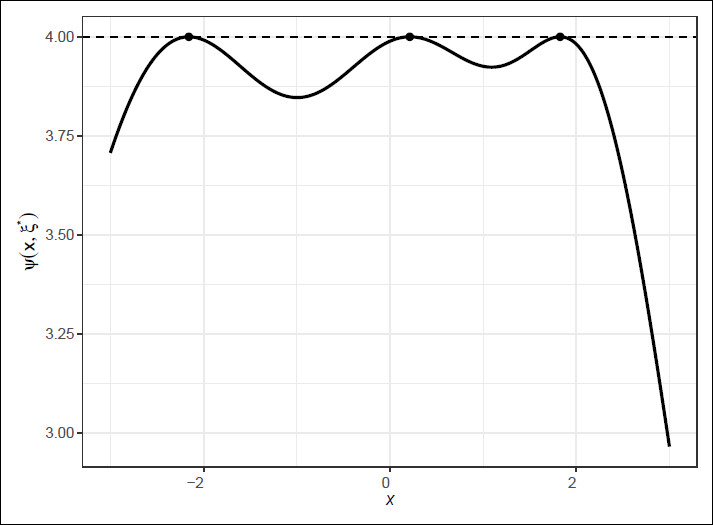
Figure 1 illustrates this theorem, showing the sensitivity function
ψ(
x, ξ*) of the
D-optimal design
ξ* of a BB regression model with linear effects of age in
μ and
σ (
α = [0, 1],
β = [−2.5, 0.6]). The horizontal dotted line represents the number of parameters
m = 4 and the black dots indicate the location of the design points.
To numerically obtain optimal designs, we used a hybrid algorithm akin to the ‘cocktail algorithm’ by
Yu (2011). This hybrid algorithm combines ideas from coordinate exchange and multiplicative algorithms, hence we refer to it as the CE+MA algorithm. Coordinate exchange algorithms (e.g.,
Meyer and Nachtsheim, 1995;
Dean et al., 2015, Chapter 21.4.2) iteratively adjust individual design points to locally improve the
D-optimality criterion while holding other points fixed. Multiplicative algorithms (e.g.,
Pronzato and Pázman 2013, Chapter 9;
Dean et al. 2015, Chapter 21) update design weights proportionally to their local sensitivities.
The CE+MA algorithm iteratively improves a candidate design by alternating between coordinate exchange and a multiplicative update. To improve numerical stability and convergence, small weights are pruned and nearby points are merged after each iteration, similar in spirit to the approach by
Yu (2011). The algorithm terminates when the sensitivity criterion is met.
To further enhance robustness, an adaptive implementation was used that automatically adjusted tuning parameters (e.g., damping and iteration limits) and reinitialized non-converged runs, ensuring stable convergence across diverse parameter configurations. In practice, the adaptive CE+MA algorithm was found to converge sufficiently across a wide range of BB regression settings, achieving numerical accuracy up to 10−4 and often much lower (10−8). The complete and annotated R implementation is provided in the supplementary material.
3 Results
Before we present and characterize
D-optimal designs for the BB regression model, we first recap existing results on related models, namely the logistic regression model and the BB logistic regression model. For the canonical logistic model with a single continuous predictor and binomial response, the optimal designs take the form of equally weighted two-point designs, placed symmetrically around
μ = 0.5, at predictor values corresponding to
μ = 0.176 and
μ = 0.824 (see e.g.,
Atkinson and Woods, 2015). Note that design points where the mean response probability is
μ = 0 or
μ = 1 are uninformative of the model parameters.
For the BB logistic regression model,
D-optimal designs are given by
Arnoldsson (2003). Although
Arnoldsson (2003) uses the intra-class correlation coefficient to characterize the dispersion, this BB logistic regression model can be thought of as a BB regression model with a constant, but parametrized, dispersion
σ. For a range of dispersion parameters and binomial denominators
n of 16 or less, they found that
D-optimal designs for the BB logistic regression model also take the form of a symmetric, two-point design, centred around
μ = 0.5. Compared to the logistic regression model, design points were moved inwards towards
μ = 0.5, more so for large dispersion and small binomial denominators.
It should be noted here that the optimal designs in
Arnoldsson (2003) are derived in a medical dose-response context. Here, the binomial denominator
n is interpreted as the number of people who are administered a certain dose
x of a drug. This number is typically quite small and can vary per dose. In the context of psychological test norming, the binomial denominator
n pertains to the number of items, that is, the test length. This is typically larger than 16 and assumed fixed over individuals. For small
n, our results corresponded to the
D-optimal designs described in
Arnoldsson (2003), but for larger
n, we found some interesting deviations from the general
D-optimal designs which are worth mentioning below.
Using the numerical procedure described in Section 2.3, we constructed
D-optimal designs for several BB regression models. Because the BB regression model differs from the BB logistic regression model already investigated by
Arnoldsson (2003) in the predictor dependency of
σ, our main interest was the effect of the non-constant dispersion
σ on the optimal designs. However, we additionally describe some results for the BB logistic regression model with constant dispersion because we found a different form for some
D-optimal designs for larger values of
n. We investigated optimal designs for relatively common test lengths of
n=25, 50 and 100 items and added the more extreme
n = 5 and
n = 250 for theoretical comparison.
3.1 BB logistic regression in psychological test norming
First, we consider the BB logistic regression model, with link functions
where we fixed
α0 = 0,
α1 = 1 and investigated several values of
β0 ∈ {−5, −4.95, …, 5}. This range of the dispersion parameter,
β0, corresponds approximately to examining intra-class correlation coefficients from near 0 to nearly 1. This is similar to the investigated range in
Arnoldsson (2003), but our
n ∈ {5, 25, 50, 100, 250} includes much larger values.
For some selected values of
β0 ∈ {−5, −2.5, 0, 2.5, 5} and all values of
n,
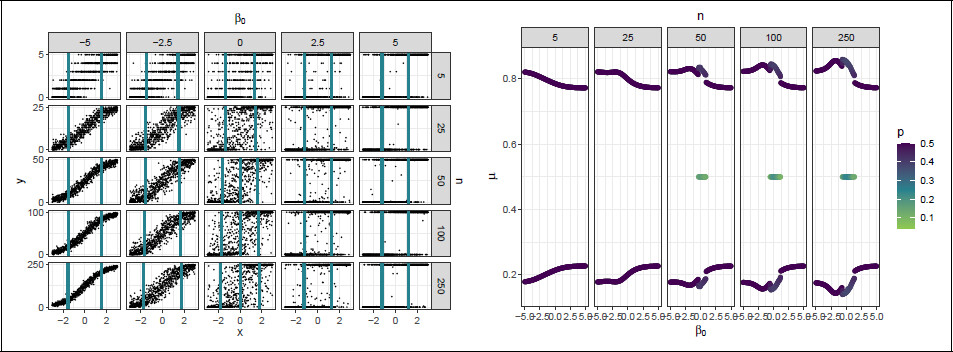
Figure 2a depicts random samples (
N = 1 000), drawing from a uniform distribution for
x and generated from their corresponding BB logistic regression models, thus illustrating the investigated models. The vertical lines represent design points from the
D-optimal designs.
Figure 2a depicts how the value of
β0 affects the test score dispersion. Lower values of
β0 correspond to a near-binomial dispersion and for higher values of
β0,
Figure 2a shows that the test scores tend to the extremes, close to a Bernoulli random variable with outcomes in {0,
n}. Both observations are in line with the limits for the test score variance of the BB distribution in Equation 2.1.
For each combination of
β0 and
n, the corresponding
D-optimal designs are displayed in
Figure 2b. Design points are represented in terms of their corresponding mean response probabilities
μ. Because not all designs were equally weighted,
Figure 2b additionally depicts the design probabilities of the design points.
For lower values of
β0, the designs tend to the optimal designs for the logistic regression model. For small values of
n, the designs correspond to the findings in
Arnoldsson (2003); the
D-optimal designs are two-point designs, symmetric around
μ = 0.5, with design points moving inwards as the overdispersion increases. This inward shift reflects the movement of the design points toward regions of greater test-score variance (which attains its maximum at
μ = 0.5), thereby improving the precision of the estimation of
β0.
For larger values of n, the design points first move outward for centre values of β0 before shifting inward again for larger values of β0. Greater separation of the design points improves the precision of the estimation of α1. It could be that the outward shift only occurs for larger n because the test scores are less concentrated near the 0 and n boundaries and thus extreme design points are more informative than for smaller n.
For some values of β0, an additional internal design point is placed at μ = 0.5 and the external design points are moved even further outward. For larger n, the range of β0 for which the internal design point is placed extends and its design probability increases. For large values of β0, the design points tend to μ = 0.227 and μ = 0.772 for all n.
3.2 BB regression
Next, we consider the BB regression model, where
σ now also depends upon the predictor
xFor the BB regression models, we fixed
α0 = 0,
α1 = 1 and
β0 = −2.5 and varied
β1 from {−1, −0.95, 0.9 …, 1}. These values
β0 and
β1 for the dispersion
β0 were informed by inspecting some commonly occurring values
β for subtests of the third Schlichting Language Test (
Schlichting et al., 2025).
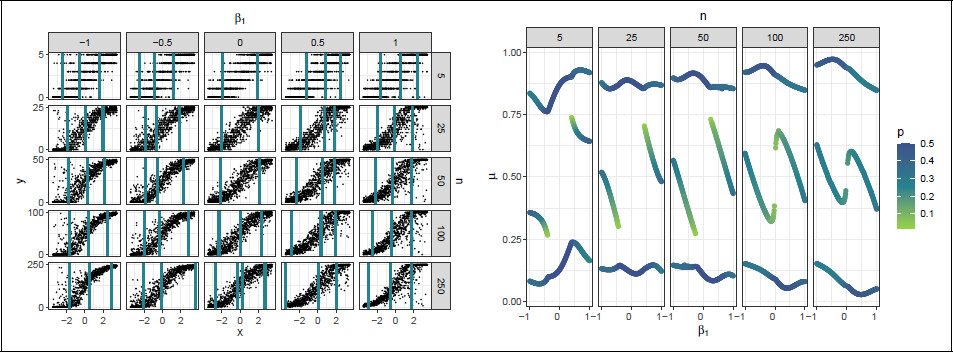
Random samples generated from BB regression models with selected values of
β1 = −1, −0.5, 0, 0.5 and 1 are depicted in
Figure 3a, for all values of
n. It can be seen in this figure that the dispersion in the response now varies over design region. Negative values of
β1 result in a relatively large dispersion for negative values of
x and low dispersion for positive
x and vice versa for positive values of
β1. The difference in dispersion over the design region increases as the absolute value of
x or
β1 increases.
For each combination of
β1 and
n,
Figure 3b portrays the
D-optimal designs. The design points of the optimal designs are again represented in terms of
μ. From
Figure 3b, it can be seen that the
D-optimal designs for the BB regression model are asymmetric two-point or three-point designs. For small |
β1|, where the dispersion is approximately constant, the designs are equally weighted two-point designs. As |
β1| increases, the designs become increasingly asymmetric and the design points shift away from regions of high dispersion where responses are highly concentrated near 0 or
n. This shift reflects a trade-off between maximizing information on the location parameter
μ, which favours regions of moderate variability and the dispersion parameter
σ, which is best estimated from regions with large changes in overdispersion. The asymmetry in the designs is more pronounced for larger values of
n, where differences in response variability across
μ are larger. In summary, these
D-optimal designs reflect a compromise between regions that are informative for both the mean and dispersion parameters.
It should be noted that
D-optimal designs for the BB regression model often contain fewer distinct design points than there are model parameters. Some designs include only two points to estimate three or four parameters (see also
Atkinson and Cook, 1995;
Arnoldsson, 2003), which would be impossible for (generalized) linear regression models. For GAMLSS models, however, this is feasible because the variance can still be estimated through replicated observations at the same design points. Consequently, the minimal number of design points corresponds to what is strictly necessary to estimate the linear predictor in either
μ or
σ.
4 Sensitivity
Before the
D-optimal designs for the BB regression model can be properly implemented, there are still a few issues that need to be addressed. First, because the
D-optimal designs are only locally optimal, they are sensitive to the assumed statistical model, both in model parameters and included predictors. Second, the
D-optimality criterion we use is aimed at parameter estimation and is not specifically tailored to normed score estimation, where the variance of the normed scores is of main interest. Unlike the designs for linear regression models in
Innocenti et al. (2023), the
D-optimal designs for BB regression do not necessarily minimize the maximum variance of the normed scores.
In this section, we illustrate and investigate these issues in a practical example. We will consider the sensitivity of the
D-optimal designs with respect to model parameters, model form and optimality criterion. As a practical example, we consider empirical test data from the Schlichting Language Test (
Schlichting et al., 2025). The particular subtest concerns sentence development in Dutch and Flemish children aged 2–7, and test scores ranged from 0 to
n = 36.
4.1 Sensitivity to parameter choice
The
D-optimal designs depend upon the prespecified parameter vector
θ. In this subsection, we investigate how changes in
θ affect the performance of the resulting optimal designs. Suppose that the true BB regression model is given by
where
x ∈ [−1, 1] represents a scaled age variable and the maximum test score
n = 36. This model was estimated from the Schlichting data and selected using the free order model selection procedure (
Voncken et al., 2019) and fitted using the R package
GAMLSS, version 5.4-12 (
Rigby and Stasinopoulos, 2005).
We will follow the approach in
Wu et al. (2005) to investigate the sensitivity of the optimal design to the specified model parameters. As a first step, we assume that the model parameters are known with a relative error of 50%, resulting in a lower and upper bound for each model parameter. For example, the lower and upper bounds for
α1 = 1.04 are 0.52 and 1.56. We then considered all the 3
6 = 729 models resulting from a fully crossed design of the model parameters and computed their corresponding locally optimal designs. The optimal designs were computed using a similar approach as described in Section 2.3. All optimal designs converged at least up until 10
−8.
To measure the performance of the locally optimal designs, we used the
D-deficiency. The
D-deficiency of a design
ξ relative to the
D-optimal design
ξ* is defined as
where
m is the number of model parameters of the true model
θ* (
Atkinson et al., 2007). The
D-deficiency expresses the percentage of additional observations that should be taken under a design
ξ to achieve the same efficiency as under the optimal design
ξ*. For example,
Ddef = 1.10 means that under
ξ, 10% more observations should be taken to achieve the same efficiency as under
ξ*, when assuming that
θ* is the true model.
To illustrate the results, we selected two models
θ1 and
θ2 resulting from the perturbed parameters.
Table 1 displays the model parameters, optimal design and
Ddef for the assumed true model
θ* and
θ1 and
θ2.
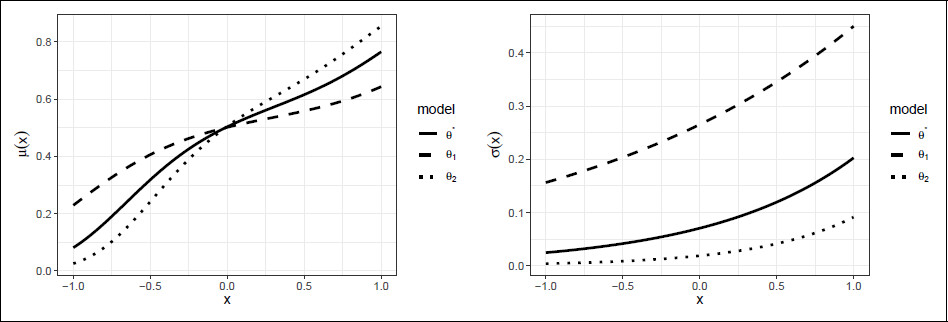
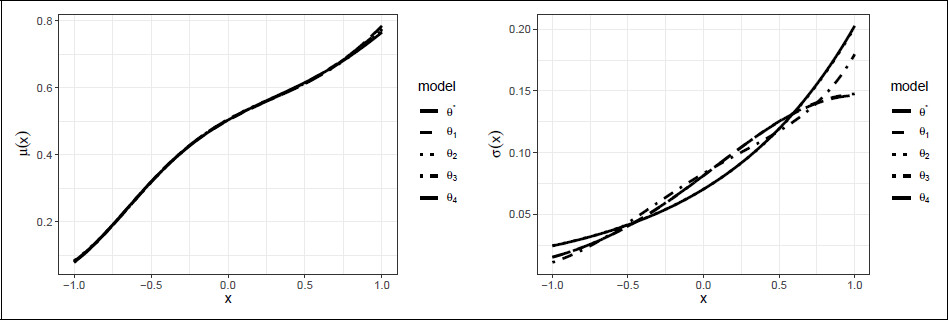
Figure 4 displays their corresponding
μ and
σ curves.
As can be seen in
Figure 4, the model functions for
θ1 and
θ2 look quite different from those for
θ*. Looking at
Table 1, we observe that the optimal designs roughly take the same form. For
θ2, the lowest design point
x = −0.94 is moved slightly to the right, presumably because the response was not informative enough at
x = −1. The
D-deficiency for
θ2 is also higher than that for
θ1, but still low. Out of all the 729 models considered,
θ2 was the model with maximum
D-deficiency, with most
D-deficiencies being close to one.
4.2 Sensitivity to model form
The locally optimal designs depend on the prespecified parameter
θ not only in model parameters, but also in model form, which we understand to mean the polynomial degrees of
μ and
σ. To investigate the sensitivity of the optimal designs to the model form, we consider several alternative models to
θ*. In the model selection procedure, these alternative models were relatively comparable to
θ* in terms of the applied model selection criterion, the Bayesian Information Criterion (BIC). Combined, the alternative models and the true model lead to a set of candidate models.
Table 2 displays for all candidate models the estimated model parameters, the BIC of the estimated model and the resulting optimal designs for these models. Additionally,
Figure 5 displays the corresponding model functions for the candidate models. It can be seen that the form of
μ is relatively close, but there are some differences in the estimation of
σ.
To investigate the sensitivity of these designs to model form, we again look a their
D-deficiency. For each candidate model in turn, we assume it is the true model and compute the
D-deficiencies of the optimal designs resulting from the competing models relative to the optimal designs of the true model. For comparison, we also investigate the performance of a uniform design
ξU. The resulting
D-deficiencies are given in
Table 3. Some entries in
Table 3 are empty because the designs were singular for the true model. For example, the true model
θ3 cannot be estimated from the design
ξ*, because four design points are insufficient to estimate the fourth-degree polynomial for
μ.
As can be seen in
Table 3, the optimal designs were relatively robust against the choice of model, with a maximal
D-deficiency of 1.155. The
D-deficiencies seem to be most affected by the largest polynomial degree in the BB regression model. Assuming a larger polynomial degree for
μ adds an extra design point to the design, which is inefficient when the true polynomial degree is lower. Note that the
D-deficiency of the uniform design is rather high (ranging from 1.650 to 2.093).
4.3 Sensitivity to optimality criterion
D-optimal designs minimize the generalized variance in the regression parameters. However, to be of practical interest in psychological test norming, the designs should perform well in terms of the variance of the normed score estimates. To investigate the performance of D-optimal designs with respect to normed score estimation, we performed a simulation study. The performance of the D-optimal designs was compared to a standard uniform design.
Taking
θ* as the true model, we simulated samples from both the
D-optimal design and a uniform design. For each sample, we fitted a BB regression model with a third-degree polynomial for
μ and a linear relation for
σ, that is, the true model. From the fitted models, we estimated for several age values
xl = −1, −0.9, …, 1 and test scores
yk = 0, 1, …, 36 the percentile
pkl and converted this to a commonly used normed score, the
z-score
zkl. In total, we simulated 5 000 samples. The simulation results were analysed using the
simhelpers package in R (
Joshi and Pustejovsky, 2022).
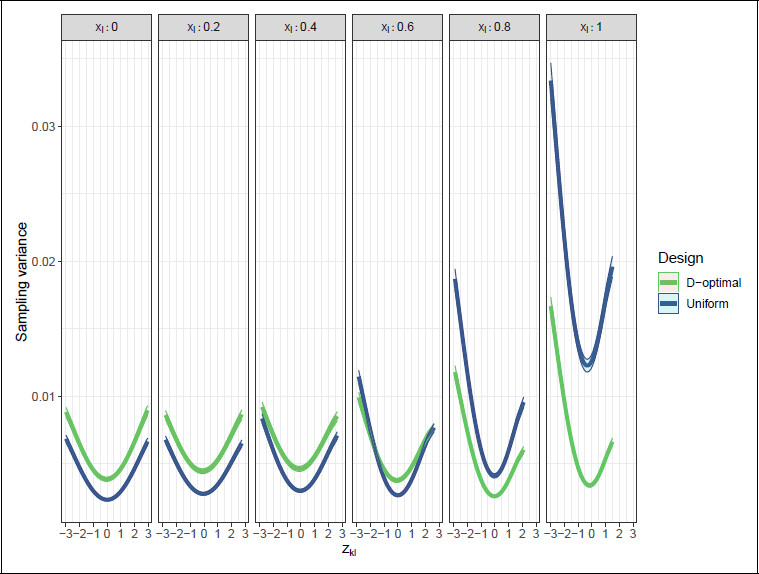
Figure 6 displays the resulting sampling variance of the
z-scores for a few selected age values
xl. Because the sampling variances were relatively symmetrical over the design region
, only the positive values of
xl are displayed.
Figure 6 includes 95% confidence bands based on the Monte Carlo standard error. Following convention in psychological test norming, only
z-scores between −3 and 3 are displayed, as more extreme scores can generally not be estimated reliably. Due to floor and ceiling effects for the outer
x-values, some
z-scores are missing.
From
Figure 6, we observe that for more central
x-values, the uniform design has lower sampling variance for all
z-scores, thus outperforming the
D-optimal design. However, both designs have reasonably low absolute sampling variance in the central
x-values, especially when compared to the outer
x-values. For the outer
x-values (e.g.,
xl = 0.8, 1.0) the
D-optimal design clearly has lower sampling variance. At
xl = 0.6 we observe that the
D-optimal design has lower variance in the extreme
z-scores only. All in all, this suggests that the uniform design performs somewhat better than the
D-optimal design in the centre of the design region and for moderate
z-scores and the
D-optimal design performs substantially better near the edges of the design region and for extreme
z-scores.
5 Discussion
The aim of this article was to derive and characterize
D-optimal designs for the BB regression model, motivated by its use in psychological test norming. In doing so, we extend the literature on optimal designs in psychological test norming (
Innocenti et al., 2023) to a non-normal and heteroscedastic test score model. Furthermore, we extend the research of
Arnoldsson (2003) into
D-optimal designs for the BB logistic model. By additionally modelling the dispersion as a function of covariates, we add to research into optimal designs for GAMLSS models (see
Atkinson et al., 2014).
The main result of this article is the derivation of
D-optimal designs for the BB regression model. In principle, our approach is generalizable to other GAMLSS models and other convex optimality criteria, but the convergence of the numerical procedure should be checked carefully. In general, the
D-optimal designs balance mean and dispersion estimation by placing design points at both points of low and high dispersion. Additionally, we present
D-optimal designs for the BB logistic regression model in the psychological test norming context. In this context, the binomial denominator in the BB logistic regression model is considerably higher than for the medical context in
Arnoldsson (2003), which leads to addition of an internal support point to the
D-optimal designs.
Two limitations still impede the practical implementation of the D-optimal designs in psychological test norming. First, the D-optimality criterion is not tailored to normed score estimation and second, the D-optimal designs we derived are only locally optimal. Both limitations are considered in a practical example relevant to psychological test norming. For this practical example, we found that the D-optimal design was relatively suitable for norm estimation. Compared to a uniform design, the D-optimal design substantially reduced the sampling variance of the normed scores at the edges of the design region, while still showing acceptably low sampling variance at the centre of the design region. Second, we found that the D-optimal design was relatively robust to changes in initial model parameters and model form and the quality of the resulting alternative designs was close to the original D-optimal design. In our example, the two limitations are thus of limited effect and the D-optimal designs could be safely applied. Yet, as it is unknown to what extent this can be generalized to other applications, it would be good to resolve the limitations.
The first limitation is the issue of the suitability of
D-optimality as a criterion for norm estimation. A possible downside to using
D-optimal designs is that they are designed for model parameter estimation and in a sense, weigh all model parameters equally. Consequently,
D-optimal designs for BB regression models where the number of model parameters for the mean is larger than for the dispersion, will put less emphasis on the dispersion estimation. However, proper dispersion estimates play a large role in the estimation of extreme norm scores. For the estimation of extreme normed scores, a criterion that puts more weight on the dispersion parameters might be suitable, as is also suggested in
Arnoldsson (2003) and
Atkinson and Cook (1995). In addition, an optimality criterion that directly minimizes the sampling variance of a normed score of interest could be considered. However, it should be considered that minimizing the sampling variance can be done in multiple ways, for example by minimizing maximum sampling variance over the design region, the integrated variance or a combination of the two (see
Walsh et al., 2024). Which criterion is best suited for the psychological test norming context remains to be investigated.
The second limitation concerns the sensitivity of the
D-optimal designs to the initial model parameters. This limitation could be addressed by extending the locally optimal designs to globally optimal designs, for example, with a Bayesian, maximin or adaptive strategy (see e.g.,
Atkinson and Woods, 2015). Prior information on the test score model could be based on previous test versions or similar tests in other countries (see also
Voncken et al., 2021).
Further ideas for future research include adding extra predictors to the BB regression model, for example, categorical variables representing gender or educational level, as is common in neuropsychological testing (e.g.,
Zec et al., 2007;
Keefe et al., 2008); extending the model to allow for simultaneous responses, accounting for administration of several subtests at once; incorporating a nested structure in the model, for samples which are collected from pupils within schools (see e.g.,
Moerbeek et al., 2000). Last, we assumed in this study that age is a fully controllable variable. This assumption could also be addressed in further research.
This study adds to the optimal design literature and advances its application in psychological test norming. Even though the practical relevance of the resulting D-optimal designs should be studied in further research, this study makes a valuable step towards integrating the efficiency of optimal design theory with the current practice in psychological test norming.