Body mapping is an intimate cartographic process that involves tracing the body.
1 Such tracing can be done on cloth, paper, or any material to create a life-sized outline of the body. Silhouettes are then filled with drawings, paintings, or cut-out images to represent embodied experiences. This visual, arts-based process is designed to empower communities to reflect on and share their stories – often those difficult to utter.
2 Steeped in activist and feminist traditions, body mapping can also be a practice of care.
3 It is not just about producing a map but is also about coming together: tending to the body to forge solidarities and generate change.
4 Vitally, this activist practice can function as an empowering and beyond-verbal research method that enables communities to process and even politicize community trauma, and our article reflects on these possibilities.
As a research method, body mapping has roots in South Africa, where it was used by HIV-positive communities to tackle stigma and address diverse experiences.
5 Led by psychologists, this body-mapping process was intended to celebrate HIV-positive lives, as well as to process trauma.
6 More recently, geographers have experimented with this method
7; however, we contend that this engagement remains limited. While geographers have been particularly good at putting the body on the map as a complex global-intimate site of power and resistance,
8 body mapping itself remains largely confined to therapeutic and medical fields. We argue that body mapping is a meaningful way of working with embodied experience as feminist geographers. Our paper seeks to expand creative conversation around the value of body mapping for geographers as both a research method and pedagogical practice that might bridge activist and academic work.
9 The paper is based on ongoing collaborative work with women in the coal-rich Lephalale Municipality in northern South Africa. One aspect of this ongoing commitment is a collaborative arts-based project – the focus of this paper.
Part I: a ‘hands-on’ workshop
This paper reflects on a collaboration that began between Thembi and the Waterberg Women Advocacy Organization (WWAO) informally in 2015 and that, in 2021, transformed into explicitly collaborative research to support women campaigning against coal extractivism and climate change in the area. Together, with the Khulumani Support Group (KSG), we devised a 3-day workshop in 2022, using body mapping to explore the gendered impacts of coal mining. The workshop included 12 women of all ages living in different areas of the Lephalale Municipality. Women were invited to join the workshop, based on their activism as part of WWAO and from diverse age groups and areas to build connections across generations and rural and urban localities. While the workshop’s intention was not therapeutic but, rather, a means to build solidarity and support women’s activism, as facilitators, we were aware of the importance of having measures in place for containment if trauma arose, including checking in with participants if they needed additional psycho-social support and maintaining the group as a collective beyond the workshop to ensure ongoing solidarity and support.
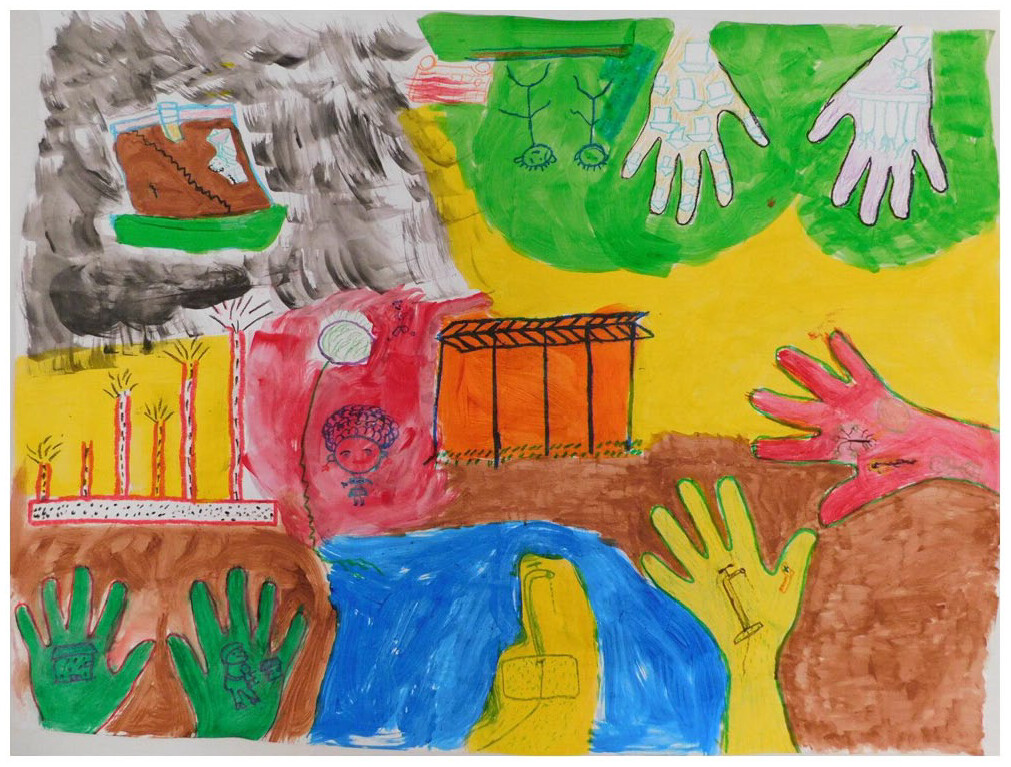
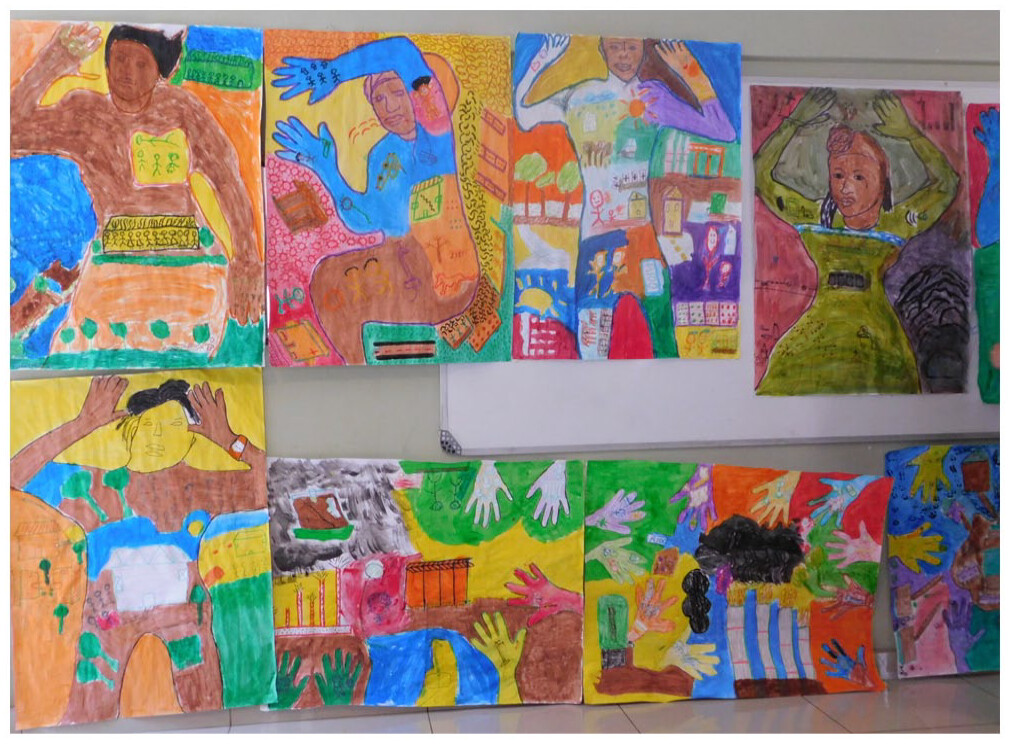
The creative process, co-facilitated with an artist and facilitator from KSG, began with a gentle task: ‘please outline your hands’. Divided into three groups, participants drew their hands on shared sheets of paper. There is something intimate and familiar about drawing hands, reminiscent of childhood art projects, which established a sense of ease. The second task was to trace and color ‘what connects these hands, and us, as women living near a coal mine and power stations?’ Across the groups, similar issues and experiences emerged. Maps illustrated the sometimes-visceral effects of climate change and the disruption of subsistence farming; pollution; land and spiritual dispossession; adverse health impacts; gender inequalities in access to employment and care work; lack of basic services; and lack of corporate accountability.
One group explained the images in their artwork, as seen below in
Figure 1. The art shows a mother carrying her baby, sick with sinusitis, to the clinic in one hand. Another hand showed the area’s overpopulation due to an influx of people in search of employment, with the green line in the center illustrating the sewerage system, which leaked while children played alongside, as the municipality had been unable to maintain and expand systems as required. The figure in red illustrates the expansion of sex work and high school dropouts among girls who came to depend on men working in the mine and power stations for their livelihoods. Vitally, this session provided a powerful avenue for participants to articulate their intersectional climate concerns. Focusing on hands enabled participants to slowly and gently enter this conversation in an embodied manner.
Part II: body (part) and position
The second day of the workshop shifted toward a more reflective activity. We asked participants, ‘Which part of your body do you want to trace?’ Thereafter, several prompting questions were asked, including ‘Where do you come from? What and whom do you hold dear? How have the mines and power stations affected you? What dreams or hopes do you have?’ Participants were also invited to consider the use of images, colors, and patterns in the representation of their experiences and feelings. After participants had completed their body maps, they were invited to share the stories informing their artwork and if the presentations could be recorded. The sharing and discussion of stories were multilingual – from Setswana to Sepedi to English – with visual materials offering ways to share across linguistic divides.
Sylvia
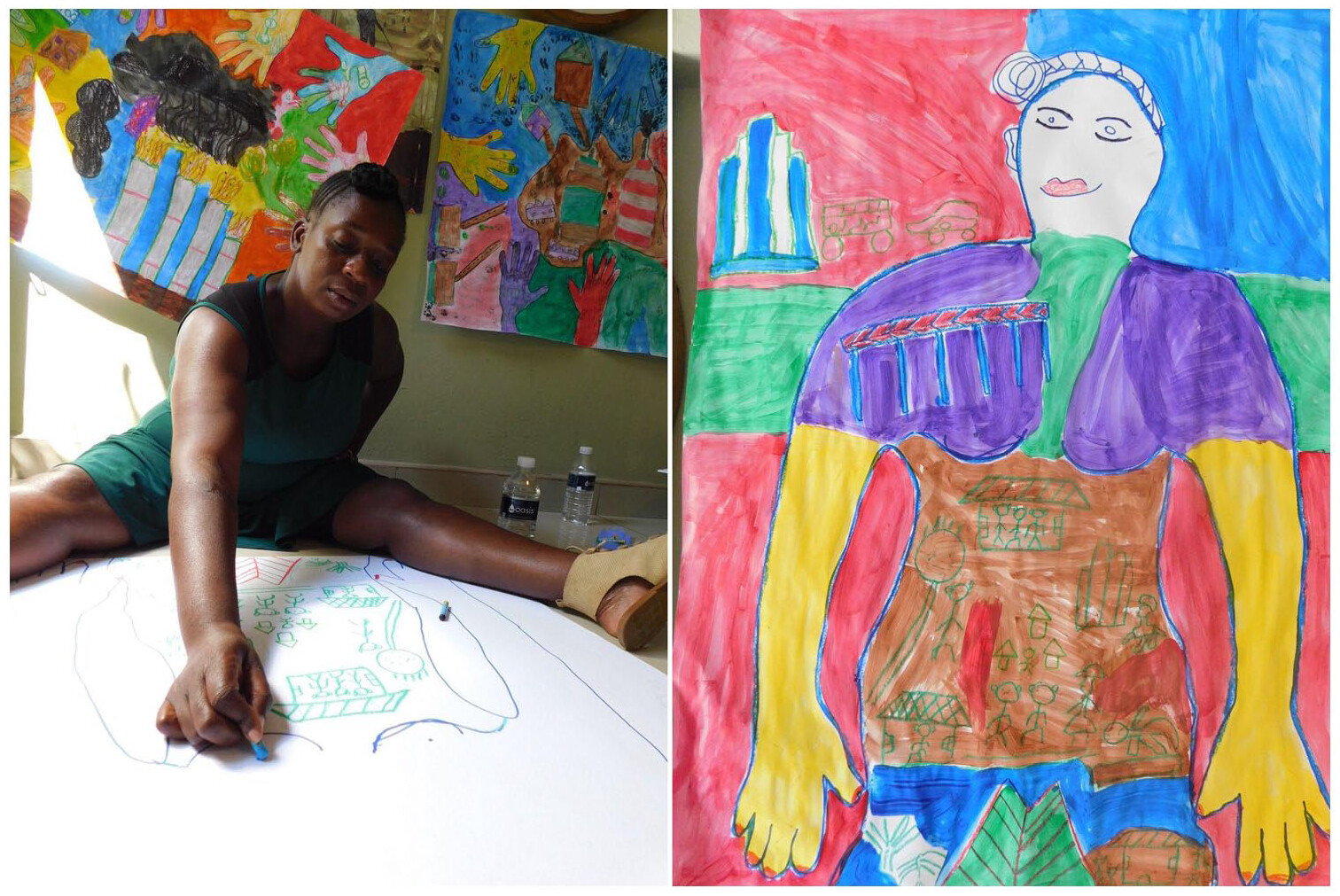
10 offered her body map to the group (
Figures 2 and 3). She drew her family and her community in rural Limpopo inside her body. She studied hard at school for a certificate, but it did not help because she is still unemployed. Sylvia highlighted gendered exploitation in mining communities by drawing a zip over her vagina. She elaborated that she is closed to sexual exploitation by men who approach women with the promise of employment. She knew a woman who died of depression because she was forced to have sex with a man at the coal-fired power station to maintain employment. The red blood inside the center of her body signified how her family had been affected by illness from the pollution: her sister-in-law died of tuberculosis, and her husband stopped working because he suffered from asthma. The power lines along her shoulder depicted Marapong, Lephalale’s urban township, as a dangerous place to live, with shacks under the power lines. Recently, she had moved from Marapong to the rural area, Shongoane, to be away from the pollution. While it was better in Shongoane, growing vegetables was increasingly difficult because of climate change. For Sylvia, drawing body maps with other women was a way to break the silence about how women were affected in mining communities.
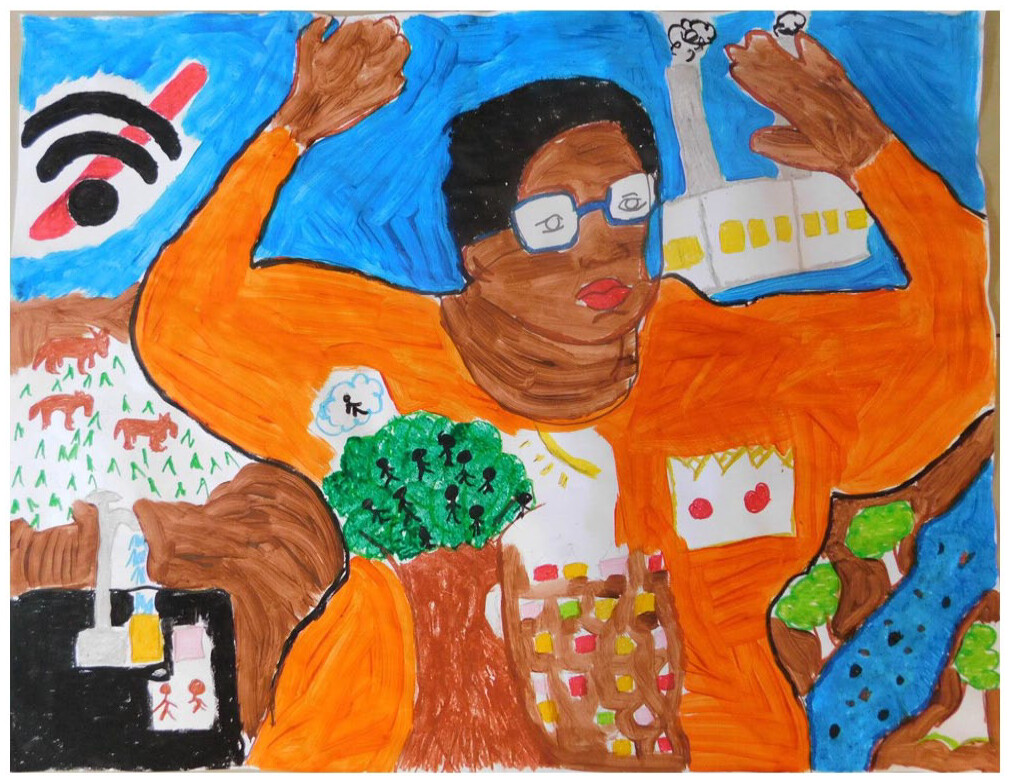
Lebo explained that she came from the rural community of Abbotspoort. Her grandmother, drawn as an angel inside her body, had 10 children, who sit in a tree (
Figure 4). Her mother was represented as a queen with a crown and heart in her chest. Lebo held her community and family close – symbolized by warm colors of yellow, orange, and red. Lebo’s map also reflected pressing social issues, illustrated around her body. Her primary concern was water, depicted as a river with black and brown marks of garbage and pollution stemming from coal mining. Residents were forced to use and drink polluted river water, although it was unsafe, because a communal water tap often ran dry. Lebo moved to Marapong, where she lived next to the power station and felt the vibrations of every blast in her home. Despite her proximity to the station, she experienced daily power cuts. The loss of internet access during power cuts disrupted her studies and job applications. She felt that youth were getting left behind in mining communities. This second stage of the workshop enabled participants to sink more deeply into their intimate experiences and express these as part of a wider community conversations rooted in particular lived geographies often marginalized in climate and energy discourses.
Part III: data sovereignty and embodied solidarities
On the last day of the workshop, we shifted the conversation to collectively reflect on ‘what next?’ Working from the principle that art belongs to the artists, rather than the researcher or any other organization, we felt that a collective reflection on the future of the maps was necessary. Workshop participants decided to use the art-making process to speak back to corporations: ‘the mines must explain what they are doing to us’. After several subsequent planning meetings, participants decided that raising awareness and accountability would be undertaken through multiple avenues, including different media formats and through a public dialog and multi-day exhibition to be held in Shongoane village in Lephalale in 2023. The body maps will be transformed into a storybook of the women’s lives and their struggles against coal and climate change in the region for further advocacy work. Thus, participants determined how to use the data, in the form of maps. This data sovereignty is not insignificant, given the persistent landscapes of extraction.
A second site of impact of this work was felt by participants themselves, who reflected on the importance of a space for voicing their embodied experiences. Through painting, one participant, who shared her story of gender-based violence, remarked, ‘I was able to express what is inside and get some relief’. The experiential process was also noted as a vital form of research to document and keep alive memories easily eclipsed: ‘by doing something practical, you don’t forget it. . . I didn’t know through painting you can get knowledge’. This process also supported women to form bonds with one another, as well as across generations, as practical space was made for children and grandchildren to play with the art materials. One participant observed that ‘by sharing and coming together as women, we can heal’.
Conclusion
Participatory, arts-based methods are ubiquitous within geography
11: community-mapping,
12 zine-ing,
13 and theater
14 to name a few powerful examples. We suggest that body mapping is an important, yet hitherto under-examined, addition to this creative toolkit. Moreover, this practice, developed across Global South geographies, heeds the call of feminist geographers to foreground diverse knowledge and forms of care to ‘unsettle extractive research relations’.
15 In this article, we engage the maps provided not only with the permission of participants but with their guidance. Indeed, participants expressly articulated a desire for their work to extend beyond the confines of the workshop space into wider climate and energy debates. We aim here to follow WWAO’s own call to embed these artistic interventions into academic and policy spaces.
Our paper begins to illuminate ways in which body maps can be used to align with and elevate existing, community-led activism. This arts-based approach was a vital tool in supporting knowledge-sharing and building feminist solidarities. While body mapping is predominantly used to document the entire body,
16 the workshop discussed here enabled participants to make decisions about which body parts to visualize, which facilitated a sense of body sovereignty too often stripped from communities. Moreover, by insisting on community ownership of both the mapping process and the maps themselves, data sovereignty remains at the heart of this method. The feminist ethos underpinning body mapping explored here provides tangible ways in which geographers can cultivate spaces of care with and for communities who regularly experience its abdication. While generative, this method also holds very real dangers for its potential to re-traumatize. What is offered here is an explicit process of robust and ongoing consent and co-creation. We contend that grounded in care, body mapping becomes not simply a method but a contribution to the powerful healing and activist work often carried by women leaders in communities, such as Lephalale, at the frontline of global climate and energy struggles.
Acknowledgments
The authors are deeply thankful for the courageous work of the Waterberg Women Advocacy Organization and the Khulumani Support Group. The authors also wish to thank the editors, Jamie Winders and Caleb Johnston, and critical reader, Rachel Pain, for their thoughtful and careful engagements.
Funding
The author(s) disclosed receipt of the following financial support for the research, authorship, and/or publication of this article: The research leading to this article received funding from the European Union’s Horizon 2020 research and innovation programme under the Marie Sklodowska-Curie grant agreement No 101023502.