Introduction
Geography curricula and multiculturalism in Israel
This study draws on the concept of
national literacies to theorize the role of education systems in the production of national identity and political legitimacy. Rather than conceiving literacy as a neutral or technical competence, national literacies refer to the ways in which school knowledge trains students to interpret space, history, and social relations through a particular national lens, thereby internalizing dominant narratives of belonging and exclusion.
1,2 Within this framework, curricula function as technologies of power that secure the historical thesis of dominant groups by selectively including, reframing, or omitting alternative narratives, a process documented across diverse contexts, including cultures of redress that domesticate historical injustice,
3 pedagogies that erase Indigenous and racialized relations to land,
4 and multicultural reforms that ultimately reinforce hegemonic national consciousness.
5–7 Within this theoretical perspective, history and geography constitute especially powerful components of national literacies. As Gotling
8 argues, these subjects function as key “technologies of power” within modern school systems, designed to cultivate loyal citizens and sustain national cohesion. While history constructs the nation through shared temporal narratives, geography constructs it spatially by rendering the nation-state visible and tangible. Through maps, landscapes, and borders, geography education enables students not only to imagine but also to “see” the state as a concrete “Fatherland,” naturalizing political boundaries and legitimizing territorial claims. Together, history and geography delineate symbolic boundaries between “us” and “them,” reinforcing national belonging and political legitimacy.
Against this theoretical backdrop, the present study analyzes how geographic education in Israel simultaneously preserves ethno-national narratives while promoting multicultural rhetoric, with particular attention to the (non-)representation of the Nakba narrative. The education system, and the geography curriculum in particular, constitutes a central arena in which relations of power, identity, and space are produced and negotiated within the nation-state, shaping collective narratives and defining the boundaries of legitimacy accorded to cultural and ethno-national identities.
This is a pioneering study that examines the systematic absence of the Nakba from the geography curriculum in Israel.
9 As a field of knowledge concerned with territory, space, and place, as well as with the social relations among groups inhabiting them, geography represents a key pedagogical site for engaging with contested historical and spatial narratives. For more than seventy-five years, the two main social groups inhabiting this territory, Jews and Arabs, have been embedded in asymmetric majority-minority power relations and engaged in ongoing physical and cognitive struggles over land and space. Yet in Israel, the Nakba appears in the history and civics curricula only as an optional topic, subject to teachers’ discretion, and is neither mandated nor encouraged for instruction.
10,11 Consequently, many teachers do not address the Nakba, and many students complete their schooling without any exposure to this formative Palestinian narrative.
The multicultural rhetoric embedded in the geography curriculum draws on theoretical frameworks of communitarian and liberal multiculturalism, alongside Tamir’s
12 distinction between thin and thick multiculturalism. While the communitarian approach emphasizes recognition, belonging, and the formative role of collective identities, the liberal approach prioritizes individual and group rights and equal participation in the public sphere. Within this framework, thin multiculturalism permits limited and cautious recognition of minority groups, whereas thick multiculturalism requires substantive engagement with historical narratives, collective identities, and spatial power relations, even when these challenge the dominant national narrative. As this study argues, such engagement is particularly critical in geographic education, where questions of territory, space, and ethno-national identity are central yet often circumscribed.
The contemporary political context in Israel
Over the past two decades, political forces on the right, often associated with neo-Zionism or post-Zionism, have gained increasing influence in Israel.
13,14 This period has been marked by a process in which the Israeli government has intensified an ideological logic that explicitly prioritizes the Jewish character of the state over its commitment to democratic values.
15 Several developments exemplify this trend: (A) the rise of messianic neo-Zionist actors who promote the notion of a “Greater Land of Israel” as a supreme, and even divinely sanctioned, principle shaping the boundaries of citizenship;
16 (B) the enactment of the Basic Law: Israel as the Nation-State of the Jewish People;
17 (C) the regime transformation led by an extreme right-wing, messianic government established in 2023, which has resulted in democratic backsliding;
18 and (D) the emergence of political culture which characterized by efforts to suppress the circulation of information that contradicts the hegemonic narrative, the cultivation of fear among dissenters, and demands for conformity, obedience, and self-censorship.
19–21 This political reality, which is also reflected in the Israeli education system, reinforces ethno-national narratives within geographic education, continues to marginalize Palestinian narratives such as the Nakba, and ultimately renders multicultural rhetoric a hollow and depoliticized facade.
Geography education in Israel: Structure and curricular framework
Geography education in Israel is organized as a three-stage program spanning primary, lower secondary, and upper secondary schooling and is structured according to spiral principles of conceptual development.
22 As such, geography accompanies students throughout most of their schooling and plays a formative role in shaping spatial knowledge, identity, and belonging.
At the primary level (grades 2–4), geography is taught within the multidisciplinary subject
Homeland, Society, and Citizenship, with instruction focusing on the immediate environment and gradually expanding to more distant spaces in order to cultivate attachment to place. By grades 5–6, the curriculum addresses the Mediterranean Basin and the geography of Israel, with particular emphasis on Jerusalem and Zionist values.
23 In lower secondary education (grades 7–9), geography becomes a compulsory subject dealing with physical and human geographic processes from global to local scales. The curriculum is organized around the study of Israel, the Middle East, selected thematic topics, and world regions, with approximately two-thirds of instructional time devoted to regional geography, reflecting the continued dominance of the regional approach.
24At the upper secondary level (grades 10–12), geography is offered as a prioritized elective track culminating in the matriculation examination.
25 Students study three regions, Israel, the Middle East, and an additional region and choose one area of specialization:
Earth and the Environment,
Development and Spatial Planning, or
Humans in the Socio-Cultural Space.
26 In 2009, new textbooks corresponding to these specializations were published, while earlier textbooks were updated with revised data. These materials are used in accordance with Ministry of Education guidelines, supplemented by an official online database providing updated information.
27The current curriculum, approved in 2008 and still in effect, incorporates thematic and global perspectives, such as globalization, spatial planning, regional inequality, cultural diversity and multiculturalism, climate change, and human-environment relations, alongside the traditional regional framework. While these additions reflect growing exposure to multicultural discourse,
28–31 textbook analysis suggests that they are largely layered onto an otherwise ethno-national and territorially oriented curriculum.
32 Overall, geography education in Israel reveals a persistent tension between multicultural educational rhetoric and a curriculum that continues to privilege ethno-national spatial frameworks, shaping both the possibilities and limits of critical engagement with space, identity, and power.
Two competing narratives within the same territory
The 1948 war is known by different names that reflect fundamentally divergent historical narratives. In the Jewish-Israeli discourse, it is referred to as the War of Independence, the War of Liberation from the British Mandate, or the War of Rebirth-invoking the return of the Jews to the promised land of Israel. In Palestinian historiography, it is known as the 1948 War or, more centrally, as the
Nakba (in Arabic means “catastrophe” or “devastation”). The war began on November 30, 1947, one day after the United Nations approved the Partition Plan, which proposed the division of Mandatory Palestine into a Jewish state, an Arab state, and an internationally governed territory encompassing Jerusalem and Bethlehem. The Arab leadership rejected the plan and opposed the establishment of a Jewish state, and hostilities erupted between Arab and Jewish communities. On May 15, 1948, following the end of the British Mandate and the declaration of the State of Israel, five Arab armies which included Egypt, Jordan, Syria, Lebanon, and Iraq invaded the territory, joined the local Arab population and initiated a full-scale regional war.
33By the end of the war, the State of Israel had expanded its territorial control to approximately 78% of the former Mandatory territory. This territorial outcome was accompanied by the large-scale displacement of the Arab population. Approximately 750,000 Palestinians were uprooted during the war: some fled in fear of the fighting, while others were expelled at later stages to neighboring Arab countries or to the West Bank and Gaza Strip. Palestinian refugees were not permitted to return to their homes during or after the war.
34 The displacement of the Arab population was perceived by Israel as a strategic advantage, and between 400 and 500 Palestinian villages were destroyed or abandoned.
35 Many of these sites were subsequently settled by Jewish immigrants, often with the original Arabic place names replaced by Hebrew ones. In urban areas, abandoned Palestinian homes were populated by waves of new Jewish immigrants.
36From this historical rupture, two distinct and competing narratives emerged within the same territory: The Zionist narrative and the Palestinian narrative. Within the Jewish-Israeli narrative, the 1948 war is framed as a heroic War of Independence and as a victory of the few against the many, symbolizing national redemption and the restoration of Jewish sovereignty in the Land of Israel. This narrative draws on the myth of “a land without a people for a people without a land,” which legitimized Jewish settlement by portraying the territory as largely empty, despite the presence of a substantial indigenous population. The dominant national ethos oscillates between Holocaust memory, centered on victimhood, and national rebirth, centered on heroism. This continuum leaves little conceptual or moral space for acknowledging Israeli responsibility for injustice inflicted upon another people.
37 For Palestinian citizens of Israel, this spatial rupture is also commemorated through Land Day, which marks continued land dispossession and the erasure of Palestinian identity and history from the landscape. In contrast, the Palestinian narrative conceptualizes the events of 1948 as the
Nakba, a term that signifies not merely a military defeat but a profound historical crisis. In Palestinian collective memory, the Nakba marks the violent severance between a past of life in a homeland and a present defined by displacement, statelessness, state of refuge, and, for those who remained within Israel, life under military rule. The Nakba thus represents an ongoing condition rather than a closed historical episode.
38Within this context, the Israeli geography curriculum, as part of the broader Zionist educational framework, largely silences the Palestinian Nakba narrative. The hegemonic Zionist narrative renders discussion of the events and spatial transformations of 1948 highly constrained and, for decades, effectively taboo. Analysis of geography textbooks reveals a systematic avoidance of Palestinian historical geography, including the destruction of villages, the erasure of Arabic toponyms, and the expropriation of land, while emphasizing Jewish settlement and territorial consolidation. The state has further worked to limit the presence of the Nakba in the public sphere, most notably through the so-called “Nakba Law,” enacted in 2011, which authorizes the reduction of state funding to institutions that commemorate Israeli Independence Day as a day of mourning.
39 Although the law does not explicitly target the education system, it is widely understood to exert a chilling effect on schools and publicly funded educational institutions, discouraging the teaching of the Nakba out of concern for political and budgetary repercussions.
The state of multiculturalism in Israel
From its very inception, Israeli society has been characterized by an ever-increasing multiplicity of cultures. Its diversity spans ethno-cultural, gendered, and national groups of Haredim (Ultra-Orthodox), women, Palestinians, Mizrahim (Jews of Middle Eastern and North African descent), Ethiopian immigrants, immigrants from the former Soviet Union, and work migrants. Concurrently, there emerged a growing recognition of the legitimacy of different cultural narratives, within formal as well as informal arenas. Mautner et al.
40 note that the conditions for creating multicultural consciousness exist in Israeli society, and Yona and Shenhav
41 describe this reality as a “multicultural situation,” wherein social heterogeneity is essential and powerful.
42 Globalization dynamics and market forces have accelerated the influx of migrants, including from the former Soviet Union and Ethiopia, as well as migrant workers from Africa, Asia, and Eastern Europe.
43–45 Such trends, alongside criticism of melting pot ideologies, granted greater legitimacy to demands by groups, particularly within Jewish society, for recognition of cultural distinctiveness.
46–48 These groups posed a challenge to the ethno-national structure in Israel. Thus, for example, immigrants from the former Soviet Union preserved their culture and identity, and immigrants from Ethiopia encountered racism and were classified as “Blacks” while also having their Judaism questioned.
49 Within this context, the religious (Jewish orthodox) public education system has functioned as a state apparatus for enforcing a rigid and hierarchical model of Jewish national identity, operating, according to Shalev Marom
50,51 as a mechanism of “re-education” through which Jews of Ethiopian origin are expected to relinquish distinct religious and cultural traditions in exchange for conditional inclusion within Israeli society.
Rapid global changes, especially the growing strength of international institutions and the information revolution, have challenged the state’s exclusive authority over territory and identity, as well as the territorial discourse. Schnell
52 observes that these processes create “territorial mutations” that necessitate a reformulation of collective Israeli identity, including a recognition of sub-identities within more flexible and open boundaries.
A theoretical discourse on multiculturalism
In recent decades the discourse on multiculturalism has crystallized into a core conceptual foundation that challenges the nation-state’s historical tendency towards cultural homogenization and the subjugation of minority groups to the dominant group. Multicultural perspectives challenge the melting pot ideology, which holds that national unity requires the blurring of collective identities and the dominance of one culture over the entire population, including through ideological power structures. Instead, these perspectives emphasize the importance of recognizing minority identities, cultural rights, and equality among the different ethno-cultural groups that form the social fabric.
53,54 Against this background, the perspective of communitarian multiculturalism underscores the fact that an individual’s identity takes shape within a concrete cultural community, rather than on the basis of a universal, neutral outlook. Mutual recognition is an essential condition for empowerment, whereas the absence or distortion of recognition leads to oppression. Therefore, the nation-state cannot make do with moral neutrality; rather, it must cultivate a collective ethos that honors the unique character of different groups and prevents a blurring of identities.
55–57 Liberal multiculturalism is also critical of the concept of state neutrality, sometimes framing it as a cover for perpetuating the dominance of hegemonic groups by excluding minority cultures. In this context, Tamir
58 distinguishes between two modes of multiculturalism. “Thick multiculturalism” denotes collectivities that align themselves with the normative foundations of liberal democracy, including commitments to equality and individual freedom. “Thin multiculturalism,” by contrast, refers to cultural formations that do not share these liberal-democratic values and may, in certain contexts, actively contest them. Groups associated with the latter tend to be organized around traditional, often patriarchal social relations, within which the freedoms of individual members are circumscribed, most notably through the regulation and limitation of women’s rights.
59 Kymlicka
60 distinguishes between collective rights for national minorities and “poly-ethnic” rights for immigrants, as part of an effort to cultivate a democratic egalitarian partnership, rather a than superior “Eurocentric” one,
61,62 and to formulate a de-colonized social order based on a multiplicity of cultural concentrations of power.
63 Recent scholarship in cultural geographies of education emphasizes how processes of marginalization operate through culture and demonstrates that cultures of representation and the representation of different identity groups, are powerful ideological devices, but also shape the everyday lived experiences of those diverse social groups.
64In the Israeli context, the multiculturalism discourse is focused on the national-Zionist character of the state, which is defined as the national homeland of the Jewish people. This construct ensures the systematic exclusion of Arab citizens from the key arenas of discourse, identity, and civic participation.
65–67 Israel also relies on republican principles that link the civic belongingness of Jewish subgroups with the extent of their contribution to the national collective.
68 Civil rights and civic belonging are measured by criteria of loyalty, contribution, and solidarity with the hegemonic identity.
69,70 Some researchers perceive multiculturalism as a threat to social unity and the Zionist ethno-national identity. Gutwein
71,72 argues that it serves as a tool for reinforcing economic and political hegemony, while weakening the welfare state, suppressing struggles for equality, and reinforcing the oppression of disadvantaged groups. Others view multiculturalism as a phenomenon that threatens to destroy society from within, aligns with post-modern and post-Zionist trends, and undermines the logic of ethno-national identity.
73–76In line with the spirit of the times (and as part of a global trend), the forces of the political right in Israel have grown increasingly stronger over the past decades, and they support opponents of multiculturalism, which is sometimes identified with neo-Zionism or post-Zionism.
77,78 This is a counter-reaction to globalization trends and the constitutional revolution that advanced liberal principles, as well as an outgrowth of the public loss of faith in the peace process that followed the collapse of the Oslo Accords and the onset of the Second Intifada. Simultaneously, the Israeli government is advancing an ideology that openly prioritizes the Jewish character of the state over its commitment to democratic principles.
79 Examples of the above, to name just a few, include the growing numbers of messianic neo-Zionists who call for “Greater Israel” as a supreme and even divine basis for delineating the boundaries of citizenship;
80 the legislation titled Basic Law: Israel as the Nation-State of the Jewish People;
81 the regime overhaul led by an extreme-right, messianic Israeli government that came into power in 2023 and has prompted an erosion of democracy;
82 and the toxic political culture that has consequently emerged, which aims to prevent the spread of information contrary to the hegemonic narrative, seeks to instil fear in those who express opposition, and demands conformity, obedience, and self-censorship.
83–85The Zionist ethno-national narrative versus the Nakba narrative
The Zionist ethno-national narrative constitutes the foundational story of collective Jewish-Israeli identity, casting the state as the historical manifestation of a generations-long Jewish aspiration for state sovereignty in the Land of Israel. This narrative frames the 1948 war as the “War of Independence” and an existential clash that was imposed upon the pre-state Jewish community shortly after the Holocaust, because of opposition by Palestinians and Arab states to the UN Partition Plan.
86 As a narrative, it is deeply embedded in the national discourse, having been disseminated by means of a monolithic, ideological approach across the education system, particularly in the subjects of geography, civics, and history, with the aim of cultivating national cohesion, a Zionist identity, and patriotic values.
87–89 The narrative portrays the Jewish side as flawless and just, while blurring, silencing, and at times flatly denying the repercussions of the Zionist enterprise for the Palestinian population.
90 In addition, the Zionist ethno-national narrative prioritizes the principle of Jewish nationalism over a commitment to democratic values and equality of civil rights for the entire population. This approach corresponds with the concept of “ethno-genealogy” coined by Sen
91 for describing a political model in which belonging to the civic collective derives from a genealogical and historical connection to the ethnos of the hegemonic majority, rather than from universal civic consent.
Conversely, the Nakba narrative poses a striking antithesis to the Zionist ethno-national narrative because it presents the events of 1948 not as the realization of Jewish sovereignty, but as a collective trauma of displacement and cultural eradication for the Palestinians.
92 Thus, it challenges the formative myths of Zionism, particularly the ethos of “purity of arms” and the framing of the Zionist enterprise as moral. The Nakba narrative also exposes the inherent contradiction between the Jewish identity of the state and the principles of democracy and equality, while also forcing one to confront questions of historical, moral, and political responsibility, which the Zionist narrative is inclined to avoid.
93 For several decades the Nakba was omitted from public discourse in Israel, official state policy, and school textbooks, including geography studies in particular. The omission sometimes stemmed from ignorance, but sometimes from deliberate denial aimed at avoiding any engagement in moral, political, and historical issues that undermine the foundation of the Zionist narrative.
94,95 Even when the Nakba was included in the school curriculum under the subject of civics or history, the approach to the issue entailed “a recognition of suffering but limited responsibility,” while also obscuring the role of the Jewish community and the Israel Defense Forces in uprooting and expelling hundreds of thousands of Palestinians.
96Education system as an epistemic control mechanism
The Israeli case provides a critical lens through which to examine the epistemic control of the education system over knowledge and national identity. It is especially crucial to notice this mechanism in societies characterized by ethnic and national rifts, and ethnocratic regimes in particular. Like other states in which national identity is intertwined with historical ethno-majority narratives, such as Sri Lanka and Estonia,
97 Turkey,
98,99 India,
100,101 and Hungary,
102 so too in Israel, textbooks serve as tools for shaping a collective identity, delineating the boundaries of recognition, and controlling historical memory. The education systems in these states function not only as a pedagogical apparatus, but also as distinctly political-power arenas via which national, ethnic, and territorial narratives are constructed and symbolic borders are delineated between those groups included in the collective memory and those excluded from it or silenced. As Foucault demonstrates in his lecture
The Order of Discourse,
103 systems of knowledge function not merely as descriptive mechanisms but as forms of power: they delineate the boundaries of what is considered “legitimate,” determining which narratives are admitted into discourse and which are silenced. In this way, a mechanism of epistemological control is produced. In Israel, the systematic omission of the Nakba narrative from geography textbooks demonstrates how educational content can construct a one-dimensional spatial-national consciousness and shape an ethno-spatial identity by marginalizing the Arab historical narrative. This phenomenon echoes similar trends in other divided ethno-majority states that strive to engineer a specific cultural and territorial consciousness: in Turkey, the establishment of the Kemalist republic entailed the institutional omission of the Kurdish narrative, a ban on the Kurdish language, and the concealment of formative events in Kurdish identity, such as the Dersim rebellion and its suppression in the 1930s.
104 In India, under the rule of the BJP party, content related to Muslim heritage and the Dalits’ struggles was omitted and replaced with a nationalist-Hindu narrative that presents India as exclusively the homeland of conservative Hinduism.
105,106 Hungary under the Orban government saw a similar phenomenon of epistemic control through the education system, which produced curricula emphasizing a hegemonic Christian-Hungarian identity, while excluding the historical narratives of minorities and silencing critical voices.
107 In France, which follows a universalist republican ideology, the education system emphasizes a collective civic identity that denies colonial history and refuses to recognize the suffering of immigrants from North Africa.
108 In the United States, notwithstanding “melting pot” ideologies and the civil rights struggle, it was only in recent decades that school curricula incorporated the history of slavery, racial segregation, and the genocide of indigenous peoples, all subjects previously excluded from the curricula.
109 In Canada as well, following a report by the Truth and Reconciliation Commission,
110 the federal education system was tasked with addressing the violent historical treatment of the indigenous population, recognizing their cultural identity, and integrating indigenous narratives into educational material.
The above comparison highlights the global nature of epistemic control in education systems that serve as ideological power structures wherein nation-states shape territorial and cultural consciousness through pedagogical tools, thereby reinforcing notions of territorial belonging and exclusion. The Israeli case aligns with a widespread pattern whereby geography education serves as a means for narrative dominance and exclusion of the “other.” As such, it contributes to a better understanding of the education system as an instrument for shaping ethnic, political, and spatial identity.
111–115Situated within this analytical framework, Israel is characterized by a convergence of several mechanisms of epistemic control: the omission of formative historical narratives, the depoliticized representation of minority cultures, cartographic practices that naturalize state borders and erase contested spaces, and alignment between curricular content and high-stakes examinations. While elements of multicultural rhetoric are formally present, the systematic exclusion of the Nakba positions Israeli geography education firmly within a model of thin multiculturalism that prioritizes ethno-national coherence over historical and spatial recognition. This configuration places Israel alongside other ethnocratic and nation-building contexts, while underscoring the particular centrality of spatial education in sustaining narrative dominance (
Table 1).
Between textbooks and classrooms: A multi-layered investigation of geographic education
This study employs a mixed-methods design combining qualitative and quantitative approaches. The qualitative component consists of a critical content analysis of geography textbooks approved by the Israeli Ministry of Education. The analysis examines the extent to which these textbooks incorporate multicultural values and represent Palestinian space and identity, with particular attention to the Nakba.
The analysis is situated within the framework of a geography curriculum approved in 2008 and still in effect, which introduced a shift toward thematic and global perspectives alongside the traditional regional approach. This revision reflects changing understandings of space and time in an era of intensified mobility and connectivity and explicitly incorporates themes of cultural diversity and multiculturalism, alongside globalization, spatial planning, regional inequality, climate change, and human-environment relations.
The qualitative analysis focuses on high school geography textbooks used under this curriculum and approved by the Ministry of Education (
Israel in the 21st Century, 2009;
Geography of the Middle East, 2008).
116 Analyzing these textbooks enables an assessment of the balance between Zionist ethno-national paradigms and multicultural paradigms within geography education, as well as the ways in which these paradigms are translated into pedagogical knowledge. Two analytical categories were defined: (1) the explicit use of the term
Nakba, and (2) references to Palestinian narratives associated with the Nakba, including expulsion, displacement, refugees, massacres, village destruction, land expropriation, and Land Day. The textbooks were systematically reviewed to identify both the frequency and scope of such references.
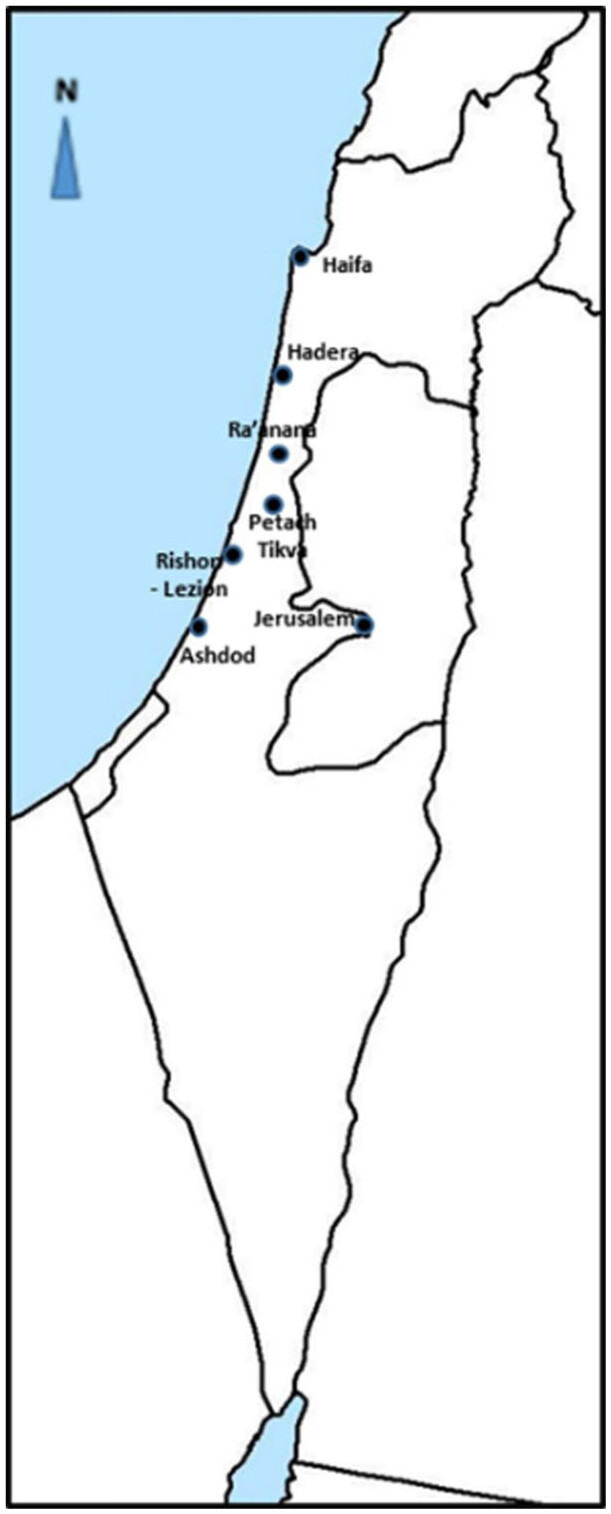
The quantitative component includes two brief surveys designed to complement the qualitative analysis by mapping familiarity with and exposure to the Nakba in geography education. The first survey targeted Jewish graduates of the geography track in public high schools. Ninety 12th-grade graduates from nine schools (Haifa, Hadera, Ra’anana, Petah Tikva, Rishon LeZion, Jerusalem, and Ashdod) responded to an anonymous online survey conducted in July 2025, following graduation (
Figure 1). The survey included three Yes/No questions: (1) Do you know what the Nakba is? (2) Did you learn about the Nakba in geography class? (3) Did you read about the Nakba in your geography textbook? Of the 140 students approached, 90 responded. Recruitment was conducted indirectly through geography teachers known to the researcher, and participation was limited to graduates aged 18 or older. All participants were informed of the study’s aims, assured anonymity, and provided with the Ethics Review Committee’s approval certificate (no. 175/2025).
The second survey targeted Jewish 12th-grade geography teachers. Thirty teachers were approached via publicly available contact information, and 16 responded. Conducted in July 2025, this survey included two Yes/No questions: (1) Should the concept of the Nakba be taught as part of the geography curriculum? (2) Did you voluntarily choose to teach the Nakba in 12th-grade geography-track classes? Teachers were assured anonymity and provided with the same ethics approval documentation.
The use of short surveys with binary questions offers analytical clarity, comparability, and transparency by enabling a clear mapping of the presence or absence of knowledge and pedagogical practices. At the same time, several limitations must be acknowledged: the relatively small sample sizes, particularly among teachers; potential social and geographic sampling bias resulting from indirect recruitment through cooperating teachers, most of whom are located between Haifa and Ashdod; and the fact that not all Israeli high schools offer a geography track, which constrained participant availability. Accordingly, the surveys are not intended to be representative but serve as a supplementary tool that contextualizes and supports the qualitative findings.
Mapping the absence of the Nakba in geography textbooks
This section presents the findings of the textbook analysis, which constitutes the primary basis for identifying the systematic omission of the Nakba from geography education. The survey data are presented as complementary evidence, illustrating how this curricular absence is reflected in students’ knowledge and teachers’ pedagogical practices.
The textbook analysis indicates that the Nakba, a formative and traumatic event in Palestinian collective history, is entirely absent from Israeli geography textbooks. A review of the geography materials published and approved by the Ministry of Education, including the updated online pedagogical platform, confirms that the concept of the Nakba does not appear anywhere in the geography curriculum.
117 This absence suggests that the omission stems not from a lack of available knowledge, but from deliberate curricular boundaries defining what is considered legitimate geographical knowledge.
The two surveys were designed to complement this qualitative finding. The first survey (
Table 2), administered to graduates of the high school geography track, included three questions. The results show that 92% of respondents answered “No” to the question “Do you know what the Nakba is?,” 95% answered “No” to “Did you learn about the Nakba in geography class?,” and 100% answered “No” to “Did you read about the Nakba in your textbook?” The second survey (
Table 3), conducted among 12th-grade geography teachers, revealed that 60% opposed teaching the Nakba as part of the geography curriculum, and 70% reported that they did not voluntarily teach the Nakba in geography-track classes, while 30% indicated that they did. These findings do not establish the omission themselves, but rather reinforce the conclusions drawn from the textbook analysis by demonstrating how curricular silences translate into limited exposure among students and cautious pedagogical choices among teachers.
An examination of the geography textbooks
118 was conducted to assess whether recent curricular revisions reflect a shift away from an exclusively ethno-national narrative toward greater recognition of cultural plurality, particularly regarding the Arab minority. Following Schnell,
119 three reference sets were examined: marginalized groups within Israeli society, the Arab-Palestinian minority and neighboring Arab states, and distant or culturally different societies. The findings suggest that while Israel, as a divided immigrant society, continues to struggle over its ethno-national identity, multicultural themes have been selectively incorporated into geography education.
120Multiculturalism appears most clearly in upper-level high school textbooks for grades 11–12, particularly Development and Spatial Planning and Humans in the Socio-Cultural Space. These books include subchapters introducing other cultures and promoting values of tolerance and mutual respect. For example, chapters discussing cultural diversity present descriptive accounts of social customs or family life, often framed in neutral or celebratory terms. Similarly, marginal groups within Jewish society, such as Haredim and Mizrahim, are addressed through demographic profiles and cultural characteristics. In elementary school textbooks (grades 2–4), substantial sections were added on the history and lifestyles of Arab families and various Jewish social groups; however, these discussions remain depoliticized and avoid any engagement with conflict, power relations, or historical injustice.
The limitations of this multicultural framing become particularly evident in the treatment of Palestinians in the upper-level textbook
The Land of Israel in the 21st Century.
121 The book differentiates between Palestinians living in the West Bank and Gaza and the Arab minority within Israel. The discussion of the Palestinian population includes references to the Palestinian Authority and major political events up to 2005, such as the First and Second Intifadas, the Oslo Accords, the Camp David Summit, the Road Map, the Gaza disengagement, and the construction of the separation wall, which is marked on maps as a green line. The Arab minority within Israel is described demographically and religiously, noting Muslims, Christians, Druze, Bedouin, and Circassians, and is characterized as increasingly urban, modern, and nationally conscious.
122At the same time, the textbooks consistently avoid addressing the structural and political dimensions of Jewish-Arab relations within Israel. In discussions of settlement patterns and population distribution, protests over land confiscation, land shortages affecting Arab communities, and conflicts over planning and development are omitted. Arab settlements are described as peripheral and largely rural, while Jewish settlement initiatives and development projects receive detailed attention. This selective representation produces a geography of coexistence without conflict, and diversity without history.
As a result, core elements of Palestinian collective memory remain entirely excluded. Geography textbooks make no reference to “Nakba” Day, avoid discussion of Palestinian citizens’ demands for recognition as a national minority, and omit any reference to Land Day, commemorated annually on March 30 in memory of the 1976 protests against land expropriation. These silences underscore the limits of multicultural inclusion in geography education: while cultural diversity is acknowledged at a descriptive level, the Palestinian national narrative and especially its spatial and historical dimensions, remains systematically marginalized.
Unmasking the curriculum: Epistemic control and the geographic politics of representation
This study examined geography textbooks in Israel through a multicultural lens in order to illuminate the educational arena in which spatial, social, and political power relations are constructed in students’ consciousness. Geography textbooks are not neutral vehicles of knowledge transmission; rather, they function as powerful tools for shaping national identity, civic consciousness, and spatial imagination.
123–125 The central question guiding this discussion is whether geography education fosters a pluralistic, multicultural consciousness grounded in recognition and equality, or whether it reproduces an ethno-national conception of space that marginalizes non-hegemonic narratives.
The paradox of thin multiculturalism in geographic education
Research has shown that since its inception, geography education in Israel has been shaped by a Zionist-territorial ethos aimed at consolidating Jewish attachment to the land, reinforcing national belonging, and legitimizing territorial sovereignty.
126 School curricula institutionalized a Jewish spatial narrative while systematically excluding Arab and other minority perspectives. This pattern reflects the broader political tension between Israel’s self-definition as a Jewish ethno-national state and its democratic civic aspirations. Since the 1990s, however, global and local discourses on multiculturalism, identity, and recognition have increasingly influenced Israeli education,
127–131 including geography education.
132,133The present study adopts a multicultural perspective informed by both liberal and communitarian traditions. While liberal multiculturalism emphasizes individual rights and equal participation in a shared civic space, it often downplays the political significance of collective identities. Communitarian multiculturalism, by contrast, views cultural groups as collective entities entitled to recognition, preservation, and public expression within the public sphere. Within this framework, Tamir’s
134 distinction between
thin and
thick multiculturalism provides a key analytical tool.
Thick multiculturalism denotes collectivities that accept the normative foundations of liberal democracy, including equality and individual freedom.
Thin multiculturalism, by contrast, refers to cultural formations that do not necessarily share these values and may contest them; such groups are often organized around traditional and patriarchal social relations that restrict individual freedoms, particularly those of women. Analytically, thin multiculturalism tends to produce symbolic and cautious recognition of difference, whereas thick multiculturalism requires substantive engagement with collective identities, historical narratives, and power relations.
Viewed through this lens, the findings indicate that Israeli geography textbooks largely operate within a framework of thin multiculturalism. Although recent curricular reforms introduced themes such as globalization, diversity, and cultural recognition, these additions have not fundamentally altered the hegemonic Zionist spatial narrative. Jewish national identity continues to function as the moral and conceptual core of geography education, limiting the scope for meaningful communitarian multiculturalism. This tension is evident in the gap between declared commitments to pluralism and their partial, depoliticized implementation, particularly in representations of Arab citizens of Israel and, to a lesser extent, Haredi communities.
Epistemic control and the power of omission: The case of the Nakba
The most salient expression of thin multiculturalism is the systematic omission of the Nakba from geography textbooks. For decades, Palestinian experiences of 1948, displacement, village destruction, and the formation of a refugee consciousness were either absent from teaching materials or addressed indirectly in ways that denied or delegitimized their significance.
135 Despite limited public and academic discussion in recent years, these narratives have not been incorporated into formal geography education.
As a result, the average Jewish student is not exposed to the Nakba as a complex historical and spatial phenomenon. When encountered at all, it is typically mediated through politicized public discourse rather than pedagogical recognition. This exclusion reflects a hegemonic strategy aimed at preserving a unified Zionist narrative and restricting competing memories that might challenge Jewish national cohesion.
Delineating “us” and “them”: Spatial hierarchies in national literacies
Geography education thus reproduces symbolic boundaries between “us” and “them,” reinforcing ethno-spatial hierarchies and undermining the possibility of shared spatial understanding. In this sense, the omission of the Nakba exemplifies the education system’s failure to move from thin to thick multiculturalism, from symbolic tolerance to genuine institutional recognition.
Toward a thick multiculturalism: Re-envisioning spatial narratives in education
This comparative analysis demonstrates that education systems, and geography textbooks in particular, operate as influential political spaces in delineating the boundaries of belonging and collective memory within the nation-state. Across ethnocratic contexts such as Sri Lanka, Estonia, Israel, Turkey, and India, as well as within ostensibly universal-liberal models such as France, the United States, and Canada, geography education functions not merely to convey spatial knowledge but to produce national identity, regulate historical memory, and define the limits of cultural and ethical recognition.
The Israeli case illustrates with particular clarity how the institutional exclusion of a narrative such as the Nakba stems not only from pedagogical avoidance but from a deeply embedded political rationale that serves ethnocratic principles. By reproducing an ethno-Zionist spatial consciousness among Jewish students, geography education reinforces symbolic hierarchies of belonging while marginalizing alternative narratives. In this respect, the case exposes the structural limitations of thin multiculturalism in contexts of ethno-national conflict and underscores the need to reconceptualize education not as a vehicle for managing diversity rhetorically, but as a potential instrument for dismantling symbolic hierarchies.
The findings point to the necessity of substantive educational reform aimed at shifting from ethno-nationally hegemonic schooling toward critical and egalitarian multicultural education. Geography textbooks, in particular, must be revised to reflect the multiplicity of cultural, national, and spatial voices that constitute Israeli society. Expanding the narrative representation of minority groups, especially Arab citizens of Israel, and recognizing their collective memory as a legitimate component of the shared spatial narrative is essential. Within this framework, the inclusion of the Nakba should be understood not as a marginal curricular addition, but as a foundational condition for mutual recognition and inclusive civic discourse.
Such recognition requires the adoption of a thick multicultural paradigm that treats cultural diversity not merely as a sociological fact, but as a moral and political right to expression, preservation, and presence in the public sphere. Geography education, accordingly, should be re-envisioned as a site for the critical interrogation of space, power, and identity, rather than as a mechanism for reproducing territorial-national dominance. Integrating principles of critical citizenship into geography curricula would enable students to develop a nuanced understanding of socio-spatial power relations, collective identities, and space as an arena of struggle over recognition.
In conclusion, this analysis underscores the persistent gap between aspirations for multicultural civic consciousness and educational practices that continue to exclude and marginalize alternative cultural identities. While communitarian multiculturalism offers a framework capable of reconciling collective identity with egalitarian civic participation, geography education in Israel remains marked by ambivalence. As long as textbooks preserve the hegemony of the Zionist narrative and silence other voices, geography education cannot realize its critical and social potential. A profound pedagogical and ideological shift is therefore required, one that recognizes students not solely as agents of the nation, but as citizens of a shared, multifaceted space shaped by multiple narratives. Such a transformation would contribute to the cultivation of a democratic spatial consciousness grounded in mutual recognition, civic responsibility, and an inclusive understanding of shared place.
Ethics statement
The study was approved by the Ethics Review Committee at Beit Berl College (approval: 175/2025).
Funding
The author received no financial support for the research, authorship, and/or publication of this article.