Introduction
Early childhood education (ECE) teachers have long struggled for professional recognition and voice in policy making, a struggle that intensified during the COVID-19 pandemic, when teachers reported feeling unheard in political dialogues and disrespected as professionals despite their ‘essential service status’ (
Eadie et al., 2021;
The Front Project, 2020). In response, many teachers turned to social networks, which were keenly utilised during this period as a source of dialogue and support (
Bussey et al., 2022;
Westbrook et al., 2022). Yet, how teachers deploy language within these digital spaces to construct professional authority remains underexplored, particularly through methodologies attuned to the nuances of dialogue itself.
This paper investigates this gap by employing a Bakhtinian dialogic methodology to examine ECE teachers’ language strategies during Victoria, Australia’s COVID-19 lockdowns (2020). A dialogic philosophy offers deeper, more nuanced insights into language strategies than traditional policy or professional identity frameworks because it attends to how meaning emerges through dialogue, how responses anticipate and answer other voices, and how temporal and spatial contexts shape what can and cannot be said (
Bakhtin, 1981). Rather than seeking generalisable patterns or sweeping statements, a Bakhtinian approach signals provocations by taking a fine-tuned look at language to signal tensions and paradoxes that might otherwise remain invisible. This paper specifically focuses on one language strategy – authoritative discourse, which
Bakhtin (1981) describes as language that demands acceptance as a dominant, hierarchical, profaned truth. While teachers deploy multiple strategies to gain professional recognition, as explored elsewhere (see
Westbrook, 2024a,
2024b,
2024c;
Westbrook et al., 2022), the nuances of authoritative discourse warrant detailed, focused analysis beyond the scope of examining multiple strategies simultaneously.
We observed professional and political dialogues that took place in a large, closed Facebook group of ECE professionals during 2020, analysing political dialogues within the platform. Through this research we set out to understand how ECE teachers navigated their professional status at a time of profound uncertainty. Our insights signal a paradox. While teachers summoned authoritative discourse to advocate for their professionalism, this same discourse simultaneously constrained the dialogic space available for diverse professional voices. To contextualise this paradox, we first trace the historical and institutional conditions that have shaped ECE teachers’ ongoing struggle for professional legitimacy.
A de-professionalised sector?
Struggles for ECE teachers to be seen as professional are rooted in socio-political contexts that have linked the sector to childminding, or ‘women’s work’ (
Brennan et al., 1998;
Hunkin, 2019). Globally, and in Australia, ECE is plagued by professional issues like low pay and inadequate recognition, which
McDonald et al. (2018) highlight contributes to high turnover rates among ECE teachers, reinforcing a narrative of undervaluation. The lack of systemic advocacy for ECE teachers exacerbates their feelings of being unheard, as their professional contributions and insights are often overlooked in broader policy discussions about the sector (
Fenech and Lotz, 2018). This lack of professional recognition has material effects, as
Molla and Nolan (2019) point out, because ECE teacher efficacy is intricately linked to their perceived legitimacy within the field. Consequently, teachers often experience a sense of being a demoralised ‘outsider’ rather than an expert professional (
Arndt et al., 2018).
A global study of professionalism indicated how policies can minimise ECE teachers’ political dialogues. Spanning New Zealand, United States of America, Ireland, Australia, and Denmark,
Ardnt et al.’s (2018) found that dominant policy and regulatory frameworks perpetuate uniformity, standardisation and narrow predetermined outcomes. These positioned local, diverse constructions of professional identity as weak or disorganised. Yet,
Ardnt et al. (2018) argue that multiple, shifting professional identities can strategically work the cracks in neoliberal systems, suggesting professional recognition might be found through embracing plurality rather than conforming to singular notions of professionalism. This insight points to a crucial tension, if diverse, contextual professional identities hold strategic potential, what happens when teachers instead turn to authoritative discourse that demands singular truth?
Investigating these tensions specifically in Australia, prior research has explored how ECE teachers enact their professionalism (
Molla and Nolan, 2019) and the barriers and challenges they experience to gain recognition as professionals (
Bradbury, 2012;
Fenech and Lotz, 2018;
Gutierrez et al., 2019). For example,
Molla and Nolan (2020) emphasise that teachers’ responding political dialogues are frequently constrained by institutional barriers that limit teachers’ ability to assert their professional identities and to advocate for their needs. These barriers include globally dominant standardised approaches to quality regulation that undermine teachers’ professional autonomy and expertise (
Hunkin, 2019;
Moss and Mitchell, 2024;
Osgood, 2009).
Much of this research investigating ECE teachers’ professionalism has located itself in Foucauldian frameworks and employed face to face interview methods (
Westbrook, 2023). While valuable, these approaches may not fully capture the unfolding, responsive nature of dialogue as it occurs in social networks, where multiple voices intersect, overlap, and contest meaning in real time. A dialogic methodology offers a different lens, one concerned with how competing meanings emerge, how responses carry traces of past conversations and anticipate future responses, and how power operates through the very structure of discourse within the dialogue (
Bakhtin, 1981;
Maybin, 2001). To investigate language and its discourses as they unfold in time and space, we turn to social networking platforms where teachers’ language strategies take place in real time.
Social networks as sites for political dialogue
Social networks facilitate unique virtual spaces for ECE teachers to dialogue about their values, concerns, and lived experiences in a community of peers, with the potential to legitimise their expertise as professionals (
Hashim and Carpenter, 2019;
Westbrook, 2024a). These virtual forums can amplify diverse and often marginalised voices in radical and creative ways (
McGarry et al., 2020), with teachers’ political dialogues identified as a significant feature of their online activity (
Greenhalgh et al., 2021;
Hashim and Carpenter, 2019). This is especially significant for a largely segmented and isolated workforce who seek professional alignment with others in virtual communities of practice.
Goodyear et al. (2019) purport that, in the context of professionalism, these virtual communities allow teachers to voice their expertise and speak on their own behalf. Research by
Bussey et al. (2022) found that during COVID-19, ECE teachers in Victoria, Australia, keenly utilised closed Facebook groups as sources of dialogue and support, providing important sites for teachers to respond to political issues impacting their lives.
Yet, social networks can also be contentious, risky spaces where certain dialogues are diminished (
Pariser, 2012). This silencing can occur due to temporal and spatial features of these virtual forums (
Bleiker, 2018). The sheer volume of participants in online dialogues means certain voices can be drowned out. In addition, access to digital technology is unequal, reinforcing existing societal hierarchies and privileges (
McGarry, 2024). The ideological context of the network can also shape interactions, such as the formation of echo chambers (
Stocchetti, 2014). This phenomenon occurs when people with similar views congregate, amplifying their shared opinions and minimising alternative viewpoints (
Conroy et al., 2012;
Pariser, 2012;
Serrano-Contreras et al., 2020). Given these possibilities and constraints, social networks signal important insights into how teachers engage in political and professional dialogues, such as their use of authoritative discourse to gain recognition.
A dialogic methodology
Policy dialogues are often analysed through frameworks that examine power, discourse, or professional identity. Yet, these approaches can overlook the nuanced language strategies through which meaning is negotiated, contested, and established in real time. A dialogic methodology investigates how multiple voices intersect, overlap, and compete for meaning (
Bakhtin, 1981;
1984a;
1984b), indicating ways teachers’ political dialogues seek professional recognition and legitimacy. As
White and Janfada (2025) point out, ‘dialogism grants specific attention to the nature of living language, its ideological effects, and its strategic orientations in social settings’ (p. 22). Rather than treating language as transparent communication, dialogic analysis examines what responses indicate about speakers’ intent and the strategies they deploy to further that intent.
From this perspective, all dialogue is understood as agentic and strategic. Speakers make deliberate choices about form and content to position themselves and others as ‘strategic dialogue partners’ (
White, 2021: 1278). Every word, tone, and silence constitutes an agentic co-construction intended to advance the speaker’s worldview. Importantly, ‘no conclusion is ever capable of definitively putting an end to dialogue, with consensus forever changeable’ (
Koczanowicz, 2016: 32). These ongoing exchanges reflect the ‘ideological becoming of a human being’ (
Bakhtin, 1981: 341), signalling insights into how ECE teachers frame their evolving political and professional identities through dialogue, as well as the strategies they employ to advance their intent and worldview.
Numerous dialogic strategies are available to speakers (see
White and Janfada, 2025), but this paper focuses specifically on authoritative discourse, attempts to gain consensus by appealing to established hierarchy and profaned truth.
Bakhtin (1981) described authoritative discourse as summoning the ‘word of the fathers’ (p. 342), because speakers attempt to unify other’s worldviews through long-held, seemingly indisputable truths. Authoritative discourse deliberately draws on established, hierarchical truth, as ‘magisterial script’ (
Bakhtin, 1981: 343), to access their authority, power, and esteem. As
Bakhtin (1981) explains, authoritative discourse is ‘indissolubly fused with its authority—with political power, an institution, a person—and it stands and falls together with that authority’ (p. 343). The intent of such a language strategy can imbue a teacher’s political dialogue with official seriousness, enshrining hierarchical might. Yet, this same strategy can become exclusionary, via its opposition to diverse voices.
Central to this divide is Bakhtin’s distinction between two types of truth, reflected in Russian language,
istina and
pravda.
Istina refers to received, universal truth. Unified, theoretical, profaned knowledge positioned as beyond reproach. As a dialogic strategy, speakers can draw on
istina to invoke established hierarchies to instil a single unified, authoritative truth. Conversely,
pravda translates in Russian as ‘justice, righteousness’ (
Boym, 1994: 96), and describes personal, unique, lived truths emerging from experience. This study analyses how
istina and
pravda coalesce in ECE teachers’ online political dialogues. By examining the employment of authoritative discourse as a language strategy, we analyse the extent to which
istina and
pravda are enabled. In addition to the consequences of single or multiple voices being able to dialogue, when strategically attempted to be heard as professionals in social networks.
Research design: Entering a social network
Social networks are unique online spaces that engender a sense of community, these sites hold an important role for communities to gather and share dialogue, making them ideal spaces for dialogic analysis (
Lundin et al., 2020). This study employed a two-phase design to examine political dialogues in a closed Facebook group,
Early Childhood Teachers & Educators Victoria, with approximately 16,000 members during 2020. This period offered a unique temporal and spatial context. The COVID-19 pandemic created conditions of profound uncertainty where policy changes unfolded rapidly, intensifying teachers’ struggles for professional recognition and voice. This group was selected because of its membership size and self-definition as a space for ECE teachers to share, debate, and support one another. Notably, this group was created by the teachers’ union, with administrators occupying positions within this organisation, an important consideration for understanding the dialogues within.
Phase 1 (1st March to 31st June 2020) involved collecting spontaneously occurring political dialogues where teachers discussed their professional legitimacy, concerns, and values impacting their lives. This included discussions of politicians and policies, often in responses to COVID-19. Given the significant volume of activity, selection focused on dialogues that epitomised dialogic exchanges where political voices flourished, captured through posts that garnered substantial responses. As the researchers, we adopted a lurking position, observing without interfering. From a dialogic perspective, every participant shapes dialogue through their presence and responses (
White and Janfada, 2025). Because each voice in the dialogue influences how meaning unfolds, by removing ourselves from Phase 1 we aimed to minimise how our researcher presence might orient teachers’ organically occurring political dialogues. Hence, our intent was to facilitate insights into their strategic orientations without our questions or responses shaping the exchanges. Phase 1, however, necessitated gathering data where political dialogues were explicit to mentions of overt policies or political views.
To enable more nuanced investigation into teachers’ political dialogues and strategic orientations, Phase 2 (31st September to 31st October 2020) occurred in a researcher-created closed group. Groups members from the Phase 1 site were invited to participate through a recruitment post shared in the main feed. Ten teachers self-selected to participate, a number determined as optimal for facilitating discussions (
Taylor et al., 2015). Notably, seven had participated in Phase 1, unintentionally supporting deeper exploration of how these teachers’ dialogues shifted across different temporal and spatial contexts.
During Phase 2, as the researchers we posted questions and provocations, such as ‘what is an example of a political issue you have recently responded to?’ and ‘what was your intent in responding?’ Our participation aimed to foster dialogic encounters that enabled exploration of teachers nuanced political dialogues, while recognising that our presence shaped what emerged. Teachers were also encouraged to publish their own posts, meaning their activity was self-determined and analysable as a political dialogue, no matter the implicit nature of posts, given the stated objectives of the space. From a dialogic perspective, our presence inevitably shaped the exchanges, as our questions carried orientations, and our responses influenced subsequent dialogue (
White and Janfada, 2025). Care was taken to disrupt the authority of our researcher title through informal language and encouraging participant posts, positioning teachers as experts of their lived experiences. Informed consent was obtained from administrators and all participants. All participants were de-identified and appear with pseudonyms.
A Bakhtinian genre unit of analysis
To analyse teachers’ political dialogues, we employed Bakhtinian genre as our unit of analysis. Genre is one’s ‘
speech plan or speech will…This plan determines both the
choice of the subject itself (under certain conditions of speech communication, in necessary connection with preceding utterances), as well as its boundaries and its
semantic exhaustiveness’ (
Bakhtin, 1986: 77, emphasis added). In other words, every speaker has a strategic intent (or ‘speech plan’) for the dialogue, analysable through their carefully chosen content (‘choice of the subject itself’) and form (such as exclamation marks).
White (2010) developed the following formula for such investigations:
Adopting this formula enables investigation of how teachers’ language choices work strategically. Our analysis signalled multiple genres employed by teachers for their political dialogues. However, this paper focuses specifically on authoritative discourse, given its pervasive presence in our initial analysis, and the significant consequences of its deployment for teachers’ professional recognition. It is important to note that genres seldom work in isolation. Teachers deployed multiple strategic orientations simultaneously, which are beyond the scope of this paper to explore fully (for a fuller discussion of the range of genres at play, see
Westbrook, 2023).
We identified authoritative discourse when dialogues exhibited the following characteristics. Drawing on officiality and ‘seriousness’ to position an idea, organisation, or experience beyond criticism. Making explicit references to hierarchy, such as citing years of experience or rank to establish superiority. Referring to a ‘right’ or ‘correct’ way to legitimise ECE professionalism. Or attempts to silence divergent views through conflict or coercion. Once located, dialogues were analysed in context to investigate the speaker’s intent and the possible consequences of these strategic orientations.
Central to analysing authoritative discourse is Bakhtin’s distinction between istina and pravda. As already indicated, istina refers to received, profaned, unified truth. Positioned beyond reproach, istina can be coupled with authoritative discourse to invoke established hierarchies. Pravda describes personal, lived truth emerging from experience. When speakers summon authoritative discourse, they strategically draw on istina to demand acceptance and silence alternatives. Our analysis examined how teachers summoned authoritative discourse in their political dialogues, attending to the tensions between an istina-singular authority and the diverse lived experiences of pravda.
Summoning authoritative discourse for professional recognition
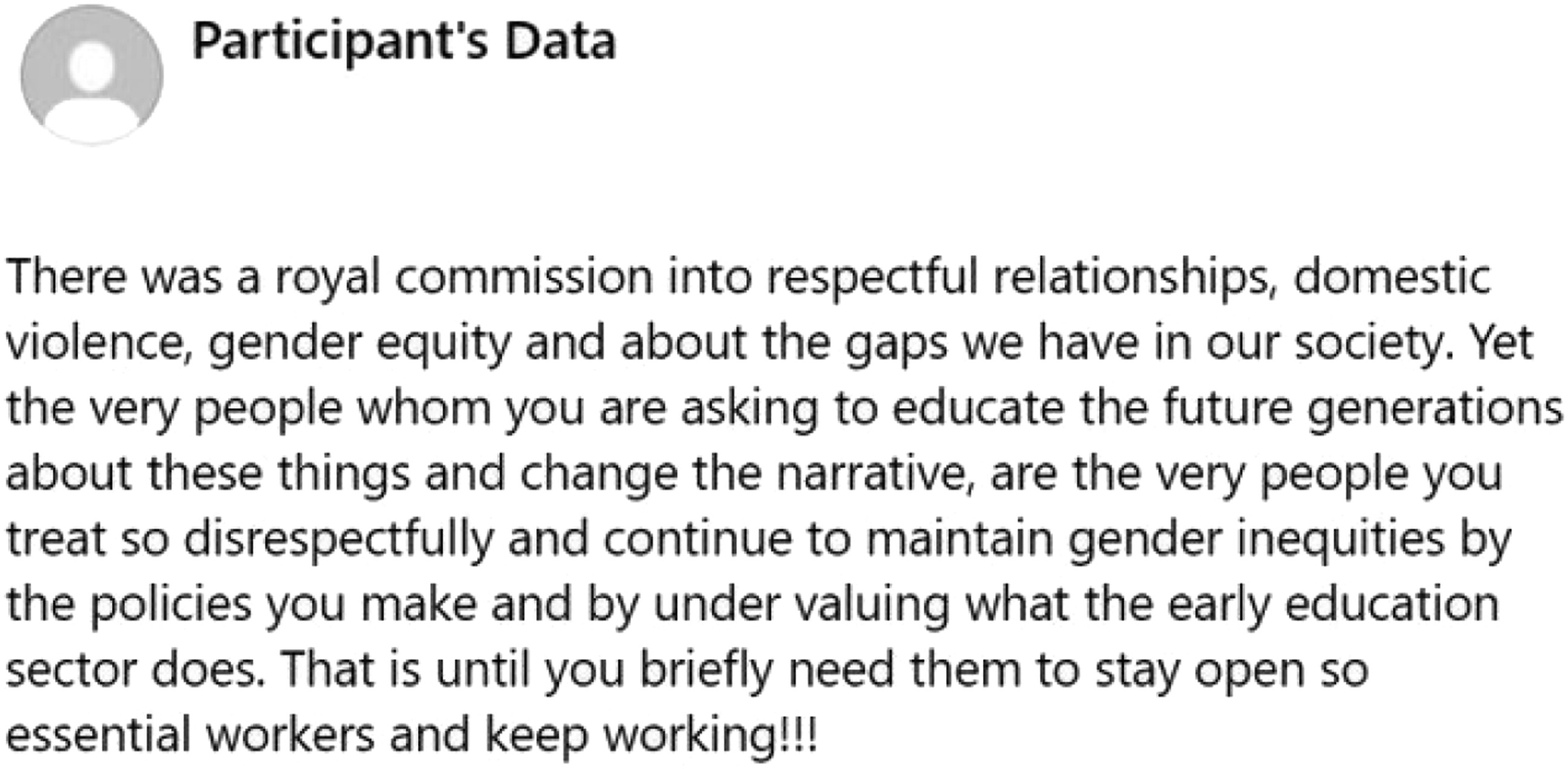
When participating in the large social networking Facebook group from Phase 1, the ECE teachers summoned authoritative discourse to advocate for their professionalism, as a legitimised identity. A teacher shared in this group an open letter they had sent to a politician to advocate for the sector. An excerpt of the post is shown in
Figure 1.
Sarah’s post in
Figure 1 demonstrates how teachers strategically deploy authoritative discourse by invoking established hierarchies to legitimise their political dialogues about professionalism. By drawing on the Royal Commission, the highest order of public inquiry in Australia commissioned by the Governor General (
CoA, 2025), Sarah summons authoritative discourse that demands recognition through its official weight and hierarchical authority. This language strategy is seemingly positioned so politicians and policy makers take her advocacy more seriously. The Royal Commission becomes the received, profaned truth (
istina) through which Sarah frames ECE teachers’ experiences of troubling working conditions, inadequate pay, and lack of professional recognition. By aligning her lived experience (
pravda) of ECE teachers’ gendered devaluation with this established authoritative truth, Sarah appears to strategically gain credibility and professional legitimacy for her political dialogue. This illustrates how authoritative discourse can enable teachers to advocate for their professionalism, by situating their concerns within officially sanctioned narratives that carry hierarchical weight. Yet, the response to Sarah’s post, shown in
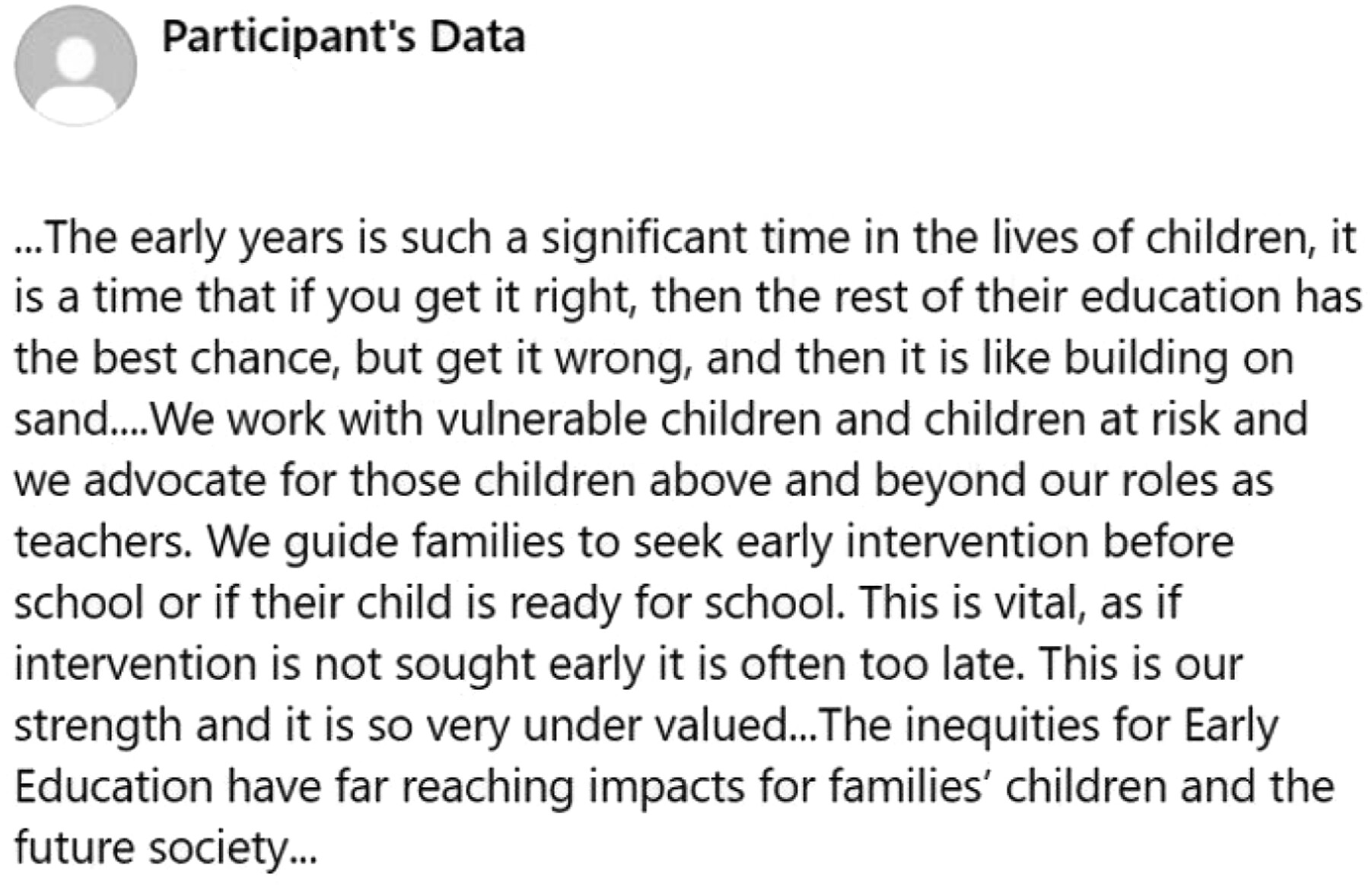
Figure 2, indicates tensions in how teachers summon authoritative discourse as a language strategy to gain professional recognition.
Radha’s response in
Figure 2 highlights the strategic deployment of authoritative discourse within political dialogues, and how these can narrow lived truth (
pravda). She suggests that gendered narratives may not constitute effective authoritative discourse for advancing professional advocacy, because they are not what ‘those at the top care about’. Instead, Radha explicitly proposes an alternative form of authoritative discourse, one that summons economic truths. ECE positioned that as which ‘feeds the economy’ and supports the ‘next generation of finances’. This strategic orientation deploys the dominant received truths (
istina) of neoliberal policy discourse, which positions ECE reform and funding through economic rationales (
Roberts-Holmes, 2021). Radha notes that ‘maybe they’ll take us more seriously… speaking so those will hear who need to listen is such a hard, hard thing to do’. Here, we observe teachers attempting to determine what ‘a person in power with authority might be moved to hear’ (
Bakhtin, 1981: 347).
However, this strategic deployment of authoritative discourse in political dialogues indicates a paradox. While Radha’s economic framing may grant political legitimacy, it requires teachers to silence aspects of their lived experience (
pravda) that do not fit within this narrow authoritative discourse. Radha urges teachers not to ‘lament their financial state first’, but rather emphasise ‘the stability and mental wellbeing of all the little souls in our care’. This mobilisation of authoritative discourse invokes the self-sacrificing ECE teacher, an enduring profaned truth (
istina) borne from the philanthropic history of ECE services (
Brennan et al., 1998). This authoritative discourse has been critiqued for over 35 years as a deficit professional narrative, interwoven with workplace stress, poor pay and conditions, and expectations of ‘superhuman’ perfection (
Corr et al., 2017). When teachers summon this authoritative discourse to gain professional recognition, they may inadvertently reinforce ‘Mary Poppins’ narratives of professionalism as ‘white, feminine, and middle class’ (
Ewens, 2019: p. 141), silencing the lived experiences (
pravda) of teachers from marginalised backgrounds, diverse cultures, perspectives, races, and values (
Gide et al., 2022;
Westbrook, 2023). The authoritative discourse strategy deployed in political dialogues to gain professional voice can, therefore, constrains whose voices can be heard, and which experiences count as legitimate within that profaned truth.
‘Building on sand’: Authoritative intervention
Teachers further summoned authoritative discourse as a language strategy by drawing on official investment and intervention doctrines.
Figure 3 shows Sarah continuing her political dialogue with politicians.
In
Figure 3, Sarah’s authoritative discourse deploys the established truth (
istina) that poor quality ECE is detrimental for children (see
Britto & UNICEF, 2017). Her metaphor that getting ECE wrong is ‘like building on sand’ summons intervention and investment narratives as profaned truth to legitimise ECE professionalism. This strategic deployment of authoritative discourse in political dialogues positions teachers’ work within dominant policy narratives that carry official weight. Similarly,
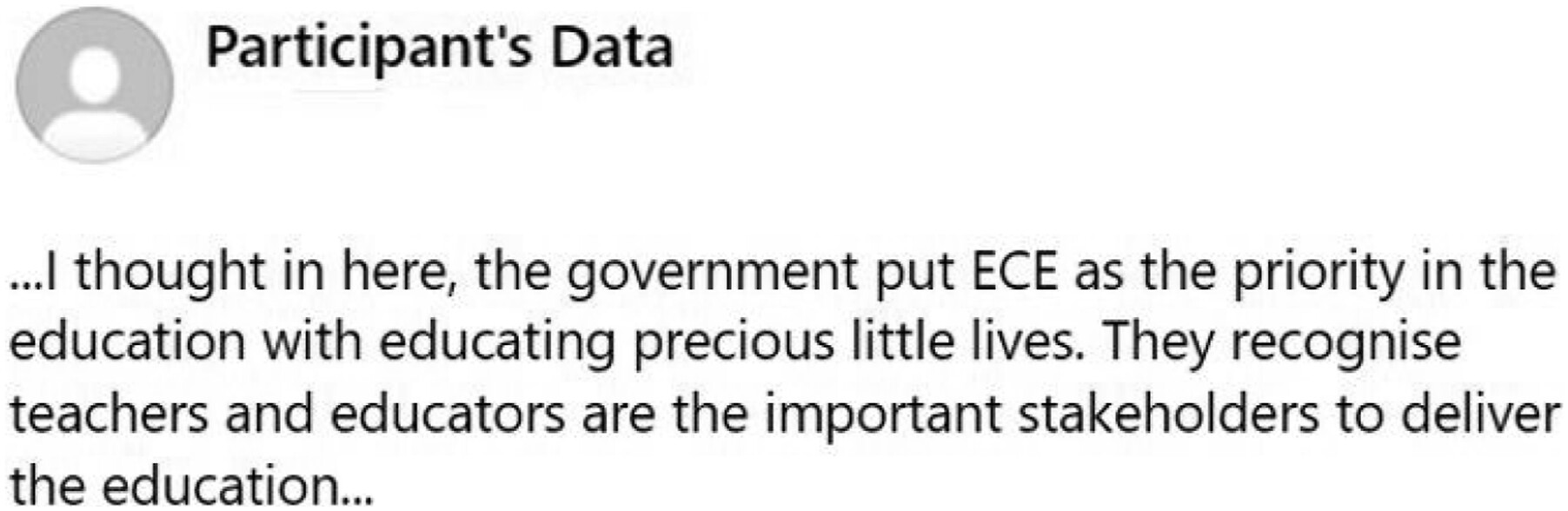
Figure 4 illustrates another teacher mobilising authoritative discourse through business and investment language.
Yulia’s post in
Figure 4 deploys authoritative discourse through references to ‘educating precious little lives’ (investment discourse), ‘stakeholders’ (business language), and the need ‘to deliver the education’ (traditionalist, rationalist epistemology drawing on John Locke). These strategic orientations summon received truths (
istina) that align with Westernised, economically driven official narratives. By invoking these established hierarchies and profaned truth in their political dialogues, teachers appear to position their professionalism as legitimate within policy narratives that politicians and policy makers are likely to recognise.
These examples demonstrate how authoritative discourse can be utilised by teachers to advocate for professional recognition, by aligning with officially sanctioned narratives. Yet, this language strategy carries inherent tensions. As
Bakhtin (1981) explained, authoritative discourse ‘remains sharply demarcated, compact and inert’ (p. 343), demanding adherence to singular, profaned truth. While mobilising these received truths (
istina) in political dialogues can grant political legitimacy, it simultaneously constrains which aspects of teachers lived experiences (
pravda) can be voiced. The authoritative discourse that enables recognition through official channels, may, paradoxically limit the dialogic space available for diverse experiences and perspectives. Social networks during times of crisis may increasingly foster authoritative discourse as teachers seek to be taken seriously, with implications for whose truths are validated and whose are silenced.
‘Outside the tent’: The limits of professional, authoritative discourse
The shift in time and space to the smaller, private Phase 2 group amplified the presence of authoritative discourse, indicating its silencing consequences more starkly. After receiving limited responses to his posts, participant Paul questioned strategies to gain professional recognition and political advocacy, with Mary responding.
Mary’s response in
Figure 5 appears to deploy authoritative discourse through the metaphor of ‘the tent’, which positions certain approaches to professionalism and political advocacy as legitimate, while marking others as beyond acceptable bounds. Paul’s political dialogue is positioned as ‘too far outside the tent’ and ‘attacks the sector’. The statement ‘I’m not going to debate you on this’ signals authoritative discourse that closes down dialogue by establishing profaned boundaries for legitimate discussion. Paul’s lived experience (
pravda) that ‘things have not improved, that existing avenues for advocacy and policy change are ineffective’ clashes with the authoritative discourse Mary summons about correct professional engagement. Paul’s reply, asking when the sector became a ‘holy cow’, highlights the sacrilegious nature of authoritative discourse. As
Bakhtin (1984a) described, authoritative discourse ‘pretends to be the ultimate word, closing off the represented world and individuals’ (p. 293). This authoritative framing in political dialogues invokes hierarchical boundaries, an ‘us or them’ distinction that positions certain voices and approaches as correct while marking Paul’s political dialogue as illegitimate.
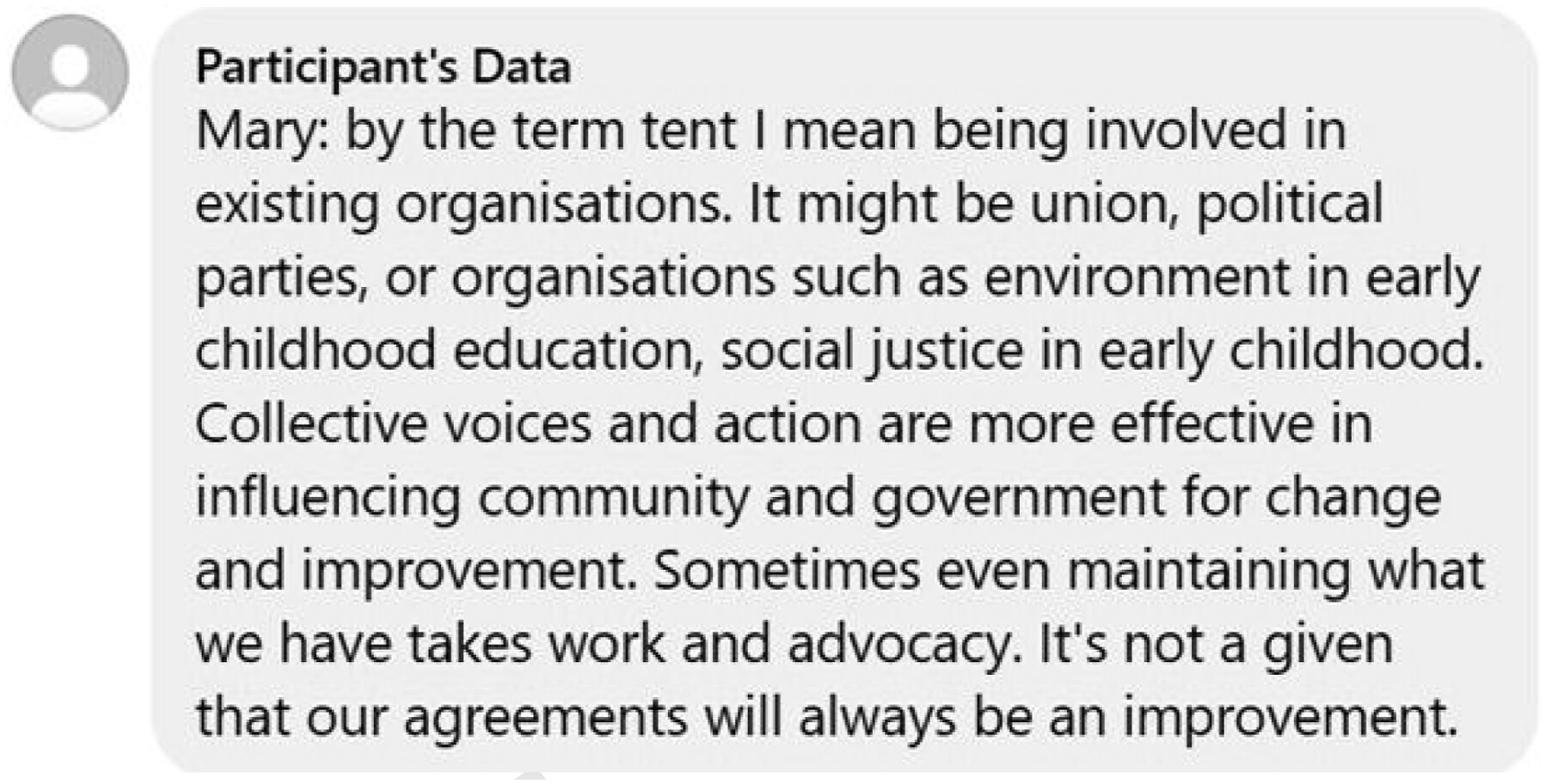
Mary expanded on the authoritative discourse of ‘the tent’ in
Figure 6, defining it as alignment with ‘existing organisations’ such as unions and political parties.
Mary’s tent in
Figure 6 exemplifies authoritative discourse that draws on officiality and organisational authority to establish profaned truth beyond reproach. By mobilising the authority of unions and political parties as the legitimate path to professional recognition, this authoritative discourse establishes a singular received truth (
istina) about how teachers should politically dialogue. Mary’s emphasis that ‘collective voices and actions are more effective’ suggests that authoritative discourse demanding unity is strategic for gaining recognition. Yet, authoritative discourse, by its nature, requires conformity to a singular profaned truth. Collective voice that deploys authoritative discourse in political dialogues silences divergent professional values and views. As a consequence, multiple lived experiences (
pravda) are condensed into a monologic narrative. Although this authoritative strategy may be perceived as enabling professional legitimacy, it paradoxically produces voicelessness for those whose experiences do not align with the profaned truth being summoned. Paul addresses the silencing effects of this authoritative discourse in
Figure 7.
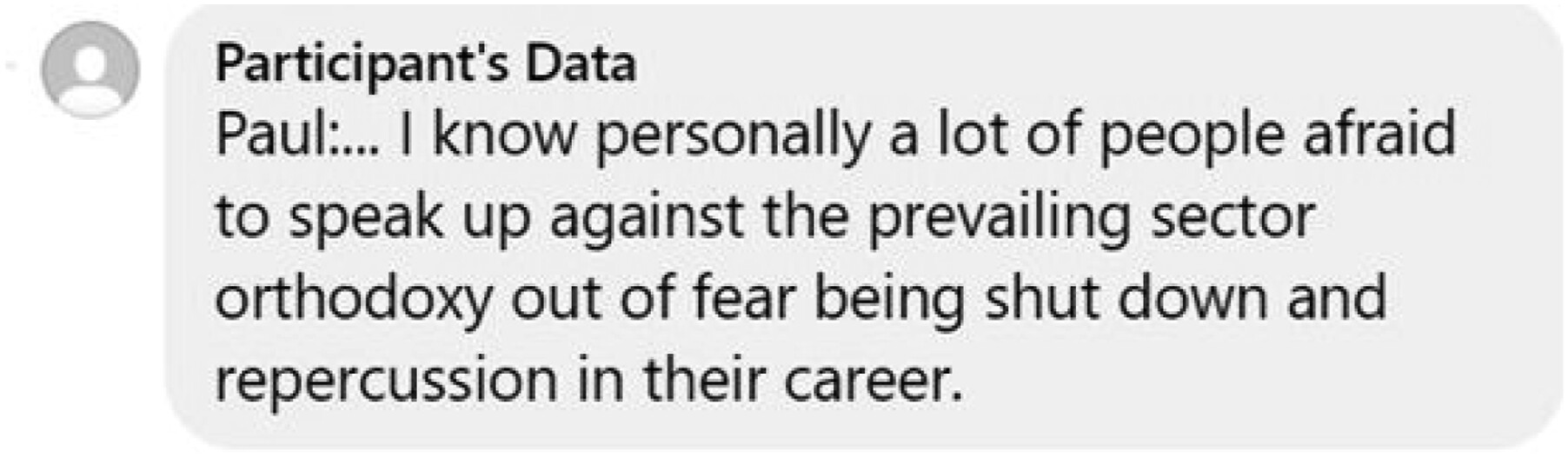
The authoritative discourse deployed in
Figure 7 by Paul's political dialogue, could paradoxically silence and marginalise members of the same population it seeks to uplift. He notes that colleagues are ‘afraid to speak up’ when differing from the ‘orthodox’ of the tent, fearing ‘repercussions’. This observation indicates how authoritative discourse, once established as profaned truth in political dialogues, silences lived experiences (
pravda) that do not conform. When organisations and ways of politically dialoguing are enshrined as an authoritative discourse beyond reproach, this strategy to gain professional recognition simultaneously constrains whose voices can be heard. With career repercussions indicated as a considerable, silencing consequence of deviating from this authoritative orthodoxy. This insight aligns with
Molla and Nolan (2020) who reported that ECE teachers experience limitations on the ‘privilege to speak’ beyond and within their sector (p. 75). While mobilising authoritative discourse in political dialogues may seem strategic for gaining professional legitimacy, its demand for adherence to singular profaned truth (
istina) reduces the dialogic space available for the rich complexities of teachers lived experiences (
pravda).
In the context of social networks, this silencing effect of authoritative discourse can manifest ‘echo chambers’ (
Serrano-Contreras et al., 2020).
An et al. (2014) emphasise that this phenomenon intensifies during political instabilities, such as COVID-19. Unlike typical echo chambers where people with similar views congregate voluntarily, the Phase 2 group was researcher moderated and inorganically formed, bringing divergent views into contact and making the silencing effects of authoritative discourse more visible. Group members reflected on this dynamic, as shown in
Figure 8.
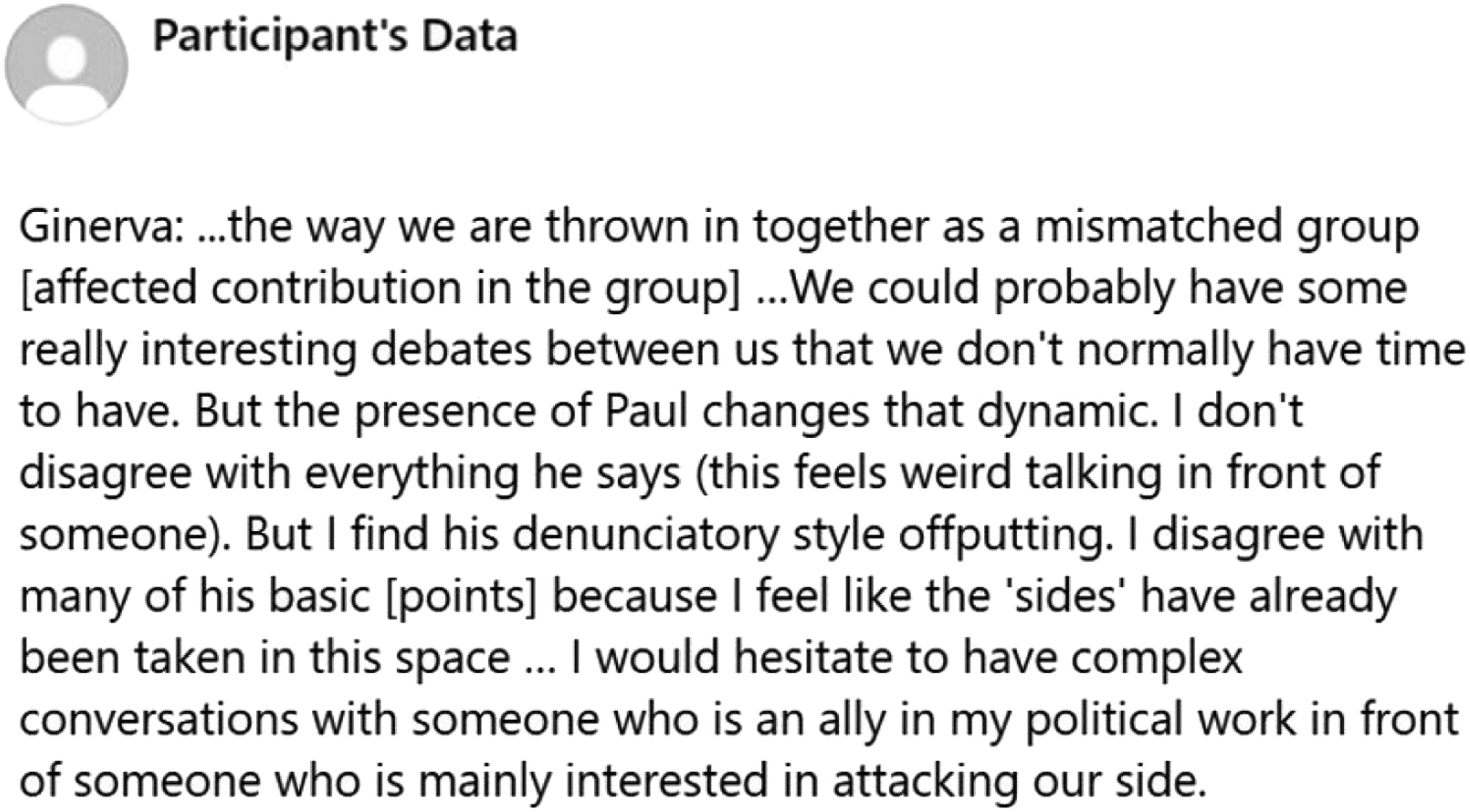
Ginevra’s reflection in
Figure 8 highlights the conditions under which authoritative discourse flourishes and silences political dialogues. She notes that ‘sides have already been taken’ and describes a ‘denunciating style’ characteristic of authoritative discourse that closes down dialogue. She further explains in
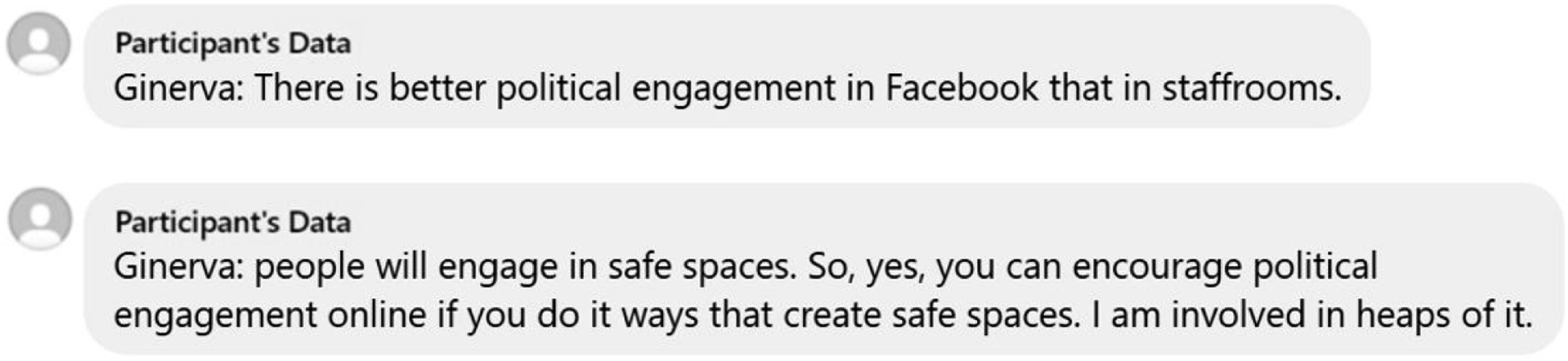
Figure 9 her understanding of spaces that enable political dialogues.
Ginevra’s notion of a ‘safe space’ in
Figure 9 is of interest. She suggests political dialogues about professionalism can flourish when there is ‘enough basic agreement’, yet she also felt uncomfortable by opposing views. This perspective suggests that ‘safe spaces’ may function as echo chambers where authoritative discourse establishes profaned truth (
istina) that participants collectively uphold, with divergent lived experiences (
pravda) marked as unsafe or illegitimate. The paradox is emphasised here. Authoritative discourse summoned as a language strategy to safeguard and advocate for ECE teachers’ professionalism through ‘safe’ dialogue spaces free from contention, may inadvertently silence teachers’ diverse expertise and lived experiences. Due to conformity to a singular received truth. Authoritative discourse, by positioning certain truths and approaches as profaned and beyond reproach, may foster a culture where questioning traditional hierarchies and beliefs becomes taboo, limiting whose voices are validated and whose professional experiences count as legitimate in political dialogues about the sector.
Implications
In this paper, we have identified and analysed ECE teachers’ deployment of authoritative discourse as a language strategy in social networking, political dialogues to gain professional recognition. The COVID-19 context proved particularly important for exploring authoritative discourse because times of crisis and profound uncertainty appear to amplify its presence. When teachers feel increasingly unheard and unrecognised, authoritative discourse may seem like a limited means to be granted legitimacy, with the insights indicating how teachers strategically summoned authoritative discourse to advocate for their professionalism.
Upholding authoritative, received truth (
istina) about ECE professionalism was positioned as the ‘safe’ avenue for advocacy and positive change. Yet, this reliance on singular, profaned truth can paradoxically undermine the expertise and lived experiences (
pravda) of ECE teachers, particularly those from marginalised backgrounds, diverse cultures, perspectives, and values. When authoritative discourse positions certain approaches, organisations, or narratives beyond reproach, as exemplified by the metaphor of being inside or outside ‘the tent’, it establishes boundaries for legitimate professional dialogue. This dynamic may contribute to a culture where questioning traditional hierarchies becomes taboo, where colleagues fear ‘repercussions’ for divergent views, and where teachers experience limitations to voice their political dialogues (
Molla and Nolan, 2020). Importantly, this is not a critique of any particular organisation, such as unions, but rather a provocation about positioning any organisation or approach as authoritative, and therefore beyond critical examination. Even structures that advance ECE rights may inadvertently silence voices when granted profaned status.
By aligning with received truths (
istina) that carry hierarchical weight, such as economic narratives or investment doctrines, teachers attempted to speak in ways ‘those at the top’ might recognise. While relying on authoritative discourse as an ‘old authority and truth [that] pretend to be absolute, to have an extratemporal importance’ (
Bakhtin, 1981: p. 212), may seem alluring, it could reduce the rich complexities of the sector and its practitioners, given its silencing nature. This strategic orientation creates a paradoxical loop. Feeling voiceless can prompt reliance on authoritative discourse, which silences divergent voices, which compounds voicelessness, which may prompt further reliance on authoritative discourse. This cycle suggests why and how teachers may experience their political dialogues as constrained, even as they actively advocate for professional recognition.
For policy and political dialogues
Policy makers and those designing platforms for professional advocacy could consider how authoritative discourse, while appearing effective for gaining legitimacy, may narrow whose voices are heard and which experiences count as legitimate. Policy dialogues that rely heavily on economic framings, investment narratives, or self-sacrificing professional images may inadvertently reinforce deficit narratives and silence teachers whose experiences do not align with these received truths. Creating space for diverse lived experiences (pravda) alongside received truths (istina) requires deliberately resisting the tendency to position certain approaches or narratives as beyond question. This might involve recognising that teachers mobilising authoritative discourse are responding to feeling unheard, addressing the systemic conditions that produce this voicelessness, rather than simply validating authoritative framings. Examining how policy narratives about ECE professionalism may privilege certain voices (white, middle class, Western ideology) while marginalising others. Creating mechanisms for critical examination of traditional hierarchies and structures, even those that have historically supported the sector. In addition to attending to how times of crisis may amplify authoritative discourse and its silencing effects.
Concluding provocations
This paper has explored how ECE teachers summoned authoritative discourse as a language strategy within their political dialogues in social networks, during COVID-19. The analysis indicated a paradox. Teachers’ use of authoritative discourse to gain professional recognition, by aligning their advocacy with received truths (
istina) that carry hierarchical weight, also constrained the dialogic space available for diverse professional voices and lived experiences (
pravda). In seeking legitimacy through established truths, teachers’ efforts to be heard sometimes echoed the very discourses that have historically limited what can be said and by whom. These dialogues suggest that while authoritative discourse may appear strategic in securing recognition, it can narrow the space for plural and dialogic engagement about what professionalism means in ECE. As
Bakhtin (1986) reminds us, authoritative discourse demands allegiance.
These insights point to a circular dynamic in how authoritative discourse operates within teachers’ political dialogues. When teachers feel unheard, they may draw on authoritative discourse to be recognised, yet this same discourse can silence other ways of speaking and knowing. The resulting sense of voicelessness can then prompt further reliance on authoritative forms of language, creating a loop that constrains the very dialogue teachers seek to open. This circularity highlights the need to remain alert to how authoritative discourse can both offer and limit possibilities for professional recognition. The challenge, then, is not to reject authoritative discourse altogether, but to hold it alongside the diverse lived truths that teachers bring. Opening space for these different truths to meet in dialogue may offer a way to break the cycle of silencing, allowing professional recognition to emerge through multiplicity rather than through a single received truth.