


A Systematic Review of the Impacts of Media Mental Health Awareness Campaigns on Young People
Abstract
Methods
Eligibility Criteria
Literature Search
Data Collection
Results
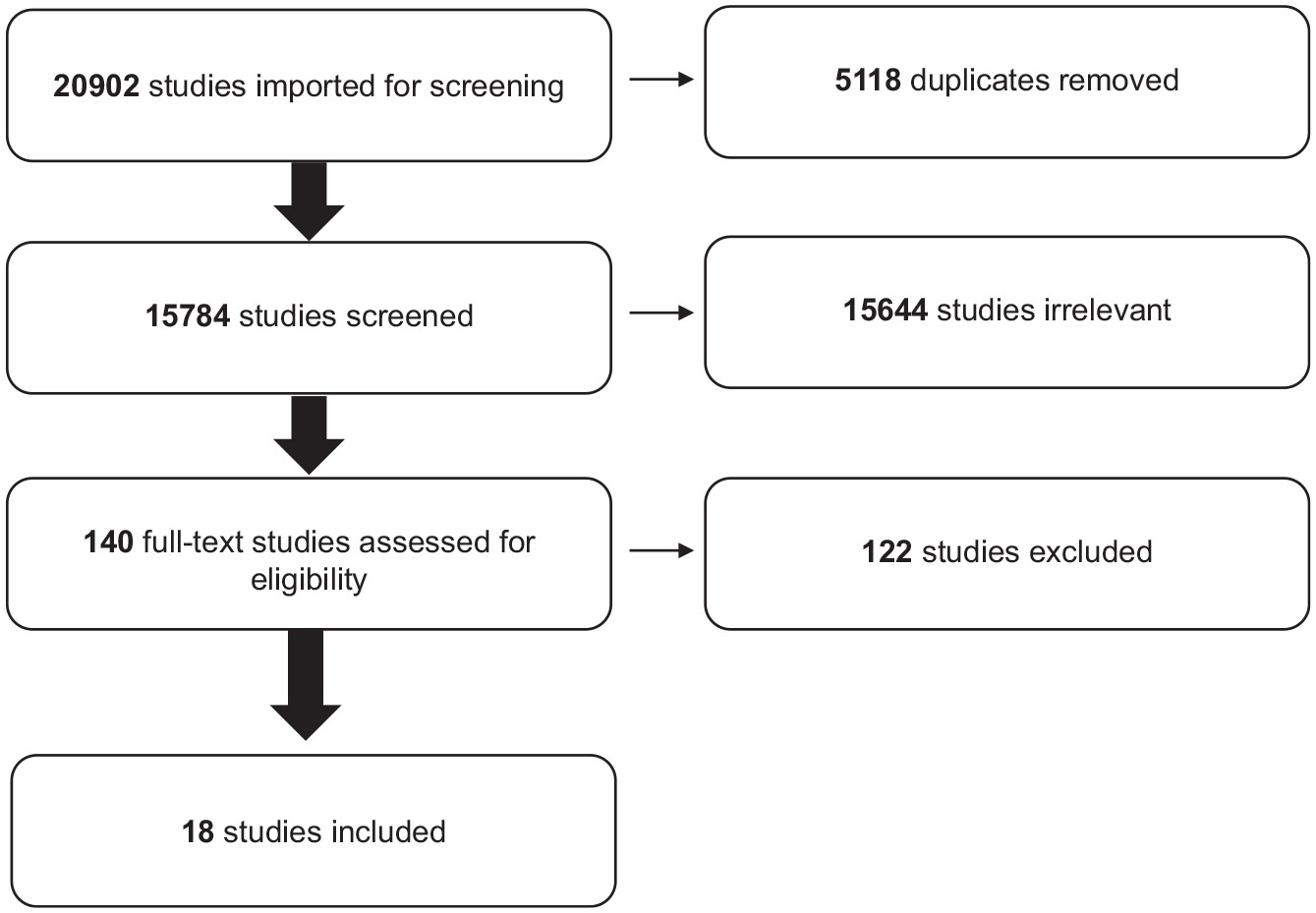
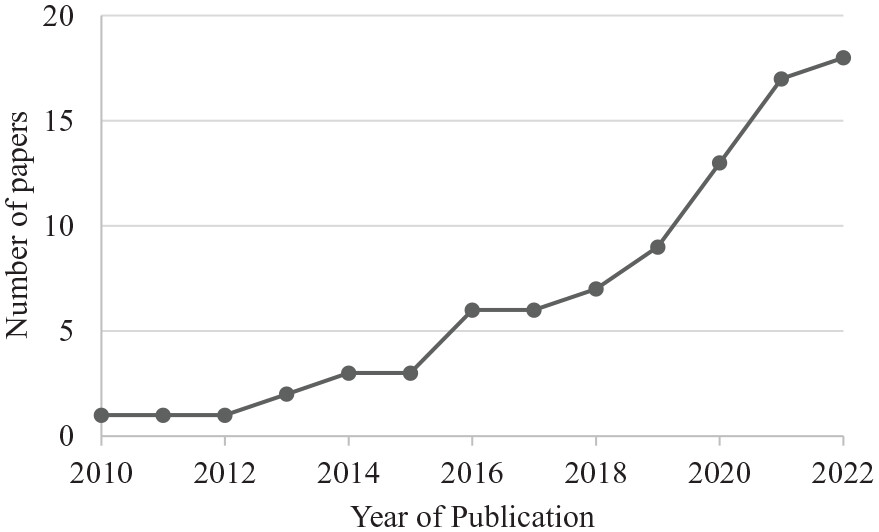
Search Outcomes
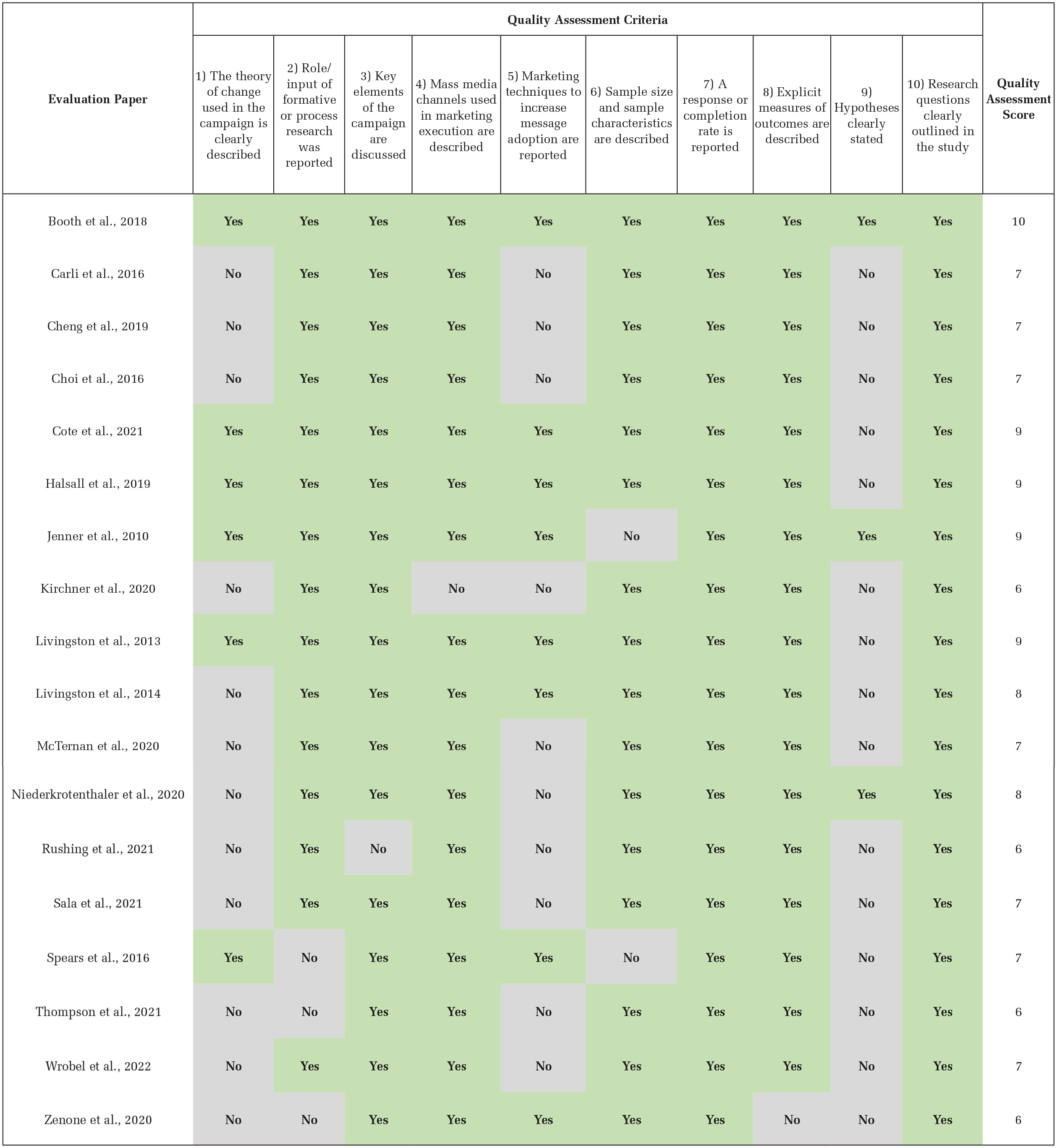
Quality Assessment of Studies in the Sample
Campaign Characteristics
| Campaign name | Country (scope) | Intended audience | Dissemination channels | Mental health focus | Outcome evaluation instrument | Sample size | Sample recruitment method | Evaluated by |
|---|---|---|---|---|---|---|---|---|
| Bell Let’s Talk | Canada (national) | General public | Social media, short message service (SMS) text messages | Stigma Mental health awareness | Time series analysis | All young people accessing outpatient mental health services in Ontario, Canada between 2006 and 2015. | Data obtained through healthcare administrative records | Booth et al. (2018) |
| Analysis of suicide counts | Total counts of suicide in Ontario, Canada from 2011 to 2016 in the weeks before and after the campaign. | Data obtained from the coroner’s office | Cote et al. (2021) | |||||
| Suicide Prevention by Internet and Media-Based Mental Health Promotion (SUPREME) | Europe (multinational) | Young people (adolescents) | Website | Stigma Mental health awareness Help-seeking | Randomized control trial | n = 2,286 | Public schools in participating countries | Carli (2016) |
| The Last Day | Hong Kong (multinational) | Young people | Video (YouTube) | Mental health awareness Suicide awareness Help-seeking | Questionnaire Media statistics | n = 108 | Online survey link in YouTube video description | Cheng et al. (2020) |
| The Truth about Suicide: Real Stories of Depression in College | United States (national) | Young people (college students) | Video | Suicide awareness | Questionnaire | n = 431 | University website and student organizations | Choi et al. (2016) |
| Mindyourmind.ca | Canada (national) | Young people | Website, social media (MySpace, Facebook, YouTube, Twitter) | Stigma Mental health awareness Help-seeking | Questionnaire Social media analytics | n = 53 | Advertisement on website and Facebook and sent to subscribers of website’s newsletter. | Halsall et al. (2019) |
| Louisiana Partnership for Youth Suicide Prevention (LPYSP) | United States (state-wide) | General public initially, then young people | Bus boards, billboards, print advertisement, newspaper, radio/movie theater public service announcements | Mental health awareness Promotion of resources | Analysis of suicide hotline call volume | All hotline callers in the state of Louisiana where the campaign was active from 2005 to 2008 | Data of call volumes obtained from call center. | Jenner et al. (2010) |
| It Gets Better Project (IGBP) | Austria (multinational) | Young people in the LGBTQ+ community | Video (Unspecified channels) | Suicide awareness | Focus groups | 19 young people, nine experts | Vienna and Salzburg branches of Homosexuelle Initiative (HOSI) | Kirchner et al. (2020) |
| In One Voice | Canada (provincial) | Young people | Video (hockey games, TV, Facebook, Twitter, YouTube) | Mental health literacy | Questionnaire | n = 806 | Market research company contacted to identify survey respondents | Livingston et al. (2013) |
| n = 438 | Market research company contacted to identify survey respondents | Livingston et al. (2014) | ||||||
| My Other Life: Ireland’s Young and Their Mental Health | Ireland (national) | General public | Video (online, on TV, and in colleges and universities) | Mental health literacy | Questionnaire | n = 2,311 | Social media such as Facebook, Twitter, YouTube; Union of Students in Ireland circulated link to institutions countrywide | McTernan et al. (2023) |
| Thinking aloud. Jule about her depression | Germany (national) | General public | Video | Mental health awareness Suicide awareness | Randomized control trial | n = 302 | Flyers posted online and in university departments | Niederkrotenthaler & Till (2020) |
| BRAVE Intervention | United States (national) | American Indian and Alaska Native (AI/AN) young people | SMS text message | Stigma Help-seeking | Randomized control trial | n = 833 | We R Native social media channels like Facebook, Instagram. Listservs associated with AI/AN populations. | Craig Rushing et al. (2021) |
| n = 270 | We R Native social media channels like Facebook, Instagram. Listservs associated with AI/AN populations. | Wrobel et al. (2022) | ||||||
| #chatsafe Campaign | Australia (national) | Young people | Social media direct messaging | Suicide awareness Safe engagement on social media | Questionnaire | n = 189 | Social media advertisement on Facebook, Instagram, Snapchat, YouTube, Twitter | La Sala et al. (2021) |
| Goalzie | Australia (national) | Young people | Mobile app | Promote help-seeking | Questionnaire | n = 1,106 presurvey participants n = 618 postsurvey participants | Diverse recruitment approaches including through schools and universities, community, partner, and parent associations, parents via social media, panel providers, and lead generation. | Spears et al. (2016) |
| Look Around | United States (municipal) | Young people in sixth to 12th grade | Movie theater advertisement, social media, web-based advertisement | Stigma Help-seeking | Questionnaire | n = 11478 | Middle schools and high schools. | Thompson et al. (2021) |
| Everything is Fine | Canada (provincial) | Young men | Print advertisement, social media (Instagram, Snapchat) | Health promotion | Questionnaire | n = 298 | Social media such as Instagram and Snapchat, print posters to secondary schools | Zenone et al. (2020) |
Outcome Evaluation Methods
Impact of Campaigns
Proximal Impacts
Intermediate Impacts
Discussion
Implications for Practice, Policy, and Research
Conclusion
ORCID iD
References
Supplementary Material
Please find the following supplemental material available below.
For Open Access articles published under a Creative Commons License, all supplemental material carries the same license as the article it is associated with.
For non-Open Access articles published, all supplemental material carries a non-exclusive license, and permission requests for re-use of supplemental material or any part of supplemental material shall be sent directly to the copyright owner as specified in the copyright notice associated with the article.
Cite
Cite
Cite
Download to reference manager
If you have citation software installed, you can download citation data to the citation manager of your choice
Information, rights and permissions
Information
Published In

Keywords
Rights and permissions

Authors
Metrics and citations
Metrics
Publication usage*
Total views and downloads: 21018
*Publication usage tracking started in December 2016
Altmetric
See the impact this article is making through the number of times it’s been read, and the Altmetric Score.
Learn more about the Altmetric Scores
Publications citing this one
Receive email alerts when this publication is cited
Web of Science: 27 view articles Opens in new tab
Crossref: 30
- Mental health and educational attainment: Replicating diminishing associations in an England cohort
- Viralizar para implicar: redes sociales y alfabetización adolescente en salud mental
- Affective Health Messages for Adolescents: Protocol for a Scoping Review
- Identifying Ingredients That Make Mental-Health Focused Short Videos Engaging: A Content Analysis of Source Type, Content Strategy, and Production Features
- Promoting equitable mental health communications for prevention and early intervention: a scoping review
- THE ROLE OF NEW MEDIA IN MENTAL HEALTH AWARENESS: A SYSTEMATIC REVIEW
- How topic content shapes LLM personality-tailored persuasion: semantic anchoring and topic stereotype effects
- The psychological consequences of mental health awareness efforts
- Demographic Insights from a Mental Health Telephone Helpline for the Punjabi and Sikh Community
- Fifty Years of One Flew Over the Cuckoo's Nest : A Qualitative Exploration of Mental Health Staff's Perspectives
- View More
Figures and tables
Figures & Media
Tables
View Options
View options
PDF/EPUB
View PDF/EPUBAccess options
If you have access to journal content via a personal subscription, university, library, employer or society, select from the options below:
I am signed in as:
View my profileSign out

I can access personal subscriptions, purchases, paired institutional access and free tools such as favourite journals, email alerts and saved searches.
loading institutional access options
SOPHE members can access this journal content using society membership credentials.
SOPHE members can access this journal content using society membership credentials.
Alternatively, view purchase options below:
Purchase 24 hour online access to view and download content.
Access journal content via a DeepDyve subscription or find out more about this option.
