In 1972, the Club of Rome published a document called,
The Limits to Growth, based on work undertaken at MIT (
Meadows et al., 1972) which modelled the consequences of five critical resources: agricultural production, industrial output, non-renewable resource depletion, pollution generation, and population growth. It suggested we needed to sort all of these problems out – or else. Just over 50 years later, on the day the first draft of this article was written (7 June 2023), New York City had the worst air quality on the planet – the pollution was five times higher than the national air quality standard, primarily a consequence of wildfires in Canada (
Milman, 2023a: 36). By the time of the second draft (18 July 2023), the Acropolis in Athens was registering 48°C (118°F), Death Valley in California hit 49°C (120°F), and the town of Sanbao in China reached 52°C (125°F). By the third draft (24 July 2023), the Greek authorities were evacuating Corfu and Rhodes in response to the wildfires there, but the British government under Prime Minister Rishi Sunak, and the official Labour Party opposition under Keir Starmer, were both considering watering down their commitments to environmental protection after a marginal result in a parliamentary by-election. On 5 September, the forecast for Thessaly, Greece was for 78 inches of rain in 48 h. Moreover, research was suggesting that the Gulf Stream system was near to collapse, possibly as early as 2025, which would alter the Atlantic Meridional Overturning Circulation (Amoc) and generate potential global catastrophes (
Carrington, 2023a). Maui’s fire and the flooding from Storm Hilary in California in August 2023, as well as the hottest day on record in Houston Texas (43°C) on 24 August 2023, and in New Orleans on 27 August (41°C), was followed by the floods in New York City at the end of September. By the time of the final draft (early December) it had been announced by the EU’s Copernicus organization, that 2023 was certain to be the warmest year on record.
1 On the face of it, one might think that the debate was finally over, and action was forthcoming. Even one of the most cited academic articles that concluded there was no evidence of a climate crisis (
Alimonti et al., 2022) has been retracted because the evidence does not support the claim (
Readfern, 2023). But, despite all this data, on the 23 August 2023, at the first Republican presidential primaries candidate debate on Fox News, one of the candidates, Vivek Ramaswamy called climate change ‘a hoax’.
2 In Argentina, the newly elected president, Javier Milei, has already threatened to close the country’s Ministry for the Environment and Sustainable Development.
This is not the first time humans have found themselves at risk, but it might be the first time we have put ourselves at risk.
3 By the beginning of September 2023, the UN’s ‘global stocktake’ insisted that unless we took 22bn tonnes of carbon dioxide out of the atmosphere (the equivalent of all the emissions from the five greatest polluters (China, India, Japan, Russia and the US) by 2030, then we could not avoid the worst impacts on climate change (
Carrington, 2023d). Even the USA, that claims to be leading the climate change reset through President Biden’s $369bn Inflation Reduction Act (which facilitates the growth of green energy through electric cars, heat pumps and renewable energy projects and should reduce US carbon emissions by almost half by 2035), is simultaneously leading the expansion of global gas and oil production (
OCI, 2023). Then, in mid-September 2023, an assessment of the world’s nine ‘planetary boundaries’ (climate, water, diversity etc.) noted that six of the boundaries were already broken and two more were on the edge, leaving only atmospheric ozone in the safe zone because of the banning of chemicals over recent decades that shrank the ozone hole - or at least it did until 2023 (
Carrington, 2023e).
4 By the middle of October, Professor Julian Allwood (Cambridge University) warned that climate change would lead to the starvation of around 1 billion people and that would trigger another world war.
5But we have been here before and time is escaping us, indeed, the first Climate Change Conference - COP (Conference of the Parties), under the United Nations Framework Convention on Climate Change, was in 1995, and since then little has been achieved, other than lots of agreements to do something (
Harvey, 2019). In fact, since the Cop26 pledges in 2021 to phase out ‘inefficient’ fossil fuel, the G20 nations have added $1tn in fossil fuel subsidies (7% of global GDP – twice the global expenditure on education) according to the International Institute for Sustainable Development – that’s an increase of 475% since 2010 (
Niranjan, 2023) and amounts to $13m a minute (
Carrington, 2023b). Indeed, in a recent Pew survey, Americans rated ‘Dealing with Climate Change’ as only the 17th most important concern, with ‘Strengthening the Economy as the first priority.
7 Yet the British population seem much more willing to support a progressive green agenda than either of the two main political parties according to a recent survey by the
Financial Times (2023). Those opposed to changing the way power is sourced are often quick to insist that, since China is the most polluting country, there is no point in doing anything until the Chinese government changes tack. This fatalistic avoidance suggests we need to consider the problem as a Wicked Problem, and explains why this makes it difficult to solve but still possible to ameliorate.
What else can we try?
When Climate Change first emerged as a problem, most of the responses concentrated on ‘solving’ the problem through the application of science, manifest, for example, in the development of biofuels. This was an attempt to solve a Wicked Problem – a problem that was either novel or recalcitrant and beyond our current understanding or resources (
Rittel and Webber, 1973) with a Tame Solution, a standard operating procedure (SOPs) that F. W. Taylor would have appreciated. But, Tame Problems are complicated, not complex (as Wicked Problems are) and SOPs are only viable for complicated problems that can been be removed from their context, fixed, and returned without affecting the context (
Crowley and Head, 2017). When we interact with Wicked Problems we often generate another Wicked Problem in the process of attempting to fix the initial issue. Thus, the first generation of biofuels appeared to denude the world of significant food resources and what looked like a solution actually became another problem. Thus, smoking is radically reduced in most countries through the rise of vaping, but the public health danger that vaping poses, especially to children (
McClure, 2023), is a reminder that trying to tame the Wicked Problem of smoking by promoting vaping often generates other unforeseen problems downstream.
This is typical of what happens when we try to solve ‘Wicked Problems’ – problems we have either never faced before or been unable to solve, because other problems emerge to compound the original problem: we can switch to electric cars, but their batteries require lithium to make the batteries and cobalt to stop them from overheating, and the extraction of both damages the environments from which they are extracted.
8 Moreover, the process is linked to exploitive labour conditions for some of the miners involved (
Pattison, 2021). So, we can make things better or worse – we can drive our cars slower and less, or faster and more, or switch to public transport or bicycles – but we may not be able to solve Climate Change, we may just have to learn to live with a different world and make the best of it we can. In other words, we cannot start again and design a perfect future – though many political and religious extremists might want us to.
The ‘we’ in this is critical because it signifies the importance of the collective in addressing Wicked Problems. Tame Problems are those we already know how to solve and might have individual solutions in the sense that an individual is likely to know how to deal with it. In short, individual-efficacy – the belief that an individual can make a difference – is strong here (
Bandura, 1989). But since Wicked Problems are partly defined by the absence of an answer on the part of the leader, then the individual leader must engage the collective in an attempt to come to terms with the problem. In other words, Wicked Problems require the transfer of authority from individual to collective because only collective engagement can hope to address the problem. Yet the transfer of efficacy from individual to collective is notoriously problematic, after all, when an individual looks at climate change, their response to it is as likely to be fatalistic as anything else, so we need to understand how
social identity operates to promote collective action yet avoids the free-rider problem where individuals are demobilized by the action of the group (
Hamann et al., 2023). On the other hand, it is a common strategy of the very organizations that generate most emissions to try and transfer responsibility from them to the individual: to encourage us to do more recycling, turn down the heating, and buy electric cars, and then to blame individuals for not doing enough. This is the equivalent of blaming the poor for being poor, rather than considering the impact of structural inequalities, like class, race, and gender. That isn’t to say that individuals are not important: after all, the richest 1% of the world’s population is responsible for more carbon emissions than the poorest 66%, so it isn’t that individuals do not matter, but it’s more a question of which individuals are responsible for more of the problems and how we respond to this (
Watts, 2023).
There is, then, a huge degree of uncertainty involved in Wicked Problems and thus it is associated with Leadership, as I am defining it here, which is not a science but an art – the art of engaging a community in facing up to complex problems, and often problems that it would rather ignore. If leadership is the decision style most appropriate for Wicked Problems because it is focused on galvanising the collective and forcing the collective to take responsibility, Tame Problems are the provenance of Management and the land of SOPs, which are crucial for known processes, like keeping the lights on and the water flowing – under normal conditions – but unsuited to the complexity of Wicked Problems. A third category of problems exists when the situation is critical, requiring rapid decision-making, and there are no SOPs to rely on. Like the other categories, Critical Problems are subjective, in that for example, a road collision is a critical problem for those involved and they look to someone – usually the police - to make decisive decisions and maintain order, but when the ambulance turns up this might be their fourth road accident of the day, and they have SOPs for most situations. In effect, for some people a road accident is a crisis, requiring a Commander, but for others, the same accident is Tame requiring Management approach, and if there have been several accidents in the same spot – and no one knows why - then we have a Wicked Problem demanding the Leadership of collective action. The same can be said of Climate Change. For those facing imminent submersion of rising sea water or catastrophic storms, the problem is Critical. But for the rescue services it might generally be Tame, while for the rest of the world it is Wicked. How, then, might we address Wicked Problems, especially given that we don’t really have a clear answer, let alone a consensus, because if we did know what to do then it would not be a Wicked Problem.
Some authors have suggested that problems like Climate Change are actually ‘super-wicked’ (
Levin et al., 2012: 123) in that ‘time is running out; those who cause the problem also seek to provide a solution; the central authority needed to address it is weak or non-existent; and, partly as a result, policy responses discount the future irrationally.’ None of these necessarily holds true: time is always running out, irrespective of the form of wicked problem, and the issue of time in Climate Change rather shifts the problem from wicked to critical, requiring a different kind of decision; those who cause the problem are not always interested in addressing it, and the central authority need not be weak – it just isn’t interested in resolving the problem; and discounting the future irrationally depends on whose version of rationality we are considering – and that, after all, is essentially the contested nature of all, not specifically ‘super,’ wicked problems. Recently
Weaver et al. (2023) have suggested using a technique they call ‘virtuous challenges’ to progress our response to climate change by introducing incremental heuristics to facilitate ‘soft transformative governance’ that take the political sting out of more radical, immediate, and threatening change initiatives, but this is predicated on the utility of rational models of change. What if we are faced with significant irrationality? For a possible solution to this conundrum, we might look at the cultural theory of Mary
Douglas (2003).
Elegant cultures and solutions
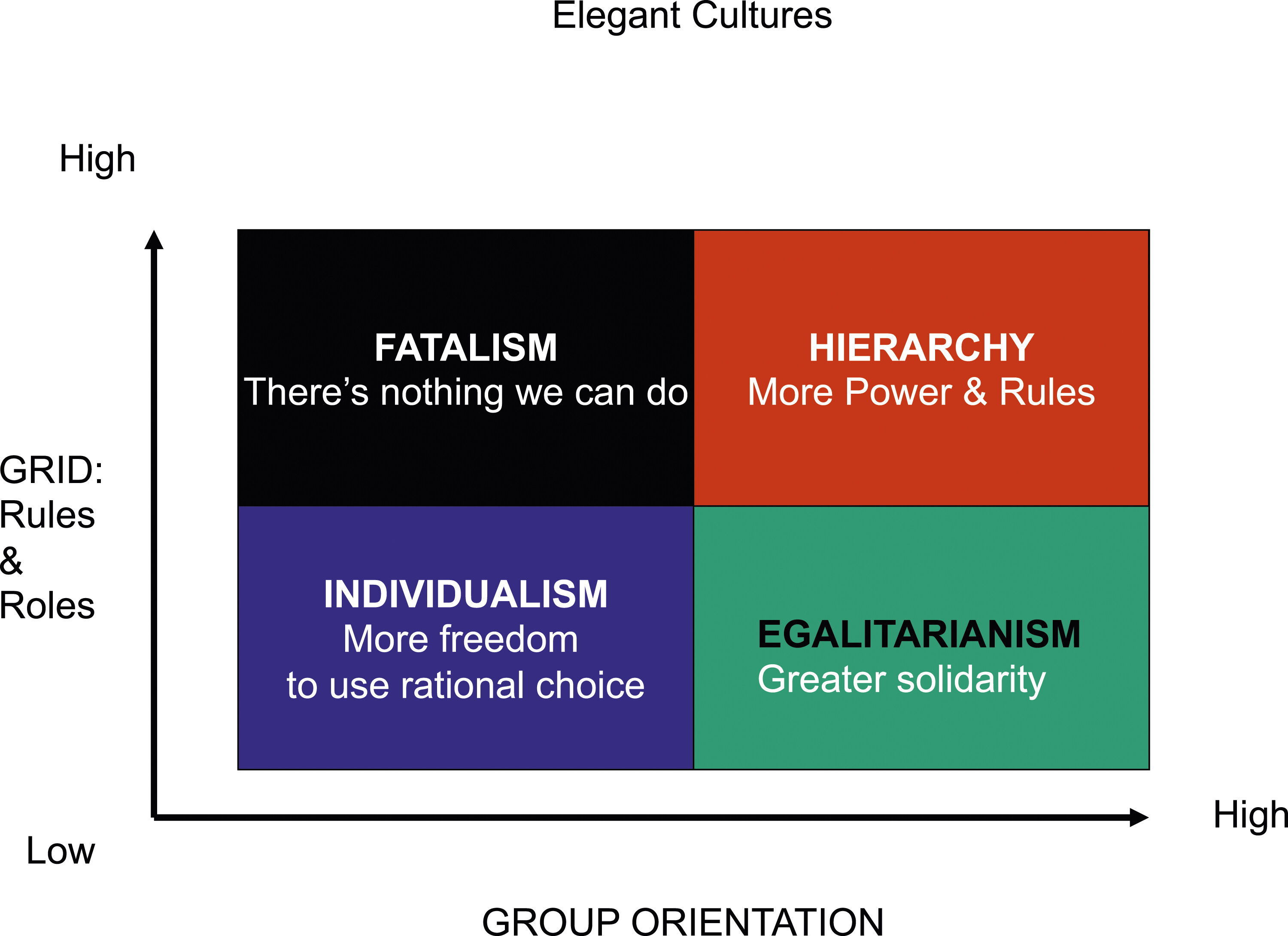
Douglas suggested that we could capture most cultures on the basis of two discrete criteria: Grid and Group. Grid relates the significance of roles and rules in a culture – some are very rigid – such as the military - but others are ostensibly loose or liberal – such as a protest group. Group relates to the importance of the group in a culture – some cultures are wholly oriented around the group – such as a cult - while others are more individually oriented – such as a meeting of entrepreneurs. When these points are plotted on a two by two matrix the following appears see
Figure 1.
Where a culture embodies both High Grid and High Group, we tend to see rigid hierarchies, such as the police. Where the culture remains High Group oriented but lacks the concern for rules and roles in Low Grid, we see Egalitarian cultures, such as trade unions. Where there is a Low Grid, Low Group situation, we have the land of Individualism – the land of entrepreneurs; and where we have High Group but Low Grid, we have Fatalism, where the population feels the rules are against them and there is no Group to save them. Over time, Douglas argues that these cultures become ‘Elegant,’ by which she means internally coherent explanations of the way the world works, and though she insists that these are just heuristic projections – and therefore many organizations sit between and across these cultural boundaries – there might well be a predominance of one particular culture in many organizations. This implies that Elegant Cultures are congealed around the core requirements of the organization, so that, for instance, the hierarchical culture of the police and the military are appropriate for resolving their proliferation of Critical and Tame problems but inadequate when it comes to addressing Wicked problems that require a more collaborative approach. Similarly, Egalitarian Cultures, such as allegedly exist with educational establishments, are viable for addressing problems that demand collaboration but poor when the demand is for decisive Command. Individualist Culture, on the other hand, is great for establishing high levels of innovation but not great when either employees need to work collaboratively or an individual needs to take overt control. In effect, all three Elegant Cultures (Individualist, Egalitarian and Hierarchical) are unable to address the complexity of issues where the problem demands high levels of individualism, group cohesion and rigid compliance simultaneously. Fatalists, on the other hand, have given up.
So, the problem is the cultural boundaries that facilitate the resolution of Tame and Critical Problems but simultaneously inhibit an effective response to a Wicked Problem that requires the techniques associated with all three Elegant Cultural types (not Fatalism). For that we need to understand how we can work across the boundaries and generate what the literature refers to as a ‘Clumsy Solution’ (
Verweij and Thompson, 2006). It is ‘Clumsy’ because it transcends the neat boundaries of the Elegant Cultures but that also implies that the ‘solution’ might be better rather than the best, and the problem might just be ameliorated, rather than resolved. In short, we are looking at an agonistic response where counter-intuitive, partial, and proto-typical ideas might need to be adopted, recognising that, since we cannot know the answer to a Wicked problem (if we do it isn’t a Wicked Problem), what we are about to do might not work either. And that means we have to be tolerant of failure and error, indeed, we have to acknowledge that, just as science progresses through the recognition of error rather than truth, what we are about to do ought to be small scale, local and reversible.
If we apply the model to Climate Change, then we can start by acknowledging that the Fatalist camp has either adopted an approach that undermines attempts to address the problem or effectively given up already. For the former, the deniers, there is often a pernicious link between supporters of carbon extraction companies and right wing politics: for example, Texas and Florida seem to be engaged in a constant attack upon the renewable energy industry, while Ohio has a proposed law which lists climate policies as a ‘controversial belief or policy’ that means universities cannot teach their students in this area. If successful these policies will worsen the environment, which will lead to greater instability in the world which will, in turn, cause the deniers to double down on the inevitable increase in migration and generate even greater political and environmental problems (
Monbiot, 2023). Similarly in Britain, in August 2023, the Environment Agency announced that, since it was no longer bound by The Water Framework Directive (WFD) – European Union legislation – that required annual checks, it would delay the monitoring of British rivers, lakes and coasts for 6 years. In 2019, the last assessment, only 14% of rivers were in good ecological health.
9For the Fatalists who have given up, who believe they have no agency, the rules prevent them for engaging with the problem and, since the collective offers little support, there is no point in expending energy to save the world; better to just either ignore the whole thing or carry on as before or even live as if the world is about to implode because there is nothing that can be done. The latter response is perhaps best captured in Neville
Shute’s 1957 novel
On the Beach10 set in Melbourne in 1963 after a nuclear war in the Northern Hemisphere where the radiation is slowly approaching and there is no possibility of surviving. In response, some of the Australians commit suicide, some devote their remaining time to partying, and others undertake dangerous car racing. A different approach to an approaching crisis is represented by Simone Weil, the French philosopher, who embodied the problems the French faced under occupation by the Germans in the First World War. As a six-year-old girl she refused to eat sugar in solidarity with hungry French soldiers. We might not feel emboldened enough to replicate her sacrifice, but we do need her kind of inspiration right now (
Toh, 2023). What fatalists need more than anything else is to regain some semblance of agency – the recognition that we can make a difference, however small (
Doron and Wallis, 2014).
Part of the issue here is the way we configure time. People that experience catastrophic events, such as floods or fires, understand such phenomena as located in the present, whereas those who claim to be unaffected by climate change, regard such dangers as located sometime in the distant future. In short, by considering the time between now and ecological catastrophe as linear we push the problem away for another generation to address, but if we configured time as cyclical, then we could denote the actions we need to take now, before it is too late in the cycle to act because the cycle will return sooner than you think. The evolutionary bias towards an immediate, over a long term, threat (job loss today over ecological disaster in 2050) might work in favour of engaging with climate change. For example, Australian data suggests that 88% of those directly affected by bush fires were either ‘very’ or fairly’ concerned about climate change, but, even then, 12% did not connect such personal disasters to climate change.
11 That 12% probably includes the Australian government which, after the warmest winter on record in 2023, approved three new coal projects the same year, the last of which came a week after the Climate Minister, Chris Bowen, said that Australia ‘was delivering real action on climate change.’ (Quoted in
Butler, 2023). It needs to, Australia has the highest per capita CO
2 emissions from coal in the G20 (China is the biggest emitter in absolute terms but third on a per capita basis) (
Morton, 2023).
In short, many of us are very good at avoiding things we think are beyond our control or beyond our understanding or worry that we couldn’t cope, so we just deny their existence.
Clayton and Karazsia (2020) suggest, there is often an emotional response to climate anxiety, but that does not necessarily translate into a behavioural response. As
Clayton and Karazsia (2020) argue, ‘You might think the scarier it is, the more we should talk about it. In fact, it’s often the reverse. It’s too scary to talk about.’ (Quoted in
Mertens, 2023) Rather like the certainty of our own demise, if we don’t talk about it, then maybe it won’t happen. This is an important point: the possibilities of ever achieving a consensus over a Wicked Problem are minimal, so we need to act in the absence of a consensus but in the presence of a majority. But that has a flaw linked to the nature of danger and responsibility. So, we know, for instance, that Wicked Problems require us all to take collective responsibility but simultaneously groups displace responsibility. Thus, the clear and present danger of lung cancer might deter individual smokers, but climate change is a collective, and configured as a distant, danger, and we are just as likely to free ride or simply ignore the problem. Indeed, as
Solnit (2023) suggests, the ‘deniers’ lobby seem to have been displaced by the ‘doomsters’ lobby, but there is politics at work here, for the doomsters represent the very interests that seek to gain from the continued burning of carbon, so they are ‘self-interested fatalists’ rather than traditionalist fatalists in the Neville Shute camp.
12 Indeed, according to
The Wall Street Journal, Rex Tillerson, Exxon CEO, while admitting publicly in 2006 that burning fossil fuel contributed to climate change, in private he and the leadership team sought to find ways to reduce public concerns and undermine scientific findings (
Matthews and Eaton, 2023).
13 Moreover, as Solnit notes, positive climate news does not make for dramatic news media stories, and however much despair is a legitimate emotion, it is not a legitimate form of analysis.
People assume you can’t be hopeful and heartbroken at the same time, [but]… of course you can. In times when everything is fine hope is unnecessary [as is leadership]. Hope is not happiness or confidence or inner peace; it’s a commitment to search for possibilities… Some days I think that if we lose the climate battle, it’ll be due in no small part to this defeatism among the comfortable in the global north, while people on the frontline communities continue to fight like hell for survival. Which is why fighting defeatism is also climate work.’ (
Solnit, 2023)
For Hierarchists, on the other hand, the solution has to be rule based and collectively enforced. In effect, we need to pursue the carbon emission limits from the various COP meetings and government standards, and rigorously enforce them by punishing those who break them. Here we might foresee the rise of more nuclear power plants protected by military police as the governments of the world centralise the ‘solution.’ But the larger problem is that the COP agreements appear to have made little difference to the global carbon dioxide emissions and the targets are essentially voluntary for each state; there are no penalties for missing the targets. Yet the Intergovernmental Panel on Climate Change (IPCC), the UN’s climate science body, has warned that CO2 emissions will need to fall by 45% by 2030 to keep the global temperature rise below 1.5 °C.
For Egalitarians, the COP rather misses the point because the solution will not come down from political leaderships but bubble up from local community groups and regional bodies taking action into their own hands, decentralising control, and encouraging communities to be more self-sustaining and resilient. In short, climate change is not ‘their’ problem, its ‘ours.’ Luxembourg, for example, has made its public transport system free to use, plus the trams have priority over cars in the city centre. But that has required significant financial support from the government and is just one of a package of measures designed to reduce carbon emissions, including investing €500 per citizen on the country’s railway system (
Brown, 2023)
While state-led and citizen-supported schemes sit within the Egalitarian mode, the Individualists proclaim a different set of solutions. Under this approach the combination of innovations in technology, set free within a competitive market, will come to our collective rescue. That might be through extracting CO
2, such as the Direct Air Capture technology built by Carbon Engineering
14 designed to fill the spaces left by oil and gas extraction with CO
2, and the Carbfix and Climework’s Orca system in Iceland that turns CO
2 into stone.
15 Moreover, only around 0.04% of the atmosphere in composed of CO
2 so the technology to remove that will be incredibly expensive. One other alternative – solar radiation modification (SRM) – involved pacing tiny reflective particles, or huge mirrors, into the atmosphere to reflect the sunlight, but that would do little for carbon reduction, even if it might cool the earth in some indeterminate – and possibly dangerous – way (
McKie, 2023: 10). But all these tend to be extremely expensive and dependent upon huge financial subsidies from government – they are not the spontaneous work of markets.
Individualists are usually wedded to such a market philosophy, so are there examples where the market might work to encourage people to acknowledge the impact of climate change? Perhaps Florida can provide an illustration of this, because it is becoming increasingly difficult for people to insure their homes against hurricane damage there, and six insurers went insolvent in 2022 with more pulling out of the home insurance market altogether in certain ‘at risk’ areas.
16 House insurance in the state in 2023 was three times higher than the national average and has forced many Floridians to face the climate crisis head on (
Otte, 2023).
Clumsy solutions
If the Elegant solutions are only ever partial, what, then, would a Clumsy Solution to Climate Change look like? In theory it would be some form of combination of all the Elegant approaches, so that implies Wind and Solar Farms, and a drastic reduction in the use of transport using ICE (internal combustion engines) – unless they adopted synthetic and carbon-free fuels such as the eFuel developed by Porsche.
17 But it also means decentralising societies, making them more resilient as well as carbon-neutral, and addressing the penalties for those who continue to break the emission rules, and preventing new oil and gas exploitation. This ‘hotpotch’ of policies looks increasingly untidy, indeed it appears positively agonistic and full of tensions and contradictions, but that really is the leitmotif of Clumsy Solutions: they do not have the elegance of single mode solutions and reveal an array of untidy ideas that may not sit together in any kind of rational model. Moreover, Clumsy Solutions require decision-makers to engage all three decision-modes: Leadership, Management and Command, because leadership, defined here as getting the collective to act even when they may not want to hear bad news, is necessary but insufficient. For example, the consequence of organizations, groups and individuals refusing to cooperate in addressing climate change implies that the coercive acts of command will be required. Since Wicked problems are moving targets, governments may start out asking us to help by driving slower, eating less meat, and minimising flights, but if that fails then they may well end up prohibiting us from driving, banning meat consumption, and grounding aircraft.
One prerequisite for change might be to accept that what we have currently tried is not working, or at least not working fast enough, so we need to try something else, and now. We also know that a major difficulty for trying to engage people in action against Climate Change is their inertial resistance. In short, if relying upon the state is necessary but not sufficient for addressing the problem, how do we engage the majority – noting that it is always unlikely that we will ever achieve a consensus and hence why this should not be a target – and why coercing a recalcitrant minority may well be necessary. For instance, in June 2023, 59% of voters in Switzerland (whose glaciers lost a third of their ice between 2001 and 2022) supported a bill to cut fossil fuel use and reach net-zero by 2050, but a substantial minority supported the opposition of the Swiss People’s Party, a right-wing which insisted the bill would push up energy prices – and that was more important than climate change (
BBC News, 2023). So, what does make people change their minds when faced with these kinds of Wicked problems?
We might turn the clock back to two different times to consider this. First, the recent Covid pandemic showed that most people (though never all the people) were willing to take the necessary precautions, wear masks, and get themselves vaccinated, if they were persuaded by their government and their media that the danger was real and immediate, and if the punishments for breaking the laws and regulations were considered appropriate. In the USA, for example, the National Bureau of Economic Research (NBER) suggests that once vaccinations were made available, the excess death rate for Republican voters was considerable higher – almost double - than it was for Democrat voters, and this is probably a consequence of the scepticism generated by Trump and senior Republicans (
Wallace et al., 2022). Were Covid to return, given that several British politicians (including ex-prime minister Johnson and current prime minister Sunak) were fined for attending illegal parties, it is not self-evident that the mass of the British people would be quite as compliant as they were between 2020 and 2022.
The second time travel case comes from the Second World War. It is noticeable that widespread French and Dutch resistance to Nazi occupation only really began when compulsory labour was adopted. In other words, once the countries had formally surrendered, it was only a small minority that engaged in acts of resistance – until a large proportion of the population was suddenly subject to forced removal to Germany. This is an important lesson for explaining the lethargy with which many people seem to consider the dangers of Climate Change: not until it materially affects them will large numbers of people get on board. That change in both countries was then compounded by the resistance movements who began to expand their attacks upon Germans and collaborators – despite the asymmetrical retributions that was imposed on the local populations as a consequence. In sum, what the resistance movements did was remove the possibility of sitting on the fence and waiting to see which way the wind blew. We might be tempted to ally ourselves to the Nudge theorists (
Thaler and Sunstein, 2022) to accomplish a change in behaviour, but though it might be appropriate for small-scale changes in behaviour, it is not at all self-evident that nudging people can address the radical dangers implied by a catastrophic climate change; we don’t need nudging, we need a kick up the backside and a systemic redirection.
Part of that shock should be linguistic because it’s through language that we understand the world; in short, language doesn’t reflect the world, it constructs it. For example, in English we talk about ‘sunrise’ and ‘sunset,’ but these terms are inaccurate – the sun does not rise or set, rather, the earth rotates so that the sun appears to move but it is us that are moving. This geocentric model is partly a result of the language predating the heliocentric work of Galileo, but it’s also an element of an anthropocentric perspective that sees humans as the most important entity in our world. It is, therefore, important to understand how our language of climate change operates to stymy moves to address the problem. We can start by noting how seriously the opponents and sceptics of climate change take the issue of language: ExxonMobil, Royal Dutch Shell, Chevron, BP, and Total (five of the largest fossil fuel companies) spent $1bn on lobbying and communications in the 3 years following the Paris Agreement in 2015 in their attempts to challenge the agreement.
18 In contrast, the environmental lobby either uses ‘global warming’ – which sounds good for those stuck in cold places, or ‘climate change’ – but then we are back to evolutionary time scales and thinking about glacial developments over eons. In fact, the shift from ‘Global Warming’ to ‘Climate Change’ did not come about because the environmental lobby wanted to prevent people using atypical cold spells as arguments against warming, but because in 2003 Frank Luntz, adviser to the Bush administration, suggested that using the term ‘Climate Change’ was ‘less frightening than “global warming”’ (Quoted in
Lakoff, 2010: 71). Even the rather better ‘Climate Justice’ doesn’t work because people don’t know what justice actually means in this context (
Freedland, 2023).
If we focus on the success of the Brexit campaign to take the UK out of the EU, the most startling thing was the simplicity of the slogans used to encapsulate the entire programme of radical discontinuity: ‘Take back control,’ ‘Get Brexit Done’ and ‘Brexit means Brexit,’ won out over the reams of economic statistics that the Remain campaign used to warn the Leavers of what would – and indeed did – happen. This is because it’s narratives that persuade people, not numbers or ‘facts’, and that’s partly why ‘1.5 C’ rise doesn’t do anything (
Lakoff, 2008). When we think back to Barack Obama’s first Presidential electoral victory, we might recall the ‘Time for a Change’ slogan, which was sufficiently broad to include everyone fed up with the status quo, and yet suitably nebulous to stop critics complaining about the lack of specifics. So, what would the equivalent be for those trying to halt the rise of carbon dioxide and consequently temperature? A ‘Climate Emergency’? ‘Stop Burning the Earth?’
Is part of this problem also the incremental nature of nudging people? In other words, do we need to embed radical not evolutionary changes? After all, we know that Hitler and the Nazis achieved an elected dictatorship in Germany not by storming the Reichstag overnight but by incrementally – and ‘legally’ - removing all opposition over a period of months. Or as, the character Mike Campbell says in Hemingway’s
The Sun Also Rises (
2004: 119) in response to a question from Bill about how he went bankrupt, ‘Two ways.’ Mike said, ‘Gradually, and then suddenly.’ Punctuated Equilibrium Theory (
Gould, 1982), replicates this and implies that change across many areas of life is often linear and incremental for long periods, then a short and radical disruption occurs – and it may well be that this pattern is emerging in the climate.
It is self-evident that part of the problem is the ever-increasing consumption generated by constant growth, so is ‘green growth’ heralded by the White House the answer, or should we face a different truth, look at the rapidly impending disaster developing before us, and accept ‘no-growth’ or ‘de-growth’ is the only answer? (
Saito, 2023).
Raworth’s (2022) doughnut in her book,
Doughnut Economics, represents a symbolic economy where the outer ring is the ecological limitation – beyond which we damage the environment - and the inner ring is the social foundation – below which people do not have the requisite material goods to live. This symbol is important because in her approach, ecological problems cannot be addressed without simultaneously addressing social problems. Providing we keep to her three premises (a fair distribution of wealth that requires radical changes to inequalities, a regenerative approach to resources, and a system that facilitates the prospering of citizens) we can address the environmental problems, yet none of this depends upon economic growth – though Raworth regards herself as ‘agnostic’ on growth per se; it’s more to do with the pursuit of prosperity than the lust for growth in and of itself. However, it does depend upon reframing the problem and starting to change in small scale and innovative ways, as represented in her social enterprise
Doughnut Economics Action Lab.
19 Furthermore, we should acknowledge that the debt traps that many poorer nations of the south find themselves in, effectively coerce them into investing in, and relying on, fossil fuels. For instance, Mozambique fell into a debt crisis when oil and gas prices fell in 2014–16 and the only way to repay the debt was by investing in further gas revenues. Only debt cancellation can really address this (
Ahmed, 2023).
For all the value of doughnut economics, one of the pragmatic problems it faces is its own optimism bias, the assumption that we can persuade people to change without coercion, which is ironic given that perhaps the greatest difficulty inhibiting progress towards addressing the ecological crisis is the persistence of optimism bias amongst so many people. So how do we get people to recognize an impending crisis when they can blithely ignore all the data and continue to live in what appears to be a world hermetically sealed off from reality? The study of optimism bias suggests we have an uphill struggle here. From
Collinson’s (2012) work on ‘Prozac Leadership’ – where the leaders only ever receive good news – to Just World Theory (the belief that the world is fair, so the morality of our acts determines our future) – and the related denial about the likelihood of being the victim of a crime (
Chapin and Coleman, 2009), such biases operate to both protect us from despair but insulate us from reality. Moreover, the cognitive bias can derive from different sources – a tendency towards narcissism, an impaired understanding of risk, a belief in fatalism, or a simple refusal to face reality. And the further bad news is that altering optimism bias is extraordinarily difficult – unless those under the illusion actually experience a contrary reality (
Helweg-Larsen and Shepperd, 2001). Indeed,
Gregersen et al. (2023) suggest that it’s anger that motivates people to engage in climate activism, not hope – which was cited seven times less by those surveyed.
Another way of putting this is to reframe the risk and turn it from one defined by the costs of doing something, like abandoning ICE transport, to one defined by the counter-risk of not doing something. In short, to remind people that the decisions we take are always dual, not just what we do but the opportunity cost of not doing something else. We might not all appreciate a steady flow of migrants and refugees into our countries (even if the tight labour market requires them (
De Haas, 2023)), but unless we sort out the climate that flow will undoubtedly increase. Furthermore, we know that many people are unwilling to engage in any kind of radical change because the risk to their own lifestyle is significant. Yet we also consistently overestimate the actions we do take and underestimate the actions we don’t. After all, we know that the kind of green action most people are willing to take – and the kind that they think is the most important in resolving the crisis – is recycling their rubbish, which saves about 0.2 CO
2 tonnes per person per year. Yet this is one of the least important actions, whereas the most important acts, such as having only one child (58.6 CO
2 tonnes saved per person per year), or not having a car (2.4 CO
2 tonnes saved per person per year), or not flying long distance (1.6 CO
2 tonnes saved per flight), are the things most people are least likely to do. Yet we write these off as the least important things, perhaps as a way of rationalizing their own decisions.
20This is critical because unless we can work out why people don’t engage with Climate Change then we can’t really establish what might work. We know, for instance, that some would argue it is simply some form of hegemony or false consciousness that explains the refusal to engage with the issue, and that might relate to the well-known Dunning-Kruger (
Dunning, 2011) effect, which argues that oftentimes those most ignorant of something are those most confident in their predictions about it. But there is more to this problem than simply ignorance. As
Bovensiepen and Pelkmans (2020) insist, much of this material implies assumptions of rational individual actors versus socially embedded actors, whereas what they call the ‘Anthropology of Ignorance’ exists along a spectrum from the purposive production of fabricated information to confuse or constrain the subject population, to the functional elements where actors or cultures generate ignorance to protect themselves from the deleterious consequences of the truth. In law, so-called ‘Wilful Blindness’ occurs when someone consciously avoids seeking information in order to avoid culpability and was initially defined in the 1976 US V Jewell case, where Jewell claimed he did not know that the car he drove across the Mexican-US border contained 110lbs of marijuana, despite being paid a large amount of cash for the job. As the court ruled, ‘deliberate ignorance and positive knowledge are equally culpable.’ (Quoted in
Bovensiepen and Pelkmans, 2020: 391) This does not mean we are completely free in our decision-making because we are all constrained by social and material forces, but we still remain ultimately responsible, however constrained our choices (see
Heffernan, 2019). Thus, just because people work in oil and gas companies does not mean they are unaware of the medium and long term dangers their actions impose on their own children and societies, but they choose to focus on their own short term benefits and persuade themselves of the inevitability of their own constrained decisions (
Rajak, 2020).
This denialism is not restricted to environmental catastrophe but is, of course, a common trope amongst those who deny the fairness about the 2020 US Presidential Election or the viability of vaccines. But we also know that the regurgitation of The Lie, whatever it happens to be, is more a test of loyalty to a specific identity than it is about the truth, so pointing out irrefutable truth does not break the cycle because it isn’t rooted in truth, it’s all about the demonstration of loyalty to, and acquisition of, an identity. In short, we are unlikely to change the minds of climate deniers by swamping them in data, but we might if we can generate a different identity for them to construct (
Pomerantsev, 2020).
We might also consider whether those climate activists that are trying to mobilize people to act are engaging in the most effective strategies? For example, do the actions of Just Stop Oil in interrupting traffic or national events by glueing themselves to roads or distributing orange confetti, lead to increased understanding of the problem or support for the cause, or do they generate hostility and compound the problem? The answer seems to be the latter, because, for example, although 58% of British people polled by ‘More In Common’ said the climate movement had their support (34% who said it did not), 72% said its protests – including Just Stop Oil - went too far (
Crerar, 2023). In short, the acts of activists might need to be more targeted at the problem, not the symptom. We could, for instance, note how inconvenient rail strikes and blockages are to the travelling public, especially since public transport is something to be encouraged. But in Sydney and Brisbane 2017 and Okayama in 2018, bus drivers took industrial action by continuing to drive but not taking any fares, effectively hitting the bus companies’ profits, not the bus passengers (
Larsson, 2018). In sum, direct action needs to be properly directed if it is to generate support for the cause, not antagonize potential supporters – as better demonstrated when climate activists blocked all the entrances to Citibank’s HQ in New York on 14 September 2023.
21In contrast,
Fritz et al. (2023) suggest that the ‘Fridays for Future Climate’ strikes, initiated originally by Greta Thunberg and later adopted by over 4 million students in 150 countries, did have some impact. For example, 30% of Swiss citizens claimed that the strikes not only influenced the way they thought about the climate but had a measurable impact on their behaviour, including changing their modes of transport and purchasing habits. Those most affected also had higher levels of education and were already sympathetic to the environmental situation. In sum: the leadership of change is possible, but note that the majority have not been persuaded to change by the strikes, and a minority of these will probably never be persuaded – and that’s why we need to retain the coercive arm of command because ultimately force may have to be used to protect the planet and avoid the nightmare scenario outlined in
Maslin (2021).