Intended for healthcare professionals

Abstract

Outside School Hours Care (OSHC) settings are a site of play, leisure and learning for approximately 560,000 Australian primary-age children per day. Despite its importance, OSHC has not been included in school-based gender equity initiatives like Safe Schools and Respectful Relationships programs. OSHC has a curriculum framework, My Time, Our Place, Framework for School Age in Australia, but it offers little guidance to educators who want to support gender equity in their programming. This article presents initial findings from the first Australian research to investigate programming for gender equity in OSHC. It investigates the complexities of how educators attend to gender in their work. In OSHC and Australian culture, normative discourses and stereotypes about childhood and gender constrain contemplation that gender might be considered in play-based settings like OSHC. This article aims to open a discussion on gender equity in OSHC and how it might be better supported.

Introduction

Outside School Hours Care (OSHC) settings are a significant site of play, leisure, care and learning for approximately 560,000 Australian primary-age children, aged 5–12 years, per day (Australian Children’s Education and Care Quality Authority [ACECQA], 2024a). Despite its importance, OSHC is often forgotten or an afterthought in Australian policy development (Cartmel & Hurst, 2021). OSHC sits in an interesting space-place in Australia, often physically onsite at a primary school or at least in close proximity, but within a funding and policy context it is situated under the auspice of early childhood. OSHC curriculum is largely play-based and has a curriculum framework, My Time, Our Place (MTOP v2.0), Framework for School Age Care in Australia 2.0 (Australian Government Department of Education [AGDE], 2022) that aims to guide the development and implementation of quality curriculum and pedagogy to support children’s engagement with learning and development, and build wellbeing, a strong sense of identity and connection to people and place . In the 2022 update of MTOP v2.0, gender identity development and gender equity became more explicitly present in the document. The role of educators in supporting constructions of gender identity and promoting equity in programs was evident:
Relationships are the foundations for the construction of identity – ‘Who I am’, ‘How I belong’ and ‘What is my influence?’ Educators are culturally responsive in assisting children and young people to explore their cultural, social, gender and linguistic identities (AGDE, 2022, p. 34).
This has opened up interesting possibilities for how OSHC educators might support gender equity in their settings, and what it mean to translate these policy imaginings into everyday practice. This paper reports on an Australian study that explores how educators understand gender identity and equity and their role in developing curriculum and pedagogy to support this.

Background

Australia has had after school activity programs for primary age children for over 100 years, with the form and content of those programs changing over time (Cartmel, 2007). As government has become more involved in its funding and monitoring, OSHC has been subject to a series of policy reforms that had placed increasing regulatory and administrative requirements on operators. In 2009, OSHC was subject to arguably the most significant change in how it was conceptualised and practised when it was added to the Australian Government’s National Quality Framework (NQF) (AGDE, 2025). The NQF introduced a suite of national policy interventions including My Time, Our Place (AGDE, 2022). The implementation of the NQF was the first time that OSHC was positioned and recognised as a site where practitioners make purposeful decisions that contribute to children’s education (Cartmel & Hurst, 2021).
MTOP is a significant influence on educators’ curriculum decisions. A review and update of MTOP commenced in 2021 with My Time, Our Place v2.0 released in 2023 (AGDE, 2022). One of the changes in MTOP v2.0 was increased attention to children’s gender identities, something that was identified in the literature review informing the update (Barblett et al., 2021). MTOP v2.0 now includes 8 specific references to gender. Whilst these inclusions appear minor, the revised framework now provides examples of practice that support children’s gender identities, something absent from the first version (AGDE, 2022). These changes have helped to create a space for conversations about the possible place of gender equity in OSHC pedagogies, a dialogue that rarely took place previously. It is this context that informs this research. Now that it is ‘okay’ to talk about gender in OSHC curriculum, this research seeks to understand better the role that gender currently has in OSHC practice.
Whilst having a dedicated curriculum is important for OSHC, the limitations of its reach and effectiveness need to recognised. MTOP is not intended to be prescriptive. It provides broad principles that are intended to inform practice but leaves the question of how to enact those principles up to individual practitioners (Hurst, 2017). The framework provides some practice examples but these are limited given the scope of MTOP. Consequently, how or whether practitioners incorporate gender in their curriculum is uncertain.
Complicating the situation further are the realities of the Australian OSHC workforce, which has low social and political status, is highly casualised and poorly paid (Cartmel & Hurst, 2021; Hurst et al., 2024). The majority of OSHC practitioners are employed in part-time and casual roles. In 2021, 66% were employed for no more than 19 hours per week and only 11% had full time employment (ACECQA, 2024b). A significant proportion of workers are tertiary students with 17.4% studying for a bachelor-level degree and not having completed a qualification (Australian Government Department of Education and Training, 2017). This suggests a workforce that is transient and patchwork (Cartmel & Hurst, 2021; Education Services Australia, 2021; Hurst et al., 2024).
Such a diverse and eclectic workforce has implications for how educators attend to gender equity. The broad range of qualifications and histories makes it almost impossible for practitioners to have a shared understanding of what gender equity is, and how it might be addressed. Additionally, the vocational nature of current OSHC qualifications do not lend themselves to the teaching of feminist and poststrucutural feminist theories that inform many contemporary approaches to teaching gender equity.

Gender Equity and Primary School Aged Children

Children aged 5–12 years have increased participation with people, places and spaces in educational institutions, sporting and recreational organisations, social media and popular culture. In these spaces children are continually encountering, navigating, negotiating and resist diverse gender discourses and identity politics. Nayak & Kehily (2008) explain that many studies in the past 20 years continue to report that most students in the primary school years describe their gendered selves in binary, heteronormative cis-gendered categories of boy/male and girl/female. Research also highlights that students police children’s gender performances and reinforce gender norms when transgressed through peer pressure (Wardman, 2017). Neuroscience has added to what Wardman (2017) explains are discourses embedded in “’truths’ about the gendered subject’s capacity for responsibility” (p. 803). Here masculine and feminine traits and behaviours are rationalised within biological determinist discourses where claims that boys are biologically noisy, aggressive and unable to sit still.
While there is little published research about gender and OSHC in Australia or internationally, there has been a large body of research literature that has explored how gender has impacted on engagement with curriculum such as science, maths and physical education in primary school (Cárcamo et al., 2021; Mejía-Rodríguez et al., 2021). There has also been research that has investigated gender and school achievement (Ayuso et al., 2020). In more recent years there has been three further branches of exploration in regard to gender and primary school children, firstly how children and teachers explored gender and identity in and out of the classroom (Davies & Banks, 1992; Paechter & Clark, 2007; Skelton et al., 2009); secondly, respectful relations curriculum (Cahill & Dadvand, 2021, 2022; Cahill et al., 2019; Molina et al., 2022); and finally how to create inclusive and supportive environments for children identifying as trans gendered, gender diverse or gender expansive (Neary, 2021; Renold, 2000). This research, although about the same cohort of children provides little insight into the practice in the OSHC settings.
We are in a time and space where anti-gender discourses and cultural wars play out in social media which infiltrates institutions such as education that attempt to silence exploration of gender identity beyond heteronormative cis-gender discourses (Butler, 2024). Reinforced by old tropes of social construction, corruption of innocent childhoods and the destruction of family values. OSHC is an interesting space that offers gender equity possibilities with the guiding framework and is not constrained by a mandated curriculum like primary schools. OSHC is often seen as a space floating between the early childhood education space and schools with a lack of government understanding or attention. However, we wonder if it is a site of political gender possibilities. It is for this reason that we wanted to explore what OSHC educators current understand about their role in supporting gender equity in their programs and the gender pedagogies that they develop and implement.

Research Design

Given the lack OSHC research and particularly gender research in this setting, this project was conceived as a first step in beginning to better understand how OSHC educators think about gender equity and some of the ways they attend to gender equity in the planning and delivery of programs.
The research questions for the project were:
What attitudes do OSHC educators have towards children and gender?
What attitudes do OSHC educators have towards gender equity and its role in OSHC curriculum?
How do OSHC educators attend to gender equity in their planning and delivery of OSHC curriculum?
To explore these questions a qualitative mixed methods online survey was developed. The survey had 60 questions that covered the following key areas:
• Attitudes to how children’s gender identities are formed;
• Attitudes to the role of OSHC in supporting gender equity;
• How educators’ attend to gender equity in their curriculum and practices;
• Educators’ confidence attending to gender equity in their curriculum and practices.
Attitudinal questions took the form of multiple choice questions using a Likert scale. Questions about curriculum and practice used both multiple choice and open-ended, written responses. It was hoped that the open-ended questions would provide insights into what was expected to be a wide range of curriculum approaches, reflective of a variety of attitudes to gender, qualifications and diverse settings. It was also hoped these responses would provide some knowledge on the sorts of barriers that can limit how educators attend to a sensitive issue like childhood and gender.

Recruitment and Participants

Participants were recruited through two main sources. Peak OSHC representative bodies in all states and territories were asked to promote the survey to their members. In addition, the survey was promoted on three social media groups operated by OSHC educators with members from across Australia. The survey was open throughout February and March 2024 to allow peak bodies time to communicate with members. The project had ethics approval from The University of Melbourne Office of Research Ethics and Integrity, Reference Number 2023-27225-47738-3.
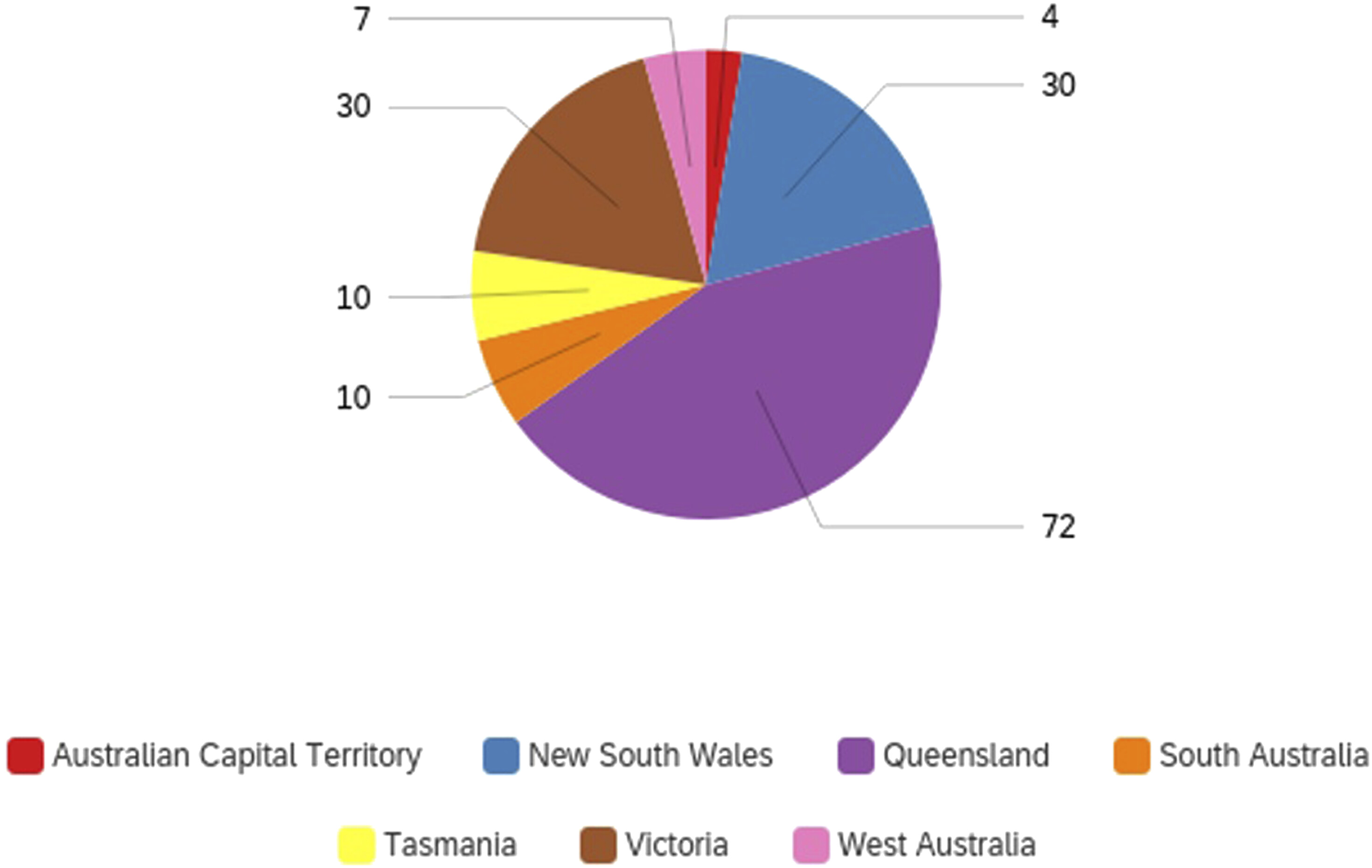
A total of 163 individuals from all states and territories except the Northern Territory completed the survey (Figure 1).
Figure 1. Survey Participants by State/Territory
The highest number of participants were from Queensland (n = 72), New South Wales (n = 30) and Victoria (n = 30), which is unsurprising given that those three states have the largest numbers of OSHC services. The majority of participants came from urban areas (n = 144), with few (n = 17) identifying as being from rural or remote locations.
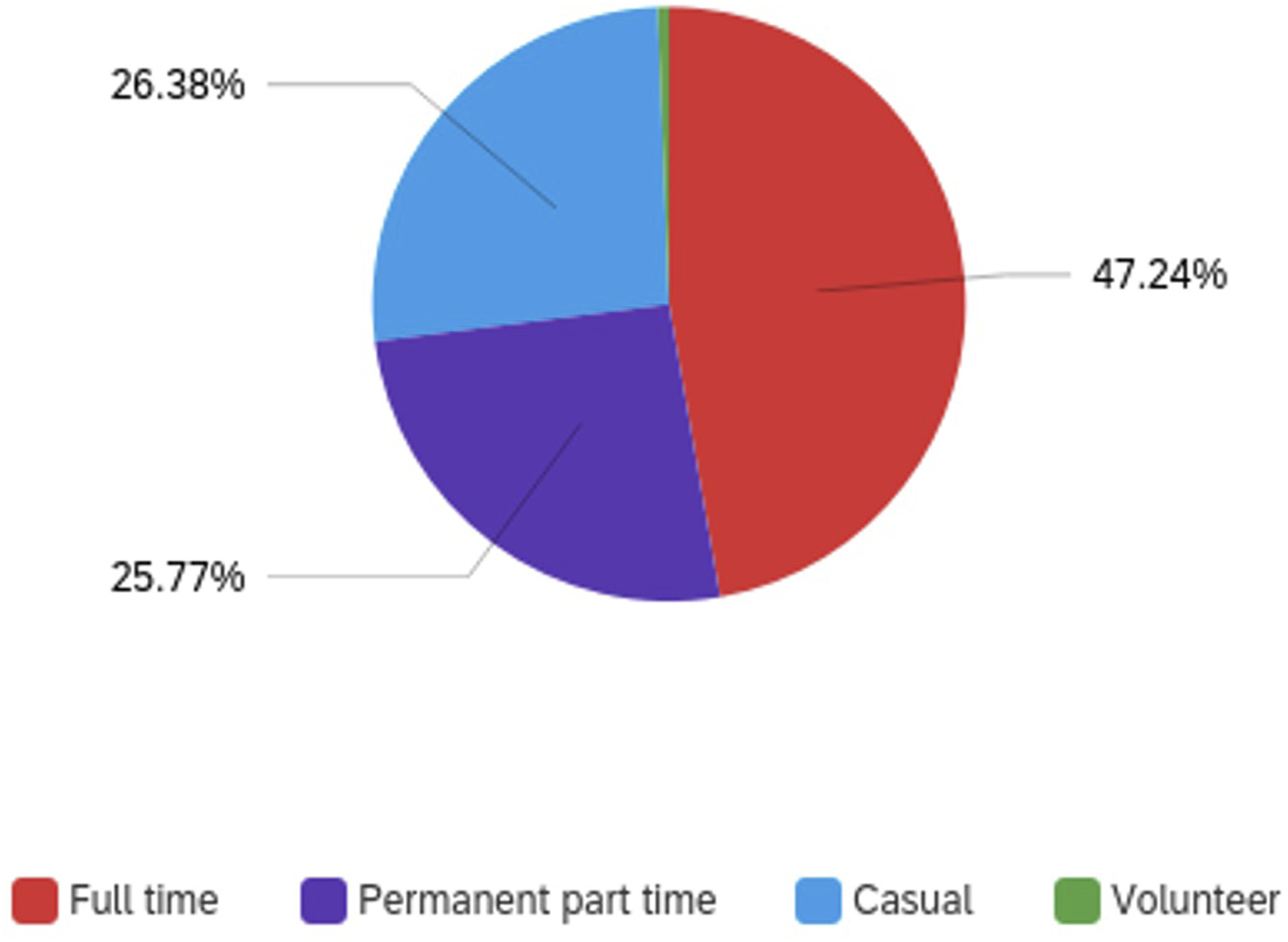
Participants worked in a range of roles, but most were in leadership roles with higher levels of responsibility for curriculum decisions such as coordinator (n = 71), educational leader (n = 19), assistant coordinator (n = 7) and regional manager (n = 13). There was a higher percentage of participants in permanent employment, consistent with the senior roles held by most participants. The majority were in full-time employment (n = 77), but large numbers also in part-time (n = 44) and casual roles (n = 43) (Figure 2).
Figure 2. Participants’ Employment Conditions
The high proportion of participants in part-time and casual work arrangements is unsurprising and characteristic of what is known about the OSHC workforce, which relies on students and other part-time workers (Cartmel & Hurst, 2021). Participants’ qualifications also reflected their relative seniority with most holding diploma (n = 69) and degree level (n = 35) qualifications. The greater representation of higher level qualifications in the sample differs from that in the broader workforce where in 2021 only 11.7% had degree qualifications and 22.3% had diploma level (ACECQA, 2024b). Participants’ genders reflected the high levels of representation of women common in early childhood education and care in Australia (McDonald et al., 2024) with 137 identifying as female, 3 as non-binary or gender fluid, and only 22 as male.

Theoretical Framework

In the analysis described in this article, we bring together critical discourse analysis and feminist theories and have utilised feminist critical discourse analysis to examine discursively produced gendered power relations (Lazar, 2007). Feminist critical discourse analysis provides ways to trace gendered discourses that are embedded in the ways we speak, act and engage with the world that produce and reproduce gendered hierarchies and inequities. Paying attention to discourse, uncovering or making meaning of the discourses that are in operation allows us to unpack or deconstruct what has come to be marked as ‘normal’ or ‘right’ in this case the normal way to be or do gender and consider what else exists. St. Pierre (2000) wrote
Once a discourse becomes ‘‘normal’’ and ‘‘natural,’’ it is diffiult to think and act outside it. Within the rules of a discourse, it makes sense to say only certain things. Other statements and others ways of thinking remain unintelligible, outside the realm of possibility (p. 485).
The feminist discourse analysis adopted in this article provides a way of stepping outside dominant discourses of gender threaded through OSHC and Australian culture. According to Lazar (2007), stepping outside gendered discourse through feminist critical discourse analysis supports us to disrupt patriarchal power and privilege noting:
The central concern of feminist critical discourse analysts is with critiquing discourses which sustain a patriarchal social order – relations of power that systematically privilege men as a social group, and disadvantage, exclude, and disempower women as a social group (p. 145).
Poststructural feminisim makes visible ‘the multiple, complex, contradictory and shifting meanings within language and how discourse come into being; how some discourses become “normal” while others are excluded’ (Przybyla-Kuchek, 2021, p. 691). In doing this we are able to disrupt constructions of educators’ gendered ideas, beliefs and practices as fixed, consistent, coherent and knowable and gain insights into the ongoing navigation and performances of identities.
We wanted to explore the gender ‘doings’ within OSHC by educators and how they saw the gender ‘doings’ of the children they worked with. We draw on Butler’s concept of performativity to understand gender as performed, relational and always in motion. West and Zimmerman (1987), ask us to consider gender as an action or movement of ‘doing’ rather than a fixed identity category writing:
We contend that the ‘doing’ of gender is undertaken by women and men whose competence as members of society is hostage to its productions. Doing gender involves a complex of socially guided perceptual interactional, and micropolitical activities that cast particular pursuits as expressions of masculine and feminine “natures” (p. 126).
In this research, we take up an opportunity presented in the curriculum framework for OSHC, which invites educators to think about and form their practices using feminist and poststructural theories (AGDE, 2022). Thinking poststructurally makes it possible to look beyond seeing pedagogical decisions as a means of developing skills, knowledge and behaviours and consider the multiple ways they are active in perpetuating gendered discourses, stereotypes and inequities.

Discussions and Findings

Our initial thematic analysis provided a first tracing of educators' beliefs about gender and the ways they thought about and enacted gender equity in their programs. In the first cut or tracings of the data we looked at the collective responses which provided a glimpse of the gender matters in the OSHC space. At a surface level, we could start to gain insight into the diverse views, experiences and pedagogies of the participants. Responses to three of these questions are summarised in Table 1. It is important to note that the number of respondents to each question varied, as some participants exited the survey prior to completion.
Table 1. Survey Responses to Attitudinal Questions
 Strongly agree %Somewhat agree %Neutral %Somewhat disagree %Strongly disagree %
OSHC settings influence children’s gender identities6.429.834.017.012.8
OSHC educators have a responsibility to include gender in their programming20.623.419.821.314.9
Play and leisure experiences in my service are set up in ways that support gender equity37.344.413.52.42.4
My OSHC setting is a place that supports children with diverse gender identities45.734.714.23.91.6
In one question, we wanted to understand if educators believed that OSHC settings influenced children’s gendered identities. Of the 141 participants that responded to this question, there were low levels of agreement with only 36.2% agreeing to the proposition on some level and 34% having a neutral position. Diversely, when asked whether their practices supported gender equity, responses were more positive. In response to the proposition that play and leisure experiences at their service are set up in ways that support gender equity, a much higher proportion of 81.7% of 126 participants agreeing to some degree. Similarly, 80.3% of 127 participants agreed that their OSHC setting was a place that supports children with diverse gender identities. When asked if they support gender equity through their planning and practice 81.1% of 127 participants responded yes. These responses indicate that a very high proportion of OSHC educators believe they consider gender equity in doing their work. Yet when asked if gender equity is part of their job, only 44% agreed. In the cohort of educators who responded to the survey, these responses suggest a complex mix of attitudes to children, gender and its role in curriculum, and perhaps an eagerness to be seen to be supporting gender equity.
When we began slice the data differently and looked further into the individual, qualitative responses of participants we started to see different movements or patterns. This highlighted not only the diverse beliefs, experiences and views of gender equity of the participants but also the complex, multiple and contradictory responses by individuals. This called for us to turn to feminist poststructural discourse analysis to make visible the multiple gendered discourses in operation and the ways that educators took up, navigated and resisted these discourses.

The Complexity and Multiplicity of Gender Beliefs and Practice in OSHC

Revisiting the data with a feminist poststructuralist lens, multiple discourses came to light. As suggested by St Pierre (2000) below, these discourses intersect in complex ways that reflect the unique histories of OSHC and those who work in it.
Poststructuralism suggests that life is the way it is because of accidental and unintended convergences in history; because of the arbitrary desires and passions of individuals; because certain discourses, for no particular reason perhaps, became more important than others; and because anonymous and contingent forms of knowledge have produced practices that can be contested and changed (St. Pierre, 2000, p. 493).
Not surprisingly, the discourses we identified include biological determinism, essentialism, humanism and hypermasculinities. Webb (2019) exploring the subjectivity of the individual and how they navigate within and between gender discourses noted:
Language produces the discursive possibilities of performance, at the same time as the ‘doer’ becomes an effect of language (p. 262).
Drawing from the responses to the open ended questions we examine the ways that these multiple discourses were evident in participants’ performances of gender thinkings, doings and beings.

Biological Determinism

Discourses of biological determinism played out in some educators’ responses. The notion that particular behaviours, traits and interests were inevitable and natural because of children’s biological cis-gender marking was present in the participants’ data.
Children engaging in rough [a]n[d] tumble. Boys tend to favour this play but also have an advantage over girls physically in this play. Modifications to rules supports both girls and boys playing in rough n tumble play understanding each others differences.
Biological deterministic discourses reinforce binary understandings of cis-gender male/female boy/girl categories as fixed and that children’s behaviour, choices of activities, materials and friendship groups are natural and inherent due to biology. Expansive or non-binary gender ‘doings’ are silenced or dismissed. Biological deterministic discourses are woven within and through essentialist discourses.

Essentialism

For a number of educators play and leisure was seen as value free and that children’s play choices were natural and therefore an expression of a child’s developmental needs.
We plan experiences for the children based on their interests not their gender. And everyone is encouraged to participate no matter gender.
We just program all different types of activities and children can participate or not.
Children are free to choose what activities they join in regardless of their gender.
Multiple discourses circulate around and within play and its role in OSHC to generate a perspective that children’s play is natural and that choices children made during play are an expression of biological need and therefore essential to children’s learning (Grieshaber & McArdle, 2010). It is a view of play that underpins how OSHC is imagined in MTOP v2.0.
Play and leisure form the foundation for ensuring all children and young people in all school age care settings engage in quality experiences for rich learning, personal development, wellbeing and citizenship opportunities (AGDE, 2022, p. 5).
In MTOP v2.0, children’s play choices are justified on the basis of play being a right and an expression of their agency and citizenship. This is something that speaks to play’s assumed immutable good. However, play choices made available to children are neither natural or free. As curators of choices made available to children, educators’ decisions are governed by discourses of gender, race, consumerism and other complexities (Grieshaber & McArdle, 2010). Similarly, the resources used to construct these choices also carry and circulate these discourses. The assumptions underpinning these educators’ statements that children’s play choices are value free ignores the reality that the choices made available to them are constrained from their inception. This prompts us to consider the implications of this now that MTOP v2.0 states that:
Educators are culturally responsive in assisting children and young people to explore their cultural, social, gender and linguistic identities (AGDE, 2022, p. 34).
It suggests that educators might take up more expansive roles with respect to gender equity beyond the ‘gender blind’ approaches described by many participants.
Biological and essentialist discourses interweave and are in motion with discourses of hypermasculinities.

Discourses of Hypermasculinities

Discourses of hypermasculinity in educational settings and beyond was seen in many statements where male dominance is maintained through what Paechter and Clark (2007), describe as boys symbolically and physically controlling, policing or capturing materials, spaces, discussions, rules and relationaships. This results in children and adults being aggressively excluded when gender norms are not performed, maintained and defended.
When providing examples of how educators attended to gender in practice, they provided examples of how boys engaged in hypermasculine play to take over toys, spaces and play narratives. Biological and essentialist views of the play informed how educators interpreted these vignettes.
Dolls and prams provided for play: prams were used by boys to wheel toys around, they chose dinosaurs and then had races pushing the prams around a course they chose.
Playing Soccer is an example of gender inequality when boys from kindy upwards tell the girls they either can’t play or are useless. We don’t actually plan games of soccer, they occur naturally on the oval. However when educators observe this behaviour from children we talk about it and ask questions to challenge these gender stereotypes i.e. talking about how amazing the Matildas (the Australian national women’s soccer team) were in the World Cup.
Examples such as the one above where boys assume ownership of prams are what Davies (2003) describes as both the exercise of male power and the construction of a male-female power relationships and hierarchies. Dolls and prams which carry feminine discourses of caring and motherhood are re-purposed as masculine by boys as a means of measuring physical supremacy. Similarly, soccer an activity already gendered as male is governed in ways that reinforce a gender relationship where girls are marked as less capable and therefore not belonging in the group and space.
Viewing play in biological and essentialist ways allows these exercises of male power to go unchallenged. It enables educators to view boys control and masculinising of prams and dolls as a ‘choice’ to play in cross-gendered ways rather than problematising it as an expression of dominance.
The educator’s responses to the masculine discourses circulating soccer play out differently. The educators in the soccer scenario takes an active role, troubling the boys’ claiming of soccer as a boys’ space. However, the genesis of the game itself is seen as being born of natural desires to play in particular ways, which assumes a more passive role for educators. Assuming that play is natural in this way means that a game of soccer emerges already gendered and marked as male, which then requires educators’ with an awareness of gender equity to disrupt hypermasculinities.
Outcome 1 of MTOP v2.0, titled Children have a strong sense of identity - Children and young people feel safe, secure and supported, specifically asks educators to create safe spaces and places to explore gender. Noting that this is evident when children and young people “feel safe to participate in all activities regardless of gender; and share spaces and resources safely and equitably with other genders/groups” (AGDE, 2022, p. 35). The examples provided illustrate how gender is performed by children and young people in OSHC and how educators attempt to intervene and advocate but, in doing so, are they making connections between MTOP v2.0 and these pedagogical practices?

Humanist Discourses

Liberal humanist discourses position children (and adults) as autonomous individuals with agency to be able to make ‘free’ choices about who they are, and what and who they play with (Davies, 2020). Poststructuralist theories disrupt the notion of an essential self or subject and that the subject is produced through discursive practices (Walkerdine, 1998; Przybyla-Kuchek, 2020)
Threads of liberal humanist discourses were evident in the participants as they wrote about the idea or belief that children are all equal and activities and spaces are available to all children. One participant wrote:
Gender equity is not something that my service thinks about although we let every child have the same experiences. We incorporate activities the children request to do within the program and if they do not want to so something the children come up to us and provide us with an activity they want to do. Yesterday we brought up next week's theme and a part of it is rainbows. Some boys said they weren't doing that. I then got everyone into groups of their favorite colour and explained if you like a colour you like rainbows as it is just a mix of colours. Some children thought that rainbows were classified as “girly” although they then understood further after this activity that it isn't.
For this educator they ‘let everyone have the same experience’ and while writing that “gender equity is not something that my service thinks about”, they then reflect on the situation and discuss how they then “explained” when a group of boys said they were not engaging with a rainbow activity because it was too girly that rainbows are for everyone. The educator called the boys out on the way they had gendered the activity and attempted to disrupt gender norms issues of subjectification, cultural norms and power relationships where silent. Butler (2004) argues that
At the most intimate levels, we are social; we are comported toward a ‘you’; we are outside ourselves, constituted in cultural norms that precede and exceed us, given over to a set of cultural norms and a field of power that condition us fundamentally (p. 45).
This educator highlighted gendered cultural norms that reinforce gender stereotypes and expectations though colour coding.

Resisting Dominant Discourses of Gender

While the dominant discourses of biological determinism, essentialism, humanism and hypermasculinities were in operation across the data, some educators reported on a number of ways that they resisted these discourses and drew on discourses that promoted gender equity and gender expansive pedagogies. One of the ways this is possible is through partnerships. Participants discussed how school partnerships can support this work:
Society automatically sets up stereotypical ‘types’ that you have to deal with everyday - our school is significantly pro - gender equity: We have non - gendered toilets; removed stereotyped language from written and verbal formats: have visual resources up that support non gendered language and choices. Barriers could be staff and families - however our school attracts a strong inclusive community.
Policies and legislation were also reported as creating opportunities for gender equity. For example, Child Safe Standards are noted by one educator and their service to include gender equity into their programming:
We have child safe goals that we work towards and a main one is creating a gender equity space and environment for all children families and educators.
Another educator wrote about the importance of service policies:
Establishing clear policies and guidelines that prioritise gender equity helps create a supportive framework for program planning and implementation. By explicitly stating the organisation’s commitment to inclusion and providing specific guidance on gender-sensitive approaches, stakeholders are empowered to take proactive steps towards equity.
Three educators discussed connecting wellbeing, safety and gender as a way to support, critically reflect and explore gender with children:
Project ‘I can do anything’ focussing on gender and wellbeing and challenging stereotypes: conversations with the children around what they want to be when they grow up/occupations, what their parents do, etc. - creating posters to have up on the wall with their responses: And posters about breaking down gender stereotypes. i.e. this helped to identify discrimination and question set ideas, extend learning and knowledge through conversations and questioning why we think the way we do
Recent reflective practice on gendered terms used to address groups of children, eg. ‘Boys and girls’, and from discussion with educators moving to more neutral terms. This supports gender equity by acknowledging that gender is not binary and allowing children to be addressed in a way that does not focus on their gender.
Recently at our service our entire staff underwent gender identity training which was provided by a psychiatrist who was a former member of staff. They spoke about what ways we can support children with diverse gender identities and how we can change our thinking to support the strengths and interests of each child within our service.
While many of the educators reported the lack of resources and training, some provided examples of materials such as books that have supported their service to implement activities to promote gender equity:
In term 4 of 2023 the educators at our service planned and program an activity using the book called They, Them, She, He Free to Be! by Maya and Matthew. We read the book to the children and informed them that it will be available for the children to look through in the service library. We then conducted an activity where the children draw themselves in the art style of the book as their true self. We then collected the draws and hung them on the wall to create a community of ME free to be.
Educator and children’s beliefs, attitudes and lived experiences were also identified as being an important element to disrupting dominant discourses:
The educators we hire at our service all have very open minds and are very accommodating. We also have children within our service who are gender fluid or identify with a gender different to their assigned gender from birth. This makes it easy for the educators to see how what we do affects particular children first hand so we can change our program and planning accordingly for the next time around.
Children’s access to social media has made them more aware of the complexity of gender, which makes it difficult because they are trying to align with an existing norm as opposed to what they personally want.
I believe OSHC is an important place for children to learn about gender equity. It creates a more welcoming space for all and provides the children with opportunities to learn, grow and become the person they are truly. This also shapes the children for the future and will therefore impact the worlds view on gender equity
These different strategies highlight that gender work in OSHC is neither cohesive or simple. Whilst educators sometimes think about gender in ways that limit actions and possibilities, they can work in other ways that resist and disrupt gender norms and stereotypes.

Conclusion

On one hand there is great frustration in the ways that OSHC is continually positioned or forgotten in the cracks of early childhood and education and care. However, cracks can be fertile ground or space for new growth or possibilities. OSHC isn’t burdened by the stakes that hold up and constrain primary school curriculum. The limited attention that OSHC is afforded provides freedom and space for sideward growth and new trajectories. However, it could be argued that OSHC educators are currently constrained or limited by dominant discourses of biological determinism, essentialism, humanism and hypermasculinities. As we continue to analyse the data through femiminist poststructural discourse analysis we reflect on Przybyla-Kuchek’s (2021) reminder that:
Every utterance creates positions, shifts power, and invokes the intertextuality of texts/discourses. That is, in some sense, it is not what is said, but rather what is created when it is said that is the focus of the analysis. Furthermore, it is not the ideas that are spoken of, but instead, how they are spoken of in relation to other ideas that are of interest (p. 699).
As discussed in this paper some of the educators reported on how within their service they created activities, policies, opportunities for professional development to resist and how they were able to challenge their own bias and the biases of others – children and educators to create programs that support gender equity. Others acknowledged the importance of this work in OSHC, however they desired support to understand the why and the how. This project has highlighted the possibilities of OSHC as a subversive space where attention to and action for gender equity is possible.

Ethical Approval

This project had ethics approval from The University of Melbourne, Office of Research Ethics and Integrity, Reference Number 2023-27225-47738-3.

Declaration of Conflicting Interests

The authors declared no potential conflicts of interest with respect to the research, authorship, and/or publication of this article.

Funding

The authors received no financial support for the research, authorship, and/or publication of this article.

ORCID iDs

Data availability statement

The researchers do not have permission to share the research data with entities and individuals outside the research team.*

References

Australian Children’s Education and Care Authority (ACECQA). (2024b). National Children’s Education and Care Workforce strategy: Workforce profile. Retrieved 16/12/2024 from. https://snapshots.acecqa.gov.au/workforcedata/profile.html
Australian Children’s Education and Care Authority (ACECQA). (2024a). NQF snapshot quarter 2 2024. ACECQA.
Australian Governement Department of Education [AGDE]. (2025). National quality framework. Retrieved 30/5/2025 from. https://www.education.gov.au/early-childhood/about/national-quality-framework
Australian Government Department of Education [AGDE]. (2022). My time, our place: Framework for school age care in Australia (V2.0). Australian Government Department of Education for the Ministerial Council.
Australian Government Department of Education and Training. (2017). 2016 early childhood education and care national workforce census.
Ayuso N., Fillola E., Masiá B., Murillo A. C., Trillo-Lado R., Baldassarri S., Villarroya-Gaudó M. (2020). Gender gap in STEM: A cross-sectional study of primary school students’ self-perception and test anxiety in mathematics. IEEE Transactions on Education, 64(1), 40–49. https://doi.org/10.1109/TE.2020.3004075
Barblett L., Cartmel J., Hadley F., Harrison L. J., Irvine S., Bobongie- Harris F., Lavina L. (2021). National quality framework approved learning frameworks update: Literature review. Australian Children’s Educations and Care Quality Authority.
Butler J. (2004). Precarious life. The powers of mourning and violence. Verso.
Butler J. (2024). Who’s afraid of gender?. Allen Lane.
Cahill H., Dadvand B. (2021). Triadic labour in teaching for the prevention of gender-based violence. Gender and Education, 33(2), 252–266. https://doi.org/10.1080/09540253.2020.1722070
Cahill H., Dadvand B. (2022). Transformative methods in teacher education about gender-based violence. Pedagogy, Culture & Society, 30(3), 311–327. https://doi.org/10.1080/14681366.2021.1977978
Cahill H., Kern M. L., Dadvand B., Cruickshank E. W., Midford R., Smith C., Farrally A., Oades L. (2019). An integrative approach to evaluating the implementation of social and emotional learning and gender-based violence prevention education. International Journal of Emotional Education, 11(1), 135–152.
Cárcamo C., Moreno A., Del Barrio C. (2021). Girls do not sweat: The development of gender stereotypes in physical education in primary school. Human Arenas, 4(2), 196–217. https://doi.org/10.1007/s42087-020-00118-6
Cartmel J. (2007). Outside School Hours Care and Schools [Thesis, Queensland University of Technology]. QUT ePrints. http://eprints.qut.edu.au/17810/
Cartmel J., Hurst B. (2021). More than just “convenient care”: What the research tells us about equitable access to Outside School Hours Care. New South Wales Department of Education.
Davies B. (2003). Frogs and snails and feminist tales : Preschool children and gender. Hampton Press.
Davies B. (2020). Subjectification: The relevance of Butler's analysis for education. In Judith butler and education (pp. 10–23). Routledge.
Davies B., Banks C. (1992). The gender trap: A feminist poststructuralist analysis of primary school children's talk about gender. Journal of Curriculum Studies, 24(1), 1–25. https://doi.org/10.1080/0022027920240101
Education Services Australia. (2021). National Children’s Education and Care workforce strategy (2022-2031). Retrieved 05/06/2025 from. https://www.acecqa.gov.au/sites/default/files/2021-10/ShapingOurFutureChildrensEducationandCareNationalWorkforceStrategy-September2021.pdf
Grieshaber S., McArdle F. (2010). The trouble with play [electronic resource]. Open University Press.
Hurst B. (2017). “Eat, play, go, repeat”: Research with older primary-age children to re-theorise school age care. [Thesis, The University of Melbourne]. http://hd.handle.net/11343/190706
Hurst B., Brannelly K., Cartmel J (2024). The production and performance of workplace hierarchies in Australian Outside School Hours Care. International Journal for Research on Extended Education, 11(1).
Lazar M. M. (2007). Feminist critical discourse analysis: Articulating a feminist discourse praxis. Critical Discourse Studies, 4(2), 141–164. https://doi.org/10.1080/17405900701464816
McDonald P., Coles L., Thorpe K. (2024). How women educators frame the scarcity of men in early childhood education and care. Gender and Education, 36(5), 1–17. https://doi.org/10.1080/09540253.2024.2357825
Mejía-Rodríguez A. M., Luyten H., Meelissen M. R. (2021). Gender differences in mathematics self-concept across the world: An exploration of student and parent data of TIMSS 2015. International Journal of Science and Mathematics Education, 19(6), 1229–1250. https://doi.org/10.1007/s10763-020-10100-x
Molina A., Cahill H., Dadvand B. (2022). The role of gender, setting and experience in teacher beliefs and intentions in social and emotional learning and respectful relationships education. Australian Educational Researcher, 49(1), 63–79. https://doi.org/10.1007/s13384-020-00420-w
Nayak A., Kehily M. J. (2008). Gender, youth and culture: Young masculinities and femininities. Palgrave Macmillan.
Neary A. (2021). Trans children and the necessity to complicate gender in primary schools. Gender and Education, 33(8), 1073–1089. https://doi.org/10.1080/09540253.2021.1884200
Paechter C., Clark S. (2007). Learning gender in primary school playgrounds: Findings from the Tomboy identities study. Pedagogy, Culture & Society, 15(3), 317–331. https://doi.org/10.1080/14681360701602224
Przybyla-Kuchek J. (2021). The possibilities of feminist poststructural discourse analysis as an approach to gender research in the mathematics classroom. Mathematics Education Research Journal, 33(4), 689–711. https://doi.org/10.1007/s13394-020-00364-5
Renold E. (2000). 'Coming out': Gender,(hetero) sexuality and the primary school. Gender and Education, 12(3), 309–326. https://doi.org/10.1080/713668299
Skelton C., Carrington B., Francis B., Hutchings M., Read B., Hall I. (2009). Gender ‘matters’ in the primary classroom: Pupils' and teachers' perspectives. British Educational Research Journal, 35(2), 187–204. https://doi.org/10.1080/01411920802041905
St Pierre E. (2000). Poststructural feminism in education: An overview. International Journal of Qualitative Studies in Education, 13(5), 477–515. https://doi.org/10.1080/09518390050156422
Walkerdine V. (1998). Counting girls out: Girls and mathematics. RoutlegeFalmer.
Wardman N. P. (2017). ‘So you can’t blame us then?’: Gendered discourses of masculine irresponsibility as biologically determined and peer- pressured in upper-primary school contexts. Gender and Education, 29(6), 796–812. https://doi.org/10.1080/09540253.2016.1166178
Webb R. (2019). ‘Being yourself’: Everyday ways of doing and being gender in a ‘rights-respecting’primary school. Gender and Education, 31(2), 258–273. https://doi.org/10.1080/09540253.2017.1309010
West C., Zimmerman D. (1987). Doing gender. Gender & Society, 1(2), 125–151. https://doi.org/10.1177/0891243287001002002