This article analyses the speeches of legislators and the interventions of interest groups during the ratification procedures of the Free Trade Agreements signed by Chile, Costa Rica, and Ecuador with China. Our descriptive results suggest a focus on economic issues at the expense of human rights and democracy. Additionally, the rhetorical strategies employed by both lobbies and politicians reinforce the idea of non-alignment or strategic autonomy in the context of bilateral relations with China. Finally, legislators in the three countries are slightly more likely to adopt protectionist stances than lobbies. Overall, it appears that politicians and lobbies in Latin America adopt a pragmatic approach to fostering economic cooperation with China.
Introduction
Before starting the process of reforming the Chinese economy, Deng Xiaoping famously said: “It doesn't matter whether a cat is black or white, as long as it catches mice.” This endorsement of pragmatism implies that if an economy is performing well, it is unnecessary to question whether a country has a state-planned or market-based economic model (China Daily, 2018). This article argues that the political dynamic of trade liberalisation between China and Latin American democracies can be characterised by the pragmatic logic of the Chinese statesman. This is not trivial. Nowadays, trade politics encompasses a wider range of topics and potentially conflicting issues. New trade dimensions include gender, human rights, labour standards, democracy, and the environment, to name a few. Given the non-democratic nature of the Chinese political regime and the negative assessments of human rights violations and lack of freedom (Freedom House, 2025; UN News, 2022), one might predict acute political conflict or polarisation surrounding Free Trade Agreements (FTAs) with China. Nevertheless, FTAs between China and Latin American economies (with Chile in 2005, Costa Rica in 2011, and Ecuador in 2023) were not characterised by polarisation or gridlock. Despite the nature of the Chinese regime and its competitive relationship with the United States, business associations were vocal in their support for engagement with China. In all three countries, politicians from different parties have voted in favour of an FTA with China at various points over the last two decades.
This study proceeds by introducing an argument about the politics of FTAs between China and Latin American countries. Put simply, in scenarios where there are opposing incentives to foster economic ties with China while signalling non-alignment towards the Chinese foreign policy or regime, both legislators and interest groups act strategically in crafting their rhetoric during congressional ratification. They avoid conflicting topics (such as human rights, democracy, labour rights, etc.). Moreover, even though groups and parliamentarians are vocal in emphasising the relevance of fostering economic ties with China, they stop short of signalling political alignment with the global power. Additionally, probably as a reaction to pressure from constituencies more exposed to competence and imports from China, legislators, rather than lobbies, are more likely to voice those concerns, but the differences in the frequencies are marginal.
To test these arguments, our research produced descriptive evidence on a number of issues. How prominent were concerns about China's human rights record and lack of democracy? Did lobbies and politicians signal their alignment with China? Who championed the protection of local industries? To answer these questions, data were collected on legislators’ speeches and lobbies participation during the ratification processes in Chile, Costa Rica, and Ecuador. Peru was excluded from the analysis because congressional ratification and vote were not required in the FTA with China. Legislative hearings are publicly available in official records, which were used to obtain descriptive data on the rhetoric used by politicians and interest groups. Each intervention during committee hearings or floor debates was segmented into quasi-sentences (N = 2092). In all three cases examined, our results demonstrate the predominance of economic topics at the expense of mentions of human rights and democracy. However, compared to Chile and Ecuador, the results for Costa Rica demonstrate a greater tendency to raise concerns about freedom and human rights, particularly among legislators. Additionally, the rhetorical strategies employed by both lobbies and politicians reinforce the idea of non-alignment. Finally, there is little difference between legislators and lobbies in terms of protectionist rhetoric.
The contribution is twofold. Firstly, little is known about the political dynamics leading to the conclusion of FTAs between authoritarian states and democracies. This is significant, given that non-democratic regimes account for one-third of FTAs worldwide (Baccini and Chow, 2018). Secondly, from an area studies perspective, little is known about the participation of interest groups and legislators, and their positions, in Latin American politics when debating FTAs with China.
Overall, our results are particularly relevant for Latin American economies that have chosen to prioritise economic complementarity alongside FTAs when establishing trade agreements. Contrary to expectation, these countries – such as the cases studied here and also Peru – have developed close trade ties with China, an authoritarian regime, more than other Latin American states that share an ideological affinity with Beijing, such as Venezuela, Bolivia, and Cuba. However, these states engage in significantly less trade.
The rest of the article is organised as follows. The first section presents a literature review and derives a number of descriptive hypotheses. Next, we examine Chile, Costa Rica, and Ecuador, describing the context in which FTAs were discussed in the legislative branch. This is followed by the data and methods section, the results, and the discussion.
Framing: Trade Politics Between China and Latin America
The political dynamic underlying trade liberalisation has attracted the attention of political scientists and economists alike (e.g. Acemoglu et al., 2016; Autor et al., 2020; Bombardini and Trebbi, 2012; Frieden, 2022; Grossman and Helpman, 1995; Mutz, 2021; Rodrik, 1995; Young, 2016). Traditionally, discussions and negotiations about trade policies have focused on the trade-off between protection and openness. However, contemporary trade politics encompasses a broader range of topics and potentially conflicting issues. New dimensions include issues such as gender, human rights, labour standards, democracy, and the environment, among others. This trend is consistent with the growing politicisation of trade liberalisation. Groups have mobilised against FTAs for various reasons, often on issues not directly related to trade competition or potential harm to local workers.
Therefore, trade debates in both developed and developing democracies have recently become increasingly politicised and conflictual. Examples include the Transatlantic Trade and Investment Partnership, the European Union (EU)–Canada Comprehensive Economic and Trade Agreement (CETA), and the Comprehensive and Progressive Agreement for Trans-Pacific Partnership in Chile (Dür et al., 2024; López et al., 2024; Young, 2016). However, FTAs between China and Chile, Costa Rica, Ecuador, and Peru cannot be characterised as cases of politicisation and legislative gridlock. This is true even though all of the aforementioned FTAs were negotiated and ratified by the legislative assembly of each country – except in Peru – at a time when the increasing competition between China and the United States might have suggested otherwise. Equally importantly, the non-democratic nature of the Chinese political regime could have generated controversies impacting the process. The same can be said of the major issue of human rights violations and labour standards. Nevertheless, these issues seemed to be irrelevant during the ratification processes. The argument's logic is simple: even though some politicians disagree with China's role in global politics, such as its economic model and handling of human rights and democracy, they may still engage with China due to perceived opportunities for specific sectors or the national economy. One might say that politicians and stakeholders applied Deng Xiaoping's pragmatic logic in building their bilateral relationships with China. This should be reflected in the rhetoric during the ratification process.
Two groups play a role in shaping the politics of FTAs during the ratification process: lobbies and legislators. Indeed, the literature focuses on these two groups in relation to trade policy or international cooperation. Likewise, legislative hearings and floor debates during ratification processes include speeches by legislators and the positions expressed by interest groups allowed to participate in committee hearings. The above enables us to identify the topics that were prioritised, and the positions adopted by legislators and lobbyists.
Lobbies and Legislators’ Rhetoric in FTAs With China
The first item refers to how China's regional trading partners make concessions on human rights and democracy. Consider how trade politics has become increasingly complex following the inclusion of new topics such as gender, human rights, and the environment (Bohnenberger, 2019). Furthermore, some regional trade associations have included democratic requirements, such as demanding that members sustain democratic regimes (Collins, 2010). As Heilmann (2016: 21) noted: “China's approach to governance is firmly rooted in, and facilitated by, the lack of checks and balances in the authoritarian party state.” This statement aligns with the conventional classification in the literature that defines China as an authoritarian regime (Freedom House, 2025) or a closed autocracy. However, there are also non-mainstream approaches that define the Chinese political regime as a “political meritocracy” (Bell, 2015) or “consultative authoritarianism” (Teets, 2013; Truex, 2017). Meanwhile, Shambaugh (2016) characterised the Chinese political system as hard authoritarianism. Additionally, several reports have documented human rights violations in China. This is particularly relevant because our time span covers FTAs ratified with China from 2005 to the last one voted in 2023 – a period of almost two decades – during which time organisations have reported persistent human rights abuses. These violations were later confirmed by a long-awaited United Nations report published in 2022 (UN News, 2022).
Nevertheless, we would argue that local stakeholders in Latin American countries were incentivised to compromise on democracy and human rights. The logic is simple. As Haggard (2018) suggests, developing democracies frequently prioritise immediate economic benefits over moral or normative considerations when dealing with authoritarian regimes, employing what he terms the “logic of strategic engagement” or “instrumental pragmatism.” Available evidence indeed shows that China's trading partners make concessions on human rights issues (Borquez et al., 2023; Flores-Macías and Kreps, 2013: 368–369). If this is the case, we should not expect to observe a prominent rhetoric conditioning economic cooperation with China on human rights or democracy to predominate during ratification processes. Instead, we expect both lobbies and legislators to circumvent the problems associated with China's human rights violations and lack of democracy.
Another explanation for the lack of prominence of human rights and democracy discourse in rhetoric surrounding the ratification of the FTA with China is the absence of strong anti-Chinese organisations in the region. If they existed, those anti-Chinese lobbies would criticise the lack of democracy and disregard for human rights. Probably, they would advocate tougher politics towards China. For example, the literature has examined the role of lobbies in American politics with regard to China, with various lobbies and groups actively pressuring US policy towards China beyond trade aspects (Sutter, 1998). Critical voices tend to emerge around socio-environmental conflicts linked to extractive projects. In Ecuador, for instance, a few human rights and environmental organisations have criticised the environmental impact of Chinese investments. In Ecuador, criticism does not appear to come from business actors or traditional economic sectors, but rather from environmental and human rights organisations. Some of the Ecuadorian organisations that have criticised the environmental conduct of Chinese companies are Acción Ecológica, Unión de Afectados por Texaco (UDAPT), and the International Federation for Human Rights. These groups have denounced the ecological and social impacts in Amazonian areas, as well as the lack of effective remediation and prior consultation mechanisms. The predominance of economic lobbies and topics during trade ratification (see Figure 1) may reinforce the tendency to avoid issues such as pluralism and human rights, as these are not priorities for these groups. Conversely, non-business groups such as unions or environmental organisations are more likely to raise issues such as the environment, labour standards, and human rights (López et al., 2024). These groups only participated marginally in the ratification of FTAs with China in the three cases in our sample. This is consistent with the idea that lobbies and politicians in Latin America play down issues such as democracy, freedom, and human rights.
Figure 1. Percentage mentioning each issue, within source, by country.
H1. Concession Hypothesis:
Lobbies and legislators play down human rights and democracy issues.
Another related expectation, albeit analytically distinct, focuses on foreign policy alignment when negotiating FTAs with China. The underlying logic is straightforward. It is a relatively well-established assumption that growing levels of trade, particularly trade dependence, between economies may induce foreign policy alignment in the long term (Hirschman, 1945). Using data on bilateral trade between 1992 and 2006, Flores-Macías and Kreps (2013) demonstrate that trade with China leads to foreign policy convergence; the more a country trades with China, the greater the likelihood of foreign policy alignment. Gachúz and Urdinez (2022: 4) observed that Latin American politics are: “… increasingly moving away from their historic political and economic dependency on the US, with many countries approaching China in search of investments, trade, loans and aid.”
Wise and Ching (2018) observed that debates are emerging regarding whether trade exchanges, particularly disproportionate investments, between China and Latin America may replicate patterns of dependence in the region. Dos Santos (1970: 231) defines dependency as “a condition in which the economy of certain countries is conditioned by the development and expansion of another.” Cardozo and Faletto's (1969) seminal work sets out a theory of the structural conditions of capitalist development in dependent nations. They describe the external dependence of Latin American economies that export primary products and are controlled by local elites in coalition with foreign capital. In this scenario, the “internationalisation of the internal market” results in increasing control of the economic systems of nations that end up dependent on monopolistic productive agents. However, we would argue that it is difficult to characterise the relationship between China and Latin American countries as dependency-based without engaging in conceptual stretching. Some elements are lacking, such as the coalition with local elites and competitive access to the international market. Furthermore, Latin American economies are not dependent on Chinese capital, and Chinese capital's participation in several important sectors of the region's economies is limited (Castaneda, 2017).
In our study, we now focus more on the agency of political and economic elites in shaping the relationship with China, rather than emphasising the structural dynamic of the dependency frame. Indeed, foreign policy actors in Latin America have chosen to cultivate positive relations with both China and the United States (Fortín et al., 2020a). This would lead to the adoption of a non-active alignment strategy (Fortín et al., 2020b). Empirical evidence seems to support this claim. Strüver (2017) and Song et al. (2020) demonstrate that partnership in bilateral trade is not driven by ideological convergence. In the case of China, bilateral economic cooperation does not entail the alignment of domestic ideologies. This idea is consistent with John Ciorciari's definition of “limited alignment,” which aims to maximise economic (or other) benefits while avoiding agency losses (limited autonomy). To further add, we should consider the effect of efforts by different US administrations to prevent Latin American countries from becoming too close to China in specific and sensitive projects and investments, such as 5G (López et al., 2022).
Another factor that reinforces this non-alignment dynamic is the disproportionate influence of economic lobbies in trade debates already noted above. This pattern is not exclusive to Latin America. In the case of the US, for example, it is thought that the role of economic interest groups is the key to understanding congressional votes on trade policy (Fordham and McKeown, 2003). In EU trade debates, economic lobbies have greater resources with which to pressure politicians and bureaucrats than Non-Governmental Organisations and other groups (Dür and Bièvre, 2007). Consequently, business lobbies avoid political alignment with China beyond the business or economic sphere, focusing on the economic pros and cons for industries instead.
We believe that speeches and interventions during ratification processes may reflect this strategic game of non-alignment. One way to operationalise this effect is to ask about “favourable (negative) mentions of particular countries with which the manifesto country has a special relationship” (Manifesto Project Dataset, Codebook, 2025). Based on the previous literature and reasoning, we anticipate that the rhetoric during ratification processes did not include any positive references to China's role in global politics or the regime, nor any other positive aspects intrinsically linked to each country in our sample's relationship with China.
H2: Non-Alignment Hypothesis:
Interest groups and legislators both avoid making positive references to China.
A final descriptive hypothesis concerns the expected differences in rhetoric between lobbies and representatives during the ratification of FTAs. One approach that may link the international playing field and domestic political dynamics is the “China shock” perspective, as set out by Autor et al. (2020). Indeed, political impacts are expected due to import competition affecting unskilled manufacturing workers in developed economies, leading them to adopt protectionism and support populist policies. Acemoglu et al. (2016) documented that the acceleration of imports from China in the last two decades has led to a decrease in manufacturing jobs and overall employment growth in the US. More closely related to the effect we expect to observe, empirical studies have shown that, in the US, increasing import competition from China has led to a fundamental change in the ideological positions of American voters. Evidence from US Congress votes on trade reform shows that electoral incentives make politicians less likely to support trade openness (Conconi et al., 2020).
Concerns about economic integration between China and Latin America tend to focus on certain sectors, such as manufacturing and textiles, which appear to be more vulnerable (Fachini, 2010). Across the region, local manufacturing producers have asked their governments for protection against imports from China and India. In Argentina and Brazil, lobbies asked for protection for their businesses against Chinese competition. However, while local companies affected by imports may claim to preserve protection through high barriers and tariffs, export-oriented sectors follow the opposite path, embracing liberalisation as it represents an opportunity for them (Grossman and Helpman, 1995).
Consider that Latin American countries seeking FTAs with China tend to be economies with a strong historical and current focus on raw materials or commodities. Consider the proportion of raw materials in each country at the time the FTA with China was debated in parliament. According to World Integrated Trade Solution–World Bank, in 2005, Chile's exports of raw materials were worth US$16,812 million, accounting for 39.95 per cent of exports. Meanwhile, exports of intermediate goods were worth US$19,366 million, accounting for 46.02 per cent of exports. In Costa Rica's case, in 2011 (when the FTA was debated), exports of raw materials were worth US$1639 million, accounting for 22.93 per cent of exports. Meanwhile, intermediate goods exports reached US$560 million, accounting for 7.84 per cent of exports. In 2023, prior to the FTA with China being ratified by Congress, Ecuador's exports of raw materials were worth US$26,636 million, accounting for 75.28 per cent of exports. Therefore, an important segment of the economic activity was based on raw materials exports when the agreement was debated and voted on in each country. Consequently, export-oriented lobbies dominated the lobbying ecosystem. Consequently, these groups were less likely to adopt a protectionist outlook.
By contrast, politicians may be more inclined to embrace protectionism than lobbies. Indeed, available evidence shows that, in the Brazilian case, voters and legislators from regions affected by Chinese imports have a greater tendency to adopt a negative view of economic integration with China (Campello and Urdinez, 2021). Economic shocks originating from the Chinese economy may influence the attitudes of politicians and voters towards China in the context of the Brazilian economy (Campello and Urdinez, 2021). Following the previous debate, the following hypothesis is proposed:
H3: Protectionism Hypothesis:
Legislators are more likely to adopt protectionist stances than economic lobbies that participated in ratification debates.
Case Selection
The cases examined here maximise contextual diversity and represent different time periods, while preserving comparability with regard to the rhetoric and discourse during the ratification processes of FTAs with China. The three countries are presidential democracies in Latin America. All three have signed FTAs with China, as well as with other economies.
Significant variations in the ratification dates of the treaties are evident: 2005 (Chile), 2011 (Costa Rica), and 2023 (Ecuador). This enables us to observe the evolution of Chinese FTAs in the context of China's economic rise and growing rivalry with the United States. Additionally, it enables us to monitor the growing international criticism of human rights violations (Pei, 2016; Ruwitch, 2022). All three countries have adopted a model of commercial openness and integration at multilateral and bilateral levels. Chile, Costa Rica, and Ecuador participate in several integration mechanisms and are active in the multilateral trade system. They have approved FTAs with China, the United States, and several other economies.
The three countries have different productive structures, enabling us to observe the influence of different economic sectors – raw materials, manufacturing, and services – on political rhetoric. For instance, Chile and Ecuador rely heavily on exporting raw materials, whereas Costa Rica has a more diversified economy. This difference is reflected in the composition of the lobbies: commodity-exporting associations predominate in Chile and Ecuador, whereas Costa Rica is home to industrial and technology companies such as Intel and Grupo Bimbo.
Geographically, the cases studied here represent three different subregions: Chile represents the Southern Cone, Costa Rica represents Central America, and Ecuador represents the Andean region. In terms of their bilateral relations with China, Chile, Costa Rica, and Ecuador have several things in common, such as having established stable diplomatic relations, adhering to the Belt and Road Initiative and sharing an interest in attracting Chinese investment in sectors such as infrastructure, energy, and agriculture. Furthermore, the three countries have a long-standing and strategic relationship with the United States, which leads them to balance their ties with both powers. However, the main difference lies in the maturity of their respective bilateral relations with China. Chile was the first Latin American country after Cuba to recognise the People's Republic of China in 1970, which is why it has been at the forefront of trade cooperation and was the first to sign an FTA. Ecuador only established diplomatic relations in 1980, while Costa Rica did so in 2007 after breaking away from Taiwan. These historical differences have influenced how deeply, quickly, and in what way each country engages with China.
Data and Methods
Data on legislators’ speeches and lobby participation during ratification processes in Chile, Costa Rica, and Ecuador were collected. Committees commonly provide interest groups with access during legislative hearings so that they can present their opinions and preferences on policies under debate (Gamboa et al., 2024; Vallejo Vera, 2023). This was also the case for the ratification debates examined in this study. Legislator and lobby interventions enabled us to ascertain their views on the FTAs with China. Each intervention in the committee or on the floor was segmented into quasi-sentences (N = 2092). Data on legislators and lobbies during the ratification process in Chile, Ecuador, and Costa Rica were retrieved from the official websites of each legislature and YouTube records. These data were then transcribed and coded manually. In the case of Ecuador, the data were retrieved from the 887th session of the National Assembly of Ecuador in 2014 (available on YouTube). In the case of Costa Rica, the data were obtained from the 7 October 2010 session of the Comisión Permanente Especial de Relaciones Internacionales y Comercio Exterior of the Asamblea Legislativa de la República de Costa Rica (Expediente No. 17.672). This was retrieved from the official webpage of the National Assembly of Costa Rica.
We relied on two schemes to code speeches and interventions. Firstly, to characterise the data, we used the model of Hurrelmann and Wendler (2023), which analyses the interventions relating to the ratification of CETA in EU member states. The codes in question were: (i) procedural aspects of ratification; (ii) economic effects and their impact on businesses, jobs, and the economy; (iii) ideological positions on social and labour standards, as well as environmental issues; and (iv) concerns about the legitimacy of dispute resolution mechanisms, and their general implications for democratic norms and principles. To test our descriptive hypotheses, we coded each quasi-sentence, using some of the coding categories of the Party Manifesto Project. We used codes 101 and 102, “Foreign Special Relationship,” to capture both positive and negative mentions. We also used code 201, “Freedom and human rights,” to capture all positive mentions of these topics with a critical tone towards China. Finally, we followed Party Manifesto codes 406 and 407, which capture favourable or negative mentions about the protection of internal markets and free trade and openness.
All the quasi-sentences were manually coded to produce a frequency count for each one. The following are examples of our coding scheme. In the “Foreign Special Relationship” coding category, examples of positive and negative coding include: “The rise of China has been reflected in a connection with major projections” (Chilean deputy); “China values the lasting relationships, both diplomatic and commercial, that it has had with Chile”; “We have seen entire Chinese ships, hundreds of them, invading and destroying our territorial sea, as the comrade mentioned in relation to the Galápagos Islands” (Ecuadorian legislator). In the “Freedom and Human Rights” coding category, some examples are as follows: “My commitment is to sustainable development and the unrestricted respect of human, labour and environmental rights. China has accumulated a long list of worldwide abuses that cannot be ignored or minimised” (Ecuadorian legislator); “It does not change the well-known facts about human rights in China, which have been widely publicised by Amnesty International and others” (Central Unitaria de Trabajadores, Chile).
Finally, in the coding category capturing protectionism (favourable and negative mentions), the following examples are given: “Our federation assumes with resignation and realism that our country's strategy of opening up to international trade does not allow for any form of protection for labour-intensive manufacturing industries such as leather and footwear” (Ecuadorian Small Business Association); “Estimates suggest that the aforementioned serious damage is due to the influx of Chinese goods at distorted prices” (Textile Institute of Chile); “A request has been made to prohibit the import of harmful used clothing, and the importance of providing security to encourage trade is emphasised” (Ecuadorian business representative). This descriptive analysis focuses on the prominence of different categories within the quasi-sentences that were created by breaking down each legislator's speech and lobby participation. It is not inferential, as it aims to characterise the rhetorical dynamics during the ratification process by focusing on frequencies and prominence.
Results and Analysis
Remember that our hypotheses are descriptive, so what follows focuses primarily on frequencies and comparisons of statistics of interest among countries. Before presenting the results related to our hypotheses, we will first examine a contextual finding. Figure 1 reveals that in Chile, Costa Rica, and Ecuador, mentions of the economic effects of the FTA with China outnumbered the other three categories taken from Hurrelmann and Wendler (2023). Therefore, the economic effects were mentioned more frequently by legislators and lobbies in Chile, members of the National Assembly in Ecuador, and lobbies in Costa Rica.
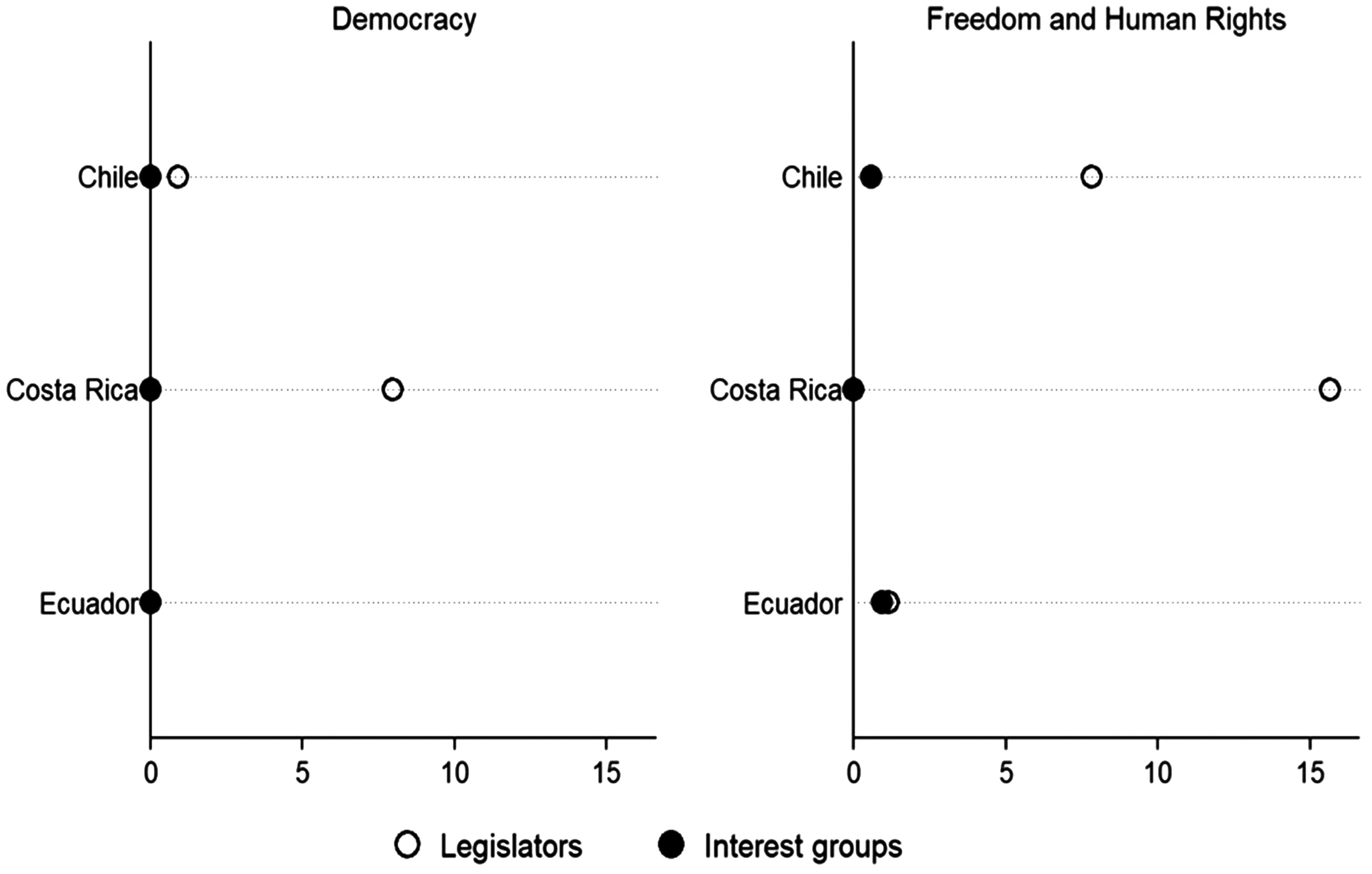
Now, let’s move on to examining our hypotheses. The first hypothesis focuses on how lobbies and legislators play down human rights and democracy issues to avoid causing conflict in their relationship with China. Figure 2 shows the percentage of quasi-sentences that address concerns about democracy, human rights, and freedom in China. Overall, the results show a considerably lower frequency of mentions compared to those focused on the economy. In Chile, interest groups almost completely avoided mentioning human rights and freedom (0.6 per cent), while legislators were slightly more active (7.8 per cent). Regarding democracy, there are almost no mentions of it in Chile (parliamentarians 0.9 per cent and groups zero). A similar pattern is observed in Ecuador, where interest groups attending the committee where the bill was debated made almost no reference to human rights or freedom (0.9 per cent). The same is true of legislators in Ecuador. Meanwhile, there was no mention of democracy at all from lobbies and legislators in Ecuador (the points overlap at zero).
Figure 2. Percentage showing concern about democracy and human rights.
The results for Costa Rica reveal a slightly different scenario. Members of the assembly were more active in raising issues related to freedom and human rights in China (15.7 per cent) and democracy (8 per cent). This may be due to Costa Rica's proximity to the United States, the influence of the latter on Costa Rica, and the country’s lower level of trade dependency on China. Meanwhile, Figure 2 shows that interest groups in Costa Rica avoid mentioning democracy, freedom, and human rights. Taken together, the results above provide preliminary support for our hypothesis that human rights, freedom, and democracy will be avoided in the rhetoric deployed during ratification.
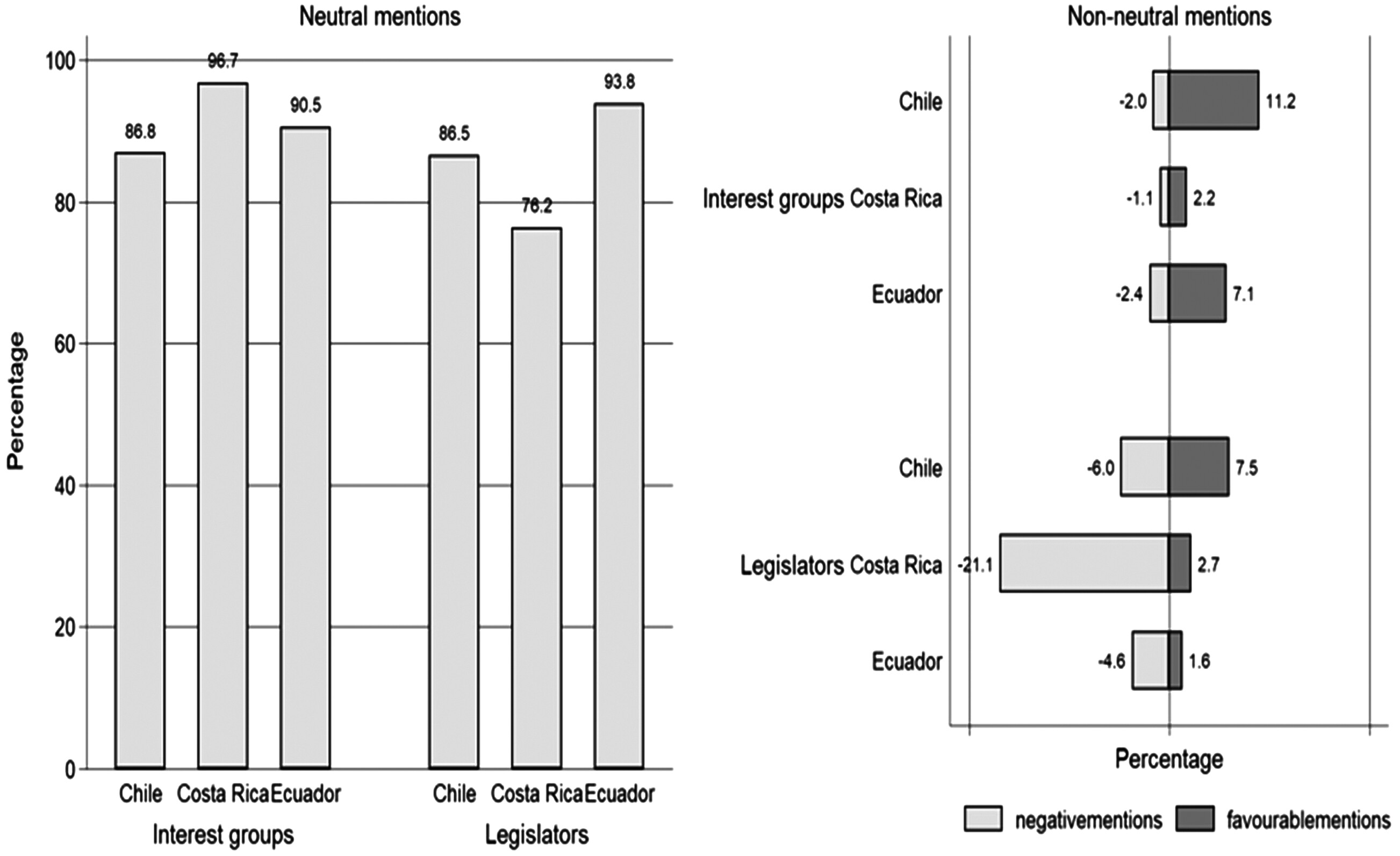
Our non-alignment hypothesis anticipates a preponderance of neutrality in quasi-sentences coded to capture positive and negative mentions, following the code: “Foreign Special Relationships: Positive favourable mentions of particular countries: China” adapted from the party manifesto. As Figure 3 shows, a high percentage of mentions did not indicate explicit alignment towards China. The left-hand plot shows that, on average, legislators and lobbies in all three countries exhibit a high percentage of neutral mentions of China, except for Costa Rican legislators.
Figure 3. Percentage of neutral and non-neutral mentions of China in each country.
This may suggest that discourse strategies strike a balance in which explicit alignment with China is not highly prominent. However, some disparities are observed in the cases. The right-hand plot of Figure 3 shows that, among non-neutral mentions, over 20 per cent of mentions of legislators in Costa Rica are negative. This is not replicated in the case of Costa Rica's interest groups. Note that legislators in Costa Rica were the most critical of human rights and freedom in China compared to lobbies and politicians in Chile and Ecuador. In terms of non-neutral mentions, Chile has a higher percentage of positive mentions of China: 11.2 per cent for interest groups. In Costa Rica, positive mentions of China represent only 2.2 per cent of quasi-sentences, and in Ecuador, 7.1 per cent.
Figure 4 corroborates our non-alignment hypothesis by computing the percentage of interventions with a positive stance towards China, segmenting the quasi-sentences into two groups: those that mention economic issues, and those that do not. Even though the frequencies are relatively low, positive mentions of China are fewer on average in sentences that do not address economic issues. In Chile, positive mentions among the group addressing economic issues represent 12.3 per cent of lobbies, while mentions not addressing economic issues are zero. Among Chilean legislators, positive stances towards China that mention economic issues represent 9.8 per cent. In Ecuador, quasi-sentences taken from legislators’ speeches corroborate this: positive mentions of China are always higher when the sentence includes a reference to the economy. For Ecuadorian lobbies, positive mentions that include economic aspects represent 8.9 per cent, while those that do not represent 0 per cent. In Costa Rica, positive mentions that do not address economic issues represent 4.3 per cent. Among legislators, positive mentions of quasi-sentences on economic issues represent 4.8 per cent. These findings also provide preliminary and descriptive confirmation of our non-alignment hypothesis.
Figure 4. Percentage of interventions with a positive stance about the relationship with China, within groups, by mentioning economic issues.
Figure 5. Percentage referring to protectionism, by source, by direction of mention.
At a descriptive level, the final test is to establish whether there are disparities between lobbies and politicians regarding the protection of local industries (see Figure 5). Our hypothesis is that legislators are more likely to adopt protectionist stances than economic lobbies that participated in ratification debates. We divided the sample into positive and negative mentions of protectionism. In Chile, lobbies show a higher percentage of negative mentions (7.5 per cent) than legislators (2.7 per cent). In Costa Rica, the percentage of positive mentions about protectionism among legislators (14.5 per cent) is considerably higher than among groups (1.1 per cent). Data from Ecuador confirm this pattern: legislators have more positive views about protectionism than lobbies (16 per cent and 9.9 per cent, respectively). As it stands, it seems that legislators in the three countries are slightly more likely to adopt protectionist stances than lobbies. However, differences are not too pronounced in Chile and Ecuador.
Discussion
FTAs are currently facing intense scrutiny, particularly in the context of the US–China trade and geopolitical competence. This is a critical issue for Latin America, as it relies heavily on these two nations as key trade and investment partners. The ratification of FTAs provides an opportunity for politicians and lobbyists to demonstrate their stance on trade liberalisation and its economic impact. In the case of representatives, ratification processes provide a venue to defend the interests of their constituencies. However, the political implications of subscribing to FTAs with China may create a different sort of incentive. Due to geopolitical reasons and the importance placed on commitment to democratic values and human rights, the political process of fostering economic cooperation with China may be more complex than anticipated.
Our results show that, in the three cases examined, economic topics predominate over mentions of human rights and democracy. Additionally, the rhetoric of both lobbies and politicians supports the notion of non-alignment. Finally, legislators adopt a more protectionist stance in their speeches than lobbies do in the three cases examined here, but the differences are marginal in the cases of Chile and Ecuador. This disparity suggests that legislators balance pressure from the electorate with expected economic benefits, tailoring their discourse to different audiences.
Overall, these results suggest, preliminarily, that the ratification process can be characterised as a game in which groups and politicians craft their speeches and interventions strategically. The political dynamic of trade liberalisation between China and Latin American democracies can be characterised as the reverse of the pragmatic logic described by Deng Xiaoping. In this case, Latin American elites adopt a similar approach, prioritising tangible economic benefits over regulatory differences or criticism regarding human rights and labour standards from their authoritarian partner.
Our contribution is twofold. Firstly, despite the fact that the political economy of trade is a well-developed field in both political science and economics, very little is known about the political dynamics that lead Latin American democracies and autocratic Asian regimes to sign FTAs. This is significant, given that non-democratic regimes account for one-third of FTA signatories worldwide (Baccini and Chow, 2018). Secondly, this study demonstrates how economies in Latin America have adopted the strategies employed by Western countries when engaging with China, an authoritarian power. Through instruments such as FTAs and appealing to economic complementarity, countries such as Chile, Ecuador, and Costa Rica have managed to justify and consolidate their deep trade ties with Beijing, thereby mitigating the political tensions that such a rapprochement could generate domestically. Thus, they have embraced the idea that greater economic integration with non-democratic actors reduces conflict and could foster openness.
Secondly, from an area studies perspective, little is known about the participation of interest groups and legislators in Latin American politics when debating FTAs with China. This gap is particularly significant given China's growing influence in the region as a major trading partner, source of foreign direct investment and provider of infrastructure project financing through its development banks. While the literature tends to focus on Chinese state diplomacy or the links between technocratic elites and Chinese actors, it pays little attention to the parliamentary arena or non-state actors such as business associations, chambers of commerce, and social movements.
One possible next step is to explore how parliamentary debates about FTAs differ from other legislative debates concerning China. In topics other than FTAs or economic cooperation instruments, non-alignment or rhetoric based on the economic benefits of cooperating with China may be less likely to be observed. This is the case with direct investments or infrastructure initiatives with geopolitical implications. Urdinez et al. (2019), for example, have shown that strong economic ties with China can coexist with strong criticism of certain types of investment, such as the construction of a space monitoring base, in Argentina. Indeed, legislative debates have shown the emergence of two opposing blocs deploying completely antagonistic rhetoric. As the authors noted: “Uncertainties about China’s future role as a global economic and political power further exacerbate stakeholder concerns in host countries over issues such as national security, unfair competition, and state ownership” (p. 237). What we observe during the ratification process of FTAs may only be valid during those debates.
Our research has some limitations. For instance, our approach was primarily descriptive. Further research could therefore adopt a more inferential approach to the phenomena. This would enable other potential explanatory factors to be controlled for, such as dependence on Chinese investment (including foreign direct investment) and trade, alongside that with the United States. In addition, including more cases would enable us to test the effect of institutional and economic variables on the different configurations of the relationship between China and Latin American political systems. The scope of our study also limits the potential generalisation of our findings to other economies in the Global South, such as African countries, where the economic relationship with China is different.
Acknowledgements
We thank the support of Sophia Elsig, Gabriel Morales Ricke, and Alvaro Viveros for their support in the data collection process.
Declaration of Conflicting Interests
The authors declared no potential conflicts of interest with respect to the research, authorship, and/or publication of this article.
Funding
The authors disclosed receipt of the following financial support for the research, authorship, and/or publication of this article: This research was funded by the Chilean Agency for Research and Development (ANID), Fondecyt Regular Grant No. 1241567; ANID Millenium Science Initiative Program (grant NCS2024_007) and ANID Millennium Science Initiative Program NCS2025_70.
Acemoglu Daron, Autor David, Dorn David, et al. (2016) Import competition and the great U.S. employment sag of the 2000s. Journal of Labor Economics 34(S1): 141–198.
Autor David, Dorn David, Hanson Gordon, et al. (2020) Importing political polarization? The electoral consequences of rising trade exposure. American Economic Review 110: 3139–3183.
Baccini Leonardo, Chow Wilfred M. (2018) The politics of preferential trade liberalization in authoritarian countries. International Interactions 44(2): 189–216.
Bombardini Matilde, Trebbi Francesco (2012) Competition and political organization: Together or alone in lobbying for trade policy? Journal of International Economics 87(1): 18–26.
Borquez Andres, Muñoz Felipe, Leiva Diego (2023) The growing Chinese economic presence in Chile: Opinions among the Chilean elite. The China Review 23(3): 131–154.
Campello Daniela, Urdinez Francisco (2021) Voter and legislator responses to localized trade shocks from China in Brazil. Comparative Political Studies 54(7): 1131–1162.
Collins Stephen D. (2010) Regional trade agreements and democracy promotion: Measuring the influence of democracy requirements in regional trade agreements. Politics & Policy 38(4): 737–764.
Conconi Paola, Facchini Giovanni, Steinhardt Max, et al. (2020) The political economy of trade and migration: Evidence from the U.S. Congress. Economics & Politics 32: 250–278.
Dür Andreas, Hamilton Scott Michael, Bièvre Dirk De (2024) Reacting to the politicization of trade policy. Journal of European Public Policy 31(1): 1–19.
Flores-Macías Gustavo A., Kreps Sarah E. (2013) The foreign policy consequences of trade: China’s commercial relations with Africa and Latin America, 1992–2006. The Journal of Politics 75(2): 357–371.
Fordham Benjamin O., McKeown Timothy J. (2003) Selection and influence: Interest groups and congressional voting on trade policy. International Organization 57(3): 519–549.
Fortín Carlos, Heine Jorge, Ominami Carlos (2020a) Latinoamérica: no alineamiento y la segunda guerra fría [Latin America: Non-alignment and the second cold war]. Foreign Affairs: Latinoamérica 20(3): 15.
Gachúz Juan Carlos, Urdinez Francisco (2022) Geopolitics and geoeconomics in the China–Latin American relations in the context of the US–China trade war and the COVID-19 pandemic. Journal of Current Chinese Affairs 51(1): 3–12.
Gamboa Ricardo, Segovia Carolina, Aubry Marcel, et al. (2024) Los grupos de interés en el proceso de toma decisiones en Chile, 1990–2020. Quién, dónde y cuánto? [Interest groups in the decision-making process in Chile, 1990–2020. Who, where and how much?] Iberoamericana. América Latina–España–Portugal 24(85): 253–283.
Hurrelmann Achim, Wendler Frank (2023) How does politicisation affect the ratification of mixed EU trade agreements? The case of CETA. Journal of European Public Policy 31(1): 157–181.
López Dorotea, Dockendorff Andrés, Lodato Simón (2024) Political entrepreneurs and interest groups in the CPTPP ratification process in Chile: A case of politicization? World Affairs 187(4): 437–447.
Rodrik Dani (1995) Political economy of trade policy. In: Grossman Gene M., Rogoff Kenneth (eds.) Handbook of International Economics, Vol. 3. Amsterdam: Elsevier, pp. 1457–1494.
Song Guoyou, Bórquez Andrés, Muñoz Felipe (2020) Rethinking strategic alignments: China and the building of wide-ranging and multidimensional networks. China: An International Journal 18(4): 1–26.
Strüver Georg (2017) China's partnership diplomacy: International alignment based on interests or ideology. The Chinese Journal of International Politics 10(1): 31–65.
UN News (2022) China responsible for ‘serious human rights violations’ in Xinjiang province: UN human rights report. UN News, 31 August. Available at: https://news.un.org/en/story/2022/08/1125932 (accessed 23 May 2025).
Urdinez Francisco, Knoerich Jan, Ribeiro Pedro Feliú (2019) Don’t cry for me “argenchina”: Unraveling political views of China through legislative debates in Argentina. Journal of Chinese Political Science 23(2): 235–256.
Vallejo Vera Sebastián (2023) By invitation only: On why do politicians bring interest groups into committees. The Journal of Legislative Studies 29(1): 1–38.
Wise Carol, Ching Victoria Chonn (2018) Conceptualizing China–Latin America relations in the twenty-first century: The boom, the bust, and the aftermath. The Pacific Review 31(5): 553–572.
Young Alasdair R. (2016) Not your parents’ trade politics: The Transatlantic Trade and Investment Partnership negotiations. Review of International Political Economy 23(3): 345–378.
Andrés Dockendorff is an Associate Professor at the International Studies Institute, University of Chile. PhD in Government, University of Essex, UK. His research focuses on interest groups, representation and legislative behavior.
Dorotea López is the Director of the International Studies Institute, University of Chile. PhD in Social Sciences, University of Chile. Her research focuses on trade policy, political economy and gender.
Andrés Bórquez is an Assistant Professor at the International Studies Institute, University of Chile. PhD in International Relations, University of Fudan, China. His research focuses on China politics and international relations.
Cite
Cite
Cite
OR
Download to reference manager
If you have citation software installed, you can download citation data to the citation manager of your choice
I can access personal subscriptions, purchases, paired institutional access and free tools such as favourite journals, email alerts and saved searches.