Introduction
As the proportion of preterm births in the United States continues to increase, rising a total of 12% between 2014 and 2022,
1 neonatal intensive care units (NICUs) are becoming critical sites of both life-saving medical intervention and targeted developmental support. Recognizing the known long-term impacts of a NICU stay on not only NICU patients
2–5 but also their parents/caregivers
6–9 and siblings,
10–12 more investment is needed in designing and studying preventative interventions and family-centered practices that could mitigate these adverse outcomes. To illustrate, prior research has shown that premature infants are at higher risk of both intellectual and developmental disabilities
13 as well as atypical language development and subsequent literacy challenges.
14 Additionally, low birth weight infants demonstrate greater likelihood of developing insecure attachment patterns with their caregivers, further jeopardizing an array of developmental milestones and functional outcomes.
7 Parents/caregivers of NICU patients have also exhibited higher risk of mental health concerns such as anxiety,
8 depression,
9 and post-traumatic stress disorder,
8 which can further interfere with the parent-infant relationship and attachment levels beyond the infant’s discharge from the NICU.
15It has been demonstrated that improving emotional well-being, engagement, and attachment for parents/caregivers can be helpful in alleviating these challenges.
16–18 Thus, family-centered interventions and practices in NICU settings offer an ideal opportunity for addressing these psychosocial and developmental sequelae while also improving outcomes for NICU patients and their families. One avenue of recent interest has been NICU reading programs. These programs typically involve providing families with access to infant-appropriate books, information about the benefits of reading to infants in the NICU, and in some versions, support and guidance from staff regarding how to incorporate reading into the family’s NICU routines. Extensive research has already demonstrated a strong and meaningful relationship between parent/caregiver reading and improved cognitive development,
19 language acquisition,
20 and literacy development
21 in typically developing infants. Further work has examined this phenomenon focusing on infants in the NICU, finding associations between parental reading at the bedside and infant language development,
22 parents’ feelings of enjoyment and closeness with their babies,
23 infant cognitive development,
23 oxygen desaturation events,
24 cardiorespiratory stability,
24 heart rate,
25 pain response,
25 parents’ likelihood to read to the baby after discharge,
26,27 interaction frequency and quality between parent and baby,
26 parents’ feelings of control and sense of normalcy,
28 improved sleep despite loud noises,
29 and improved morale for NICU staff.
30Despite the many benefits and relationships associated with NICU reading programs that have been reported by previous research studies, these works have also detailed significant barriers to program or intervention participation for parents/caregivers in this setting. More specifically, these studies have identified consistent access to books
30 and parental knowledge about the developmental benefits of reading to premature infants
27–31 as areas for future program improvement. Therefore, after designing and implementing a NICU reading program that addressed these gaps, the purpose of this study was to examine relationships between parent/caregiver participation in a bedside NICU reading program and self-reported attachment, anxiety, and program satisfaction. Three research questions were addressed.
(1) What is the relationship between participation in a parent-led, bedside NICU reading program and parent-reported anxiety?
(2) What is the relationship between participation in a parent-led, bedside NICU reading program and parent-reported postnatal attachment?
(3) How do parents/caregivers perceive and experience a parent-led, bedside NICU reading program?
Based on prior studies to date, it was hypothesized that participation in a parent-led, bedside NICU reading program would be associated with decreased parent/caregiver anxiety and increased parent/caregiver attachment between the pre- and post-intervention time points. It was also hypothesized that participants would report satisfaction with their experiences in the program and perceive the program as beneficial.
Methods
Site
This study was conducted in a level IV NICU at a large freestanding children’s hospital associated with an academic medical center in the Southeastern United States. The hospital’s multi-floor, 119-bed neonatology service cares for infants and families from a multistate radius, including both urban and highly rural populations. The site was chosen both for its size and accessibility, and expedited approval was received from the institution’s institutional review board in December 2023 under protocol number 231658.
Participants
Participants in this study were parents/caregivers of NICU infants at the research site who were over the age of 18 at the time of participation and proficient in the English language. In addition, participants became eligible when their infants no longer required a closed isolette, allowing for parent/caregiver positive touch and auditory stimulation to occur safely during reading interactions. Parents/caregivers of infants in state custody or foster care were excluded from the study.
Sixty-six parents/caregivers enrolled in the study between January 2024 and May 2024; however, six were removed from analysis due to missing post-intervention data. The total number of participants approached for enrollment was not formally tracked, but declines were minimal. Primary reasons for declining to consent included not having enough time to read to the infant, living too far away from the hospital to visit regularly, and anticipating imminent discharge, and one parent/caregiver cited concern about protecting their infant’s privacy. Of the 60 participants who completed all study measures and were included in this analysis (
Table 1), 75.0% were mothers (
n = 45) and 25.0% were fathers (
n = 15). Most participants (66.7%;
n = 40) reported an annual total household income of less than $75,000. Participants were primarily white/Caucasian (76.7%;
n = 46) and between the ages of 20–29 years (50.0%;
n = 30) or 30–39 years (43.3%;
n = 26). According to the World Health Organization’s designations for the degrees of prematurity,
32 23.3% (
n = 14) of the NICU patients involved in this study were born extremely preterm, 31.7% (
n = 19) were born very preterm, 40.0% (
n = 24) were born moderate to late preterm, and 3.3% (
n = 2) were born at 38 weeks of gestation or more. The average gestational age for infants in this study was approximately 31.0 weeks, and the average infant age at enrollment was approximately 45.4 days.
Procedures
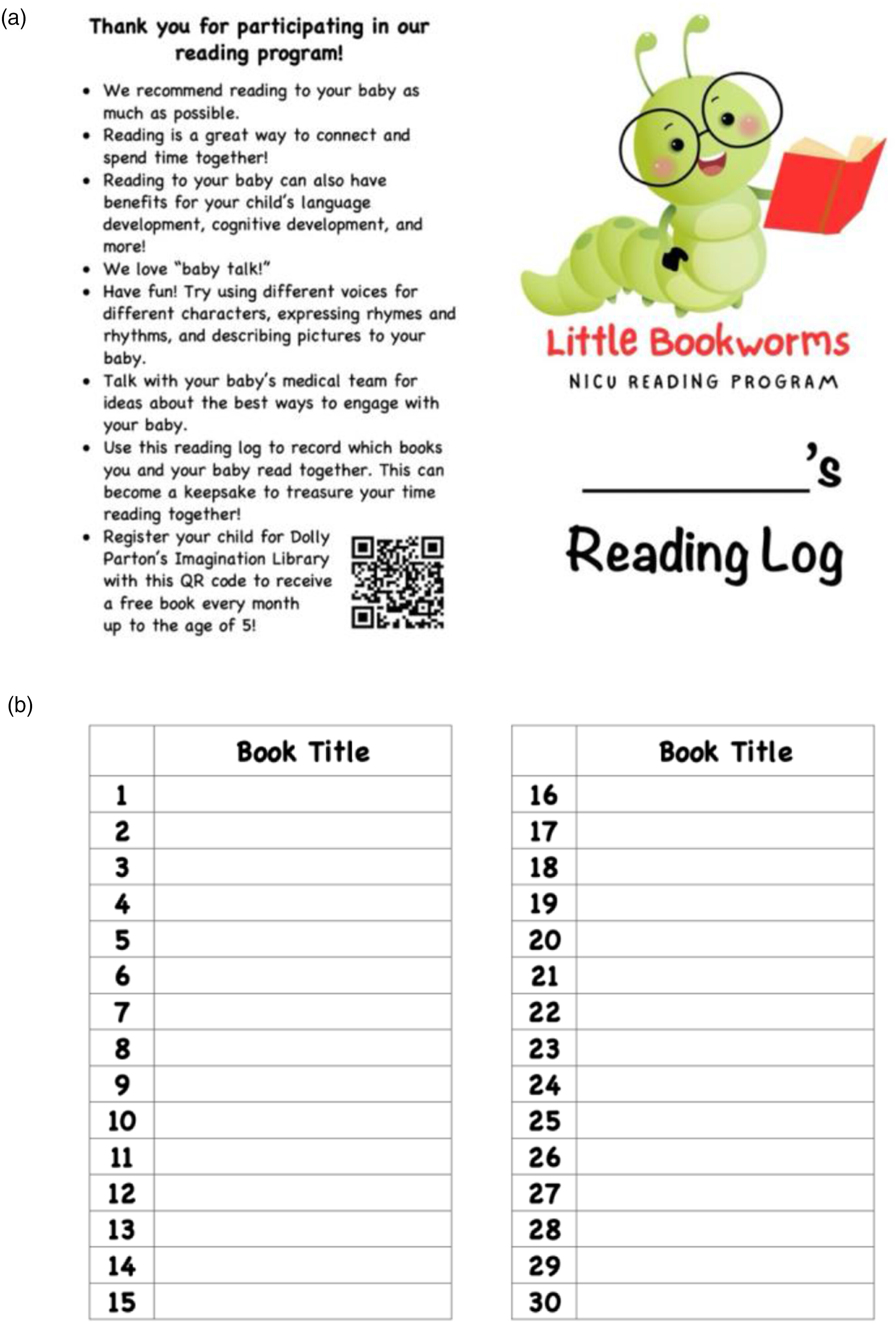
Titled “Little Bookworms,” the parent-led, bedside NICU reading program consisted of three primary components: (1) consistent and constant (24-hour) access to age-appropriate books, (2) brief in-person education and written reminders about the importance of and best practices for reading to an infant in the NICU, and (3) a keepsake reading log to help parents/caregivers document their reading interactions with their infant. Noting the many barriers to NICU visitation and interaction with very premature infants that parents/caregivers often encounter, the program encouraged participants to read to their infant for at least 1 hour each week for the duration of their participation in the program.
A variety of developmentally appropriate and culturally diverse books were provided on a cart at the medical reception desk of the unit at all times, and upon enrollment in the study, all participants were provided a copy of the reading log (
Figure 1) that could be used to keep track of which books they read with their infant. The back page of the reading log provided information and tips for reading to their NICU patient, in addition to a QR code that connected parents/caregivers with Dolly Parton’s Imagination Library as a means of in-home access to reading materials after discharge from the NICU. Parents/caregivers could also request an additional reading log at any time, whether to document additional books, add to the infant’s baby book or memory chest, or to share with the infant’s other parents/caregivers.
All eligible parents/caregivers were briefly introduced to the study at the bedside by a member of their infant’s healthcare team. If the parent/caregiver expressed interest, they were then visited by a member of the research team who explained the research study in more detail and obtained informed consent using REDCap on an iPad. At the time of consent, participants were also asked to complete a short demographic survey, the Spielberger State-Trait Anxiety Inventory (STAI), and either the Maternal Postnatal Attachment Survey (MPAS) or the Paternal Postnatal Attachment Survey (PPAS), all of which were presented in REDCap on an iPad. Participants self-identified as mothers or fathers prior to completing the MPAS or PPAS surveys to guide the team in which instrument would be most appropriate.
After a participating infant was scheduled for discharge by the NICU medical team, the parent/caregiver participants were again approached by a member of the research team at the bedside to complete the post-intervention measures within 24 hours of the planned discharge. The post-intervention measures included the Spielberger State-Trait Anxiety Inventory (STAI), either the Maternal Postnatal Attachment Survey (MPAS) or Paternal Postnatal Attachment Survey (PPAS), and a Program Perceptions and Experiences survey using REDCap on an iPad.
Measures
The State-Trait Anxiety Inventory (STAI) is a self-report assessment of episodic anxiety.
33 The original STAI contained 20 questions for state anxiety and 20 questions for trait anxiety, each with answer choices corresponding to a four-point Likert scale. However, the STAI was later adapted to a shortened version consisting of six questions, each with four-point Likert scale answer choices.
34,35 Given the many stressors and challenges associated with parenting an infant in the NICU, the six-item STAI was chosen for this study to reduce potential participation burden. This shortened six-item STAI survey is scored on a singular, total composite scale from 6 to 24, with higher scores indicating higher levels of anxiety. The six-item STAI has demonstrated good internal consistency with a Cronbach’s alpha value of 0.82.
34The Maternal Postnatal Attachment Survey (MPAS)
36,37 and Paternal Postnatal Attachment Survey (PPAS)
38,39 questionnaires ask a series of multiple-choice questions designed to assess a caregiver’s perceived attachment to their infant. The 19 questions on the MPAS and PPAS surveys are each scored on a scale from 1 to 5, meaning that participants’ total possible composite scores could range from 19 to 95, with higher scores indicating higher levels of perceived attachment.
37,39 The MPAS survey contains three sub-scales: Quality of Attachment (nine questions; total score range of 9–45), Absence of Hostility (five questions; total score range of 5–25), and Pleasure in Interaction (five questions; total score range of 5–25).
37 The PPAS survey contains three different sub-scales: Patience and Tolerance (eight questions; total score range of 8–40), Pleasure in Interaction (seven questions; total score range of 7–35), and Affection and Pride (four questions; total score range of 4–20).
39 The MPAS and PPAS demonstrate good internal consistency as demonstrated by Cronbach’s alpha values of 0.78 and 0.81, respectively.
38,40Notably, three questions on the MPAS and PPAS questionnaires were slightly edited to fit the NICU setting. Specifically, language was added to clarify that the survey questions were to be based on the respondent’s experiences in the NICU rather than using the generic “two weeks” or “three months” in the original versions. In addition, the word “interacting” was used as a substitute for “playing” with the infant in one question on each questionnaire to account for the limitations of a NICU stay on typical infant activities.
Data analysis
This study used a quasi-experimental, pre- and post-intervention design to examine the relationships between participation in a parent-led, bedside NICU reading program and parent-reported anxiety, postnatal attachment, and satisfaction. Participant self-reported anxiety, as measured with the total composite STAI score, and postnatal attachment, as measured with the MPAS or PPAS total composite and sub-scale scores, were both assessed at pre- and post-reading program participation time points. Given the Likert-type response format of the chosen measures, initially planned t-tests could not be conducted as the sample data failed to meet normality assumptions. Therefore, pre- and post-intervention anxiety and attachment scores were analyzed with nonparametric Wilcoxon signed-rank tests. For all analyses, an alpha level of .05, two-tailed was used as the level of significance. All descriptives and tests were conducted in SPSS, version 30.0. Additionally, a basic content analysis was used to explore participants’ written responses on the Program Perceptions and Experiences survey.
Discussion
The purpose of this quasi-experimental study was to examine potential relationships between participation in a parent-led, bedside NICU reading program and self-reported anxiety and postnatal attachment scores. Additionally, this study also aimed to explore parent/caregiver perceptions of and experiences with the reading program. In line with the study team’s hypotheses, the results of this study indicated that parent/caregiver participation in the NICU reading program was associated with a significant reduction in parent-caregiver anxiety and increased attachment across the pre- and post-intervention time points. However, with lack of a control group to compare to, it is not possible to attribute these changes solely to participation in the reading program. Additionally insightful, participants largely stated that they enjoyed the program and perceived it to be helpful, thus supporting the implementation of parent-led, bedside NICU reading programs where feasible.
In participants in this study, parental anxiety was found to decrease between the pre- and post-intervention time points at a statistically significant level—a result which held even when mothers’ and fathers’ anxiety scores were analyzed separately. Additionally, a significant increase in attachment was observed between time points specifically in participating mothers. Notably, this increase was not replicated for paternal attachment. Finally, participants indicated full support of the program (100% enjoyment) and shared several perceived benefits of participation.
These observed relationships between participation in a parent-led, bedside NICU reading program, decreased anxiety, and increased postnatal attachment closely mirror the findings of prior observational and experimental studies.
23,26–28 Recognizing that NICU infants are at higher risk of adverse developmental and psychosocial outcomes beyond discharge,
2–5,13,14 enhancing parent/caregiver emotional responses, engagement, and well-being can help to mitigate these challenges.
16–18 Participants in this study rated their anxiety lower and attachment higher across the two time points, which is an optimal directionality as lower levels of anxiety may allow parents/caregivers to better direct their cognitive and emotional energies into caring for their infant. Although it is not possible to disentangle the impact of the Little Bookworms NICU Reading Program from other factors impacting parental anxiety and attachment such as the infant’s improving medical status and approaching discharge date, the results of this quasi-experimental study suggest that implementation of a parent-led, bedside NICU reading program does not appear to interrupt, disrupt, or reverse adaptive parent/caregiver mental health and attachment trajectories in the NICU—which may be a worthwhile investment in patient- and family-centered care.
The Little Bookworms NICU Reading Program was intentionally designed to address challenges related to reading material access and developmental appropriateness of reading interventions seen in prior research. Consistent access to books has previously been reported as a barrier to parental bedside reading in the NICU.
27,30 In this program and for the purposes of this study, a consistently full book cart remained constantly accessible at the medical reception desk on the unit, and this information was shared with families during enrollment as well as on the back page of the provided reading log. In their responses to the Program Perceptions and Experiences survey, multiple participants reported this greater awareness of and unhampered access to books in the NICU as enjoyable aspects of their participation in the program.
Prior studies have also reported some concerns from parents/caregivers and staff regarding the safety and appropriateness of reading to premature infants in the NICU.
27,31 To address this, the back page of the reading log created for this program included specific information about the benefits of reading to infants and encouraged collaboration with the infant’s medical team to identify what would be most appropriate for their child’s developmental needs. Moreover, participants did not report concerns about the developmental appropriateness of the program on the Program Perceptions and Experiences survey.
The findings of this study have several implications for supportive care for NICU infants and their families. Primarily, this study broadly supports parent-led, bedside reading programs in NICU settings. Though reductions in anxiety and strengthened attachment scores observed in this quasi-experimental study cannot be solely attributed to the reading program due to study design and multiple confounding variables, the reading intervention was not associated with any harm, participant concerns, or other negative effects. Further, with only the minimal time, energy, and resources required to implement the parent-led NICU reading program, such an intervention could be an efficient and accessible offering in any NICU setting serving families of varied resource levels.
For future programs, several participants in this study suggested novel methods of providing reading materials, such as offering eBooks for parents/caregivers to read aloud to their infants. Additionally, some participants specifically expressed interest in creating audio recordings so that their infants could benefit from hearing their voice reading a book even when they are unable to be at the bedside. As they shared in the open response portion of the Program Perceptions and Experiences survey, it appears that expanding reading programs in this way could provide parents/caregivers with an additional avenue of care engagement and comfort in knowing that they are directly supporting their baby’s development from afar. Finally, as the results of this study align with the impacts noted in prior works, it is important that medical and psychosocial staff who prepare for or work in NICU environments are exposed to and encouraged to help educate parents/caregivers about the value of bedside reading for NICU patients.
The findings of this study also suggest that NICU reading programs may merit attention in discussions regarding program funding—especially with interested donors or philanthropy groups. Implementing and maintaining the Little Bookworms program over the course of this study cost less than $1000. It is evident that NICU reading programs may be beneficial for parents/caregivers and infants based on research to date and the contributions of this study; this can be achieved with minimal materials and staffing resources while also supporting improved developmental and psychosocial outcomes for infants and families. Moreover, the use of educational handouts like the Little Bookworms reading log in this study can be both a means of education for parents/caregivers as well as a connecting point to community-based resources such as Dolly Parton’s Imagination Library. Finally, NICU reading programs could be used in conjunction with other evidence-based supportive interventions like kangaroo care, infant massage, and other types of positive touch to maximize potential benefits for the infant and parent/caregiver.
These findings may support an existing and growing area of research, but more work is needed to explore the implementation of NICU reading programs for non-English speaking families and infants. Though the perceived benefits of reading may be theoretically similar across linguistic groups, there may be additional barriers to healthcare access and participation that could disproportionately affect program experiences and outcomes for this population. Additionally, per participant feedback received in this study, future research could investigate the impacts of alternative reading materials, such as eBooks and parental audio recordings, on parental anxiety, attachment, and satisfaction.
Although a decent proportion of participants in this study were fathers (25%;
n = 15), more work could be done to explore interventions that can reduce paternal anxiety and increase paternal postnatal attachment in more significant ways. Conversely, more work could be done to identify and address barriers to reading program participation that fathers may be more likely to experience. Moreover, the structure of the MPAS and PPAS surveys did not make space for primary caregivers who may not be mothers or fathers, so future research studies could investigate attachment using surveys that provide more flexibility for the diversity of parents/caregivers in the NICU. Due to the rather homogeneous distribution of demographics in this study, there was little that could be learned about potential relationships between the focus variables and factors such as race, ethnicity, and socioeconomic status in this current study, so investigating these correlations could be a valuable next step for future research studies. Inspired by prior findings that have demonstrated the long-term benefits of reading to infants like cognitive development,
19 language acquisition,
20 and literacy development,
21 more research is also needed to investigate potential longitudinal benefits of NICU reading programs, following participants throughout early childhood.
Strengths of this study included that the Little Bookworms NICU Reading Program intervention and study surveys were carefully designed to minimize intrusiveness and burden, considering the busy nature of the NICU environment and the significant stress parents/caregivers experience during an infant’s hospitalization. The flexibility of the study intervention allowed parents/caregivers to read on their own schedule and in their own way, minimizing the perception of the intervention as another task to complete in a busy and stressful time. Additionally, the questionnaires for this study were chosen not only for the variables of interest they assessed, but also for their brevity and reliability to again reduce the amount of time and energy parents/caregivers had to extend in order to participate. The inclusion of both mothers and fathers in this study also provided a more nuanced approach to data analysis, allowing examination of potential differences between mothers’ and fathers’ experiences with NICU reading programs.
As with any study, there were also several limitations of this research. First, generalization of these results is limited by the sample size of 60, especially for fathers (
n = 15), and the fact that all participants were recruited from the same research site. Thus, conducting a multi-center study could increase the size and diversity of the sample, increasing the possible generalizability of the results. Additionally, though feasibility led to the design of this research as a quasi-experimental study, the lack of a control group restricted the depth of interpretations that can be drawn without risking over-reach. Furthermore, it is possible that only parents who were already interested in reading chose to enroll in the study, potentially introducing selection bias that could have influenced the results. Similarly, because participants only became eligible to participate in the study after their infant no longer required a closed isolette and had transitioned to an open crib, it could be argued that these NICU patients were healthier and closer to discharge, possibly contributing to the improvements observed in participants’ attachment and anxiety during their participation in the study. Due to these infants being closer to discharge than those who were still in closed isolettes, there was often a shorter period of time remaining in the family’s NICU stay than may have otherwise been experienced if participants had been enrolled in the study at the beginning of their NICU admission, so these results may not be generalizable to families with infants still in closed isolettes. In addition, although some may critique the study’s use of the six-question form STAI instead of the full inventory, the shorter survey was more amenable to the challenges of the NICU environment and has been well-validated as a reliable measurement tool.
34,35To summarize, NICU reading programs are innovative, developmentally grounded, and family-centered interventions with the potential to reduce anxiety and improve attachment for parents/caregivers who have infants in the NICU. Mental health and connection to the infant can markedly alter parents’ experiences in the NICU as well as after discharge, so it is important to implement programming that can support parents/caregivers in these areas throughout their time in the NICU. Furthermore, these programs can be implemented with minimal time, materials, and personnel costs, making them a potentially high-yield investment in patient and family well-being.