Intended for healthcare professionals
Free access
Research article
First published online September 15, 2023

Moving From Faith Development to Faith Engagement in Christian Schools: A Scoping Review

Abstract

Fowler’s theory of faith development has been the primary method of assessing faith formation in children since the 20th Century. However, despite some adjustments to Fowler’s theory, there is a need to re-examine it’s relevance in the new millennium. This scoping review aims to provide an overview of current research related to faith formation for children and situate the research in terms of Fowler’s theory of Faith Development. Utilising the Scoping Review methodology developed by Arksey & O’Malley, a review of empirical literature related to faith formation activities with children was undertaken. These articles were placed within Fowler’s Faith Developmental stages. Results indicate that Fowler’s stages of Faith Development hold little relevance to existing research. A discussion regarding the use of the term Faith Engagement as a way of describing the outcomes of faith formation activities occurs.

Introduction

Christian schools are at the forefront of evangelisation and spiritual transformation. Their distinctive nature is tied to an active program that places student relationship with their creator at the heart of school activities. Despite this importance, a paucity of research exists examining the impact of faith development activities within a school context. Existing research is slanted towards an investigation of Religious Education curricula and their impact on student engagement and openness towards matters of faith. Further highlighting the disparity of research attention, many school students anecdotally report that their conversion experiences occur outside of the Religious Education classroom.1 Research undertaken by Petrie et al.2 identified a further link between a student’s engagement with their faith and opportunities provided by the school to explore their faith further. However, further research is needed to identify specific activities that have an influence on the faith development of school students. To facilitate this, there is a need to provide a map of existing research in faith development activities so that future research can be well informed of the existing landscape.

Literature Review

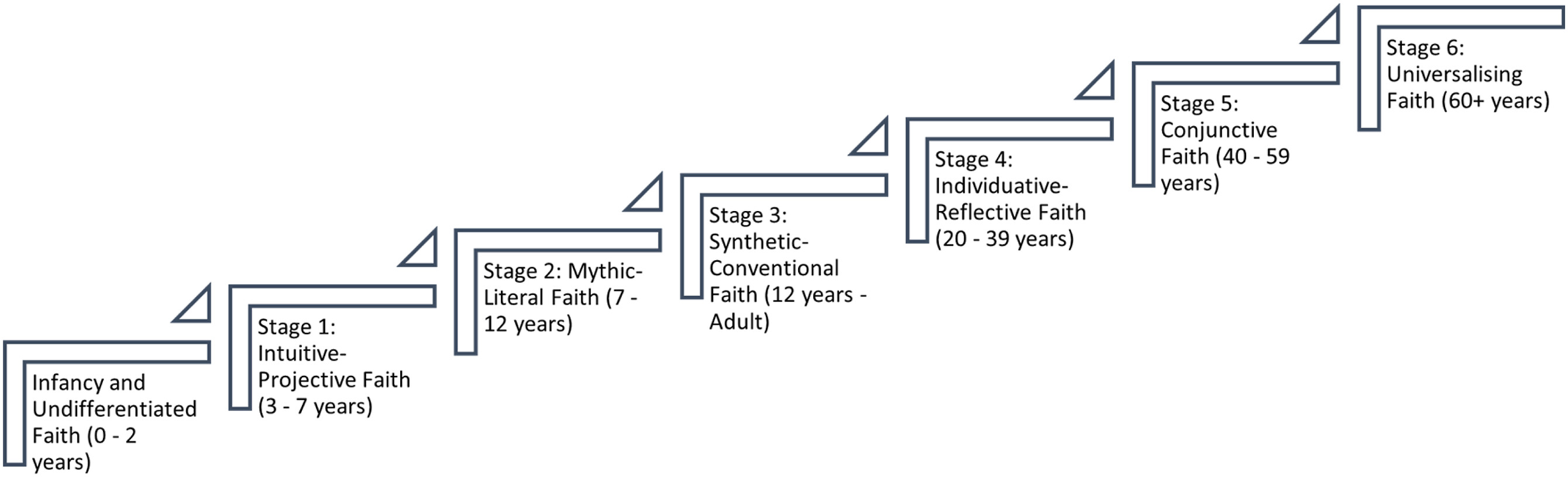
Faith Development Theory, as proposed by James Fowler examines the process of an individual’s faith as they develop from an infant through to death in old age. Similarities can be drawn between Fowler’s Faith Development Theory and Erik Erikson’s stages of psychological development, as the terminology and age range used are similar.3 Figure 1 provides an overview of Fowler’s stages of faith development, and the associated age ranges.
Figure 1. Fowler’s stages of faith development (adapted from Fowler, 1995).
It is important to note that the age ranges proposed by Fowler are not linked to biological age alone. Rather, they are linked to psychosocial development, and structural-environmental interaction.4 An individual may present at a biological age that is beyond their present stage of faith development. Subsequently, the ages must be viewed as a guide only, and not as a firm boundary of development.
In analysing the applicability of Fowler’s Faith Development theory, several attempts have been made to use it as a framework for understanding how young people view the world. Sister Ruth Ann Eisenstein used Fowler’s Faith Development theory to highlight how people across the stages develop their models and understanding of God.5 School children, according to Eisenstein, shift their image of God from one of a king or monarchs during Stage 2, to a ruler who is shrouded in mystery by the conclusion of Stage 3. Hiebert drew parallels across these two stages to stages of development, notably Selman’s Social Perspective Theory in Stage 2, and Kolhberg’s Moral Development Theory in Stage 3.6 It is here that a link is made explicitly between a child’s development of their faith, and the relationship they have established with the world around them.7 This connection between faith and the relationship with their world would therefore be extrapolated to the age and developmental stages that a child would naturally progress through as they age.
Several critiques of Faith Development Theory highlight potential areas of deficiency, notably with regards to development of the self8 and how faith is expressed.9 Fowler highlights that as Faith Development Theory grows and evolves, it adapts to new usage, and this has occurred within the field of Religious Education.10 This causes a conundrum, as faith should not be ‘reductionist’,11 but rather dynamic and reflective of the ‘deepest dimensions of our relationship with the holy’.12 Subsequently, attempts to measure faith development using scales or objective measures13 need to be treated with caution, as they cannot take into consideration the personal nature of relationship, especially with the divine. This conundrum presents another problem with Fowler’s Faith Development Theory – if it cannot be measured objectively, then how can an individual be identified as being in a particular stage?
This conundrum has resulted in several discussions on how Faith Development Theory could be progressed into the new millennium. Heywood14 posited that by removing the structuralist element of Faith Development Theory, that a constructive new approach could be developed. Heywood argues that by viewing the stages as non-linear, the potential exists that an individual could move throughout the various stages as they wrestle with more complex matters of their faith.15 In highlighting the troubles with empirical evidence and research into Faith Development Theory, Parker notes that there is research both supporting Heywood’s hypothesis, but also equally valid evidence supporting the sequential nature of the stages, particularly with regards to children.16 Coyle goes further, suggesting that a potential resolution is in fact to combine Faith Development Theory with other theories, specifically ones that incorporate psychological and sociological factors that could potentially explain faith development further.17 Current research in Faith Development Theory has sought to combine it with other elements. Streib18 has approached Faith Development by examining Types and Styles of religious belief. This has enabled more quantifiable approaches to measuring Faith Development Theory in practice, as Streib’s research noted that based on experiences and teaching, individuals tended to either progress or regress in their faith.19 This opens the potential for viewing Faith Development as a spectrum (Figure 2), as opposed to a linear process.
Figure 2. Faith development as a spectrum.
The focus of the scoping review is to examine the impact of explicit faith development activities and the impact they have on the faith development of school students. By viewing Fowler’s Faith Development Theory as a spectrum, we create a framework whereby the experiences had by school students can be used as a catalyst for placing the individual on the Faith Development Spectrum.

Methods

As the topic engages with research from both the Education and Theology disciplines, a scoping review approach was utilised. The research approach undertaken uses the framework established by Arksey & O’Malley.20 In the initial stage, a research question was formulated. The question is: ‘How do explicit faith development activities in schools influence the faith development of school students?’. Several terms in this question require further definition to be actualised into a research term.
Firstly, ‘explicit faith development activities’ refers to school activities that sit outside of the curriculum for the stated purpose of enhancing student faith.21 These include activities such as bible study programs, school chapel services (including worship components), corporeal worship, evangelisation opportunities to and for students, mission trips and retreats. The goal of these programs is to enhance the faith of believing students and encourage opportunities for faith exploration.
Another term that requires definition is ‘faith development’. As the lens through which the results will be examined are through Fowler’s Stages of Faith Development, our definition of faith development must be derived from the same framework. Therefore, faith development is a human phenomenon through which a person seeks to obtain an understanding of the ultimate environment.22
School students is perhaps the easiest to be defined. School students for the purposes of the scoping review are defined as any person enrolled in a primary or secondary school, undertaking a course of study.
The second stage of Arksey & O’Malley’s scoping review framework requires a creation of the criteria for inclusion and exclusion. The initial criteria required that the literature be: (a) peer-reviewed, (b) written in English and (c) focussed on how an explicit faith activity within a school has influenced the faith of students enrolled in the school. To achieve this, we used a search of electronic databases, followed by a reference list search and then a manual search within academic journals that heralded 5 or more results.
The key search terms depicted in Figure 3 were used for the initial search of relevant electronic databases. The databases searched included: A + Education, Alta Religion, Education Journals, ERIC, JSTOR, ProQuest Religion Database, Sociology Source Ultimate and Wiley. This search yielded a total of 285 publications.
Figure 3. Search terms.
No date range was set for the search parameters. As the history of faith-based schools is vast, it is important to recognise the contribution these historical activities had on the present-day activities of schools around the world.
Implementing Stage 3 of Arksey & O’Malley’s framework involves examining the retrieved publications on a post-hoc basis for relevance.23 All duplicates were removed, resulting in a remainder 198 publications for title and abstract screening. Title and abstract screening identified 102 publications that made links between faith development activities within a school environment and the faith development of school students. A reference list search across these publications identified a further 17 publications which were relevant for inclusion into study. These publications also included similar studies undertaken for activities within the Hindu, Islamic, Jewish faith traditions. While the focus of the study is designed for Christian schools, due to the similarity of research methods and criteria, these studies were chosen as being relevant for inclusion. All publications that met the inclusion criteria were examined in their entirety, leading to the exclusion of 77 publications. A manual search was then conducted for key authors and journals that heralded results within the initial search. This added a further four publications. This meant that 47 publications were included in the final review, as detailed in Figure 4.
Figure 4. Scoping Review Process.
Stage 4 of Arksey & O’Malley’s scoping review framework requires ‘charting’ of the relevant data. The key information charted included the bibliographic data for the publications, as well as an identification of the faith development activities that were described. No publication identified more than two activities as being a significant contribution to the faith development of school students.

Results

Descriptive Overview

It is not possible to present a substantial analysis of all 47 publications. The following is a illustrative review of the identified publications, followed by an over-arching review of their findings. This is reflective of Stage 5 of Arksey & O’Malley’s framework for scoping review methodology.24
Year of publication. The earliest article published was in 1980, with the most recent in 2021. Most of the research has occurred since 2007, with 41 publications between 2007 and 2021.
Publication type. 28 theses for Higher Degree by Research were included in the study. 18 peer-reviewed academic journal articles were also included, with 1 book chapter.
Methodology. Surveys were the predominant research methodology used (n = 19), followed by mixed qualitative and quantitative methods (n = 12), semi-structured interviews (n = 11). Three articles were centred on literature reviews, one entirely based on observations, and another using vignette responses as the primary research means.

Substantive Overview

The following section has been organised by the predominant themes identified in the scoping review. This presentation is centred on the adaptation of the scoping review framework established by Arksey & O’Malley25 with the enhancements proposed by Westphaln,26 by way of inclusion of word clouds as additional figures and highlighting proposed areas for future research.

Prayer

The most common area for examination was Prayer (n = 14). Both private and corporate prayer were examined in the studies, with research finding that prayer positively supports faith development (n = 5) and was dependent upon teacher-student relationships (n = 5). The remaining studies found prayer either had no impact on faith development (n = 2) or had mixed impact on a cohort (n = 2).
Three publications that demonstrated positive support for faith development through prayer examined prayer in isolation. Two mixed method studies undertook guided prayer activities with both pre and post intervention results recorded.27,28 In both studies, students reported that they felt their faith had been enhanced through dedicated prayer. A further study examined prayer in the context of regular activities within a Catholic school.29 Miszczak’s quantitative study clearly identified a link between prayer and faith development; however, it was clear that prayer formed a significant part of the over-arching culture of the Catholic school. This was well supported by a phenomenological study undertaken by Boyd-Mitchell,30 and a qualitative study undertaken by Blount31 who both found a similar outcome within a Christian school environment, however corporate worship was also found to have a positive impact. The potential exists that prayer, in conjunction with other elements of a faith-based school environment has a positive impact on the faith development of school students.
However, the impact that the school environment and prayer have on faith development appears to be directly correlated to the quality of relationships between teachers and students. Research undertaken by Massucci,32 Benton33 & Kohn34 identify that prayer has a positive influence on the faith development of school students in circumstances where students and teachers have a positive relationship. As teacher-student relationships are a hallmark of a positive school climate,35 this presents an area of future research, particularly in relation to prayer activities.

Chapel

Chapel services (including mass services) were identified as the principal area of focus in twelve publications. These formal times of communal worship and gathering were important stimuli for several studies examining the role that they played in the faith development of school students. Several studies examining chapel services focussed on elements of chapel services such as Prayer,36,37 Worship38,39 and Bible Study.40 In addition to this, some studies of Chapel services examined their impact in light of broader activities such as Retreats.41,42
Four studies found that Chapel services had no impact on the faith development of school students.43 Casson’s article examining the function of Mass in the Catholic school uncovered that students saw these times of communal gathering and worship as ‘a means of maintaining memory’ of school tradition and identity, as opposed to providing opportunities for personal growth and faith development.44 By contrast, Walker found that while students do not readily identify Chapel services as a significant contributor to faith development, Chapel services could still contribute by ways of subconsciously reinforcing the spiritual community.45 This is reinforced by the notion that students who did not attend Chapel services identified its absence as something that they had missed in their schooling life,46 despite the tension in being forced to step away from academic lessons in order to attend.47 However, this does not extend into life beyond school, as when asked to reflect on their schooling experiences, Chapel services are not identified as an element of school life that is positively reminisced over.48
Chapel services had a positive impact on faith development in five studies. Blount identified that school students in the third and fourth grades made clear links to Chapel services as opportunities for learning about God and assisting in moral development.49 Leading into adolescence, Chapel services continued to have an influence on faith development if they were reflective of the experiences of the adolescent. This reflection was often as a result of having students involved in the organisation and running of the services, as a social capital effect is noted.50 This extends into the moral development realm, as identified by Blount,51 as the social capital developed by school students involved in Chapel services enhanced the audience members respect for not only those involved in the service, but for their peers as well.52 Russell’s findings extend into Catholic school environments as well, with similar results being found in Maronite schools, particularly when framed in light of Catholic social teaching.53
The role of teacher-student relationships was identified as being paramount in three studies. When students engage with a Chapel service that feature teachers with whom they maintain a positive relationship, they become more receptive to the message being delivered.54 This becomes pronounced where teacher-student mentoring programs exist, as students look favourably upon messages that are delivered by teachers who they are in a mentoring relationship with.55 School students also take social cues from older peers in the audience and observing how they interact with certain teachers. Where younger students see older students interacting positively with an individual teacher, they become more receptive to the message delivered by that teacher.56

Worship

The act of worship, incorporating times of singing praise to a deity that reflects a consistent attitude or state of mind57 was examined in ten studies. Worship is regularly aided with music, however the style of music was often more a reflection of the charism and identity of the school as opposed to a deliberate theological choice.58 The act of worship is designed to connect the individual with both the divine as well as the corporate body of Christ, in this, creating community as well as developing faith.59
Only three publications stated that worship had no impact on the faith development of school students.60,61,62 Marrah’s findings were particularly interesting, citing that school students felt they were easily able to have a spiritual experience without undertaking a spiritual discipline, including corporate gathering and worship.63 This could in theory be aligned to Tozer’s definition of worship that places attitude and state of mind at the centre,64 and school students demonstrating resistance to corporate worship in the same vein they resist chapel services if they do not have a positive relationship with the teachers. These elements were not explicitly explored in Marrah’s research, however the lack of influence that worship has in the faith development of the students surveyed is well supported by Walker’s project which also noted worship having no impact on student faith development.65 For Walker, worship formed an integral part of chapel services, and as such the impact of worship on faith development of the students in the study were the same as the chapel services themselves. This is reflected by Scholefield,66 who examined Mass and worship in the context of Jewish and Catholic schools. Scholefield found that the worship style was more aligned with the identity and charism of the schools, and subsequently were more traditional than protestant schools.67 Subsequently, student engagement in corporate worship was less, as the overall chapel service was also identified as being less engaging.68
The remaining articles (n = 7) noted that worship had a positive impact on the faith development of school students. The reasons for this were varied. Laytham examines worship not just as a musical experience in Chapel services, but as an element of theological education.69 By this context, the broader classroom experience contains elements of worship that are both corporate and designed to connect the individual with the divine at an attitudinal level, akin to Tozer’s definition.70 Hidaya et al.71 arrive at the same conclusion as worship is incorporated into theological education in an Islamic school context. This indicates that for corporate worship to have an impact on the faith development of school students, a curriculum element on worship needs to be incorporated into formal religious education lessons. However, in a broader context, worship needs to have a purposeful placement in the school life for it to have meaning. Jonker denotes a link between worship and play in school students aged up to 7 years old.72 By being purposeful in establishing the parameters for worship and interaction, making effective use of physical space and modelling use of time, younger school students engage more positively with the worship experience, seeing it as a time of joy and ‘natural connection’ with God.73 This natural connection between individuals and God is noted by Wright’s examination of worship in Protestant schools in Western Australia.74 As Wright notes, Chapel services that incorporate worship are usually aimed to engage school students through use of modern music and simple lyrics. These in turn create experiences that the school students can recall and build upon later with discussions with teachers and peers.75
While worship is often examined in conjunction with Chapel services, two studies examined how worship in conjunction with other faith experiences such as Mission Trips and Prayer. Martin notes that in a Catholic school context, many young people view acts of service as a form of worship.76 This seems akin to the definition that Tozer has of worship, involving an attitudinal element that becomes paramount to the experience.77 However, as Martin examines further – the act of connecting with the divine is the ultimate outcome of faith-based schools, and allowing school students time, space and opportunity to connect with their creator is therefore of importance78. Boyd-Mitchell came to similar conclusions when examining how worship often established the foundation for prayer, enabling school students to feel a stronger connection with the divine in their prayer life after a period of worship.79

Evangelisation

For the purposes of the Scoping Review, evangelisation is the act of encouraging another person to alter their faith and convert to a new faith tradition.80 Within a school context, this often becomes the focus of dedicated programs that are designed to encourage students to become members of the faith tradition of the school they are enrolled in. Eight publications focussed on the role that evangelisation has on the faith development of school students. Five papers focussed on evangelisation activities exclusively, where three combined evangelisations with other faith development activities. Most of the research undertaken incorporated surveys, including mixed-method research (n = 5), with two focussing purely on qualitative research methods and one literature review.
Three publications identified that evangelisation activities positively support faith development in schools. Langdoc undertook a literature review into potential ways to make children more spiritually aware, including use of multimedia within messages and allowing children to explore concepts of faith through play and free art.81 While these suggestions were applicable for younger students in a classroom context, they were not supported with empirical research. Evangelisation activities in secondary school contexts requires a more structured approach to be effective.82 Cumiskey’s publication identifies that evangelisation is most effective when it is part of a coordinated set of activities that incorporate Bible Study, Chapel services, Mission Trips and Retreats.83 In this context, not a single activity was identified as being more effective than another, rather, the effect was most pronounced when all activities were taken into consideration. This can be developed further in light of Petrie et al.’s analysis of School Climate and Faith Engagement.84 Faith engagement is somewhat different to faith development, in that faith engagement is a ‘a positive and dedicated commitment to faith-development practices’.85 School climate is informed in part by faith development activities that become part of everyday life for the school students who are in attendance at the school.86 This research identifies a clear link between a broad range of faith development activities in schools, and the positive impact it has on the faith of the students.
Three studies noted that evangelisation was only effective if students maintained a positive relationship with their teachers. Hoeksema identifies a clear link between teacher-student relationships and the positive attitude adopted by students in their engagement with faith-development practices.87 This distinction is made clear by Hoeksema, identifying that curriculum distinctiveness is simply not sufficient to ensure student engagement in their faith.88 Rather, students identify their relationships with their teachers as being part of the core element of the community, and subsequently their openness to faith.89 This is built upon by Christie & Christian’s90 research into faith development of senior students. Teacher relationships were seen as a key element of the school distinctiveness, and subsequently had a large influence on the willingness of students to participate in faith development activities. For younger children, the relationship with their teacher becomes even more important, as they become more willing to follow directions associated with faith development activities such as prayer.91
Two publications found no relationship between evangelisation activities and faith development of school students. Dernlan’s research comparing ‘classical’ and ‘modern’ Christian school environments concluded that while some evangelistic efforts were received well by students, typically, students were resistant if they were not already of a Christian faith.92 By contrast, Christian & Kilgour found that while Primary school students were typically engaged with faith development activities, this had dissipated by the time students reached Year 10, as resistance levels were high.93 Reasons for the resistance was not recorded in either publication.

Retreat

Retreats are a distinct school activity where students spend time off-site undertaking a program designed to help them engage with an element of their everyday lives.94 Retreat programs can help students engage socially and typically have a positive impact on student relationships with their teachers and peers.95 Seven publications examined the impact of retreats on faith development for school students. All publications included a survey as a research instrument, with three incorporating mixed methods.
Most publications (n = 5) found that retreats had a positive impact on student faith development. Kereky’s analysis of Ignatian-style retreats for upper primary school students found that students appreciated the routine of retreats, commencing with prayer and devotions.96 The structure of the retreat activities enabled positive interactions with their spirituality, as well as broader consideration of how their faith may adapt into the future.97 As well as this, retreats had the impact of altering student perceptions of one another, especially in light of sharing experiences and structured team-building exercises.98,99 The change in perceptions of their peers occurred moreso in a faith-based schooling environment, potentially due to the teachings associated with the charism and identity of the school.100 Free time on retreats, especially retreats with a faith development focus enabled peer relationships to be enhanced through unstructured time, particularly if a student was separated from their usual peer group.101 The improvement in peer relationship that occurred during unstructured peer time could in turn, make students more receptive to their peers when sharing during the structured moments.102 This social capital enhances the impact that faith-development activities have on entire cohorts of students, as peers become more receptive to each other as they are provided a platform on which they can contribute to the faith development activities of the school.103,104

Bible Study

Bible Study in this context is defined as an active exploration of religious texts outside of a formal, dedicated religious instruction lesson. Bible Study could incorporate an examination of religious texts within a pastoral care context, or as part of a retreat or mission trip. Six publications explored Bible Study as an explicit faith development activity and its impact on the faith of student participants.
Three studies examined principles developed from faith traditions other than Christianity as part of an examination of the impact that study of sacred texts has on faith development. One study105 recorded that Bible Study had no impact on the faith of the students. However, this study sought to incorporate traditional Jewish teaching methods as a way of exploring Biblical texts. This approach involved repetition of scripture until a child had been able to commit the verse to memory.106 Therefore the potential exists that the approach to studying the Bible had a negative impact on the receptiveness of the students due to the singular teaching approach deployed. This cannot be confirmed, as the study was a literature review and not a randomised control trial. Another study examined Hindu approaches to teaching scripture, with a pre-and-post intervention survey demonstrating a positive impact on the faith development of school children.107 Utilising silence in a similar fashion, Langdoc demonstrated a potential positive impact on the faith development of primary school students.108 These two studies indicate that if used appropriately, silent reflection following a time of scripture examination has a positive impact on both the faith development of students, as well as their general wellbeing.
Three studies identified that Bible Study has a positive impact on student faith development if there is a positive relationship between the student and the teacher. Kanakanui identified that students are more willing to engage in discussions about scripture if the teacher has taken time to get to know the students, and allows space for open discussion.109 Kanakanui’s examination was centred on Bible Study in isolation to other activities, whereas similar findings from Horan110 & Short111 examined Bible Study in conjunction with other faith-based activities. However, the impact was dependent upon teacher-student relationships, where students who identified a negative relationship with their teachers reporting higher resistance levels compared to those who identified positive relationships.

Discussion and Conclusion

The over-arching theme that has appeared in the literature to date is that school-based programs do not appear to have a specific influence on student faith development. Rather, teacher-student relationships are the most significant influence in enhancing a students’ faith. Teacher relationships are a hallmark of a positive school climate,112 and as such it is not surprising to see teacher relationships become an important part of faith development in schools as well. Further to this, as students age, their cynicism of faith matters become more enhanced as noted by Christian & Kilgour.113 The cynicism does not align neatly within Fowler’s Stages of Faith Development. The Synthetic-Conventional stage of faith development is marked by Fowler as ‘conformist’ in nature (1995, p. 172). Therefore, if an adolescent is in a faith-based school climate, they should conform to the charism of the school.
However, as teacher-student relationships have been identified as a key element of student faith development, and adolescents become disengaged with the faith activities of a school as they get older, it draws into question whether Fowler’s stages of faith development are an appropriate measure for future research. The research captured in this study indicates that faith development of young people does not fall neatly into the stages outlined by Fowler. It appears apparent that the different stages of faith development are not worked through in sequential order. Rather, it could be worth examining faith development not as a linear process, but as something that young people engage with over time. The term faith engagement, as deployed by Petrie et al. appears to be more appropriate.114 By engaging in the faith activities of the school, student faith will develop. Students will engage positively as they interact in faith activities that enable and enhance existing relationships with their teachers.
Further research is required to demonstrate the link between teacher-student relationships and faith engagement. Use the school climate measure developed by Zullig will provide an in-depth understanding of how faith engagement and school climate work together considering teacher-student relationships. As this scoping review has engaged with literature from a wide range of cultural backgrounds, its findings will need to be supported by school climate measures being undertaken in a similar breadth of cultural backgrounds.

Author’s Note

The authors whose names are listed immediately above certify that they have NO affiliations with or involvement in any organization or entity with any financial interest (such as honoraria; educational grants; participation in speakers’ bureaus; membership, employment, consultancies, stock ownership, or other equity interest; and expert testimony or patent-licensing arrangements), or non-financial interest (such as personal or professional relationships, affiliations, knowledge or beliefs) in the subject matter or materials discussed in this manuscript.

Declaration of Conflicting Interests

The author(s) declared no potential conflicts of interest with respect to the research, authorship, and/or publication of this article.

Funding

The author(s) disclosed receipt of the following financial support for the research, authorship, and/or publication of this article: Research is funded by a grant from the South Pacific Division of the Adventist Church.

ORCID iD

Footnotes

CReDIT Statement Ben Archer: Conceptualisation, Formal Analysis, Investigations, Writing – Original Draft & Review. ORCiD: 0000-0002-3215-5432
1. Mike Cumiskey, ‘The Impact of Faith-Based Programs on Christian High School Students in a Rural Christian Independent School’ (Dordt University, 2019).
2. K. Petrie et al., ‘The Relationship between School Climate and Faith Engagement’, in Revealing Jesus in the Learning Environment: Experiences of Christian Educators, ed. P. & Christian Kilgour B. (Cooranbong, Australia: Avondale Academic Press, 2019), 125–64.
3. James W. Fowler, Stages of Faith: The Psychology of Human Development and the Quest for Meaning, 1st ed. (HarperCollins, 1995), 109.
4. Fowler, 114.
5. Sister Ruth Ann Eisenstein, ‘Development Of Some Models Of God and Suggested Relationships to James Fowler’s Stages of Faith Development’, Religious Education 73, no. 6 (1 November 1978): 640–55, https://doi.org/10.1080/0034408780730604.
6. Dennis W. Hiebert, ‘The Sociology of Fowler’s Faith Development Theory’, Studies in Religion/Sciences Religieuses 21, no. 3 (1992): 321–35, https://doi.org/10.1177/000842989202100308.
7. James W. Fowler, ‘Faith Development Theory and the Postmodern Challenges’, The International Journal for the Psychology of Religion 11, no. 3 (2001): 159–72, https://doi.org/10.1207/S15327582IJPR1103_03.
8. John McDargh, ‘Faith Development Theory and the Postmodern Problem of Foundations’, The International Journal for the Psychology of Religion 11, no. 3 (1 July 2001): 185–99, https://doi.org/10.1207/S15327582IJPR1103_05.
9. Heinz Streib, ‘Faith Development Theory Revisited: The Religious Styles Perspective’, The International Journal for the Psychology of Religion 11, no. 3 (1 July 2001): 143–58, https://doi.org/10.1207/S15327582IJPR1103_02.
10. James W. Fowler, ‘Faith Development at 30: Naming the Challenges of Faith in the New Millenium’, Religious Education 99, no. 4 (Fall Fall 2011- -13 2004): 412.
11. Fowler, 412.
12. Fowler, 412.
13. Gary K. Leak, Anne A. Loucks, and Patricia Bowlin, ‘Development and Initial Validation of an Objective Measure of Faith Development’, The International Journal for the Psychology of Religion 9, no. 2 (1 February 1999): 105–24, https://doi.org/10.1207/s15327582ijpr0902_2; Stephen Parker, ‘Measuring Faith Development’, Journal of Psychology and Theology 34 (Winter 2006): 337+.
14. David Heywood, ‘Faith Development Theory: A Case for Paradigm Change’, Journal of Beliefs & Values 29, no. 3 (1 December 2008): 263–72, https://doi.org/10.1080/13617670802465813.
15. Heywood, 269.
16. Stephen Parker, ‘Research In Fowler’s Faith Development Theory: A Review Article’, Review of Religious Research 51, no. 3 (2010): 240.
17. Adrian Coyle, ‘Critical Responses to Faith Development Theory: A Useful Agenda for Change?’, Archive for the Psychology of Religion 33, no. 3 (2011): 295, https://doi.org/10.1163/157361211X608162.
18. Heinz Streib, ‘Extending Our Vision of Development Growth and Engaging in Empirical Scrutiny: Proposals for the Future of Faith Development Theory’, Religious Education 99, no. 4 (2004): 427–34, https://doi.org/10.1080/00344080490519913; Heinz Streib, ‘Theory: “Faith Development Research Revisited: Accounting for Diversity in Structure, Content, and Narrativity of Faith”’, The International Journal for the Psychology of Religion 15, no. 2 (1 April 2005): 99–121, https://doi.org/10.1207/s15327582ijpr1502_1; Heinz Streib, Zhuo Job Chen, and Ralph W. Hood, ‘Categorizing People by Their Preference for Religious Styles: Four Types Derived from Evaluation of Faith Development Interviews’, The International Journal for the Psychology of Religion 30, no. 2 (2020): 112–27, https://doi.org/10.1080/10508619.2019.1664213; Heinz Streib, Zhuo Job Chen, and Ralph W. Hood Jr., ‘Faith Development as Change in Religious Types: Results from Three-Wave Longitudinal Data with Faith Development Interviews’, Psychology of Religion and Spirituality, 9 August 2021, https://doi.org/10.1037/rel0000440.
19. Streib, Chen, and Hood, ‘Faith Development as Change in Religious Types: Results from Three-Wave Longitudinal Data with Faith Development Interviews’.
20. Hilary Arksey and Lisa O’Malley, ‘Scoping Studies: Towards a Methodological Framework’, International Journal of Social Research Methodology 8, no. 1 (2005): 19–32, https://doi.org/10.1080/1364557032000119616.
21. Theodore Brelsford, ‘Religious Education Beyond the Schooling Model’, Religious Education 100, no. 4 (2011): 357–61.
22. Fowler, Stages of Faith: The Psychology of Human Development and the Quest for Meaning, 33–34.
23. Arksey and O’Malley, ‘Scoping Studies: Towards a Methodological Framework’, 26.
24. Arksey and O’Malley, ‘Scoping Studies: Towards a Methodological Framework’.
25. Arksey and O’Malley.
26. Kristi K Westphaln et al., ‘From Arksey and O’Malley and Beyond: Customizations to Enhance a Team-Based, Mixed Approach to Scoping Review Methodology’, MethodsX 8 (1 January 2021): 101375, https://doi.org/10.1016/j.mex.2021.101375.
27. Todd Belardi, ‘The Prayer Project: A Thirty Day Spiritual Exercises Program for Teens’ (D.Min., Ann Arbor, University of St. Mary of the Lake/Mundelein Seminary, 2021), ProQuest One Academic (2547494127).
28. Debra R. Keeler, ‘The Impact of a Christian School’s Intentional “Listening Prayer” Practices on a First Grader’s Understanding of and Relationship with God’ (Ed.D., Ann Arbor, Columbia International University, 2012), ProQuest One Academic (1348689344).
29. Ewa Miszczak, ‘The Impact of Participation in the Catholic Communities on Various Aspects of Youth’s Life/Religijnosc Mlodziezy Uczestniczacej We Wspolnotach Katolickich’, Annales Universitatis Mariae Curie-Sklodowska 38, no. 2 (2014- -21 2013): 63–76, https://doi.org/10.2478/sectio-2013-0003.
30. Marsha Boyd Mitchell, ‘Spiritual Nurture in Developing the Faith of Christian High School Students: A Phenomenological Study’ (Ed.D., Ann Arbor, Liberty University, 2015), Education Database (1765422010).
31. Angie H. Blount, ‘Intentional Practices of Christian Schools for Spiritual Formation of Third- and Fourth-Grade Students: A Multiple Case Study’ (Ed.D., Ann Arbor, Liberty University, 2018), Education Database (2050635584).
32. Joseph Daniel Massucci, ‘The Unique Identity of Catholic High Schools: A Comparison of the Church’s Expectations and a School Community’s Experiences and Beliefs’ (Ph.D., Ann Arbor, University of Dayton, 1993), ProQuest One Academic (304101851).
33. Mark Steven Benton, ‘Adolescent Faith Development as Related to the Influence of Christian School Teachers in Church of Christ K–12 Schools’ (Ed.D., Ann Arbor, Oral Roberts University, 2008), ProQuest One Academic (304831039).
34. Eli Kohn, ‘Prayer Services in Jewish Religious High Schools for Girls in Israel - Teachers’ Perspectives’, Journal of Religious Education 68, no. 1 (1 April 2020): 43–58, https://doi.org/10.1007/s40839-020-00091-w.
35. Keith J. Zullig, Molly R. Matthews-Ewald, and E. Scott Huebner, ‘An Introduction to the School Climate Measure’, AASA Journal of Scholarship & Practice 18 (Spring 2021): 49+.
36. Blount, ‘Intentional Practices of Christian Schools for Spiritual Formation of Third- and Fourth-Grade Students: A Multiple Case Study’.
37. Patrick Stephen Fahy, ‘The Effectiveness on Christian Criteria of 17 Australian Catholic High Schools’ (Ph.D., Ann Arbor, Boston College, 1980), ProQuest One Academic (302988247).
38. Joseph Aubrey Walker, ‘Student Perceptions of the Effects of Chapel Services on the Faith Formation of Students in Christian Schools’ (Ed.D.Ed.Lead., Ann Arbor, Union University, 2019), ProQuest One Academic (2328032600), https://www.proquest.com/dissertations-theses/student-perceptions-effects-chapel-services-on/docview/2328032600/se-2?accountid=26359.
39. Winnie Gray White, ‘Christian Music Experiences in the Faith Development of Adolescents: A Phenomenological Study’ (Liberty University, 2014).
40. Anne Puidk Horan, ‘Fostering Spiritual Formation of Millennials in Christian Schools’, Journal of Research on Christian Education 26, no. 1 (2017): 56–77, https://doi.org/10.1080/10656219.2017.1282901.
41. Ronald O. Russell, ‘Head, Hands, and Heart: A Measurement of Adolescent Faith Formation. A Quantitative Study of the Influence of Theology Classes, School Masses, Prayer Opportunities at School, Retreats, and Christian Service Programs on the Faith Development of Catholic High School Students’ (Ph.D., Ann Arbor, Cardinal Stritch University, 2021), ProQuest One Academic (2508838704).
42. John Sureau, ‘Students’ Perspectives of Catholic Secondary School Campus Ministry: An Analysis of Social Capital Theory in Three High Schools’ (Ph.D., Ann Arbor, Fordham University, 2012), ProQuest One Academic (936121137).
43. Ann Casson, ‘“Religious” and “Spiritual” Capitals: The Experience of the Celebration of Mass in the English Catholic Secondary School’, International Studies in Catholic Education 5, no. 2 (2021- -11 2013): 204–17, https://doi.org/10.1080/19422539.2013.821340; Carrie Fuller and Lauri Johnson, ‘Tensions Between Catholic Identity and Academic Achievement at an Urban Catholic High School’, Journal of Catholic Education 17, no. 2 (7 April 2014): 95–123; Jessica Halliday Hardie, Lisa D. Pearce, and Melinda Lundquist Denton, ‘The Dynamics and Correlates of Religious Service Attendance in Adolescence’, Youth & Society 48, no. 2 (2 March 2016): 151–75, https://doi.org/10.1177/0044118X13483777; Walker, ‘Student Perceptions of the Effects of Chapel Services on the Faith Formation of Students in Christian Schools’.
44. Casson, ‘“Religious” and “Spiritual” Capitals: The Experience of the Celebration of Mass in the English Catholic Secondary School’, 204.
45. Walker, ‘Student Perceptions of the Effects of Chapel Services on the Faith Formation of Students in Christian Schools’.
46. Walker.
47. Fuller and Johnson, ‘Tensions Between Catholic Identity and Academic Achievement at an Urban Catholic High School’.
48. Hardie, Pearce, and Denton, ‘The Dynamics and Correlates of Religious Service Attendance in Adolescence’.
49. Blount, ‘Intentional Practices of Christian Schools for Spiritual Formation of Third- and Fourth-Grade Students: A Multiple Case Study’.
50. Sureau, ‘Students’ Perspectives of Catholic Secondary School Campus Ministry: An Analysis of Social Capital Theory in Three High Schools’.
51. Blount, ‘Intentional Practices of Christian Schools for Spiritual Formation of Third- and Fourth-Grade Students: A Multiple Case Study’.
52. Russell, ‘Head, Hands, and Heart: A Measurement of Adolescent Faith Formation. A Quantitative Study of the Influence of Theology Classes, School Masses, Prayer Opportunities at School, Retreats, and Christian Service Programs on the Faith Development of Catholic High School Students’.
53. Margaret Ghosn, ‘From Spiritual Formation to Outreach: What the Maronite People Are Saying’, The Australasian Catholic Record 95, no. 2 (8 April 2018): 178–89.
54. Fahy, ‘The Effectiveness on Christian Criteria of 17 Australian Catholic High Schools’.
55. Horan, ‘Fostering Spiritual Formation of Millennials in Christian Schools’.
56. Donna R. Thomson, ‘Growing in Favor with God: Young Children’s Spiritual Development and Implications for Christian Education’ (Ed.D., Ann Arbor, University of North Texas, 2009), ProQuest One Academic (304962448).
57. A.W. Tozer, Whatever Happened To Worship? (London, United Kingdom: WingSpread Publishers, 2012).
58. Lynne Scholefield, ‘The Spiritual, Moral, Social and Cultural Values of Students in a Jewish and a Catholic Secondary School’, International Journal of Children’s Spirituality 6, no. 1 (6AD): 41–53, https://doi.org/10.1080/13644360124019.
59. Scholefield.
60. Todd R. Marrah, ‘The Furnishing the Soul Project: A Portrait of the Spiritual Lives of ACSI Students’ (Ed.D., Ann Arbor, Columbia International University, 2009), ProQuest One Academic (305064384).
61. Scholefield, ‘The Spiritual, Moral, Social and Cultural Values of Students in a Jewish and a Catholic Secondary School’.
62. Walker, ‘Student Perceptions of the Effects of Chapel Services on the Faith Formation of Students in Christian Schools’.
63. Marrah, ‘The Furnishing the Soul Project: A Portrait of the Spiritual Lives of ACSI Students’.
64. Tozer, Whatever Happened To Worship?
65. Walker, ‘Student Perceptions of the Effects of Chapel Services on the Faith Formation of Students in Christian Schools’.
66. Scholefield, ‘The Spiritual, Moral, Social and Cultural Values of Students in a Jewish and a Catholic Secondary School’.
67. Scholefield.
68. Scholefield.
69. Brent Laytham, ‘Let Us Pray: Classroom Worship in Theological Education’, Teaching Theology and Religion 13, no. 2 (2 April 2010): 110–24, https://doi.org/10.1111/j.1467-9647.2010.00593.x.
70. Tozer, Whatever Happened To Worship?
71. Rifa Hidayah et al., ‘Learning Worship as a Way to Improve Students’ Discipline, Motivation, and Achievement at School’, Journal of Ethnic and Cultural Studies 8, no. 3 (9 August 2021): 292–310, https://doi.org/10.29333/ejecs/748.
72. Laura Jonker, ‘Experiencing God: The History and Philosophy of “Children and Worship”’, Christian Education Journal 12, no. 2 (Fall 2017): 298–313.
73. Jonker.
74. Anne Wright, ‘What Is Going on in Worship in Protestant Church Schools in Western Australia?’, Religious Education Journal of Australia 31, no. 2 (2015): 3–9, https://doi.org/10.3316/aeipt.218486.
75. Wright.
76. Richard L. Martin Jr., ‘Catholic Secondary School Students’ Religious Profiles and Perceptions of Religious Influence: A Case Study’ (Ed.D., Ann Arbor, University of San Francisco, 2016), ProQuest One Academic (1798850730).
77. Tozer, Whatever Happened To Worship?
78. Martin, ‘Catholic Secondary School Students’ Religious Profiles and Perceptions of Religious Influence: A Case Study’.
79. Boyd Mitchell, ‘Spiritual Nurture in Developing the Faith of Christian High School Students: A Phenomenological Study’.
80. Virgilio Elizondo, ‘Evangelization Is Inculturation: A Case Study’, Missiology 43, no. 1 (1 January 2015): 17–26, https://doi.org/10.1177/0091829614552632.
81. Bryan Langdoc, ‘Quiet, Please! Turning Down the Volume in Children’s Spiritual Formation.’, Liturgy 28, no. 3 (2013): 51.
82. Cumiskey, ‘The Impact of Faith-Based Programs on Christian High School Students in a Rural Christian Independent School’.
83. Cumiskey.
84. Petrie et al., ‘The Relationship between School Climate and Faith Engagement’.
85. Petrie et al., 129.
86. Petrie et al., ‘The Relationship between School Climate and Faith Engagement’.
87. Timothy Hoeksema, ‘A Study of Dutch Calvinist School Distinctiveness’ (Ed.D., Ann Arbor, University of California, Los Angeles, 1991), ProQuest One Academic (303923371).
88. Hoeksema.
89. Hoeksema.
90. A. Christie and B Christian, ‘What Considerations Are Important for Fostering the Faith Development of Senior Students? A Case Study of Two Schools with Campus Churches’, TEACH Journal of Christian Education 26, no. 1 (January 2012): 28–35.
91. Thomson, ‘Growing in Favor with God: Young Children’s Spiritual Development and Implications for Christian Education’.
92. Timothy James Dernlan, ‘Spiritual Formation: A Comparative Study of Modern and Classical Christian Schools’ (Ed.D., Ann Arbor, Ashland University, 2013), ProQuest One Academic (1646482160).
93. B Christian and P Kilgour, ‘Faith Formation: Perceptions of Primary and High School Students in Australian Adventist Schools.’, TEACH Journal of Christian Education 8, no. 2 (2014): 20–27.
94. David Ronald Rickerhauser, ‘Project Connect: Examining the Effects of a Cooperative Task Retreat on Secondary Students’ Perceptions of Peer Relations, Self-Concept, and Academic Self-Concept’ (Ph.D., Ann Arbor, Texas A&M University - Commerce, 2010), ProQuest One Academic (276442839).
95. Rickerhauser.
96. Andrew S. Kereky Jr., ‘Adapting the Ignatian Spiritual Exercises for Children’ (D.Min., Ann Arbor, Saint Mary Seminary and Graduate School of Theology, 2008), ProQuest One Academic (304819877).
97. Kereky.
98. Christopher Iwancio, ‘The Pilgrims’ Return: The Influence of the Assisi Pilgrimage on High School Participants’ (Ed.D., Ann Arbor, University of San Francisco, 2019), ProQuest One Academic (2316439994).
99. Rickerhauser, ‘Project Connect: Examining the Effects of a Cooperative Task Retreat on Secondary Students’ Perceptions of Peer Relations, Self-Concept, and Academic Self-Concept’.
100. Rickerhauser.
101. Iwancio, ‘The Pilgrims’ Return: The Influence of the Assisi Pilgrimage on High School Participants’.
102. Christopher Miller, ‘A Descriptive Study of Religious Engagement and the Internalization of Religious Beliefs of 12th-Grade High-School Students Who Attended Kairos Retreats and Fourth-Day Follow-Up Activities as Juniors in Five U.S. Jesuit All-Male High Schools’ (Ed.D., Ann Arbor, University of San Francisco, 2019), ProQuest One Academic (2386290318).
103. Russell, ‘Head, Hands, and Heart: A Measurement of Adolescent Faith Formation. A Quantitative Study of the Influence of Theology Classes, School Masses, Prayer Opportunities at School, Retreats, and Christian Service Programs on the Faith Development of Catholic High School Students’.
104. Sureau, ‘Students’ Perspectives of Catholic Secondary School Campus Ministry: An Analysis of Social Capital Theory in Three High Schools’.
105. Amanda Burkhart, ‘Getting Back to the Root of Christian Education: A Historical Analysis of the Ancient Jewish Educational System with Implications for Christian Education in the Twenty-First Century for Children and Youth Ministries in Southern Baptist Churches’ (Ed.D., Ann Arbor, Southeastern Baptist Theological Seminary, 2013), Education Database (1432262868).
106. Burkhart.
107. Samta P. Pandya, ‘Promoting Spiritual Well-Being among Hindu Children in South Asian, Southeast Asian and African Countries: Bala Vihars of Chinmaya Mission’, International Journal of Children’s Spirituality 21, no. 1 (2016- -06 2016): 19.
108. Langdoc, ‘Quiet, Please! Turning Down the Volume in Children’s Spiritual Formation.’
109. Lindon-Patrick Pauoa Kanakanui, ‘Faith Development as Experienced by Christian High School Seniors’ (Ed.D., Ann Arbor, Liberty University, 2017), ProQuest One Academic (1891353035).
110. Horan, ‘Fostering Spiritual Formation of Millennials in Christian Schools’.
111. Cecelia Ruth Short, ‘The Stated Goals and Purposes of Christian Schools and the Reasons Parents Give for Choosing Them’ (Ed.D., Ann Arbor, The College of William and Mary, 2001), ProQuest One Academic (250934804).
112. Christina Gray, Gabrielle Wilcox, and David Nordstokke, ‘Teacher Mental Health, School Climate, Inclusive Education and Student Learning: A Review’, Canadian Psychology/Psychologie Canadienne 58, no. 3 (2017): 203–10, https://doi.org/10.1037/cap0000117.
113. Christian and Kilgour, ‘Faith Formation: Perceptions of Primary and High School Students in Australian Adventist Schools.’
114. Petrie et al., ‘The Relationship between School Climate and Faith Engagement’.