

Intended for healthcare professionals
Open access
Research article
First published online August 16, 2025

Everything Is Better Together: Analyzing the Relationship Between Socializing and Happiness in the American Time Use Survey

Abstract

Social interaction is robustly linked to happiness, but are all daily activities better with other people, or are some activities more enjoyable in solitude? We utilized data from four waves of the American Time Use Survey (ATUS) to test whether the impact of socializing varied across a comprehensive list of activities. Specifically, we examined the relationship between socializing and happiness across more than 80 daily activities by analyzing 105,766 activity episodes from 41,094 participants. Remarkably, we found that participants consistently rated every common daily activity as more enjoyable when interacting with someone else. Across 297 activity-specific coefficients over the 4 years of analyses (60–85 coefficients per year), only one coefficient was negative. Moreover, every activity was significantly more enjoyable with other people in at least 1 year. These results suggest that whether we are eating, reading, or even cleaning up around the house, happiness thrives in the company of others.
“Reading parties”—events where strangers meet up to alternate between quiet reading and lively conversation—are becoming popular in cities like New York and Los Angeles (Young, 2023). The meetups are predicated on a simple idea: reading is more enjoyable with company. But is reading truly more enjoyable with others, and is the same true for other solitary pursuits?
A large body of theoretical and empirical evidence suggests that socializing could make almost any activity more enjoyable. Humans have a fundamental need to belong (Baumeister & Leary, 1995), and social interaction is consistently linked with well-being (e.g., Bernstein et al., 2018; Diener & Seligman, 2002; Mehl et al., 2010; Rohrer et al., 2018; Sandstrom & Dunn, 2014; Sun et al., 2020). Increasing sociability is also one of the most reliable ways to boost happiness (Folk & Dunn, 2023, 2024). As such, socializing may be a boon to happiness in any context.
That said, socializing may not make all experiences more enjoyable. Indeed, some work suggests that the impact of sharing an experience with someone else depends on whether the activity was enjoyable (e.g., Boothby et al., 2014, 2016). For example, people thought sweet chocolates tasted better, but bitter chocolates tasted worse, when they were eating them at the exact same time as someone else in the room (Boothby et al., 2014). Thus, pleasurable activities may be better when paired with social interaction, but unpleasant activities like cleaning or running errands might be even more tedious.
In addition, work on the benefits of solitude also suggests that some activities may be more enjoyable alone. Experiencing solitude is associated with decreased stress and increased calm, especially when people voluntarily seek out such experiences (Coplan et al., 2019; Long et al., 2003; Nguyen et al., 2018; Weinstein et al., 2023). As such, the activities that people frequently do alone, such as reading, may actually be more enjoyable in solitude.
Yet, little is known about how the link between socializing and happiness varies from one activity to the next. One seminal study (Kahneman et al., 2004) asked participants to reconstruct their previous day by indicating how long they spent engaging in 16 different activities (e.g., socializing, intimate relationships, eating). Overall, people were happier when they were with others versus alone, but the authors did not investigate whether each activity (e.g., relaxing, eating, preparing food) was more enjoyable with others.
More recently, Roshanaei and colleagues (2024) examined the association between “meaningful social interactions” and well-being using momentary assessments. Participants were happier when meaningfully socializing versus not socializing, and the authors examined the effect of meaningful social interaction across five activities (i.e., resting, studying/working, dining, exercising or consuming media). They found that socializing was most beneficial when participants were resting and that the effect was smaller when dining and studying/working. While this suggests there may be some situational variability for the effects of socializing, it is unclear whether this variability extends beyond “meaningful” interactions and the limited number of activities examined.
In the present study, we utilized data from the American Time Use Survey (ATUS) to test whether the impact of socializing varied across a comprehensive list of activities. Specifically, we examined the relationship between socializing and happiness across more than 80 daily activities by analyzing 105,766 activity episodes from 41,094 participants. By leveraging this large-scale dataset, we aimed to investigate whether socializing was always associated with greater happiness—or if some activities were best enjoyed alone.

Method

We conducted the same set of analyses on the 2010, 2012, 2013 and 2021 waves of the ATUS (the only years that included questions about happiness). We preregistered the primary analyses and exclusion criteria for the 2013 and 2021 analyses (see the preregistration at: https://tinyurl.com/ysbw72m3).

Transparency and Openness

All data, analysis code, and information on the survey materials are available at https://tinyurl.com/bd4pzsur. We report how we reached our final sample size, noting all exclusions. All data were analyzed using R (R Core Team, 2013)

Participants and Procedure

The ATUS is conducted by the United States Census Bureau, which selects a diverse range of households to accurately reflect the country’s demographic characteristics. From each selected household, one person aged 15 or older is chosen to participate in a telephone interview, in which they were asked to describe the previous day in episodic fashion, similar to the Day Reconstruction Method (Kahneman et al., 2004). Participants were also randomly presented with three of the episodes they described and asked to indicate how happy they felt during the episode and whether they were interacting with anyone (see Measures). ATUS coders categorize each episode into one of over 400 pre-specified activity categories. The three episodes rated by each participant are the primary unit of our analyses (see Table 1 for sample details). Detailed information on the ATUS methodology is available at: https://www.bls.gov/tus/.
Table 1 Sample Details for 2010, 2012, 2013, 2021 Datasets
YearPrimary analyses preregistered?# of participants (N)# of included individual episodes# of excluded individual episodesAge M (SD)Ethnic background% Female
2010No12,72832,7925,36846.75 (17.65)65% White
15% Black
14% Hispanic
3% Asian
3% Not listed above
56
2012No11,27029,1984,62447.85 (17.77)66% White
15% Black
14% Hispanic
4% Asian
1% Not listed above
55
2013Yes10,28026,3074,50748.11 (17.83)65% White
15% Black
14% Hispanic
3% Asian
3% Not listed above
55
2021Yes6,81617,4692,99251.63 (18.36)66% White
14% Hispanic
12% Black
5% Asian
3% Not listed above
54

Exclusions

We excluded episodes that were inherently social, such as episodes that fell within the overarching activity categories, “Caring for and helping household members,” “Telephone calls,” “Socializing and communicating,” “Socializing, relaxing, and leisure as part of job,” and “Job interviewing.” Within each year, we also excluded activities with fewer than 30 data points (i.e., episodes) to ensure the estimates in our multi-level model were stable (see Table 1 for exclusion details). These exclusions were pre-registered in our 2013 and 2021 analyses.

Measures

Activity Type

Each episode described by participants was coded into pre-specified activity categories by ATUS coders. Each activity category is represented by a six-digit number (e.g., 060101), as detailed in the ATUS documentation (https://tinyurl.com/9799hmwy). For example, a code of 060101 for an episode indicates that the participant was engaging in an activity that was categorized as “Taking class for degree, certification, or licensure.”

Social Interaction

Participants were randomly presented with three episodes from their day, and for each episode they were asked, “Were you interacting with anyone during this time, including over the phone?” with response options “Yes” (1) or “No” (0).

Happiness

For each of the three episodes, participants were asked “From 0 – 6, where a 0 means you were not happy at all and a 6 means you were very happy, how happy did you feel during this time?” It is worth noting that participants were presented with this question before being asked whether they were interacting with anyone during the activity.

Results

Primary Analyses

We utilized multi-level modeling to account for the fact that the social interaction (binary) and happiness (continuous) variables were nested within participants and activity types. This approach allowed us to test whether the effect of social interaction on happiness varied across activities, while accounting for mean differences in happiness across activities and participants. The multi-level models estimated how happiness varied as a function of social interaction (fixed effect), while including random intercepts for participant and activity type, as well as random slopes for the effect of social interaction on happiness per activity type. As recommended by Yaremych et al. (2023), we group-mean centered the binary social interaction variable by activity type, to avoid conflating within- and between-effects in our model. Because we excluded activities that had fewer than 30 datapoints, the number of activities included in each analysis (i.e., year) ranged from 60 to 85.
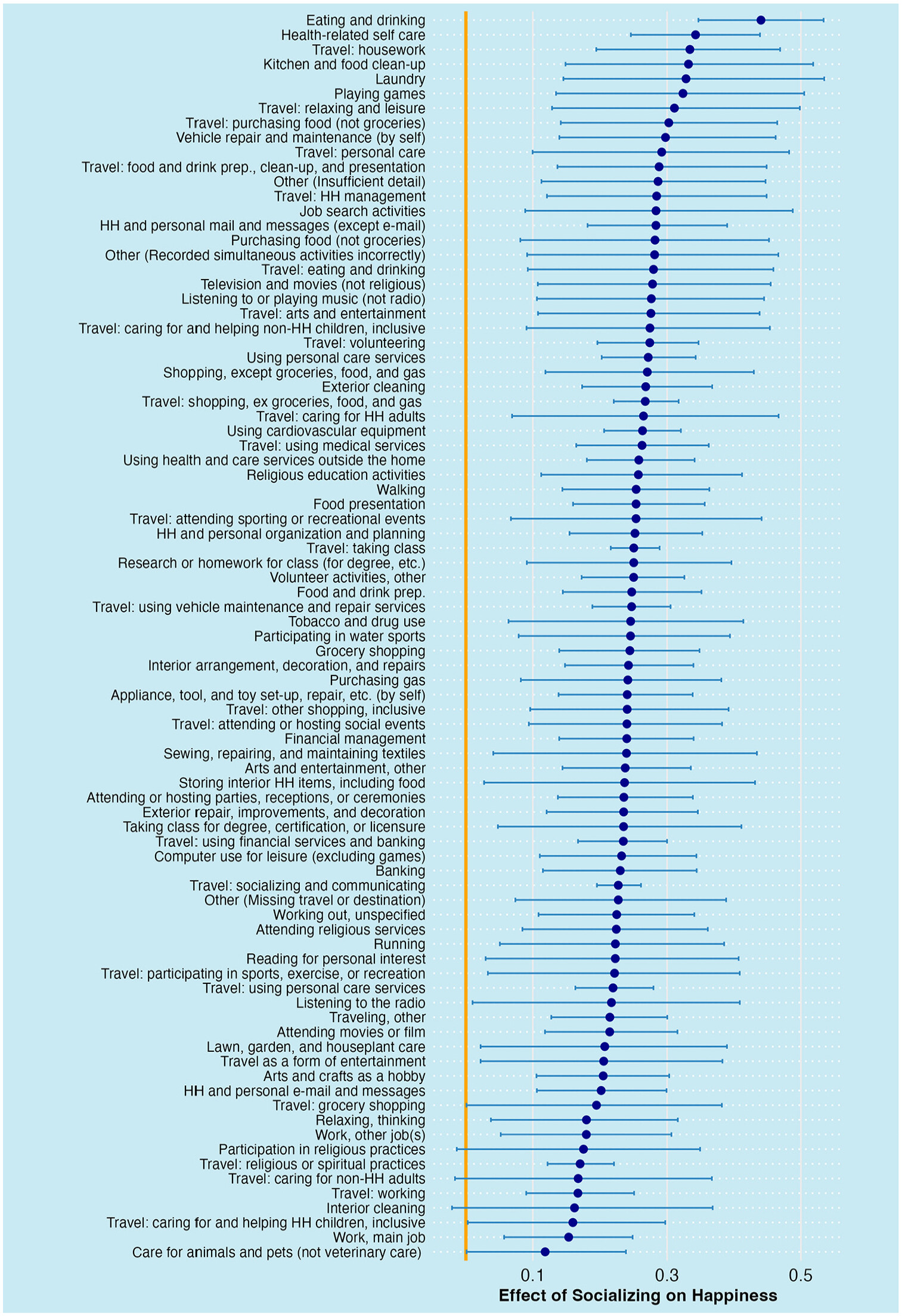
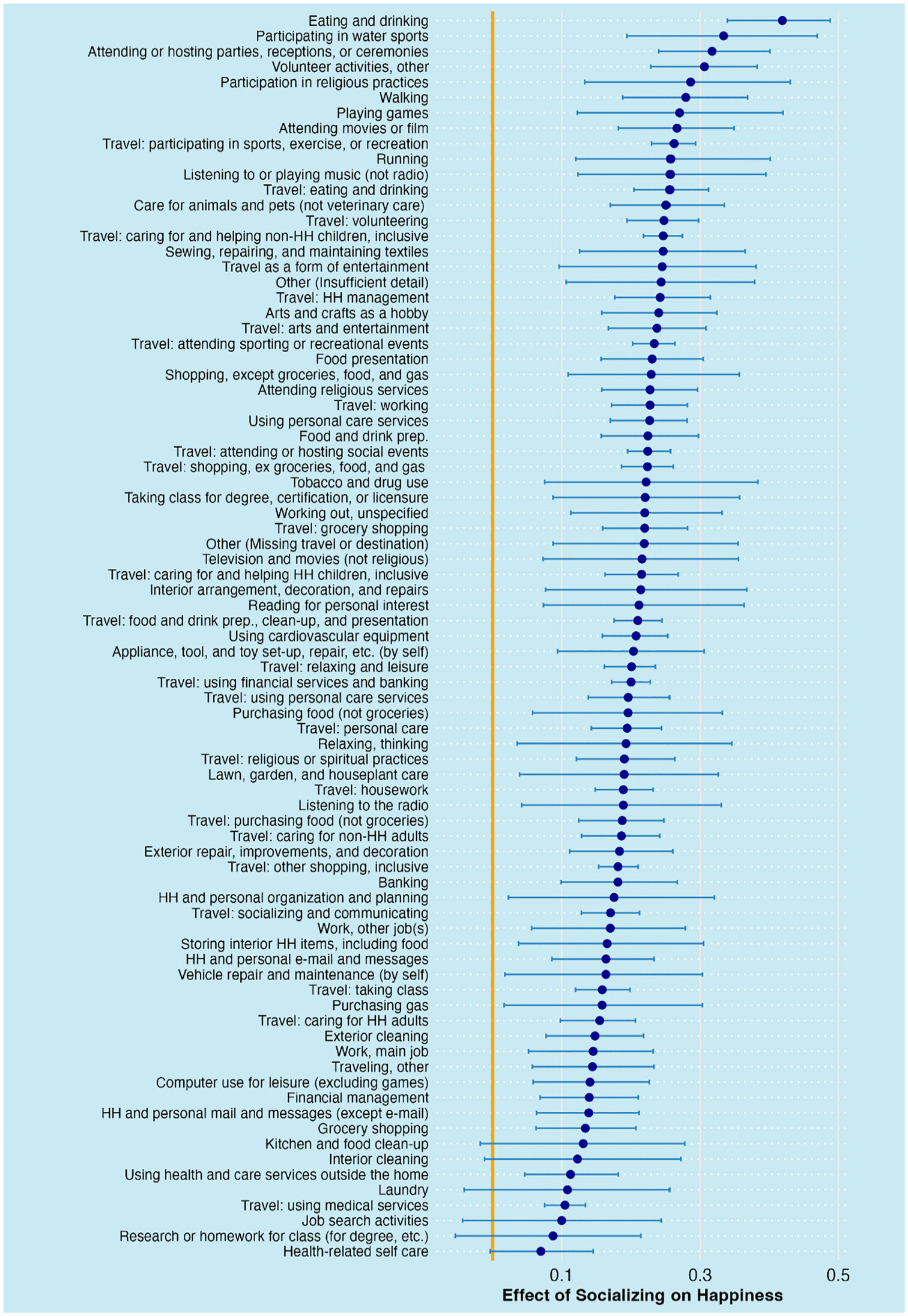
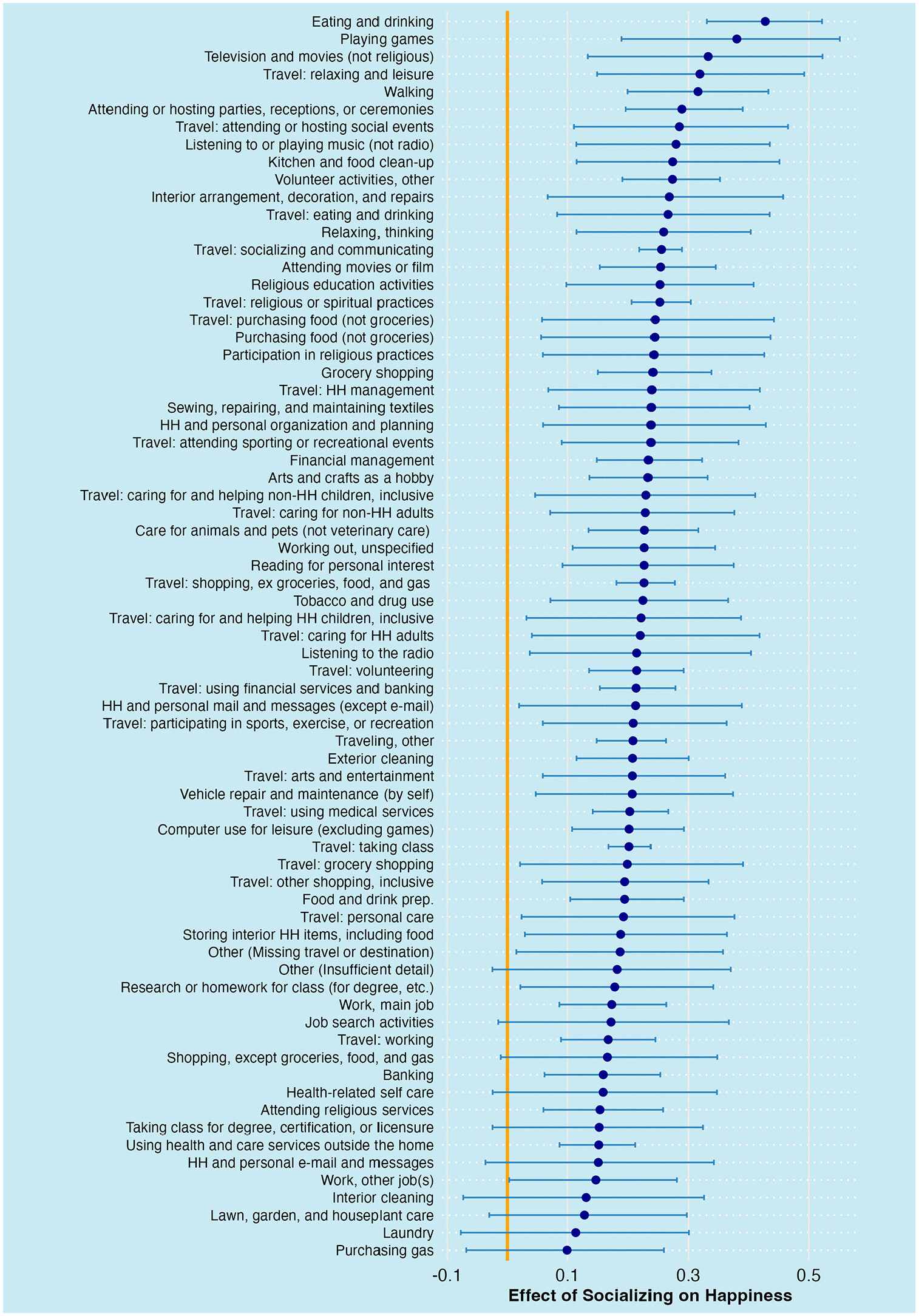
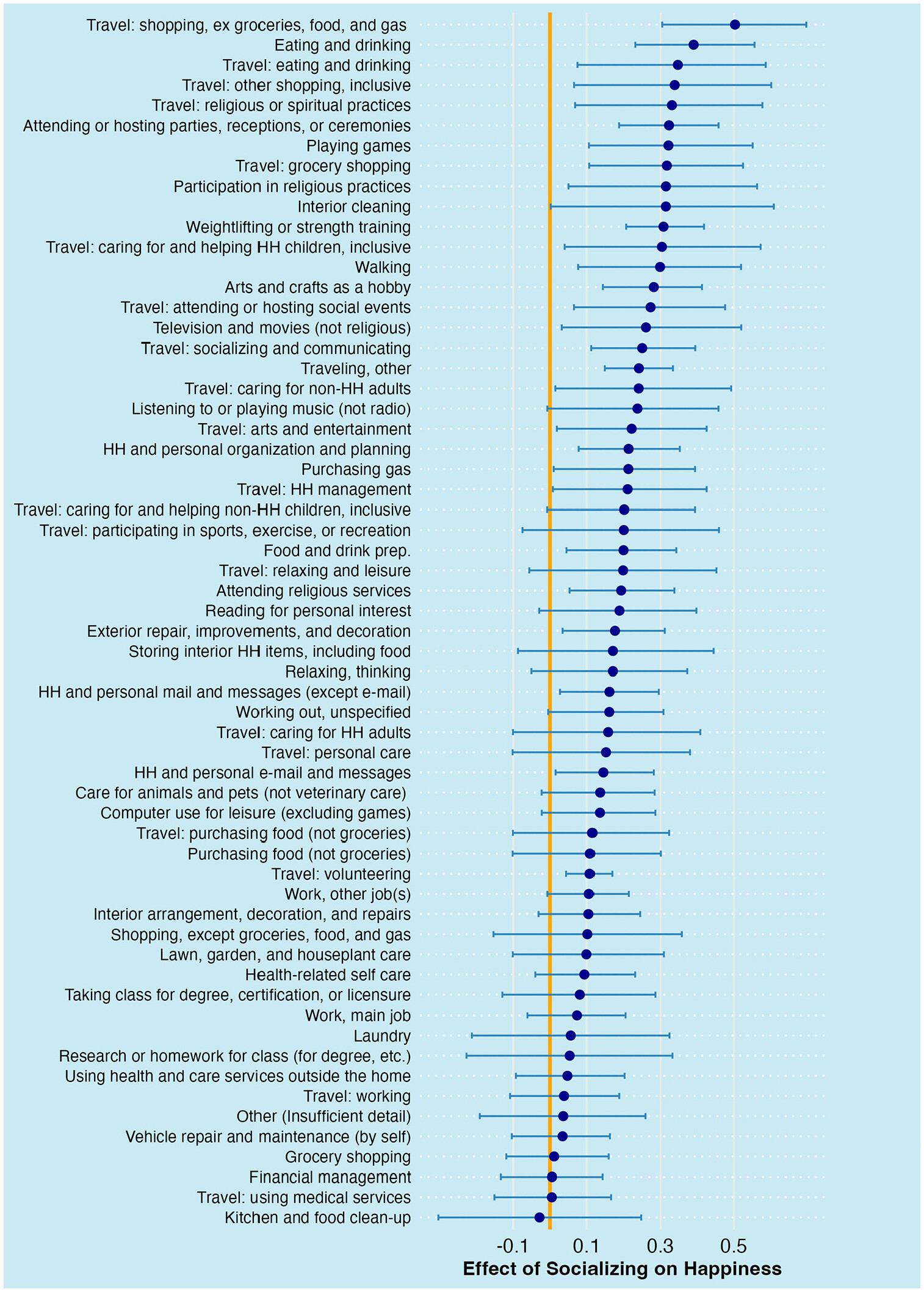
Our primary focus was examining the impact of social interaction on happiness within each activity type (see the supplemental material for the detailed results from the models in each year). We calculated the effect of social interaction for each activity by combining the general effect that social interaction had on happiness across all activities (i.e., the fixed-effect) with the unique adjustment for each specific activity (i.e., the activity-specific random slope adjustment). We then calculated simulation-based 95% uncertainty intervals for each of the activity-specific effects using the sim() function from the arm package in R. The activity-specific estimates are presented in Figures 14 for each of the 2010, 2012, 2013, and 2021 analyses.
Figure 1 Activity Specific Effects of Social Interaction on Happiness for 2010 (Exploratory)
Note. X-axis represents the unit increase on the 0–6 happiness scale associated with socializing during an activity. Colons in the activity titles are placeholders for “related to.” For example, “Travel: grocery shopping” indicates travel related to grocery shopping; HH = Household.
Figure 2 Activity Specific Effects of Social Interaction on Happiness for 2012 (Exploratory)
Note. X-axis represents the unit increase on the 0–6 happiness scale associated with socializing during an activity. Colons in the activity titles are placeholders for “related to.” For example, “Travel: grocery shopping” indicates travel related to grocery shopping; HH = Household.
Figure 3 Activity Specific Effects of Social Interaction on Happiness for 2013 (Preregistered)
Note. X-axis represents the unit increase on the 0–6 happiness scale associated with socializing during an activity. Colons in the activity titles are placeholders for “related to.” For example, “Travel: grocery shopping” indicates travel related to grocery shopping; HH = Household.
Figure 4 Activity Specific Effects of Social Interaction on Happiness for 2021 (Preregistered)
Note. X-axis represents the unit increase on the 0–6 happiness scale associated with socializing during an activity. Colons in the activity titles are placeholders for “related to.” For example, “Travel: grocery shopping” indicates travel related to grocery shopping; HH = Household.
Strikingly, 296 of the 297 activity-specific coefficients were positive. The only negative coefficient across the 4 years was for the effect of socializing on happiness while engaging in kitchen and food clean-up in 2021 (−0.028). In all other years, however, the estimate for this activity was greater than zero, underscoring the robust association between social interaction and happiness. In 2010, 82 of 85 (96%) coefficients were significantly greater than zero, while the proportion of significant effects was somewhat smaller in 2012 (93%) and 2013 (86%). In 2021, a much smaller number of coefficients were significantly greater than zero (48%), likely due to the smaller sample size.
Across the 4 years, eating/drinking tended to show the largest happiness increases when paired with socializing. Travel and active leisure such as walking and running were also some of the activities that displayed the largest increases in happiness when socializing was involved (vs. not). Importantly, however, every single activity we examined was rated as statistically significantly more enjoyable when paired with social interaction in at least 1 year.

Examining the Role of Previous Levels of Happiness (Exploratory)

Previous research suggests that socializing increases happiness (Folk & Dunn, 2023, 2024), but our findings could still reflect reverse causality: people who already felt happy may have been more likely to socialize. If reverse causality fully explains our findings, then controlling for how happy participants felt prior to an activity should eliminate the relationship between socializing and how happy participants felt during the activity.
Because of the ATUS design, we could test this directly. We identified participants who had randomly been asked to rate their happiness for two consecutive activities (e.g., eating from 7–8AM and commuting to work from 8–9AM; ns ranging from 2097 to 4206 per year). We then used multi-level modelling to predict people’s happiness in the second activity from how happy they felt immediately prior to the activity and whether they were interacting with anyone. The model included a random intercept for activity type, but we did not account for clustering by participant because each participant contributed only one consecutive activity pair. Across all years, social interaction still predicted participants’ happiness even after controlling for their prior mood (ps < .029; see Table 2 for a summary). Of course, there are other aspects of the study design that preclude a causal interpretation of our results, which we return to in our discussion. Nevertheless, this analysis helps rule out one alternative explanation for our findings.
Table 2 Fixed Effects of multi-level model Predicting Happiness During Activity From Social Interaction and Prior Happiness
Year/Variablebtp
2010(n= 4206)
 Social interaction (1 = Yes, 0 = No)0.245.35<.001
 Prior happiness0.6047.78<.001
2012 (n= 3785)
 Social interaction (1 = Yes, 0 = No)0.204.35<.001
 Prior happiness0.6145.73<.001
2013(n= 3124)
 Social interaction (1 = Yes, 0 = No)0.244.81<.001
 Prior happiness0.6140.43<.001
2021 (n= 2097)
 Social interaction (1 = Yes, 0 = No)0.132.19.029
 Prior happiness0.6536.77<.001

Moderation Analyses (Exploratory)

Beyond our primary analyses, we assessed whether two characteristics of activities moderated the relationship between social interaction and happiness. Our first moderation analysis was informed by past research suggesting that the impact of sharing an experience with someone depends on whether the activity was enjoyable (e.g., Boothby et al., 2014, 2016). Specifically, we tested whether the relationship between socializing and happiness depended on how enjoyable an activity was when engaged in alone. There was a significant interaction effect in 2010 (p = .008) and 2013 (p = .049), such that socializing was more associated with happiness for activities that were less enjoyable alone. However, these effects were quite small, and they were not statistically significant in 2012 (p = .725) or 2021 (p = .682). Given the somewhat weak evidence for this moderation effect, we provide the full details of the analysis and results in the supplemental material.
We also reasoned that people might choose to socialize during activities that are most enjoyable with others and socialize less frequently during activities that are least enjoyable among company. As discussed, research shows that solitude is most beneficial when it is consciously sought out (Coplan et al., 2019; Weinstein et al., 2023). As such, the relationship between socializing and happiness might be weakest for typically solitary activities like reading, because people may engage in these activities precisely because of their solitary nature. To test for this possibility, we first calculated the proportion of time people reported socializing during each activity (social frequency). Activities such as eating, volunteering, and working involved socializing on over 50% of instances, while reading, arts and crafts, and commuting to work were among the activities most often done in solitude (i.e., socializing 9%–26% of the time). We then used a multi-level model similar to our primary analysis, except we included a fixed interaction term between the social frequency of each activity and the effect of social interaction on happiness. In addition, because our moderator (social frequency) is an activity-level variable that already captures how the effect of socializing varies across activities, we did not include activity-specific random slopes in this model.
As shown in Table 3, the interaction effect was significant in 2010 (p = .009), 2012 (p = .040), and 2013 (p = .040), suggesting that socializing is more strongly associated with happiness for the activities that more typically take place in the company of others. As such, we did find evidence that the most commonly social activities are most enjoyable with others (vs. alone), and that typically solitary activities show relatively smaller increases in happiness when paired with social interaction. Critically, however, even among the most solitary activities, the relationship between social interaction and happiness remained significant. Indeed, when we calculated the simple slope between social interaction and happiness among the 25% most frequently solitary activities (e.g., reading, arts and crafts, commuting), the relationship was significantly positive across all 4 years (ps < .001).
Table 3 Fixed Effects of Model Testing Whether Social Frequency of Activities Moderates the Relationship Between Socializing and Happiness
 btp
2010
 Social interaction (1 = Yes, 0 = No)0.2816.01<.001
 Social frequency (centered)0.863.78<.001
 Social interaction × Solo enjoyability (centered)0.312.63.009
2012
 Social interaction (1 = Yes, 0 = No)0.2413.85<.001
 Social frequency (centered)0.683.31.001
 Social interaction × Solo enjoyability (centered)0.242.06.040
2013
 Social interaction (1 = Yes, 0 = No)0.2714.71<.001
 Social frequency (centered)0.592.18.033
 Social interaction × Solo enjoyability (centered)0.252.06.040
2021
 Social interaction (1 = Yes, 0 = No)0.2310.15<.001
 Social frequency (centered)0.481.73.089
 Social interaction × Solo enjoyability (centered)0.211.37.171

Discussion

Across more than 40,000 participants and more than 100,000 episodes, we found that participants consistently rated every common daily activity as more enjoyable when interacting with someone else. Indeed, across 297 activity-specific coefficients over the 4 years of analyses, only one was negative: in 2021, kitchen clean-up was slightly less enjoyable when social interaction was involved (−0.028). Notably, every activity was significantly more enjoyable with other people in at least 1 year; from using drugs or purchasing gas to grocery shopping or banking, adding a touch of sociability was always associated with greater happiness. Our results also support the reports from attendees of reading parties—reading was significantly more enjoyable with the addition of social interaction in 3 of the 4 years. Of all the activities, eating consistently showed the largest happiness increase when paired with socializing, except in 2021, when it ranked second. In addition, people tended to be much happier when socializing (vs. not) during episodes that involved travel, reflecting the relative pleasure of commuting with company. People were also happier when engaging in active leisure with others, as activities such as walking, running, and working out were all significantly more enjoyable when they involved social interaction.
Because we did not randomly assign participants to engage in these activities with or without social interaction, we cannot draw causal conclusions from our analyses. We did rule out one key confound, however, by showing that social interaction predicted people’s current happiness over and above their prior happiness levels. Nevertheless, our findings do not directly contradict previous experimental work suggesting that sharing negative experiences amplifies displeasure (e.g., Boothby et al., 2014, 2016). Indeed, the naturalistic aspect of the ATUS means that even when people were engaging in an activity in the company of others, they were not necessarily sharing the exact experience. For example, participants may have been on the phone with a friend while cleaning up, rather than scrubbing countertops side by side. In fact, our measure of social interaction was dichotomous (Yes/No), meaning that we cannot differentiate between socializing in-person or over the phone. As such, it is impossible to know how exactly participants were socializing during every activity. Moreover, some activities may be fundamentally different when social interaction is involved; dining alone may involve a simple meal at home, while dining with others might consist of a decadent meal at a fancy restaurant. That said, it is notable that even mundane or unpleasurable activities in our analyses were still more enjoyable with company. In fact, we found some exploratory evidence that socializing was most associated with happiness for the activities that were least enjoyable alone. The findings uncovered here provide an interesting counterpoint to the existing experimental work and highlight the value of descriptive research in psychology (e.g., Asch, 1952; Baumeister et al., 2007; Rozin, 2009).
If everything is better together, then why do people still choose to do things alone? One obvious explanation is that companionship is not always available; even if we want to socialize while we empty the litter box, we may not always have an available friend to chat with. Nevertheless, past research suggests people may underestimate the emotional benefits of interacting with others (Epley & Schroeder, 2014). Consistent with this pattern, even when it came to the activities that were most frequently done alone, people still reported significantly more enjoyment when accompanied with others. This suggests that people may be systematically underestimating how happy they will feel when socializing during activities that are typically solitary.
That said, it is important to note that people are motivated by more than just happiness (Oishi & Westgate, 2021, 2025; Ryan & Deci, 2000) and that solitude is conducive to creativity (Long et al., 2003) and often necessary for many personal pursuits. Indeed, reading parties may be more enjoyable than reading alone, but if we want to finally conquer War and Peace, a little solitude may be necessary. Likewise, preparing for that big exam may require foregoing that always fun — but always unproductive — group study session. Given the potential conflict between social interaction and productivity, it is possible that people focused on productivity (e.g., “productivity orientation”; Keinan & Kivetz, 2011) may be more likely to forego opportunities to socialize during more utilitarian activities.
When considering our findings, it is worth underscoring that the effects are relatively small. For example, on average in 2013, people were 0.22 points happier on the 0–6 happiness scale when they were socializing (vs. not). However, given that people face countless opportunities to socialize throughout their daily lives, these small effects may accumulate into meaningful differences in overall happiness. Indeed, Götz et al. (2022) argue that such small effects can compound over time.
Although this study contained a diverse sample of American adults, it is unclear whether these findings would generalize to other cultural contexts. For example, research suggests that the emotional impact of specific social interactions differs between Eastern and Western cultures (e.g., Pourmand et al., 2021). Moreover, the ATUS does not collect any information on individual differences such as personality. As a result, we were unable to explore how individual differences such as introversion might influence the relationship between socializing and happiness. While it is possible that the relationship might be attenuated for more introverted individuals, there is evidence that the relationship between socializing and happiness is similar across extraverts and introverts (e.g., Epley & Schroeder, 2014; Lucas et al., 2008; Srivastava et al., 2008; Sun et al., 2020).
A key strength of the current study is that we were able to examine an 11-year timespan in which the United States experienced major cultural changes, including a global pandemic and the election of Donald Trump. The consistency between our exploratory (2010 and 2012) and preregistered (2013 and 2021) analyses is remarkable given these societal shifts. Indeed, socializing was still consistently related to increased happiness, even in the wake of the COVID-19 pandemic, although the smaller effect sizes in 2021 likely reflect the additional costs of socializing during this time. Taken together, these results suggest that whether we are eating, reading, or even cleaning up around the house, happiness thrives in the company of others.

Declaration of Conflicting Interests

The author(s) declared no potential conflicts of interest with respect to the research, authorship, and/or publication of this article.

Funding

The author(s) received no financial support for the research, authorship, and/or publication of this article.

ORCID iD

Footnote

Handling Editor: Yuthika, Girme

References

Asch S. E. (1952). Social psychology New York. Prentice Hall.
Baumeister R. F., Leary M. R. (1995). The need to belong: Desire for interpersonal attachments as a fundamental human motivation. Psychological Bulletin, 117(3), 497–529.
Baumeister R. F., Vohs K. D., Funder D. C. (2007). Psychology as the science of self-reports and finger movements: Whatever happened to actual behavior? Perspectives on Psychological Science, 2(4), 396–403.
Bernstein M. J., Zawadzki M. J., Juth V., Benfield J. A., Smyth J. M. (2018). Social interactions in daily life: Within-person associations between momentary social experiences and psychological and physical health indicators. Journal of Social and Personal Relationships, 35(3), 372–394.
Boothby E. J., Clark M. S., Bargh J. A. (2014). Shared experiences are amplified. Psychological Science, 25(12), 2209–2216.
Boothby E. J., Smith L. K., Clark M. S., Bargh J. A. (2016). Psychological distance moderates the amplification of shared experience. Personality and Social Psychology Bulletin, 42(10), 1431–1444.
Coplan R. J., Hipson W. E., Archbell K. A., Ooi L. L., Baldwin D., Bowker J. C. (2019). Seeking more solitude: Conceptualization, assessment, and implications of aloneliness. Personality and Individual Differences, 148, 17–26. https://doi.org/10.1016/j.paid.2019.05.020
Diener E., Seligman M. E. P. (2002). Very happy people. Psychological Science, 13(1), 81–84. https://doi.org/10.1111/1467-9280.00415
Epley N., Schroeder J. (2014). Mistakenly seeking solitude. Journal of Experimental Psychology: General, 143(5), 1980–1999. https://doi.org/10.1037/a0037323
Folk D., Dunn E. (2023). A systematic review of the strength of evidence for the most commonly recommended happiness strategies in mainstream media. Nature Human Behaviour, 7, 1697–1707. https://doi.org/10.1038/s41562-023-01651-4
Folk D., Dunn E. (2024). How can people become happier? A systematic review of preregistered experiments. Annual Review of Psychology, 75(1), 467–493.
Götz F. M., Gosling S. D., Rentfrow P. J. (2022). Small effects: The indispensable foundation for a cumulative psychological science. Perspectives on Psychological Science, 17(1), 205–215.
Kahneman D., Krueger A. B., Schkade D. A., Schwarz N., Stone A. A. (2004). A survey method for characterizing daily life experience: The day reconstruction method. Science, 306(5702), 1776–1780. https://doi.org/10.1126/science.1103572
Keinan A., Kivetz R. (2011). Productivity orientation and the consumption of collectable experiences. Journal of Consumer Research, 37(6), 935–950.
Long C. R., Seburn M., Averill J. R., More T. A. (2003). Solitude experiences: Varieties, settings, and individual differences. Personality and Social Psychology Bulletin, 29(5), 578–583. https://doi.org/10.1177/0146167203029005003
Lucas R. E., Le K., Dyrenforth P. S. (2008). Explaining the extraversion/positive affect relation: Sociability cannot account for extraverts’ greater happiness. Journal of Personality, 76(3), 385–414. https://doi.org/10.1111/j.1467-6494.2008.00490.x
Mehl M. R., Vazire S., Holleran S. E., Clark C. S. (2010). Eavesdropping on happiness. Psychological Science, 21(4), 539–541. https://doi.org/10.1177/0956797610362675
Nguyen T. T., Ryan R. M., Deci E. L. (2018). Solitude as an approach to affective self-regulation. Personality and Social Psychology Bulletin, 44(1), 92–106.
Oishi S., Westgate E. C. (2021). A psychologically rich life: Beyond happiness and meaning. Psychological Review, 129(4), 790. https://doi.org/10.1037/rev0000317
Oishi S., Westgate E. C. (2025). Psychological richness offers a third path to a good life. Trends in Cognitive Sciences. Advance online publication. https://doi.org/10.1016/j.tics.2025.04.002
Pourmand V., Lawley K. A., Lehman B. J. (2021). Cultural differences in stress and affection following social support receipt. PLOS ONE, 16(9), Article e0256859.
R Core Team. (2013). R: A language and environment for statistical computing.
Rohrer J. M., Richter D., Brümmer M., Wagner G. G., Schmukle S. C. (2018). Successfully striving for happiness: Socially engaged pursuits predict increases in life satisfaction. Psychological Science, 29(8), 1291–1298.
Roshanaei M., Vaid S. S., Courtney A. L., Soh S. J., Zaki J., Harari G. M. (2024). Meaningful peer social interactions and momentary well-being in context. Social Psychological and Personality Science, 15(8), 921–932.
Rozin P. (2009). What kind of empirical research should we publish, fund, and reward? A different perspective. Perspectives on Psychological Science, 4(4), 435–439.
Ryan R. M., Deci E. L. (2000). Self-determination theory and the facilitation of intrinsic motivation, social development, and well-being. American Psychologist, 55, 68–78.
Sandstrom G. M., Dunn E. W. (2014). Social interactions and well-being: The surprising power of weak ties. Personality and Social Psychology Bulletin, 40(7), 910–922. https://doi.org/10.1177/0146167214529799
Srivastava S., Angelo K. M., Vallereux S. R. (2008). Extraversion and positive affect: A day reconstruction study of person-environment transactions. Journal of Research in Personality, 42(6), 1613–1618. https://doi.org/10.1016/j.jrp.2008.05.002
Sun J., Harris K., Vazire S. (2020). Is well-being associated with the quantity and quality of social interactions? Journal of Personality and Social Psychology, 119(6), 1478.
Weinstein N., Vuorre M., Adams M., Nguyen T. (2023). Balance between solitude and socializing: Everyday solitude time both benefits and harms well-being. Scientific Reports, 13(1), 21160. https://doi.org/10.1038/s41598-023-44507-7
Yaremych H. E., Preacher K. J., Hedeker D. (2023). Centering categorical predictors in multilevel models: Best practices and interpretation. Psychological Methods, 28(3), 613.
Young M. (2023, December 19). It’s my party and I’ll read if i want to. New York Times. https://www.nytimes.com/2023/12/19/books/reading-rhythms.html

Biographies

Dunigan Folk is a PhD candidate at the University of British Columbia and an incoming post-doctoral researcher at the University of Pennsylvania. His research focuses on how our time and technology use shapes our happiness.
Elizabeth Dunn is a Professor of Psychology at the University of British Columbia whose research explores how time, money, and technology shape human happiness.

Supplementary Material

Please find the following supplemental material available below.

For Open Access articles published under a Creative Commons License, all supplemental material carries the same license as the article it is associated with.

For non-Open Access articles published, all supplemental material carries a non-exclusive license, and permission requests for re-use of supplemental material or any part of supplemental material shall be sent directly to the copyright owner as specified in the copyright notice associated with the article.