[{id=147246, label=Diseases of male genital organs (N40-N53), uri=n40-n53}, {id=147608, label=Female infertility, uri=n80-n98_n97}, {id=145852, label=ICD, uri=icd}, {id=146338, label=Maternal care for other conditions predominantly related to pregnancy, uri=o20-o29_o26}, {id=146392, label=Noninflammatory disorders of female genital tract (N80-N98), uri=n80-n98}, {id=146084, label=Other and unspecified disorders of male genital organs, uri=n40-n53_n50}, {id=146092, label=Other maternal disorders predominantly related to pregnancy (O20-O29), uri=o20-o29}]

n40-n53, n80-n98_n97, icd, o20-o29_o26, n80-n98, n40-n53_n50, o20-o29,
Intended for healthcare professionals
Open access
Research article
First published online August 5, 2021

Development of Early Marriage Attitude Scale: A Multi-Dimensional Scale for Measuring the Attitudes Toward Child Marriage

Abstract

Child marriage can cause lifetime disadvantage and deprivation for female adolescents; however, it is still widespread in developing countries. Evaluation of female adolescents’ attitudes toward child marriage is vital to design adequate prevention programs. The aim of the study was to develop a self-administered scale to measure female adolescents’ attitudes toward child marriage in Malaysia. The scale items were created and refined through four stages: item pool generation, expert review, translations, and pretesting. A pretest was conducted with 30 female adolescents in Kuala Lumpur, Malaysia, to check for understandability of the language, and responses were analyzed. The scale was tested for face and content validities during the expert review process. Forty items were obtained in seven constructs as follows: (a) intuitive decision making, (b) believing in fate, (c) parental economic hardship during adolescence, (d) spiritual belief, (e) social norms, (f) opinion about premarital sex, and (g) relationship with parents/guardians. The results of the pretest proved the comprehensiveness of the items. Early Marriage Attitude Scale (EMAS) was developed to assess female adolescents’ attitudes toward child marriage in Malaysia. The EMAS demonstrated face and content validities and is ready to be tested for further validation among Malaysian adolescents.

Introduction

Child marriage is defined as a formal marriage or informal union below 18 years old. It can cause lifetime disadvantage and deprivation for minors especially females; however, it is still widespread in developing countries. It has been reported by the United Nations Children’s Fund (UNICEF, 2018) that child marriage would severely compromise the well-being of the married adolescent girls when they go through such experiences as early pregnancy, social isolation, unable to continue schooling, limited opportunities for career and vocational advancement, and increased risk of domestic violence. World Health Organization (WHO, 2013) reported that more than 140 million girls globally will become child brides between 2011 and 2020. There is a growing research interest concerning the driving forces of child marriage, and its implication for the health of female adolescents underscores the need for valid measures to assess the female adolescents’ attitudes toward child marriage.
The social and cultural contexts behind child marriage are not evident but wide-ranging, including prevailing gender inequality. In Bangladesh, it is reported that female sexuality is controlled through early marriage (Chowdhury, 2004). Also, one of the main reasons for child marriage is family poverty. Parents in some of the developing countries believe that the girls are an economic burden to the family and decide to marry off their daughters early (Parsons et al., 2015; Petroni et al., 2017). This further leads to a lack of opportunity for the girls to receive education and an inability to participate in the labor force. Globally, there are some known health consequences of child marriage such as problems associated with early intercourse and pregnancy including infant and maternal mortality, repeated pregnancies, the risk for HIV, and other sexually transmitted diseases as well as depression (Ferdousi, 2014; Mahato, 2016; Nour, 2006; Svanemyr et al., 2015). There are other social and economic consequences such as a denial of childhood, social isolation, the restriction of personal freedom, and the lack of educational opportunity (Ferdousi, 2014; Mahato, 2016). It is also notable that child marriage persists through generation by generation; thus, the daughters will likely be facing the same cycle of childhood deprivation as their mothers experienced, who was also married at a young age. There are some programs and policies to prevent child marriage which had shown some evidence for improvement. According to Lee-Rife et al. (2012), the programs that offered incentives and empowered the girls with the information, skills, and support networks in the developing countries had worked to prevent child marriage. Also, enhancing the accessibility for schooling allow girls to be engaged in staying at school and not to quit school due to child marriage (Brown, 2012). Furthermore, by educating and mobilizing the parents, we can anticipate the changes in the social norms of the parents concerning the age of marriage of their daughters (Nour, 2006). Currently, there is no scale to assess the attitudes, perceptions, or opinions about child marriage. The reason for the absence of such a scale may be due to the current main approach of retrospective examination of background after the cases of child marriage become a critical problem in society. If a prospective approach to foresee female adolescents’ attitudes toward child marriage is taken, it can be reflected as the views of the target groups to develop prevention programs for child marriage. The typical programs and activities to prevent child marriage are closely linked with measures to overcome the already-existing problems such as poverty and school dropouts. However, there seems no program that foresees potential tendencies among female adolescents toward child marriage such as personality and perception about premarital sex. Malaysia, an emerging economy in Southeast Asia, is one of such countries facing the problem of child marriage.
There is a scarcity of reliable statistics to report the official rate of child marriage in Malaysia. According to the latest census in 2010, the ratio of adolescent girls who are married between 15 and 19 years old in Malaysia is about 6% within population of that age range (Kohno et al., 2019). The country is in its growth transition phase of an emerging economy and aiming to obtain developed nation status by 2030. The literacy rate of the youth aged 15 to 24 years in Malaysia is quite high with 97% as of 2018 (UNESCO Institute of Statistics, 2020). The use of digital devices such as mobile phones is increasing among the youths in Malaysia. However, there is a digital divide between rural and urban youths (Mohamed et al., 2012). Concerning religious norms and sexuality among Malay youths in Malaysia, the previous study reported that religious activities reduced the risk of continuing sexual activity for female youths but not for male youths. (Muhammad et al., 2017). Under the current legal framework as of December 2018, it is not illegal for female adolescents below 18 years old to be married in Malaysia. Among many reasons why child marriage is socially allowed, one is the Muslim religious value that permits girls to be married after the onset of puberty, coupled with the perception that pregnancy out of wedlock is a sin (Kohno et al., 2019, 2020; Sudan, 2015; Sudan et al., 2012). When parents know that their unmarried daughter is pregnant, they marry off the daughter quickly to avoid the sins of having a baby out of wedlock by the Muslim religious belief and to preserve the family’s dignity. However, a recent statement of concern was raised by a member of Parliament to not blame religion as a reason for child marriage but to focus on the health, psychological, and social implications of the girls who go through child marriage (Ho, 2017). Also, the traditional value and culture supporting child marriage remain common among the ethnic minorities on Borneo Island (Hin, 2017; Kohno et al., 2020). In this context, there is a growing concern against child marriage in Malaysia, which catches media attention as well as concerns of the general public. Also, teenage pregnancy is on the rise in Malaysia, which is a flip of the same coin as child marriage, as most of the teenage pregnant girls out of wedlock either chose to or unable to get married when they find out about pregnancy outside of wedlock (Mohd et al., 2015; K. Omar et al., 2010). Considering this, it can be argued that a measurement scale that allows assessing female adolescents’ attitudes toward child marriage in Malaysia would make a unique contribution to understand why some of the girls get married underage in Malaysia. There is an existing scale that focused on measuring the attitudes of university students toward their parents and about marriage in Northern Cyprus (Görkem & Bengisoy, 2018). Another study, although not in the form of the scale, investigated the effects of female youth’s attitudes on teenage premarital pregnancy in the United States and revealed the factors associated with premarital pregnancy are self-esteem, attitudes toward school, attitudes toward women’s family roles, and educational expectations (Plotnick, 1992).
Valid and reliable measures of attitudes toward child marriage would allow for comparison of responses among female adolescents of different cultural and socioeconomic backgrounds and would allow policy makers and health practitioners to identify what constitutes the attitudes toward child marriage. Therefore, the aim of this study was to develop a multi-dimensional, self-administered scale to measure the attitudes toward child marriage among female adolescents in Malaysia.

Conceptual Frameworks

This study adopted multiple theories as conceptual frameworks to guide our analysis. One is the dual-process approach to health risk decision making (Gerrard et al., 2008). This theory explains that two modes of information processing operate in decision making. While the variation of what is the labeling of these two modes is still in debate, these are typically represented by heuristics/experiential and systematic/analytic reasoning. A more detailed version of the same concept is elaborated by cognitive-experiential self-theory (CEST) which describes that the analytic system is based on effort, logic, and deliberation, while the experiential system is based on impulse, intuition, and image-based (Epstein, 1994; Gerrard et al., 2008). In this study, we adopt these factors of the dual-process approach as the possible determinants of how adolescent girls make decisions about child marriage. The second model used in this study is the locus of control theory (Gerrard et al., 2008). This theory articulates the gradient in people’s belief system that they have control over the outcome of events in their lives at one extreme, and on the other end believe that external forces beyond control are acting to control the outcome of individuals. In this study, we adopt this framework to investigate the component of fate as the expression of external locus of control as the perceived reason for child marriage.

Method

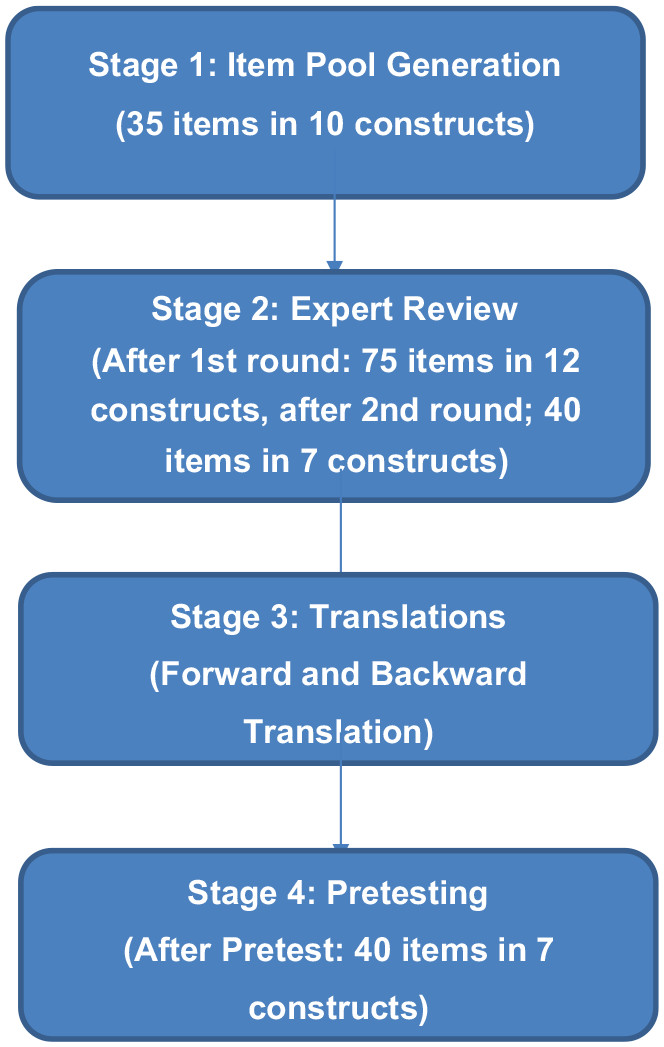
This scale was named the Early Marriage Attitude Scale (EMAS). The development process comprised four stages: item pool generation, expert review, translations, and pretesting. Figure 1 shows the developmental stages.
Figure 1. Four stages of development of the Early Marriage Attitude Scale (EMAS).

Stage 1: Item Pool Generation

The first phase of the item generation was carried out by creating a list of constructs. These constructs were developed based on the findings of the qualitative research studies previously conducted by the researchers. From this study which was conducted among women who had child marriage in Kelantan and Sarawak states in Malaysia, we revealed some factors influencing child marriage, girls’ personality in early adolescence, family poverty, community tolerance toward child marriage, and religiosity (Kohno et al., 2019, 2020). In these studies, the authors identified that not only the individual attitudes and characteristics of the adolescent girls such as fate-believing and engagement in health risk behavior are important but also the relationship with parents is a vital factor influencing the decision of marrying early. Factors influencing child marriage were also identified from the literature review for comprehensiveness, and we used two theories as introduced above. Through the literature review, we found that it is essential to incorporate the aspects of health and economic implications, an opportunity for education, as well as social and cultural factors of the adolescent girls (Brown, 2012; Chowdhury, 2004; Hampton, 2010; Nour, 2006; Parsons et al., 2015; Santhya et al., 2010; Soylu et al., 2014). Based on the results of qualitative findings and literature review, the definitions of each construct for the developed scale were created, and the questions were made in the form of statements that can be responded to by the degree to which a respondent agrees or disagrees. Table 1 shows the initial set of constructs and their definitions. Additional data on the initial list of item pools are available in Online Appendix A.
Table 1. Initial Set of Constructs and Definitions.
Construct No.Construct namesDefinitions
1Intuitive Decision MakingThe action or process of making decisions based on what one feels to be true even without conscious reasoning
2Believing in FateHave faith in the truth or existence of the development of events outside a person’s control, regarded as predetermined by a supernatural power
3Parental Economic Hardship During ChildhoodSevere economic suffering or privation of parents during the period when the respondent was a child (up to 10 years old)
4Parental Economic Hardship During AdolescenceSevere economic suffering or privation of parents during the period following the onset of puberty during which a young person develops from a child into an adult (10–19 years old)
5ReligiosityStrong religious feeling or belief
6Social NormsA standard or pattern relating to society
7Knowledge on Age of MarriageAssessing whether the respondent has knowledge on legal marriage age in Malaysia
8Opinion About Age of MarriageAsking respondents about their opinion about the ideal marriage age
9Perception of MarriageAsking respondents about their perception of marriage
10Opinion About Premarital SexViews about sex before marriage

Stage 2: Expert Review

The expert review was conducted to assess the face and content validities of the item pool. The criterion for selecting the experts for a review panel was based on the individual’s expertise with the focused topic of this study (Davis, 1992). Expertise was defined as having special skills or knowledge that was acquired by training, study, or practice. To keep diversity, experts from multiple academic disciplines as well as occupational types were recruited. Eight experts were invited to participate in the review process from May to August 2018. They were experts in the fields of law, public health, and sociology, whose occupations were the university professors and lecturers, a government officer, and an officer in a non-governmental organization. A review document that contained the list of the constructs, their definitions, and the draft item pool was sent. The experts were asked to assess the fit of each item to the prespecified objectives by choosing among the five response options (strongly agree, agree, neither agree nor disagree, disagree, and strongly disagree; Gehlbach & Brinkworth, 2011). They were also asked to respond on the relevance and clarity of each item against the construct definitions, by responding from five options for relevance (not relevant, somewhat relevant, relevant, very relevant, can’t tell) and clarity (not clear, somewhat clear, clear, very clear, can’t tell) (Gehlbach & Brinkworth, 2011). To assess face validity, “the extent to which a measure reflects what it is intended to measure” was asked (Hardesty & Bearden, 2004). Whereas, for assessing content validity, “the degree to which a measure’s items represent a proper sample of the theoretical content domain of a construct” was asked (Hardesty & Bearden, 2004). The criteria of the face and content validities were chosen to be evaluated in this study so that we can check whether the items can be judged as appropriate by the respondents, as well as to assess the adequacy against the construct of interest (Boateng et al., 2018).
Concerning the evaluation method, a rule for the retention of a question was set in the item pool after expert review as having all the experts rated at least “somewhat relevant” in the evaluation of the relevance, and calculated a score of item content validity index (I-CVI) based on the feedback from the experts (Polit et al., 2007). In addition, the mean construct content validity index (CVI) was checked, as well as the scale content validity index (S-CVI). Based on their responses, I-CVI was calculated, by counting the number of agreements by the experts (numerator), divided by the total number of experts (denominator). The agreement was determined if the experts rated 4 (agree) or 5 (strongly agree) in the question of fit to the objectives. Any rates below 3 (neither agree nor disagree) were considered as not agreed. According to the guidelines set by Polit and Beck (Polit et al., 2007), the cutoff points for the inclusion of items to the scale item with CVI > 0.78 were considered as excellent regardless of the number of experts; thus, this cutoff value was adopted in this study. In the second round of expert review, five experts were asked to evaluate the relevance of each item against the construct definition, by choosing their responses from four options (not relevant, somewhat relevant, relevant, very relevant). The expert agreement meant that the scores of either 3 (relevant) or 4 (very relevant) were chosen. CVI scores for each item were calculated, and the cutoff score of 0.78 was prespecified.

Stage 3: Translations

After the expert review, the item pool was translated from English to Malay as a forward translation and then translated from Malay to English as a backward translation. Forward and backward translation techniques were used to translate the EMAS from English into Malay, using a guideline of a cross-cultural health care research by Sousa et al. (Sousa & Rojjanasrirat, 2011). The purpose of translation is to achieve equivalence between the instrument in the source language (English) and the instrument in the target language (Malay) (Sperber, 2004). The translation process was undertaken from August to September 2018. The forward translation was conducted by two Malay translators who are natives in Malay and had fluency in English. The results of two versions by two translators were checked by a third translator who is a native Malay and has fluency in English, and the translation was finalized by choosing the best translation between the two versions, and minor revisions were made where necessary.
The third translator chose the best translation between the two versions by taking into consideration of the cultural appropriateness and put priority on the choice of commonly used words for ease of understanding. All the translators in the forward translation process checked carefully the translated sentences to translate in “a culturally relevant and comprehensible form while maintaining the meaning and intent of the original items” (Sperber, 2004, p. S124). After that, backward translation was conducted by a translator with a native level of fluency in both English and Malay. A backward translator was given a document describing the list of item pools in Malay and produced the English translation of the scale from the Malay version. The backward translator was blinded and not provided with the original English version of the item pool, nor any other information related to the purpose and objective of the study so that he had no knowledge about the item pool and thus could make an independent and fair judgment in backward translation (Sousa & Rojjanasrirat, 2011; Wild et al., 2005). Because issues concerning culturally sensitive and unique aspects were anticipated to appear during the translation processes, therefore, it was ensured to check for the usage of the most appropriate English wording within the Malaysian cultural context. To fulfill this, after the backward translation was conducted, the developed scale was checked by the researchers and reviewed the translated items for the appropriateness of the contents within Malaysian culture (D. Omar, 2008).
Then, three authors (A.K., M.D., and N.D.N.F.) compared the original English version and the backward translated English version and checked the similarity of the meanings, rather than the precision of word-by-word match. After completing forward and backward translation, the wording of both English and Malay versions of EMAS was finalized.

Stage 4: Pretesting

After translation, a pretest was conducted among 30 female adolescents aged 15 to 17 years old in a public housing community in Kuala Lumpur, Malaysia. These target groups were chosen, as it is important to choose the respondents in a pretest who are as similar as possible to the target respondents when conducting full administration of the scale (Hunt et al., 1982). The setting of the community in which we conducted data collection was the public housing community in Kuala Lumpur which was built to overcome the issue of squatters and provide affordable housing for the low-income group in Malaysia (Hashim et al., 2012).
The typical setting of these public housing communities is that the building is high and densely populated with many family members and shares common space such as parks, small shops, parking for cars and motorcycles, and a playground for the children (D. Omar, 2008). At one community complex, several thousand residents cohabit in multiple buildings. The pretest aimed to check whether the developed scale was properly understood by the target group in terms of language and comprehension and whether the expected responses could be obtained from them. A pretest was conducted in a self-administered format to 30 participants as this number was considered as a desirable sample size for a pretest (Perneger et al., 2015). The response options were formatted in a 5-point Likert-type scale (strongly agree, agree, neither agree nor disagree, disagree, strongly disagree), and the respondents were asked to mark the response that they agreed the most. To calculate the score, the responses were assigned with the points of 5 for strongly agree and 1 for strongly disagree. For some of the reversed question items, the highest points were assigned to the strongly disagree response option. In this pretesting phase, a response option of “I don’t understand the question” had been added to identify respondents who did not understand the meaning of the questions. When respondents chose this option, it will not be scored. After each of the respondents completed the self-administered questionnaire, they were asked to have a short debriefing session with the interviewers in a face-to-face interview mode. The respondents were asked by the interviewer about their comprehension (What do you understand about this question?), clarity of the questions (Which question has unclear wording?), length of the scale (Do you think we need to shorten this questionnaire?), and whether there was any other content which should be included in the scale (Is there any other question that you think should be included in this questionnaire?). These were important because they had helped the researchers to assess the easiness of respondents answering the scale with regard to its length besides the contents. The conversation had been recorded with the permission of the respondents. Subsequently, the recorded conversation was transcribed in Malay, then translated into English, followed by an analysis of the responses qualitatively. The analysis of the debriefing data was conducted by assigning codes and counting frequencies. The analysis results were used to improve the readability and the comprehensiveness of the scale as had been performed in other studies of questionnaire development (Mohtadi et al., 2012).

Ethical Considerations

All respondents were explained in advance about the purpose and the summary of the study, qualification, procedure, voluntary nature of the participation, and the expected risk and benefit to the individual as well as to the community. Especially, the confidentiality of the respondents was ensured, and the time to explain confidentiality was set aside, using a participant information sheet. Signed consent was received from both the parents or guardian and the participants. This research was approved by the Kyoto University Graduate School and Faculty of Medicine Ethics Committee (R1026) as well as the University of Malaya Research Ethics Committee (UM.TNC2/RC/H&E/UMREC-163).

Results

The EMAS is a 40-item questionnaire with Likert-type response purporting to measure the female adolescents’ attitudes toward child marriage. The instrument is designed to elucidate the following seven domains: (a) intuitive decision making, (b) believing in fate, (c) parental economic hardship during adolescence, (d) spiritual belief, (e) social norms, (f) opinion about premarital sex, and (g) relationship with parents/guardians. The initial draft of EMAS before expert review consisted of 10 domains, which was reduced after refinement. The initial construct of “religiosity” was modified as “spiritual belief” with the definition of “a religious conviction relating to the human spirit or soul as opposed to material or physical things.” Also, a new construct of “relationship with parents/guardians” was added, with the definition of “the state of being connected to a father, a mother and/or guardians.”

Expert Review

The CVI was calculated using data of experts’ evaluation of fit to objective (Table 2), and I-CVI is available in Online Appendix B. As the CVI for all constructs were above the prespecified value, all constructs were maintained and proceed to the next step. The experts were also invited to create new items if they felt that the provided list of item pools did not sufficiently reflect what it purports to assess in each construct. This procedure was added as a way to improve the content validity of the developed scale by obtaining a proper representation of the constructs (Hardesty & Bearden, 2004).
Table 2. Mean CVI for Each Construct (First Step of Expert Review).
Construct nameCVI
Construct 1 (Intuitive Decision Making)0.97
Construct 2 (Believing in Fate)0.97
Construct 3 (Parental Economic Hardship During Childhood)0.84
Construct 4 (Parental Economic Hardship During Adolescence)0.80
Construct 5 (Religiosity)0.92
Construct 6 (Social Norms)1.00
Construct 7 (Knowledge on Age of Marriage)0.88
Construct 8 (Opinion About Age of Marriage)0.94
Construct 9 (Perception of Marriage)0.94
Construct 10 (Opinion About Premarital Sex)0.94
Note. CVI = content validity index.
The experts suggested 40 new items (available in Online Appendix C), which led to the second version of the item pool of 12 constructs with 75 items. Among the added items, two of them were adapted from the Duke University Religion Index (DUREL), a scale on religiosity (Koenig Harold et al., 1997). The three researchers (A.K., M.D., and N.D.N.F.) selected the items by carefully reviewing the expanded item pool, with the mind of a parsimonious selection of items to only select the items which are deemed pertinent. In the end, seven constructs with 44 questions were chosen as the finalized item pool. The list of revised item pool at the second round of expert review is shown in Online Appendix D. This time, five experts were asked to evaluate the relevance of each item against the construct definition, by choosing their responses from four options (not relevant, somewhat relevant, relevant, very relevant). The expert agreement meant that the scores of either 3 (relevant) or 4 (very relevant) were chosen. CVI scores for each item were calculated, and the cutoff score of 0.78 was prespecified. Table 3 shows the CVI for each construct concerning the evaluation of relevance in the second round of expert review, before and after item deletion. I-CVI values for each item in the second round of expert review are shown in Online Appendix E.
Table 3. Mean CVI for Each Construct (Second Step of Expert Review).
Construct nameCVICVI (after item deletion)
Construct 1 (Intuitive Decision Making)0.940.97
Construct 2 (Believing in Fate)1.001.00
Construct 3 (Parental Economic Hardship During Adolescence)0.831.00
Construct 4 (Religiosity)0.880.91
Construct 5 (Social Norms)0.920.92
Construct 6 (Opinion About Premarital Sex)0.941.00
Construct 7 (Relationship With Parents)0.800.80
Note. CVI = content validity index.
In the second round of expert review, four items with low I-CVI values from the item pool were eliminated and resulted in seven constructs with 40 items. The values of mean CVI for each construct were above the prespecified cutoff point even before the elimination of four items but improved after item reduction (Table 4). Table 4 shows the list of finalized items before translations and pretesting.
Table 4. Finalized Item Pool at the End of Expert Review.
ConstructItem No.Items
Intuitive Decision-Making1I tend to make decisions based on what my instinct tells me
2I will not think instinctively when I make important life decisions such as marriage
3I make decisions rationally when I make important life decisions such as marriage
4It is important to think over upon the idea when making important life decisions such as marriage
5I will make decisions instinctively if I am under duress
6I will make decisions instinctively if I am forced into a specific circumstance such as marriage due to pregnancy
7I always consult others (e.g., family and friends) for assistance in making my decisions
Believing in Fate8I believe in fate
9My future is determined by fate
10My life is influenced by my destiny
11I do not allow my future to be determined by fate
12My fate is determined by my actions or decisions
13I believe whatever happened to me is already predestined
Parental Economic Hardship During Adolescence14I had to work to pay for my basic needs such as food and shelter during my adolescent years
15I have completed 11 years of schooling (Standard 1–Form 5)
16I assisted my parents to earn income to support my family during my adolescent years
17In my view, my family was poor during my adolescent years. Poor means having little money and/or few possessions
Spiritual Belief18I believe in God; therefore, I will not do what is forbidden in my religion
19I will be punished by God if I commit a sin
20I should never do anything sinful
21In my religion, it is all right to marry at the age below 18 years old
22My religious beliefs are what really lie behind my whole approach to life
23I try hard to carry my religion over into all other dealings in life
Social Norms24I think that I care about what the community member thinks about my behavior
25I don’t care about what anybody says but believe in what I think and do
26I want to make sure that people in my community accept me
27In my community, it is normal to get married below 18 years old
28I worry that my neighbors and friends would say negative things if I get married below 18 years old
Opinion About Premarital Sex29I think it is all right to have sex before marriage, if a couple is in love
30I am totally against the idea of having premarital sex for any reason
31I think it depends on the circumstances whether premarital sex is acceptable or not
32Premarital sex is prohibited/not accepted in my culture and religion
33Premarital sex is illegal
34I think it is all right to have sex before marriage even if a couple is NOT in love
35I understand what will happen to my health and well-being if I have premarital sex
Relationship With Parents36I get along very well with my parents
37I am happy with how my parents treat me
38I sometimes feel like wanting to escape from my parents
39I tell everything to my parents
40I wish my parents would spend more time with me

Pretesting

Thirty female adolescents participated in the pretest that took place in October 2018. The mean age was 15.8 years; the majority are attending secondary school, are Malay ethnicity (73%), embrace Islam (77%), and are current students (83%). The socio-demographic information of the respondents is shown in Table 5.
Table 5. Socio-Demographic Information of the Respondents (N = 30).
Categoryn (%)
Age15.8 years
 1514 (47%)
 169 (30%)
 177 (23%)
Education
 Standard 6 (12 years old)1 (3%)
 Form 3 (13 years old)16 (53%)
 Form 4 (14 years old)8 (27%)
 Form 5 (15 years old)5 (17%)
Ethnicity
 Malay22 (73%)
 Indian7 (23%)
 Others1 (3%)
Religion
 Islam23 (77%)
 Hindu6 (20%)
 Christian1 (3%)
Employment status
 Student25 (83%)
 Employed4 (13%)
 No answer1 (3%)
Number of siblings
 23 (10%)
 34 (13%)
 46 (20%)
 More than 517 (56%)
It took 10 to 25 min for them to complete the questionnaire, and on average, it took 5 min for the debriefing interview. Due to the illiteracy of one respondent, the scale was administered to her as an interview mode, by the interviewer reading the questions aloud, and based on the oral responses from this respondent, the interviewer marked down the responses in the response sheet on her behalf. It took 1 hr to complete the scale in this way.
The summary data of the score are shown in Table 6 (details are available in Online Appendix F). The percentage of midpoint responses out of all possible responses was 15% (179/1,200). The percentage of “I don’t understand” responses out of all possible responses was 0.75% (9/1,200). The percentage of missing data (no response) was 0.33% (4/1,200).
Table 6. Summary of the Score.
Summary dataScores
Mean (range)112.9 (95–130)
Median115.5

Data Analysis

The data were analyzed descriptively. Table 7 shows the construct evaluation measures.
Table 7. Construct Evaluation Measures of the Pretest (Descriptive Statistics).
MeasuresMSDPossible rangeActual rangeSkew
Intuitive Decision-Making17.62.790–3512–22–0.34
Believing in Fate20.32.980–3012–25–0.16
Parental Economic Hardship During Adolescence11.82.530–208–170.32
Spiritual Belief24.53.150–3019–29–0.15
Social Norms14.52.210–2510–200.49
Opinion About Premarital Sex11.73.000–357–180.29
Relationship With Parents12.42.280–259–170.49
Total score112.88.480–20095–130–0.08
As shown in Table 7, most of the mean scores for each construct are fair. The low means were observed for the construct of “Opinion About Premarital Sex,” which indicates that the respondents tend to have a conservative view toward this construct. There was no outlier in these data by checking the box plots of the scores for each construct. There were some missing values, and the mean imputation method was used. Missing data were substituted with the mean value of that item. Therefore, it can be concluded that the items in this scale were understood properly by the respondents in this pretest, and the scale is relevant to this group in demonstrating a common ground.
The analysis of the debriefing data was conducted by assigning codes and counting frequencies. The transcripts of the debriefing were analyzed by checking the response to the four questions. The summary of codes is described in Table 8.
Table 8. Codes of Debriefing Data (N = 30).
CategoryCodeFrequency (number of respondents)%
Scale ContentsUnderage marriage1653
Importance of marriage13
Opinion on premarital sex and the relationship with parents13
Teenagers who get married due to pregnancy13
Social issue among teenagers, about non-marriage relationship13
Unclear WordingGerak Hati (intuition)517
Cenderung (tend to)27
Ditetapkan (predestined)27
No problem1033
Scale LengthAcceptable as it is2480
Little bit long27
Additional QuestionNone2273
Relationship with friends/influence from friends27
Individual emotions13
Based on the results of the analysis of debriefing data concerning Scale Contents, the content of the scale was understood by about half of the respondents. In terms of unclear wording, some specific words were difficult for some of the respondents to understand. For example, some of them did not understand what it means by “follow the instinct.” They know the word “instinct,” but it is not clear for them to conceptually imagine what the situation is like, because of lack of life experience. In terms of the scale length, most of the respondents stated that it is adequate. Concerning the addition of questions, although there were some minor opinions to add questions on a relationship with friends and individual emotions, it was decided not to include them in the scale, to maintain the scope of this scale.
The open-ended discussions were conducted between the respondents and the interviewer, concerning what was the impression the respondents had about the topic of child marriage. Some of the respondents understood that child marriage is a bad thing, and by taking part in the research, they can help prevent child marriage. Some of them clearly stated that pregnancy is the reason why some of the girls get married at a young age. They also raised concerns that those girls who get married at a young age do not know what the risks of child marriage are. The girls knew that those who get marry early are not afraid of the potential risks associated with child marriage because they are unaware of such risks. Other respondents thought it is normal to get married at a young age, as they see their friends and acquaintances getting married early.

Discussion

In this study, a scale to measure the attitudes toward child marriage (EMAS) was developed and pretested among female adolescents, aged between 15 and 17 years old, in Malaysia. It is well known that this age range is the time when some of the girls who are vulnerable to the risk of child marriage would encounter the possibility of choosing child marriage, due to such factors as an experience of premarital sex or pregnancy. Therefore, it is important to assess the attitudes of young female adolescents toward child marriage, before they are exposed to such risks critically. Various studies on adolescent health take into consideration of the appropriate age of the target group. For example, in the study of adolescent pregnancy outcomes and risk factors in Malaysia, the girls aged 10 through 19 years were targeted for analysis (K. Omar et al., 2010). In the study asking about premarital sexual intercourse, the study targeted students aged 12 through 19 years old (Lee et al., 2006). The study of the determinants of sexual intercourse among unmarried youths in Malaysia targeted unmarried girls aged between 15 and 21 years old (Zulkifli & Low, 2000). Some of the studies include as young as 10 years old. However, in our study, it is not necessary to include those youngest adolescent group aged 10 to 14 years old, as the subject matter included in this scale may be sensitive and something they have never thought about before. Although a recent case of child marriage of an 11-year-old girl marrying a 41-year-old man shocked Malaysian society, and it can be observed that lowering the age of marriage in extreme cases is perceived as a problem in Malaysia, it is still a rare case (“41-Year-Old Man Wanted to Marry Child Bride Since She Was 7,” 2018). Considering the age range of the target group in the aforementioned studies, and the discussion points as elaborated earlier, it is recommended that the targeted age range for this scale should be set conservatively as the female adolescents aged between 15 and 17 years old.
Another aspect of the discussion is the scoring method, including the format of the response options for this scale. In this scale, it is recommended to adopt the 4-point Likert-type scale response options without the midpoint response: strongly agree, agree, disagree, strongly disagree. This is because of the response observed from the pretest, as well as two arguments made by the studies concerning scale development by other researchers. One argument is that, in the longitudinal study of asking about political opinion, the young adolescent group (12–14 years old) tended to choose relatively more midpoint options, compared with the older adolescent group (18 years old and above) (Raaijmakers et al., 2000). Another researcher pointed out that, given the limitations of children’s cognitive ability and communicative and social skills, it is expected that they are sensitive to “the temptation to satisfice by choosing a neutral mid-point when this is not the optimal answer” (Borgers et al., 2004, p. 20). Furthermore, in our study, the rate of choosing the midpoint response was 15% out of all possible responses. This rate is not outstanding, yet may be improved if the response with a clear direction was chosen. Considering these findings, therefore, it is recommended that this scale adopts the response options without midpoint. Taking into consideration, the scoring method shall be determined as a future study, once further validity and reliability tests have been completed.
Regarding the comprehensiveness of the instrument, the debriefing analysis revealed the scale was well received by the assumed target group. Only a few participants reported some difficulty understanding the words used in the questions. Therefore, it is recommended that this scale be administered as self-administration mode, with the option of reading aloud to the respondents who have reading difficulty. In a future study, it is recommended to add explanations to those words which were deemed difficult, to enhance understanding, but not to change the words of the items of this scale, as it is important to maintain these words, and given that the response was relatively few.
The implication of this study to the health of adolescents is numerous. One obvious advantage is to be able to assess their perceptions about child marriage as scores, which can be utilized to come up with the policies and programs regarding adolescent health. The scale consists of such construct as an opinion about premarital sex. By understanding the adolescent girls’ perception of premarital sex, the data can be used to develop educational materials that support and empower adolescent girls with more adequate knowledge of sexual health. Another implication is that this scale can be used for health promotion. The summary scores of EMAS can be used to communicate and heighten the awareness of not only the girls but also the parents, teachers, and other community members who play an important role in the improvement process of adolescent health.

Strengths and Limitations

This is the first scale developed to assess the attitudes of female adolescents toward child marriage. The development process was comprehensive as a qualitative study, literature review, expert review, and the feedback obtained from the targeted group in the debriefing interviews during the pretest. Because it is important to hear from the adolescent girls about their perceptions and attitudes toward child marriage, by doing so, we can enhance understanding of what are the variables that are influencing their decisions concerning child marriage, and reflect the voices of the girls who may be exposed to the risk of child marriage in a tangible form as the scale scores. We believe that this scale can be utilized by the practitioners and government officers who oversee in creating policies to prevent child marriage, to capture the real perception and attitudes of the adolescent girls related to the 10 constructs that are included in this scale. Limitations of this study are that this scale as its current form includes redundancy of the items, which is purposefully maintained at this stage. The elimination of redundancy shall be based on the results of factor analysis with several hundred participants. Also, bias arising from the question order and other sources were not explored in this study. Furthermore, an open-ended question may add values by collecting data that reflect the true feelings of the respondents. Therefore, such a question as “Why do you think some girls get married before the age of 18?” can be added to this EMAS scale. The scores of EMAS during the pretest must be interpreted with caution as some respondents chose the response option of “I don’t understand the question.” In such a case, they received zero points; therefore, the score may not represent the results fairly. Hence, this pretest resulted in just tentative conclusions about the contents. Another limitation is concerning the applicability of this scale to multiple ethnic groups. Most of the respondents in the pretest were Malay ethnic group, with some Indians, but there were no representatives from Chinese. Therefore, caution is required when adopting this scale to all ethnicities even in Malaysia. The EMAS as in its current form must be checked for reliability and validity by applying this to a larger sample as a pilot test and conduct factor analysis for the considerations of item reduction and identification and confirmation of distinct constructs before usage. In future studies, the authors aim to identify and delete the redundant items, the least useful, and irrelevant, to produce a concise instrument with a minimum number of items and allow for wider usage in various settings. Furthermore, EMAS can be used in cross-cultural research as items are made available in English, although the items must go through the pretest for content validation. In the end, the EMAS is a good measure of assessing female adolescents’ attitudes toward child marriage and can be applied once the necessary validations are conducted.

Conclusion

This study resulted in the initial development of a new measure, the EMAS. The EMAS has been shown to demonstrate face and content validities. The availability of such an instrument would accelerate research in finding out more about the relationship between the attitudes of female adolescents and the occurrence of child marriage.

Acknowledgments

The authors would like to express appreciation to the experts as well as the respondents of this study.

Declaration of Conflicting Interests

The author(s) declared no potential conflicts of interest with respect to the research, authorship, and/or publication of this article.

Funding

The author(s) disclosed receipt of the following financial support for the research and/or authorship of this article: This report was made possible with financial support of scholarship awarded to A.K. from Soroptimist International of Kyoto.

ORCID iD

References

Boateng G. O., Neilands T. B., Frongillo E. A., Melgar-Quiñonez H. R., Young S. L. (2018). Best practices for developing and validating scales for health, social, and behavioral research: A primer. Frontiers in Public Health, 6, Article 149.
Borgers N., Sikkel D., Hox J. (2004). Response effects in surveys on children and adolescents: The effect of number of response options, negative wording, and neutral mid-point. Quality & Quantity, 38(1), 17–33.
Brown G. (2012). Out of wedlock into school: Combating child marriage through education. https://educationenvoy.org/wp-content/uploads/2013/09/Child-Marriage.pdf
Chowdhury F. D. (2004). The socio-cultural context of child marriage in a Bangladeshi village. International Journal of Social Welfare, 13(3), 244–253.
Davis L. L. (1992). Instrument review: Getting the most from a panel of experts. Applied Nursing Research, 5(4), 194–197.
Epstein S. (1994). Integration of the cognitive and the psychodynamic unconscious. American Psychologist, 49(8), 709–724.
Ferdousi N. (2014). Child marriage in Bangladesh: Socio-legal analysis. International Journal of Sociology and Anthropology, 6(1), 1–7.
41-year-old man wanted to marry child bride since she was 7. (2018, July 17). The Star Online. https://www.thestar.com.my/news/nation/2018/07/17/41-year-old-man-wanted-to-marry-child-bride-since-she-was-7/
Gehlbach H., Brinkworth M. E. (2011). Measure twice, cut down error: A process for enhancing the validity of survey scales. Review of General Psychology, 15(4), 380–387.
Gerrard M., Gibbons F. X., Houlihan A. E., Stock M. L., Pomery E. A. (2008). A dual-process approach to health risk decision making: The prototype willingness model. Developmental Review, 28(1), 29–61.
Görkem A., Bengisoy A. (2018). Investigating the attitude of PCG University Students towards their parents and towards marriage. Higher Education Studies, 8(1), 18–24.
Hampton T. (2010). Child marriage threatens girls’ health. Journal of the American Medical Association, 304(5), 509–510.
Hardesty D. M., Bearden W. O. (2004). The use of expert judges in scale development: Implications for improving face validity of measures of unobservable constructs. Journal of Business Research, 57(2), 98–107.
Hashim A. E., Samikon S. A., Nasir N. M., Ismail N. (2012). Assessing factors influencing performance of Malaysian low-cost public housing in sustainable environment. Procedia—Social and Behavioral Sciences, 50, 920–927.
Hin O. K. (2017). Child marriages in Malaysia: Reality, resistance and recourse. http://docplayer.net/54549935-Child-marriages-in-malaysia-reality-resistance-and-recourse.html
Ho K. Y. (2017, September 10). Child marriages: Don’t bring religion into it, says DAP MP. FMT News. https://www.freemalaysiatoday.com/category/nation/2017/09/10/child-marriages-dont-bring-religion-into-it-says-dap-mp/
Hunt S. D., Sparkman R. D. Jr., Wilcox J. B. (1982). The pretest in survey research: Issues and preliminary findings. Journal of Marketing Research, 19, 269–273.
Koenig Harold G., Keith M., George P. (1997). Religion index for psychiatric research: A 5-item measure for use in health outcome studies. American Journal of Psychiatry, 154, 885–886.
Kohno A., Dahlui M., Farid N. D. N., Ali S., Nakayama T. (2019). In-depth examination of issues surrounding the reasons for child marriage in Kelantan, Malaysia: A qualitative study. https://bmjopen.bmj.com/content/9/9/e027377
Kohno A., Dahlui M., Farid N. D. N., Safii R., Nakayama T. (2020). Why girls get married early in Sarawak, Malaysia—An exploratory qualitative study. BMC Women’s Health, 20(1), 1–13.
Lee L. K., Chen P., Lee K., Kaur J. (2006). Premarital sexual intercourse among adolescents in Malaysia: A cross-sectional Malaysian school survey. Singapore Medical Journal, 47(6), 476–481.
Lee-Rife S., Malhotra A., Warner A., Glinski A. M. (2012). What works to prevent child marriage: A review of the evidence. Studies in Family Planning, 43(4), 287–303. https://doi.org/10.1111/j.1728-4465.2012.00327.x
Mahato S. K. (2016). Causes and consequences of child marriage: A perspective. International Journal of Scientific and Engineering Research, 7(7), 697–702.
Mohamed H., Judi H. M., Nor S. F. M., Yusof Z. M. (2012). Bridging digital divide: A study on ICT literacy among students in Malaysian rural areas. Australian Journal of Basic and Applied Sciences, 6(7), 39–45.
Mohd M. A., Adibah H., Haliza G. (2015). A review of teenage pregnancy research in Malaysia. The Medical Journal of Malaysia, 70(4), 214–219.
Mohtadi N. G., Griffin D. R., Pedersen M. E., Chan D., Safran M. R., Parsons N., Sekiya J. K., Kelly B. T., Werle J. R., Leunig M., McCarthy J. C., Martin H. D., Byrd J. W. T., Philippon M. J., Martin R. L., Guanche C. A., Clohisy J. C., Sampson T. G., Kocher M. S. . . . Multicenter Arthroscopy of the Hip Outcomes Research Network. (2012). The development and validation of a self-administered quality-of-life outcome measure for young, active patients with symptomatic hip disease: The International Hip Outcome Tool (iHOT-33). Arthroscopy: The Journal of Arthroscopic & Related Surgery, 28(5), 595–605.
Muhammad N. A., Shamsuddin K., Sulaiman Z., Amin R. M., Omar K. (2017). Role of religion in preventing youth sexual activity in Malaysia: A mixed methods study. Journal of Religion and Health, 56(6), 1916–1929.
Nour N. M. (2006). Health consequences of child marriage in Africa. Emerging Infectious Diseases, 12(11), 1644–1649.
Omar D. (2008). Communal living environment in low cost housing development in Malaysia. Asian Social Science, 4(10), 98–105.
Omar K., Hasim S., Muhammad N. A., Jaffar A., Hashim S. M., Siraj H. H. (2010). Adolescent pregnancy outcomes and risk factors in Malaysia. International Journal of Gynecology & Obstetrics, 111(3), 220–223.
Parsons J., Edmeades J., Kes A., Petroni S., Sexton M., Wodon Q. (2015). Economic impacts of child marriage: A review of the literature. The Review of Faith & International Affairs, 13(3), 12–22.
Perneger T. V., Courvoisier D. S., Hudelson P. M., Gayet-Ageron A. (2015). Sample size for pre-tests of questionnaires. Quality of Life Research, 24(1), 147–151.
Petroni S., Steinhaus M., Fenn N. S., Stoebenau K., Gregowski A. (2017). New findings on child marriage in sub-Saharan Africa. Annals of Global Health, 83(5–6), 781–790.
Plotnick R. D. (1992). The effects of attitudes on teenage premarital pregnancy and its resolution. American Sociological Review, 57, 800–811.
Polit D. F., Beck C. T., Owen S. V. (2007). Is the CVI an acceptable indicator of content validity? Appraisal and recommendations. Research in Nursing & Health, 30(4), 459–467.
Raaijmakers Q. A., Van Hoof J., ’t Hart H., Verbogt T. F., Vollebergh W. A. (2000). Adolescents’ midpoint responses on Likert-type scale items: Neutral or missing values? International Journal of Public Opinion Research, 12, 208–216.
Santhya K. G., Ram U., Acharya R., Jejeebhoy S. J., Ram F., Singh A. (2010). Associations between early marriage and young women’s marital and reproductive health outcomes: Evidence from India. International Perspectives on Sexual and Reproductive Health, 36(3), 132–139. https://doi.org/10.1363/ipsrh.36.132.10
Sousa V. D., Rojjanasrirat W. (2011). Translation, adaptation and validation of instruments or scales for use in cross-cultural health care research: A clear and user-friendly guideline. Journal of Evaluation in Clinical Practice, 17(2), 268–274.
Soylu N., Ayaz M., Yüksel T. (2014). Early-married and sexually abused girls differ in their psychiatric outcomes. Child Abuse & Neglect, 38(9), 1552–1559.
Sperber A. D. (2004). Translation and validation of study instruments for cross-cultural research. Gastroenterology, 126, S124–S128.
Sudan S. A. (2015). Educating children on sexual matters based on the teaching of Islam: The role of Muslim parents. Journal of Education & Social Policy, 2(5), 109–114.
Sudan S. A., Hisham N. A., Rahman N. S. N. A., Abdallah S. S. (2012). Islamic preventive measures on premarital teen sex: A religious model. Academic Research International, 3(2), 427–443.
Svanemyr J., Chandra-Mouli V., Raj A., Travers E., Sundaram L. (2015). Research priorities on ending child marriage and supporting married girls. Reproductive Health, 12(1), Article 80.
UNESCO Institute of Statistics. (2020). Malaysia. http://uis.unesco.org/country/MY
United Nations Children’s Fund. (2018). Child marriage. https://data.unicef.org/topic/child-protection/child-marriage/
Wild D., Grove A., Martin M., Eremenco S., McElroy S., Verjee-Lorenz A., Erikson P. (2005). Principles of good practice for the translation and cultural adaptation process for patient-reported outcomes (PRO) measures: Report of the ISPOR Task Force for Translation and Cultural Adaptation. Value in Health, 8(2), 94–104.
Zulkifli S. N., Low W.-Y. (2000). Sexual practices in Malaysia: Determinants of sexual intercourse among unmarried youths. Journal of Adolescent Health, 27(4), 276–280.

Supplementary Material

Please find the following supplemental material available below.

For Open Access articles published under a Creative Commons License, all supplemental material carries the same license as the article it is associated with.

For non-Open Access articles published, all supplemental material carries a non-exclusive license, and permission requests for re-use of supplemental material or any part of supplemental material shall be sent directly to the copyright owner as specified in the copyright notice associated with the article.