




A Systematic Review of the Impact of Remote Working Referenced to the Concept of Work–Life Flow on Physical and Psychological Health
Abstract
Background:
Method:
Results:
Conclusion/Application to Practice:
Background
The Concept of Work–Life Flow
The Role and Practice of Occupational Health Nursing
Method
| 1. “remote work “OR “virtual work “OR telework OR “work from home” AND 2. depression OR anxiety OR stress OR “mental health “OR “mental illness “OR distress 3. “psychological impacts “OR well-being ORwell-beingOR substance use OR addiction OR “internet use “OR gaming OR gambling2.“musculoskeletal disorder*”OR “back pain” OR “neck pain” OR “repetitive strain injury”OR “eye strain” OR vision OR fatigue OR sleep 4. COVID OR COVID-19 OR “corona virus” OR pandemic |
Results
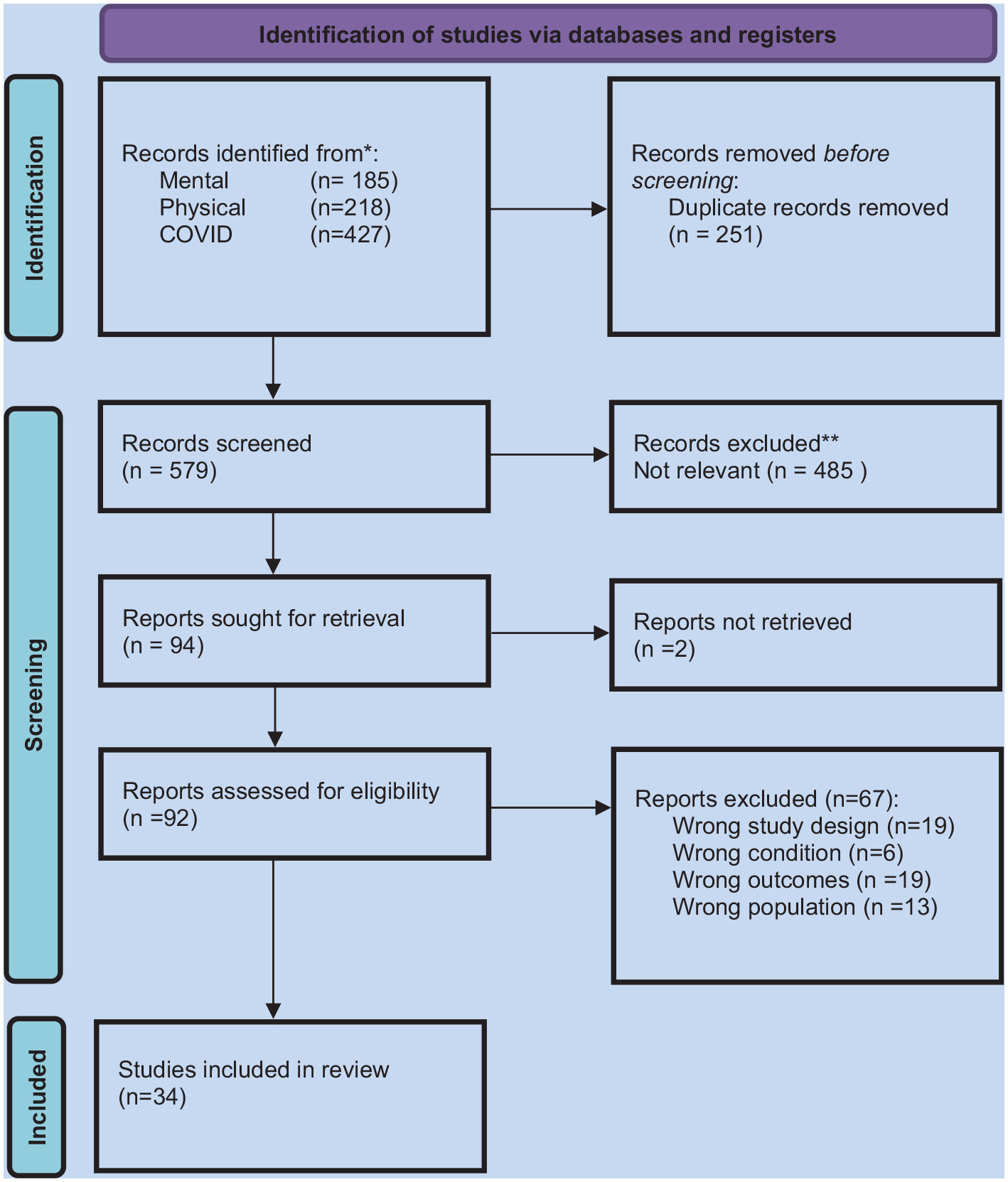
| Author (year) | Primary outcomes | Study population (n = sample size) | Country | Study type |
|---|---|---|---|---|
| Ahmed et al. (2020) | Work attendance during the first 3 days after onset of acute respiratory illness | People with access to remote working (n = 198)People without access (n = 1,164) | United States | Cross-sectional, survey |
| Astell-Burt, & Feng (2021) | Respite, connection, and exercise and exercise during the COVID-19 pandemic | General population (n = 3,043) | Australia | Cross-sectional, survey |
| Bennett et al. (2021) | Prevalence and nature of video conferencing fatigue | Remote workers (n = 55) | United States | Cross-sectional, survey |
| Björndell & Premberg (2021) | Physicians’ experiences of video consultation with new patients visiting a publicly owned virtual primary care clinic | Primary care physician remote workers (n = 10) | Sweden | Cross-sectional, interviews |
| Chang et al. (2021) | Relationship between proactive coping, future time orientation, and perceived work productivity during the coronavirus (COVID-19) pandemic | Remote workers (n = 778) | Taiwan and United States | Longitudinal, field experiment |
| Cheng & Zang (2021) | Relationship between COVID-19 task setbacks and exhaustion; influence of task interdependence | Fulltime teleworkers due to the pandemic lockdown (n = 1,022) | United States | Longitudinal, diary |
| Darouei & Pluut (2021) | Influence of working from home on experiences of time pressure, work–family conflict, and work-related employee well-being | Professional workers (n = 34) | The Netherlands | Longitudinal, survey |
| Dhont et al. (2020) | Impact of social isolation and working from home and to guide future work. | Remote workers physicians (n = 43) | Italy | Cross-sectional, survey |
| Edwards et al. (2021) | PM2.5 exposure after lockdown | Embassy workers (n = 4) | Nepal | Cross-sectional, air monitors |
| Estrada-Muñoz et al. (2021) | Levels of technostress | Teachers (n = 3,006) | Chile | Cross-sectional, survey |
| Fischer et al. (2020) | Impact of telework on risk for SARS-CoV-2 infection | Case patients (n = 153); Control (n = 161) | United States | Longitudinal, case-control |
| Fukushima et al. (2021) | Comparison of physical activity (PA) and sedentary behavior (SB) levels during work time between those who work from home (WFH) and at workplaces (no WFH), and by WFH subgroups. | General population (n = 1,239) | Japan | Cross-sectional, surveys |
| Giovanis & Ozdamar (2022) | Impact of WFH on the individuals’ perception about their future financial situation and their mental well-being | General population (n = approx. 30,000) | Turkey | Cross-sectional, survey |
| Grech et al. (2022) | Increase of back pain complaints has increased from pre-COVID-19 to during the COVID-19 period | General population (n = 388) | Malta | Cross-sectional, survey |
| Hallman et al. (2021) | Extent to which the 24-hour allocation of time to different physical behaviors changes between days working at the office (WAO) and days WFH in office workers during the pandemic. | Workers working remotely and in office (n = 27) | Sweden | Longitudinal, accelerometer, and diary |
| Hoffman (2021) | Impact of companion animals on well-being for those teleworking | Individuals who only had dogs (n = 90), who only had cats (n = 90), who had both dogs and cats (n = 50), and who had neither dogs nor cats (n = 150) | United States | Cross-sectional, survey |
| Houle et al. (2021) | Telecommuting and individual associated factors related to headache and neck pain occurrence in telecommuters over a 5-day follow-up. | Telecommuters (n = 162) | Canada | Longitudinal, emails, surveys |
| Ng et al. (2021) | Effect of work overload (workload and techno overload), on behavioral stress, | Remote workers (n = 530) | Italy | Cross-sectional, survey |
| Izdebski & Mazur (2021) | Relationship between occupational activity and mental health during the first COVID-19 lockdown | General population (n = 3,000) | Poland | Cross-sectional, social media data |
| Kawashima et al. (2021) | Relationship between telework implementation and the presence of a fever (body temperature higher than 37.5 °C) within 1 month as a surrogate indicator of COVID-19 infection | Social networking service users general population (n = 270,000) | Japan | Cross-sectional, social media data |
| Kenny (2020) | Prevalence, incidence, characteristics, and impact of self-perceived dysphonia and vocal tract discomfort in those working from home during COVID-19 | Remote workers (n = 1,575) | Ireland | Cross-sectional, survey |
| Kumar et al. (2020) | Perceived stress scores (PSS) and COVID-19-related stress (COVID-SS) scores to evaluate general and COVID-19-induced stress | Academic staff (n = 9) | United States | Cross-sectional, case study |
| Lafferty et al. (2022) | Impact of the COVID-19 pandemic on employment and care-giving responsibilities | Family carers (n = 16) | Ireland | Cross-sectional, interviews |
| Larrea-Araujo et al. (2021) | Ergonomic risk factors for teleworking | Researchers (n = 204) | Equador | Cross-sectional, survey |
| Limbers et al. (2020) | Associations between parenting stress, quality of life, and physical activity | Full-time working mothers (n = 200) | United States | Cross-sectional, survey |
| McDowell et al. (2020) | Associations of changing COVID-19-related employment conditions with physical activity and sedentary behavior | General population (n = 2,303) | Ireland | Cross-sectional, survey |
| Oksanen et al. (2021) | Potential stress effects of social media communication (SMC) at work | General employees before COVID crisis (n = 1,308) and general employees during COVID crisis (n = 1,081) | Finland | longitudinal, social media data |
| Reizer et al. (2021) | Links between conditions of uncertainty with psychological distress during the coronavirus 2019 lockdown. | Married parents working from home (n = 186) | Israel | Cross-sectional, survey |
| Rohwer et al. (2020) | Insights into job demands and resources in virtual teamwork | Virtual team members (n = 46) | Germany | Cross-sectional, survey |
| Shklarski et al. (2021) | Significant challenges and specific adaptations to this experience of providing remote therapy from home during the COVID-19 pandemic | Remote working therapists (n = 92) | United States | Cross-sectional, survey, and interviews |
| Shockley et al. (2021) | Impact of camera on videoconferencing fatigue | Remote working healthcare workers (n = 103) | United States | Longitudinal, field experiments |
| Tušl et al. (2021) | Actual and perceived overall impact of the COVID-19 crisis on work and private life, and the consequences for mental well-being (MWB), and self-rated health (SRH) | German and Swiss employees’ general population (n = 2,118) | German and Switzerland | Cross-sectional, survey |
| van Niekerk & van Gent (2021) | Mental health and well-being | University staff members (n = 280) | South Africa | Cross-sectional, survey |
| Wang et al. (2020) | Challenges experienced by remote workers at this time | Remote workers (n = 561) | China | Cross-sectional, interviews, and survey |
Quality Appraisal
| Author, year | Key relevant findings | Certainty of evidence |
|---|---|---|
| Ahmed et al. (2020) | WFH associated with less smoking | Low** |
| WFH associated with increased number of people reporting excellent health | Low** | |
| WFH associated with less reporting of conditions associated with influenza | Low** | |
| Astell-Burt & Feng (2021) | WFH associated with increased exercise. Geography and enjoyment of outdoor spaces being mediators. | Low** |
| WFH associated with increased enjoyment of outdoor spaces | Low** | |
| Bennett et al. (2021) | WFH associated increased videoconferencing fatigue | Low** |
| Switching off microphone associated with decreased videoconferencing fatigue | Moderate*** | |
| Increased perceived group belongness associated with decreased videoconferencing fatigue | Moderate*** | |
| Björndell & Premberg (2021) | WFH associated with increased perception of working in peace | Very low* |
| WFH associated with less stress | Very low* | |
| WFH associated with increased enjoyment of the home | Very low* | |
| Chang et al. (2021) | In the WFH context, proactive coping is associated with self-perceived productivity | Low** |
| In the WFH context, proactive coping is associated with future time orientation | Low** | |
| In the WFH context, future time orientation is associated with self-perceived productivity | Low** | |
| Cheng & Zang (2021) | In the WFH context, higher task interdependence is negatively associated with emotional exhaustion | Low** |
| Darouei & Pluut (2021) | WFH associated with decreased time pressure associated with less family conflicts | Low** |
| Dhont et al. (2020) | WFH associated with less depression | Very low* |
| WFH associated with less guilt | Very low* | |
| Edwards et al. (2021) | WFH associated with decreased exposure to air contaminants | Very low* |
| Estrada-Muñoz et al. (2021) | WFH associated with increased “technoanxiety” | Very low* |
| WFH associated with increased “technostrain” | Very low* | |
| WFH associated with increased “technofatigue” | Very low* | |
| Fischer et al. (2020) | WFH may reduce risk of COVID-19 infection | High**** |
| Fukushima et al. (2021) | WFH associated with reduced physical activity | High**** |
| WFH associated with increased sedentary behavior | High**** | |
| Giovanis & Ozdamar (2022) | WFH associated with decreased mental health as measured by the General Health Questionaire (GHQ) | Moderate*** |
| Grech et al. (2022) | WFH associated with increased back pain | Very low* |
| Hallman et al. (2021) | WFH associated with increased sleep | Moderate*** |
| Increased sleep associated with decreased work time | Moderate*** | |
| Increased sleep associated with decreased leisure time | Moderate*** | |
| Hoffman (2021) | Pet dogs associated with increased socialization with other people | Very low* |
| Pet dogs associated with healthy amounts of physical activity | Very low* | |
| Pet dogs associated with taking at least one 15-minute walk during the workday | Very low* | |
| Houle et al. (2021) | Headache related disability associated with increased risk of headaches | Low** |
| Neck pain related disabiluity associated with increased risk of neck pain | Low** | |
| Ng et al. (2021) | Workload associated with increased stress | Moderate** |
| Job crafting associated with less stress | Moderate** | |
| Kawashima et al. (2021) | WFH associated with lower fever rates | Low** |
| Izdebski & Mazur (2021) | Female gender associated with decreased mental health | Low** |
| Threat of worsening employment terms associated with decreased mental health | Low** | |
| Kenny (2020) | Frequently raising/straining voice (increased frequency) increased risk of new onset dysphonia | Moderate** |
| Older age associated with increased risk of new onset dysphonia | Moderate** | |
| Poor air quality associated with increased risk of new onset dysphonia | Moderate** | |
| Increased stress associated with increased risk of new onset dysphonia | Moderate** | |
| Higher frequency associated with self-rated dysphonia severity | Low** | |
| Poor posture associated with self-rated dysphonia severity | Low** | |
| Raising or straining voices associated with increased risk of new onset vocal tract discomfort | Moderate** | |
| Increased telephone use associated with increased risk of new onset vocal tract discomfort | Low** | |
| Increased frequency of frequently raising/straining voice associated with increased risk new onset vocal tract discomfort | Low** | |
| Increased stress associated with increased risk of new onset vocal tract discomfort | Low** | |
| Poor air quality associated with increased risk of new onset vocal tract discomfort | Low** | |
| Kumar et al. (2020) | Intervention reduced Perceived Stress Scores | Low** |
| Intervention reduced COVID-19-related stress scores | Low** | |
| Lafferty et al. (2022) | COVID-related work challenges associated with increased stress | Very low* |
| Larrea-Araujo et al. (2021) | Age associated with increased risk of neck ailments | Very low* |
| Arm ailments associated with increased risk of forearm | Very low* | |
| Limbers et al. (2020) | Parenting stress associated with a lower quality of life | Low** |
| Parenting stress associated with lower social relationships | Low** | |
| Parenting stress associated with lower environmental quality life | Low** | |
| Attenuation of negative effect of parenting stress on social relationships and environmental quality of life | Low** | |
| McDowell et al. (2020) | WFH associated with increased sitting time | High**** |
| WFH associated with increased screen time | High**** | |
| Oksanen et al. (2021) | Previous experience using social media communication associated with a decrease in “technostress” | Moderate*** |
| Previous experience using social media communication associated with a decrease in work exhaustion | Moderate*** | |
| Increase in use of formal social media associated with increased technostress | Moderate*** | |
| Reizer et al. (2021) | Intolerance of uncertainty and distress | Low** |
| Rohwer et al. (2020) | Degree of virtuality associated with boundarylessness | Low** |
| Psychological detachment associated with improved sleep quality | Low** | |
| Perceived stress associated with reduced sleep quality | Low** | |
| Shklarski et al. (2021) | WFH associated with videoconferencing fatigue | Very low** |
| Shockley et al. (2021) | Having camera on associated with increased videoconferencing fatigue | Moderate*** |
| Tušl et al. (2021) | WFH particularly if experienced for the first time associated with perceived positive impact on work–life | Moderate*** |
| van Niekerk & van Gent (2021) | Psychological distress and mental well-being (MWB) | Very low* |
| Age associated with decreased psychological distress | Very low* | |
| Age associated with increased mental wellbeing | Very low* | |
| Female gender associated with increased psychological distress | Very low* | |
| Wang et al. (2020) | Ineffective communication associated with work–home interference | Very low* |
| procrastination (e.g. social media, long breaks) associated with reduced productivity | Very low* | |
| Job autonomy associated with increased loneliness | Very low* | |
| High workload associated with increased devotion to work | Very low* | |
| Low workload associated with decreased work–home balance | Very low* | |
| Low social support associated with increased procrastination | Very low* | |
| High workload associated with increased work–home interference | Moderate*** | |
| High workload associated with increased work–home interference | Moderate*** | |
| Work–home interference associated with increased emotional exhaustion | Moderate*** | |
| How to work interference associated with increased emotional exhaustion | Moderate*** | |
| Loneliness associated with increased emotional exhaustion | Moderate*** | |
| WFH associated with increased loneliness | Moderate*** |
Acceleration of Remote Working Practices and Use of Environments
Physical Impact
Psychological Impacts
Health Behaviors and Mediating Factors
Discussion
Limitations
Implications for Practice
Conflict of Interest
Funding
ORCID iDs
References
Cite
Cite
Cite
Download to reference manager
If you have citation software installed, you can download citation data to the citation manager of your choice
Information, rights and permissions
Information
Published In

Keywords
Rights and permissions

Authors
Metrics and citations
Metrics
Publication usage*
Total views and downloads: 30306
*Publication usage tracking started in December 2016
Altmetric
See the impact this article is making through the number of times it’s been read, and the Altmetric Score.
Learn more about the Altmetric Scores
Publications citing this one
Receive email alerts when this publication is cited
Web of Science: 30 view articles Opens in new tab
Crossref: 49
- EasyGuard: A Gamified App for Generating Strong and Memorable Passwords
- Integration of Artificial Intelligence into Human Resource Management in Manufacturing Enterprises: A Systematic Literature Review of Challenges, Approaches, and Evolution (2000–2025)
- Assessing the antecedents behind after-hours work in teleworkers: a scoping review
- Nurse leaders' experiences with hybrid work schedules
- Scoping review on the effect of labour inspections on occupational health and safety: a meta-analytic update
- Re-anchored lives: Working from home, gender, and everyday well-being in Sweden
- The association between videoconference fatigue and psychophysical strain over time: Are age and remote work risk factors?
- Gestión del talento humano en entornos híbridos: Retos y efectos en el desempeño organizacional en el Hospital General Docente de Calderón durante el año 2024
- Remote work and loneliness: Evidence from a nationally representative sample of employed U.S. adults
- Sanal Ofislerde Sosyal Mübadele ve Uzaktan Çalışmanın Çalışanlar Üzerindeki Etkileri
- View More
Figures and tables
Figures & Media
Tables
View Options
View options
PDF/EPUB
View PDF/EPUBAccess options
If you have access to journal content via a personal subscription, university, library, employer or society, select from the options below:
I am signed in as:
View my profileSign out

I can access personal subscriptions, purchases, paired institutional access and free tools such as favourite journals, email alerts and saved searches.
loading institutional access options
AAOHN members can access this journal content using society membership credentials.
AAOHN members can access this journal content using society membership credentials.
Alternatively, view purchase options below:
Purchase 24 hour online access to view and download content.
Access journal content via a DeepDyve subscription or find out more about this option.
