Intended for healthcare professionals

Abstract

Researchers have proposed that emotion regulation can enhance or hinder socioaffective and sociocognitive processes. However, an integration of the evidence is still lacking. The present preregistered meta-analysis disentangled the link between adaptive and maladaptive emotion regulation and different aspects of social affect and cognition. Our findings, based on 549 effect sizes from 58 samples, show that adaptive emotion regulation is positively related to cognitive empathy (ρ = .22), affective empathy (ρ = .07), and compassion (ρ = .19) but negatively related to empathic distress (ρ = –.12). Furthermore, maladaptive emotion regulation is negatively related to cognitive empathy (ρ = –.11) and positively related to empathic distress (ρ = .19). Our findings open up new pathways for practitioners, as it might be possible to foster empathy and compassion and alleviate empathic distress through emotion regulation training. Furthermore, the results suggest a potential explanation for the link between mental disorders and interpersonal problems.
Being able to understand other people’s emotions, to feel with them and show compassion, that is, our socioaffective and sociocognitive processes, is important for successful and satisfying social interactions. Notably, there is growing evidence that social cognitive-affective processes and emotion regulation are interrelated (Thompson, van Reekum, & Chakrabarti, 2019;Thompson, Uusberg, et al., 2019). More concretely, our response to another person’s emotions may differ depending on our ability to regulate our emotional states (Gross, 1998; McRae & Gross, 2020). For example, Eisenberg (2000) suggests that we can turn to the needs of others only if we are able to regulate our own emotions successfully. Further, putting ourselves in the shoes of others might help us regulate our feelings in a situation in which we feel sad or angry. Importantly, however, the regulation strategy we use needs to fit the context (Aldao, 2013; Blanke et al., 2020; Troy et al., 2013).
People with mental disorders suffer both from problems in their interpersonal life and from difficulties in regulating their emotions (e.g., Aldao et al., 2010; Gross & Jazaieri, 2014; Millgram et al., 2020). This is also reflected in the definition of a mental disorder in the fifth edition of the Diagnostic and Statistical Manual of Mental Disorders (DSM-5):
A mental disorder is a syndrome characterized by clinically significant disturbance in an individual’s cognition, emotion regulation, or behavior that reflects a dysfunction in the psychological, biological, or development processes underlying mental functioning. Mental disorders are usually associated with significant distress or disability in social, occupational, or other important activities. (quoted in Stein et al., 2021, p. 895)
On the basis of prior research, one could assume that emotion regulation and social cognitive-affective processes are interrelated and that this contributes to difficulties in people’s social lives (Aldao et al., 2010). However, although these processes have been studied in different areas of psychology, the evidence has not yet been integrated quantitatively, and a comparison of clinical versus nonclinical samples is pending.
In the current meta-analysis, we aimed to provide an integrative overview of the association between emotion regulation and social affect and cognition and, further, to compare the evidence from clinical versus nonclinical samples.

Defining Emotion Regulation

Emotion regulation has been characterized as “the processes by which individuals influence which emotions they have, when they have them, and how they experience and express these emotions” (Gross, 1998, p. 275). Emotion regulation is not a single process but rather a family of processes or strategies, and it has been widely studied in different areas of psychology. For example, it has been studied from a motivational perspective, which defines emotion regulation as being able to change current unpleasant emotions into desired emotions (Millgram et al., 2020). Emotion regulation has also been studied from a process-oriented perspective. This research has for example focused on how the specific situation, how we place our attention, and how we respond to an emotion affects our emotional experience in their emotional intensity, duration, frequency, or type of emotion (Gross & Jazaieri, 2014). Furthermore, other researchers emphasize that the context and the flexibility of responses to the environment play an important role for emotion regulation (Aldao, 2013), meaning that an emotion regulation strategy needs to fit the situation to be effective (Haines et al., 2016). Although these different approaches shed light on different aspects of emotion regulation that are all important to fully understand the concept, they have also led to a divergence in definitions (Gross & Jazaieri, 2014). What they have in common is that they can be sorted into adaptive and maladaptive emotion regulation approaches, making it possible to combine them and incorporate knowledge from different areas of psychology.1
Adaptive emotion regulation is the ability to deal with one’s own emotions effectively, applying emotion regulation strategies variably and flexibly to meet the demands of contextual situations (Blanke et al., 2020; Jordan et al., 2002). Adaptive emotion regulation is often characterized by the frequent use of strategies, such as problem solving and cognitive reappraisal, that are linked to positive psychological outcomes, such as lower negative affect (Garnefski & Kraaij, 2006), reduced levels of psychopathology (Aldao et al., 2010), and higher levels of mental health (Hu et al., 2014). The use of cognitive reappraisal, for example, has been found to predict increased levels of well-being (Haga et al., 2009). Moreover, utilizing adaptive emotion regulation includes having a broad repertoire of emotion regulation strategies and a certain flexibility, so the strategy fits the context (Aldao, 2013; Troy et al., 2013). Theoretical models from clinical, social, intercultural, development, and organizational psychology associate adaptive emotion regulation with better well-being (Quoidbach et al., 2010), health (Hu et al., 2014), and relationship quality (Troyer & Greitemeyer, 2018; Vater & Schröder-Abé, 2015), as well as improved academic and work performance (Wang et al., 2017). Studying adaptive emotion regulation therefore includes measuring the ability and flexibility of emotion regulation and, accordingly, the ability to effectively downregulate negative emotions, reappraise, or use acceptance, always depending on the context of the original study.
By contrast, we use maladaptive emotion regulation to refer to difficulties in emotion regulation that are characterized by ineffective strategies or by inflexibility to adequately adapt the strategy to a specific situation (Aldao, 2013). It can entail the frequent use of suppression, which has been linked to increased depressed mood and reduced life satisfaction (Haga et al., 2009). Maladaptive emotion regulation can lead to problems with emotional intensity such as hypo- or hyperreactivity and problematic emotional duration, such as being overwhelmed by anger or fear or not being able to feel happy for an extended period of time, or more generally speaking, difficulties with regulating emotions (Gross & Jazaieri, 2014). Different approaches have been used to understand these difficulties, for instance, focusing on the frequent use of specific strategies (e.g., suppression; Aldao et al., 2010) or suggesting a motivational approach, which concentrates on maladaptive emotion goals (Millgram et al., 2020).
Maladaptive emotion regulation is part of most theoretical models explaining mental disorders (Aldao et al., 2010), as it is frequently associated with poorer social well-being, lower social support, and poorer relationship quality and satisfaction (Chervonsky & Hunt, 2017). Evidence shows that maladaptive emotion regulation is linked to negative mental health consequences such as anxiety, aggression, depression, and stress (e.g., Garnefski & Kraaij, 2006; Martin & Dahlen, 2005), and it further increases the risk of mental disorders (e.g., Cole et al., 2008; Hu et al., 2014). Accordingly, empirical research has highlighted the role of maladaptive emotion regulation as a risk factor for mental disorders, finding medium to large effect sizes between the frequent use of strategies such as rumination, avoidance, and suppression on the one hand and symptoms of anxiety, depression, eating disorders, and substance-related disorders on the other hand (Aldao et al., 2010). Thus, maladaptive emotion regulation is part of mental disorders.
In summary, emotion regulation has been hypothesized to be the underlying driver of or protective factor against mental disorders (Aldao et al., 2010). Mental disorders are often tied to problems in interpersonal relationships (Whisman & Baucom, 2012). Further, as we will describe below, emotion regulation has been portrayed as the underlying mechanism for differences in social affect and cognition (Powell, 2018).

Defining Social Affect and Cognition

Socioaffective and sociocognitive processes encompass different facets (e.g., Kanske et al., 2016; Reniers et al., 2011; Wieck & Kunzmann, 2015). The first is cognitive empathy, defined as the ability to accurately infer and understand other people’s thoughts and feelings (often labeled “perspective taking,” “theory of mind,” “mentalizing,” or “empathic accuracy”; Frith & Frith, 2006; Ickes, 1993). The second facet is affective empathy, referring to vicariously sharing another person’s emotions, regardless of valence (positive or negative), while still being able to distinguish between self and others’ emotional states (typically labeled “affective match” or “emotional congruence”; Wieck & Kunzmann, 2015). The third facet is empathic distress (Bloom, 2017; Davis, 1983; De Vignemont & Singer, 2006), an aversive and self-referential negative reaction that often leads to withdrawal behavior (Batson et al., 1987; Eisenberg & Fabes, 1992). And the fourth facet is compassion, a feeling of concern for others’ suffering and the desire to alleviate it (also termed “sympathy” or “empathic concern”; Singer & Klimecki, 2014; Wieck et al., 2022). In order to experience compassion, one needs to create a healthy distance between oneself and the other person. Without an adequate self–other distinction, sharing another person’s emotions can induce personal or empathic distress, a negative feeling of being overwhelmed by the feelings of others. Prior research has repeatedly demonstrated that compassion is associated with prosocial behavior, whereas personal distress often leads to withdrawal behavior motivated by the desire to protect oneself from negative emotions (Singer & Klimecki, 2014).
Different aspects of social affect and cognition are typically involved in social relations; however, they are clearly distinguishable from each other, can arise separately, and have different neurophysiological correlates (e.g., Kanske et al., 2016; Klimecki et al., 2014; Preckel et al., 2018). For instance, the cognitive facet of empathy is resource demanding and requires mental flexibility (Decety & Jackson, 2004). Cognitive empathy by itself could be used to manipulate another person because we are able to understand another person’s thoughts and feelings without necessarily feeling compassion for them. Furthermore, the cognitive facet of empathy is resource demanding and requires mental flexibility (Decety & Jackson, 2004). Consistent with this idea, research has shown that cognitive empathy is positively related to cognitive intelligence (Adolphs, 2006; Kunzmann et al., 2018; Schlegel et al., 2020; Wieck et al., 2022). By contrast, affective empathy is a more automatic process, thus less cognitively demanding (Decety & Jackson, 2006). We can feel sadness by watching a sad person, without understanding their situation in detail. The same holds true for compassion or empathic distress: For example, although a Buddhist monk who is skilled in emotion regulation might feel only warmth and concern for the suffering or pain of others, a child might be easily overwhelmed by the sad feelings of their parents and feel even more (empathic) distress and sadness than the parents themselves (Klimecki & Singer, 2012).

The Relationship Between Emotion Regulation and Social Affect and Cognition

Psychologists in different areas have proposed models for the pathways between emotion regulation and the different facets of social affect and cognition. For example, in a prominent theory within developmental psychology, Eisenberg (2000) proposes that sharing other people’s emotions and experiencing compassion require us to maintain our own emotional reactions within a tolerable range, so we can concentrate on the needs of others and support them. For instance, a father can comfort his scared child only if he is able to control his own fear. In other words, the inability to regulate one’s own emotions may lead to problems in social interactions.
Eisenberg (e.g., 2000) was mostly referring to children; however, clinical psychologists have suggested that social difficulties in adults, which can be observed for almost all mental disorders, arise because of difficulties in social cognitive-affective processing (Jansen et al., 2020). Green and colleagues (2015) propose that different aspects of social processing, such as affect sharing, mentalizing, and emotion regulation, can be impaired and that different patterns can be found that are typical for each mental disorder. The existing theoretical explanations are therefore often specific to the type of disorder or the respective socioaffective and sociocognitive facet. For instance, problems in interpersonal behavior and emotion regulation difficulties have been suggested as both risk and maintaining factors of eating disorders (Lavender & Anderson, 2010; Mansour et al., 2016), borderline personality disorder (Glenn & Klonsky, 2009; Harari et al., 2010), social anxiety (Helbig-Lang et al., 2015), bipolar disorder (Van Rheenen et al., 2014), obsessive-compulsive disorder (Jansen et al., 2020), and depression (Martin & Dahlen, 2005). Gilbert (2015) made a more general suggestion that adaptive emotion regulation not only helps one to regulate one’s own feelings but also assists in regulating the feelings of others. Enhanced usage of maladaptive emotion regulation should therefore be associated with more conflicts in one’s social life, which might explain the difficulties people with mental disorders face in their interpersonal relationships. Proceeding from these explanations, one might expect to find a similar pattern for clinical and nonclinical populations in how these different facets are linked to emotion regulation; however, the size of the association should be more pronounced in the clinical population. Disentangling the relationships between emotion regulation (both adaptive and maladaptive) and different facets of social affect and cognition might offer insights into, for example, how individuals can enhance compassion and lower empathic distress. Therefore, the results of our meta-analysis will have practical implications for how to improve one’s social life and overall well-being. Given that different areas of psychology have proposed different pathways between emotion regulation and social affect and cognition, we will briefly describe these theories and the evidence for the link between emotion regulation (both adaptive and maladaptive) and each facet of social affect and cognition separately.

The relationship between emotion regulation and cognitive empathy

The idea that emotions and cognitive abilities (which, as described above, include cognitive empathy) are linked is not new. For instance, Salovey and Mayer (1990) proposed the concept of emotional intelligence, which suggests that the perception of, regulation of, understanding of, and ability to generate emotions are connected (Jordan et al., 2002). In their view, the ability to regulate one’s own emotions and cognitive empathy are part of the same construct.2 In line with this assumption, evidence has shown that cognitive intelligence is related to the ability to read and label one’s own as well as other people’s emotions (Ochsner & Gross, 2008; Schlegel et al., 2020). Furthermore, executive functions should be linked to both emotion regulation and cognitive empathy (Eisenberg, 2010); hence, lower sociocognitive abilities, which also encompass cognitive empathy, should be related to more maladaptive regulation, whereas being able to read and label one’s own as well as other people’s emotions should be related to more adaptive emotion regulation (Ochsner & Gross, 2008). This is in line with arguments in organizational psychology suggesting that adaptive emotion regulation and cognitive empathy are related (Wang et al., 2017) as well as with ideas from personality psychology hypothesizing a link between cognitive empathy and reappraisal as an adaptive emotion regulation strategy (Vater & Schröder-Abé, 2015).
Findings from studies of adaptive emotion regulation and cognitive empathy support these assumptions: For example, a study by Laghi et al. (2018) with adolescents found that cognitive reappraisal is positively linked to perspective taking. For nonclinical participants, moderate (Buruck et al., 2014; Jordan et al., 2002; Powell, 2018; Shaw et al., 2020; Thompson, van Reekum, & Chakrabarti, 2019; Tully et al., 2016; Wang et al., 2017) to high (Berrios Martos et al., 2013; Taute et al., 2010) positive correlations have been found between adaptive emotion regulation and cognitive empathic abilities. However, in clinical samples, this link vanishes (Ghiasi et al., 2016; Lehmann et al., 2014; Rowland et al., 2013), perhaps because these samples typically use adaptive emotion regulation less frequently than nonclinical samples do (Aldao et al., 2010). Furthermore, unregulated emotions or inadequately regulated emotions may lead to higher levels of stress, which in turn negatively affects the ability to infer other people’s emotions accurately (Smeets et al., 2009). This is underscored by studies with nonclinical samples reporting correlations between maladaptive emotion regulation and lower cognitive empathic abilities mostly of moderate (Di Girolamo et al., 2019; Lockwood et al., 2014; Miguel et al., 2017; Powell, 2018; Troyer & Greitemeyer, 2018; Tully et al., 2016; Vater & Schröder-Abé, 2015) to high (Rowland et al., 2013) effect size.
Considering theoretical assumptions and past evidence (Berrios Martos et al., 2013; Buruck et al., 2014; Di Girolamo et al., 2019; Jordan et al., 2002; Lockwood et al., 2014; Miguel et al., 2017; Powell, 2018; Rowland et al., 2013; Shaw et al., 2020; Taute et al., 2010; Thompson, van Reekum, & Chakrabarti, 2019; Troyer & Greitemeyer, 2018; Tully et al., 2016; Vater & Schröder-Abé, 2015; Wang et al., 2017), we hypothesized that adaptive emotion regulation (e.g., flexibility, broader repertoire of strategies, using strategies such as reappraisal) would be positively correlated with social cognitive facets (i.e., theory of mind, cognitive empathy, perspective taking), whereas maladaptive emotion regulation (e.g., frequent use of suppression, rumination, small repertoire of strategies, general difficulty in regulating emotions) would be negatively correlated with social cognitive facets.

The relationship between emotion regulation and affective empathy

Shared affection and vicarious feelings have been suggested to be connected to emotion regulation processes (Berrios Martos et al., 2013). Although this relationship was thoroughly studied in children (Eisenberg, 2010), sharing another person’s emotions has not been studied extensively with regard to emotion regulation processes in adults. Two extant studies with nonclinical adult samples found moderate positive correlations between affective empathy and (implicit) emotion regulation (Taute et al., 2010; Thompson, van Reekum, & Chakrabarti, 2019). Thompson, van Reekum, and Chakrabarti (2019) found that empathy with negative emotions could be reduced. They conducted two experiments in which they measured the emotion regulation strategy reappraisal; in the first experiment, they measured reappraisal with the Emotion Regulation Questionnaire (ERQ; Abler & Kessler, 2009; Gross & John, 2003), and in the second experiment, they measured it with an implicit task. The results showed that cognitive empathy was related to the reappraisal measured by the ERQ, whereas affective empathy was related to the implicit task. They therefore suggest that affective empathy might be connected to more implicit and automatic reappraisal processes, whereas cognitive empathy might be related to conscious emotion regulation. However, other researchers consider regulatory processes to be central for ensuring that sharing other persons’ (negative) emotions is not experienced as aversive. In other words, regulatory processes may help to prevent affective empathy from turning into empathic distress (e.g., Decety & Jackson, 2004; Decety & Jackson, 2006; Eisenberg, 2000); thus, by regulating one’s own emotions, one creates space and openness to others’ emotions. Moreover, studies investigating patients with borderline personality disorder, which is characterized by frequent usage of maladaptive emotion regulation, showed a higher level of affective empathy compared with people in a nonclinical control group (Harari et al., 2010). Empathic dysfunction has become a part of theoretical models explaining interpersonal problems in borderline personality disorder (Ripoll et al., 2013). Instead of keeping a balance between one’s own and shared emotions, patients feel distressed and overwhelmed by the emotions of other people. Maladaptive emotion regulation might therefore be accompanied by more affective arousal but not affective empathy. This might explain why some findings support the assumption that maladaptive emotion regulation is associated with increased self-reported affective empathy (Di Girolamo et al., 2019; MacDonald & Price, 2019), whereas other studies have found contradictory results, with affective empathy linked to less maladaptive emotion regulation (Lockwood et al., 2014; Powell, 2018; Troyer & Greitemeyer, 2018).
Given the ambiguous evidence, we refrained from formulating a hypothesis for the link between affective empathy and both adaptive and maladaptive emotion regulation. However, in the current study, we aimed to shed light on the link between affective empathy and emotion regulation in an exploratory analysis in order to provide clarity about the relationship between the two constructs and take a closer look at the methodologies used as a possible explanation for the contradictory results.

The relationship between emotion regulation and empathic distress

Eisenberg and Fabes (1992) suggest that deficits in emotion regulation abilities might be accompanied by the experience of empathic distress. It is easy to imagine that when overwhelmed by one’s own emotions (e.g., when very frightened or angry), one’s attentional focus is reduced (“tunnel vision”), and hence one cannot focus on other people (Eysenck et al., 2007; Shields et al., 2016). Clinical psychology has suggested that maladaptive emotion regulation is a risk and maintaining factor for empathic distress and the feeling of being overwhelmed by other people’s emotions (Mansour et al., 2016). Personal distress has also been suggested as a mediator of the association between maladaptive emotion regulation and social avoidance (Grynberg & López-Pérez, 2018). By applying adaptive emotion regulation, one should be able to feel someone else’s feelings without getting overwhelmed. This is in line with theoretical assumptions from organizational psychology positing that emotion regulation abilities are related to experiencing positive empathic feelings rather than distress (Berrios Martos et al., 2013). Recent studies on personal distress and maladaptive emotion regulation mostly report correlations of moderate to high strength (Buruck et al., 2014; Contardi et al., 2016; Grynberg & López-Pérez, 2018).
On this basis, we assumed that adaptive emotion regulation and empathic distress would be negatively correlated, whereas maladaptive emotion regulation would be positively associated with empathic distress.

The relationship between emotion regulation and compassion

Eisenberg and Fabes (1992) suggest that self-regulation is central for experiencing compassion. Only if people can control their feelings well will they have the resources to show compassion and prosocial behavior. However, findings from correlative studies on emotion regulation and compassion are slightly contradictory. Although most studies show positive correlations between adaptive emotion regulation and compassion (Berrios Martos et al., 2013; Gordon & Chesney, 2017; Lebowitz & Dovidio, 2015; Tully et al., 2016), a handful have found the reverse pattern (Grynberg & López-Pérez, 2018; Shaw et al., 2020). Concerning maladaptive emotion regulation and compassion, studies predominantly report a negative link (Buruck et al., 2014; Contardi et al., 2016).
On the basis of the evidence described above, we hypothesized that adaptive emotion regulation would be positively correlated with compassion (e.g., empathic concern, empathic care, and sympathy), whereas maladaptive emotion regulation would be negatively correlated with compassion.

Clinical samples versus nonclinical samples

Different types of emotion regulation have been shown to have both positive and negative relationships with psychological well-being (Gross & John, 2003; Hu et al., 2014). Hence, emotion regulation is increasingly incorporated into theoretical frameworks of mental disorders (Aldao et al., 2010) and widely studied in relation to psychological health. For instance, a study by Haga et al. (2009) revealed significant links between suppression and reduced life satisfaction and increased depressed mood. Previous research investigating maladaptive emotion regulation using the Difficulties in Emotion Regulation Scale (DERS; Gratz & Roemer, 2004) has revealed correlations with a variety of mental disorders, including anxiety disorders (Helbig-Lang et al., 2015; Tull et al., 2009), depression (Ehring et al., 2008), substance-related disorders (Fox et al., 2007, 2008), eating disorders (Lavender & Anderson, 2010; Whiteside et al., 2007), posttraumatic stress disorder (McDermott et al., 2009), and bipolar disorder (Van Rheenen et al., 2014). Furthermore, studies using the Coping Orientations to the Problems Experienced (COPE) Inventory (Carver, 1997) indicate that avoidant thought and action tendencies are associated with depression, anxiety, and stress (Mahmoud et al., 2012) as well as limited physical functioning in people with medical conditions (Eisenberg et al., 2012).
Moreover, differences in social affect and cognition have been found in clinical samples, resulting in typical social affect and cognition patterns: For instance, impaired cognitive empathy has been identified as a key symptom in patients with eating disorders (Mansour et al., 2016), impaired (affective) empathy has been associated with obsessive-compulsive disorder (Jansen et al., 2020; Salazar Kämpf et al., 2022) and schizophrenia (Bonfils et al., 2017; Green et al., 2015). Schreiter et al. (2013) reported a positive association between empathic distress (i.e., shared pain) and depressive symptoms. Moreover, Kahn et al. (2017) reported a positive correlation between affective empathy and symptoms of anxiety in adolescence. These differences might explain why people with mental disorders often experience problems in their social lives. Integrating the evidence of adaptive and maladaptive emotion regulation and their association with social affect and cognition and, consequently, social interactions will result in important knowledge for our everyday lives, as well as for practitioners in clinical psychology. We therefore analyzed differences between samples with mental disorders and nonclinical samples.

Transparency and Openness

The current study was preregistered at https://osf.io/cyhzk/. The data, code, and coding manual have been made publicly available via OSF and can be accessed at https://osf.io/bmgeq/. We report how we determined our sample size, all data exclusions, all manipulations, and all measures used in the study (Simmons et al., 2011).

Method

Inclusion and exclusion criteria

The inclusion and exclusion criteria for the present meta-analysis were developed in accordance with Preferred Reporting Items for Systematic Reviews and Meta-Analyses (PRISMA) guidelines (Liberati et al., 2009; Supplemental Material). First, the study had to be empirical or quantitative (i.e., qualitative studies, theoretical work, or literature reviews were excluded). Second, intervention studies (i.e., studies in which participants were instructed to engage in a particular emotion regulation strategy) were excluded if they did not include a control group or baseline data (e.g., Gross, 1998; Gross & John, 2003). Third, both clinical and nonclinical samples were included. Fourth, the study had to be a unique sample that was not previously included in the current meta-analysis. If a data set was used more than once, we coded all of the data from the first published manuscript utilizing the data set. Fifth, studies had to be written in English, German, or Spanish. Sixth, the studied population had to be adults (aged 18 and above). Three studies included samples in which the age range started at 17 years (Bailey et al., 2020; Chan, 2008; Jordan et al., 2002); we decided to include these studies because the mean age was over 18 years. Finally, studies were excluded if measurements did not sufficiently separate the constructs examined or if they did not correspond to the above-mentioned definitions. More concretely, the excluded instruments were the Empathy Quotient (Baron-Cohen & Wheelwright, 2004), which captures empathy as a one-dimensional construct and does not distinguish between cognitive and affective components, and the Mentalization Questionnaire (Hausberg et al., 2012), which does not differentiate between emotion regulation and cognitive empathy. In order to reduce publication bias and generate the most comprehensive data possible, we set no restrictions on publication status or cultural context.

Literature searches

We searched for studies that provided data on at least one relationship between one of the social affect and cognition variables and emotion regulation. A systematic search was conducted for articles published between 1998 and 2019 using PsycInfo, Web of Science, PubMed, Google Scholar, and ProQuest. We chose 1998 as the starting point because there was little work on what is now referred to as emotion regulation prior to Gross’s (1998) definition of emotion regulation (Aldao et al., 2010). We searched for combinations of the following terms across titles, abstracts, and keywords: “emotion* regulation,” “emotion* dysregulation,” “empathy,” “perspective taking,” “cognitive empathy,” “sympathy,” “compassion.” In addition, we contacted authors in the field of research, looked up the publication lists of authors who have published substantially on the topics of interest, and sent out a call for unpublished data via the mail distribution list of the German Psychological Society and ResearchGate. Two of the authors conducted independent searches, which yielded similar results. The literature search was performed between January and October 2019. A total of 1,621 records were identified through database searching and other sources, of which 782 were duplicates. We screened the remaining 839 records on the basis of their abstracts and excluded 739. There was 78% agreement between the two coders in the first abstract-based screening, which narrowed the data set down to 104 studies, of which both raters read the full text. If doubts arose as to the suitability of the study while we read the full text, the accordant study was discussed and a joint decision on inclusion or exclusion was made. The process is shown in Figure 1.
Fig. 1. Flowchart showing the step-by-step process by which we selected the studies included in the meta-analysis.

Study characteristics

The literature search resulted in a data set of 42 studies with 58 independent samples (Fig. 1). The articles included were published between 2002 and 2019. The total number of participants was 10,422 (age: M = 32.35 years, SD = 11.91, range = 18.29–72.40). Of the 58 independent samples, 47 were from peer-reviewed published studies (which is more than 80% of the included samples), two were from a doctoral thesis, one was from a master’s thesis, and eight were from other sources (e.g., unpublished raw data). Twelve samples (n = 620 persons) were from clinical populations and 46 (n = 9,802 persons) from a nonclinical population. Clinical samples included persons with schizophrenia (k = 5), bipolar disorder (k = 3), borderline personality disorder (k = 1), depression (k = 1), schizoaffective disorder (k = 1), and undefined mental disorders according to DSM-5 Axis I and/or II (k = 1).
Almost all (96%) emotion regulation instruments used—except one—were self-report measures (see Table S1 in the Supplemental Material available online). This is not surprising, as most dispositional measures of emotion regulation are self-report questionnaires (Aldao et al., 2010). Typically, in these questionnaires, participants are asked to answer what they think or do across different situations and periods on a Likert scale, most frequently how they typically react after a stressful or threatening life event. The most commonly used measure of adaptive (44%) and maladaptive (41%) emotion regulation was the ERQ (Abler & Kessler, 2009; Gross & John, 2003).
A wide variety of social affect and cognition measurements exist, and we assigned each instrument and/or their subscales to the corresponding social affect and cognition facet as defined above (see Table S2 in the Supplemental Material). Two different approaches are typically used to assess social affect and cognition: self-report questionnaires and test-based tasks. In questionnaires, participants are asked to report, for example, how often they take another person’s perspective and how successful their perspective-taking attempts typically are (e.g., Interpersonal Reactivity Index; Davis, 1983). Test-based tasks are usually administered under standardized conditions in the laboratory. For example, participants are presented with pictures or videos depicting a person exhibiting a discrete emotion and are asked to select the correct emotion from a list of emotional terms or to answer questions referring to the person’s mental states (cognitive empathy; e.g., Movie for the Assessment of Social Cognition; Dziobek et al., 2006) and emotional experience (affective empathy; e.g., Multifaceted Empathy Test; Dziobek et al., 2008). Similar to emotion regulation, social affect and cognition facets were most frequently measured by self-report (73%), followed by test-based measures (24%). For affective empathy, the Questionnaire of Cognitive and Affective Empathy (Reniers et al., 2011) was the most frequently used measure (44%). The Interpersonal Reactivity Index (Davis, 1983) was the most applied measure to assess empathic distress (96%), compassion (97%), and cognitive empathy (48%).

Coding procedure

Data were extracted by two independent raters using a coding manual designed for the current project (see https://osf.io/fehkw/). A total of 88.40% of the studies were double coded. Interrater reliability was good (84.20% agreement).
For each study, both raters extracted (a) citation, (b) publication status (e.g., published), (c) sample type, (d) sample size, (e) descriptive sample variables, (f) emotion regulation measures, (g) social affect and cognition measures, and (h) effect sizes. The information on sample type included whether the sample was clinical or nonclinical (and if possible, the type of mental disorder). The sample size was coded on the basis of the number of participants included in the effect-size calculations. Descriptive statistics for the sample included information on the age of the study participants (mean and standard deviation). For the emotion regulation measures, the adaptiveness (i.e., adaptive vs. maladaptive), type of measurement (i.e., self-report, other-report, performance-based measure, other), reliability (i.e., Cronbach’s α), and name of the instrument and its respective subscales, if correlations were reported on a subscale level, were coded. The coded information on the social affect and cognition measures included the facet (i.e., cognitive empathy, affective empathy, empathic distress, compassion), as well as the type of measurement, instrument and subscale name, and their reliability coefficients. If a study reported correlations for several independent samples, all samples were included in the meta-analysis as independent samples. If several correlations of interest were investigated within a single sample (e.g., adaptive emotion regulation with cognitive empathy, empathic distress, and compassion), all correlations were coded individually. If an instrument exclusively focused on one construct, sum scores were coded (e.g., all subscales of the DERS measure maladaptive emotion regulation). For intervention studies, only the correlation in the control group and/or the correlation before the intervention (baseline) were coded.

Statistical analyses

Data analysis was conducted in R using the meta (Schwarzer, 2007) and dmetar (Harrer et al., 2019) packages. Because some studies included several independent samples, samples were chosen as the unit of analysis (k). In the majority of studies, the reported effect sizes were Pearson’s correlation coefficient r; however, one scale had to be reversed because correlations for the Movie for the Assessment of Social Cognition were inverted: A higher number of “non–theory-of-mind” errors referred to weaker theory-of-mind abilities (Fossati et al., 2018). One study reported Spearman’s ranking-correlation coefficient r (Thompson, van Reekum, & Chakrabarti, 2019), and this value was included without transformation (Hunter & Schmidt, 2004).
If a study reported several correlations between the same social affect or cognition facet and emotion regulation, the correlations were coded individually and averaged at the sample level prior to analysis so that each sample contributed only one correlation to the analysis. Correlations based on total values of a scale (across subscales) were included in the analysis if all subscales measured the same construct (e.g., the DERS).
We examined eight hypotheses using random-effects models (resulting in eight different models, i.e., each of the four social affect and cognition facets with adaptive and maladaptive emotion regulation), in which the random variance component was determined using restricted maximum likelihood (Viechtbauer, 2010). That is, we allowed the true effect to vary from study to study. The restricted maximum likelihood estimator was used to estimate the true variance of effect sizes in the population τ2. To investigate the extent to which clinical and nonclinical samples differ in their relationship between adaptive and maladaptive emotion regulation and the social affect and cognition facets, we calculated eight mixed-effects models with sample type (clinical vs. nonclinical) as a covariate (see Subgroup Analyses for cases in which more than 10 samples were available).

Sensitivity analysis

To verify whether the pooled effect sizes were robust and did not merely reflect effect sizes from one sample, we excluded effect sizes for samples whose 95% confidence intervals (CIs) differed significantly from those of the other effect sizes. The models were calculated again without these samples (Harrer et al., 2019).

Heterogeneity analyses

For each of the eight models, Q statistics and I2 statistics were calculated to determine the extent of heterogeneity, that is, the variability between the effect sizes. If heterogeneity is large, this indicates systematic differences between samples.

Subgroup analyses

As specified a priori, subgroup analyses were conducted to investigate the extent to which clinical and nonclinical samples exhibit differences in the relationship between adaptive and maladaptive emotion regulation and different facets of the social affect and cognition. A minimum of 10 samples is needed to calculate subgroup effects with sufficient power (Higgins & Thompson, 2004).

Publication bias and p-hacking

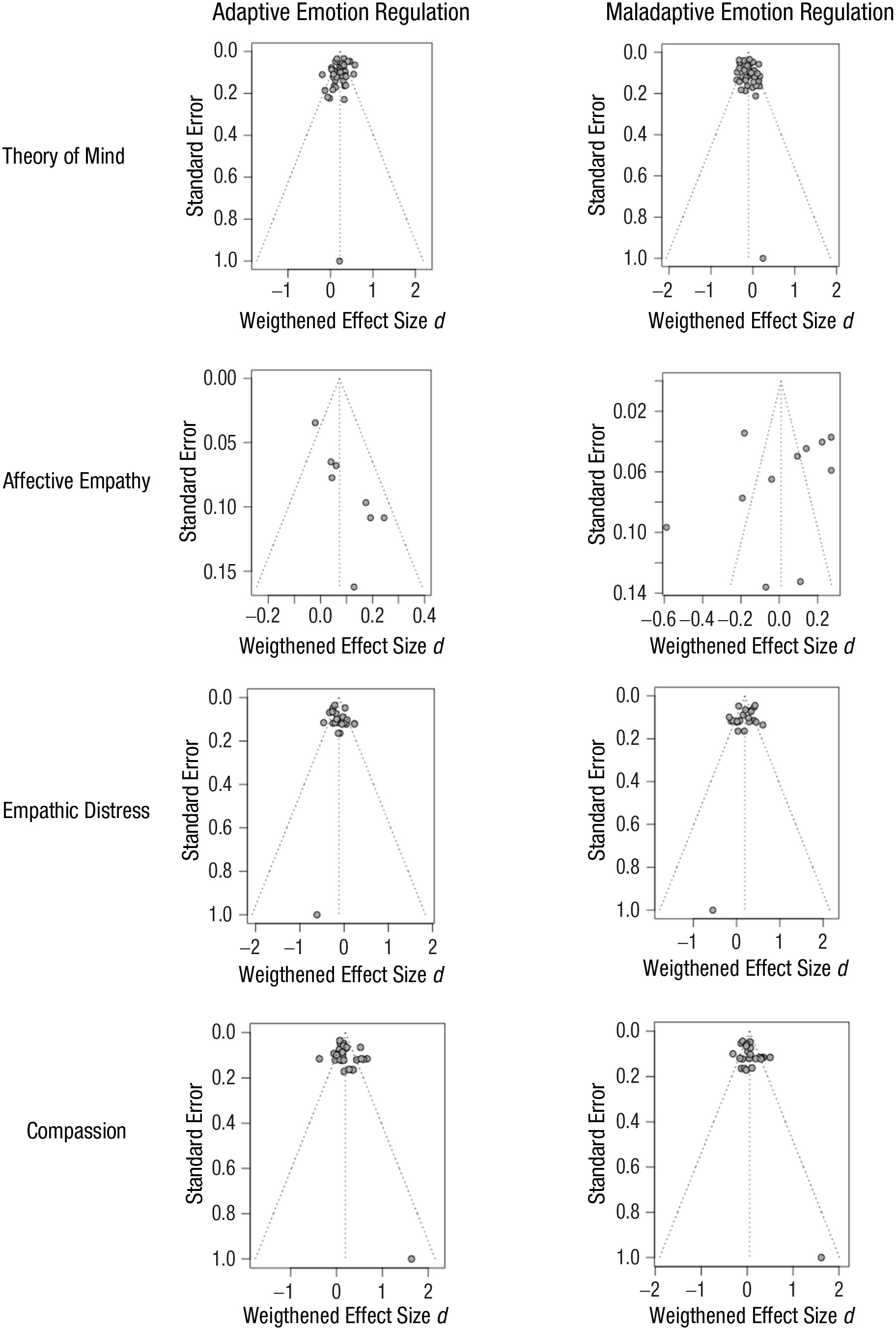
Because articles are more likely to be published when they find statistically significant results, the extent of impact is typically overestimated. To correct for this bias and exclude results based on p-hacking, we added p-curves (Simonsohn et al., 2014) and funnel plots (Fig. 2) as indicators of the robustness of effects. Because the visual interpretation of funnel plots is error prone (Page et al., 2019), Egger’s regression test for funnel-plot asymmetry (Egger et al., 1997; Sterne & Egger, 2005) was used.
Fig. 2. Funnel plots showing the relation between each type of emotion regulation (adaptive and maladaptive) and each of the four facets of social affect and cognition. Each dot indicates a study. The dashed triangle indicates the region within which 95% of studies are expected to lie in the absence of both biases and heterogeneity.

Results

Random-effects models

In total, eight random-effects models were tested across all samples (see Figs. 3 and 4).
Fig. 3. Forest plots showing the relation between each type of emotion regulation (adaptive and maladaptive) and each of the four facets of social affect and cognition. Separate plots are shown for the relation between adaptive emotion regulation and (a) cognitive empathy, (c) affective empathy, (e) empathic distress, and (g) compassion, as well as for the relation between maladaptive emotion regulation and (b) cognitive empathy, (d) affective empathy, (f) empathic distress, and (h) and compassion. Larger squares indicate greater effect sizes. A degree symbol indicates a clinical sample. CI = confidence interval.
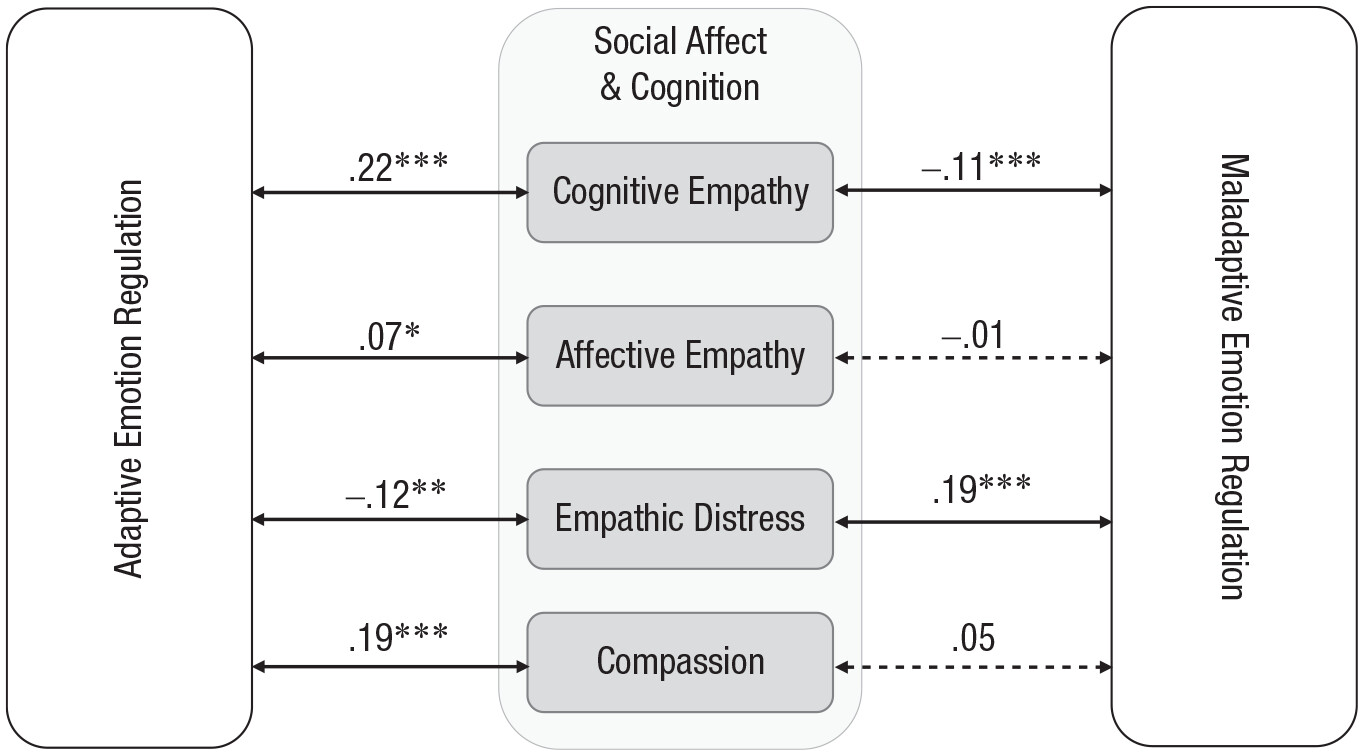
Fig. 4. Associations between adaptive and maladaptive emotion regulation and each facet of social affect and cognition (cognitive empathy, affective empathy, empathic distress, and compassion; see also Table 1). Solid arrows indicate significant correlations (*p = .037,**p = .002, ***p < .0001); dashed arrows indicate nonsignificant correlations.

The relationship between emotion regulation and cognitive empathy

As expected, adaptive emotion regulation was positively related to cognitive empathy (ρ = .22, k = 46, p < .001, 95% CI for ρ = [.17, .27]), whereas maladaptive emotion regulation was negatively correlated with cognitive empathy (ρ = –.11, k = 40, p < .0001, 95% CI for ρ = [−.16, –.05]). For an overview of the included samples, see Figs. 3a and 3b.

The relationship between emotion regulation and affective empathy

Affective empathy was positively related to adaptive emotion regulation (ρ = .07, k = 9, p = .037, 95% CI for ρ = [.01, .14]); however, there was no significant relationship between maladaptive emotion regulation and affective empathy (ρ = .01, k = 11, p = .897, 95% CI for ρ = [−.14, .16]). For an overview of the included samples, see Figs. 3c and 3d.

The relationship between emotion regulation and empathic distress

Adaptive emotion regulation and empathic distress were negatively correlated (ρ = –.12, k = 22, p = .002, 95% CI for ρ = [−.19, –.04]), whereas maladaptive emotional regulation and empathic distress were positively correlated (ρ = .19, k = 23, p <.001, 95% CI for ρ = [.10, .27]). For an overview of the included samples, see Figs. 3e and 3f.

The relationship between emotion regulation and compassion

Adaptive emotion regulation and compassion exhibited a positive correlation (ρ = .19, k = 28, p < .0001, 95% CI for ρ = [.11, .27]). The correlation between maladaptive emotion regulation and compassion was not significant (ρ = .05, k = 25, p = .171, 95% CI for ρ = [−.02, .13]). For an overview of the included samples, see Figs. 3g and 3h.

Heterogeneity analyses

The Q statistics (Table 1) were significant for all models, indicating heterogeneity between studies, with the exception of the model for the association between adaptive emotion regulation and affective empathy.
Table 1. Overview on the Results concerning the Associations between Emotion Regulation and each Facet of Social Affect and Cognition
Emotion regulation strategy and social affect and cognition facetr95% CIpkp value for QI2
Adaptive      
 Cognitive empathy.22[.17, .27]< .000146< .000172.6%
 Affective empathy.07[.01, .14].0379.14335.8%
 Empathic distress−.12[−.19, –.04].00222< .000171.3%
 Compassion.19[.10, .27]< .000128< .000180.2%
Maladaptive      
 Cognitive empathy−.11[−.17, –.06]< .000140< .000177.1%
 Affective empathy.01[−.14, .16].89711< .000194.2%
 Empathic distress.19[.10, .27]< .000123< .000180.8%
 Compassion.05[−.02, .13].17125< .000178.8%
Note: CI = confidence interval.

Sensitivity analyses

To assess the impact of outliers, we first tested seven of the eight models with all samples and then tested them without the samples whose CIs did not overlap with that of the pooled effect size. The model for adaptive emotion regulation and affective empathy did not show any outliers; therefore, no second model was calculated. We removed two samples from the model of adaptive emotion regulation and empathic distress (Lebowitz & Dovidio, 2015; Mohnke, 2019 sample 5), four from the model of adaptive emotion regulation and compassion (Berrios Martos et al., 2013; Mohnke, 2019 sample 2, sample 3 and sample 4), and five from the model of adaptive emotion regulation and cognitive empathy (Berrios Martos et al., 2013; Jordan et al., 2002; Krauskopf & Knigge, 2017; Taute et al., 2010; Wang et al., 2017). We further excluded one study from the models of maladaptive emotion regulation and (a) cognitive empathy (Tully et al., 2016), (b) affective empathy (Miguel et al., 2017), and (c) compassion (Mohnke, 2019b). From the model of maladaptive emotion regulation and empathic distress, we removed three outliers (Bonfils, 2018; Contardi et al., 2016; Gordon, 2014). After excluding outliers, we found that all correlations described above remained in the original direction: Adaptive emotion regulation was positively associated with cognitive empathy (ρ = .19, k = 40, p < .001, 95% CI for ρ = [.15, .23]), whereas maladaptive emotion regulation was negatively related to cognitive empathy (ρ = –.12, k = 39, p < .001, 95% CI for ρ = [−.17, –.06]). The association between maladaptive emotion regulation and affective empathy was not significant (ρ = –.02, k = 10, p = .821, 95% CI for ρ = [−.17, .13]). Empathic distress was negatively associated with adaptive emotion regulation (ρ = –.16, k = 20, p < .001, 95% CI for ρ = [−.21, –.09]) and positively related to maladaptive emotion regulation (ρ = .14, k = 20, p < .001, 95% CI for ρ = [.05, .22]). Adaptive emotion regulation and compassion remained significantly correlated (ρ = .12, k = 24, p < .001, 95% CI for ρ = [.06, .17]), whereas the correlation of maladaptive emotion regulation and compassion was not significant (ρ = .03, k = 24, p = .365, 95% CI for ρ = [−.04, .10]).
Including several correlations of a single sample (e.g., Bailey et al., 2020) can lead to an overestimation of meaningful correlations because of mutual interdependence. To address this issue, we conducted an analysis of all models including only one sample of each study in the overall data set. The results point to the robustness of the findings, with the exception of the model for adaptive emotion regulation and empathic distress, which we were not able to calculate because there were not enough data points.

Subgroup analyses

To investigate potential differences concerning distinct samples and measurement, we conducted subgroup analyses for the variable sample type (clinical vs. nonclinical) and type of measurement (self-report vs. test-based) if at least 10 samples were available for the respective model and there were more than two samples for each group. Hence, no subgroup analyses could be performed for the relationships between both adaptive (no clinical samples) and maladaptive emotion regulation (only one clinical sample) and affective empathy regarding the sample type. We could not conduct subgroup analyses for adaptive and maladaptive emotion regulation and (a) empathic distress or (b) compassion, as all samples were based on self-report measures. Further, we had to exclude the model investigating adaptive emotion regulation and affective empathy because we had only nine samples in total.
Six mixed models were calculated for the subgroup analysis of clinical versus nonclinical samples. In all models, there were more samples including nonclinical than clinical subjects. Significant differences between clinical and nonclinical samples were found only in the models for adaptive and maladaptive emotional regulation and compassion: The correlations were significantly stronger in clinical samples (maladaptive: ρ = .35, k = 4; adaptive: ρ = .54, k = 4) than in nonclinical samples (maladaptive: ρ = .01, k = 21; adaptive: ρ = .14, k = 24). The difference between clinical (ρ = .10, k = 9) and nonclinical (ρ = .24, k = 35) samples was almost statistically significant (p = .066) in the model for adaptive emotion regulation and cognitive empathy.
Three mixed models were calculated for the exploratory subgroup analysis of self-report versus test-based measures. In all models, there were more samples including self-report than test-based measures. Significant differences between self-report and test-based measures were found in the models for adaptive and maladaptive emotional regulation and cognitive empathy: The correlations were significantly stronger with test-based measures for maladaptive emotion regulation (ρ = –.21, k = 9) than in self-report measures (maladaptive: ρ = –.11, k = 30). For adaptive emotion regulation, the opposite pattern was found: Self-report measures showed a stronger correlation (ρ = .25, k = 36) than test-based measures (ρ = .04, k = 8). Two studies combined self-report and test-based measures (maladaptive: ρ = .14, k = 2; adaptive: ρ = .21, k = 2). The difference between self-report (ρ = –.03, k = 8) and test-based measures (ρ = .13, k = 3) was not significant in the model for maladaptive emotion regulation and affective empathy.

Publication bias and p-hacking

To check whether the effect sizes were influenced by publication bias, we (a) generated, visually inspected, and tested eight funnel plots with the Egger test for asymmetry (Page et al., 2019) and (b) performed seven p-curve analyses (the p-curve for adaptive emotion regulation and affective empathy could not be performed because there were not enough significant p values). For adaptive emotion regulation and affective empathy, the Egger test could not be performed, as at least 10 samples are needed (Page et al., 2019). The Egger tests for all other models were not significant, indicating no publication bias. The p-curve analyses revealed a right-skewed distribution of p values for all seven samples, indicating that no evidence suggestive of such influences was observed.

Discussion

This meta-analysis provides a systematic summary of the state of research on the relationship between adaptive versus maladaptive emotion regulation and socioaffective and sociocognitive facets. We further sought to integrate evidence from clinical, developmental, intercultural, organizational, and personality psychology on this topic. Building on 42 studies (58 samples), the findings suggest that using adaptive emotion regulation positively relates to cognitive empathy, affective empathy, and compassion, whereas it negatively relates to empathic distress. Moreover, maladaptive emotion regulation is negatively related to cognitive empathy and positively related to empathic distress.

The relationship between emotion regulation and cognitive empathy

As expected, and consistent with prior work, our results showed a positive association between adaptive emotion regulation and cognitive empathy (e.g., Taute et al., 2010; Wang et al., 2017) and a negative association between maladaptive emotion regulation and cognitive empathy (e.g., Lockwood et al., 2014). This is in line with theories from different areas of psychology (e.g., Eisenberg’s, 2010, theory of empathy-related responding; Salovey and Mayer’s, 1990, concept of emotional intelligence; see also Jordan et al., 2002): People who report being able to regulate their own emotions in an adaptive way are more likely to be able to take another person’s perspective, and people who report not being able to regulate their own emotions in an adaptive way are less likely to be able to take another person’s perspective. There are different possible explanations for this finding: Taking other people’s perspective might help to regulate one’s own emotions, for example, one might be less angry at the other person for making a mistake if one can also imagine that this person feels sad or ashamed because of the mistake. Another explanation could be that by being able to regulate one’s own emotions, one has the capacity to focus on the other person, which is a prerequisite for perspective taking. Cognitive empathy is resource demanding and requires both fluid and crystallized intelligence (Ochsner & Gross, 2008; Wieck et al., 2022); this finding shows that also regulating one’s emotions is inherently linked to accurately taking others’ perspective.
The negative association between maladaptive emotion regulation and cognitive empathy might also be explained by the focus of attention: For example, trying to suppress one’s feelings, rumination, or thinking about one’s past or future are self-centered emotion regulation strategies that might be associated with more difficulties focusing on other people’s perspectives. Furthermore, less cognitive empathy might also be part of not being able to react flexibly to the situation. This could be due to the use of a maladaptive strategy or difficulties fitting the right strategy to the situation (Haines et al., 2016) because one might not be able to read the room or imagine how other people feel in a particular situation. This suggests that maladaptive emotion regulation interferes with cognitive empathy, whereas adaptive emotion regulation does not. Further, being less effective at regulating one’s feelings is related to anxiety, depressed mood, and stress (e.g., Garnefski & Kraaij, 2006; Martin & Dahlen, 2005). In contrast, cognitive reappraisal, which is an adaptive regulation strategy, helps one to focus on other aspects of a situation, which thus helps to reframe the situation. This could imply that it facilitates focusing on the perspective of other people. Furthermore, our results could also mean that focusing on the perspective of other people seems to help to regulate one’s own feelings in an adaptive way. Future research could study the direction of the effect to investigate whether it is possible to shift focus from oneself to others by practicing more adaptive emotion regulation, to enhance, for example, leadership skills or reduce anxious or depressed symptomatology.

The relationship between emotion regulation and affective empathy

As expected, and in line with the findings of Eisenberg and Fabes (1992), our results showed that adaptive emotion regulation and affective empathy were positively related (e.g., Taute et al., 2010), although the effect size was small. Surprisingly, in our meta-analysis, we found no link between maladaptive emotion regulation and affective empathy. However, we could include only nine studies investigating the link between affective empathy and adaptive emotion regulation and 11 studies investigating the link between affective empathy and maladaptive emotion regulation. Thus, the findings should be taken with caution. One possible explanation for both the small effect size for adaptive regulation and the nonsignificant effect for maladaptive regulation could be that the included studies differentially conceptualized and operationalized affective empathy, encompassing concepts such as mimicry, emotional contagion, and affective match (Hess & Blairy, 2001). We were forced to combine these concepts given the small number of studies available, even though one might expect to find different results between more automatic, unconscious processes such as emotional contagion or mimicry and processes that might already involve emotion regulation, such as affective empathy or affective match. It is possible that automatic processes (e.g., contagion) occur too quickly or are unaffected by emotion regulation, whereas affective empathy is more intertwined with regulatory processes. Moreover, self–other differentiation is necessary for affective empathy, whereas emotion contagion is often considered a precursor of empathy that is already present in babies (Singer & Klimecki, 2014).
Schipper and Petermann (2013) argue that affective empathy develops faster than cognitive empathy: Whereas affective empathy activates the amygdala, hypothalamus, and orbitofrontal cortex with fast processing of the emotion signal, cognitive empathy is more closely related to processes involved in executive functions and self-regulation. This is supported by the meta-analysis by Yan and colleagues (2020), which showed that executive function was more strongly related to cognitive empathy (r = .20) than to affective empathy (r = .09).
In summary, less is known about the specific interactions between these differing conceptualizations of affective empathy and their specific timeline, and less research has been done regarding affective empathy and emotion regulation than regarding the other facets of the social affect and cognition. Accordingly, future researchers may wish to investigate these different processes (i.e., automatic vs. conscious processes) by combining different methodological approaches (i.e., implicit and explicit measures), complementing controlled laboratory sessions with experience-sampling studies, and looking from different perspectives (e.g., self- and other-report) in order to shed light on the specific timeline.

The relationship between emotion regulation and empathic distress

As predicted, our results show that adaptive emotion regulation is negatively associated with empathic distress (e.g., Chan, 2008; Jordan et al., 2002), whereas maladaptive emotion regulation is linked to increased empathic distress (e.g., Contardi et al., 2016; Grynberg & López-Pérez, 2018). This suggests that modulating emotional arousal indeed seems to be linked to preventing negative empathic overarousal, as suggested by research in developmental psychology (Eisenberg, 2010) and organizational psychology (Berrios Martos et al., 2013). Further studies could investigate whether and how personal distress mediates the association between maladaptive emotion regulation and social processes such as avoidance and relationship regulation (Grynberg & López-Pérez, 2018). For instance, suppression or rumination might be connected differently to social behaviors and perceptions. Thus, one could assume that rumination is linked to avoiding confrontations, whereas suppression might be linked to the inability to communicate one’s own needs. Examining these underlying processes might be fruitful in order to create interventions to help people who often experience distress improve their social interactions and relationship quality.

The relationship between emotion regulation and compassion

In line with our prediction, results showed that adaptive emotion regulation was associated with increased compassion (e.g., Bailey et al., 2020; Lebowitz & Dovidio, 2015). However, the link was much stronger in clinical than in nonclinical samples (e.g., Mohnke, 2019b). In line with this result, we found no association between maladaptive emotion regulation and compassion in nonclinical samples but a negative link between compassion and maladaptive emotion regulation in clinical samples. Research on compassion in the field of meditation and mindfulness (Engen & Singer, 2015; Jazaieri et al., 2016; Kraus & Sears, 2009) has shown that compassion meditation training positively affected participants’ emotional state by allowing them to feel more warmth and concern for others (Klimecki et al., 2013). On the basis of such findings, compassion itself has been discussed as an adaptive emotion regulation strategy: A study investigating the emotional regulatory efficacy of reappraisal and compassion showed that cognitive reappraisal primarily reduced the occurrence of negative feelings, whereas compassion largely increased positive feelings (Engen & Singer, 2015). Accordingly, compassion might act as a buffer by generating positive emotions (Preckel et al., 2018). Therefore, experiencing compassion benefits not only one’s social relationships but also one’s well-being, which explains why it has become part of psychotherapeutic interventions (Gilbert, 2015). However, most of the evidence in the psychotherapeutic context has focused on self-compassion, a construct we excluded from our meta-analysis. It would be fruitful to extend this research in psychotherapy to compassion for other people, as caring for others might have a range of positive outcomes both for oneself and for one’s relationships with other people.

Clinical samples versus nonclinical samples

Clinical samples with bipolar disorder, depression, schizoaffective disorder and schizophrenia, and other mental disorders according to DSM-5 Axis I and/or II (which were not further defined in the primary study and, thus, could not be further differentiated in the meta-analysis) were included in our meta-analysis. A statistically significant difference between clinical and nonclinical samples was found only for compassion, in which clinical samples had a stronger negative link between maladaptive emotion regulation and a stronger positive link between adaptive emotion regulation and compassion. This effect could also be an outlier due to the small sample size; thus, further research is needed. The lack of differences for the other facets of social affect and cognition might be a result of every disorder having its own specific social affect and cognition pattern. For example, aggressive offenders exhibit higher cognitive empathy and lower affective empathy (Winter et al., 2017), whereas people with depression or obsessive-compulsive disorder exhibit higher affective empathy (O’Connor et al., 2002; Salazar Kämpf et al., 2022) compared with nonclinical samples. Another suggestion by McRae and Gross (2020) is that people with mental disorders might use adaptive emotion regulation successfully when cued in the laboratory; however, they do not use it frequently in their everyday lives, which is in line with the idea that they might have difficulties fitting a strategy to a situation (Haines et al., 2016). This meta-analysis shows that more research with regard to different disorders is necessary in order to be able to compare them. Aldao and colleagues (2010), for example, suggest that internalizing disorders differ from externalizing disorders in their regulatory strategies. Future studies could therefore examine whether different forms of maladaptive emotion regulation (e.g., internalizing vs. externalizing) have different outcomes for social affect and cognition abilities and whether specific patterns of effects on interpersonal behavior become apparent.

Self-report versus test-based measures

It is easily imaginable that how we measure social affect and cognition affects our results. We conducted exploratory analyses for differences between self-report and test-based measures. For maladaptive emotion regulation and cognitive empathy, the correlation was stronger for test-based measures than for self-report measures, which could mean that maladaptive emotion regulation hinders cognitive empathy processes. Interestingly, for adaptive emotion regulation and cognitive empathy, the opposite pattern was found: Self-report measures showed a stronger correlation than test-based measures. This could indicate either that we overestimated the effect our adaptive regulation had on cognitive empathy or that maladaptive emotion regulation hindered cognitive empathic processes but adaptive emotion regulation did not enhance them. It would be interesting to study whether and how self-evaluation and actual performance influence each other.
The difference between self-report and test-based measures was not significant in the model for maladaptive emotion regulation and affective empathy; however, only a few studies could be included—hence more research is needed to confirm these results. It is important to note that most of the studies included in this meta-analysis were based on self-reports; hence, research would profit from more test-based studies. Furthermore, more observational research is needed regarding all social affect and cognition facets.

Other possible moderators

When different studies are included in a meta-analysis, the estimates will vary from one study to another. These differences might stem from random sampling error or from heterogeneity (von Hippel, 2015). In our meta-analysis, there were several sources of heterogeneity, including differences in the measurement, the sample type, the study design, or the data-analysis method. Including such diverse studies made possible both an overview and a closer look at specific factors (different social affect and cognition facets or the type of measurement). Future research should further shed light on other possible mechanisms and moderators influencing the strength of the association between emotion regulation and different facets of social affect and cognition. For example, taking another person’s perspective or feeling empathetic with them may also be influenced by how that person has made someone feel previously, whether this person upset or cheered up his or her interaction partner, what kind of relationship they have with each other, or whether the person has sufficient resources and motivation to engage with the other person.
Furthermore, factors such as age and gender could also influence the way we regulate our emotions and our social affect and cognition. In their review, Doerwald and colleagues (2016) describe that, compared with younger adults, older adults report being better at perceiving their emotions and having more cognitive empathy and more emotion regulation knowledge. However, the authors found no evidence for age differences between young and older adults’ effectiveness of regulating their own emotions. Other research has found that older adults show poorer performance in cognitive empathy than younger adults (e.g., Wieck et al., 2022) but perform at the same level or even better in affective empathy (Sze et al., 2012; Wieck & Kunzmann, 2015). However, the recent state of research does not reveal a clear picture, and findings are highly dependent on the method used. When using contextually embedded and age-fair tasks, age differences disappear (Isaacowitz et al., 2017; Wieck & Kunzmann, 2015). Future research could compare the different social affect and cognition facets between young and older adults, focusing on different methodological approaches.
As to gender, Nolen-Hoeksema (2012) describes how women are widely viewed as more emotional than men, with greater tendencies to express their emotions, whereas men are pictured as tending to avoid both the experience and expression of emotions. Nolen-Hoeksema states that there are gender differences for self-reported rumination, with women generally reporting a higher tendency to ruminate than men, whereas Berke et al. (2018) report that men are more externalizing (e.g., show aggressive behaviors) and suggest that these gender differences stem from childhood socialization and social pressure. It would be interesting to study how social affect and cognition is affected by socialization and whether the differences are reversible, for example, whether boys are explicitly being instructed to express their emotions.
In other words, both emotion regulation and social affect and cognition might depend on contextual (e.g., type of relationship, degree of resource demands) and individual (e.g., motivation, cognitive abilities, age, gender) factors, which should be investigated in future studies in more detail (Thompson, van Reekum, & Chakrabarti, 2019; Thompson, Uusberg, et al., 2019).

Theoretical and practical contributions

This meta-analysis makes several theoretical and practical contributions. Pietromonaco and Collins (2017) found that both social connection and social disconnection shape biological responses and behaviors with consequences for one’s health and well-being. In this meta-analysis, we show that this link might be bidirectional: Our responses to our own emotions are also linked to whether we are able to connect to others (e.g., through compassion) or feel stressed by other people’s emotions (e.g., empathic distress). Accordingly, Eisenberg (2010) suggested that emotion regulation contributes to a person’s ability to exhibit prosocial behavior (especially when there is a cost to the self). In this vein, the results of this meta-analysis point to possible theoretical explanations for why people who use maladaptive emotion regulation have smaller social networks and less satisfactory relationships (Chervonsky & Hunt, 2017): They might perceive other people’s emotions as more overwhelming and stressful, making affective and cognitive empathy as well as compassion less likely and consequently leading to problems in their social lives. Moreover, not being able to put oneself in the shoes of others or feel compassion might affect whether one can choose the most adaptive strategy in a situation (Haines et al., 2016).
Social relationships play a crucial role in our everyday lives and in our well-being (Pietromonaco & Collins, 2017). Connecting personal strategies of emotion regulation to how we react to other people’s emotions, and hence understanding specific mechanisms of social affect and cognition, offers new potential avenues for interventions to reintegrate people into social contexts. Various therapeutic approaches already incorporate emotion regulation training (Aldao et al., 2010), including dialectical behavioral therapy (Linehan, 1987) and emotion regulation therapy (Mennin & Fresco, 2014). However, this meta-analysis indicates that the effect of such interventions on patients’ social relationships might be bigger than expected, as emotion regulation affects the social affect and cognition in various ways. This finding could have practical implications for therapeutic approaches, as it shows that patients might show improvements in interpersonal behavior after learning adaptive emotion regulation.

Limitations and future directions

Both social affect and cognition and emotion regulation are multidimensional constructs, and they were defined and operationalized in different ways in the included studies. This may have led to conceptual blurriness with respect to cognitive and affective empathy, as demonstrated by the fact that we had to subsume different concepts (for cognitive empathy: perspective taking, theory of mind, mentalizing, empathic accuracy; for affective empathy: emotion contagion, affective match) under this term. This blurriness probably affected our results. Less research has been done regarding the link between emotion regulation and affective empathy. This might be because of the aforementioned blurriness of the concept but also because of difficulties in eliciting authentic emotions worth regulating in the laboratory. It therefore seems necessary to develop a concise definition but also to conduct more studies using real-life interactions, such as couple studies in the laboratory (e.g., Haase et al., 2016; Rohr et al., 2019) or ecological momentary assessments conducted in vivo (e.g., Colombo et al., 2020). Future researchers should seek to close this gap in order to gain further insights into how emotion regulation might affect the perception of social contexts (via social affect and cognition), how this might be connected to mental disorders, and how people actually behave in social contexts.
The same is true for empathic distress, which is used to describe a multitude of stressful experiences that can vary depending on the situation. Moreover, our meta-analysis indicates that some measures of emotion regulation overlap with psychopathology measures (Treynor et al., 2003); for example, rumination is not only a form of maladaptive emotion regulation but also a part of depressive symptomatology. Finally, clinical models of emotion regulation are distinct from prominent models of emotion regulation in basic affective science (e.g., Gross, 1998). Whereas those frameworks tend to conceptualize emotion regulation as more process-oriented, clinical psychology defines emotion regulation more as an ability that can be trained and developed, and difficulties in emotion regulation are seen as an important maintaining factor of mental disorders (Hallion et al., 2018). Furthermore, researchers have recently proposed dynamic models of emotion regulation in which various factors interact (e.g., demographic variation, personality, type of emotion, sensitivity to context, availability of a diverse repertoire of regulatory strategies, responsiveness to feedback, timing; Bonanno & Burton, 2013; Chen & Bonanno, 2021), which because of sample size could not be investigated as different factors. Because we included emotion regulation questionnaires that differ in their conceptual backgrounds, we could include a much broader range of studies. However, the Self-Report Instrument for the Assessment of Emotion-Specific Regulation Skills (Ebert et al., 2013), the Emotional Competence Questionnaire (Rindermann, 2009), or the Emotion Regulation Inventory (König, 2011), measure emotion regulation competencies in a way that is emotionally specific and/or competence oriented, whereas other research has focused on assessing difficulties in emotion regulation, such as the Cognitive Emotion Regulation Questionnaire (Garnefski & Kraaij, 2007) or the DERS (Gratz & Roemer, 2004). Those questionnaires have their roots in clinical psychology, more concretely “in ‘third-wave’ models of cognitive behavioral therapy, which propose a central role for experiential avoidance in the onset and maintenance of most forms of emotional disturbance” (Hallion et al., 2018, para. 1). The most widely used questionnaire, the ERQ (Abler & Kessler, 2009; Gross & John, 2003), assesses the frequency of different strategies used. We divided scales and subscales of these different questionnaires into adaptive and maladaptive emotion regulation. This enabled us to include data from other areas of psychology and consequently gain a broader overview, but this was also limited by the use of a categorical system—it did not reflect the complexity of everyday life. A strength of our study was that we included studies from all areas of psychology, leading to a haziness in understanding the process level of the interplay between regulatory and social affective and cognitive processes. Future studies in clinical psychology focusing on more recent multicomponent models of emotion regulation, which take into account context sensitivity, repertoire, and feedback responsiveness (Chen & Bonanno, 2021) or goals (Millgram et al., 2020), might offer new insights on the interplay between mental disorders and social affect and cognition. Overall, it would be fruitful for future research to develop consistent and precise definitions by combining and comparing different theoretical approaches and testing the suitability of different methodological approaches to measure these precise definitions.
Furthermore, most of the studies included in this meta-analysis relied on self-report data, especially regarding the assessment of emotion regulation, where only one measurement (the Mayer-Salovey-Caruso emotional intelligence test; see Table S1) was performance based. Previous research has shown that behavioral and self-report data often yield different findings regarding the relationships between, for example, affective empathy and depression (Schreiter et al., 2013). In other words, it is not clear whether individuals accurately report their emotion regulation strategies and social affective and cognitive abilities (Robinson & Clore, 2002), as this requires metacognitive abilities and might be influenced by moods, social desirability, or self-presentation biases. For example, people with social anxiety underestimate their social abilities (Hofmann, 2007). Furthermore, often-used measures such as the ERQ are limited to two emotion regulation strategies (reappraisal and suppression) and assess only the frequency of use and do not include the fit of a certain strategy for a situation (Haines et al., 2016). Therefore, one avenue for further research is more performance-based studies comparing different situations, as self-reports do not necessarily predict how people act in a real-life situation. One challenge of performance-based research is to develop stimuli that are able to evoke emotions in the study participants (Wieck et al., 2022). In this vein, Eisenberg (2010) suggests that if an empathy-inducing stimulus is not potent enough to elicit emotions in the observer, emotion regulation may be irrelevant. Newly developed test-based measures that evoke emotions tackle this issue, for example, with video clips depicting people talking about an emotional situation and expressing emotions (e.g., Kanske et al., 2015; Wieck & Kunzmann, 2015; Wieck et al., 2022).
This meta-analysis was intended to provide an overview of the current state of research; however, an overarching theory on the relationship and processes linking emotion regulation and social affect and cognition is still missing. Thompson, Uusberg, et al. (2019) suggest a framework for empathy and emotion regulation processes by stating that real-world interactions encompass complex dynamics between perception, mimicry, and cognitive processes, where both interaction partners influence each other to a degree that depends on their capacity and propensity to do so. Schurz and colleagues (2021) propose a hierarchical model of social cognition, similar to models of intelligence research, with predominantly cognitive processes, more affective processes, and combined processes. However, the studies included in this meta-analysis are correlational; hence, no claims of directionality or processes can be made. To shed light on the timeline of emotion regulatory and social affective and cognitive processes within interpersonal interaction, more studies with different methodological approaches are needed. For example, it might be fruitful for future studies to analyze the interplay between these processes on the individual level (e.g., social affective and cognitive processes, emotion regulation abilities, motivation) and social level (e.g., similarity between interaction partners). For instance, there are at least three potential explanations for a person experiencing compassion: (a) People differ in their tendency to be compassionate toward others (actor effect), (b) people vary in their tendency to elicit compassion (partner effect), or (c) the person who feels compassion for the other person has a specific compassionate relationship with the other person; in other words, people differ in their specific compassionate match (relationship effect). Another avenue of research could be to investigate whether people differ in their level of compassion depending on the situation or to make a detailed analysis of the different parts that encompass adaptive emotion regulation (e.g., flexibility, repertoire, frequent use of a certain strategy). Further follow-up questions could be to investigate the factors that facilitate social affective and cognitive matches, such as processes of emotional coregulation (English & Eldesouky, 2020) or similarity. Methodological approaches, such as the social-relations model by Back and Kenny (2010), might lead to more profound insights on the interplay between emotion regulation and social affect and cognition.
Furthermore, we did not account for contextual influences on emotion regulation and social affect and cognition, such as how these processes differ between different emotions (e.g., anger, sadness or happiness), interpersonal relationships (e.g., coworkers or romantic partners), or cultural contexts. Haga and colleagues (2009), for example, found differences in the use of strategies across cultures, ages, and gender. This meta-analysis relies mostly on data from Western adult cisgender males and cisgender females in the laboratory, which might not be representative of the interplay between emotion regulation and social affect and cognition in general. Rather, it reflects how these processes can be typically observed in these specific groups in individualistic countries.

Conclusion

Theoretical accounts point to emotion regulation as a socially embedded process. Amassing empirical findings, the present meta-analysis contributes to a better understanding of interconnectedness of adaptive versus maladaptive emotion regulation and social affect and cognition. In doing so, this meta-analysis represents a step forward in understanding the complex interplay between emotion regulation and social affective and cognitive processes. Nevertheless, more research is needed to gain a better understanding of how emotion regulation and social affective and cognitive processes influence each other and how using observational versus performance-based measures, different regulatory strategies or investigating them in different contexts affects these processes.

ORCID iDs

Footnotes

Declaration of Conflicting Interests The author(s) declared that there were no conflicts of interest with respect to the authorship or the publication of this article.
1. We chose a generic term (mal)adaptive emotion regulation for the classification we have made, deciding against other terms such as “functional” and “dysfunctional.” We did so to ensure a broad concept encompassing notions of flexibility, context-sensitivity, etc.
2. It should be noted that the inclusion of cognitive empathy as part of emotional intelligence is controversial (Jordan et al., 2002). Emotional-intelligence research has been criticized for a “lack of theoretical clarity regarding the relative roles of emotion perception, emotion understanding, and emotion regulation facets” (Joseph & Newman, 2010, p. 54).

Open practices

  • Open Data
  • Open Materials
  • Preregistration
This article has received the badges for Open Data, Open Materials, and Preregistration. More information about the Open Practices badges can be found at http://www.psychologicalscience.org/publications/badges.

Transparency

Action Editor: Jennifer Lau
Editor: Jennifer L. Tackett
Author Contributions
Maike Salazar Kämpf: Conceptualization; Data curation; formal analysis; Investigation; Methodology; Project Administration; Visualization; Writing – original draft; Writing – review & editing.
Luisa Adam: Conceptualization; Data curation; Investigation; Writing – review & editing.
Margund K. Rohr: Investigation; Writing – review & editing.
Cornelia Exner: Investigation; Supervision; Writing – review & editing.
Cornelia Wieck: Conceptualization; Formal analysis; Investigation; Methodology; Supervision; Writing – review & editing.

References

*An asterisk indicates that the study was included in the meta-analysis.
Abler B., Kessler H. (2009). Emotion regulation questionnaire–Eine deutschsprachige Fassung des ERQ von Gross und John [Emotion Regulation Questionnaire – A German version of the ERQ by Gross and John]. Diagnostica, 55(3), 144–152. https://doi.org/10.23668/psycharchives.402
Adolphs R. (2006). How do we know the minds of others? Domain-specificity, simulation, and enactive social cognition. Brain Research, 1079(1), 25–35. https://doi.org/10.1016/j.brainres.2005.12.127
Aldao A. (2013). The future of emotion regulation research: Capturing context. Perspectives on Psychological Science, 8(2), 155–172. https://doi.org/10.1177/1745691612459518
Aldao A., Nolen-Hoeksema S., Schweizer S. (2010). Emotion-regulation strategies across psychopathology: A meta-analytic review. Clinical Psychology Review, 30(2), 217–237. https://doi.org/10.1016/j.cpr.2009.11.004
*Arutyunyan K. (2018). Better understanding of the nature of empathy: Interaction of empathy, attachment styles, narcissism, dogmatism, anxiety, and emotion regulation in people of helping professions [Doctoral dissertation]. University of London. http://openaccess.city.ac.uk/id/eprint/21657/
Back M. D., Kenny D. A. (2010). The social relations model: How to understand dyadic processes. Social and Personality Psychology Compass, 4(10), 855–870. https://doi.org/10.1111/j.1751-9004.2010.00303.x
*Bailey P. E., Brady B., Ebner N. C., Ruffman T. (2020). Effects of age on emotion regulation, emotional empathy, and prosocial behavior. The Journals of Gerontology: B: Psychological Sciences and Social Sciences, 75(4), 802–810. https://doi.org/10.1093/geronb/gby084
Baron-Cohen S., Wheelwright S. (2004). The Empathy Quotient: An investigation of adults with Asperger syndrome or high functioning autism, and normal sex differences. Journal of Autism and Developmental Disorders, 34(2), 163–175. https://doi.org/10.1023/B:JADD.0000022607.19833.00
Batson C. D., Fultz J., Schoenrade P. A. (1987). Distress and empathy: Two qualitatively distinct vicarious emotions with different motivational consequences. Journal of Personality, 55(1), 19–39. https://doi.org/10.1111/j.1467-6494.1987.tb00426.x
Berke D. S., Reidy D., Zeichner A. (2018). Masculinity, emotion regulation, and psychopathology: A critical review and integrated model. Clinical Psychology Review, 66, 106–116. https://doi.org/10.1016/j.cpr.2018.01.004
*Berrios Martos M. P., Lopez-Zafra E., Pulido-Martos M., Augusto J. M. (2013). Are emotional intelligent workers also more empathic? Scandinavian Journal of Psychology, 54(5), 407–414. https://doi.org/10.1111/sjop.12058
Blanke E. S., Brose A., Kalokerinos E. K., Erbas Y., Riediger M., Kuppens P. (2020). Mix it to fix it: Emotion regulation variability in daily life. Emotion, 20(3), 473–485. https://doi.org/10.1037/emo0000566
*Blanke E. S., Riediger M., Brose A. (2018). Pathways to happiness are multidirectional: Associations between state mindfulness and everyday affective experience. Emotion, 18, 202–211. https://doi.org/10.1037/emo0000323
Bloom P. (2017). Empathy and its discontents. Trends in Cognitive Sciences, 21(1), 24–31. https://doi.org/10.1016/j.tics.2016.11.004
Bonanno G. A., Burton C. L. (2013). Regulatory flexibility: An individual differences perspective on coping and emotion regulation. Perspectives on Psychological Science, 8(6), 591–612. https://doi.org/10.1177/1745691613504116
*Bonfils K. A. (2018). The roles of emotion regulation and metacognition in performance-based empathy [Doctoral dissertation]. Purdue University. https://scholarworks.iupui.edu/handle/1805/13297
Bonfils K. A., Lysaker P. H., Minor K. S., Salyers M. P. (2017). Empathy in schizophrenia: A meta-analysis of the Interpersonal Reactivity Index. Psychiatry Research, 249, 293–303. https://doi.org/10.1016/j.psychres.2016.12.033
*Buruck G., Wendsche J., Melzer M., Strobel A., Dörfel D. (2014). Acute psychosocial stress and emotion regulation skills modulate empathic reactions to pain in others. Frontiers in Psychology, 5, Article 517. https://doi.org/10.3389/fpsyg.2014.00517
*Cameron C. D., Payne B. K. (2011). Escaping affect: How motivated emotion regulation creates insensitivity to mass suffering. Journal of Personality and Social Psychology, 100(1), 1–15. https://doi.org/10.1037/a0021643
Carver C. S. (1997). You want to measure coping but your protocol’ too long: Consider the brief COPE. International Journal of Behavioral Medicine, 4(1), 92–100. https://doi.org/10.1207/s15327558ijbm0401_6
*Chan E. (2008). The roles of theory of mind and empathy in the relationship between dysphoria and poor social functioning [Master’s thesis]. Queen’s University. https://qspace.library.queensu.ca/handle/1974/1565
Chen S., Bonanno G. A. (2021). Components of emotion regulation flexibility: Linking latent profiles to depressive and anxious symptoms. Clinical Psychological Science, 9(2), 236–251. https://doi.org/10.1177/2167702620956972
Chervonsky E., Hunt C. (2017). Suppression and expression of emotion in social and interpersonal outcomes: A meta-analysis. Emotion, 17(4), 669–683. https://doi.org/10.1037/emo0000270
Cole P. M., Luby J., Sullivan M. W. (2008). Emotions and the development of childhood depression: Bridging the gap. Child Development Perspectives, 2(3), 141–148.
Colombo D., Fernández-Álvarez J., Suso-Ribera C., Cipresso P., Valev H., Leufkens T., Sas C., Garcia-Palacios A., Riva G.,  Botella C. (2020). The need for change: Understanding emotion regulation antecedents and consequences using ecological momentary assessment. Emotion, 20(1), 30–36. https://doi.org/10.1037/emo0000671
*Contardi A., Imperatori C., Penzo I., Del Gatto C., Farina B. (2016). The association among difficulties in emotion regulation, hostility, and empathy in a sample of young Italian adults. Frontiers in Psychology, 7, Article 1068. https://doi.org/10.3389/fpsyg.2016.01068
Davis M. H. (1983). Measuring individual differences in empathy: Evidence for a multidimensional approach. Journal of Personality and Social Psychology, 44(1), 113–126. https://doi.org/10.1037/0022-3514.44.1.113
Decety J., Jackson P. L. (2004). The functional architecture of human empathy. Behavioral and Cognitive Neuroscience Reviews, 3(2), 71–100. https://doi.org/10.1177/1534582304267187
Decety J., Jackson P. L. (2006). A social-neuroscience perspective on empathy. Current Directions in Psychological Science, 15(2), 54–58. https://doi.org/10.1111/j.0963-7214.2006.00406.x
De Vignemont F., Singer T. (2006). The empathic brain: How, when and why? Trends in Cognitive Sciences, 10(10), 435–441. https://doi.org/10.1016/j.tics.2006.08.008
*Di Girolamo M., Giromini L., Winters C. L., Serie C. M. B., de Ruiter C. (2019). The Questionnaire of Cognitive and Affective Empathy: A comparison between paper-and pencil versus online formats in Italian samples. Journal of Personality Assessment, 101(2), 159–170. https://doi.org/10.1080/00223891.2017.1389745
Doerwald F., Scheibe S., Zacher H., Van Yperen N. W. (2016). Emotional competencies across adulthood: State of knowledge and implications for the work context. Work, Aging and Retirement, 2(2), 159–216. https://doi.org/10.1093/workar/waw013
Dziobek I., Fleck S., Kalbe E., Rogers K., Hassenstab J., Brand M., Kessler J., Woike J. K., Wolf O.T., Convit A. (2006). Introducing MASC: A movie for the assessment of social cognition. Journal of Autism and Developmental Disorders, 36, 623–636. https://doi.org/10.1007/s10803-006-0107-0
Dziobek I., Rogers K., Fleck S., Bahnemann M., Heekeren H. R., Wolf O. T., Convit A. (2008). Dissociation of cognitive and emotional empathy in adults with Asperger syndrome using the Multifaceted Empathy Test (MET). Journal of Autism and Developmental Disorders, 38, 464–473. https://doi.org/10.1007/s10803-007-0486-x
Ebert D. D., Christ O., Berking M. (2013). Entwicklung und Validierung eines Fragebogens zur emotionsspezifischen Selbsteinschätzung emotionaler Kompetenzen (SEK-ES) [Development and validation of a self-report instrument for the assessment of emotion-specific regulation skills (ERSQ-ES)]. Diagnostica. https://doi.org/10.1026/0012-1924/a000079
Egger M., Smith G. D., Schneider M., Minder C. (1997). Bias in meta-analysis detected by a simple, graphical test. British Medical Journal, 315(7109), 629–634.
Ehring T., Fischer S., Schnülle J., Bösterling A., Tuschen-Caffier B. (2008). Characteristics of emotion regulation in recovered depressed versus never depressed individuals. Personality and Individual Differences, 44(7), 1574–1584. https://doi.org/10.1016/j.paid.2008.01.013
Eisenberg N. (2000). Emotion, regulation, and moral development. Annual Review of Psychology, 51, 665–697. https://doi.org/10.1146/annurev.psych.51.1.665
Eisenberg N. (2010). Empathy-related responding: Links with self-regulation, moral judgment, and moral behavior. In Mikulincer M., Shaver P. R. (Eds.), Prosocial motives, emotions, and behavior: The better angels of our nature (pp. 129–148). American Psychological Association. https://doi.org/10.1037/12061-007
Eisenberg N., Fabes R. A. (1992). Emotion, regulation, and the development of social competence. In Clark M. S. (Ed.), Emotion and social behavior (pp. 119–150). SAGE.
Eisenberg S. A., Shen B.-J., Schwarz E. R., Mallon S. (2012). Avoidant coping moderates the association between anxiety and patient-rated physical functioning in heart failure patients. Journal of Behavioral Medicine, 35(3), 253–261. https://doi.org/10.1007/s10865-011-9358-0
Engen H. G., Singer T. (2015). Compassion-based emotion regulation up-regulates experienced positive affect and associated neural networks. Social Cognitive and Affective Neuroscience, 10(9), 1291–1301. https://doi.org/10.1093/scan/nsv008
English T., Eldesouky L. (2020). We’re not alone: Understanding the social consequences of intrinsic emotion regulation. Emotion, 20(1), 43–47. https://doi.org/10.1037/emo0000661
*Enríquez H., Ramos N., Esparza O. (2017). Impact of the mindful emotional intelligence program on emotional regulation in college students. International Journal of Psychology & Psychological Therapy, 17(1), 39–48.
Eysenck M. W., Derakshan N., Santos R., Calvo M. G. (2007). Anxiety and cognitive performance: Attentional control theory. Emotion, 7(2), 336–353. https://doi.org/10.1037/1528-3542.7.2.336
*Fossati A., Borroni S., Dziobek I., Fonagy P., Somma A. (2018). Thinking about assessment: Further evidence of the validity of the Movie for the Assessment of Social Cognition as a measure of mentalistic abilities. Psychoanalytic Psychology, 35(1), 127–141. https://doi.org/10.1037/pap0000130
Fox H. C., Axelrod S. R., Paliwal P., Sleeper J., Sinha R. (2007). Difficulties in emotion regulation and impulse control during cocaine abstinence. Drug and Alcohol Dependence, 89(2–3), 298–301. https://doi.org/10.1016/j.drugalcdep.2006.12.026
Fox H. C., Hong K. A., Sinha R. (2008). Difficulties in emotion regulation and impulse control in recently abstinent alcoholics compared with social drinkers. Addictive Behaviors, 33(2), 388–394. https://doi.org/10.1016/j.addbeh.2007.10.002
Frith C. D., Frith U. (2006). The neural basis of mentalizing. Neuron, 50(4), 531–534. https://doi.org/10.1016/j.neuron.2006.05.001
Garnefski N., Kraaij V. (2006). Relationships between cognitive emotion regulation strategies and depressive symptoms: A comparative study of five specific samples. Personality and Individual Differences, 40(8), 1659–1669. https://doi.org/10.1016/j.paid.2005.12.009
Garnefski N., Kraaij V. (2007). The Cognitive Emotion Regulation Questionnaire. European Journal of Psychological Assessment, 23(3), 141–149. https://doi.org/10.1027/1015-5759.23.3.141
Gärtner A., Strobel A. (2021). Individual differences in inhibitory control: A latent variable analysis. Journal of Cognition, 4(1), 1–18. https://doi.org/10.5334/joc.150
*Ghiasi H., Mohammadi A., Zarrinfar P. (2016). An investigation into the roles of theory of mind, emotion regulation, and attachment styles in predicting the traits of borderline personality disorder. Iranian Journal of Psychiatry, 11(4), 206–213.
Gilbert P. (2015). The evolution and social dynamics of compassion. Social and Personality Psychology Compass, 9(6), 239–254. https://doi.org/10.1111/spc3.12176
Glenn C. R., Klonsky E. D. (2009). Emotion dysregulation as a core feature of borderline personality disorder. Journal of Personality Disorders, 23(1), 20–28. https://doi.org/10.1521/pedi.2009.23.1.20
*Gordon H. (2014). Investigating the relation between empathy and prosocial behavior: An emotion regulation framework [Master’s thesis]. Virginia Polytechnic Institute and State University. https://vtechworks.lib.vt.edu/handle/10919/78070
*Gordon N. S., Chesney S. A. (2017). On the outside looking in: Distress and sympathy for ethnic victims of violence by out-group members. Journal of Cognition and Culture, 17(3–4), 199–217.
Gratz K. L., Roemer L. (2004). Multidimensional assessment of emotion regulation and dysregulation: Development, factor structure, and initial validation of the Difficulties in Emotion Regulation Scale. Journal of Psychopathology and Behavioral Assessment, 26(1), 41–54. https://doi.org/10.1023/B:JOBA.0000007455.08539.94
Green M. F., Horan W. P., Lee J. (2015). Social cognition in schizophrenia. Nature Reviews Neuroscience, 16(10), 620–631. https://doi.org/10.1038/nrn4005
Gross J. J. (1998). The emerging field of emotion regulation: An integrative review. Review of General Psychology, 2(3), 271–299. https://doi.org/10.1037/1089-2680.2.3.271
Gross J. J., Jazaieri H. (2014). Emotion, emotion regulation, and psychopathology: An affective science perspective. Clinical Psychological Science, 2(4), 387–401. https://doi.org/10.1177/2167702614536164
Gross J. J., John O. P. (2003). Individual differences in two emotion regulation processes: Implications for affect, relationships, and well-being. Journal of Personality and Social Psychology, 85(2), 348–362. https://doi.org/10.1037/0022-3514.85.2.348
*Grynberg D., López-Pérez B. (2018). Facing others’ misfortune: Personal distress mediates the association between maladaptive emotion regulation and social avoidance. PLOS ONE, 13(3), Article e0194248. https://doi.org/10.1371/journal.pone.0194248
Haase C. M., Holley S. R., Bloch L., Verstaen A., Levenson R. W. (2016). Interpersonal emotional behaviors and physical health: A 20-year longitudinal study of long-term married couples. Emotion, 16(7), 965–977. https://doi.org/10.1037/a0040239
Haga S. M., Kraft P., Corby E. K. (2009). Emotion regulation: Antecedents and well-being outcomes of cognitive reappraisal and expressive suppression in cross-cultural samples. Journal of Happiness Studies, 10(3), 271–291. https://doi.org/10.1007/s10902-007-9080-3
Haines S. J., Gleeson J., Kuppens P., Hollenstein T., Ciarrochi J., Labuschagne I., Grace C., Koval P. (2016). The wisdom to know the difference: Strategy-situation fit in emotion regulation in daily life is associated with well-being. Psychological Science, 27(12), 1651–1659.
Hallion L. S., Steinman S. A., Tolin D. F., Diefenbach G. J. (2018). Psychometric properties of the Difficulties in Emotion Regulation Scale (DERS) and its short forms in adults with emotional disorders. Frontiers in Psychology, 9, Article 539. https://doi.org/10.3389/fpsyg.2018.00539
Harari H., Shamay-Tsoory S. G., Ravid M., Levkovitz Y. (2010). Double dissociation between cognitive and affective empathy in borderline personality disorder. Psychiatry Research, 175(3), 277–279. https://doi.org/10.1016/j.psychres.2009.03.002
Harrer M., Cuijpers P., Furukawa T. A., Ebert D. D. (2019). Doing meta-analysis in R: A hands-on guide. https://bookdown.org/MathiasHarrer/Doing_Meta_Analysis_in_R/
Hausberg M. C., Schulz H., Piegler T., Happach C. G., Klöpper M., Brütt A. L., Sammet I., Andreas S. (2012). Is a self-rated instrument appropriate to assess mentalization in patients with mental disorders? Development and first validation of the Mentalization Questionnaire (MZQ). Psychotherapy Research, 22(6), 699–709. https://doi.org/10.1080/10503307.2012.709325
Helbig-Lang S., Rusch S., Lincoln T. M. (2015). Emotion regulation difficulties in social anxiety disorder and their specific contributions to anxious responding. Journal of Clinical Psychology, 71(3), 241–249. https://doi.org/10.1002/jclp.22135
Hess U., Blairy S. (2001). Facial mimicry and emotional contagion to dynamic emotional facial expressions and their influence on decoding accuracy. International Journal of Psychophysiology, 40(2), 129–141. https://doi.org/10.1016/S0167-8760(00)00161-6
Higgins J. P. T., Thompson S. G. (2004). Controlling the risk of spurious findings from meta-regression. Statistics in Medicine, 23(11), 1663–1682. https://doi.org/10.1002/sim.1752
Hofmann S. G. (2007). Cognitive factors that maintain social anxiety disorder: A comprehensive model and its treatment implications. Cognitive Behaviour Therapy, 36(4), 193–209. https://doi.org/10.1080/16506070701421313
Hu T., Zhang D., Wang J., Mistry R., Ran G., Wang X. (2014). Relation between emotion regulation and mental health: A meta-analysis review. Psychological Reports, 114(2), 341–362. https://doi.org/10.2466/03.20.PR0.114k22w4
Hunter J. E., Schmidt F. L. (2004). Methods of meta-analysis: Correcting error and bias in research findings (2nd ed.). SAGE.
Ickes W. (1993). Empathic accuracy. Journal of Personality, 61(4), 587–610. https://doi.org/10.1111/j.1467-6494.1993.tb00783.x
Isaacowitz D. M., Livingstone K. M., Castro V. L. (2017). Aging and emotions: Experience, regulation, and perception. Current Opinion in Psychology, 17, 79–83. https://doi.org/10.1016/j.copsyc.2017.06.013
*Jakobson L. S., Pearson P. M., Kozub Z., Hare C., Rigby S. N. (2018). Links between traits associated with the broad autism phenotype and empathy and young adults’ ability to decode speaker intentionality. Research in Autism Spectrum Disorders, 50, 11–21. https://doi.org/10.1016/j.rasd.2018.03.001
Jansen M., Overgaauw S., De Bruijn E. R. (2020). Social cognition and obsessive-compulsive disorder: A review of subdomains of social functioning. Frontiers in Psychiatry, 11, Article 118. https://doi.org/10.3389/fpsyt.2020.00118
Jazaieri H., Lee I. A., McGonigal K., Jinpa T., Doty J. R., Gross J. J., Goldin P. R. (2016). A wandering mind is a less caring mind: Daily experience sampling during compassion meditation training. Journal of Positive Psychology, 11(1), 37–50. https://doi.org/10.1080/17439760.2015.1025418
*Jordan P. J., Ashkanasy N. M., Härtel C. E. J., Hooper G. S. (2002). Workgroup emotional intelligence: Scale development and relationship to team process effectiveness and goal focus. Human Resource Management Review, 12(2), 195–214. https://doi.org/10.1016/S1053-4822(02)00046-3
Joseph D. L., Newman D. A. (2010). Emotional intelligence: An integrative meta-analysis and cascading model. Journal of Applied Psychology, 95(1), 54–78. https://doi.org/10.1037/a0017286
Kahn R. E., Frick P. J., Golmaryami F. N., Marsee M. A. (2017). The moderating role of anxiety in the associations of callous-unemotional traits with self-report and laboratory measures of affective and cognitive empathy. Journal of Abnormal Child Psychology, 45(3), 583–596. https://doi.org/10.1007/s10802-016-0179-z
Kanske P., Böckler A., Trautwein F.-M., Parianen Lesemann F. H., Singer T. (2016). Are strong empathizers better mentalizers? Evidence for independence and interaction between the routes of social cognition. Social Cognitive and Affective Neuroscience, 11(9), 1383–1392. https://doi.org/10.1093/scan/nsw052
Kanske P., Böckler A., Trautwein F. M., Singer T. (2015). Dissecting the social brain: Introducing the EmpaToM to reveal distinct neural networks and brain–behavior relations for empathy and theory of mind. NeuroImage, 122, 6–19. https://doi.org/10.1016/j.neuroimage.2015.07.082
Klimecki O., Singer T. (2012). Empathic distress fatigue rather than compassion fatigue? Integrating findings from empathy research in psychology and social neuroscience. Pathological Altruism, 5, 368–383.
Klimecki O. M., Leiberg S., Lamm C., Singer T. (2013). Functional neural plasticity and associated changes in positive affect after compassion training. Cerebral Cortex, 23(7), 1552–1561. https://doi.org/10.1093/cercor/bhs142
Klimecki O. M., Leiberg S., Ricard M., Singer T. (2014). Differential pattern of functional brain plasticity after compassion and empathy training. Social Cognitive and Affective Neuroscience, 9(6), 873–879. https://doi.org/10.1093/scan/nst060
König D. (2011). Die Regulation von negativen und positiven Emotionen. Entwicklung des Emotionsregulations-Inventars und Vergleich von Migränikerinnen mit Kontrollpersonen [The regulation of negative and positive emotions. Development of the Emotion Regulation Inventory and comparison of migraineurs with controls] [Unpublished doctoral dissertation]. University of Vienna.
*Köther U., Lincoln T. M., Moritz S. (2018). Emotion perception and overconfidence in errors under stress in psychosis. Psychiatry Research, 270, 981–991. https://doi.org/10.1016/j.psychres.2018.03.044
Kraus S., Sears S. (2009). Measuring the immeasurables: Development and initial validation of the Self-Other Four Immeasurables (SOFI) Scale based on Buddhist teachings on loving kindness, compassion, joy, and equanimity. Social Indicators Research, 92(1), 169–181. https://doi.org/10.1007/s11205-008-9300-1
*Krauskopf K., Knigge M. (2017). Die Komplexität kognitiver Emotions-repräsentationen als Facette sozio-emotionaler Kompetenzen von Lehrkräften. Eine Pilotstudie zur Entwicklung von Items zur Erfassung der Levels of Emotional Awareness im Lehramtsstudium [The complexity of cognitive representations of emotions as a facet of pre-service teachers’ socio-emotional competencies. A pilot study on assessing Levels of Emotional Awareness in teacher training]. Empirische Sonderpädagogik, 1, 66–89.
Kunzmann U., Wieck C., Dietzel C. (2018). Empathic accuracy: Age differences from adolescence into middle adulthood. Cognition and Emotion, 32(8), 1611–1624. https://doi.org/10.1080/02699931.2018.1433128
Laghi F., Lonigro A., Pallini S., Baiocco R. (2018). Emotion regulation and empathy: Which relation with social conduct? Journal of Genetic Psychology, 179(2), 62–70. https://doi.org/10.1080/00221325.2018.1424705
Lavender J. M., Anderson D. A. (2010). Contribution of emotion regulation difficulties to disordered eating and body dissatisfaction in college men. International Journal of Eating Disorders, 43(4), 352–357. https://doi.org/10.1002/eat.20705
*Lebowitz M. S., Dovidio J. F. (2015). Implications of emotion regulation strategies for empathic concern, social attitudes, and helping behavior. Emotion, 15(2), 187–194. https://doi.org/10.1037/a0038820
*Lehmann A., Bahçesular K., Brockmann E.-M., Biederbick S.-E., Dziobek I., Gallinat J., Montag C. (2014). Subjective experience of emotions and emotional empathy in paranoid schizophrenia. Psychiatry Research, 220(3), 825–833. https://doi.org/10.1016/j.psychres.2014.09.009
Liberati A., Altman D. G., Tetzlaff J., Mulrow C., Gøtzsche P. C., Ioannidis J. P., Clarke M., Devereaux P. J., Kleijnen J., Moher D. (2009). The PRISMA statement for reporting systematic reviews and meta-analyses of studies that evaluate health care interventions: Explanation and elaboration. PLOS ONE, 6(7), Article e1000100. https://doi.org/10.1371/journal.pmed.1000100
Linehan M. M. (1987). Dialectical behavior therapy for borderline personality disorder: Theory and method. Bulletin of the Menninger Clinic, 51(3), 261–276.
*Lockwood P. L., Seara-Cardoso A., Viding E. (2014). Emotion regulation moderates the association between empathy and prosocial behavior. PLOS ONE, 9(5), Article e96555. https://doi.org/10.1371/journal.pone.0096555
*MacDonald H. Z., Price J. L. (2019). The role of emotion regulation in the relationship between empathy and internalizing symptoms in college students. Mental Health & Prevention, 13, 43–49. https://doi.org/10.1016/j.mhp.2018.11.004
Mahmoud J. S. R., Staten R., Hall L. A., Lennie T. A. (2012). The relationship among young adult college students’ depression, anxiety, stress, demographics, life satisfaction, and coping styles. Issues in Mental Health Nursing, 33(3), 149–156. https://doi.org/10.3109/01612840.2011.632708
*Mansour S., Rozenblat V., Fuller- Tyszkiewicz M., Paganini C., Treasure J., Krug I. (2016). Emotions mediate the relationship between autistic traits and disordered eating: A new autistic-emotional model for eating pathology. Psychiatry Research, 245, 119–126. https://doi.org/10.1016/j.psychres.2016.08.21
Martin R. C., Dahlen E. R. (2005). Cognitive emotion regulation in the prediction of depression, anxiety, stress, and anger. Personality and Individual Differences, 39(7), 1249–1260. https://doi.org/10.1016/j.paid.2005.06.004
McDermott M. J., Tull M. T., Gratz K. L., Daughters S. B., Lejuez C. W. (2009). The role of anxiety sensitivity and difficulties in emotion regulation in posttraumatic stress disorder among crack/cocaine dependent patients in residential substance abuse treatment. Journal of Anxiety Disorders, 23(5), 591–599. https://doi.org/10.1016/j.janxdis.2009.01.006
McRae K., Gross J. J. (2020). Emotion regulation. Emotion, 20(1), 1–9. https://doi.org/10.1037/emo0000703
Mennin D. S., Fresco D. M. (2014). Emotion regulation therapy. In Gross J. J. (Ed.), Handbook of emotion regulation (2nd ed., pp. 469–490). Guilford Press.
*Miguel F. K., Giromini L., Colombarolli M. S., Zuanazzi A. C., Zennaro A. (2017). A Brazilian investigation of the 36-and 16-item Difficulties in Emotion Regulation Scales. Journal of Clinical Psychology, 73(9), 1146–1159. https://doi.org/10.1002/jclp.22404
Millgram Y., Huppert J. D., Tamir M. (2020). Emotion goals in psychopathology: A new perspective on dysfunctional emotion regulation. Current Directions in Psychological Science, 29(3), 242–247. https://doi.org/10.1177/0963721420917713
*Mohnke S. (2019). ERQ and IRI values of a non-clinical control group, patients with schizophrenia, patients with bipolar disorder and patients with depression [unpublished SPSS data set]. Charité Berlin.
*Mota S., Leckelt M., Geukes K., Nestler S., Humberg S., Schröder-Abé M., Schmukle S. C., Back M. D. (2019). A comprehensive examination of narcissists’ self-perceived and actual socioemotional cognition ability. Collabra: Psychology, 5(1), Article 6. https://doi.org/10.1525/collabra.174
Nolen-Hoeksema S. (2012). Emotion regulation and psychopathology: The role of gender. Annual Review of Clinical Psychology, 8(1), 161–187. https://doi.org/10.1146/annurev-clinpsy-032511-143109
Ochsner K. N., Gross J. J. (2008). Cognitive emotion regulation: Insights from social cognitive and affective neuroscience. Current Directions in Psychological Science, 17(2), 153–158. https://doi.org/10.1111/j.1467-8721.2008.00566.x
O’Connor L. E., Berry J. W., Weiss J., Gilbert P. (2002). Guilt, fear, submission, and empathy in depression. Journal of Affective Disorders, 71(1–3), 19–27. https://doi.org/10.1016/S0165-0327(01)00408-6
*Orri M., Pingault J.-B., Rouquette A., Lalanne C., Falissard B., Herba C., Côté S. M., Berthoz S. (2017). Identifying affective personality profiles: A latent profile analysis of the Affective Neuroscience Personality Scales. Scientific Reports, 7(1), Article 4548. https://doi.org/10.1038/s41598-017-04738-x
Page M. J., Higgins J. P. T., Sterne J. A. C. (2019). Assessing risk of bias due to missing results in a synthesis. In Higgins J. P. T., Thomas J., Chandler J., Cumpston M., Li T., Page M. J., Welch V., Flemyng E. (Eds.), Cochrane handbook for systematic reviews of interventions (Version 6.0). The Cochrane Collaboration. https://training.cochrane.org/handbook
Pietromonaco P. R., Collins N. L. (2017). Interpersonal mechanisms linking close relationships to health. American Psychologist, 72(6), 531–542. https://doi.org/10.1037/amp0000129
*Powell P. A. (2018). Individual differences in emotion regulation moderate the associations between empathy and affective distress. Motivation and Emotion, 42(4), 602–613. https://doi.org/10.1007/s11031-018-9684-4
Preckel K., Kanske P., Singer T. (2018). On the interaction of social affect and cognition: Empathy, compassion and theory of mind. Current Opinion in Behavioral Sciences, 19, 1–6. https://doi.org/10.1016/j.cobeha.2017.07.010
Quoidbach J., Berry E. V., Hansenne M., Mikolajczak M. (2010). Positive emotion regulation and well-being: Comparing the impact of eight savoring and dampening strategies. Personality and Individual Differences, 49(5), 368–373. https://doi.org/10.1016/j.paid.2010.03.048
Reniers R., Corcoran R., Drake R., Shryane N. M., Völlm B. A. (2011). The QCAE: A Questionnaire of Cognitive and Affective Empathy. Journal of Personality Assessment, 93(1), 84–95. https://doi.org/10.1080/00223891.2010.528484
Ripoll L. H., Snyder R., Steele H., Siever L. J. (2013). The neurobiology of empathy in borderline personality disorder. Current Psychiatry Reports, 15(3), 344–355. https://doi.org/10.1007/s11920-012-0344-1
Robinson M. D., Clore G. L. (2002). Belief and feeling: Evidence for an accessibility model of emotional self-report. Psychological Bulletin, 128(6), 934–960.
*Rohr M. K., Nestler S., Kunzmann U. (2019). A trouble shared is a trouble halved: Age differences in emotional experience and expression during couples’ conversations. Psychology and Aging, 34, 848–861.
*Rowland J. E., Hamilton M. K., Vella N., Lino B. J., Mitchell P. B., Green M. J. (2013). Adaptive associations between social cognition and emotion regulation are absent in schizophrenia and bipolar disorder. Frontiers in Psychology, 3, Article 607. https://doi.org/10.3389/fpsyg.2012.00607
Salazar Kämpf M., Kanske P., Kleiman A., Haberkamp A., Glombiewski J., Exner C. (2022). Empathy, compassion, and theory of mind in obsessive-compulsive disorder. Psychology and Psychotherapy: Theory, Research and Practice, 95(1), 1–17. https://doi.org/10.1111/papt.12358
Salovey P., Mayer J. D. (1990). Emotional intelligence. Imagination, Cognition and Personality, 9(3), 185–211. https://doi.org/10.2190/DUGG-P24E-52WK-6CDG
Schipper M., Petermann F. (2013). Relating empathy and emotion regulation: Do deficits in empathy trigger emotion dysregulation? Social Neuroscience, 8(1), 101–107. https://doi.org/10.1080/17470919.2012.761650
Schlegel K., Palese T., Mast M. S., Rammsayer T. H., Hall J. A., Murphy N. A. (2020). A meta-analysis of the relationship between emotion recognition ability and intelligence. Cognition and Emotion, 34(2), 329–351. https://doi.org/10.1080/02699931.2019.1632801
Schreiter S., Pijnenborg G. H. M., Aan Het Rot M. (2013). Empathy in adults with clinical or subclinical depressive symptoms. Journal of Affective Disorders, 150(1), 1–16. https://doi.org/10.1016/j.jad.2013.03.009
Schurz M., Radua J., Tholen M. G., Maliske L., Margulies D. S., Mars R. B., Sallet J., Kanske P. (2021). Toward a hierarchical model of social cognition: A neuroimaging meta-analysis and integrative review of empathy and theory of mind. Psychological Bulletin, 147(3), 293–327. https://doi.org/10.1037/bul0000303
Schwarzer G. (2007). meta: An R package for meta-analysis. R News, 7(3), 40–45.
*Shaw D. J., Czekóová K., Pennington C. R., Qureshi A. W., Špiláková B., Salazar M., Brázdil M., Urbánek T. (2020). You ≠ me: Individual differences in the structure of social cognition. Psychological Research, 84, 1139–1156. https://doi.org/10.1007/s00426-018-1107-3
Shields G. S., Moons W. G., Tewell C. A., Yonelinas A. P. (2016). The effect of negative affect on cognition: Anxiety, not anger, impairs executive function. Emotion, 16(6), 792–797. https://doi.org/10.1037/emo0000151
Simmons J. P., Nelson L. D., Simonsohn U. (2011). False-positive psychology: Undisclosed flexibility in data collection and analysis allows presenting anything as significant. Psychological Science, 22, 1359–1366. https://doi.org/10.1177/0956797611417632
Simonsohn U., Nelson L. D., Simmons J. P. (2014). p-curve and effect size: Correcting for publication bias using only significant results. Perspectives on Psychological Science, 9(6), 666–681. https://doi.org/10.1177/1745691614553988
Singer T., Klimecki O. M. (2014). Empathy and compassion. Current Biology, 24(18), R875–R878. https://doi.org/10.1016/j.cub.2014.06.054
Smeets T., Dziobek I., Wolf O. T. (2009). Social cognition under stress: Differential effects of stress-induced cortisol elevations in healthy young men and women. Hormones and Behavior, 55(4), 507–513. https://doi.org/10.1016/j.yhbeh.2009.01.011
Stein D. J., Palk A. C., Kendler K. S. (2021). What is a mental disorder? An exemplar-focused approach. Psychological Medicine, 51, 894–901. https://doi.org/10.1017/S0033291721001185
Sterne J. A. C., Egger M. (2005). Regression methods to detect publication and other bias in meta-analysis. In Rothstein H. R., Sutton A. J., Borenstein M. (Eds.), Publication bias in meta-analysis (pp. 99–110). Wiley.
Sze J. A., Gyurak A., Goodkind M. S., Levenson R. W. (2012). Greater emotional empathy and prosocial behavior in late life. Emotion, 12(5), 1129–1140. https://doi.org/10.1037/a0025011
*Taute H. A., Huhmann B. A., Thakur R. (2010). Emotional information management: Concept development and measurement in public service announcements. Psychology & Marketing, 27(5), 417–444. https://doi.org/10.1002/mar.20337
Thompson N. M., Uusberg A., Gross J. J., Chakrabarti B. (2019). Empathy and emotion regulation: An integrative account. Progress in Brain Research, 247, 273–304. https://doi.org/10.1016/bs.pbr.2019.03.024
*Thompson N. M., van Reekum C. M., Chakrabarti B. (2019). How cognitive and affective empathy relate to emotion regulation: Divergent patterns from trait and task-based measures. bioRxiv. https://doi.org/10.1101/611301
Treynor W., Gonzalez R., Nolen-Hoeksema S. (2003). Rumination reconsidered: A psychometric analysis. Cognitive Therapy and Research, 27(3), 247–259. https://doi.org/10.1023/A:1023910315561
Troy A. S., Shallcross A. J., Mauss I. B. (2013). A person-by-situation approach to emotion regulation: Cognitive reappraisal can either help or hurt, depending on the context. Psychological Science, 24(12), 2505–2514. https://doi.org/10.1177/0956797613496434
*Troyer D., Greitemeyer T. (2018). The impact of attachment orientations on empathy in adults: Considering the mediating role of emotion regulation strategies and negative affectivity. Personality and Individual Differences, 122, 198–205. https://doi.org/10.1016/j.paid.2017.10.033
Tull M. T., Stipelman B. A., Salters-Pedneault K., Gratz K. L. (2009). An examination of recent non-clinical panic attacks, panic disorder, anxiety sensitivity, and emotion regulation difficulties in the prediction of generalized anxiety disorder in an analogue sample. Journal of Anxiety Disorders, 23(2), 275–282. https://doi.org/10.1016/j.janxdis.2008.08.002
*Tully E. C., Ames A. M., Garcia S. E., Donohue M. R. (2016). Quadratic associations between empathy and depression as moderated by emotion dysregulation. Journal of Psychology: Interdisciplinary and Applied, 150(1), 15–35. https://doi.org/10.1080/00223980.2014.992382
*Van Rheenen T. E., Meyer D., Rossell S. L. (2014). Pathways between neurocognition, social cognition and emotion regulation in bipolar disorder. Acta Psychiatrica Scandinavica, 130(5), 397–405. https://doi.org/10.1111/acps.12295
*Vater A., Schröder-Abé M. (2015). Explaining the link between personality and relationship satisfaction: Emotion regulation and interpersonal behaviour in conflict discussions. European Journal of Personality, 29(2), 201–215. https://doi.org/10.1002/per.1993
Viechtbauer W. (2010). Conducting meta-analyses in R with the meta for package. Journal of Statistical Software, 36(3), 1–48. https://doi.org/10.18637/jss.v036.i03
von Hippel P. T. (2015). The heterogeneity statistic I2 can be biased in small meta-analyses. BMC Medical Research Methodology, 15(1), Article 35. https://doi.org/10.1186/s12874-015-0024-z
*Wang J., Zhang Z., Jia M. (2017). Understanding how leader humility enhances employee creativity: The roles of perspective taking and cognitive reappraisal. Journal of Applied Behavioral Science, 53(1), 5–31. https://doi.org/10.1177/0021886316678907
Whisman M. A., Baucom D. H. (2012). Intimate relationships and psychopathology. Clinical Child and Family Psychology Review, 15(1), 4–13. https://doi.org/10.1007/s10567-011-0107-2
Whiteside U., Chen E., Neighbors C., Hunter D., Lo T., Larimer M. (2007). Difficulties regulating emotions: Do binge eaters have fewer strategies to modulate and tolerate negative affect? Eating Behaviors, 8(2), 162–169. https://doi.org/10.1016/j.eatbeh.2006.04.001
Wieck C., Kunzmann U. (2015). Age differences in empathy: Multidirectional and context-dependent. Psychology and Aging, 30(2), 407–419. https://doi.org/10.1037/a0039001
Wieck C., Scheibe S., Kunzmann U. (2022). Development and validation of film stimuli to assess empathy in the work context. Behavior Research Methods, 54(1), 75–93. https://doi.org/10.3758/s13428-021-01594-6
Winter K., Spengler S., Bermpohl F., Singer T., Kanske P. (2017). Social cognition in aggressive offenders: Impaired empathy, but intact theory of mind. Scientific Reports, 7(1), Article 670. https://doi.org/10.1038/s41598-017-00745-0
Yan Z., Hong S., Liu F., Su Y. (2020). A meta-analysis of the relationship between empathy and executive function. PsyCh Journal, 9(1), 34–43. https://doi.org/10.1002/pchj.311

Supplementary Material

Please find the following supplemental material available below.

For Open Access articles published under a Creative Commons License, all supplemental material carries the same license as the article it is associated with.

For non-Open Access articles published, all supplemental material carries a non-exclusive license, and permission requests for re-use of supplemental material or any part of supplemental material shall be sent directly to the copyright owner as specified in the copyright notice associated with the article.