
[{id=147310, label=Chondropathies (M91-M94), uri=m91-m94}, {id=145852, label=ICD, uri=icd}, {id=146689, label=Metabolic disorders (E70-E88), uri=e70-e88}, {id=146591, label=Other and unspecified metabolic disorders, uri=e70-e88_e88}, {id=147226, label=Other disorders of blood and blood-forming organs (D70-D77), uri=d70-d77}, {id=147438, label=Other disorders of cartilage, uri=m91-m94_m94}, {id=145722, label=Other specified diseases with participation of lymphoreticular and reticulohistiocytic tissue, uri=d70-d77_d76}]

m91-m94, icd, e70-e88, e70-e88_e88, d70-d77, m91-m94_m94, d70-d77_d76,
Intended for healthcare professionals
Open access
Research article
First published online January 22, 2024

Spider silk enhanced tissue engineering of cartilage tissue: Approach of a novel bioreactor model using adipose derived stromal cells

Abstract

Human cartilage tissue remains a challenge for the development of therapeutic options due to its poor vascularization and reduced regenerative capacities. There are a variety of research approaches dealing with cartilage tissue engineering. In addition to different biomaterials, numerous cell populations have been investigated in bioreactor-supported experimental setups to improve cartilage tissue engineering. The concept of the present study was to investigate spider silk cocoons as scaffold seeded with adipose-derived stromal cells (ASC) in a custom-made bioreactor model using cyclic axial compression to engineer cartilage-like tissue. For chemical induction of differentiation, BMP-7 and TGF-β2 were added and changes in cell morphology and de-novo tissue formation were investigated using histological staining to verify chondrogenic differentiation. By seeding spider silk cocoons with ASC, a high colonization density and cell proliferation could be achieved. Mechanical induction of differentiation using a newly established bioreactor model led to a more roundish cell phenotype and new extracellular matrix formation, indicating a chondrogenic differentiation. The addition of BMP-7 and TGF-β2 enhanced the expression of cartilage specific markers in immunohistochemical staining. Overall, the present study can be seen as pilot study and valuable complementation to the published literature.

Introduction

Cartilage tissue consists of chondrocytes and the extracellular matrix (ECM) that mainly composes of proteoglycans and collagens.1 Chondrocytes produce and maintain the ECM and are essential for the cartilage integrity and function.2 Due to the avascularity of cartilage tissue, there is almost no regenerative capacity.3 In research, numerous efforts have been made to develop auspicious approaches for cartilage repair.4 The approaches are diverse being based on tissue engineering principals, novel biomaterials, various cell types, growth factors and gene therapeutic options.4 Chondroprogenitor cells, deriving from periosteum,5 perichondrium,6 and articular cartilage7 as well as adipose or bone marrow derived stem cells8 or allogeneic chondroblasts,9 in combination with various scaffold materials have been investigated. The multi-lineage capacity of adipose-derived stromal cells (ASC) was discovered in 2001, and soon after they went into the focus of tissue engineering scientists.10 ASC can differentiate to form bone, cartilage, muscle or fat tissue as well as various other cell types, representing an auspicious perspective for tissue engineering applications.1113 Due to their favorable secretion profile of growth factors and cytokines, ASC showed a highly regenerative potential in pre-clinical and clinical settings.14,15 It was described earlier that ASC also enhance vascularization in de-novo tissue formation.16 To improve chondrogenic differentiation, most cartilage tissue engineering strategies are combined with free or encapsulated growth factors.17 As reported elsewhere, ASC differentiated into chondrocytes by applying transforming growth factor beta (TGF-β) as well as ascorbate and dexamethasone to a three-dimensional culture system.10,18 TGF-β proteins induced chondrogenesis in embryonic19 and adult stem cells,20,21 increased ECM synthesis22 and enhanced proliferation of chondrocytes.23 TGF-β1 is known to influence cell-cell interactions between chondrogenic progenitor cells,24 whereas TGF-β2 interferes hypertrophic differentiation, and TGF-β3 influences stem cell differentiation.25 Other studies achieved chondrogenic differentiation of ASC by supplementing the culture medium with bone morphogenic proteins (BMP), as BMP is known to influence chondrogenesis and osteogenesis.26 It was shown earlier that BMP-2 and BMP-7 enhance ECM production in chondrogenic progenitor cells and mature chondrocytes.27 By adding BMP-2 to tissue engineering approaches, increased expression levels of sex-determining region Y box gene 9 (SOX-9),28 collagen type II,29 and aggrecan30 could be observed. As reported elsewhere, BMP-7 increases the ECM production but at the same time reduces the infiltration of fibroblasts into the scaffold material.31 By adding a combination of 5 ng/mL TGF-β2 and 100 ng/mL BMP-7, it was possible to grow cartilage tissue that was most similar to ordinary cartilage.32 Besides chemical induction of differentiation, the application of cyclic pressure, which causes mechanotransduction via binding motif-dependent integrins and thus induction of chondrogenic differentiation has been investigated.26,33 The application of pressure in dynamic cell cultures usually requires a bioreactor model. As published earlier, scaffolds grown in dynamic bioreactor perfusion models showed enhanced cell proliferation and biochemical secretion profiles compared to static cultures.34 For long-term in vitro cultures in bioreactor systems, shear stress seemed to increase ECM synthesis resulting in greater tissue production.35 A plethora of custom-made bioreactor systems has been investigated in cartilage tissue engineering including parallel-plate bioreactors,36 rotating wall bioreactors,37 wavy-wall bioreactors,38 and concentric cylinder bioreactors.39 Regarding successful cartilage tissue engineering purposes, chondrogenic differentiation of ASC could be achieved in a three-dimensional collagen scaffold with treatment of cyclic hydrostatic pressure in a bioreactor model.26
For cartilage tissue engineering, different biomaterials have been investigated such as alginate, agarose, cellulose, chitosan, chondroitin sulfate, collagen, fibrin, and gelatin.35 As described elsewhere, a three-dimensional scaffold structure that enhances cartilage-like tissue production should be provided by the biomaterial.35,40 High initial cell seeding density as well as cell-cell interactions showed increased ECM production and deposition.41 Furthermore, the scaffold material should be highly biocompatible and biodegradable as well as sufficiently mechanically loadable.42 The mechanical properties of the chosen scaffold material depend on mechanical strength, elasticity and biodegradation.42 Due to its unrivaled biomechanical properties, spider silk of the species Nephila edulis represents a highly promising scaffold material for tissue engineering. According to current knowledge, there are seven different types of spider silk, each with different biomechanical properties.43 For example, silk from the tubuliform gland, used for the egg cocoons, provides a porous structure with high toughness whereas dragline silk from the major ampullate gland has a high tensile strength, reaching up to 4 × 109 N·m.1,44 At the same time, dragline silk showed auspicious results regarding in vitro and in vivo biocompatibility.45,46 Due to its three-dimensional porous structure, its compressive strength and the successful support of chondrocyte growth, cocoon silk seems promising for cartilage tissue engineering purposes.47 The concept of the present proof-of-concept study was the investigation of spider silk cocoons as scaffold seeded with ASC in a bioreactor model to engineer cartilage-like tissue. For chemical induction of differentiation, BMP-7 and TGF-β2 were added to enhance chondrogenic differentiation.

Methods

Cell culture

Rat adipose-derived stromal cells (rASC) came as a donation of another work group within our laboratory that sacrificed the Lewis rats for other purposes. Isolation and characterization of rASC were performed according to standardized methods described earlier.48 rASC were cultured in Dulbecco’s modified Eagle’s growth medium (DMEM-F12) (Gibco, Thermo Fisher Scientific, Waltham, MA, USA), adding 10% (v/v) fetal bovine serum (Sigma-Aldrich, Merck, Darmstadt, Germany), 1% (v/v) 10,000 µg/mL penicillin and streptomycin (Sigma-Aldrich, Merck, Darmstadt, Germany) and 0.1% (v/v) 50 mg/mL ascorbic acid-2-phosphate (Sigma-Aldrich, Merck, Darmstadt, Germany). rASC were incubated at 37°C and 5% CO2 in a humidified atmosphere. Upon reaching confluence, cells were detached with 0.25% (v/v) trypsin/ethylene diamine tetra acetic acid (Gibco, Thermo Fisher Scientific, Waltham, MA, USA) and subcultured. rASC of passage 1 were used for the following experiments.

Animal handling and harvesting procedure of spider silk

According to the German Animal and Welfare Law, studies including spiders as an invertebrate species do not require any ethical or legal approval. Spiders of the species Nephila edulis were kept in 25°C warm and humidified rooms in our local laboratory facilities. Breeding and care of the spiders under laboratory conditions can be considered standardized.49 The silk cocoons that were made of cylindriform silk were collected in the laboratory. Spider eggs were removed from the cocoons and the cocoons were macroscopically cleaned of large debris and eggshell remnants. The cocoons were stretched out and cut into pieces measuring 1 × 1 × 1 cm. Then, the cocoons were washed alternately in 70% (v/v) ethanol (Carl Roth, Karlsruhe, Germany) and distilled water in total of four times and air-dried. Cleaned cocoons were steam sterilized prior to their further use.

Construct preparation

1 × 106 rASC were injected into the core of the cocoons using a Hamilton syringe (Hamilton Bonaduz, Bonaduz, Switzerland) with a total volume of 40 µL. Attention was paid to an even distribution of cells starting from the core of the cocoon, recognizable by an increasing moisture penetration due to the injected solution. The cocoons were transferred to 6-well plates (Techno Plastic Products, Trasadingen, Switzerland) and incubated for 90 min at 37°C and 5% CO2. Following incubation, the plates were filled with 5 mL cell culture medium, containing the above-described supplements. The cocoons were intubated for 14 days to achieve uniform cell proliferation and distribution. The medium was changed thrice weekly and the constructs were transferred to a new 6-well plate each time. After a period of 14 days, the colonized constructs were assigned to the experimental groups. Subsequent incubation and differentiation lasted for 28 days per experimental group. Table 1 shows an overview of the experimental groups and the corresponding differentiation during the course.
Table 1. Overview of the four experimental groups and the respective type of differentiation.
Experimental group numberType of differentiationNumber of samples
1Chemical (TGF-β2 and BMP-7)(n = 8)
2Mechanical (bioreactor)(n = 8)
3Mechanical-chemical (bioreactor + TGF-β2 and BMP-7)(n = 8)
4None (controls)(n = 8)

Chemical induction of differentiation

Recombinant growth factors were commercially available and used for chemical differentiation. About 5 ng/mL (v/v) recombinant rat TGF-β2 (Cusabio, Houston, TX, USA) and 100 ng/mL (v/v) recombinant rat BMP-7 (Creative BioMart, Shirley, NY, USA) were added to the DMEM-F12 medium in addition to the supplements mentioned above. In experimental group 1, the constructs were cultured in plates for 28 days. The medium containing the growth factors was changed thrice weekly. At each medium change, the constructs were transferred to a new plate. Group 3 constructs were transferred to the bioreactors and further cultivated for a period of 28 days in bioreactor medium supplemented with the growth factors.

Concept of bioreactor cultivation and mechanical induction of differentiation

Based on the conceptional designs published earlier and the experience thus gained by the authors with bioreactor models in spider silk enhanced tissue engineering,13,50 a modified and optimized custom-made bioreactor model was constructed. A total of two bioreactors were built by the Central Research Devices Unit of Hannover Medical School using polysulfone, glass and stainless steel. The bioreactor mainly consisted of an incubation chamber made of glass, that could be hermetically sealed with a glass lid. A screw cap inserted in the lid with three attached sterile filters (Techno Plastic Products, Trasadingen, Switzerland) allowed gas exchange. To achieve axial cyclic compression of the constructs without free floatation, the constructs were attached to the bottom of the incubation chamber using vessel clamps (Schwartz Micro Serrefine, Fine Science Tools, Heidelberg, Germany). The compression plunger made of polysulfone was fixed to a drive rod made of stainless steel, which was driven by an external DSMP420 planetary gear motor (Drive-System Europe, Werther, Germany). The rated voltage of the motor was 12 V with a rated torque of 700 Ncm and a rated speed of 5700 rpm, resulting in a frequency of 95 Hz. The entire bioreactor model was kept in an incubator cabinet at 37°C. Axial cyclic compression of the constructs was constant over a period of 28 days with a frequency of 95 Hz. The constructs of experimental groups 2 and 3 were subsequently transferred to the bioreactors after 14 days of pre-cultivation. To the bioreactor medium for experimental group 3, the growth factors BMP-7 and TGF-β2 were added in the above given concentrations. The bioreactor medium for experimental group 2 was analogous to the rASC cell culture medium. The medium was changed thrice weekly. After 28 days of incubation, the constructs were removed from the bioreactors and further processed.

Histology

From each experimental group, three samples were randomly selected for histological examination and fixed in 4% (v/v) buffered formalin (Carl Roth, Karlsruhe, Germany). Following fixation for 5 days, constructs were dehydrated in a graded series of increasing alcohol concentrations, cleared in xylene (Carl Roth, Karlsruhe, Germany) and embedded in paraffin. Samples were cut into 12 µm sections using a microtome (Microm Inter-national, Walldorf, Germany), deparaffinated, rehydrated by descent alcohol concentrations and stained with hematoxylin/eosin (HE), alcian blue, and safranin O. For HE staining, samples were stained with 1% hematoxylin according to Meyer (Merck, Darmstadt, Germany) for 5 min, rinsed with tab water for 10 min, and stained with 2% eosin (Merck, Darmstadt, Germany) for an additional 2 min. For alcian blue staining, samples were washed in 3% (v/v) acetic acid (Carl Roth, Karlsruhe, Germany) for 3 min and then stained in alcian blue solution (Fluka, Honeywell, Charlotte, NC, USA) for 40 min. After washing again in 3% (v/v) acetic acid, nuclei were stained with hematoxylin according to Meyer (Merck, Darmstadt, Germany) for 5 min followed by rinsing in tap water for 10 min. For safranin O staining, hematoxylin staining according to Meyer was first performed according to the above-mentioned protocol. After rinsing in tap water for 2 min, staining was performed with 0.001% (v/v) Fast Green solution (Sigma-Aldrich, Merck, Darmstadt, Germany) for 5 min. This was followed by a washing step in 1% (v/v) acetic acid (Carl Roth, Karlsruhe, Germany) for 15 s and staining with 0.1% (v/v) safranin O solution (Merck, Darmstadt, Germany) for 5 min. All slides were dehydrated by ascendant alcohol concentrations and mounted with Roti®-Histokit (Carl Roth, Karlsruhe, Germany). A Keyence BZ-8000K microscope (Keyence, Neu-Isenburg, Germany) with associated software was used to analyze stained sections.

Immunohistochemical staining

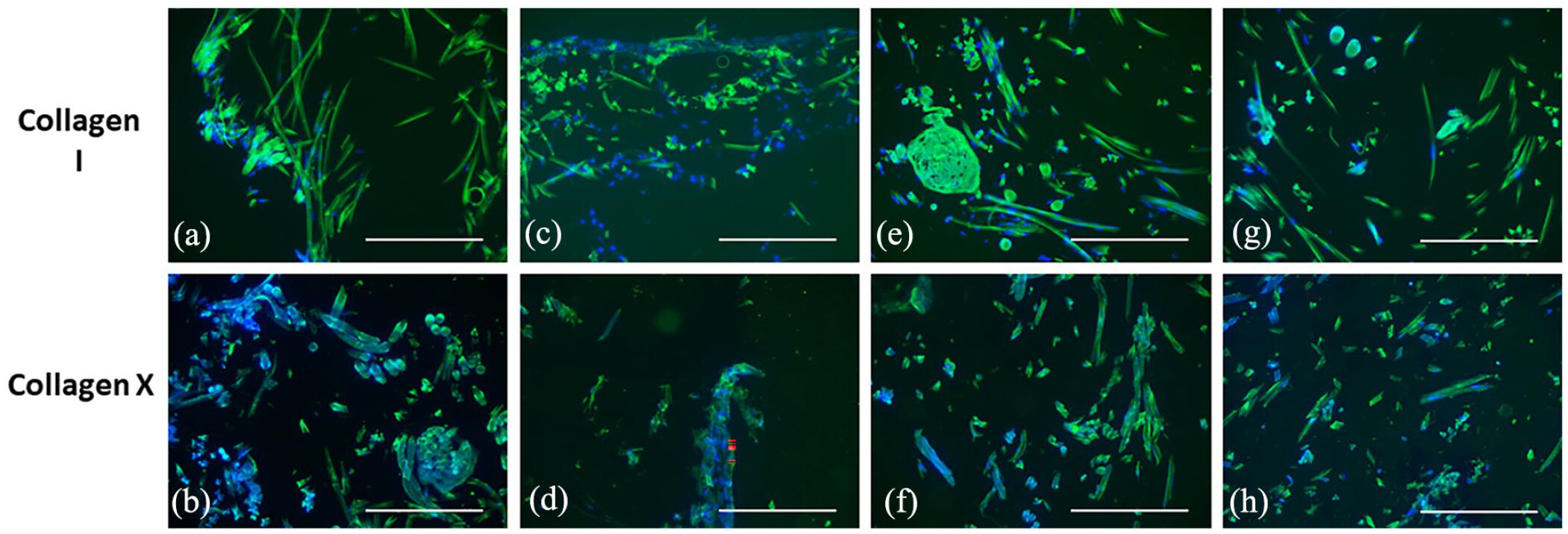
From each experimental group, three samples were randomly selected for immunohistochemical examination. Fixation and cutting followed the above-described protocols. Sections were deparaffinated and rehydrated by descent alcohol concentrations, permeated with 0.1% (v/v) Tritron X-100 (Carl Roth, Karlsruhe, Germany), blocked with 2% (v/v) bovine serum albumin (BSA) (Sigma-Aldrich, Merck, Darmstadt, Germany) and washed with phosphate buffered saline (PBS) (Gibco, Thermo Fisher Scientific, Waltham, MA, USA). For mature hyaline cartilage, staining was performed with anti-rabbit polyclonal collagen II antibody (abcam, Cambridge, UK; # ab34712), anti-rabbit polyclonal SOX-9 antibody (abcam, Cambridge, UK; # ab3697) and anti-mouse monoclonal aggrecan antibody (Thermo Fisher Scientific, Waltham, MA, USA; # MA3-16888). For incomplete chrondrogenic differentiation, staining was performed with anti-rat polyclonal collagen type I antibody (Merck, Darmstadt, Germany; # AB755P) and anti-rabbit polyclonal collagen X antibody (biorbyt, Cambridge, UK). Primary antibodies were diluted 1:100 in 1% (v/v) BSA and incubated at 4°C over night, followed by extensive washing with PBS. Alexa Fluor™ 488 conjugated chicken anti-mouse antibody (invitrogen, Thermo Fisher Scientific, Waltham, MA, USA) and Alexa Fluor™ 488 conjugated goat anti-rabbit antibody (invitrogen, Thermo Fisher Scientific, Waltham, MA, USA) were used as secondary antibodies. Secondary antibodies were incubated for 30 min. Sections were covered and counterstained with SlowFade® Diamond Antifade Moutant with 4′,6-diamidino-2-phenylindole (DAPI) (life technologies, Thermo Fisher Scientific, Waltham, MA, USA) according to the manufacturers’ instructions. A Zeiss Axiovert 200M fluorescence microscope (Carl Zeiss, Oberkochen, Germany) and corresponding software was used to view stained sections.

Results

Successful preparation of densely seeded silk constructs
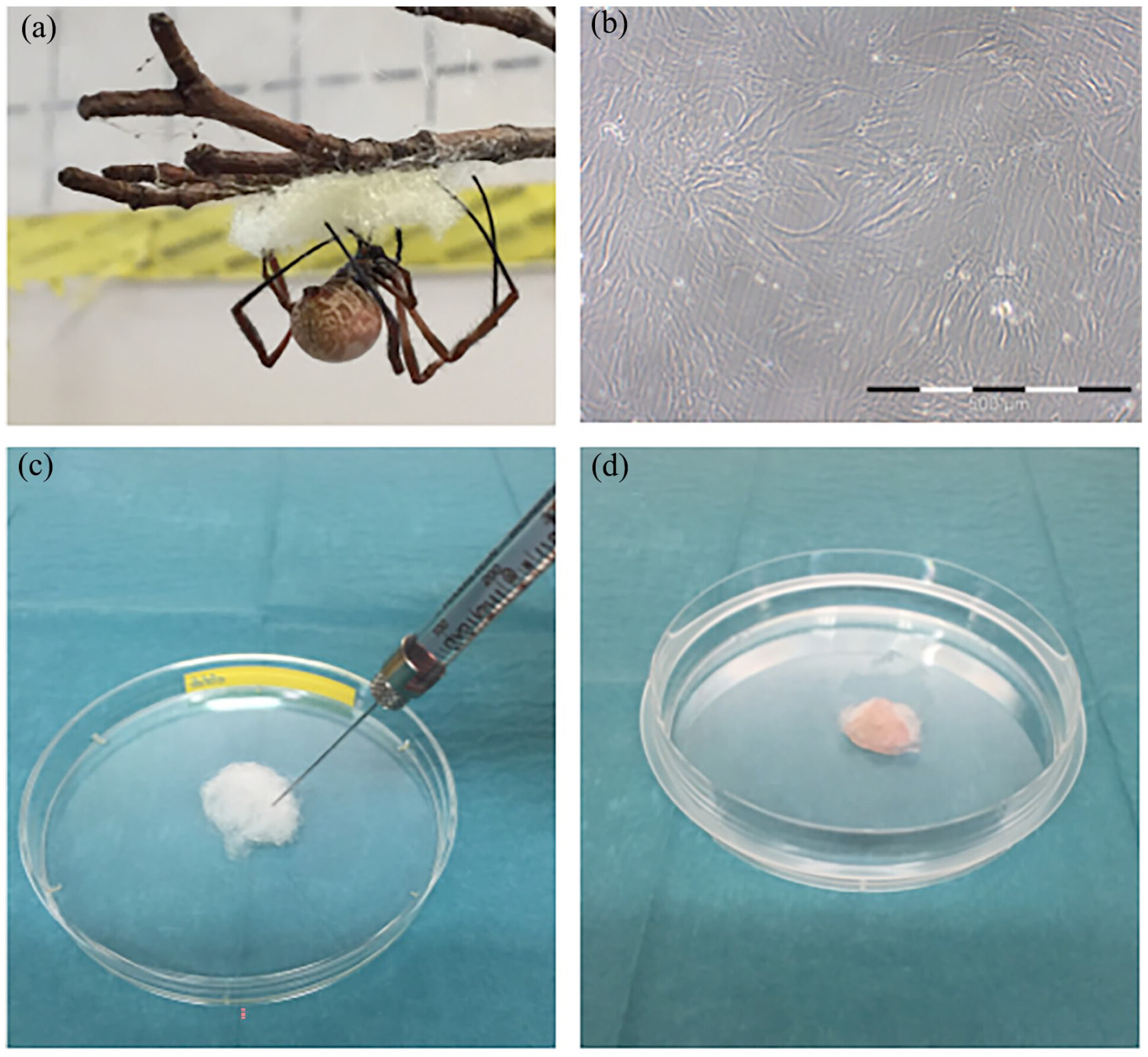
Silk cocoons were collected from our spider breeding facilities. Figure 1(a) shows a spider of the species Nephila edulis with a silk cocoon containing the spider eggs. A total of 20 silk cocoons were collected, cleaned, cut and sterilized. Figure 1(b) shows rASC of passage 1 in culture. Hamilton syringes were used to inject the cell suspension into the silk cocoons (Figure 1(c)). Figure 1(d) shows a spider silk cocoon after successful injection of cell suspension. In all 32 constructs, a homogeneous distribution of the cell suspension was observed. This was recognizable by an increasing and continuous wetting of the constructs starting from the core where the injection took place. Only small areas on the outside remained native.
Figure 1. Preparation of spider silk scaffolds. (a) Spider of the species nephila edulis with a silk cocoon. (b) rASC of passage 1 in culture. (c) Injection of rASC suspension into spider silk scaffolds using a Hamilton syringe. (d) Spider silk cocoon after successful injection of rASC.
All 32 constructs were incubated for a period of 14 days before being assigned to the experimental groups. Macroscopically, no abnormalities were observed during this period. Microscopically, there was an outgrowth of cells onto the bottom of the plates, so the constructs were transferred to a new plate each time the medium was changed. Homogenous distribution in a three-dimensional manner was assumed for all of the following experiments and was later on proved using histological staining.

Chemical induction of chondrocyte differentiation

After a pre-incubation of 14 days, the constructs of experimental group 1 were further incubated in plates (Figure 2(a)). The growth factors were added to the cell culture medium to chemically induce chondrogenic differentiation. After chemical differentiation and removal of the constructs from the plates, no macroscopic changes of the spider silk matrix or visible production of ECM were observed (Figure 2(b)). Macroscopically, the constructs resembled wet cotton balls. The constructs of experimental group 4 (controls) also showed no visible macroscopic changes or macroscopically visible ECM production (Figure 2(c)).
Figure 2. Chemical induction of chondrocyte differentiation. (a) Constructs of experimental group 1 in culture after 14 days. (b) Constructs of experimental group 1 after 28 days of chemical stimulation with TGF-β2 and BMP-7 (TGF-β2: transforming growth factor beta-2; BMP-7: bone morphogenic protein-7). (c) Constructs of experimental group 4 after 28 days of culture.

Design and construction of the bioreactor for mechanical induction of differentiation
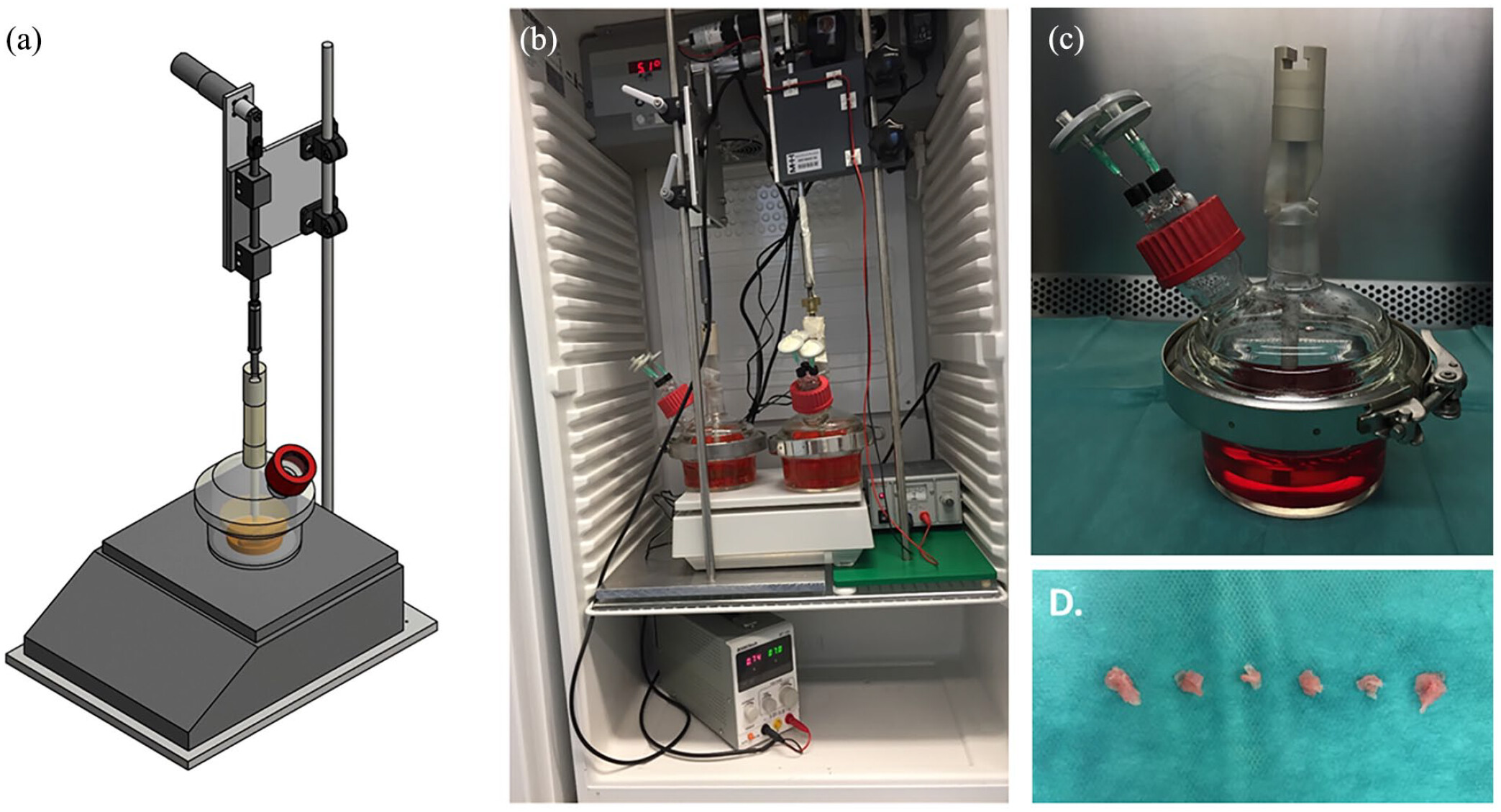
The custom-made bioreactor model is shown in Figure 3(a). For the mechanical induction of differentiation, the constructs of experimental group 2 were transferred to the bioreactor after 14 days of pre-incubation. The constructs were subjected to continuous axial cyclic compression using the bioreactor (Figure 3(b), left). In parallel, the constructs of experimental group 3 were also mechanically stimulated in the second bioreactor (Figure 3(b), right), with the difference that TGF-β2 and BMP-7 were added to the bioreactor medium. Sterile cultivation and mechanical stimulation of the constructs were successfully achieved in both bioreactors. After 28 days, mechanical stimulation was stopped and the bioreactors were removed from the incubator, as exemplarily shown for experimental group 2 (Figure 3(c)). Macroscopically, no changes of the spider silk matrix were observed after removal of the constructs of experimental groups 2 and 3 from the bioreactors. Macroscopically, the constructs resembled wet cotton balls. No production of a separate ECM could be observed macroscopically. There were no macroscopic differences between the constructs of experimental groups 2 and 3. Figure 3(d) shows the constructs of experimental group 2 prior to fixation for histological examination.
Figure 3. Bioreactor model for axial cyclic compressions of silk constructs. (a) Conceptual design sketch of the bioreactor. (b) Both filled bioreactors in the incubation cabinet with running motors for axial compression of the constructs. (c) Removal of a bioreactor from the incubation cabinet after mechanical stimulation of eight constructs (experimental group 2) over a period of 28 days. (d) Six removed constructs from the bioreactor after mechanical stimulation (experimental group 2) before histological fixation.

Histological analysis showed a change in cell morphology and first evidence for ECM production
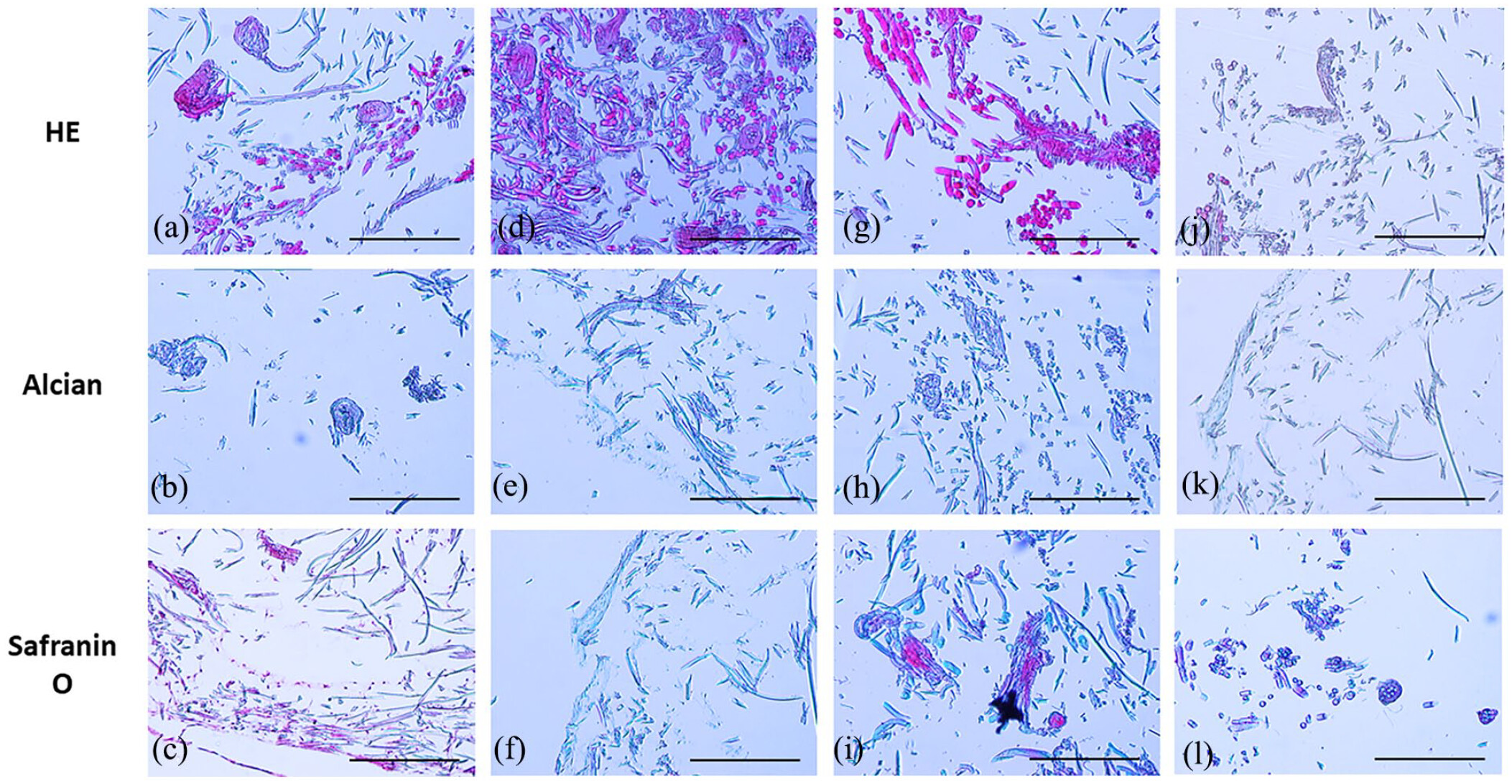
Overall, the spider silk contained in the samples was difficult to cut using a microtome. In histological sections, the silk often appears as a broken structure or detached from the paraffin. Remained spider silk fibers appeared as small fragments, but showed certain three-dimensionality. All histological results are shown in Figure 4. The measurement bar represents 200 µm.
Figure 4. Results of HE, alcian blue and safranin O stainings of all experimental groups. (a) HE stainging group 1. (b) Alcian blue staining group 1. (c) Safranin O staining group 1. (d) HE staining group 2. (e) Alcian blue staingin group 2. (f) Safranin O staining group 2. (g) HE staining group 3. (h) Alican blue staining group 3. (i) Safranin O staining group 3. (j) HE staining group 4. (k) Alcian blue staining group 4. (l) Safranin O staining group 4. The measurement bar represents 200 µm.
Overall in experimental group 1, a low cell density was observed in HE (Figure 4(a)), alcian blue (Figure 4(b)) and safranin O staining (Figure 4(c)). Most of the cells were attached to the silk fibers as exemplarily shown in Figure 1(a). Some of the cells formed coherent roundish cell formations surrounded with solid layers of de novo tissue formations, that were stained red in HE (Figure 4(a)) and bluish in alcian blue (Figure 4(b)), indicating the presence of components of de novo formed ECM. A planar formation of de-novo ECM could not be observed in all staining. The spider silk fibers showed no coherent orientation within the constructs of experimental group 1 (Figure 4(a)).
In experimental group 2, a higher cell density was observed in HE (Figure 4(d)), alcian blue (Figure 4(e)), and safranin O (Figure 4(f)) compared to experimental group 1. Mechanical stimulation resulted in an increase in roundish cell formations with surrounding tissue neoplasms compared (Figure 4(d)) to chemical stimulation alone (Figure 4(a)). The cell morphology of rASC changed from an elongated phenotype (Figure 1(b)) to a more rounded phenotype (Figure 4(d) and (e)), although ASC-like cells continued to be observed in the constructs (Figure 4(e) and (f)). The amorphous mass surrounding the roundish cell formations was stained red in HE (Figure 4(d)) and bluish in alcian blue (Figure 4(e)), indicating de novo ECM production produced by the cells. In the marginal area of the histological sections, the formation of a thin strip of an amorphous tissue layer between the spider silk fibers and the adherent cells could be observed (Figure 4(e) and (f)). This could be stained bluish in alcian blue (Figure 4(e)) and slightly greenish in safranin O (Figure 4(f)), indicating de novo ECM components. As in experimental group 1, the spider silk fibers showed no coherent orientation within the constructs. Taken together the observations of experimental group 2, de novo ECM production of rASC can be postulated after mechanical induction of differentiation of rASC toward chondrocytes.
In experimental group 3, a high cell density could be observed as comparable to experimental group 2 (Figure 4(g)). Again, a de novo ECM production could be assumed, as cells formed roundish cell formations and surrounding amorphous mass production (Figure 4(g)–(i)). In the marginal of the histological sections, a continuous bluish strip of amorphous mass could be detected (Figure 4(h)). In safranin O, first roundish cell formations were observed that stained orange to red, indicating the formation of de novo cartilage tissue or mucins (Figure 4(i)).
In experimental group 4, a cell density comparable to experimental group 1 could be observed (Figure 4(j)). The cells were mostly attached to the silk fibers (Figure 4(j) and (k)) and formed roundish cell formations in some cases (Figure 4(k) and (l)). The cell formations were stained bluish (Figure 4(k)) in alcian blue and reddish (Figure 4(l)) in safranin O, indicating cartilage-like tissue. The spider silk fibers showed no coherent orientation within the constructs (Figure 4(j)–(l)).
Overall, an increase in cell densitiy and cell proliferation could be observed in experimental group 2 and 3, which both had been subjected to mechanical stimulation. Roundish cell formations were found in all experimental groups. Furthermore, a de-novo ECM production could be observed in experimental group 2, 3, and 4 (control group).

Immunohistochemical stainings indicated chondrogenic differentiation of rASC

For mature hyaline cartilage tissue, immunohistochemical staining for collagen type II, SOX-9, and aggrecan were performed. Due to its autofluorescence, spider silk fragments are visible in all images. In experimental group 1, the cells appeared adherent or in close positioning to the spider silk fibers in all staining (Figure 5(a)–(c)). The silk fibers showed green autofluorescence, as exemplarily shown in Figure 5(b). After 28 days of chemical induction of differentiation, isolated green fluorescent staining for collagen type II could be observed (Figure 5(a)), whereas the immunohistochemical staining for aggrecan (Figure 5(b)) and SOX-9 (Figure 5(c)) remained negative. In experimental group 2, cells were observed to be attached to the silk fibers (Figure 5(d) and (e)) as well as forming a coherent cell layer in the marginal areas (Figure 5(f)). Histologically, an amorphous cell mass was already observed (Figure 4(e) and (f)), which was now revealed by immunohistochemistry with the detection of aggrecan (Figure 5(e)) and SOX-9 (Figure 5(f)). The roundish cell formations could also be stained with SOX-9 (Figure 5(f)), so that a differentiation toward chondrocytes or corresponding progenitor cells might be present. In experimental group 3, increasing expression of collagen type II (Figure 5(g)) and aggrecan (Figure 5(h)) was observed. The amorphous cell mass already observed in the histology stained for aggrecan (Figure 5(h)) and collagen type II (Figure 5(g)) in particular. The cells were adherent to the spider silk fibers (Figure 5(g)–(i)), as already observed in experimental groups 1 and 2. The spider silk fibers also showed a green autofluorescence (Figure 5(i)). SOX-9, as a marker for differentiation of precursor cells into chondrocytes, could not be stained in the samples (Figure 5(i)). In experimental group 4, the cells were found to be adherent to the spider silk fibers (Figure 5(j) and (k)), as indicated by the blue immunofluorescence. After 28 days without chemical and mechanical stimulation, the samples were negative for aggrecan (Figure 5(k)). Isolated areas stained for SOX-9 (Figure 5(l)) and collagen type II (Figure 5(j)), suggesting that spontaneous chondrogenic differentiation of rASC may be present. Thus, compared to group 1, pure chemical differentiation seems rather to even suppress chondrogenic differentiation.
Figure 5. Immunohistochemical staining for mature hyaline cartilage of all experimental groups. (a) Collagen type II staining group 1. (b) Aggrecan staining group 1. (c) SOX-9 staining group 1. (d) Collagen type II staining group 2. (e) Aggrecan stainig group 2. (f) SOX-9 staining group 2. (g) Collagen type II staining group 3. (h) Aggrecan staining group 3. (i) SOX-9 staining group 3. (j) Collagen type II staining group 4. (k) Aggrecan staining group 4. (l) SOX-9 staining group 4.
For incomplete chondrogenic differentiation, staining was performed for collagen type I and collagen type X. In experimental group 1, the cells showed adherence to the spider silk fibers with green autofluorescence of the silk fibers (Figure 6(a) and (b)). However, the staining for collagen type I (Figure 6(a)) and collagen type X (Figure 6(b)) remained negative in experimental group 1. Experimental group 2 showed comparable results to experimental group 1 in terms of cell orientation and properties of spider silk (Figure 6(c) and (d)). In the marginal part of the histological sections, the formation of a thin strip of an amorphous tissue layer between the spider silk fibers and the adherent cells could be observed that stained partially green fluorescent for collagen type I (Figure 6(c)) and collagen type X (Figure 6(d)). In experimental group 3, a roundish mass formation with attached cells that stained green fluorescent for collagen type I was detected (Figure 6(e)). Collagen type X staining remained negative for experimental group 3, only green autofluorescence of spider silk fibers could be observed (Figure 6(f)). In controls (experimental group 4), immunohistochemical staining for collagen type I and X remained negative (Figure 6(g) and (h)). Only spider silk fibers showed green autofluorescence (Figure 6(g)) and cells orientated along the silk fibers (Figure 6(g) and (h)).
Figure 6. Immunohistochemical staining for incomplete chrondrogenic differentiation of all experimental groups. (a) Collagen type I group 1. (b) Collagen type X group 1. (c) Collagen type I group 2. (d) Collagen type X group 2. (e) Collagen type I group 3. (f) Collagen type X group 3. (g) Collagen type 1 group 4. (h) Collagen type X group 4.

Discussion

To the authors’ knowledge, the present study is among the first studies that investigated spider cocoons silk as matrix for cartilage tissue engineering purposes using a custom-made bioreactor model and rASC. Culture of ASC was already achieved in hydrogels, but should be considered with caution because of spontaneous contraction, limited mass transport and rapid degradation.13,51 In the present experimental approach, hydrogels were omitted and only spider silk cocoons were used as scaffold material. Our workgroup was among the first to investigate native spider silk for tissue engineering purposes.52 Spider silk is known for its tensile and breaking strength (up to 521 MJ/kg³) that surpasses many artificial biomaterials,53 its tear strength of 4.8 GPa, an elasticity of up to 35% and can be possible sterilized.54 Spider silk cocoons have already been used for cartilage tissue engineering purposes and seem to be more suitable, as porous silk scaffolds have greater cell spreading and expression properties.47 In the handling of the cartilage-like constructs of this study, no change in biomechanical properties was observed. Due to the size of the constructs, biomechanical testing of the load-bearing capacity was not possible and should be realized in future experiments.3 Especially against the clinical background of the stress on hyaline articular cartilage, this point should be given crucial importance. Current clinical treatment approaches involve the use of minced autologous cartilage fragments with autologous conditioned plasma for the treatment of cartilage defects in the metatarsophalangeal joint.55 Due to the outstanding biomechanical and immunological properties of spider silk, equivalent clinical results can probably be expected here in future clinical applications. To generate sufficiently large silk constructs, one could make use of established framing models54 or rely on synthetic spider silk and 3D tissue printing using silk inks.5658 In the present study, spider silk cocoons could be successfully seeded with a higher cell density as compared to other results in literature.13,47 For a translational experimental, human ASC should be used and cell pooling should be performed to eliminate donor-specific differences.59,60 Another point that should be critically discussed is the immunogenicity of the manufactured cartilage constructs. Silk samples treated with trypsin or protein kinase K showed reduced inflammatory response compared to native spider silk.61 Due to its proven promising immunological properties of native spider silk, one can speak of a future-oriented biomaterial.46 Regarding scaffold degradation, controlled enzymatically or hydrolytically degradation can enhance tissue and direct neo-cartilage formation.35 Scaffolds with degradable and non-degradable parts showed improved ECM distribution and formation compared to completely non-degradable scaffolds.62 It was proven that native spider silk exhibits slow biodegradation while maintaining highly cytocompatible.46 Thus, it can be assumed that this also applies to the cartilage-like constructs of this study. However, a comprehensive degradation study over a longer period is needed to verify the corresponding assumptions.
As shown by the histological and immunohistochemical results of the present study, a high cell density and proliferation could be observed, especially in experimental groups 2 and 3. During histological processing, there were isolated issues with the cutting of the spider silk, due to the extraordinary biomechanical properties that caused difficulties for the blades of the microtome to cut the tissue pieces.13,45 The histological results of the present study suggest that mechanical stressing of rASC colonized cocoons can induce an increase in ECM matrix production, as shown by the histological results of experimental group 2. A further increase in cell density could be observed by adding BMP-7 and TGF-β2, as shown by the histological results of experimental group 3. These findings are in parallel with the published literature, as it was presumed that a high initial cell seeding density can improve ECM synthesis due to cell-cell interactions.41 Differentiated chondrocytes can be characterized by a rounded morphology and the production of ECM molecules such as collagen II and sulfated glycosaminoglycanes.35 Overall, roundish cell morphology could be observed in all experimental groups as seen in the histological staining of Figure 4. A chondrocyte-like cell morphology can be stated but further quantification toward a chondrocyte specific phenotype is needed.
In the present study, the application of axial cyclic mechanical stress resulted in de-novo formation of ECM as well as the expression of aggrecan and SOX-9. The results are in line with the published literature as mechanotransduction via binding motif-dependent integrins and thus induction of chondrogenic differentiation has been described earlier.26,33 In experimental group 3, the addition of BMP-7 and TGF-β2 to the bioreactor medium was able to induce de-novo ECM formation and expression of aggrecan and collagen type II, which is consisted with the published literature.2830 It is of interest that weak immunohistochemical staining for collagen type II and SOX-9 could be detected in the unstimulated controls of experimental group 4. A possible explanation could be that the long cultivation period resulted in spontaneous chondrogenic differentiation of rASC, as already described by another work group.63,64
To detect incomplete chondrogenic differentiation, immunohistochemical staining for collagen type I and collagen type X were performed in the present study. In experimental group 2, collagen type I and collagen type X could be detected whereas a combination of the experimental approach using growth factors led to reduced expression of the same. It was shown earlier in chondrogenic pellet culture that cells synthesized cartilage specific matrix such as collagen type II and glycosaminoglycans and at the same time showed low levels of collagen type I and collagen type X.65 In the present study, the formation of de-novo cartilage tissue or differentiation of rASC could only be demonstrated qualitatively by immunohistochemical staining. A quantitative proof by molecular biological methods, such as real-time polymerase chain reaction, was not possible. Unfortunately, an attempt of ribonucleic acid isolation from the samples of all experimental groups was not successful. The findings are in line with the published literature, as other studies demonstrated the lack of molecular biological proof of ASC differentiation due to an interference of spider silk molecules during ribonucleic acid isolation.13 This is clearly a limitation of the feasibility of the present proof-of-concept study that needs to be overcome by future research approaches. Based on the results of the present pilot-study, a successful establishment of the developed bioreactor model for chondrogenic differentiation of rASC on spider silk cocoons can be stated. However, to date no tissue engineering approaches achieved the properties and structures of native cartilage tissue. The further generation of in vitro and in vivo data are needed to further assess the significance and possible future perspectives of the presented research approach. Further approaches could include optimized in vitro setups and in vivo transplantation into the natural environment of joints to further improve chondrogenic differentiation by local biochemical and biomechanical influences.

Conclusions

By seeding the innovative biomaterial of spider silk cocoons with rASC, a high colonization density and cell proliferation could be achieved. By mechanical induction of differentiation using a newly established bioreactor model, cell morphology changed to a more roundish phenotype and new ECM formation could be observed, indicating a chondrogenic differentiation. The addition of BMP-7 and TGF-β2 enhanced the expression of cartilage specific markers. Nevertheless, further studies are needed to elucidate the findings of the present study in the broad context of the published literature and assess future research perspectives.

Acknowledgments

In memory of Prof. Dr. rer. nat. Kerstin Reimers-Fadhlaoui († 23.12.2015), former head of the experimental department of Plastic, Esthetic, Hand and Reconstructive Surgery at Hannover Medical School. The authors are grateful to Andrea Lazaridis for her excellent technical support. Additionally, the authors want to thank the Central Research Devices Service Unit of Hannover Medical School for the design and construction of the custom-made bioreactor.

Declaration of conflicting interests

The author(s) declared no potential conflicts of interest with respect to the research, authorship, and/or publication of this article.

Funding

The author(s) disclosed receipt of the following financial support for the research, authorship, and/or publication of this article: This research received no external funding. This research was funded within the framework of “Hochschulinterne Leistungsförderung (HiLF) 2016” of Hannover Medical School. This publication is funded by the Deutsche Forschungsgemeinsschaft (DFG) as part of the “Open Access Publikationskosten” program.

ORCID iD

Footnote

Guarantor FS.

References

1. Carballo CB, Nakagawa Y, Sekiya I, Rodeo SA. Basic Science of articular cartilage. Clin Sports Med 2017; 36: 413–425.
2. Johnston SA. Osteoarthritis: joint anatomy, physiology, and pathobiology. Vet Clin North Am 1997; 27: 699–723.
3. Krishnan Y, Grodzinsky AJ. Cartilage diseases. Matrix Biol 2018; 71-72: 51–69.
4. Hunziker EB. The elusive path to cartilage regeneration. Adv Mater 2009; 21: 3419–3424.
5. Gelse K, Mühle C, Franke O, et al. Cell-based resurfacing of large cartilage defects: long-term evaluation of grafts from autologous transgene-activated periosteal cells in a porcine model of osteoarthritis. Arthritis Rheum 2008; 58: 475–488.
6. Park J, Gelse K, Frank S, et al. Transgene-activated mesenchymal cells for articular cartilage repair: a comparison of primary bone marrow-, perichondrium/periosteum- and fat-derived cells. J Gene Med 2006; 8: 112–125.
7. Grande DA, Singh IJ, Pugh J. Healing of experimentally produced lesions in articular cartilage following chondrocyte transplantation. Anat Rec 1987; 218: 142–148.
8. Li X, Wang M, Jing X, et al. Bone marrow- and adipose tissue-derived mesenchymal stem cells: characterization, differentiation, and applications in cartilage tissue engineering. Crit Rev Eukaryot Gene Expr 2018; 28: 285–310.
9. Chang C-H, Kuo T-F, Lin C-C, et al. Tissue engineering-based cartilage repair with allogenous chondrocytes and gelatin-chondroitin-hyaluronan tri-copolymer scaffold: a porcine model assessed at 18, 24, and 36 weeks. Biomaterials 2006; 27: 1876–1888.
10. Zuk PA, Zhu M, Mizuno H, et al. Multilineage cells from human adipose tissue: implications for cell-based therapies. Tissue Eng 2001; 7: 211–228.
11. Naderi N, Combellack EJ, Griffin M, et al. The regenerative role of adipose-derived stem cells (ADSC) in plastic and reconstructive surgery. Int Wound J 2017; 14: 112–124.
12. Strauss S, Neumeister A, Barcikowski S, et al. Adhesion, vitality and osteogenic differentiation capacity of adipose derived stem cells seeded on nitinol nanoparticle coatings. PLoS One 2013; 8: e53309.
13. Schlottmann F, Strauss S, Plaass C, et al. Spider silk-augmented scaffolds and adipose-derived stromal cells loaded with uniaxial cyclic strain: first investigations of a novel approach for tendon-like constructs. Appl Sci 2021; 11: 1218.
14. Rehman J, Traktuev D, Li J, et al. Secretion of angiogenic and antiapoptotic factors by human adipose stromal cells. Circulation 2004; 109: 1292–1298.
15. Locke MB, Feisst VJ. Human adipose-derived stem cells (ASC): their efficacy in clinical applications. In: Bhattacharya N and Stubblefield PG (eds) Regenerative medicine. London: Springer, 2015, pp.135–149.
16. Lauvrud AT, Kelk P, Wiberg M, Kingham PJ. Characterization of human adipose tissue-derived stem cells with enhanced angiogenic and adipogenic properties. J Tissue Eng Regen Med 2017; 11: 2490–2502.
17. Goessler UR, Bieback K, Bugert P, et al. Human chondrocytes differentially express matrix modulators during in vitro expansion for tissue engineering. Int J Mol Med 2005; 16: 509–515.
18. Zuk PA, Zhu M, Ashjian P, et al. Human adipose tissue is a source of multipotent stem cells. Mol Biol Cell 2002; 13: 4279–4295.
19. Hwang NS, Kim MS, Sampattavanich S, et al. Effects of three-dimensional culture and growth factors on the chondrogenic differentiation of murine embryonic stem cells. Stem Cells 2006; 24: 284–291.
20. Seyedin SM, Rosen DM, Segarini PR. Modulation of chondroblast phenotype by transforming growth factor-beta. Pathol Immunopathol Res 1988; 7: 38–42.
21. Iwasaki M, Nakata K, Nakahara H, et al. Transforming growth factor-beta 1 stimulates chondrogenesis and inhibits osteogenesis in high density culture of periosteum-derived cells. Endocrinology 1993; 132: 1603–1608.
22. Kim SE, Park JH, Cho YW, et al. Porous chitosan scaffold containing microspheres loaded with transforming growth factor-β1: implications for cartilage tissue engineering. J Control Release 2003; 91: 365–374.
23. Vivien D, Galéra P, Lebrun E, Loyau G, Pujol JP. Differential effects of transforming growth factor-beta and epidermal growth factor on the cell cycle of cultured rabbit articular chondrocytes. J Cell Physiol 1990; 143: 534–545.
24. Narcisi R, Quarto R, Ulivi V, et al. TGF β-1 administration during ex vivo expansion of human articular chondrocytes in a serum-free medium redirects the cell phenotype toward hypertrophy. J Cell Physiol 2012; 227: 3282–3290.
25. Patil AS, Sable RB, Kothari RM. An update on transforming growth factor-β (TGF-β): sources, types, functions and clinical applicability for cartilage/bone healing. J Cell Physiol 2011; 226: 3094–3103.
26. Ogawa R, Mizuno S, Murphy GF, Orgill DP. The effect of hydrostatic pressure on three-dimensional chondroinduction of human adipose-derived stem cells. Tissue Eng Part A 2009; 15: 2937–2945.
27. Whitty C, Pernstich C, Marris C, et al. Sustained delivery of the bone morphogenetic proteins BMP-2 and BMP-7 for cartilage repair and regeneration in osteoarthritis. Osteoarthr Cartil Open 2022; 4: 100240.
28. Cha B-H, Kim J-H, Kang S-W, et al. Cartilage tissue formation from dedifferentiated chondrocytes by Codelivery of BMP-2 and SOX-9 genes encoding bicistronic vector. Cell Transplant 2013; 22: 1519–1528.
29. Hicks DL, Sage AB, Shelton E, et al. Effect of bone morphogenetic proteins 2 and 7 on septal chondrocytes in alginate. Otolaryngol Head Neck Surg 2007; 136: 373–379.
30. Park Y, Sugimoto M, Watrin A, Chiquet M, Hunziker EB. BMP-2 induces the expression of chondrocyte-specific genes in bovine synovium-derived progenitor cells cultured in three-dimensional alginate hydrogel. Osteoarthr Cartil 2005; 13: 527–536.
31. Kaps C, Bramlage C, Smolian H, et al. Bone morphogenetic proteins promote cartilage differentiation and protect engineered artificial cartilage from fibroblast invasion and destruction. Arthritis Rheum 2002; 46: 149–162.
32. Kock L, van Donkelaar CC, Ito K. Tissue engineering of functional articular cartilage: the current status. Cell Tissue Res 2012; 347: 613–627.
33. Kock LM, Schulz RM, van Donkelaar CC, et al. RGD-dependent integrins are mechanotransducers in dynamically compressed tissue-engineered cartilage constructs. J Biomech 2009; 42: 2177–2182.
34. Pazzano D, Mercier KA, Moran JM, et al. Comparison of chondrogensis in static and perfused bioreactor culture. Biotechnol Prog 2000; 16: 893–896.
35. Chung C, Burdick JA. Engineering cartilage tissue. Adv Drug Deliv Rev 2008; 60: 243–262.
36. Gemmiti CV, Guldberg RE. Fluid flow increases type II collagen deposition and tensile mechanical properties in bioreactor-grown tissue-engineered cartilage. Tissue Eng 2006; 12: 469–479.
37. Freed LE, Hollander AP, Martin I, et al. Chondrogenesis in a cell-polymer-bioreactor system. Exp Cell Res 1998; 240: 58–65.
38. Bueno EM, Bilgen B, Barabino GA. Wavy-walled bioreactor supports increased cell proliferation and matrix deposition in engineered cartilage constructs. Tissue Eng 2005; 11: 1699–1709.
39. Saini S, Wick TM. Concentric cylinder bioreactor for production of tissue engineered cartilage: effect of seeding density and hydrodynamic loading on construct development. Biotechnol Prog 2003; 19: 510–521.
40. Flynn LE, Prestwich GD, Semple JL, Woodhouse KA. Proliferation and differentiation of adipose-derived stem cells on naturally derived scaffolds. Biomaterials 2008; 29: 1862–1871.
41. Iwasa J, Ochi M, Uchio Y, et al. Effects of cell density on proliferation and matrix synthesis of chondrocytes embedded in atelocollagen gel. Artif Organs 2003; 27: 249–255.
42. Armiento AR, Stoddart MJ, Alini M, Eglin D. Biomaterials for articular cartilage tissue engineering: learning from biology. Acta Biomater 2018; 65: 1–20.
43. Gosline JM, Guerette PA, Ortlepp CS, Savage KN. The mechanical design of spider silks: from fibroin sequence to mechanical function. J Exp Biol 1999; 202: 3295–3303.
44. Lewis RV. Spider Silk: ancient ideas for new biomaterials. Chem Rev 2006; 106: 3762–3774.
45. Schäfer-Nolte F, Hennecke K, Reimers K, et al. Biomechanics and biocompatibility of woven spider silk meshes during remodeling in a rodent fascia replacement model. Ann Surg 2014; 259: 781–792.
46. Kuhbier JW, Coger V, Mueller J, et al. Influence of direct or indirect contact for the cytotoxicity and blood compatibility of spider silk. J Mater Sci Mater Med 2017; 28: 127.
47. Gellynck K, Verdonk PC, Van Nimmen E, et al. Silkworm and spider silk scaffolds for chondrocyte support. J Mater Sci Mater Med 2008; 19: 3399–3409.
48. Kuhbier JW, Weyand B, Radtke C, et al. Isolation, characterization, differentiation, and application of adipose-derived stem cells. In: Kasper C, van Griensven M and Pörtner R (eds) Bioreactor systems for tissue engineering II. Berlin, Heidelberg: Springer, 2010, pp.55–105.
49. Liebsch C, Fliess M, Kuhbier JW, Vogt PM, Strauss S. Nephila edulis-breeding and care under laboratory conditions. Dev Genes Evol 2020; 230: 203–211.
50. Kall S, Nöth U, Reimers K, et al. In vitro Herstellung von Sehnenkonstrukten aus humanen mesenchymalen Stammzellen und einem Kollagen Typ I Gel. Handchir Mikrochir Plast Chir 2004; 36: 205–211.
51. Chaicharoenaudomrung N, Kunhorm P, Noisa P. Three-dimensional cell culture systems as an in vitro platform for cancer and stem cell modeling. World J Stem Cells 2019; 11: 1065–1083.
52. Allmeling C, Jokuszies A, Reimers K, et al. Spider silk fibres in artificial nerve constructs promote peripheral nerve regeneration. Cell Prolif 2008; 41: 408–420.
53. Agnarsson I, Kuntner M, Blackledge TA. Bioprospecting finds the toughest biological material: extraordinary silk from a giant riverine orb spider. PLoS One 2010; 5: e11234.
54. Kuhbier JW, Allmeling C, Reimers K, et al. Interactions between spider silk and cells–NIH/3T3 fibroblasts seeded on miniature weaving frames. PLoS One 2010; 5: e12032.
55. Roth KE, Klos K, Simons P, et al. Minced cartilage bei Knorpeldefekten am Großzehengrundgelenk. Oper Orthop Traumatol 2021; 33: 480–486.
56. Moore CA, Shah NN, Smith CP, et al. 3D bioprinting and stem cells. In: Singh S, Rameshwar P (eds) Methods in molecular biology. Clifton, NJ: Humana Press, 2018, pp.93–103.
57. Agostinacchio F, Mu X, Dirè S, Motta A, Kaplan DL. In situ 3D printing: opportunities with silk inks. Trends Biotechnol 2021; 39: 719–730.
58. DeSimone E, Schacht K, Pellert A, Scheibel T. Recombinant spider silk-based bioinks. Biofabrication 2017; 9: 044104.
59. Kuhbier JW, Weyand B, Radtke C, et al. Isolation, characterization, differentiation, and application of adipose-derived stem cells. Adv Biochem Eng Biotechnol 2010; 123: 55–105.
60. Kuhbier JW, Weyand B, Sorg H, et al. Stem cells from fatty tissue: a new resource for regenerative medicine? Chirurgia 2010; 81: 826–832.
61. Gellynck K, Verdonk P, Forsyth R, et al. Biocompatibility and biodegradability of spider egg sac silk. J Mater Sci Mater Med 2008; 19: 2963–2970.
62. Bryant SJ, Anseth KS. Controlling the spatial distribution of ECM components in degradable PEG hydrogels for tissue engineering cartilage. J Biomed Mater Res 2003; 64A: 70–79.
63. Heng BC, Cao T, Lee EH. Directing stem cell differentiation into the chondrogenic lineage in vitro. Stem Cells 2004; 22: 1152–1167.
64. Bosnakovski D, Mizuno M, Kim G, et al. Gene expression profile of bovine bone marrow mesenchymal stem cell during spontaneous chondrogenic differentiation in pellet culture system. Jpn J Vet Res 2006; 53: 127–139.
65. Diekman BO, Christoforou N, Willard VP, et al. Cartilage tissue engineering using differentiated and purified induced pluripotent stem cells. Proc Natl Acad Sci 2012; 109: 19172–19177.