The Declaration of Independence
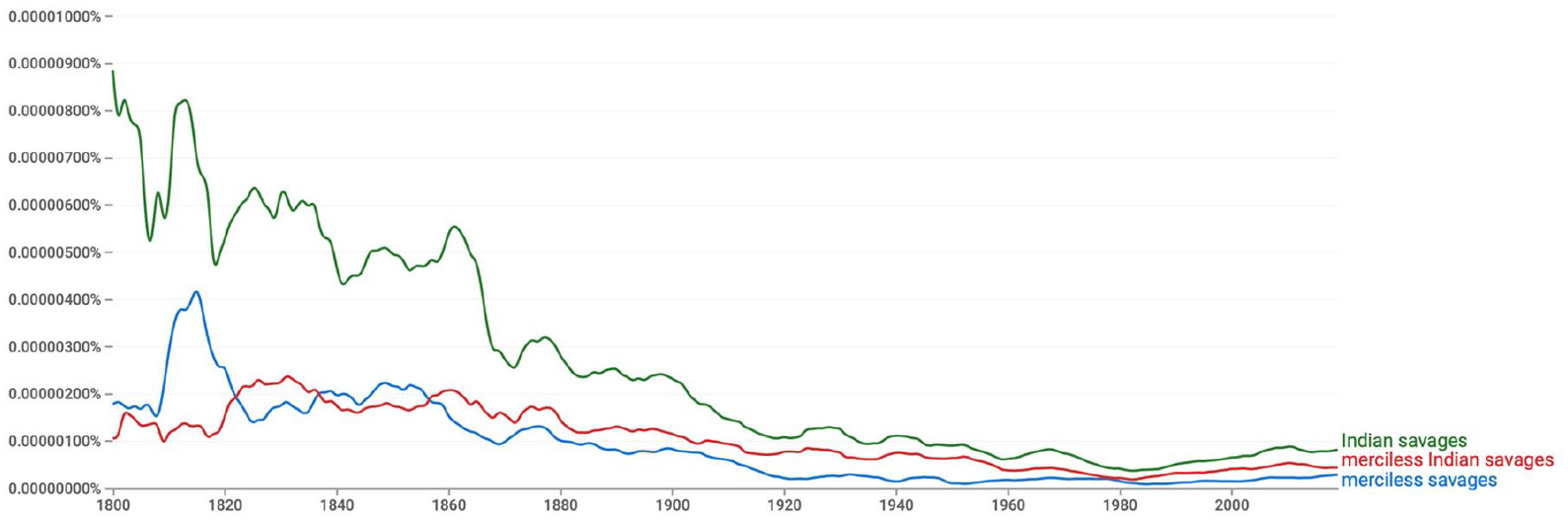
Utilizing political framing and distributional media, secular European-American leaders joined Christian clergy in demanding anti-Indigenous framing, oppression, and removal or extermination. Probably the most widely circulated secular example of this intense anti-Indigenous framing is the primary U.S. founding document, the Declaration of Independence. There the bitingly racist phrase, merciless Indian savages, is featured by Thomas Jefferson, the Declaration’s principal architect, to describe the “problem” of Native Americans. The anti-Indigenous subframe and broader white frame around it were already deeply engrained in colonial whites’ minds like that of Jefferson. He frequently espoused major elements of the anti-Indigenous subframe, as well as of other white racist framing such as that of African Americans. He was clearly influenced by leading English philosophers John Locke and Thomas Hobbes, who spread anti-Indigenous framing across the English-speaking world during the seventeenth to eighteenth centuries.
Thomas Hobbes ([1651] 1904:84), who influenced Thomas Jefferson, emotionally described lives of “
savage people in many places of America. . . [as] poor, nasty, brutish, and short.” To this day, this last phase is widely featured in the English-speaking world, often disconnected from its original anti-Indigenous language.
John Locke, investor in English slave trade and supporter of American slavery, was a favorite philosopher of Jefferson, influencing his and other founders’ ideas—especially in the Declaration of Independence (
Constitutional Rights Foundation 2001). For instance, the influential
John Locke ([1689] 1884:211) expounds negatively on Native Americans:
There cannot be a clearer demonstration of anything, than several Nations of the Americans are of this, who are rich in Land, and poor in all the Comforts of Life; whom Nature having furnished as liberally as any other people, with the materials of Plenty, i.e., a fruitful Soil, apt to produce in abundance, what might serve for food, raiment, and delight; yet, for want of improving it by labour, have not one hundredth part of the Conveniences we enjoy: And a king of a large fruitful Territory there feeds, lodges, and is clad worse than a day Labourer in England.
Locke frames Indigenous peoples racially as unintelligent, impoverished, and lazy. Lacking a work ethic, they have no desire to utilize the environment for profit and are devoid of “real” civilization. Civilized whites versus uncivilized savages again are a key element in anti-Indigenous framing. Since Native Americans do not conform to his English version of civilization, their lives and culture are antithetical to civilization, and by implication, Christianity. Christian leaders, like Locke, had long framed Native Americans as worthy of domination due to their less-than-human status in the eyes of the Christian God (
Stannard 1993:64–66;
Williams 2012:121–78). This influential narrative of Native Americans as uncivilized savagesby a leading Western philosopher and capitalist investor reinforced the already extensive anti-Indigenous framing.
Several decades later, in the Declaration of Independence influenced by Locke, Jefferson included highly racist language about actions of the British king:
He has excited domestic insurrections amongst us, and has endeavoured to bring on the inhabitants of our frontiers, the merciless Indian Savages, whose known rule of warfare, is an undistinguished destruction of all ages, sexes, and conditions.
The leading founder Jefferson reveals his broad white racial frame and anti-Indigenous subframe in this famous passage. Centuries-old images of Native peoples as merciless Indian savages advance a narrative of brutal beings intent on destroying European-Americans. This passage reflects, and potentially generates, white emotions of fear and anger toward Native people: Fear of their animal-like ferocity and anger at their supposedly immoral warfare. The Declaration racially frames Native Americans as savages lacking in human values and willing to blindly destroy white Americans. White self-victimizing in the Declaration allows elite and ordinary whites to rationalize their anti-Indigenous violence as virtuous and necessary actions to secure their safety and right to lands they invaded.
Revealingly, Jefferson, and other white founders, chose to
remove a strongly worded racialized passage in the draft Declaration blaming the African slave trade and slave insurrections on British King George, even as they chose to keep the anti-Indigenous passage (
Feagin 2020:39). Elite whites here solidified an aggressive anti-Indigenous frame in the new nation’s founding document. By the time of the Declaration’s writing, the newly coalescing nation had many decades of anti-Indigenous stereotypes and narratives engrained into its dominant white framing. In contrast, removing anti-slavery statements from the Declaration, even those indicting the British king, effectively protected that horrific institution as a critical white economic enterprise. Meanwhile, the often-genocidal destruction of Native Americans, rationalized and virtuized due to alleged Indigenous savagery, cleared the landscape for more white exploitation of Native America. Native clearance and extermination were essential for white land-grabs, but the slave trade and slavery were integral to exploitation of those and other lands by powerful whites. Both are enshrined in the Declaration.
After writing the Declaration, as a leading slaveholder and government official, Jefferson continued to advance the anti-Indigenous subframe and broader white racist framing. He reflects Locke’s racist sentiments in his only major book,
Notes on the State of Virginia ([1781] 1787:96–97), the first such book by an American intellectual. “Savage” Native Americans have
never submitted themselves to any laws, any coercive power, any shadow of government. Their only controuls are their manners . . . whether no law, as among the savage Americans, or too much law, as among the civilized Europeans . . . It will be said, that great societies cannot exist without government. The savages therefore break them into small ones.
Like Locke a century earlier, Jefferson reinforces cognitive and image stereotypes of savages who live by natural “manners” (customs) rather than formal laws that govern “civilized” whites. He advances narratives that they lacked real government or laws and that European civilization, with formal laws, is superior—thereby explicitly framing civilization as formal law and order. This too creates a sense of white virtuousness and superiority over Native Americans. Again, these dimensions of anti-Indigenous framing seem underlain with strong emotions of racial superiority that rationalize many anti-Indigenous actions he supported.
Thomas Jefferson ([1781] 1787) offers some “positive” framing in his
Notes book (Query VI) of a Native American as one who “meets death with more deliberation, and endures tortures with a firmness unknown . . . with us” (p. 63), and he further expounds on the oratory skills and family dynamics of Native peoples, he is mainly establishing there the racialized concept of the “noble savage.” This still popular white framing of Native Americans as noble warriors portrays them as operating nobly but from a baser instinct, from a so-called Golden Age of humanity before they became corrupted (
Williams 2012). Moreover,
Jefferson’s ([1781] 1787:68) Query VI also contains a passage where he asserts his race perspective: “I do not mean to deny, that there are varieties in the race of man, distinguished by their powers both of body and mind. I believe there are . . .” While Jefferson does make some seemingly positive comments about Native Americans, he makes clear in this book that he operates fully out of a white racial frame accenting white superiority, including his buttressing of the patronizing white narrative of the “noble savage.”
Jefferson further made evident his strong anti-Indigenous framing during and after his presidency (1801–1809). As president, he described Native Americans as uncivilized in contrast to civilized whites. Later President
Andrew Jackson (1833) argued that “savages” did not have “the intelligence, the industry, the moral habits. . . . essential to any favorable change in their condition” and engaged in brutal Indigenous removal policies. Yet, decades before, President Jefferson had set the foundation for such racial removal. In an 1803 letter to William Henry Harrison, Governor of Indiana Territory and later the U.S. president, Jefferson said he wanted kept secret his advocacy of violent anti-Indigenous government action:
As to their fear, we presume that our strength and their weakness is now so visible that they must see we have only to shut our hand to crush them, and that all our liberalities to them proceed from motives of pure humanity only. Should any tribe be foolhardy enough to take up the hatchet at any time, the seizing the whole country of that tribe, and driving them across the Mississippi, as the only condition of peace, would be an example to others, and a furtherance of our final consolidation
He racially frames white society as virtuously
humanitarian, but this “virtuousness” is oppressively paternalistic and threatening violence. Later, in an 1807 letter to his Secretary of War, Jefferson (
Ostler 2015) said,
if we are constrained to lift the hatchet against any tribe, we will never lay it down until that tribe is exterminated or driven beyond the Mississippi . . . In war they will kill some of us; we shall destroy all of them.
Again, his anti-Indigenous framing victimizes whites as their “necessary” violence would be due to Native Americans defending their lands. His use of the word “extermination,” and the destruction it references, indicates a genocidal inclination that even then was not a new concept to other white officials or Native Americans (
Ostler 2015).
Even earlier, Tsalagi (Cherokee) War Chief
Tsi’yu-gunsini (1775) recognized this common white genocidal intent:
They leave scarcely a name of our people except those wrongly recorded by their destroyers . . . Not being able to point out any further retreat for the miserable Tsalagi, the extinction of the whole race will be proclaimed.
A few years later, the U.S. Secretary of War
Henry Knox ([1790] 1832:97) insisted in a letter to General Josiah Harmar: “efficient protection . . . against solitary, or small parties of enterprising savages, seems altogether impossible. No other remedy remains, but to extirpate, utterly, if possible, the said banditti.” Native Americans are explicitly constructed as white-harming savages and criminals. Again, Knox’s claim of white victimization virtuizes extinction-focused violence.
Other Major “Founders”
We now consider other major white “founders” of the United States to further show the institutional extent, bedrock depth, and founding significance of anti-Indigenous framing and its very specific language. Consider these highly racist and expansionist words about Indigenous societies by the first and most famous U.S. president:
We are attempting to drive them by force of arms out of their Country; which as we have already experienced is like driving the Wild Beasts of the Forest which will return as soon as the pursuit is at an end and fall perhaps on those that are left there; when the gradual extension of our Settlements will as certainly cause the Savage as the Wolf to retire; both being beasts of prey tho’ they differ in shape.
This major letter to the Continental Congress by General
George Washington (1783) reveals the anti-Indigenous subframe as firmly entrenched in official thinking and policy of the new country (
Utter 2002:387–88). Often referencing graphic
images like “wild beasts” and “savages” in their linguistic phrasing, powerful whites like the brutal slaveholder Washington proclaimed and reinforced anti-Indigenous framing that helped to generate violent anti-Indigenous actions.
The framing of Native peoples with
animalizing “wild beasts” language reinforces the narrative that they are subhuman, and therefore lacking the rights of white Christians and necessarily subjugated.
Washington’s (1783) framing of Native people as bestial and brutal creatures who will “return as soon as the pursuit is at an end and fall perhaps on those that are left there” seems to seek an
emotional response from elite and ordinary whites. Emotions are likely powerful motivators in the anti-Indigenous subframe that justify inclinations toward anti-Indigenous violence. Washington, the top military leader, does not portray the aggressive colonialism as what it really is—a white invasion of Native homelands, but portrays invaders as victims attacked by subhuman savages.
In all eras, anti-Indigenous framing reinforces the view that whites’ genocidal actions can be rationalized as virtuous and necessary for survival. Whites can obsess over Native savagery as an evil victimizing them, evil that had to be dealt with aggressively and then by virtuizing whites’ expropriating actions. Creation and support of an anti-Indigenous subframe by revered officials like Washington reinforce viewing, even today, these pursuits as necessary and moral.
President
James Madison (1812), the “father of the U.S. Constitution,” made similar arguments in his annual address to Congress in the War of 1812 era:
A distinguishing feature in the operations . . . is the use made by the enemy [the British] of the merciless savages under their influence. Whilst the benevolent policy of the United States invariably recommended peace and promoted civilization among that wretched portion of the human race . . . the enemy has not scrupled to call to his aid their ruthless ferocity, armed with the horrors of those instruments of carnage and torture which are known to spare neither age nor sex.
Into the nineteenth century, the influential Madison promotes racist framing of Native people as infantile and manipulated by the British, like Jefferson, while continuing white fixation on Indigenous people as merciless, uncivilized, unworthy inhabitants of the new United States. Madison’s emotive language likely invokes in his white audience racialized emotions rationalizing government anti-Indigenous violence. Madison reiterates the official framing of the new United States as having benevolent policies aimed at bringing civilization to inferior savages, while framing whites simultaneously as their innocent victims and saviors. This white-victimizing perspective again accents the perceived virtuousness of white Americans, their civilizing mission, and, implicitly, their legitimating Doctrine of Discovery.
Significantly, this rationalized white genocide targeting Native Americans has had a long and contemporary international legacy. For example, Adolf Hitler and other Nazi leaders in Germany
studied these U.S. anti-Indigenous policies before they developed their horrific policies of large-scale genocide (
Miller 2019).
Leading State Officials: More Anti-Indigenous Framing
We noted the importance of the Doctrine of Discovery in a consequential 1823 Supreme Court case legally justifying Native oppression. This legal precedent had earlier incarnations. Official European colonial policies long imbedded much anti-Indigenous framing (
Townsend 2019). These policies were enforced by invasion forces, colonial militias, and federal militaries. Leading white politicians used armed forces and the broader fiscal-military state to oppress Native communities (
Dunbar-Ortiz 2021) and regularly advocated violence in communication with military leaders, who held similar attitudes (
Drinnon 1997:65, 331–32;
Stannard 1993:119–33).
Consider the prominent deputy governor of colonial Pennsylvania and Chief Justice of the New Jersey Supreme Court, Robert Hunter Morris. In 1756, he organized, and rewarded, volunteer white
scalping parties to murder Native Americans there (
Silver 2009). At one point, his
Provincial Commissioners (1756), including influential founder Benjamin Franklin, conveyed disappointment in a letter at how few Native scalps had been collected. A year earlier, in a letter to revolutionary war veteran and influential Pennsylvania politician, Captain William Parsons,
Robert H. Morris (1755b) argued, “. . . it gives me great concern to see that a few merciless savages can by reason of the defenceless state of the province, perpetuate such horrid cruelties and indecencies on poor innocent people living peacefully. . .” Through racist images of “merciless savages,” he too proclaims and reinforces an
official narrative of Native Americans as waging an immoral war. Morris, like almost all leading colonizers we have studied, transforms Indigenous peoples from human to inhuman while self-victimizing Euro-American invaders as not at fault because of their imagined right to the provincial lands. White framing of the
innocence of invading white colonizers regularly rationalizes the often-genocidal violence of colonialism.
Other correspondence between leading whites is equally revealing of the anti-Indigenous subframe’s recurring savagery themes and language. In a letter to General William Johnson (
[1755a] 1851), Deputy Governor Morris argued, “You cannot conceive what a vast Tract of Country has been depopulated by these merciless Savages . . . with all its horrid Circumstances . . . without the least Provocation from us . . ..” In his vigorous, white-framed language, Morris again perpetuates the racist narrative of uncivilized savages. His anti-Indigenous subframe includes not only savagizing but also white victimization, and this doubtless encouraged his military officers’ oppressive actions toward Native peoples.
This legacy of asserted white
innocence in “Indian wars” has persisted over centuries. Even today, this framing of white virtuousness in many books and articles continues to advance racist narratives that Native “aggression” (i.e., resistance) against colonizing white “settlers” far outweighed white anti-Indigenous violence and, thus, that large-scale white genocide does
not meet the official qualifications for “true genocide” (e.g., see
Ostler 2015). Revealingly, whites were violently displacing the
real settlers there.