Intended for healthcare professionals

Abstract

Christianity in China grew rapidly in the decades following the end of the Cultural Revolution. Some scholars and journalists claim that Christianity in China is still expanding in the twenty-first century. In this study, the authors contrast evidence for such claims with the results from two decades of survey data. In 19 nationally representative surveys conducted since the early 2000s, the authors find no clear evidence that Christianity continues to grow as a share of China’s population. Surveys conducted in the past decade indicate that about 2 percent of Chinese adults identify as Christian. Contrary to claims that Christianity is rising in popularity among young Chinese, surveys consistently find that Christian identification is more common among seniors than among young adults. Despite their limitations, the authors argue that surveys provide crucial information about the recent trajectory of China’s Christian population.
During the Cultural Revolution, religion was banned in China. When restrictions receded in the 1980s and 1990s, religion flourished as China entered into an era of economic reform and opened up to the world (Goossaert and Palmer 2011). Among China’s major religions, Christianity experienced the most prominent growth (Aikman 2006; Bays 2012). Many scholars and journalists have claimed that Christianity in China, especially Protestant Christianity, continued to expand in recent years (see Chalufour 2023; “Protestant Christianity” 2020), though others have cast doubt on claims of religious revival (Hu 2017; Zhang, Brenner, and He 2022) and the growth of Christianity (Zhou, Lai, and Li 2024) in the twenty-first century.
Some influential scholars have even said that China is on track to have a Christian majority by midcentury. Stark and Wang (2015) claimed that Christianity in China may grow at a 7 percent annual rate in the decades to come, resulting in about 580 million Chinese Christians in 2040. Similarly, in his presidential address to the Society for the Scientific Study of Religion, Fenggang Yang (2016) suggested that the number of Protestant Christians will grow at an annual rate of 7 percent to 10 percent, making up a majority of the country by 2050.
However, we find that nationally representative surveys, such as the Chinese General Social Survey (CGSS), do not provide any clear evidence that Christianity in China is growing. The share of self-identified Christians varies modestly between surveys but has hovered around 2 percent in recent years.
Proponents of the ongoing Christian growth narrative argue that survey data about religion in China might not be trustworthy, because of concerns about respondents censoring responses and the effects of tightened government control over Christian activity since 2013, when President Xi Jinping officially took office (Ong 2023).
The fate of Christianity in China is consequential for our understanding of both religion in China and of Christianity in global context. Given the vast population of China, any significant shifts could influence the global trajectory of Christianity.
This study is not the first to wrestle with the complexities of measuring religion in China and understanding Christian trends. But we aim for this study to be the most thorough and comprehensive investigation of what the best available data reveals about the trajectory of China’s Christian population.
We first review scholarly discussions about the trajectory of Christianity in China and assess qualitative and quantitative data that is often cited to support the narrative of rapid Christian growth. We then analyze nationally representative surveys to detect signs that confirm or refute the narrative of Christian growth since the early 2000s. Specifically, we focus on the trends of Christian identification in surveys and Christians’ age characteristics, an indicator often used to discern the likely direction of population change. In addition, we present results of robustness tests that provide clues about the reliability of recent surveys and their suitability for inferring religious trends.

Evidence for Ongoing Christian Growth

Discussions about the continuing expansion of Christianity in China in recent decades often cite government statistics, church membership reports, linear projections of Christian growth, and ethnographic studies.1 Few studies rely on nationally representative surveys to understand Christian trends in China, perhaps in part because several large-scale surveys with religion measures only became publicly available in the 2010s.

Government Estimates

Chinese government statistics suggest there was rapid growth of Christianity in China in the decades following the Cultural Revolution. Estimates published by the China Christian Council (CCC), the Protestant Three-Self Patriotic Movement (TSPM) committee, and the Catholic Patriotic Association, which typically include only Christians who worship in officially sanctioned churches, indicate that the number of Christians grew by 8 million between 1982 and 1997 (from 6 million to 14 million), and the growth was especially rapid for Protestants (from 3 million to 10 million), according to these government figures (Pew Research Center 2023c).2 Fieldwork studies and journalistic reporting confirmed a boom of Christianity in China in the later twentieth century, especially a rising number of Protestants who attend unauthorized places of worship, also known as house churches (jiating jiaohui, 家庭教会) (Bays 2012; Yang 2005).3
Although the direction of Christian growth in the 1980s and 1990s described by government statistics is uncontroversial, it is more difficult to evaluate whether recent government statistics, such as the 2018 estimate of 38 million Protestants (State Council Information Office 2018), capture ongoing Christian growth. The government does not provide details on exactly how estimates were made in each time point, but the available details suggest there are differences that prevent these figures from being equivalent in methodology and thus directly comparable (Xinhuanet 2018).4 Government estimates in 1982 and 1997 seem to be based on counts of people in state association churches, while the official figure of 23 million that was published in the 2010 Blue Book on Religion came from a Chinese Academy of Social Sciences survey, which counts Christians associated with unregistered churches, as well as the official associations (Jin and Qiu 2010).
Even government estimates that include only Christians in registered churches may not accurately reflect the overall trends of Christianity in China because of the government’s effort to absorb unregistered churches into the official system since 2008. Apparent growth in the total population of people in registered churches could therefore be the result of including people in previously unauthorized meeting points rather than a consequence of natural increase or religious switching.

Estimates Based on Church Membership Reports

International nonprofit organizations and advocacy groups also have published data claiming that Protestants in China have increased sharply. For example, the U.S.-based interdenominational Christian ministry Asia Harvest estimates that there were 109.7 million Protestant Christians of all ages in China in 2020 (roughly 8 percent of the country’s total population).5 Asia Harvest’s estimates are based on their secondary analysis of published sources (including government estimates) as well as interviews with leaders of unregistered churches who granted its research team access to their membership statistics.
Asia Harvest’s estimate of the number of people in the government recognized Protestant organization, the TSPM, is high compared with other sources. Its 2020 estimate of 39.8 million TSPM Protestants is larger than both the 2016 government estimate of Protestants in registered churches (28 million) and the 2018 government estimate of Protestants in registered and unregistered churches (38 million) (Phoenix InfoNews 2016; State Council Information Office 2018).
Johnson and Zurlo (2020), researchers associated with the Center for the Study of Global Christianity at Gordon Conwell Theological Seminary and the Institute on Culture, Religion and World Affairs at Boston University, published estimates about the size of many different Christian populations in China (and every other country of the world) using estimates gathered from Christian networks in the country. Estimates from their World Religion Database are more conservative than those of Asia Harvest. World Religion Database numbers suggest that Protestant Christianity in China grew from 6 percent of the country (70.0 million people) in 2000 to 7 percent (95.9 million) in 2020. Their 2020 figures are their projections from estimates they made for the year 2015 (Zurlo 2024).
Statistics on church membership may suffer from double counting and other limitations. For example, Christians who have moved to the city for employment may have been enumerated both by their rural “home” church and their “receiving” church in the city. Church rosters may also fail to account for members leaving Christianity, and there is survey evidence suggesting significant flows both into and out of Christianity (Pew Research Center 2023c). Research also has documented the phenomenon of Christian converts leaving the church. Some studies suggest that many rural Christians, especially those who converted because of (cured) illness, may not be committed followers but “utilitarian Christians” who worship the Christian god along with other gods (Qi, Liang, and Li 2014; Zheng, Wang, and Wang 2015).

Projections

Another kind of evidence that is frequently cited in news reports to support the expansion of Christianity in China is population projections of the number of (Protestant) Christians. It is common for researchers to project what the future changes in a population could be if their assumptions about future trends pan out.
For instance, several news reports (e.g., Blumberg 2014; Phillips 2014) about a rise of Christianity in China cite Yang’s claim that “China could be the most Christian country by 2030,” which is based on his assumption that Protestants have been growing at 7 percent or more per year and will continue to do so (Yang 2015). This growth rate was calculated using the Chinese government’s estimate of fewer than 1 million Protestants in 1950 and a Pew Research Center estimate of 58 million Protestant Christians in 2010 (Pew Research Center 2011; Yang 2015). Stark and Wang (2015) estimated an annual Christian growth rate of 7 percent using the Chinese government statistics for 1980 (10 million) and their own estimate of Christians as of 2007 (60 million), and they projected that China would be home to 150 million Christians by 2020.
A closer examination of these calculations raises some methodological concerns: the patterns of change are not based on comparable data sources or measures. In both studies, the rate of change was computed by directly comparing government statistics (in 1950 or 1980) with adjusted survey estimates as of 2010.6 Meanwhile, their projections fail to consider the influence of other factors.
Formal demographic population projections (Hackett et al. 2015; Kramer, Hackett, and Stonawski 2022; Stonawski et al. 2015) use sophisticated mathematical techniques to model change using data on the demographic characteristics of groups, including their age and sex structure, and their fertility, migration and mortality rates. Projections of religious groups may also factor in voluntary switching of religious identities. However, the projections by Yang, Stark, and Wang rely on the simpler exercise of extending annual growth rates into the decades ahead.
These linear projections fail to directly consider the influence of changes in China’s overall population trajectory. In the late twentieth century, Christian numbers and overall population numbers were both growing. Between 1949, when the People’s Republic of China was established, and 1990, the country’s population more than doubled from 542 million to 1.15 billion (National Bureau of Statistics of China 2022). But China’s population growth has been slowing and its population has been aging, with the annual growth rate declining from 3 percent in the 1960s to below 1 percent in the 2000s and 2010s (United Nations Department of Economic and Social Affairs 2022). In 2023, China had negative population growth. China’s population is on track to continue declining, from 1.43 billion in 2023 to 1.31 billion by 2050, according to projections by the United Nations Department of Economic and Social Affairs (2022).
For Christianity in China to increase in size in the decades ahead, it will need to grow as a share of a broader population that is in numerical decline. Fertility rates are low in China, so if Christians had high fertility rates, this could be a source of demographic growth. Although there are data showing that Christians would like to have somewhat more children than the religiously unaffiliated (Li 2017; Xie and Zhou 2022), we do not have any evidence that Christians are actually having more children than non-Christians. Christian populations also could grow via large influxes of Christian migrants. However, general migration is an overall source of population decline rather than growth in China, as more China-born people live outside China than foreign-born people live in China. If Christianity is to grow as a share of the Chinese population, this will require recruiting many new adherents and retaining a large share of the children born to Christian parents. Even keeping children in the faith may prove difficult because of government restrictions on children participating in worship services and religious socialization (Pew Research Center 2023a).

Qualitative Observations

Fieldwork studies and observations point to Christianity becoming more urban. CCC and TSPM leaders and senior clergy tend to agree that many rural churches are losing members because young people are leaving for city jobs (Qi et al. 2014; Yang 2018). Some urban churches seem to be thriving, with official churches reportedly becoming crowded and house churches expanding their worship sites to accommodate an inflow of rural Christians (Koesel 2013; Sanchez 2022). Some scholars consider the rise of “newly emerging urban churches,” whose members are often young and highly educated professionals, an important indicator of Chinese people’s increased interest in Protestantism (Huang 2014; Vala 2017). Although these studies of communities provide rich description about Christianity in these settings, it is impossible to know the extent to which such studies are representative of other areas in China. Some of the apparent Christian growth in cities may be the result of broader patterns of urban population growth in an urbanizing country.
Some have cited the demographic characteristics of Chinese Christians—young and urban—in qualitative studies as evidence supporting the narrative of rapid Chrisitan growth at the national level, even though nationally representative surveys generally show that Christianity is less popular among younger Chinese. Qualitative studies indicate that such young and urban Christians are different from their rural counterparts in religious life. For instance, unlike rural Christians, who tend to emphasize miracles in their religious life, and whose conversion was often related to healing, illness or physical health (Huang 2014; Li 2012; Liu 2014; Qi et al. 2014), many young professionals converted to Christianity to seek a sense of meaning, and their religious life involves studying religious texts to enhance their understanding of the faith (Huang 2004; Yang 2005).
There is some now dated survey evidence, though based on small nonrepresentative samples, suggesting that younger people were more likely than their elders to identify as Christian. For instance, a 1998 survey conducted by Li and Liu (2000) showed that 5 percent of college students in Beijing identified as Christian, and a 2007 survey of 301 college students in Shanghai also found that 5 percent of college students identified as Christian (Hua 2007). The 5% figure is higher than the share of Christians among the general population in the two cities, which they claimed to be about 1 percent. Despite the shortcomings of these surveys, scholars and journalists frequently cite these findings to discuss “Christianity fever” among college students (see Ren 2012; Ye and Xing 2012; Zhang et al. 2011).
However, studies based on nationally representative surveys often suggest otherwise. For instance, using data from the 2010 CGSS, Lu and Zhang (2016) showed that Christian identification is more common among older and rural Chinese (based on either their type of household registration or place of residence), and self-identified Christians tend to have fewer years of formal schooling than the average population. And such patterns were noted in studies that analyze data from other waves of the CGSS (Pew Research Center 2023c; Zhou et al. 2024) and other surveys (Francis-Tan and Tian 2022; Han et al. 2017).

Summary of Evidence

As we have seen, there are data sources that point to the ongoing and possibly rapid growth of Christianity in some areas of China. However, it is not clear whether these sources provide an accurate picture of the recent past at the national level, let alone whether they should be used to infer the probable future of Christianity in China. The Chinese government relies on inconsistent methodology to derive its estimates of the number of Christians, which makes its estimates incomparable over time; church membership statistics may suffer from double counting; and scholars have made linear projections on the basis of the provocative assumption that China’s Christian population will grow at a 7 percent (or higher) rate annually, even though the overall population is declining. Qualitative studies give us a rich understanding of particular communities, but we do not know whether the findings from these studies are generalizable.

Measuring Christian Trends with Surveys

Over the past decade, several nationally representative survey projects have been conducted by academic groups in China, allowing researchers to explore the demographic and geographic characteristics of Chinese Christians. Some surveys, such as the CGSS, have consistently asked about Christian affiliation over time, making it possible to investigate religious trends since the early 2000s.
Studies based on national survey data—those with repeated measures on religion—have shed light on religious trends in recent decades.7 They found evidence supporting China’s religious revival in the 1990s and the early 2000s, but not in mid-2000s or 2010s. For instance, using data from the four waves of the World Values Survey (WVS), Hu (2017) found that although the level of perceived importance of religion increased between 1990 and 2001, the growth was not observed in the 2007 and 2012 waves of the WVS.8 Zhang et al. (2022) examined the patterns of religious nonaffiliation in all the nationally representative surveys conducted between 1990 and 2018, including the CGSS, and found that after controlling for differences in question wording and format of the religious affiliation measure across surveys, the level of religious nonaffiliation declined during the 1990s and 2000s, but the changes since 2006 are not statistically significant (Zhang et al. 2022). Using data from the CGSS conducted between 2006 and 2021, Zhou et al. (2024) found no evidence of rising religious affiliation among Chinese residents since 2010.
A few quantitative studies focus on trends in Christianity. Some scholars have claimed to find survey evidence of continued Christian growth in the twenty-first century. Using data from a 1995 survey conducted by the HorizonKey company and a 2005 survey carried out by Religious Experience Research Centre at the University of Wales and the Ian Ramsey Centre at the University of Oxford, Yao (2007) presented results that the share of respondents who “believe in God/Jesus grew from 2.2% to 5.8%” between 1995 and 2005 as evidence for the rapid growth in religious beliefs in China, even though Yao acknowledged in the article that the statistics from the two surveys might not be comparable because of their differences in sampling coverage. It is also unclear whether the belief questions were asked in the same wording and format in the two surveys, factors that research has shown to have considerable effect on the results (Pew Research Center 2023c; Zhang et al. 2022). Hu and Leamaster (2015) examined the intergenerational transmission of religious affiliation using the 2010 CGSS and found some evidence supporting Christian growth among adults born in the reform era (after 1978): Christian fathers are more successful at passing down their religion than fathers identifying with traditional Chinese religions, and children of parents tied to traditional Chinese religions are more likely to “convert” to Christianity than children of Christians to “convert” to traditional religions.
Quantitative data from repeated surveys paints a different picture. Francis-Tan and Tian (2022) analyzed longitudinal data from the China Family Panel Studies in 2012 and 2016 and found that the Christian share remained largely stable between two waves, even though there was a considerable level of movement into and out of Christianity, measured by the share of respondents who switched answers between years. Using multiple waves of data from CGSS, Zhou et al. (2024) observed higher levels of affiliation with Christianity (and religion in general) among Chinese adults born in the 1960s, who grew up during the Cultural Revolution and entered adulthood in the initial stages of China’s reform era, than those born in the 1970s and later. On the basis of this cohort pattern, they argued that that the revival of Christianity (and religion) in China was a transient phenomenon and did not continue into the 2010s.
Nevertheless, when scholars and journalists discuss the putative continued growth of Christianity in the twenty-first century, they rarely cite analysis of repeated measures of Christian identity in nationally representative surveys over time. Instead, they tend to contrast one survey data point with a different type of data or else they rely entirely on nonsurvey data.
Existing research has documented limitations of using surveys to measure Christianity and how it is changing in China. Some scholars contend that Chinese surveys asking about religious affiliation produce an undercount of Christians, because some Christians, particularly those who worship in unauthorized churches, may not agree to be interviewed or divulge their religious identity to interviewers. In the religion magazine First Things, Stark, Johnson, and Mencken (2011) briefly mentioned a study in which about 1 in 10 presumed Christians who agreed to be interviewed did not admit to being Christian when asked (unfortunately, details of this study have not appeared in any peer-reviewed journal). Likewise, members of the Chinese Communist Party (CCP), who are prohibited from holding a religious affiliation, might not disclose their Christian affiliation. Sampling variation also could influence results. Christian figures may vary slightly depending on whether Wenzhou, said to be the most Christian city in China, is included in the sample (Pew Research Center 2023c).9
It could be that a modest degree of underreporting of Christian identity is present across surveys because of the sensitivity of measuring religion in China. If so, it is important to evaluate whether there is evidence that such potential underreporting has increased in recent years. If people have grown more likely to conceal Christian identity in recent years, this could make it difficult to see evidence of Christian growth in surveys. However, if underreporting of Christian identity has remained stable (e.g., a 10 percent undercount), then the trend in incidence rates over time should reveal whether Christianity is rapidly growing, even if the measured incidence rate at any point in time is conservative.
The capacity of surveys to accurately reflect religious changes could, for example, be affected by intensifying government control over Christian activity. In a Christianity Today article (Ong 2023), Fenggang Yang expressed doubts about religion results from surveys conducted since 2013, when Xi Jinping became China’s president, saying, “In an environment that is increasingly hostile to religion, who would want to answer survey questions on religion?” This is a valid question but so far, empirical studies have not found evidence of changes in survey response rates, religion item-response rates, or much change in responses to religion measures before and after Xi became the country’s leader. Francis-Tan’s (2023) analysis of longitudinal data from the 2012 and 2016 CFPS suggests that Christian identification is “relatively unresponsive” to the increased government regulations. If this conclusion is accurate, Christian identification patterns in recent surveys should accurately reflect the overall trends of Christianity.
The government’s effort to eradicate unregistered Protestant sites involves not just disbanding churches whose leaders refuse government oversight but also granting legal status to those whose leaders agree to affiliate with the Protestant TSPM committee. This “legalization” process may have removed one reason for people to conceal their Christian identity in recent surveys. Moreover, research suggests that Christians in China may not have clear knowledge regarding whether the church they attend is registered or not. A 2015 survey of Christians in Wuhan city conducted by Han et al. (2018) found about a third of Christians either did not know the legal status of the churches they attend or were misinformed about it.
This study aims to shed light on the trends of Christianity in the past two decades by combing through all available data from nationally representative surveys to examine various claims of ongoing Christian growth. We consider surveys to be the best available tool to discern trends in Christianity in the absence of other high-quality data that tracks the number of Christians in China. And we argue that surveys, especially those that consistently measure Christian affiliation, can provide valuable insights into how Christianity is changing, even if they fail to capture the full number of Christians in China.
Furthermore, in response to the concerns regarding the ability of recent surveys to accurately capture religious trends, we conducted robustness tests to indirectly measure whether policy changes have affected survey participation and responses to religion questions. We examined whether Christians have become less likely to participate in recent surveys. We also analyzed the trends in religious identification among Chinese people to test for any differences between those who are more likely to be affected by the changing policy, such as urban residents, and the rest of the population.

Data and Methods

Data

In recent decades, several nationally representative surveys have become available to international scholars, including the CGSS (2006–2021), the China Family Panel Studies (2012–2018), the China Labor-Force Dynamics Survey (CLDS; 2012–2014), the WVS (2001–2018), and the 2007 Spiritual Life Study of Chinese Residents (SLSCR).10 All these surveys include repeated measures of religious identity, except for the 2007 SLSCR, which was only fielded once. Meanwhile, quantitative studies investigating religious changes have emerged, though most have focused on the overall trends of religion and not specifically on Christian growth.
In this study, we analyze all Christianity measures in all available national surveys to shed light on the trends of Christianity in China since the early 2000s. We use data from 10 waves of the CGSS, 4 waves of data from the CFPS, 2 waves of data from the CLDS, and 4 waves from the WVS. See Appendix A for a summary of sample details of these surveys, including number of respondents aged 18 years and older and provincial units in each survey sample. Details about the religion question in each survey can be found in Appendix B.

Measures

We rely on a Christian affiliation measure—the only (relatively) consistent measure across surveys and over time—to examine the trends of Christianity. The wording for religious (zongjiao) affiliation differs slightly across surveys. It was “What is your religious belief (zongjiao xinyang 宗教信仰)?” in the CGSS and “Which religion (zongjiao) do you believe in (xinyang)?” in the WVS. Despite this wording difference, these questions are understood in China to measure formal commitment to an organized religion or value system.
We also investigated the age characteristics among self-identified Christians as well as those who engage in Christian belief and practice. The 2016 CFPS included the frequency of attending Christian worship services (zuo libai, 做礼拜), and we created a binary variable denoting whether individuals reported attending services at least a few times a year (coded 1) or not.11 The 2018 CFPS asked about religious belief in a yes/no format for a list of religious figures, including Jesus Christ, Tianzhu (a word used by Chinese Catholics for God), Buddha or bodhisattva and Allah.12 Those who answered “yes” to Jesus Christ or Tianzhu were coded as holding Christian beliefs. This measure allows us to explore the overlap between Christian affiliation and Christian beliefs among Chinese people.

Results

All descriptive statistics, test statistics and regression models were estimated using the standard poststratification weights provided with the corresponding survey. There is one exception: CGSS datasets used in this study have been reweighted so that the combined weighted share of ethnic minority respondents, including Muslim majority ethnic groups, matches the aggregate adult share of these ethnic groups in China’s census.13

Levels of Christian Identification Vary Slightly across Surveys

Table 1 presents the Christian share among adults by survey and year. Surveys measuring Chrisitan identification do not always agree on the exact size or percentage of Christians among Chinese adults, and even surveys conducted around the same year sometimes produce different results. For instance, according to the 2007 WVS, self-identified Christians made up about 3.5 percent of the country, while the result was about 2.1 percent in the 2006 CGSS. These differences may be result of sampling variation (the WVS is carried out in fewer provincial sampling units than the CGSS, for example). Give the margins of error at the 95 percent confidence level, the difference of about 1 percentage point is not statistically significant. The WVS has particularly wide margins of error (±1.4 percent) because of its relatively small sample size, with about 2,000 respondents for the 2007 wave, compared with more than 10,000 respondents in the 2006 CGSS. Across surveys, the share of Chinese adults who identify as Christian is generally between 2 percent and 3 percent. In the 2021 CGSS, only 1.4 percent of respondents identified as Christian. However, this wave was conducted during a period of high coronavirus 2019 disease levels in several Chinese provinces, and it did not cover as many regions as previous waves of the CGSS. Therefore, the 2021 results are not directly comparable with earlier CGSS waves.
Table 1. Christian Affiliation by Survey, Year, and Age Group.
CFPSAll (%)18–34 Years (%)35–54 Years (%)≥55 Years (%)Oldest-Youngest Difference
 20122.1 (±.4)1.52.12.91.3
 20162.6 (±.5)1.42.43.31.9
CLDSa
 20122.9 (±.8)3.02.63.7.7
 20142.2 (±.6)2.11.93.21.1
WVS
 20013.3 (±2.0)2.63.83.3.7
 20073.5 (±1.4)1.64.15.84.2
 20133.3 (±1.4)2.03.94.82.8
 20182.5 (±1.0)2.72.13.1.4
SLSCR
 20073.1 (±.6)2.73.72.4−.3
CGSS
 20062.1 (±.6)1.62.32.61.0
 20082.2 (±.8)1.82.42.4.6
 20102.2 (±.6)1.62.32.61.0
 20112.5 (±.9)1.62.63.01.3
 20122.5 (±.6)1.72.62.81.1
 20132.2 (±.6)1.31.82.81.5
 20152.3 (±.6)1.22.22.81.6
 20171.6 (±.5)1.31.42.41.1
 20181.8 (±.5).91.82.81.9
 20211.4 (±.6).91.51.91.0
Source: Chinese General Social Survey (CGSS), China Family Panel Studies (CFPS), China Labor-Force Dynamics Survey (CLDS), World Values Survey (WVS), and Spiritual Life Study of Chinese Residents (SLSCR).
Note: Statistically significant differences are in boldface type. Margins of error at the 95 percent confidence level are in parentheses. The analysis excludes respondents younger than 18 years. Differences are calculated using unrounded figures.
a
The CLDS collects data on working-age individuals (15–64 years).

Christian Identification Remained Stable in China after 2001

Surveys show no pattern of significant increase in the share of self-identified Christians. In 2001, about 3.3 percent of Chinese adults said their religion is Christianity when asked “What is your religion?” according to the WVS, and when the survey was repeated in 2018, about 2.5 percent of Chinese adults said the same. The difference of approximately 1 percentage point falls within the margin of sampling error and is not statistically significant.
The CGSS offers a clearer picture of the trends of Christianity, as it includes 10 waves of cross-sectional data since 2006. According to the CGSS, about 2.1 percent of adults in China self-identified as Christian in 2006, versus 1.8 percent in the 2018 survey, the most recent wave before the coronavirus pandemic.
Such apparent stability in Christian shares over time does not mean there has been little movement into or out of Christianity. Scholars have identified “fluidity” in religious life in China (Francis-Tan and Tian 2022): Chinese people often turn to religion for practical reasons—seeking protection or blessing of spiritual powers—and as a result, their devotion or concentration to a religion (belief or practice) can be short-lived (Yao 2007). Previous studies using longitudinal data from the 2012 and 2016 CFPS have found evidence of such religious fluidity (Francis-Tan and Tian 2022; Pew Research Center 2023c). About a third of adults who identified as Christian in the 2016 survey (2.7 percent) did not claim Christianity as their religion in the previous wave, suggesting that about 0.9 percent of Chinese adults converted to Christianity between the two survey years. Meanwhile, about a quarter of Chinese adults who claimed to be Christian in the 2012 (2.4 percent) survey no longer did so in the 2016 survey, meaning 0.6 percent of Chinese adults left Christianity between two waves.14 Although panel surveys can measure movement into and out of a religion, church membership statistics may be better at capturing new people walking in the front door than they are at measuring people defecting out the back door.
Some argue the lack of survey evidence for an increase in Christian identification over time is because the survey measure of religious identity fails to reflect the full extent of Christian affiliation. This identification measure, which is typically based on the question about formal religious (zongjiao) affiliation, does not capture all Chinese people who engage in religious beliefs and practices (Chao and Yang 2018; Yao 2007). Some Chinese people may engage in Christian beliefs and practices without describing themselves as Christian. Therefore, survey patterns of Christian identification may not align with the trends of Christian belief and practice. Because of the lack of repeated Christian belief and practice measures in surveys, we cannot track how beliefs and practices associated with Christianity have changed since 2001 in the Chinese public. In the following section we discuss demographic differences between Chinese people who claim Christian identity, who hold Christian belief, and who attend church services. This is a way to gauge the discrepancy, or consistency, among people who affirm Christian identification and those who affirm belief or practice measures.

Age Patterns in Christian Affiliation, Belief, and Practice

In this section we focus on age patterns in Christian affiliation, belief and practice to search for evidence that Christianity could be on a growth trajectory. If the narrative of rapid Christian growth is correct, we would expect to find that young Chinese are more likely to identify as Christian than their elders. Furthermore, we look for any evidence that Christianity is making up a growing share of young adults.
Our analysis of data from 19 national surveys that measure Christian identity finds that younger Chinese are not more likely than their elders to identify as Christian. To the contrary, the opposite pattern emerges: older Chinese adults are more likely to be Christian. The age differences between adults younger than 35 years and those 55 and older remain statistically significant (p < .001) after controlling for survey, survey year and other demographic characteristics factors that may differ across surveys because of survey design, including gender, education, and urban or rural residence.15 Appendix C presents results from weighted logistic regression analysis.16
As shown in Table 1, in the 2018 CGSS, about 2.8 percent of Chinese adults 55 years and older identified as Christian, compared with 0.9 percent among those ages between 18 and 34. Similar pattern emerges when looking at the 2016 CFPS: about 3.3 percent of Chinese adults 55 and older identified as Christian, compared with 1.4 percent among those younger than 35.
Because of sampling differences, the estimates sometimes vary considerably between surveys, but the discrepancies are not statistically significant. For instance, the highest estimate, the share of Christians among adults ages 55 and above in the 2007 WVS (5.8 percent), came with wide margins of error (±2.5 percent), which overlaps with the margin of error for the estimate of 2.4 percent (±1.3 percent) in the 2008 CGSS. Similarly, the 2018 WVS reported the incidence rate of Christian identification of 2.7 percent among Chinese adults younger than 35 years, an estimate that has a much larger margin of error than the lower estimates from other surveys collected during this time.
Age patterns are similar when looking at measures of Christian belief. In the 2018 CFPS, about 7.3 percent of Chinese adults say that they believe in Jesus Christ and/or Tianzhu, but many of them also express belief in non-Christian deities, including Buddha or bodhisattva, immortals (Daoist deities), and Allah. Just 2.7 percent of adults hold Christian belief exclusively, without believing in Buddha or bodhisattva, immortals, or Allah.
As shown in Table 2, Chinese adults younger than 35 years are less likely than those 55 and older to say that they believe in the Christian God, measured by belief Jesus Christ and/or Tianzhu. They are also less likely to say they attend Christian worship services (zuo libai) at least a few times a year than their elders (1.8 percent vs. 4.1 percent).17 The results still hold after controlling for gender, education and urban or rural residence (or household registration status) (p < .01).
Table 2. Age Patterns in Christian Belief and Practice.
MeasuresTotal (%)18–34 Years (%)35–54 Years (%)≥55 Years (%)Oldest-Youngest Difference
Believe in only Jesus Christ and/or Tianzhu2.7 (±.5)1.62.73.72.0
Believe in multiple deities, including Jesus Christ and/or Tianzhu7.3 (±.8)5.86.89.43.6
Attend Christian worship services a few times+ a yeara3.3 (±.5)1.83.34.12.3
Note: Statistically significant differences at the 95 percent confidence level are in boldface type. Differences are calculated using unrounded figures.
a
This question is from the 2016 China Family Panel Studies; the others are from the 2018 China Family Panel Studies.
The CGSS, which has consistently measured Christian affiliation since 2006, provides no evidence that Christianity is gaining among young Chinese adults. In fact, between 2006 and 2018, adults younger than 35 years became significantly less likely to say their religion is Christianity (1.6 percent vs. 0.9 percent, p < .05). By comparison, Christian identification among older adults (≥55 years) remained stable (2.6 percent vs. 2.8 percent). The patterns are even clearer when looking at Christian affiliation by birth cohorts over time. We categorized all respondents in the CGSS data into five cohort groups on the basis of their year of birth, each group spanning the interval of 15 years, except for the most recent 1995–2003 cohort. Table 3 presents Christian affiliation by birth cohort. Younger cohorts on average are significantly less likely to identify as Christian (p < .001), and over time, the share of self-identified Christians among each birth cohort remained largely stable between 2010 and 2018.
Table 3. Christian Affiliation by Birth Group and Survey Year.
CGSSTotal (%)1920–1934 (%)1935–1949 (%)1950–1964 (%)1965–1979 (%)1980–1994 (%)1995–2003 (%)
20062.12.82.31.81.8
20082.22.82.02.31.9
20102.23.72.72.12.31.5
20112.52.13.52.91.91.6
20122.55.42.42.82.01.8
20132.23.52.72.81.31.3
20152.32.53.22.52.11.3.4
20171.62.12.72.31.31.3.9
20181.83.53.52.51.71.2.6
20211.42.61.61.8.91.1
Note: Only estimates with cell sizes greater than 200 are shown. The precision of the estimates varies widely (margins of error at the 95 percent confidence level between ±0.5 percent and ±2.5 percent) as the cell size differs across cohort and survey year. CGSS = Chinese General Social Survey.
The four waves of the WVS also suggest that Christian shares remained stable since the early 2000s. Only two data points for Christian identification are available to us from the CFPS (2.1 percent in 2012, 2.6 percent in 2016) and the CLDS (2.9 percent in 2012, 2.2 percent in 2014).18 This is too little information to infer a clear trend.

Can Recent Surveys Accurately Measure Christian Trends?

Some scholars have raised concerns about the reliability of recent surveys on religion. They contend that the Chinese government’s intensified scrutiny of unregistered Christian activity has affected the ability of surveys to accurately capture the trends in Christianity (see Ong 2023). It is possible that Chinese people, especially Christians, have become less likely to participate in surveys since 2013, the year Xi Jinping officially took office as China’s president, and that those who agreed to be interviewed have become more reluctant to disclose their Christian affiliation in surveys (Kuo 2019). Because of the lack of data that directly measures underreporting of Christianity, we investigate existing data to evaluate these concerns.
We first reviewed the response rates of surveys conducted since 2001. There has been a modest decline in survey cooperation over time, on the basis of the response rates reported by survey organizations. For example, response rates reported for WVS’s China sample dropped from 72 percent in 2001 to 62 percent in 2018. The CGSS reported response rates of about 75 percent for surveys conducted in 2010 and 2018, though response rates were slight lower, about 70 percent, in some intervening years (see Appendix A for response rates by survey).19 Declining response rates are an international challenge for survey research and not a phenomenon unique to China (Kennedy and Hartig 2019). However, there is not a large decline in survey participation since 2013 or clear evidence of rising nonresponse rates for religion items that are sprinkled in social surveys.20 Of the surveys discussed in this article, the lowest response rate was reported for the 2007 SLSCR conducted by HorizonKey. It reported a response rate of 28 percent.21
We tested whether Christians have become less likely to participate in surveys using the longitudinal data from the CFPS between 2012 and 2018. Our analysis shows that among adults who self-identified as Christians in the 2012 CFPS, about 75 percent stayed to participate in the 2018 wave, a higher rate than the overall retention rate (68 percent). Christians are not statistically different from others in their likelihood to stay on the survey panel after controlling for age, gender, education, and urban/rural residence. Consistent with our related (Hackett and Tong forthcoming) analysis of Chinese surveys on religion in the recent decades, we found no evidence that Christians were more likely than others to decline to participate in recent surveys.
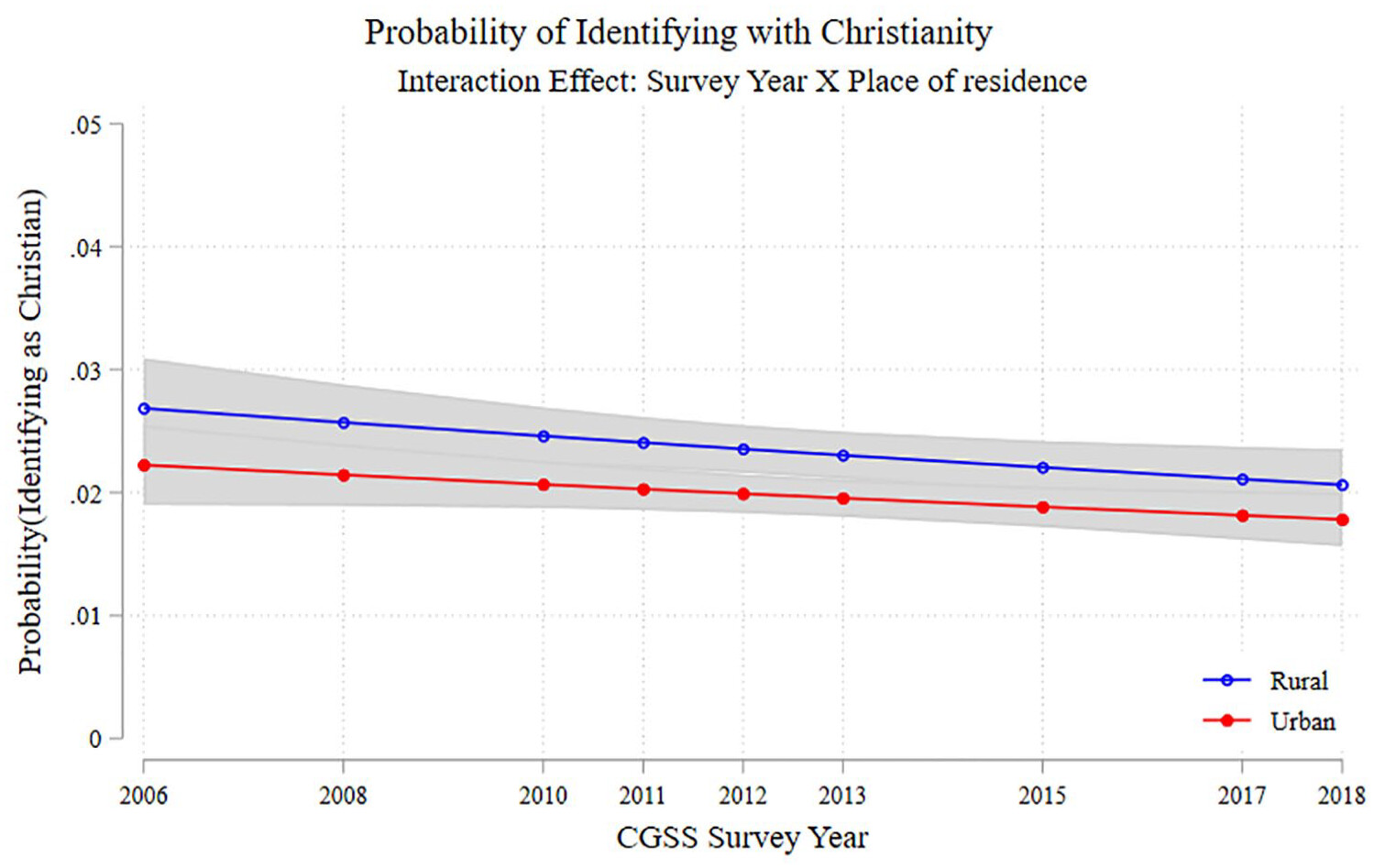
Meanwhile, we explored signs of increased underreporting by comparing answer patterns to religion questions in recent surveys between different segments of the Chinese population. If the intensifying scrutiny of religion since 2013 influenced disclosure of Christian affiliation, we would expect such an effect to be particularly pronounced among urban residents, who often experience greater governmental oversight of religious activities than their rural counterparts (Liang 2014; Weller 2014; Yao 2007; Zhou et al. 2024). To test this hypothesis, we analyzed all the waves of the CGSS conducted between 2006 and 2018 and compared whether there is significant difference in the Christian identification patterns over time between urban and rural Chinese residents.
Between 2006 and 2018, the share of urban residents who claimed Christian identity changed little, from 1.9 percent to 1.7 percent. The level of Christian identification remained stable among rural residents as well, from 2.3 percent to 1.9 percent. We use weighted logistic regression controlling for demographic variables (age, gender, ethnicity, and education) and CCP membership to examine whether place of residence affects trends in self-reported Christian identification. The interaction effects between place of residence and survey year are not statistically significant (see Appendix D for detailed regression results).
Figure 1 presents the predicted probability of identifying with Christianity by survey year and place of residence. Self-reported Christian identification follows the same trajectory for those living in urban cities as for those in rural areas, rejecting our hypothesis of diverging patterns in recent surveys because of tightened control over religion. Our finding of no trend difference between urban and rural residents suggests that survey responses are not clearly responsive to changes in government policy.
Figure 1. Predicted probability of identifying with Christianity by survey year and place of residence.
Source: Chinese General Social Survey (CGSS), 2006 to 2018.
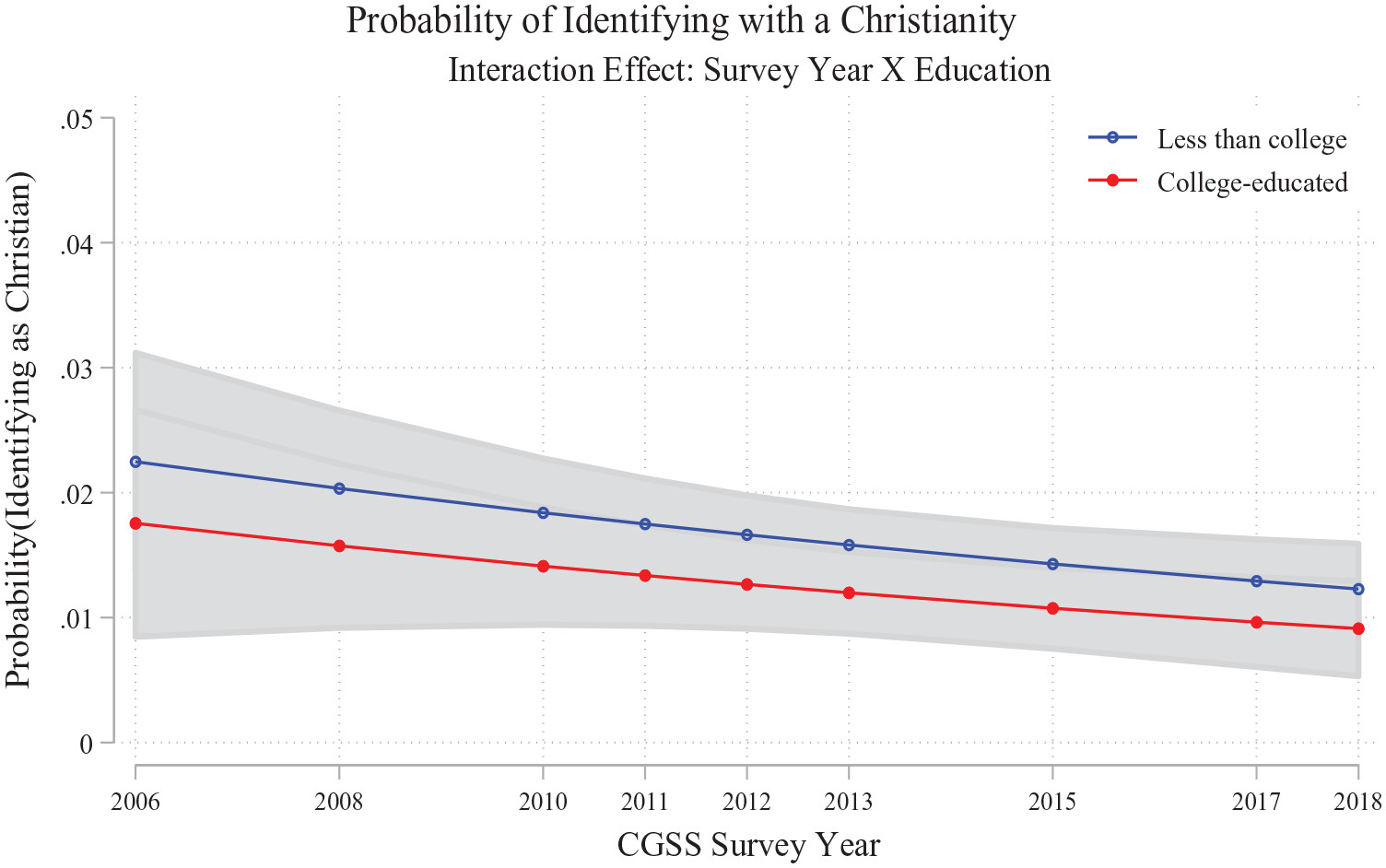
We also tested for differences in response patterns by educational attainment among young adults born in the 1980s or later. Since the early 1990s, the Chinese government has made ideological and patriotic education an integral part of school curriculum, mandating that all students in public schools, from elementary levels to graduate programs, take courses that are designed to foster allegiance to the CCP and promote atheism. And the governmental effort to instill loyalty among college students is particularly intensive as the CCP considers universities the frontline of their ideological work (Xie et al. 2017). One may expect the changing policy to have a greater impact on college-educated adults than those without a college degree, and those with a college degree may be more likely to censor their answers in response to the intensified scrutiny of religion.22
Between 2006 and 2018, the share of self-identified Christians among young adults (born in 1980 or after) without a college degree dropped slightly from 2.0 percent to 1.2 percent, and the shares changed from 1.2 percent to 0.8 percent for those college-educated adults. The differences in their change over time remain statistically insignificant after controlling for age, gender, CCP membership, urban/rural residence (see Figure 2).23 College-educated adults born in 1980 or later experienced a similar trend in their Christian identification in recent years as their peers without a college degree (see Appendix D for detailed regression results).
Figure 2. Predicted probability of identifying with Christianity by survey year and education.
Source: Chinese General Social Survey (CGSS), 2006 to 2018.
Note: This analysis includes only Chinese adults born in 1980 or after.

Discussion

Some scholars have relied on a mix of fieldwork studies, claims by religious organizations, journalists’ observations and government statistics to argue that China is experiencing a surge of religion and is perhaps even on a path to having a Christian majority by 2050. However, our review of these sources reveals they have serious limitations that cast doubts on claims about continued Christian growth in China in the twenty-first century.
Understanding Christian trends in China is important for understanding Christianity in global context. If Christianity is rapidly growing as a share of China’s population, this is a departure from broad trends in the country’s spiritual landscape (Pew Research Center 2023b). Furthermore, it would be a departure from the general trend in many advanced economies, such as the United States and United Kingdom (Booth and Goodier 2023), where significant declines in Christian shares are occurring (Kramer et al. 2022). If China is experiencing ongoing Christian growth while other large economic powers experience Christian decline, this would be an important phenomenon for social scientists to understand.
Our analysis of data collected across multiple waves of the CGSS, the WVS and other large-scale surveys finds no confirmation of rising levels of Christian identity in China, at least not as measured by formal Christian affiliation. These national surveys provide no clear evidence that Christianity is currently on a growth trajectory. Contrary to the narrative that China’s Christianity is popular among young Chinese, surveys generally find they are less likely than their elders to identify as Christian. They are also less likely to believe in the Christian God or attend Christian worship services. Furthermore, the CGSS, conducted between 2006 and 2018, indicates Chinese adults younger than 35 years have become significantly less likely to identify as Christian over time, contrary to the assertion that Christianity is growing more popular among young Chinese.
In this study, we also addressed concerns about the ability of recent surveys to accurately reflect Christian trends by conducting two analyses. First, we compared re-interview rates between self-identified Christians and other respondents in the CFPS, and found no evidence that Christians have become less likely to participate in interviews. Second, using data from the 2006 and 2018 CGSS, we analyzed response patterns of urban residents and young Chinese adults with a college education: the subgroups whose responses in surveys are especially likely to be affected by political circumstances. In line with the observations of Francis-Tan (2023), our findings of no significant interaction effects between survey year and urban/rural residence and between survey year and college education suggest that the government’s tightened control over religion since President Xi Jinping came to power has had little impact on survey responses in recent years. Indeed, survey data about religious (zongjiao) participation among Christians are similar in data collected before and after Xi came to power. In the 2008 CGSS, about 72 percent of self-identified Christians say they participate in religious activity at least a few times a year, and the share was 73 percent in the 2018 CGSS.24 Such stability was not observed among self-identified Buddhists, whose share of frequent attenders dropped from 58 percent to 36 percent over the same time.
Although we cannot be absolutely certain whether surveys accurately capture Christian trends in China, it is plausible that China’s Christian population has plateaued or even begun to decline in the twenty-first century. The government’s intensified scrutiny of Christian activities in recent decades, including the cross-removal campaign in Zhejiang and other provinces and the “Sinicization of religions,” has made Christianity an increasingly sensitive topic in China (Pew Research Center 2023a). Additionally, the government has stepped up efforts to regulate unauthorized churches and intensified crackdown on unauthorized churches that refuse to join the state-controlled associations.
Scholars have different perspectives on whether the government’s tightened control is stifling Christian growth. Some argue that this shift in political context will have little or only modest impact on slowing the growth of Christianity. For example, in his recent talk about the rise of Christianity in China, Yang (2023) claimed that China would become the largest Christian nation “very soon,” but acknowledged this might be delayed for a couple of decades because of the government’s actions. This view aligns with the “triple-market model” Yang (2006) proposed to understand China’s religious landscape. He argued that heavy regulation of religion does not lead to religious decline but will push believers into a “gray market,” which includes legally ambiguous groups that are largely neglected by the state. Yang has widely claimed (in interviews, talks, and blogs) that the Chinese government’s effort to contain Christian growth will not succeed and may instead fuel expansion. As evidence, he cites the tripling of China’s Christian population between 1949 and 1979, three years after the end of Cultural Revolution, and he draws parallels to Christian growth in the fourth century Roman Empire (Danello 2018; Domínguez 2015; Yang 2015, 2022; Zambrano 2021).
However, some are less optimistic about the future trajectory of Christianity in China. Sun (2017) contended that Christian growth in China is contingent on the social and political context and urges scholars to bring the state—the powerful actor that shapes that context—back to the analysis of factors driving the phenomenal rise of Christianity in reform-era China. She argued that while much of the earlier growth can be attributed to the institutional features of house churches, such as fervent evangelism and efficient organizational structure that scholars have pointed out (Bays 2012; Koesel 2013; Vala and O’Brien 2007), the strengths of Christian organizations are “useless” if the state is determined to crack down on them (Sun 2017).
Yang and Sun disagree about the state’s relation to the social space that house churches operate in. Yang described it as “gray market,” with activities that the state struggles to regulate such as Christian families gathering at home to discuss beliefs with their young children. Sun argued that because of the state’s restraint in using coercion and incapacity to rigorously regulate unauthorized religious activities, Christianity in China operates in “interstitial social space.” She stated that Christian growth during the reform era was possible largely because the state prioritized economic development, and local authorities were not interested in taking aggressive actions against unregistered Christian groups. This logic also is used in other studies focusing on the complicated relations between local authorities and unauthorized religious groups. For instance, Weller (2014) observed that the government often manages such groups by “pretending not to notice violations of the regulations,” which created a social space for unregistered churches to thrive outside the official system. Similarly, Vala (2017) noticed that the spread of unregistered churches across China did not occur in the space overlooked by the state, but with the authorities’ “tacit permission.”
The intensified scrutiny of unauthorized Christian activity has reduced the capacity for house churches to operate independently. Government reports from local religious bureaus and united front work department offices indicate that local authorities have been carrying out a program of “connecting unauthorized meeting points with an official church (yitangdaidian 以堂带点)” and conducting investigations of unregistered churches. For instance, in 2018, in the local authorities of Shanghai’s Fengxian district identified 86 unauthorized Christian sites and accepted 73 into the official system (see Pew Research Center 2023c). Anecdotal reports also confirm the narrative of shrinking space for house churches. In a recent article discussing the Chinese government’s 2023 update on regulations on religious sites, Vala (2024) wrote that since the 2010s, about a third of churches in some areas have been closed and meeting points in rural areas have been banned.
In summary, China’s Christian population seems to be plateauing. The government’s scrutiny and crackdown on unregistered Christian activity in recent years may have prevented some Chinese people from becoming or remaining Christian. The official ban on religious education and activity for children, for example, may be inhibiting the transmission of Christian identity to the next generation, as evidenced by the fact that younger cohorts, those born in 1980s and later, are less likely to identify as Christian in the CGSS.
We acknowledge limitations of this study. First, because of the lack of repeated measures of Christian belief and practice in surveys, we cannot track how various beliefs and practices associated with Christianity have changed among the Chinese public in recent decades. We do not know, for example, whether overall belief in Jesus Christ or attendance at Christian worship services (i.e., zuo libai) has risen, declined or remained stable. Our analysis of the age patterns in Christian identification, belief and practice suggest they may have been stable in the recent decades. Second, our study is mostly descriptive, and it does not attempt to explain the lack of Christian growth, identify factors that have contributed to the trends since 2001, or make predictions about the future trajectory of Christianity in China.
We do not contend that surveys are the only tool to estimate the number of Christians in China and to assess the trends of Christianity. Rather, in this study, we review evidence about the growth trajectory of China’s Christian population by combing through all available sources, including surveys, which provide helpful insights into the demographic characteristics of Chinese Christians. Our analysis reveals no clear support for the notion of ongoing Christian growth since the 2000s.
The recent plateau in Christian identification levels could be temporary. Scholars have observed that believers in China are often “consumers” who turn to gods and religious rituals when the need arises (Chau 2011). Subsequently, there is considerable movement into and out of religion (Francis-Tan and Tian 2022). It is possible that China could experience another wave of religious revival if the political circumstances shifted to encourage religious beliefs and practices, or if Chinese people are pushed into a dire situation in which more people turn to religion for protection or blessing. During the coronavirus pandemic, Chinese people were more likely to search for religion-related terms online and in other countries, some people said the pandemic strengthened their religious faith (Pew Research Center 2021; Ruan, Vaughan, and Han 2023). Although Christian shares in China may go up or down in the future, available evidence indicates that Christians are not currently on a trajectory to make up a majority of the country’s population by midcentury.

Authors’ Note

This article is an expanded version of a chapter in the Pew Research Center (2023c) report “Measuring Religion in China.” Some of the results we report here are mentioned in that report and a related blog post.

Funding

The author(s) disclosed receipt of the following financial support for the research, authorship, and/or publication of this article: Funding for this research comes from the Pew Charitable Trusts and the John Templeton Foundation (grants 61640 and 62287).

ORCID iDs

Footnotes

Replication Statement This study analyzes publicly available datasets. Our Stata code for analyzing these datasets and information on where these datasets can be downloaded is available on the Open Science Framework at https://osf.io/emr6p/.
1 In this study, we focus on claims about Protestants and the total Christian population in China. Catholics make up roughly 10 percent of Chinese Christians, and there is a general consensus that the size of China’s Catholic population has been fairly stable in recent years (Pew Research Center 2023c). What is less clear is the extent to which Protestants (about 90 percent of Chinese Christians) may have been growing.
2 It is unclear whether these government estimates (or subsequent government estimates cited on the following pages) are for Christians of all ages or solely adults. If we assume that they include only adults, Christians made up 1.0 percent in 1982 and 1.6 percent in 1997, and the shares would be 0.6 percent and 1.1 percent if government statistics are for Christians of all ages.
3 In this study, we use authorized churches, registered churches, and official churches to describe churches (jiaotang, 教堂) or meeting points (juhuidian, 聚会点) that are under the supervision of the CCC and the TSPM or the Catholic Patriotic Association. Conversely, we use unauthorized churches and unregistered churches to refer to Christian places of worship that operates outside of the official system.
4 Protestants made up about 0.1 percent of China’s total population (542 million) as of 1949. The government did not provide details about how the estimate of 38 Protestant Christians as of 2018 was derived. But it is close to the figure Peking University researchers shared in 2017 and 2018 (Lu 2018). Researchers estimated that the total number of adults who either formally identify as Christian, profess Christian beliefs or regularly attend Christian worship services, including Protestants and Catholics, was about 40 million, on the basis of analysis of measures from China Family Panel Studies surveys (Lu, Wu, and Zhang 2019).
5 Among Asia Harvest’s (2023) total estimate of 110 million Protestant Christians, about 40 million belong to the state-approved church and 70 million are independents. For context, Asia Harvest’s “China Stats” page compares this with an estimate from another Christian ministry, Operation World, which says that there were 51.7 million Evangelicals (Protestants) in 2001 (4 percent of the population). In other words, according to this Asia Harvest table, the Protestant count doubled in two decades.
6 Note that both the estimates of 58 million and 60 million were based on the 2007 Spiritual Life Study of Chinese Residents after making upward adjustments for what was assumed to be an undercount of Christians in the survey. See Stark and Wang (2015) and “Appendix C: Methodology for China” in the Pew Research Center’s (2011) Global Christianity report.
7 We excluded quantitative studies that did not rely on surveys from the same project to examine religious trends because patterns derived from cross-survey comparisons tend to suffer from various limitations, such as differences in question wording and format as well as in sampling strategy. For instance, using data from two surveys, the 2001 World Values Survey and the 2007 Spiritual Life Study of Chinese Residents, Stark and Liu (2011) noted that the share of respondents who answered “no religion” declined from 93 percent in the 2001 to 77 percent in the 2007 survey. They said this was evidence of “religious awakening” among Chinese people, even though results of the unaffiliated share from the two surveys are not directly comparable because of their difference in question wording as well as in sampling strategy. Unlike the 2001 World Values Survey (and most other social surveys), which lists “Buddhism” as the response option to the religion identity question, the 2007 survey included “Buddhism or Believe in Buddha.” Similarly, Yao (2007) found that urban Han Chinese have become more engaged in religious and spiritual beliefs and practices between 1995 and 2005 using data from two surveys that differ sampling coverage: the 2005 survey included more small or medium-sized cities than the 1995 survey (Yao 2007).
8 The 2012 wave of the WVS was conducted between 2012 and 2013; in this study, we refer to this dataset as the 2013 WVS.
9 Some surveys, such as the CGSS, do not publish enough detail on their primary sampling units for us to determine whether respondents from Wenzhou are included. The China Labor-Force Dynamics Survey includes Wenzhou, so we can consider what the national incidence rate for Christian identity would be for 18- to 64-year-old adults in the 2012 China Labor-Force Dynamics Survey with Wenzhou city (2.9 percent) and without (2.7 percent). In this survey, about one in five Wenzhou respondents identify as Christian, although the sample is not designed to be representative at the city level.
10 The 2014 CLDS is the most recent wave available to the authors.
11 As zuo libai refers to the type of ritual worship common to Christians and Muslims, this question is not posed to respondents who told interviewers that they identify with Buddhism or Taoism, whose typical religious practice is commonly known as shaoxiang baifo (烧香拜佛), meaning to burn incense to pay respects to Buddha and other deities. The results shown here represents Chinese adults who identify with Christianity or nonreligion and engage in zuo libai at least a few times a year, as a share of all Chinese adults.
12 The 2014 CFPS also asked about religious belief, but the results are not directly comparable with the 2018 results, because of their differences in question wording and format. In 2014, the CFPS asked respondents to select the deities and religious figures they believed in from among a list of options, and the wording for belief changed from using the word xin (信) in 2014 to xiangxin (相信) in 2018. In this study, we focused on the 2018 CFPS to describe the characteristics of Chinese people holding Christian beliefs.
13 See the methodology section in the Pew Research Center’s (2023c) report “Measuring Religion in China” for more details on the reweighting process.
14 The analysis includes only respondents who participated in both the 2012 and 2016 CFPS; the results differ slightly from those presented in Table 1, which were based on the entire sample. Among respondents in both waves of the CFPS, there was slightly more movement into Christianity between waves (0.9 percent) than movement away from Christian identity (0.6 percent). However, this difference is not statistically significant.
15 We focused on place of residence rather than household registration statuses because information on the later was not available in the WVS or the SLSCR. We excluded ethnicity from the analysis because such information was not available in the WVS. However, our finding on the age effect still holds after controlling for household registration statuses and ethnicity (and excluding data from these two surveys).
16 Note that approximately 2 percent of the adults in our sample are Christians, which is considered a rare event in statistical modeling and for which penalized logistic regression would typically be preferable. However, our sample size is large enough for traditional logistic regression to produce reliable estimates (Allison 2012), and that is the method we used in this study.
17 The results shown here represents Chinese adults who identify with Christianity or nonreligion and engage in zuo libai at least a few times a year, as a share of all Chinese adults.
18 The 2014 and 2018 CFPS did not ask about religious affiliation.
19 Response rates for the 2010, 2011, 2012, and 2013 CGSS came from the Chinese National Survey Data Archive (http://www.cnsda.org/index.php), and response rate information is not directly available for the 2015, 2017, 2018 and 2021 waves. We sourced response rates of these waves from CGSS documentation contained within East Asia Social Survey files (https://www.icpsr.umich.edu/web/ICPSR/series/486). Response rate information for the WVS’s China sample came from the technical report for each wave. Because of a lack of details about response rates reported by the CGSS and the WVS, it is unclear if their response rates have been calculated following the same methods across wave and thus can be used to discern trends in Chinese people’s willingness to participate in surveys over time.
20 Although some scholars speculated that Chinese people might have more reluctant to answer zongjiao questions in recent surveys, Hackett and Tong’s (forthcoming) analysis of item-response rates to the zongjiao affiliation question found no indication that respondents are more likely to give nonanswers in recent surveys.
21 Surveys carried out by private survey firms usually have lower response rates than others conducted by academic teams (see Hackett and Tong forthcoming).
22 In addition, we tested for differences in response patterns by CCP membership because one may expect such policy changes to have a noticeable impact on CCP members, as the government has repeatedly emphasized its strict ban on their belief in religion (Campbell 2016; Pew Research Center 2023b). We found no statistically significant interactive effects between CCP affiliation and survey year, suggesting that response patterns of Christian affiliation over time are similar between CCP members and nonmembers.
23 To assess the robustness of our findings, we conducted the same analysis using the four waves of data from the CFPS, including the 2014 and 2018 waves that asked about Christian belief. The results are fully consistent with those presented in current text.
24 This measure is based on the question worded “How often do you participate in religious (zongjiao 宗教) activities?” The 2006 CGSS did not ask this question.

References

Aikman David. 2006. Jesus in Beijing: How Christianity Is Transforming China and Changing the Global Balance of Power. Washington, DC: Regnery.
Allison Paul. 2012. “Logistic Regression for Rare Events.” Statistical Horizons. Retrieved November 30, 2024. https://statisticalhorizons.com/logistic-regression-for-rare-events/.
Asia Harvest. 2023. “Christians in China Stats.” Retrieved November 20, 2023. https://www.asiaharvest.org/christians-in-china-stats/china.
Bays Daniel H. 2012. A New History of Christianity in China. Chichester, UK: Wiley-Blackwell.
Blumberg Antonia. 2014. “China on Track to Become World’s Largest Christian Country by 2025, Experts Say.” Huffington Post, April 22. Retrieved December 21, 2024. https://www.huffpost.com/entry/china-largest-christian-country_n_5191910.
Booth Robert, Goodier Michael. 2023. “Census Data Suggests UK Faces ‘Non-religious Future,’ Say Campaigners.” The Guardian, January 30. Retrieved December 21, 2024. https://www.theguardian.com/uk-news/2023/jan/30/census-data-england-wales-uk-non-religious-future-campaigners.
Campbell Charlie. 2016. “China’s Leader Xi Jinping Reminds Party Members to Be ‘Unyielding Marxist Atheists.’” Fortune. Retrieved December 21, 2024. https://fortune.com/2016/04/25/china-marxist-atheists/.
Chalufour Marc. 2023. “What’s behind Boom of Christianity in China?” Retrieved November 6, 2023. https://www.bu.edu/articles/2023/why-is-christianity-growing-in-china/.
Chao L. Luke, Yang Fenggang. 2018. “Measuring Religiosity in a Religiously Diverse Society: The China Case.” Social Science Research 74:187–95.
Chau Adam Yuet. 2011. “Modalities of Doing Religion and Ritual Polytropy: Evaluating the Religious Market Model from the Perspective of Chinese Religious History.” Religion 41(4):547–68.
Danello Mike. 2018. “A Faith Repressed: The Future of Chinese Christians.” Brown Political Review. Retrieved October 19, 2024. https://brownpoliticalreview.org/2018/04/faith-repressed-future-chinese-christians/.
Domínguez Gabriel. 2015. “Attempt to Rein in Christianity?.” Retrieved October 19, 2024. https://www.dw.com/en/expert-china-aiming-to-reduce-christianitys-public-profile/a-18632073.
Francis-Tan Andrew. 2023. “Economy of Shadows: The Effects of Restrictive Regulation on Religiosity in China.” Journal for the Scientific Study of Religion 62(3):624–47.
Francis-Tan Andrew, Tian Felicia F. 2022. “Fluidity of Faith: Predictors of Religion in a Longitudinal Sample of Chinese Adults.” Journal for the Scientific Study of Religion 61(1):75–99.
Goossaert Vincent, Palmer David A. 2011. The Religious Question in Modern China. Chicago: University of Chicago Press.
Hackett Conrad, Stonawski Marcin, Potančoková Michaela, Grim Brian J., Skirbekk Vegard. 2015. “The Future Size of Religiously Affiliated and Unaffiliated Populations.” Demographic Research 32:829–42.
Hackett Conrad, Tong Yunping. Forthcoming. “Religion in China: How Can We Measure Change.” Review of Religious Research.
Han Junqiang, Meng Yingying, Xu Chengcheng, Qin Siqi. 2017. “Urban Residents’ Religious Beliefs and Influencing Factors on Christianity in Wuhan, China.” Religions 8(11):244.
Han Junqiang, Meng Yingying, Qin Siqi. 2018. “House Church: Investigating Chinese Urban Christians’ Choice of Religious Practicing Site in Wuhan, China.” Religions 9(4): 100. https://doi.org/10.3390/rel9040100.
Hu Anning. 2017. “Changing Perceived Importance of Religion in Mainland China, 1990–2012: An Age-Period-Cohort Analysis.” Social Science Research 66:264–78.
Hu Anning, Leamaster Reid J. 2015. “Intergenerational Religious Mobility in Contemporary China.” Journal for the Scientific Study of Religion 54(1):79–99.
Hua Hua. 2007. “Survey on Christian College Students: Based on the Example of Several Universities in Shanghai.” Youth Studies.
Huang Jianbo. 2004. “‘Who Am I’: Identity Tension among Chinese Intellectual Christians.” Paper Presented at the annual meeting of the Association for the Sociology of Religion, San Francisco, CA, August 14, 2004.
Huang Jianbo. 2014. “Being Christians in Urbanizing China: The Epistemological Tensions of the Rural Churches in the City.” Current Anthropology 55(S10):S238–47.
Jin Ze, Qiu Yonghui. 2010. “Annual Reports on China’s Religions.” Beijing, China: Social Science Academic Press.
Johnson Todd M., Zurlo Gina A. 2020. World Christian Encyclopedia. Edinburgh, UK: Edinburgh University Press.
Kennedy Courtney, Hartig Hannah. 2019. “Response Rates in Telephone Surveys Have Resumed Their Decline.” Pew Research Center. Retrieved October 22, 2024. https://www.pewresearch.org/short-reads/2019/02/27/response-rates-in-telephone-surveys-have-resumed-their-decline/.
Koesel Karrie J. 2013. “The Rise of a Chinese House Church: The Organizational Weapon.” China Quarterly 215:572–89.
Kramer Stephanie, Hackett Conrad, Stonawski Marcin. 2022. “Modeling the Future of Religion in America.” Pew Research Center. Retrieved May 1, 2024. https://www.pewresearch.org/religion/2022/09/13/modeling-the-future-of-religion-in-america/.
Kuo Lily. 2019. “In China, They’re Closing Churches, Jailing Pastors—and Even Rewriting Scripture.” The Observer, January 13.
Li Feng. 2017. “Does Religious Belief Affect Fertility Intention? An Analysis Using Data from 2010 CGSS.” Studies in World Religions 3:18–34.
Li Huawei. 2012. “Suffering and Conversion: The Exploration on Social Causes of Peasant’s Conversion to Christianity in Henan Province.” China Agricultural University Journal of Social Sciences Edition 29(3):81–91.
Li Suju, Liu Qifei. 2000. Youths and “Religion Fever.” Beijing: China Youth Publishing House.
Liang Yongjia. 2014. “Morality, Gift and Market: Communal Temple Restoration in Southwest China.” Asia Pacific Journal of Anthropology 15(5):414–32.
Liu Yi. 2014. “Pentecostal-Style Christians in the ‘Galilee of China.’” Review of Religion and Chinese Society 1(2):156–72.
Lu Yunfeng. 2018. “How Was the Figure of 3969 Christians in China Was Derived (Zhongguo Jidutu 3969 de Xin Shuju Shi Zenyang Dechu De).” Retrieved October 18, 2024. http://www.pacilution.com/ShowArticle.asp?ArticleID=9121.
Lu Yunfeng, Wu Yue, Zhang Chunni. 2019. “How Many Christians Are There in China: An Estimate Based on China Family Panel Studies (Zhongguo Jiujing You Duoshao Jidutu—Jiyu Zhongguo Jiating Zhuizong Diaocha de Guji).” Open Times.
Lu Yunfeng, Zhang Chunni. 2016. “Dangdai Zhongguo Jidutu Xianzhuang Guankui: Jiyu CGSS He CFPS Diaocha Shuju” [“Observation in Present Situation of Contemporary Chinese Christian: Based on the Survey Data from CGSS and CFPS”]. Shijie Zongjiao Wenhua (1).
National Bureau of Statistics of China. 2022. China Statistical Yearbook. Beijing: China Statistics Press.
Ong Isabel. 2023. “Have China’s Christians Peaked? Pew Researches the Data Debate.” Christianity Today, August 30. Retrieved December 21, 2023. https://www.christianitytoday.com/2023/08/china-christian-churches-pew-measuring-religion-surveys/.
Pew Research Center. 2011. “Global Christianity—A Report on the Size and Distribution of the World’s Christian Population.” Retrieved October 18, 2018. http://www.pewforum.org/2011/12/19/global-christianity-exec/.
Pew Research Center. 2021. “More Americans Than People in Other Advanced Economies Say COVID-19 Has Strengthened Religious Faith.” Retrieved September 3, 2024. https://www.pewresearch.org/religion/2021/01/27/more-americans-than-people-in-other-advanced-economies-say-covid-19-has-strengthened-religious-faith/.
Pew Research Center. 2023a. “10 Things to Know about China’s Policies on Religion.” Retrieved November 15, 2023. https://www.pewresearch.org/short-reads/2023/10/23/10-things-to-know-about-chinas-policies-on-religion/.
Pew Research Center. 2023b. “Chinese Communist Party Promotes Atheism, but Many Members Still Partake in Religious Customs.” Retrieved November 17, 2023. https://www.pewresearch.org/short-reads/2023/09/05/chinese-communist-party-promotes-atheism-but-many-members-still-partake-in-religious-customs/.
Pew Research Center. 2023c. “Measuring Religion in China.” Retrieved September 20, 2023. https://www.pewresearch.org/religion/2023/08/30/measuring-religion-in-china/.
Phillips Tom. 2014. “China on Course to Become ‘World’s Most Christian Nation’ within 15 Years.” The Telegraph, April 19. Retrieved December 21, 2024. https://www.telegraph.co.uk/news/worldnews/asia/china/10776023/China-on-course-to-become-worlds-most-Christian-nation-within-15-years.html.
Phoenix InfoNews. 2016. “Exclusive Interview with Elder Fu Xianwei, Chairman of the China Christian Three-Self Patriotic Movement Committee.”
“Protestant Christianity Is Booming in China.” 2020. The Economist.
Qi Gubo, Liang Zhenhua, Li Xiaoyun. 2014. “Christian Conversion and the Re-imagining of Illness and Healthcare in Rural China.” Asia Pacific Journal of Anthropology 15(5):396–413.
Ren Jiaoli. 2012. “A Study of Belief Problems among College Students.” Master’s thesis, Shangxi University, China.
Ruan Rongping, Vaughan Kenneth R., Han Dan. 2023. “Trust in God: The COVID-19 Pandemic’s Impact on Religiosity in China.” Journal for the Scientific Study of Religion 62(3):523–48.
Sanchez Jamie. 2022. “Rural-to-Urban Migrants: Possibilities for New Churches in China’s Cities.” Missiology 50(3):240–50.
Stark Rodney, Johnson Byron, Mencken Carson. 2011. “Counting China’s Christians.” First Things 213:14.
Stark Rodney, Liu Eric Y. 2011. “The Religious Awakening in China.” Review of Religious Research 52(3):282–89.
Stark Rodney, Wang Xiuhua. 2015. A Star in the East: The Rise of Christianity in China. West Conshohocken, PA: Templeton Foundation Press.
State Council Information Office. 2018. “China’s Policies and Practices on Protecting Freedom of Religious Belief.” Beijing, China: State Council Information Office.
Stonawski Marcin, Skirbekk Vegard, Hackett Conrad, Potančoková Michaela, Connor Phillip, Grim Brian. 2015. “Global Population Projections by Religion: 2010–2050.” Pp. 99–116 in Yearbook of International Religious Demography 2015. Leiden, the Netherlands: Brill.
Sun Yanfei. 2017. “The Rise of Protestantism in Post-Mao China: State and Religion in Historical Perspective.” American Journal of Sociology 122(6):1664–1725.
United Nations Department of Economic and Social Affairs. 2022. “Population Divisions.” In World Population Prospects 2022: Summary of Results, UN DESA/POP/2022/TR/NO. 3. Geneva, Switzerland: United Nations.
Vala Carsten T. 2017. The Politics of Protestant Churches and the Party-State in China: God Above Party? London: Routledge.
Vala Carsten T. 2024. “The 2023 Regulations for Religious Activity Site Registration.” Retrieved October 19, 2024. https://www.chinasource.org/resource-library/blog-entries/the-2023-regulations-for-religious-activity-site-registration/.
Vala Carsten, O’Brien Kevin. 2007. “Attraction without Networks: Recruiting Strangers to Unregistered Protestantism in China.” Mobilization: An International Quarterly 12(1):79–94.
Weller Robert P. 2014. “The Politics of Increasing Religious Diversity in China.” Daedalus 143(2):135–44.
Xie Ying, Tong Yunping, Yang Fenggang, Xie Ying, Tong Yunping, Yang Fenggang. 2017. “Does Ideological Education in China Suppress Trust in Religion and Foster Trust in Government?” Religions 8(5):94.
Xie Dayuan, Zhou Yonghong. 2022. “Religion Effects on Fertility Preference: Evidence from China.” Journal of Population Research 39(3):341–71.
Xinhuanet. 2018. “China Has Nearly 200 Mln Religious Believers: White Paper.” Retrieved December 21, 2024. https://www.xinhuanet.com/english/2018-04/03/c_137084917.htm.
Yang Fenggang. 2005. “Lost in the Market, Saved at McDonald’s: Conversion to Christianity in Urban China.” Journal for the Scientific Study of Religion 44(4):423–41.
Yang Fenggang. 2006. “The Red, Black, and Gray Markets of Religion in China.” Sociological Quarterly 47(1):93–122.
Yang Fenggang. 2015. “Christianity’s Growth in China and Its Contributions to Freedoms.” Retrieved November 6, 2023. https://berkleycenter.georgetown.edu/responses/christianity-s-growth-in-china-and-its-contributions-to-freedoms.
Yang Fenggang. 2016. “Exceptionalism or Chinamerica: Measuring Religious Change in the Globalizing World Today.” Journal for the Scientific Study of Religion 55(1):7–22.
Yang Fenggang. 2022. “The Tricolor Religious Market and the Growth of Christianity.” Retrieved October 19, 2024. https://www.chinasource.org/resource-library/blog-entries/the-tricolor-religious-market-and-the-growth-of-christianity/.
Yang Fenggang. 2023. “The Rise of Christianity in Modernising China.” COMIUCAP. Retrieved April 17, 2024. https://www.comiucap.net/is-china-the-new-roman-empire/.
Yang Yi. 2018. “Rise and Decline of Rural Church in China.” China Christian Daily.
Yao Xinzhong. 2007. “Religious Belief and Practice in Urban China 1995–2005.” Journal of Contemporary Religion 22(2):169–85.
Ye Huisu, Xing Na. 2012. “An Analysis of College Student Christians’ Characteristics and Conversion Patterns.” Qunwen Tiandi.
Zambrano Max. 2021. “Fenggang Yang Illustrates How in Communist China, Religions Have Endured and Thrived in Interfaith Lecture.” The Chautauquan Daily. Retrieved October 19, 2024. https://chqdaily.com/2021/07/fenggang-yang-illustrates-how-in-communist-china-religions-have-endured-and-thrived-in-interfaith-lecture/.
Zhang Chan, Brenner Philip S., He Lirui. 2022. “Measuring Religious Non-affiliation in China: A Comparison of Major National Surveys in China.” International Journal of Public Opinion Research 34(1):edac005.
Zhang Zongxin, Niu Xixia, Deng Shangmin, Zhang Xiaolian, Fang Shijiang, Song Jia. 2011. “A Survey of College Students’ Religious Belief in Shandong Province.” Journal of Shandong University of Technology (Social Sciences Edition).
Zheng Honge, Wang Wei, Wang Libin. 2015. “Rural Christians’ View of Sickness Treatment Behavior: A Case Study from a Shandong Village, China.” Anthropology & Medicine 22(2):114–26.
Zhou Dao, Lai Xiaozhen, Li Long. 2024. “Changing Religious Affiliation in the Chinese Mainland: A Cohort Perspective.” Review of Religious Research 66(4):486–511.
Zurlo Gina A. 2024. World Religion Database. Leiden, the Netherlands: Brill.

Biographies

Conrad Hackett is associate director of research and a senior demographer at the Pew Research Center. He studies global religion from demographic and sociological perspectives. His expertise includes measuring religious change and how religion relates to characteristics such as gender, fertility and education.
Yunping Tong is a research associate at the Pew Research Center specializing in international religious demography. She is an author of “India’s Sex Ratio at Birth Begins to Normalize” and “The Religious Composition of the World’s Migrants.” Her expertise includes measuring religion and demographic characteristics in Asia.

Supplementary Material

Please find the following supplemental material available below.

For Open Access articles published under a Creative Commons License, all supplemental material carries the same license as the article it is associated with.

For non-Open Access articles published, all supplemental material carries a non-exclusive license, and permission requests for re-use of supplemental material or any part of supplemental material shall be sent directly to the copyright owner as specified in the copyright notice associated with the article.