Vehicle ramming attacks (VRAs) continue to threaten public safety around the world. Defined as an attack in which the perpetrator uses their vehicle as a weapon to intentionally strike civilians and/or other vehicles, VRAs require only that the perpetrator know how to drive and have access to a vehicle (
Miller and Hayward 2019;
Williams, Corner, and Taylor 2022). Their low-tech and low-skill requirements make them an attractive attack choice for groups or individuals who seek to induce fear, promote an ideological message, or cause harm for any personal reason, including suicide (
Miller and Hayward 2019;
Rodde and Olmstead 2025).
Miller and Hayward (2019) recognized that VRAs are used by a diverse group of perpetrators, who vary in terms of their ideologies and geographic locations. They argued that sociologist Gabriel Tarde’s concept of “contagion” is useful in understanding VRAs, which travel through the “mediascape” and are internalized and imitated by a “varied array of subjects who in turn are animated by a diverse set of motivations, psychologies, and ideologies” (
Miller and Hayward 2019:3;
Tarde [1888] 2010,
[1903] 2013). They support this argument by demonstrating how rises in the use of VRAs coincide with prominent “successful” attacks (such as the 2016 Nice attack in France), as well as the promotion of VRAs through social media and other Internet sources (such as Al Qaeda’s
Inspire newsletter) (
Miller and Hayward 2019).
Since Miller and Hayward’s work, there have been dozens more VRAs across the globe. The year 2025 alone was marked by several prominent attacks, varying in terms of their motivations. On New Year’s morning, Shamsud-Din Jabbar rammed through a crowd on Bourbon Street in New Orleans in the United States in a terrorist ramming inspired by the Islamic State that killed 14 and injured at least 52 people (
https://en.wikipedia.org/wiki/2025_New_Orleans_truck_attack). Several months later, May 26, Paul Doyle drove through a crowd celebrating the Liverpool Football Club’s league win, injuring at least 130 people (
https://en.wikipedia.org/wiki/2025_Liverpool_parade_attack). Although initially feared to be a terrorist attack, it was later determined that Dole acted in a fit of road rage.
Given that research on VRAs is still rather limited in scope, we expand on the work of
Miller and Hayward (2019), examining trends and characteristics of these attacks between 2000 and 2025. We use the Global Terrorism Database to create a dataset of all VRAs that occurred between 2000 and June 2022 (
Start 2022). We supplement these data with
RAND’s (2009) Database of Worldwide Terrorism Incidents 1968–2009, Wikipedia’s “List of Vehicle-Ramming Attacks” (
https://en.wikipedia.org/wiki/List_of_vehicle-ramming_attacks), and several academic journal articles and news reports (details can be found in the
supplementary materials) to create a dataset that includes both terror-related and non-terror-related VRAs.
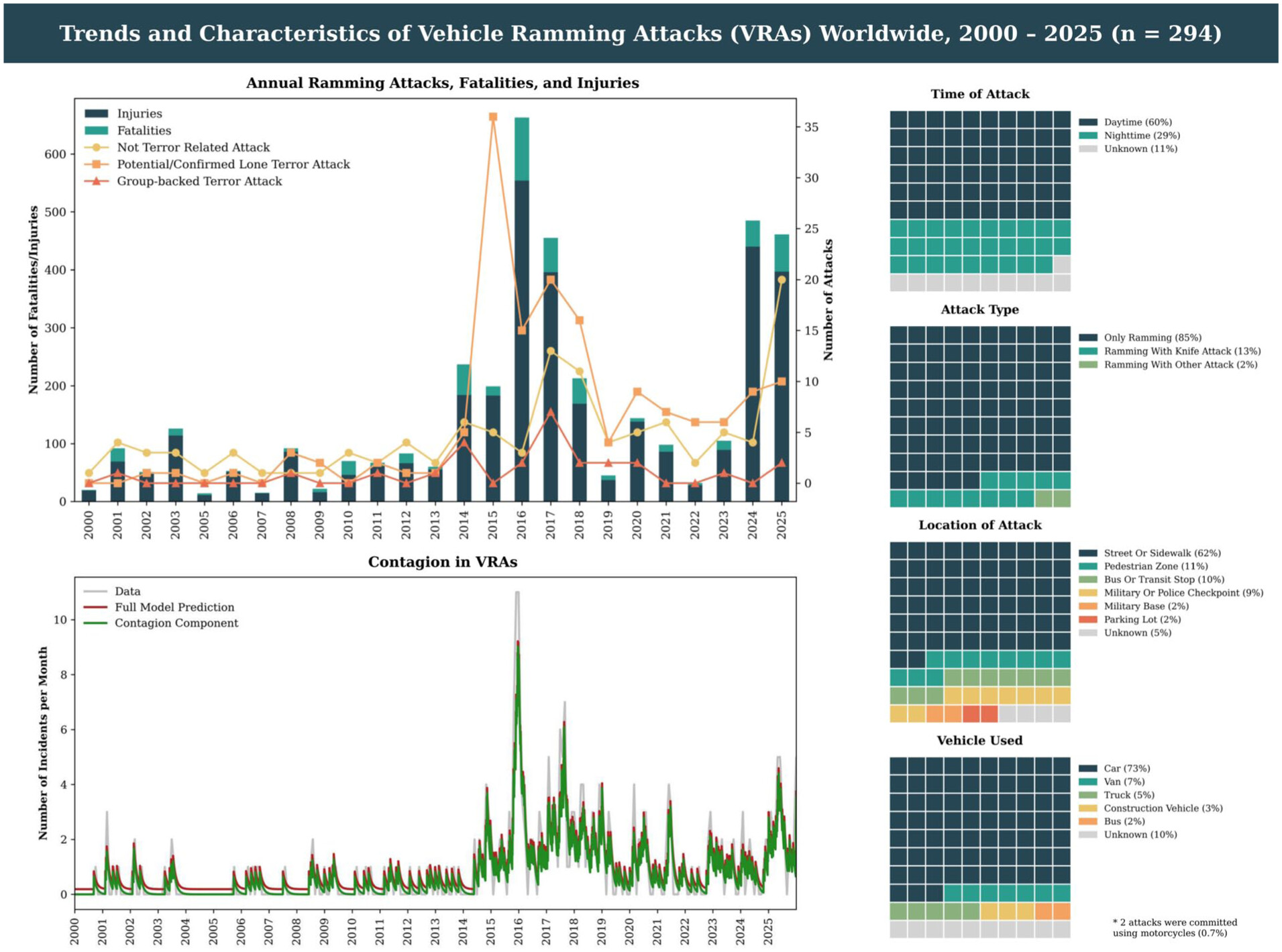
Figure 1 presents preliminary findings on the trends and characteristics of all recorded VRAs between 2000 and 2025.
Between 2000 and 2025, there were 294 VRAs worldwide, an average of one attack every 32.3 days. Of these, 113 (38.4 percent) were not terror related, 155 (52.7 percent) were potential or confirmed lone-wolf terror attacks, and 26 (8.8 percent) were group-backed terror attacks. The main chart shows trends in these attacks over time.
In general, we see consistency in the spikes of VRAs across the three motive types, lending support to
Miller and Hayward’s (2019) argument that there is a contagion effect whereby the “successful” completion of one attack inspires others to commit “copycat” attacks (
Weil 2023). We see a large spike in VRAs in 2015 and 2016, with an average of one attack every 8.9 and 9.1 days, respectively. The majority of these attacks (including all of the confirmed or potential lone-wolf terror attacks) occurred in Israel or the West Bank. This spike coincided with the 2015–2016 wave of violence in the Israeli-Palestinian conflict (
Miller and Hayward 2019;
Perry, Hasisi, and Perry 2018). As Miller and Hayward argued, in late 2016, VRAs began to spread to other regions, specifically Europe and North America. In this case, the “successful” attack that spurred copycats and the contagion effect is likely the 2016 Nice attack, in which Mohamed Lahouaiej-Bouhlel drove a truck through a pedestrian promenade, killing 86 and injuring 458 (
Weil 2023). We see a similar spike in non-terror-related attacks in 2025, possibly due to a similar contagion effect, spurred by the 2025 Bourbon Street attack. In general, it appears that the trends in VRAs support Miller and Hayward’s contagion argument.
On the basis of this analysis, we find that each VRA is predicted to trigger 0.815 additional attacks (p < 0.001), suggesting that there is significant contagion. We present these results in graphic form in the figure, aggregating to the monthly level.
On the right side of the figure, we present four waffle charts that summarize the general characteristics of all VRAs: the time, type, and location of the attack, as well as the type of vehicle used. We find that the majority of attacks occur during the day (60 percent), do not include any additional attacks (85 percent), are committed on a street or sidewalk (62 percent), and are committed using cars (including SUVs and pickup trucks) (73 percent).
Although more thorough analyses are needed on the characteristics and trends of VRAs, this preliminary work highlights the diversity of this attack method, in terms of motive, characteristics, and geographic location. In addition, our work lends support to the notion that a contagion effect exists, although future work should consider the impact of high-profile attacks (however defined) and the reporting of attacks as it relates to overall contagion. Future research should also further examine the characteristics of VRAs to help inform prevention strategies as this could help not only prevent planned attacks, but also any copycat attacks that could follow.